

Home Blood Pressure Monitors: Wrist vs Arm and How to Take a Reading That Counts

Key Takeaways
- A cuff too small for the arm overestimated systolic pressure by about 5 mmHg in a 2023 randomized trial, and by close to 20 mmHg for arms needing an extra-large cuff.
- Every centimeter a wrist monitor sits below heart level adds roughly 0.7 to 0.8 mmHg, so a wrist resting on the lap can inflate a reading by 15 to 20 mmHg.
- Validation means a device matched reference measurements within an average of 5 mmHg in a standardized study of at least 85 people; many devices sold online have never been tested.
- The UK protocol clinicians use is two readings one minute apart, morning and evening for seven days, discarding day one and averaging the rest.
- A home average of 135/85 mmHg corresponds to a clinic reading of 140/90, because home readings normally run a few points lower.
- Randomized trials show self-monitoring with clinician-guided adjustment lowers systolic pressure by roughly 3.5 to 5 mmHg over a year, a difference linked to about 10 percent fewer major cardiovascular events per 5 mmHg at population level.
For most adults, the best home blood pressure monitor is an automatic upper-arm cuff that has passed independent validation testing and fits your arm circumference. Wrist monitors can be accurate but are far more sensitive to position. A reading that counts means five minutes seated and quiet, back and arm supported, feet flat, no talking, then two readings a minute apart, morning and evening, averaged over seven days.
The cuff hisses, the screen blinks, and someone at a kitchen table decides whether to worry. That small scene is playing out far more often since August 2025, when the American Heart Association and the American College of Cardiology released a new guideline for high blood pressure that leans harder than any before it on readings taken outside the clinic. Searches for the home blood pressure monitor climbed with it, and so did the confusion: wrist or arm, which model, how many readings, and whether any of it changes what a doctor actually does.
As of early 2026, the honest picture is reassuring in one way and demanding in another. A well-chosen monitor is accurate enough to guide real medical decisions, which is why guidelines in the United States, the United Kingdom and Europe now ask for home numbers before a diagnosis is settled.
The catch is that accuracy lives mostly in technique, not in the box. Get the cuff, the posture and the timing right and the numbers become evidence. Skip those steps and they become noise with a decimal point.
What changed recently: why the home blood pressure monitor is trending
Three things converged. On August 14, 2025, the American Heart Association and American College of Cardiology published a new high blood pressure guideline, replacing the 2017 version. It kept the diagnostic threshold at 130/80 mmHg, but it strengthened the role of out-of-office measurement: a raised clinic reading should be confirmed with home or ambulatory readings before someone is labeled hypertensive, and home readings should help guide whether treatment is working. It also introduced a newer risk calculator, PREVENT, to help decide when stage 1 readings warrant medicine rather than lifestyle change alone. Every one of those steps assumes a validated monitor at home.
Second, the baseline problem is huge. The CDC estimates that nearly half of US adults have high blood pressure by the 130/80 definition, and only about one in four of those has it controlled. Clinics simply cannot check everyone often enough; the guideline effectively outsources part of the job to kitchen tables.
Third, the market moved. Pharmacy shelves, online stores and wearable makers now sell devices that look alike but are not alike, and viral claims about smartwatches and phone apps measuring blood pressure have blurred the line between a medical instrument and a gadget.
None of this is a sudden reversal. The NHS has asked for ambulatory or home confirmation of a diagnosis since 2011, and the 2017 US guideline already recommended home monitoring. What is new is emphasis, visibility and the sheer number of people being told to buy a monitor without being told how to use it. That instruction gap is what this article fills.
How does a home blood pressure monitor actually work?
Almost every automatic cuff on the market uses the oscillometric method. In plain terms, the cuff inflates until it briefly squeezes the artery closed, then deflates while a pressure sensor listens for the tiny pulsations the artery wall transmits into the cuff. Those pulsations grow, peak and fade as the cuff loosens. The peak roughly marks mean arterial pressure, and a built-in algorithm estimates systolic pressure (the pressure when the heart contracts) and diastolic pressure (the pressure between beats) from the shape of that curve. Blood pressure is reported in millimeters of mercury, written mmHg, a historical unit from the days of glass column gauges.
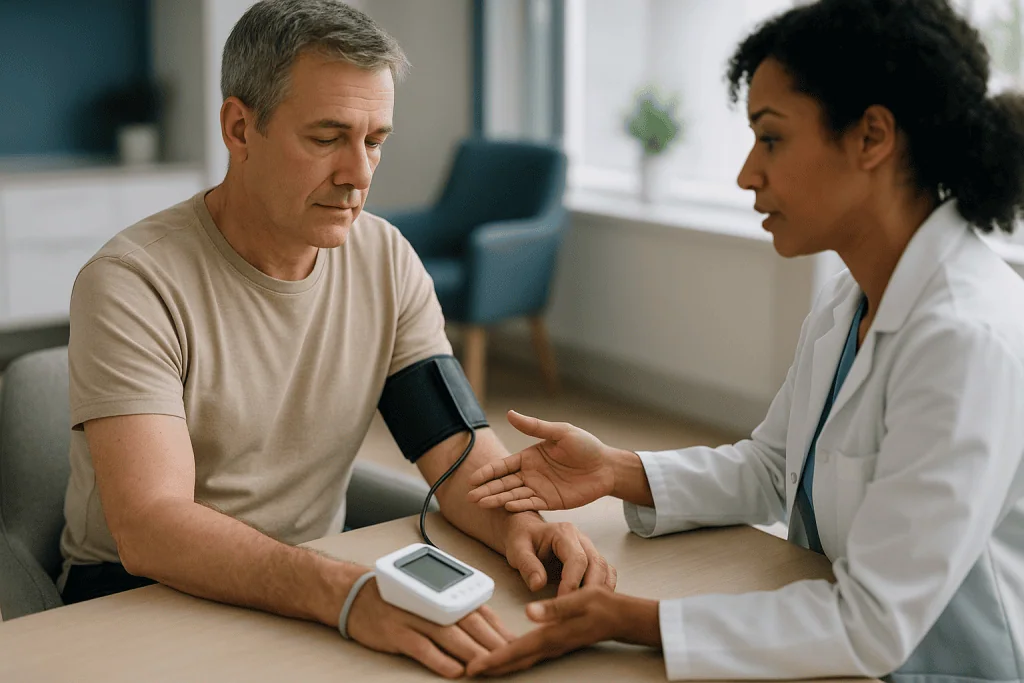
The older clinic method is auscultatory: a clinician listens with a stethoscope for the thumping Korotkoff sounds as the cuff deflates. The two methods agree well on average but not identically, which is one reason your home and clinic numbers rarely match to the digit.
Two practical consequences follow from the mechanism. First, each manufacturer’s algorithm is proprietary and tuned on its own test population, so two monitors can read the same arm differently. That is exactly why independent validation matters, and we return to it below. Second, anything that adds extra vibration or distorts the pulsation pattern corrupts the estimate: talking, fidgeting, a trembling arm, a cuff over a sweater, or an irregular heart rhythm such as atrial fibrillation (a chaotic, irregular heartbeat) in which beat-to-beat pulse strength varies. Many monitors now flag irregular rhythms; fewer have been formally tested for accuracy in people who have them.
Understand the method and the rules of good technique stop feeling arbitrary. Every one of them exists to give the sensor a clean, quiet pulse to read.
Wrist vs arm blood pressure monitor: which one should you trust?
The upper arm wins for most people, and the reason is anatomy rather than engineering. An arm cuff sits over the brachial artery, a large vessel at roughly the same height as the heart when the arm rests on a table. A wrist cuff reads the radial artery, which is narrower, sits among bones and tendons, and travels wherever your hand goes. The American Heart Association recommends upper-arm devices and does not recommend wrist or finger monitors for routine use; Mayo Clinic takes a slightly softer line, noting that wrist monitors can be accurate if used exactly as directed.
Position is the whole story. Blood is a fluid column, so every centimeter the measurement point sits below heart level adds roughly 0.7 to 0.8 mmHg to the reading. A wrist resting on the lap may be 20 to 30 cm below the heart, which can inflate systolic pressure by 15 to 20 mmHg. Bending the wrist forward or backward changes the artery’s shape and adds more error. Arm cuffs are forgiving of small slips; wrist cuffs are not.
| Feature | Upper-arm monitor | Wrist monitor |
|---|---|---|
| Artery measured | Brachial (large, near heart level) | Radial (small, mobile) |
| Sensitivity to position | Low to moderate | High: must be at heart level |
| Independently validated models | Many | Fewer, but they exist |
| Guideline position | Preferred (AHA, NHS, European societies) | Acceptable alternative when arm cuffs cannot be used |
| Typical error | Wrong cuff size, cuff over clothing | Wrist below heart, bent wrist |
The wrist vs arm blood pressure monitor question therefore has a clear default and a legitimate exception, which the next section covers.
When does a wrist blood pressure monitor make sense?
Some arms defeat arm cuffs. A very large upper-arm circumference may exceed even extra-large cuffs, and an undersized cuff reads falsely high, so a validated wrist device can be the more accurate option, not the compromise. People with arm pain, limited shoulder mobility or lymphedema (swelling after lymph node removal, often following breast cancer surgery) are commonly advised to avoid inflating a cuff on the affected arm, and if the other arm is also unsuitable, the wrist offers a route.
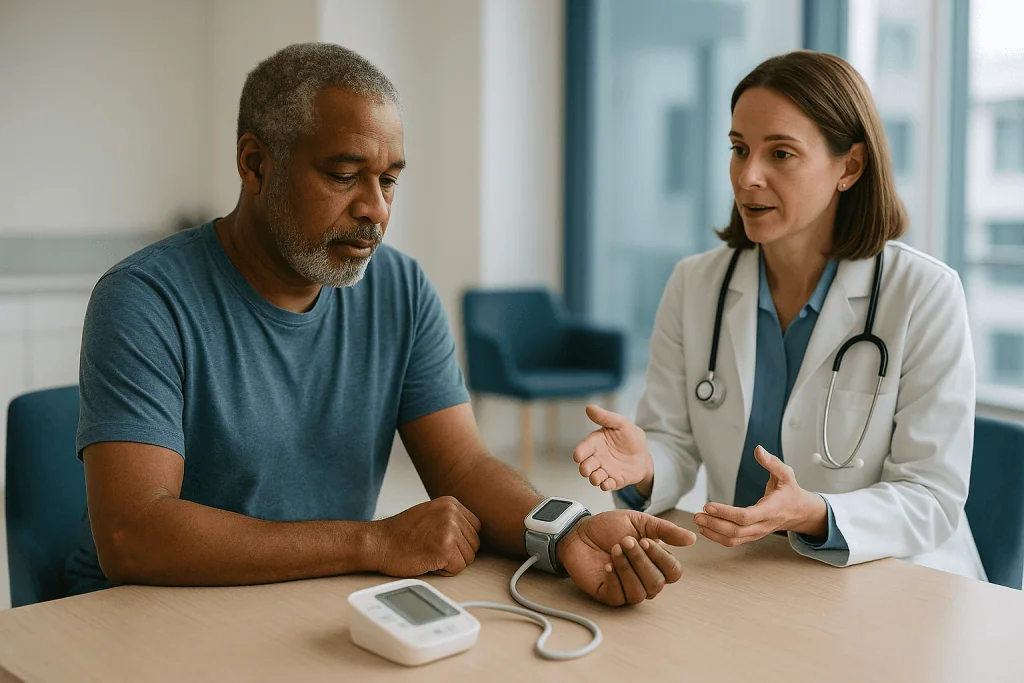
If a wrist monitor is the right tool, the technique has to be exact. Sit with back support, place the elbow on a table and lift the hand so the wrist sits at mid-chest level, roughly over the lower end of the breastbone. Keep the wrist straight and the hand relaxed, not clenched. Some devices include a position sensor that refuses to start until the wrist is at the right height, a genuinely useful feature rather than a gimmick. Stay still and silent through the reading.
Mayo Clinic suggests one more step that applies doubly to wrist devices: bring the monitor to an appointment and take a reading right after the clinic measures your pressure on the same arm, with the same rest period. Agreement within about 5 mmHg is reassuring; consistent differences larger than 10 mmHg mean the device, the technique or the fit needs attention.
Choose a wrist model from an independent validated-device list, exactly as you would an arm model. A validated wrist monitor used correctly beats an unvalidated arm monitor used carelessly, and that ordering, validation first, placement second, brand last, holds across this whole topic.
What is the most accurate blood pressure monitor for home use?
The honest answer is not a model name. It is any automatic upper-arm monitor that has passed independent validation testing and comes with a cuff that fits your arm. Validation means the device was tested against reference measurements in a structured study, typically on at least 85 people spanning a range of arm sizes and pressures, under an international protocol (ISO 81060-2, harmonized in 2018 by the US, European and international standards groups). To pass, the device’s average error must fall within 5 mmHg of the reference, with limited scatter.
That bar matters because many devices never attempt it. Analyses of online marketplaces in several countries have found that the majority of listed blood pressure monitors had no published validation study at all. They may be fine; nobody has checked. Independent registries in the United States, the United Kingdom and internationally publish lists of devices that have passed, and a few minutes on one of those lists is the single highest-value step in choosing a monitor.
When people ask which blood pressure monitor cardiologists recommend, the answer from specialty societies is consistent and unglamorous: validated, upper arm, automatic, with a cuff range that covers your measured circumference, memory for at least two users, and an averaging function. Irregular-heartbeat detection is a reasonable extra. Bluetooth is convenient for sharing readings but adds nothing to accuracy.
Two features deserve skepticism. Readings displayed to the tenth of a millimeter imply precision the method does not have. And a monitor marketed on its ability to measure ‘without a cuff’ is not a validated blood pressure monitor in the sense doctors mean, a point taken up later.
Finally, accuracy is not permanent. Manufacturers generally suggest a check every one to two years; the clinic comparison described above is the practical way to do it.
Do home blood pressure monitors really work? What the evidence actually says
Yes, and the evidence has a clear shape, with different strengths for different claims.
For prediction, the evidence is strong but observational. Large cohort studies in Japan and Europe following thousands of adults for a decade or more found that home readings predicted stroke, heart attack and death better than readings taken in a clinic. This is consistent across populations, but observational data show association, not proof that acting on home numbers changes outcomes.
For improving control, the evidence comes from randomized trials and is moderate. The largest, a UK trial of about 1,200 adults published in 2018, found that when patients self-monitored and their clinicians adjusted treatment using those readings, systolic pressure was roughly 3.5 mmHg lower after a year than with usual care; adding remote transmission of readings to the clinic pushed the difference toward 4 to 5 mmHg. Meta-analyses agree: self-monitoring alone produces small gains of 2 to 4 mmHg, and gains grow when a clinician or pharmacist uses the data. Several millimeters sounds trivial, but pooled trial data suggest each 5 mmHg reduction in systolic pressure cuts major cardiovascular events by about 10 percent across a population.
For preventing strokes directly, the evidence is thin. No trial has been large enough to show that home monitoring itself reduces hard outcomes; the benefit is inferred from better control.
For diagnosis, the case rests on expert consensus built on that observational data. Because clinic readings misclassify a substantial share of people in both directions, US, UK and European guidelines all recommend out-of-office confirmation.
So the monitor works, provided it is validated, used correctly, and its readings reach a clinician who acts on them. Remove any of those three and the evidence stops applying.
Why blood pressure cuff size matters more than the brand
Here is the mistake that quietly ruins more home readings than any other. The inflatable bladder inside a cuff should encircle 75 to 100 percent of the upper arm, with a width of roughly 40 percent of the circumference. A cuff too small for the arm has to squeeze harder to close the artery, so it reads high. A cuff too large reads low.
A 2023 randomized crossover trial published in a major US medical journal put numbers on this. When adults who needed a large cuff were measured with a standard one, systolic pressure read about 5 mmHg too high; for those who needed an extra-large cuff, the error was closer to 20 mmHg. People who needed a small cuff but got a standard one read about 4 mmHg too low. Those are differences large enough to start or withhold a prescription.
Measuring your arm takes thirty seconds. Use a soft tape midway between the shoulder tip and the elbow, with the arm relaxed at your side. Standard cuffs supplied with many monitors cover roughly 22 to 32 cm or 22 to 42 cm; check that your number falls comfortably inside the printed range, and buy the manufacturer’s larger or smaller cuff if it does not.
Placement completes the job. The cuff sits on bare skin with its lower edge 2 to 3 cm above the elbow crease, and the artery marker printed on the cuff lines up with the inside of the arm where you can feel the pulse. Snug means two fingertips slide under the edge, no more. A rolled-up sleeve that bunches above the cuff acts as a tourniquet and distorts the reading, so a short sleeve or a removed layer beats pushing fabric upward.
Fit first, features later. The fanciest monitor with the wrong cuff is a very confident liar.
How to take blood pressure at home so the reading counts
Guidelines from the AHA, NHS and Mayo Clinic agree on the ritual almost word for word, and each step exists to remove a known source of error. Treat it as a short procedure, not a glance.
- Avoid caffeine, nicotine and exercise for 30 minutes beforehand, and empty your bladder.
- Sit in a chair with back support at a table, feet flat on the floor, legs uncrossed.
- Rest quietly for five minutes. No phone, no television, no conversation.
- Place the cuff on a bare arm and rest that arm on the table so the cuff is at heart level, roughly mid-chest.
- Stay silent and still while the cuff inflates and deflates.
- Take two readings one minute apart and write both down, or let the device store them.
Timing matters as much as posture. Measure in the morning before breakfast and before any blood pressure medicine, and again in the evening before bed. Readings taken at random moments, after an argument or a flight of stairs, are not wrong, but they are not comparable, and comparability is what a clinician needs.
The first time you use a new monitor, measure both arms with the same technique. A difference of a few millimeters is normal; use the higher arm from then on, because that arm reflects the pressure your heart and brain actually experience. A consistent gap larger than 10 to 15 mmHg is worth mentioning to your doctor, since it can occasionally point to narrowing in one of the arm arteries.
One more habit from clinical practice: record what you get, not what you hoped for. Discarding a high reading and repeating until a better one appears is understandable and completely defeats the purpose.
The small mistakes that add 10 points to a blood pressure reading
Measurement error is not random noise that averages out. Most common mistakes push the number in one direction, upward, and they stack. Educational materials from the American Heart Association and partner organizations summarize the typical effect of each, drawn from clinical studies of measurement technique.
- A full bladder: roughly 10 to 15 mmHg higher systolic.
- Back or feet unsupported: about 6 to 10 mmHg higher.
- Arm hanging unsupported or below heart level: around 10 mmHg higher.
- Crossed legs: about 2 to 8 mmHg higher.
- Cuff placed over clothing: anywhere from 5 to 50 mmHg, depending on the fabric.
- Talking or actively listening during the reading: about 10 mmHg higher.
Stack three of those, say a sweater, a chat and dangling feet, and a genuinely normal 118/76 can print as something that looks like stage 2 hypertension. The reverse pattern, a reading falsely low, is rarer but happens with an oversized cuff or an arm propped well above heart level.
Other influences are less about posture than physiology. A cold room raises pressure through blood vessel constriction. Pain does the same. The hour after waking brings a natural rise known as the morning surge, which is why guidelines accept morning readings as real rather than as device error. Alcohol the night before and a poor night’s sleep both nudge morning numbers upward.
Then there is the subtler error of the observer. People round to the nearest 10, remember the lowest reading of the week, or stop measuring once the numbers look good. Monitors with memory and averaging remove that temptation, which is a stronger argument for the feature than convenience.
None of these mistakes requires a new device to fix. They require a chair, a table, a measured arm and five minutes of boredom.
How many readings do you need, and what do the numbers mean?
A single reading diagnoses nothing. Blood pressure swings by 10 mmHg or more across an ordinary day, with meals, posture, emotion and the clock. What clinicians want is an average that smooths those swings into a stable estimate.
The NHS protocol is the most explicit: two readings, one minute apart, every morning and evening for seven days (at least four days is acceptable). Discard the first day, which tends to run high while the routine is still novel, and average the rest. The US guideline asks for a similar pattern yielding at least 12 readings. Either way, you end up with one number pair that represents your week rather than your worst moment.
Interpreting that pair requires knowing that home thresholds differ slightly from clinic ones, because home readings usually run lower. In the UK, a home average of 135/85 mmHg or higher is treated as stage 1 hypertension, equivalent to a clinic reading of 140/90. The US guideline treats a home reading of 130/80 as corresponding to the same clinic value, and defines normal as below 120/80 in either setting. These are population thresholds for discussion with a clinician, not personal verdicts; a reading in the 130s means different things for a healthy 35-year-old and someone with kidney disease.
Keep the log simple. Date, time, both readings, and a note for anything unusual such as illness, poor sleep or a missed dose of medicine. Most connected monitors export this automatically; a notebook works just as well.
Once a diagnosis is settled and treatment is stable, weekly or monthly rechecks usually suffice unless your doctor asks for more. Measuring several times a day, every day, mostly measures anxiety.
White coat and masked hypertension: why home numbers tell a different story
The strongest argument for the home blood pressure monitor is that clinics misclassify people, in both directions, surprisingly often.
White coat hypertension is the familiar one: pressure that is high in the clinic and normal at home, driven by the stress of the setting. Studies suggest it accounts for somewhere between 15 and 30 percent of people whose clinic readings are raised. Left unexamined, it leads to medicine for a condition that may not be there, with side effects and no benefit. Observational data suggest white coat hypertension carries a modestly higher long-term risk than truly normal pressure, so it is a reason for follow-up rather than dismissal, but it is not the same as sustained hypertension.
Masked hypertension is the dangerous mirror image: normal in the clinic, high at home or at work. Estimates put it around 10 to 15 percent of adults with normal office readings, more common in smokers, heavy drinkers, people with diabetes and those under chronic stress. Because these people pass every clinic check, their elevated pressure goes untreated, and cohort studies show their cardiovascular risk approaches that of people with recognized hypertension.
Home monitoring is the practical way to find both groups. A full seven-day protocol, compared against a clinic reading, usually settles the question. When it does not, or when night-time pressure is in doubt, clinicians may order ambulatory monitoring: a wearable cuff that measures automatically every 20 to 30 minutes for 24 hours, including during sleep, which no home device can do.
Deciding which category you fall into, and what follows from it, is a clinical judgment that weighs your overall risk. Your job is to supply clean data; the interpretation belongs to your doctor.
Smart monitors, apps and cuffless wearables: what counts and what doesn't
Connectivity and accuracy are separate questions, and marketing often blurs them.
A validated upper-arm cuff that happens to send readings to a phone is a good thing. The data are the same; the transmission simply makes them harder to lose and easier to share. Trials in which readings reached the clinic automatically produced slightly larger reductions in pressure than self-monitoring alone, so if your clinician offers a remote monitoring program, a connected validated cuff is the right tool.
Cuffless wearables are different. Smartwatches, rings and bands that display a blood pressure estimate infer it from the pulse waveform or the timing of the pulse’s arrival at the wrist, usually after calibration against a real cuff. They are not tested under the same validation standard as cuff devices, their accuracy drifts as the calibration ages, and they struggle precisely when pressure changes most. Expert consensus statements from European and American hypertension societies conclude that cuffless devices are not yet suitable for diagnosing or managing high blood pressure. They may become so; as of early 2026 they are not.
Phone apps that claim to measure blood pressure from a fingertip on the camera have no supporting evidence, and regulators in the United States have acted against some in the past. Treat any such claim as entertainment.
Pharmacy kiosk machines sit in between. They use real cuffs, but the cuff is one size, the setting is noisy, and nobody rests for five minutes beside the vitamin aisle. A kiosk reading can flag a problem worth following up; it should not be the number that settles a diagnosis.
The rule holds: the method and the validation make a reading count. The screen it appears on does not.
Common myths about home blood pressure monitors
Myth: wrist monitors are always inaccurate. Validated wrist monitors held at heart level perform acceptably; the problem is how they are usually held, not what they are. Arm cuffs remain the default because they forgive more.
Myth: one high reading means you have high blood pressure. Diagnosis rests on an average over days, confirmed by a clinician. A single number after coffee, stairs or bad news is a data point, not a verdict.
Myth: the lower of two arms is the true pressure. Guidelines say the opposite. Use the higher arm consistently; that is the pressure your organs experience.
Myth: you can calibrate a monitor at home. Consumer devices cannot be recalibrated by users. What you can do is compare against a clinic measurement and replace the unit if it consistently disagrees.
Myth: good home numbers mean the medicine can stop. Normal readings on treatment usually mean the treatment is working. Any change to a prescribed medicine is a decision for the prescribing clinician, informed by your log.
Myth: a smartwatch measures blood pressure. It estimates it, after calibration, and expert consensus does not yet support those estimates for diagnosis or management.
Myth: higher morning readings mean the device is faulty. Pressure naturally rises in the hours after waking. That is physiology, and it is why guidelines ask for both morning and evening readings.
Myth: the most expensive monitor is the most accurate. Validation status and cuff fit predict accuracy. Nothing about the feature list, the screen size or the app does.
Every one of these corrections points to the same principle: the number is only as good as the method behind it, and interpretation belongs in a conversation with a clinician, not in a moment of alarm or relief at the kitchen table.
When to see a doctor about your home blood pressure readings
Home monitoring is a tool for conversation, not a substitute for one, and some readings should end the conversation and start a phone call.
Call emergency services immediately if a reading of 180/120 mmHg or higher comes with any of the following: chest pain or pressure, shortness of breath, sudden weakness or numbness, trouble speaking, a severe headache unlike your usual ones, vision changes, or confusion. Those symptoms point to a hypertensive emergency in which organs may be under acute strain.
Contact your clinician the same day if a reading of 180/120 or higher occurs without symptoms: sit quietly for five minutes, repeat the measurement, and if it remains that high, seek advice rather than waiting for the week to finish.
Book a routine appointment when a seven-day home average reaches 135/85 mmHg or above (or 130/80 if your doctor uses the US threshold), when readings consistently differ between arms by more than 10 to 15 mmHg, when the monitor repeatedly flags an irregular heartbeat, or when readings fall below about 90/60 and come with dizziness, fainting or unusual fatigue.
In pregnancy, a home reading of 140/90 or higher, or any sudden rise from your usual numbers, warrants a same-day call to your maternity team, since blood pressure disorders of pregnancy can progress quickly.
Whatever the readings show, never start, stop, skip or adjust a blood pressure medicine on your own. Bring the monitor and your log to appointments so the clinic can check the device against its own and see the pattern rather than a snapshot. The decision about what the numbers mean, and what to do next, belongs with the clinician who knows your full history.
Frequently asked questions
What is the most accurate blood pressure monitor for home use?
The most accurate option is an automatic upper-arm monitor that appears on an independent validated-device list and comes with a cuff matching your measured arm circumference. Accuracy depends on validation and fit, not on brand or features. Confirm it against a clinic reading when you first buy it and every year or two afterward.
Which blood pressure monitor do cardiologists recommend?
Specialty societies, including the American Heart Association, recommend validated, automatic upper-arm cuffs rather than any particular brand. Useful features are a cuff range covering your arm, memory for multiple users, and automatic averaging. Irregular-heartbeat detection is a reasonable extra. Wrist and finger devices are not recommended for routine use.
Do home blood pressure monitors really work?
Yes. Large observational studies show home readings predict stroke and heart attack better than clinic readings, and randomized trials show that self-monitoring combined with clinician-guided treatment adjustment lowers systolic pressure by roughly 3.5 to 5 mmHg over a year. The benefit depends on using a validated device correctly and sharing the readings with your clinician.
Is the wrist vs arm blood pressure monitor difference big enough to matter?
Often, yes. Wrist readings are highly sensitive to hand position, and a wrist held below heart level can read 15 to 20 mmHg too high. Upper-arm cuffs are the guideline default. A validated wrist monitor held at mid-chest level is an acceptable alternative when an arm cuff cannot be used.
How often should I check my blood pressure at home?
For diagnosis or after a treatment change, take two readings one minute apart every morning and evening for seven days, then average them excluding the first day. Once readings are stable, your clinician may suggest weekly or monthly checks. Measuring many times a day usually adds anxiety rather than information.
Why are my home readings different from the doctor's?
Home readings typically run a few mmHg lower because you are calmer and better rested, which is why home thresholds are set slightly lower than clinic ones. Larger gaps can reflect white coat hypertension, masked hypertension, different cuff sizes or technique errors. Bring your monitor to an appointment so both can be compared directly.
Which arm should I use for a home blood pressure monitor?
Measure both arms the first time, then consistently use the arm with the higher reading. Small differences are normal. A consistent difference greater than 10 to 15 mmHg is worth telling your doctor, as it occasionally signals narrowing in an arm artery. Avoid an arm affected by lymphedema or recent surgery unless advised otherwise.
Can a smartwatch replace a home blood pressure monitor?
Not yet. Cuffless wearables estimate pressure from pulse signals after calibration against a real cuff, and they are not tested under the validation standard used for cuff devices. Expert consensus from hypertension societies does not support them for diagnosing or managing high blood pressure. A validated cuff remains the instrument that counts.
What home blood pressure reading is too high?
A seven-day home average of 135/85 mmHg or higher is treated as stage 1 hypertension in UK guidance; the US guideline treats 130/80 at home as the equivalent threshold. A single reading of 180/120 or higher with chest pain, breathlessness, weakness, speech or vision changes is an emergency. Discuss averages with your clinician.
How do I know my blood pressure monitor is still accurate?
Bring it to an appointment and take a reading immediately after the clinic measures the same arm under the same conditions. Agreement within about 5 mmHg is reassuring; consistent gaps above 10 mmHg suggest a problem with the device, cuff fit or technique. Repeat the check every one to two years and replace worn cuffs.
References
- MedlinePlus: Blood pressure monitors for home
- NHS: High blood pressure (hypertension) – Diagnosis
- CDC: High Blood Pressure Facts
This article is for general information only and is not a substitute for professional medical advice. Please consult a qualified doctor about your individual situation.

More from the Blog
Telehealth: What Can Be Diagnosed on a Video Call and What Cannot
Telehealth can reliably assess conditions a clinician diagnoses mostly by history and by looking: many rashes, mental health concerns, medication follow-ups, chronic disease check-ins…

Recovering from Radiotherapy: How Long Until You Feel Better
Most people start to feel noticeably better within a few weeks of their last radiotherapy session, although side effects such as fatigue and skin…

Patient Portals: How to Read Your Own Lab Results Without Panicking
A patient portal is the secure website or app your health system uses to show you appointments, messages, and test results, and since 2021…

Over-the-Counter CGMs: What Glucose Data Means for People Without Diabetes
Over-the-counter continuous glucose monitors such as Stelo and Lingo show adults without diabetes how blood sugar rises and falls through the day. For most…

Smart Rings Compared: Galaxy Ring, Ultrahuman and Oura: What They Measure Well
The Samsung Galaxy Ring, Oura Ring and Ultrahuman Ring Air all use an optical sensor on the finger to track resting heart rate, nighttime…

Palliative Chemotherapy: What the Term Means
Palliative chemotherapy is chemotherapy given with the aim of controlling a cancer rather than curing it. Its goals are to shrink or slow tumors,…