

How a Combined Neck and Face Lift Is Performed: Incisions, Deeper Tissue Work and Closure

Key Takeaways
- A combined neck and face lift tightens the SMAS layer of the face and the platysma muscle of the neck, then trims skin without tension; skin-only lifts relax quickly and look pulled.
- The Mayo Clinic gives a typical operating time of two to four hours, longer when the neck component or other procedures are added.
- Incisions run from the temple hairline along the edge of the tragus, under the earlobe and behind the ear, with a separate short cut hidden in the crease under the chin for platysma repair.
- Hematoma is the most common early complication and usually appears within the first day, so sudden one-sided swelling or pressure is a same-day call.
- Sutures typically come out at about a week and many people return to work around two weeks, but final settling of swelling and scars takes months.
- Mayo Clinic experience puts the typical duration of results at around ten years; the neck usually relaxes before the face, and aging simply resumes from the new baseline.
A combined neck and face lift is one operation, usually under general anesthesia and typically lasting two to four hours or longer. The surgeon places incisions around the ear and under the chin, lifts and tightens the SMAS layer in the face and the platysma muscle in the neck, removes or repositions fat, trims excess skin and closes in fine layers.
Most people who ask about this operation have already done the mirror test. Fingers at the jawline, a gentle lift toward the ears, and there it is: the face they remember, sitting a centimeter higher than the one they woke up with. The neck is usually what bothers them most, the softening under the chin that no amount of posture or moisturizer seems to touch.
What they often do not know is what actually happens once the marker pen comes out. A neck and face lift procedure is not a matter of pulling skin tighter. It is a layered operation on tissue most of us have never heard named, performed through incisions designed to disappear into the folds of the ear and the shadow under the chin.
This explainer walks through that operation step by step, from anesthesia to the last suture, and then through the weeks that follow, so the conversation with a surgeon starts from understanding rather than hope.
What does a neck and face lift procedure actually change?
Think of the lower face and neck as a stack of four layers. On top sits skin. Beneath it lies a cushion of fat, thicker in the cheeks and jowls, often collecting under the chin. Below that runs a sheet of fibrous tissue and thin muscle called the SMAS, short for superficial musculoaponeurotic system, which covers the cheek and connects to the platysma, the broad, paper-thin muscle that fans across the front of the neck. Deeper still are the retaining ligaments, short tethers that pin the whole assembly to bone.
Aging loosens every layer at once. Skin loses elastin and stretches. Fat drifts downward or thins in the cheek while thickening under the jaw. The SMAS and platysma slacken, and the two edges of the platysma can separate in the midline, producing the vertical cords people notice when they clench their jaw. Ligaments hold firm, which is why sagging tissue gathers around them into jowls and the deepening fold from nose to mouth.
A modern neck and face lift procedure works on the support layer rather than the surface. The surgeon repositions or tightens the SMAS and platysma, adjusts fat where it has pooled, and only then trims skin so it lies flat without tension. According to the Mayo Clinic, a face-lift addresses sagging skin, deepening folds between nose and mouth, jowls and excess skin or fat in the neck; it does not treat fine wrinkles, sun damage or uneven pigment. Those belong to other treatments.
That distinction matters. Pulling skin alone gives a tight, wind-swept look that relaxes within months. Moving the deeper layer restores the shape underneath and lets the skin follow, which is the whole logic behind the incision and dissection choices described in the sections that follow.
Can a face lift and neck lift be done at the same time?
Yes, and in practice the two are usually a single operation. The tissues do not respect the line of the jaw. The SMAS of the cheek runs straight into the platysma of the neck, so lifting one while leaving the other alone can produce a visible mismatch: a smooth jawline above a neck that still sags, or a crisp neck beneath jowls that remain.

Surgeons describe several combinations, and the labels are worth decoding because they show up constantly online. A lower facelift targets the jowls and jawline through incisions around the ear. A neck lift on its own concentrates on the platysma and the area under the chin, sometimes through only a chin incision if the skin has kept its elasticity. A combined neck and face lift uses both sets of incisions and treats the two regions in one continuous dissection.
Neck lift vs lower facelift is therefore less a rivalry than a question of where the laxity sits. Someone with a soft neck and a still-firm cheek may be offered the neck component only. Someone with jowls but a defined neck may be offered the face component only. Most people over their mid-fifties show change in both, which is why the combined operation is the default many surgeons discuss.
The NHS notes that a facelift can be carried out alongside other procedures, such as neck surgery or eyelid work, in the same session. Combining them means one anesthetic, one recovery period and one set of scars planned as a whole. It also means a longer operation and more swelling at once, a trade-off the treating team will weigh against a person’s overall health and how much correction is actually needed.
Who is a combined lift usually for, and who is asked to wait?
Surgeons tend to look for three things at consultation: genuine laxity of the deeper layers, skin that can still shrink and redrape, and a body that will heal well. The typical candidate has jowls, a blurred jawline and loose neck skin or visible platysma bands, and is in good general health. Age itself is not the deciding factor; tissue quality and medical fitness are.
Certain circumstances usually lead to a pause rather than a refusal. Smoking is the most consistent one. Nicotine narrows the small blood vessels that keep the lifted skin flap alive, and both the NHS and the Mayo Clinic flag smokers as being at higher risk of poor wound healing and skin loss. Surgeons commonly ask people to stop for a period before and after surgery, with the exact timing set by the team. Uncontrolled blood pressure raises the chance of bleeding under the skin. Diabetes that is not well managed slows healing. Medicines and supplements that thin the blood are usually reviewed and may need adjusting, a decision that belongs to the prescribing clinician, never to the patient alone.
People who are actively losing significant weight are often asked to reach a stable weight first, since further loss can loosen the result. Anyone with unrealistic expectations, a recent major life upheaval or a history of body dysmorphic disorder should expect a careful conversation, and possibly a referral for psychological support, before any date is set. That is good practice, not a brush-off.
Preparation typically includes a medical history, examination and photographs from standard angles, and sometimes blood tests. The surgeon will ask about previous facial surgery, sun exposure, and how skin has scarred in the past. All of this shapes the technique chosen on the day.
Anesthesia, positioning and the first marks on the skin
The operation begins before the first incision. The NHS describes a facelift as usually performed under general anesthetic, meaning the person is fully asleep, though some surgeons use deep sedation with local anesthetic for shorter procedures. The choice depends on the extent of planned work, the person’s health and the anesthetist’s assessment.
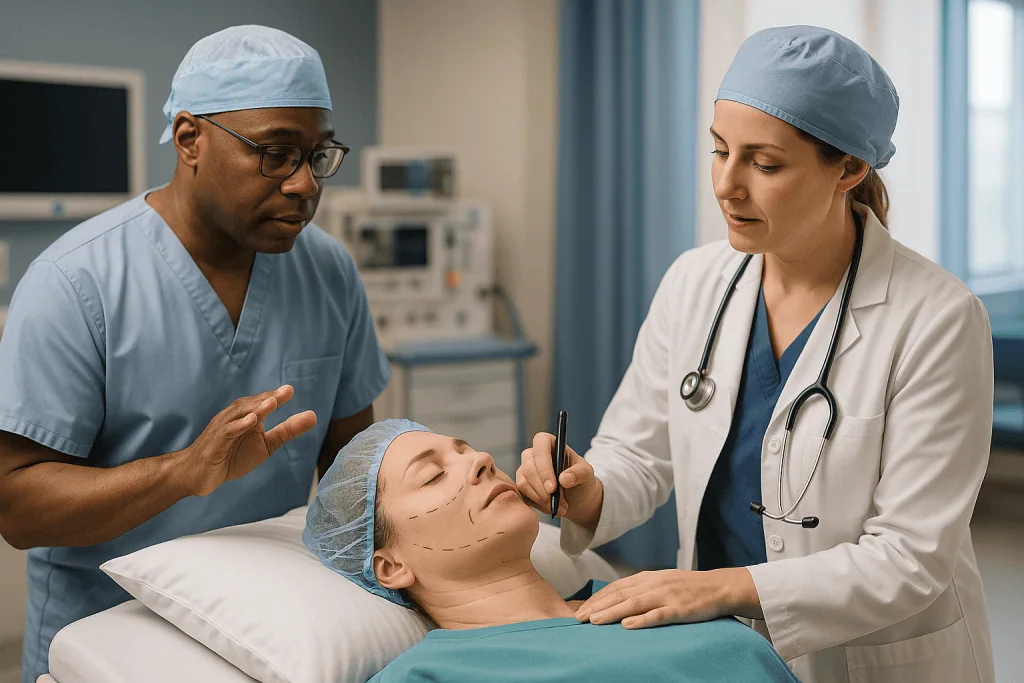
With the patient upright, the surgeon marks the skin. These lines are not decoration. They record where jowls sit when gravity is acting, where the platysma bands run, where fat has collected and exactly how the incision will curve around each ear. Once the person is lying flat, the face changes shape, and the marks become the only reliable map.
The hairline and ear are studied closely. A line drawn too far forward of the ear leaves a scar on the cheek; one that cuts across the sideburn can shift the hairline upward in a way that is hard to disguise. Surgeons often route the incision along the edge of the tragus, the small cartilage flap in front of the ear canal, so the scar hides in its shadow.
After the patient is asleep, the face and neck are cleaned and the tissues are infiltrated with a dilute solution containing local anesthetic and a small amount of a vessel-constricting agent. This numbs the area for after surgery, reduces bleeding, and lifts the skin slightly from the layer beneath, making the dissection cleaner. The Mayo Clinic gives a typical operating time of two to four hours, longer when additional procedures are added. A combined neck and face lift frequently sits toward the upper end of that range, and the team plans the day accordingly.
Neck and face lift procedure step by step: where the incisions go
The facial incision follows a path designed to be invisible in ordinary conversation. It usually starts in the hair at the temple, curves down in front of the ear along the tragus, wraps under the earlobe, then runs upward behind the ear before turning into the hair at the back of the scalp. Drawn on paper it looks like an elongated S hugging the ear.
Each portion has a job. The temple section allows the surgeon to lift the cheek and outer eye region. The section in front of the ear provides access to the mid-cheek and jowl. The curve behind the ear is what lets the neck skin be lifted upward and backward and any excess removed, which is why a neck lift performed alone without this segment can only correct so much.
The Mayo Clinic notes that incision placement varies with the technique chosen and the amount of correction needed. A limited or mini lift, aimed mostly at the jowl, may stop at or just behind the earlobe. A full combined lift extends well into the posterior hairline to handle a heavier neck.
Once the skin is opened, the surgeon lifts it away from the underlying SMAS using scissors or electrocautery, staying in a thin plane just beneath the skin so its blood supply is preserved. This flap extends forward toward the cheek and downward across the jaw toward the neck. How far it travels depends on the plan: a short skin flap with most of the movement happening in the deeper layer, or a longer skin flap when the surface itself needs redistributing.
Cleveland Clinic points out that the neck component is often approached both from behind the ears and from a small horizontal incision hidden in the crease beneath the chin. That chin incision is the subject of the next section.
The under-chin incision and what happens to the platysma
A neck that has lost its angle usually needs work from the front. A small incision, typically a few centimeters, is placed in or just behind the natural crease under the chin. Through it the surgeon can see the structures a side approach cannot reach: the fat lying directly under the skin, the two medial edges of the platysma, and sometimes deeper fat sitting between them.
The first step is usually fat. Excess superficial fat may be removed by liposuction through a fine cannula or by direct excision under vision. Surgeons are conservative here; a neck emptied of too much fat can look hollow and skeletal, and it exposes the muscle edges rather than smoothing them.
Next comes the platysma itself. When its two edges have separated and drifted downward, they form the vertical bands that give the neck a stringy appearance. The surgeon brings the edges back together in the midline and stitches them, a technique called platysmaplasty, in effect re-creating a continuous sling from one jaw angle to the other. Some surgeons also release the lower portion of the muscle to let the angle under the jaw deepen. Cleveland Clinic describes tightening or adjusting the neck muscles as a standard element of a neck lift.
Deeper structures are occasionally addressed as well. Enlarged salivary glands under the jaw or bulky muscles in the floor of the mouth can contribute to fullness, and a few surgeons reduce them, though this adds risk and is far from routine.
The chin incision is then set aside while the surgeon returns to the side of the face. The lateral pull applied to the platysma from behind the ears, described next, works together with the midline repair to create a two-directional tightening that neither approach can achieve alone.
Deep plane facelift and neck lift or SMAS lift: what the deeper work involves
This is where facelifts genuinely differ from one another, and where much of the online argument lives. Every well-performed modern lift moves the SMAS. The question is how.
| Technique | What is done to the SMAS | Typical rationale |
|---|---|---|
| SMAS plication | Folded on itself and stitched, no cutting | Less dissection; often chosen for milder laxity |
| SMASectomy | A strip removed along the jowl line, edges sewn together | Shortens the layer directly over the jowl |
| Extended SMAS flap | Lifted as a separate sheet, moved upward and backward, anchored | Greater repositioning of cheek and jowl |
| Deep plane | Skin and SMAS lifted together as one unit after releasing ligaments | Moves the whole composite; skin under less tension |
In a deep plane facelift and neck lift, the surgeon dissects beneath the SMAS rather than above it, releases the retaining ligaments that tether the cheek, and lifts skin and muscle layer as a single flap. Supporters argue this places the tension on the strong fibrous layer rather than the skin and gives a more natural movement of the cheek. Critics point out that it passes close to the branches of the facial nerve, which run just under the SMAS, and requires meticulous anatomy.
Honest evidence here is thinner than marketing suggests. Comparative studies are small, outcomes are judged by photographs, and follow-up is inconsistent. No mainstream guideline names one technique as superior for all patients. The Mayo Clinic simply notes that the surgeon repositions fat and tissue and tightens underlying muscle. What can be said is that surgeons trained in a technique tend to get their best results with it, so the choice usually reflects the surgeon’s experience matched to the individual anatomy, not a universal ranking.
Redraping, trimming and closing the skin in layers
With the SMAS and platysma secured, the surgeon returns to the skin. The flap that was lifted earlier is now laid back over the new contour and drawn gently upward and backward. The direction matters. Straight backward flattens the cheek and can distort the mouth; a mostly vertical lift follows the way tissue originally descended. Surgeons commonly describe this step as redraping rather than pulling, and the aim is a skin flap that lies flat with no tension at all along the incision line.
Excess skin is then trimmed. This is conservative work. A few millimeters too much removed around the ear can pull the earlobe downward into an elongated shape, sometimes called a pixie ear, or drag the tragus forward so the ear canal becomes visible. Both are recognizable signs of an over-tightened lift and are difficult to correct later.
Closure happens in layers. Deep absorbable sutures take the weight and hold the skin edges together without strain. The surface is then closed with fine sutures or skin staples in the hair-bearing scalp, where staples avoid damaging follicles. In front of the ear, surgeons often bevel the incision edges so hair can grow through the scar. The chin incision is closed last, again in layers, and left as a thin line in the crease.
Before the final stitches, the surgeon inspects every part of the wound bed for bleeding. Small vessels are sealed with cautery. Some teams place a thin drain under the skin on each side to carry away fluid overnight; others rely on a snug dressing or a tissue sealant instead. The Mayo Clinic notes that sutures are typically removed within about a week, and the surgeon usually explains the timeline before the patient goes home.
Facelift and neck lift recovery time: the first days and weeks
Recovery follows a fairly predictable arc, though every face writes its own version. The first night is usually spent either in hospital or under supervision at home, with the head raised and a padded dressing wrapped around the face and neck. The NHS notes an overnight stay is common after a general anesthetic facelift.
Days one to three are the least comfortable stretch. Swelling and bruising climb during this period, and most people describe tightness and numbness rather than sharp pain. The dressing is usually changed or removed at the first follow-up visit, and drains, if placed, come out within a day or two. Sleeping propped up and keeping the head still helps limit swelling.
Around one week, sutures in front of and behind the ear are typically removed, and scalp staples soon afterward, per the Mayo Clinic. Bruising begins its familiar march from purple through green to yellow and drifts downward into the neck and chest as it fades.
By about two weeks, the NHS suggests many people feel ready to return to work and to be seen socially, often with light makeup over any residual bruising. Numbness around the ears and cheeks commonly lingers for weeks to months as small skin nerves regrow.
Strenuous exercise, heavy lifting and anything that raises blood pressure are usually held for several weeks; the surgeon sets the exact timing. The Mayo Clinic advises that the final result takes months to settle as the last of the swelling resolves and scars mature from pink to pale. Sun protection on the incisions during that year is one of the few things a patient can do to influence how the scars finally look.
Risks and complications, explained without alarm
Every surgeon discusses risk at consultation, and it is worth knowing what the words mean before that conversation.
A hematoma is a collection of blood under the skin flap. The Mayo Clinic identifies it as the most common complication of a facelift, usually appearing within the first day, and it typically requires a return to the operating room to release the blood and stop the bleeding. It presents as sudden, often one-sided swelling and pressure. High blood pressure, blood-thinning medicines and vigorous activity in the first days raise the chance.
A seroma is a pocket of clear fluid rather than blood, usually smaller and often managed by drawing it off with a needle in clinic.
Nerve injury comes in two forms. Sensory nerves to the skin are cut in every lift, which is why numbness is expected and almost always resolves. Injury to branches of the facial nerve, which move the muscles of expression, is far less common and usually temporary, according to Cleveland Clinic and the Mayo Clinic, though permanent weakness is a recognized possibility. The greater auricular nerve behind the ear, which supplies sensation to the earlobe, is another structure surgeons take care to protect.
Skin loss occurs when the blood supply to the flap fails, most often behind the ear. Smoking is the leading avoidable risk factor. Infection is uncommon in the well-supplied face but does occur. Scarring can thicken, widen or lose pigment; earlobe distortion and hairline shifts are technique-related rather than random. Hair loss around the incisions is usually temporary.
Anesthetic risks apply as with any operation. None of this is a reason to avoid surgery, but all of it belongs in a decision made with full information.
How long will a face and neck lift last?
Nobody can stop the clock, and a lift does not try to. What it does is reset the tissues to an earlier position; aging then resumes from that new baseline. The Mayo Clinic states that a face-lift is not permanent and that, in general, results can be expected to last about ten years, while the NHS puts it more loosely as several years. Those are population estimates from clinical experience, not guarantees for any one face.
Several factors pull the number in either direction. Skin quality is the biggest. Thick, elastic skin with little sun damage holds a lift far longer than thin, crepey skin. The neck typically relaxes before the face, partly because the platysma is thin and partly because the neck moves constantly. Significant weight fluctuation after surgery loosens tissue. Smoking accelerates collagen loss. Genetics decide much of the rest.
Technique plays a role, though less cleanly than advertisements imply. Lifts that rely mainly on skin tension tend to relax sooner because skin stretches; lifts that anchor the SMAS and platysma hold their shape longer because those layers resist stretch. Whether any specific deep-layer method outlasts another has not been settled by rigorous comparative research.
People sometimes ask how long a neck lift lasts on its own. The same logic applies, and because the neck relaxes first, isolated neck lifts are among the procedures most often revisited. A secondary or touch-up lift years later is a normal part of the story for many patients, not a sign the first one failed.
Framed honestly: the operation buys a span of years during which the face and neck look as they did earlier, and then aging continues in the ordinary way. How many years depends on the person as much as the surgeon.
Is a face and neck lift worth it? Alternatives and what they can and cannot do
Worth is personal, so the useful question is what the alternatives actually deliver. People searching for the best procedure for tightening the face and neck usually meet four categories.
Injectables such as neuromodulators, described by class here rather than as a recommendation, can soften platysma bands temporarily by relaxing the muscle, and fillers can restore lost cheek volume. Neither moves sagging tissue back into place, and effects last months.
Energy-based skin tightening using radiofrequency or focused ultrasound heats the deeper skin to stimulate collagen. Mainstream sources including Cleveland Clinic describe these as offering modest, gradual tightening suited to mild laxity. They do not reposition the SMAS or repair the platysma, and results vary widely between individuals. Anyone promised a lift-like result from a device alone is being oversold.
Thread lifts use barbed absorbable sutures placed under the skin to hoist tissue. Evidence for longevity is limited, and effects are generally described as temporary.
Limited or mini lifts are true surgery with shorter incisions and less dissection. They suit early jowling in people with good neck contour and recover faster, but they cannot correct a heavy neck.
The combined lift stands apart because it is the only option that addresses all four layers at once. That is also why it carries the longest recovery and the surgical risks discussed above. Where laxity is mild, less invasive routes make sense; where the platysma has separated and skin hangs below the jaw, no non-surgical option changes that anatomy.
A candid surgeon will sometimes recommend against the operation, or suggest waiting. That advice deserves as much weight as any enthusiastic yes.
What people often get wrong about a combined neck and face lift
Myth: a facelift lifts the whole face. It does not. The operation described here treats the lower two-thirds of the face and the neck. Forehead, brows and eyelids need separate procedures, which is why surgeons often ask whether those areas bother a person too.
Myth: tighter is better. The over-pulled, mask-like look comes from tensioning skin instead of the deeper layer. A well-executed lift places the skin under no tension at all, which is precisely why it looks unoperated.
Myth: the scars will be obvious. Incisions run in the ear folds and hairline and mature over about a year. Most people can wear their hair up eventually. Scars do exist, though, and anyone told there will be none should ask again.
Myth: it treats wrinkles and sun damage. The Mayo Clinic is explicit that a face-lift does not address fine lines, pigment change or texture. Resurfacing treatments do that job and are sometimes combined with, or staged after, surgery.
Myth: results are permanent, or alternatively that the face will collapse afterward. Neither. Aging resumes from a new baseline. Nothing about surgery makes tissue sag faster than it otherwise would have.
Myth: a mini lift gives a full result with a weekend recovery. Smaller incisions mean smaller correction. Recovery is shorter, but a mini lift cannot fix a neck the way the full operation does.
Myth: numbness afterward means something went wrong. Sensory nerves to the skin are cut in every lift. Numbness around the ears and cheeks is expected and usually resolves gradually over months.
Myth: the technique name decides the result. Anatomy, skin quality and the surgeon’s familiarity with their own method matter more than whether the brochure says deep plane or SMAS.
Questions to ask your care team before a neck and face lift
A good consultation is a two-way examination. These questions tend to surface the information that matters most.
- Which layers will you work on in my case, and why does my anatomy suit that approach rather than a more limited or more extensive one?
- Exactly where will the incisions run around my ears and hairline, and how will you protect my sideburn and earlobe shape?
- Will the neck be treated from under the chin as well as from behind the ears, and will the platysma be repaired in the midline?
- What type of anesthesia do you recommend for me, and who provides it?
- How long do you expect the operation to take, and will I stay overnight?
- Do you use drains, and when are dressings and sutures removed?
- What is your plan if a hematoma develops in the first day, and how do I reach you out of hours?
- Which of my medicines or supplements need reviewing before surgery, and who makes that decision?
- How much time should I plan away from work, and when can I resume exercise?
- What would you consider a disappointing outcome, and how would you manage it?
- Are there areas, such as my brows or eyelids, that this operation will not improve?
- Could I speak with previous patients, or see standardized photographs taken at least a year after surgery?
Listen for specifics rather than reassurance. A surgeon who describes the anatomy of your own face, names the trade-offs of their chosen technique and explains what they will not be able to change is giving you the information a decision actually needs. Bring a companion if you can; two sets of ears catch more, and the details of anesthesia, aftercare and emergency contact deserve to be written down.
When to call your doctor after a neck and face lift
Most recovery days are uneventful: tight, swollen, bruised and slowly better. A few signs are different, and they warrant a call to the surgical team the same day, or urgent care if the team cannot be reached.
The most time-sensitive is a possible hematoma. Sudden swelling on one side of the face or neck, increasing pressure or pain that is worse on one side, a firm or tense feeling under the skin, or bruising that darkens rapidly in the first day or two should prompt immediate contact. The Mayo Clinic notes that hematomas typically form within about twenty-four hours and usually need prompt surgical treatment.
Call promptly for signs of infection: spreading redness around an incision, warmth, thick or foul-smelling discharge, or a fever. Report any area of skin, especially behind the ear, that turns dusky, purple or black, or an incision edge that opens.
New weakness of one side of the face, difficulty closing an eye, an asymmetric smile or drooping of the lower lip should be reported, even though many such changes prove temporary. So should severe or worsening pain not eased by the medicine the team prescribed, or any reaction to medication such as rash or vomiting.
Seek emergency care without waiting for a callback for chest pain, shortness of breath, calf pain or swelling, sudden confusion, or bleeding that soaks through a dressing and does not stop with gentle pressure. Blood clots in the legs or lungs are uncommon after facial surgery but are recognized risks of any operation under general anesthesia.
When in doubt, call. Surgical teams would far rather answer an unnecessary question than hear about a complication a day late. Your surgeon’s instructions and judgment take precedence over anything written here.
Frequently asked questions
Can face lift and neck lift be done at the same time?
Yes, and this is the usual arrangement because the SMAS of the cheek and the platysma of the neck are one continuous layer. Treating them together avoids a mismatch between a lifted jawline and a still-loose neck. The NHS notes that a facelift is commonly combined with neck surgery in the same session, which means a single anesthetic and one recovery, though the operation is longer and swelling is greater at once.
How long will a face and neck lift last?
The Mayo Clinic says results are not permanent and, in general, can be expected to last around ten years, while the NHS describes several years. Skin quality, sun damage, weight stability, smoking and genetics all shift that figure. The neck usually loosens before the face because the platysma is thin and constantly moving. Aging continues from the new baseline rather than accelerating, and a later touch-up is common.
What is the best procedure for tightening my face and neck?
There is no single best procedure; the right one depends on which layers have loosened. Mild skin laxity may respond modestly to energy-based tightening or injectables, whereas separated platysma bands, jowls and hanging neck skin can only be corrected by surgery that repositions the SMAS and repairs the muscle. A surgeon examining your face in person is the only reliable way to match technique to anatomy.
Is a face and neck lift worth it?
That depends on how much the changes bother you, how much correction your tissues need and how you weigh a surgical recovery and its risks against a result the Mayo Clinic describes as lasting roughly ten years. Non-surgical options cannot move sagging deeper tissue, so for significant laxity the lift is the only route that changes the underlying shape. A candid consultation, including the option of not operating, is the way to decide.
What is the difference between a neck lift vs lower facelift?
A lower facelift targets the jowls and jawline through incisions around the ear and works on the SMAS. A neck lift concentrates on the platysma muscle and fat under the chin, using a chin incision and often incisions behind the ears. Because the two layers connect, many people need both, which is why the combined neck and face lift is the version most surgeons discuss for changes below the cheekbones.
What is a deep plane facelift and neck lift?
In a deep plane technique the surgeon dissects beneath the SMAS rather than above it, releases the retaining ligaments of the cheek and lifts skin and muscle layer together as one unit before extending the same dissection into the neck. Supporters say this places tension on the strong fibrous layer rather than skin. Comparative evidence against other SMAS methods is limited, and no mainstream guideline ranks one technique above the others.
What is the typical facelift and neck lift recovery time?
Swelling and bruising build over the first three days, sutures are typically removed at about a week, and the NHS suggests many people return to work and social life around two weeks. Numbness around the ears can linger for months as skin nerves regrow, and strenuous exercise is usually held for several weeks at the surgeon’s direction. The Mayo Clinic notes the final result takes months to fully settle.
Will a neck and face lift leave visible scars?
Scars exist but are placed to hide: along the edge of the tragus in front of the ear, under the earlobe, behind the ear and into the hairline, plus a short line in the crease under the chin. They mature from pink to pale over about a year. Thick or widened scars, earlobe distortion and hairline shifts are recognized risks, so ask your surgeon how they plan the incision for your ear and hairline.
How long does a neck lift last on its own?
An isolated neck lift follows the same broad pattern as a full lift, with results described by the NHS as lasting several years, but the neck tends to relax sooner than the face because the platysma is a thin, mobile muscle. Weight changes and skin quality matter a great deal. For that reason neck-only procedures are among those most often revisited later, and surgeons often discuss the combined operation instead.
Does a facelift treat wrinkles and sun damage?
No. The Mayo Clinic is explicit that a face-lift does not improve fine lines, uneven pigment or skin texture, because those are problems of the skin surface rather than of sagging deeper tissue. Resurfacing treatments such as lasers or chemical peels address them and may be staged after surgery once healing is complete. Your treating team can advise which combination, if any, suits your skin.
References
This article is for general information only and is not a substitute for professional medical advice. Please consult a qualified doctor about your individual situation.

More from the Blog

Do Facial Augmentation Results Last? Implants vs Fat Transfer Over the Years
Facial augmentation results vary by method. Solid cheek and chin implants are designed to stay in place indefinitely and usually keep their shape for…

Preparing for Face Aesthetics Surgery: Blood Tests, Anesthesia Review and Medicine Changes
Preparing for facial surgery usually means a pre-assessment visit where blood tests check clotting, blood count and kidney function, an anesthesia review covers your…

Supporting Someone After a Neck and Face Lift: Drains, Dressings and the First Days Home
In the first days after a neck and face lift, a helper's main tasks are keeping the head raised, emptying and recording any drains,…

Facial Augmentation With Fat Transfer or Implants: Which Option Suits Which Face?
Facial fat transfer uses a person's own fat, taken by gentle liposuction and injected into the face, to add soft, natural-looking volume; facial implants…

How Surgeons Sequence Combined Face Aesthetics Procedures: One Operation or Several?
Surgeons combine facial procedures in one operation when the areas heal on a similar timetable, the patient is medically well, and total anesthesia time…

How Surgeons Sequence Combined Face Aesthetics Procedures: One Operation or Several?
Surgeons may combine facial procedures such as a facelift, eyelid surgery and fat grafting in one operation when a person is healthy, does not…