

How a Dentist Bonds Dental Crystals (Tooth Gems) Without Drilling the Enamel
Key Takeaways
- A tooth gem is bonded with the same acid-etch and light-cured resin technique used for white fillings and orthodontic brackets, so no enamel is drilled and the change is reversible by polishing.
- The etching gel removes only a few microns of surface mineral to create microscopic pits that resin locks into, and saliva remineralizes the surrounding enamel afterward.
- The most common long-term problem is a chalky white ring of early demineralization around the gem's edge, caused by plaque collecting against the resin margin rather than by the bonding itself.
- Cleveland Clinic gives standard dental bonding a typical lifespan of 3 to 10 years, but a gem sits proud of the tooth and often loosens sooner, especially if moisture contaminated the bond or it sits in the bite path.
- Nail glue and super glue are cyanoacrylates that set brittle, irritate gum tissue, and leave a rough uncleanable film; dental composite resin is the only adhesive designed for permanent contact with saliva.
- Whitening gel cannot penetrate resin, so anyone planning to whiten should do it before placement or accept a differently shaded spot when the gem is eventually removed.
A dentist bonds a tooth gem the same way tooth-colored fillings are bonded: the enamel is cleaned, briefly etched with a mild acid gel that roughens it microscopically, coated with a thin bonding agent, and the gem is set in a small dot of resin hardened with a blue curing light. No drilling is needed because the resin grips the etched surface rather than a cut cavity. Removal is by gentle polishing, not cutting.
The mirror in the exam room is small and unflattering, and she is holding it an inch from her face, tilting her head so the overhead light catches the front of her upper left canine. “Right there,” she says. “Just one. Something tiny.” Then the question that has been sitting under the whole appointment: “You’re not going to drill into it, are you?”
It is a fair worry. Most of what people remember from a dental chair involves a handpiece and a whine. Tooth gem placement is different, and the difference is worth understanding before you decide, because it explains both why the procedure is gentle and where its real risks hide.
The short version: the gem is not screwed, glued with hardware-store adhesive, or set into a hole. It is bonded to the outer skin of the tooth with the same chemistry dentists have used for decades to attach white fillings. What that means for your enamel, your gums, and your Tuesday-morning brushing routine is the rest of this story.
What tooth gem placement actually involves
A tooth gem is a small decorative crystal, a piece of glass, or a metal shape fixed to the visible surface of a front tooth. Placement means attaching it, and in a dental setting that attachment borrows directly from a routine procedure called dental bonding, in which a tooth-colored resin is stuck to enamel to repair chips or close gaps.
Enamel is the hard outer layer of the tooth. It is the most mineralized tissue in the body, harder than bone, and it does not grow back once lost. That last fact is why the no-drilling detail matters so much. A drilled surface is permanently changed. An etched-and-bonded surface can, in most cases, be returned close to its original state when the gem is polished off.
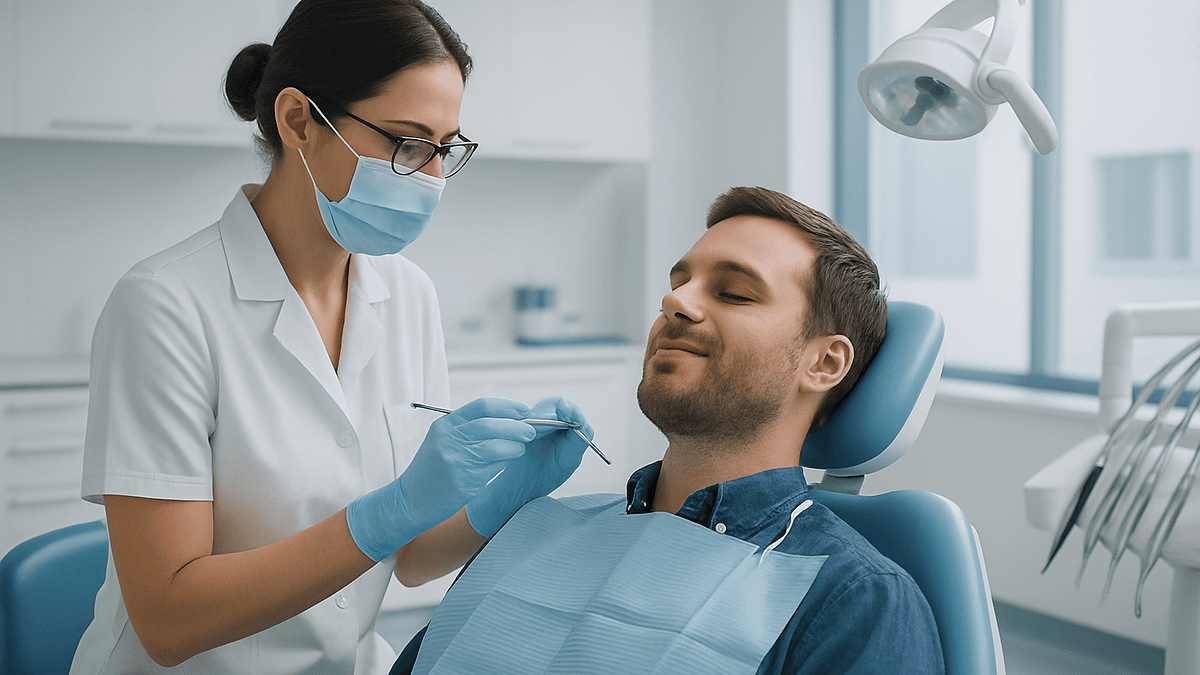
The procedure itself is quiet. There is no numbing injection in typical cases, because nothing reaches the nerve or even the softer dentin beneath the enamel. The patient feels a slightly sour taste from the etching gel, some cotton rolls holding the lip away, the pressure of a fingertip or instrument positioning the gem, and the warmth of a curing light held a centimeter from the tooth for a few seconds at a time.
Cleveland Clinic describes standard dental bonding as taking roughly 30 to 60 minutes per tooth, and gem placement sits at the short end of that range because there is no shaping of resin to do. What takes the time is the preparation: checking the tooth is sound, cleaning away plaque, keeping the surface dry, and confirming the spot works with how the lips move.
Everything that follows in this article rests on that one idea. The gem sits on the tooth, held by resin that has locked into a microscopically roughened surface. It is an addition, not a subtraction.
Why no drilling is needed: the etch-and-bond chemistry
Under a microscope, freshly cleaned enamel is smooth and slightly greasy with saliva proteins. Resin will not stick to it reliably. So the dentist changes the surface, not by cutting but by dissolving a whisper of mineral.

The tool is a gel of dilute phosphoric acid, painted on for a matter of seconds and rinsed off. The acid removes a few thousandths of a millimeter of the enamel surface and, more usefully, dissolves the mineral unevenly, leaving a honeycomb of microscopic pits and ridges. Dentists call this pattern “micro-retention.” The enamel looks frosty white when it is dried, which is the visual cue that etching has worked.
Next comes the bonding agent, a runny liquid resin that soaks into that honeycomb like water into a sponge. When the curing light shines on it, the liquid hardens into thousands of tiny resin tags anchored inside the enamel. The gem is then placed on a bead of thicker resin, which chemically fuses to the already-hardened bonding layer and is cured again.
The result is a mechanical lock rather than a chemical weld to the tooth itself. That distinction is why the process is reversible. Polishing removes the resin tags from the surface; it does not have to dig into the tooth to release the gem.
Two practical consequences follow. First, the surface must be bone dry during bonding, since saliva or breath moisture blocks the resin from reaching the pits, which is the commonest reason a gem falls off early. Second, the etched ring of enamel just beyond the gem is temporarily more porous. Saliva remineralizes it within hours to days in a healthy mouth, which is one reason dentists ask patients to avoid staining or acidic drinks right after the appointment.
Step by step: what happens in the chair
Appointments vary, but the sequence below reflects how bonding is taught and how a dental professional typically adapts it for a gem.
- Examination. The tooth is checked for decay, cracks, existing fillings, and gum health. A gem is not placed over a cavity or on a tooth that needs treatment first.
- Position check. The spot is chosen with the patient sitting up and speaking, since a gem that looks central at rest can hide under the lip in conversation or catch on it.
- Cleaning. The surface is scrubbed with a fluoride-free polishing paste. Fluoride paste at this stage can interfere with etching.
- Isolation. Cotton rolls, a cheek retractor, or a small rubber sheet keep the tooth dry and the tongue away.
- Etching. Acid gel is applied only to a spot slightly larger than the gem, left briefly, rinsed thoroughly, and the tooth is air-dried until it looks chalky.
- Bonding agent. A thin layer is brushed on, thinned with air, and light-cured.
- Placement. A small dot of flowable resin goes on the tooth; the gem is seated with a wax-tipped pick and pressed gently so resin flows up around its edges.
- Curing. The light is held over the gem from more than one angle, since the crystal itself can shadow the resin beneath.
- Finishing. Any excess resin ledge is smoothed so plaque has nowhere to lodge, and the bite is checked to make sure the opposing tooth does not strike the gem.
The patient is usually shown the result in the mirror, told what to avoid for the first day, and given a plan for review or removal. Nothing in that list involves a drill touching healthy enamel, and a careful clinician will say so out loud before starting, because that reassurance is often the reason the person booked with a dentist rather than a kit.
What are tooth gems made of, and does the material matter?
Three families of material turn up on front teeth. Each behaves differently against enamel, resin, and the opposing tooth.
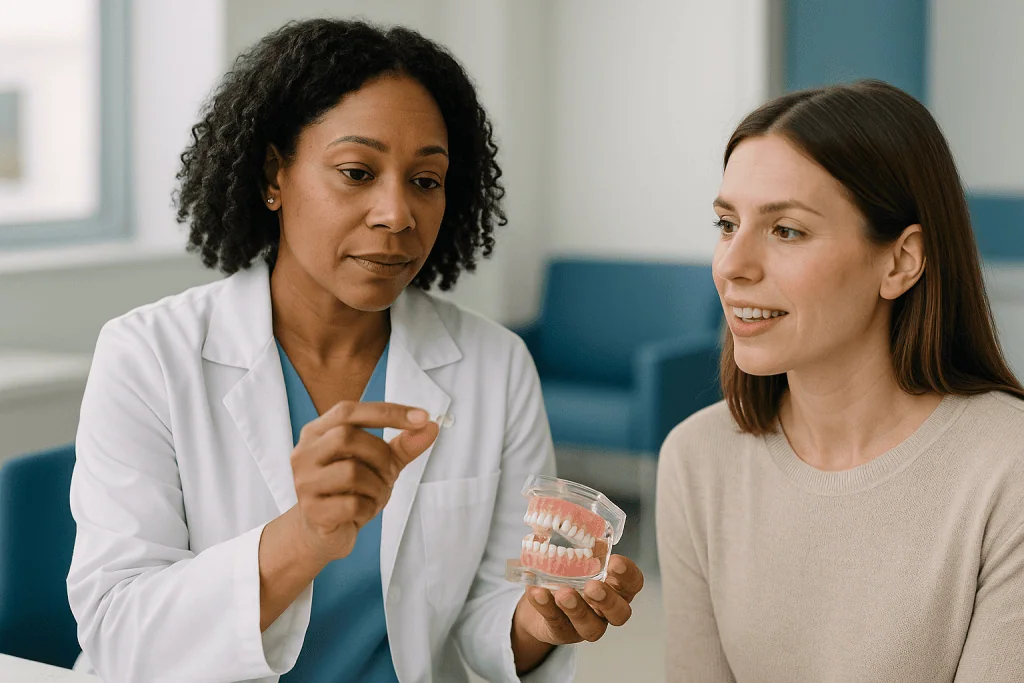
Lead-free crystal glass is the most common. It is cut with a flat back and often coated with a thin metallic layer so it sparkles against a white tooth. Because glass is softer than enamel, it rarely damages the tooth it bites against, though its edges can chip if the gem is knocked.
Metal shapes in gold or other alloys are smoother and less likely to fracture, but metal is harder than enamel. If a metal gem sits where the lower teeth strike it, it can wear a facet into the opposing tooth over months. Placement away from the bite matters more with metal than with glass.
Rhinestones marketed for craft or nail use are the outlier. They may contain lead or nickel, and their foil backing can corrode in saliva. Dental professionals generally decline to place them, and the Cleveland Clinic and other mainstream sources on oral health stress that anything staying in the mouth long term should be intended for that purpose.
The resin matters as well. Dental composite is designed to be biocompatible, to release nothing harmful as it sets, and to stay stable in a wet, acidic environment. Cyanoacrylate glues, the chemistry behind super glue and nail glue, are not. They set brittle, irritate soft tissue, and give off heat and vapor while hardening. Their failure mode on a tooth is either falling off within days or, worse, staying on but trapping bacteria under a rough, uncleanable film.
Size is the last variable. Smaller gems, roughly the size of a sesame seed, have less surface to catch food and are easier to keep clean than larger designs that span most of a tooth. There is no evidence base ranking one gem brand or size over another, so material and size are decisions to make with the clinician, based on your bite and your habits.
Who tooth gem placement usually suits, and who is asked to wait
The ideal candidate is an adult with healthy gums, no untreated decay, permanent front teeth that have been fully in place for years, and a brushing habit that is already reliable. That last point is not a moral judgment; it is mechanical. A gem adds an edge for plaque to gather against, and someone who already cleans well can manage that edge easily.
Several situations usually prompt a dentist to suggest waiting or to decline.
Children and teenagers with recently erupted teeth. Newly erupted enamel is less mineralized and more vulnerable to acid for a period after it appears. Primary (baby) teeth are also poor candidates because they are shed. Most dentists prefer to wait until the person is an adult and can consent to a cosmetic change and its upkeep.
Active tooth decay or gum disease. The NHS and Mayo Clinic both describe decay as a progressive process driven by plaque acid. Sealing a gem near an active lesion hides it and complicates treatment. Bleeding, swollen gums also need attention before any cosmetic work.
Orthodontic treatment. Braces and clear aligners both interact with the front surfaces of teeth. A gem interferes with aligner fit and can be dislodged when brackets are placed or removed.
Heavy grinding or clenching. Bruxism, the habit of grinding teeth usually during sleep, puts repeated shear force on anything bonded to a tooth. Gems in these mouths fail sooner and can chip enamel on the way out.
Planned whitening. Whitening gel cannot reach enamel under resin. Whitening first, then placing the gem after the shade has settled, avoids a pale ring later.
Crowns, veneers, or large fillings on the target tooth. Resin bonds poorly and unpredictably to porcelain, and etching techniques for it are different. Most clinicians steer gems to natural enamel only.
None of these is a permanent no. They are reasons to fix or finish something else first, and the treating dentist is the right person to judge the timing.
Do dentists approve of tooth gems? The honest answer
Ask ten dentists and you will hear a range, but the range is narrower than the internet suggests. Very few object to a small, professionally bonded gem on a healthy adult tooth. Almost all object to home kits, nail glue, and gems placed on teeth that have not been examined.
The reason for the moderate view is that the technique is not exotic. Dentists bond resin to enamel dozens of times a week for fillings, orthodontic brackets, and chipped edges. A gem is a bracket without the wire. The professional bodies that publish guidance on oral health, including the WHO and national health services, do not single out tooth jewelry as a hazard; their concern is with the general principles of keeping enamel intact and plaque under control.
Where dentists do express reservation, it tends to be about three things. First, hygiene: the gem’s edge is a permanent plaque trap on the smoothest, most self-cleaning part of the mouth. Second, reversibility: even careful polishing can leave a faint trace of resin or a barely measurable loss of surface enamel, and DIY glue removal can gouge. Third, priority: a patient who wants a gem while carrying untreated decay has, from the dentist’s chair, put the order of business backwards.
It is also honest to say that the published research on tooth gems specifically is thin. Case reports describe problems with amateur placement and with gems worn for years without cleaning. What does not exist is a large, long-term trial measuring enamel outcomes after professional placement and removal. So a dentist who says “probably fine if it is done properly and you look after it” is not hedging; that is what the evidence actually supports.
The decision, then, is less about permission and more about sequence: healthy mouth first, professional technique second, honest upkeep third. Your own dentist is the person who can say whether your teeth meet the first condition.
How long do tooth gems last once bonded?
No mainstream health source publishes a lifespan for tooth gems, and any clinic quoting a precise number is estimating. What can be said is grounded in the parent procedure. Cleveland Clinic notes that dental bonding typically lasts somewhere between 3 and 10 years before it needs touching up or replacing, with the wide range explained by bite forces, habits, and hygiene.
A gem is a smaller, simpler bond than a repaired chip, which cuts both ways. Less resin means less to fail, but a gem also sits proud of the tooth surface, where lips, food, and the opposing teeth all push on it. In practice, many gems come loose within months rather than years, and that is not a sign of poor work so much as of physics.
Factors that shorten the life of a gem include:
- Moisture contamination during bonding, which is the leading cause of early loss.
- Placement in the bite path, so the lower teeth strike it when chewing or speaking.
- Grinding or clenching, especially at night.
- Habits such as nail biting, chewing pens, or opening packets with the teeth.
- Very hard or sticky foods that pry at the edge.
- Repeated exposure to acidic drinks, which softens the enamel around the resin margin.
Factors that help it last are the mirror image: dry field technique, a spot chosen with the bite in mind, a night guard if grinding is already known, and gentle cleaning that does not use the gem as a scraping point.
When a gem does come off, the resin patch may stay behind as a small rough dot. That is worth having smoothed, both for comfort and because rough resin gathers plaque. A gem that is swallowed is almost always passed without incident given its size, but a gem that is inhaled, which is rare, is a medical matter, covered in the section on when to call your doctor.
What are the downsides of getting a tooth gem?
The risks of a professionally placed gem are modest, but they are real and worth naming in plain language.
Plaque and decalcification. The most common problem is a chalky white ring around or under the gem when it is eventually removed. This is early demineralization, the first stage of decay, caused by plaque sitting undisturbed against the resin edge. The NHS describes this reversible white-spot stage as the point at which fluoride and better cleaning can still repair enamel. Caught late, it becomes a cavity.
Gum irritation. A gem placed too close to the gum line, or resin left as a ledge, traps debris where the gum meets the tooth. Redness and bleeding on brushing follow, the early signs of gingivitis described by Mayo Clinic.
Wear on the opposing tooth. Relevant mostly for metal gems or any gem in the bite path.
Chipping. Glass gems can fracture, leaving a sharp edge that catches the lip until it is smoothed.
Enamel changes on removal. Polishing removes resin and, unavoidably, a microscopic layer of enamel surface. Done carefully this is not clinically significant; done aggressively, or done by scraping at home, it can leave a visible dull patch.
Staining. Resin margins can pick up color from coffee, tea, red wine, and tobacco, producing a faint brown halo that enamel around it does not show.
Masking. A gem covers a small area of tooth that can no longer be visually inspected. Regular check-ups and X-rays when indicated matter more, not less, while it is in place.
None of these is dramatic. Compared with the risks of drilling or of DIY glue, they are minor. But they are the reasons a dentist will ask about your brushing before asking about your design, and they are why the honest answer to “is a tooth gem harmless?” is “nearly, if you clean around it every day.”
DIY tooth gem kit vs dentist placement: are tooth gems safe either way?
Home kits are sold with the promise that the process is simple. The bonding steps are simple. What a kit cannot supply is the examination beforehand, a dry field, a curing light of adequate power, dental-grade resin, or anyone to fix a problem afterward. The table sets the two paths side by side.
| Aspect | Dental professional | Home kit or nail glue |
|---|---|---|
| Tooth checked for decay first | Yes, with X-rays if needed | No |
| Adhesive | Dental composite resin designed for the mouth | Often cyanoacrylate or an unregulated resin |
| Enamel preparation | Controlled acid etch, rinsed and dried | Uncontrolled, or skipped, so the gem fails early or sits on plaque |
| Moisture control | Retractors, cotton, air syringe | Difficult with one hand and a phone mirror |
| Curing | Calibrated dental light | Weak LED or none |
| Excess adhesive | Smoothed at the margin | Usually left as a ledge |
| Removal | Polishing that spares enamel | Scraping, which can gouge enamel or gums |
| Follow-up | Built into routine care | None |
The safety question, then, has two answers. A gem bonded by a trained clinician onto a healthy, examined tooth is a low-risk cosmetic procedure whose main hazard is neglecting the plaque around it. A gem glued on at home carries the risks of chemical burns to the gum, a permanently rough film that harbors bacteria, gems that fall off and are swallowed at night, and damage during the inevitable attempt to pick it off.
Where a friend or an untrained studio offers placement with proper resin, the missing piece is still the examination. Nobody without dental training can rule out a cavity beneath the surface they are about to seal. That, more than the adhesive, is what the dental setting adds.
What the first days and weeks after tooth gem placement usually look like
The immediate aftermath is undramatic, which is itself useful to know, because a gem that hurts or a gum that throbs is not normal and deserves a call.
The first hour. The resin is fully hard the moment the light stops; there is no waiting period for it to “set.” The tongue will find the gem repeatedly. That fascination fades within a day or two for most people, in the same way a new filling stops feeling foreign.
The first day. Dentists often ask patients to avoid deeply colored or acidic drinks and very sticky foods for the rest of the day. The point is not the resin, which is already cured, but the ring of etched enamel around it that is remineralizing from saliva. Brushing that evening is expected, gently, with a soft brush.
The first week. Occasional mild sensitivity to cold on the treated tooth can occur and usually settles within days; the etching is confined to enamel, so persistent or sharp pain suggests something else and should be reviewed. Some people notice the lip catching slightly on the gem. If that continues, the edge can be smoothed.
Ongoing. The daily routine is the one MedlinePlus and the NHS describe for everyone: brushing twice a day with a fluoride toothpaste and cleaning between the teeth once a day. The only adjustment is attention. Angle the brush so bristles sweep along the gem’s edge from every direction. Floss the neighboring contacts as usual; the gem does not change that. An interdental brush or a rubber-tipped stimulator can clear the margin where the gem meets the gum side of the tooth.
Keep dental check-ups on their normal schedule and mention the gem, so the clinician looks under and around it with a mirror and probe. If it has been in place for many months, ask whether the margin still looks clean. A quick polish of the resin edge at a routine visit can remove early stain before it sets in.
Tooth gem removal: what actually happens when you want it off
People often assume that whatever attached the gem must be undone with the same force. In fact, removal is the gentlest part of the whole story when it is done properly, and the most damaging part when it is not.
In a dental setting, the clinician first checks whether the gem itself can be lifted. Because the bond between resin and gem is often weaker than the bond between resin and etched enamel, a light twist with pliers or a fingernail-thin instrument frequently pops the crystal off, leaving a flat dot of resin behind. The remaining resin is then removed with a fine polishing point or a rubber cup and paste, working across the tooth rather than digging into one spot.
The goal is to remove resin without removing meaningful enamel. Because resin is softer than enamel, an experienced hand can feel and see the moment the polisher reaches tooth. A final polish restores the natural gloss. Some dentists apply a topical fluoride at this stage because the enamel under the gem has been shielded from saliva and toothpaste for the duration.
What the surface looks like afterward depends on what happened during wear. If plaque was controlled, the enamel is usually indistinguishable from its neighbors. If it was not, a pale, matte ring where the gem sat is common. That is early demineralization, and the NHS and Mayo Clinic describe it as potentially reversible with fluoride and improved cleaning, but it needs monitoring.
Home removal is where harm concentrates. Scraping with a fingernail, a pin, or a metal tool scratches enamel and cuts gum. Dissolving glue with acetone irritates soft tissue and does nothing to composite resin. If a gem has partly come off and is catching, the safe interim step is to leave it alone and book an appointment rather than to work at it.
What people often get wrong about tooth gems
“The dentist drills a little dimple for the gem to sit in.” No. The gem sits on the surface, held by resin locked into microscopically etched enamel. Drilling would be both unnecessary and irreversible.
“Etching is just a fancy word for damaging the tooth.” Etching removes a few microns of surface mineral, a fraction of what a single acidic meal can soften. The same step precedes every white filling and every orthodontic bracket, and saliva remineralizes the surrounding enamel afterward.
“Nail glue is basically the same stuff.” It is not. Dental resin is a light-cured composite designed for permanent contact with saliva and gum. Cyanoacrylate sets brittle, generates heat, irritates tissue, and leaves a rough film that cannot be polished clean.
“A gem protects the tooth underneath.” The area under a well-bonded gem is sealed, but the margin around it is a plaque trap, and the gem hides the surface from inspection. Net effect is neutral at best and depends entirely on cleaning.
“You cannot brush over it or it will fall off.” Brushing is exactly what keeps the margin healthy. A cured bond does not loosen with a toothbrush. What loosens it is biting force and moisture during placement.
“Whitening will lighten the tooth under the gem too.” Whitening gel cannot penetrate resin, so the covered spot keeps its original shade. Whiten first if you plan to.
“If it falls off, the tooth is ruined.” A gem that comes off leaves either a clean etched patch that saliva repairs or a small resin dot that a dentist smooths in minutes. Neither is damage in the usual sense.
“Once it is on, it is permanent.” Removal by polishing is routine and, done with care, leaves enamel close to how it started. The permanence people fear applies to drilling, not to bonding.
Each of these misunderstandings pushes people toward either needless fear or careless confidence. The truth sits in the middle: a low-risk, reversible procedure whose main variable is you.
Questions to ask your care team before tooth gem placement
A good consultation is a conversation, not a menu. These questions tend to surface the information that matters for your particular mouth.
- Have you examined this tooth for decay or cracks, and do you want an X-ray before bonding anything to it?
- Is my gum around this tooth healthy enough, or should that be addressed first?
- Will the gem sit in my bite path? Can you check with me sitting up and talking, not just lying back?
- What material is the gem, and is it made for use in the mouth?
- What adhesive will you use, and is it a dental composite resin?
- Do I grind or clench my teeth, based on what you see, and does that change your advice?
- If I am considering whitening, braces, or aligners, in what order should those happen?
- How will you smooth the resin edge so plaque does not collect against it?
- How should I clean around the gem, and is there a tool you recommend for the margin?
- What signs would tell me the margin is not staying clean?
- If the gem falls off, what should I do with the resin left behind?
- How will you remove it when I want it gone, and what do you expect the enamel to look like afterward?
- Are there any reasons, in my case, that you would rather I waited or chose a different tooth?
Notice what is missing from the list: nothing about how to choose a design. That is the part most guides spend their words on, and it is the part least likely to affect your teeth. Design is a preference. Tooth health, bite, hygiene, and adhesive are the decisions with consequences, and they belong in the room with a clinician who has looked at your mouth.
If the answers to the first two questions reveal a problem, the right response is to treat that first and revisit the gem later. A dentist who says so is not being difficult; they are doing the examination the gem exists to be placed after.
When to call your doctor
Most gem-related problems are minor and can wait for a routine dental appointment: a gem that has come off, a rough resin dot, a lip that keeps catching, or a margin that looks stained. A short list of signs, though, deserves a same-day call to your dentist or, in one case, emergency care.
Contact your dentist promptly if you notice:
- Pain in the treated tooth that lasts more than a few days, or sharp pain on biting, since etching alone should not cause this.
- Sensitivity to hot or cold that is getting worse rather than fading.
- Gum around the gem that is red, swollen, bleeding, or pulling away from the tooth.
- A white, chalky, or brown patch appearing at the edge of the gem or on the tooth after the gem comes off.
- A chipped gem with a sharp edge cutting the lip or tongue.
- Any sign of a chemical burn on the gum, such as a white, sloughing patch, after a home kit or glue was used.
- Swelling of the face or jaw, a bad taste, or a feeling that the tooth is loose.
Seek emergency medical care immediately if:
- A gem comes off and is inhaled rather than swallowed, causing coughing, wheezing, or difficulty breathing. Although rare, an inhaled foreign body needs urgent assessment.
- Swelling spreads to the floor of the mouth, neck, or eye, or you have fever with facial swelling, which can indicate a spreading infection.
Swallowing a gem, by contrast, is rarely a problem. Objects this small usually pass through the digestive tract on their own. Mention it to your dentist so the resin left on the tooth can be smoothed.
The broader picture is that a gem is a small addition to a mouth that still needs the same care as before. The WHO estimates that oral diseases affect close to 3.5 billion people worldwide, most of it preventable decay and gum disease driven by plaque. The gem does not change that arithmetic. Daily cleaning and regular check-ups do, and every decision about placement, timing, and removal should sit with the dental team that can actually see your teeth.
Frequently asked questions
How much does it cost to get a tooth gem placed?
This article does not give prices, because cost varies by region, by clinician, and by what the examination finds, and a figure quoted online is rarely what an individual pays. What is worth knowing is what a dental fee typically covers that a kit does not: an examination for decay, X-rays if needed, dental-grade resin, moisture control, a calibrated curing light, smoothing of the resin edge, and follow-up. Ask your dental office directly for their fee and what it includes.
Do dentists approve of tooth gems?
Most dentists are neutral to cautiously accepting of a small gem bonded professionally onto a healthy adult tooth, because the technique is identical to routine dental bonding. Where they object is to home kits, nail glue, gems placed on unexamined teeth, and gems on children or on teeth with active decay or gum disease. The evidence base specific to gems is thin, so the honest professional position is that it is probably fine when done properly and cleaned around daily.
How long do tooth gems last?
No mainstream health source publishes a lifespan for tooth gems. The nearest guide is dental bonding, which Cleveland Clinic says typically lasts 3 to 10 years depending on bite forces and habits. A gem is a smaller bond that protrudes from the tooth, so many come off within months rather than years, particularly if the surface was damp during placement, the gem sits in the bite path, or the person grinds their teeth. Loss is not usually harmful; the resin left behind is simply polished smooth.
What are the downsides of getting a tooth gem?
The main downside is a plaque trap at the resin edge, which can leave a white ring of early demineralization or a stained halo when the gem is removed. Other risks include gum irritation if the gem sits near the gum line, wear on the opposing tooth with metal gems in the bite path, chipping of glass gems, minor enamel surface change on removal, and the gem hiding part of the tooth from inspection. All are manageable with careful placement, daily cleaning, and routine check-ups.
Are tooth gems safe for your enamel?
A professionally bonded gem is low risk for enamel. The acid etch removes only a microscopic layer of surface mineral, the same step used before white fillings, and saliva remineralizes the area afterward. Enamel harm comes from other directions: plaque sitting against the margin for months, scraping a gem off at home, or using cyanoacrylate glue that cannot be polished away. Keeping the edge clean and having removal done by a dentist keeps the enamel outcome close to neutral.
Does tooth gem placement hurt?
Placement is typically painless and does not usually require a numbing injection, because everything happens on the enamel surface and nothing reaches the softer dentin or the nerve. People notice a sour taste from the etching gel, pressure from the instrument seating the gem, and the warmth of the curing light. Mild, brief cold sensitivity can occur for a few days afterward. Pain that is sharp, persistent, or worsening is not expected and should be reviewed by the dentist.
Can you use a DIY tooth gem kit safely at home?
Home kits carry risks that a dental setting removes: no examination for decay under the gem, difficulty keeping the tooth dry with one hand, weak or absent curing lights, adhesives that may be unregulated or cyanoacrylate-based, and no way to smooth the resin edge. The most common outcomes are a gem that falls off within days or one that stays on over a rough, plaque-harboring ledge. Removal at home by scraping is where most actual enamel and gum damage occurs.
How is tooth gem removal done, and will it leave a mark?
A dentist usually lifts the crystal off with a light twist, then polishes away the remaining resin with fine rubber points and paste, stopping as soon as tooth surface is reached because resin is softer than enamel. If the margin was kept clean, the enamel generally looks like its neighbors afterward. If plaque sat against the gem for a long time, a pale matte ring of early demineralization may be visible; that stage can often be reversed with fluoride and better cleaning but needs monitoring.
Can teenagers or children get a tooth gem?
Most dentists prefer to wait until adulthood. Baby teeth will be lost, and newly erupted permanent teeth have enamel that is less mineralized and more vulnerable to acid for a period after they appear. Teenagers are also frequently in or about to start orthodontic treatment, which conflicts with a bonded gem. A dentist who declines for a young patient is applying the same caution they would to any elective cosmetic change during a period when the teeth are still maturing.
Can I whiten my teeth after getting a tooth gem?
You can, but the enamel under the gem will not change shade, because whitening gel cannot penetrate cured resin. When the gem is eventually removed, a spot matching the original tooth color may be visible against the whitened surrounding enamel. The usual advice is to whiten first, wait until the shade has stabilized, and then have the gem placed. Whitening products also do not weaken a properly cured bond, so an existing gem is not at risk from them.
References
- Cleveland Clinic – Dental Bonding
- MedlinePlus – Dental care – adult
- NHS – Tooth decay
- World Health Organization – Oral health fact sheet
This article is for general information only and is not a substitute for professional medical advice. Please consult a qualified doctor about your individual situation.

More from the Blog

What MRI and CT Reveal About TMJ: The Disc, Arthritis and Joint Damage
MRI is the preferred way to see the soft tissues of the temporomandibular joint, especially whether the cartilage disc sits on top of the…

What Porcelain Veneers Can Change and What Still Depends on Your Gums: Realistic Results
Porcelain veneers are thin ceramic shells bonded to the front of teeth. They can reliably change color, small chips, minor spacing and the shape…

Can Gum Disease Kill You? The Links to Heart and Whole-Body Health
Gum disease itself rarely kills, but advanced periodontitis is associated with higher rates of heart attack, stroke, and poorly controlled diabetes, and in rare…

After Halitosis Treatment: Hydration, Tongue Cleaning and the Daily Routine Dentists Recommend
After halitosis treatment, dentists usually recommend a simple halitosis daily routine: brush twice a day for two minutes with fluoride toothpaste, clean between the…

Tongue Scraping: What It Actually Does (and Doesn’t) for Your Mouth
Tongue scraping removes the bacteria-rich coating on the tongue's surface and, in small clinical studies, modestly reduces the sulfur compounds behind bad breath for…

When Bruxism Needs Treatment: Worn Enamel, Morning Jaw Pain and Headaches
Bruxism needs treatment when grinding or clenching is causing measurable harm or persistent symptoms: enamel that is visibly flattening or chipping, jaw muscles that…