

How a Swallow Study Works: The X-Ray and Camera Tests Before Swallowing Rehabilitation
Key Takeaways
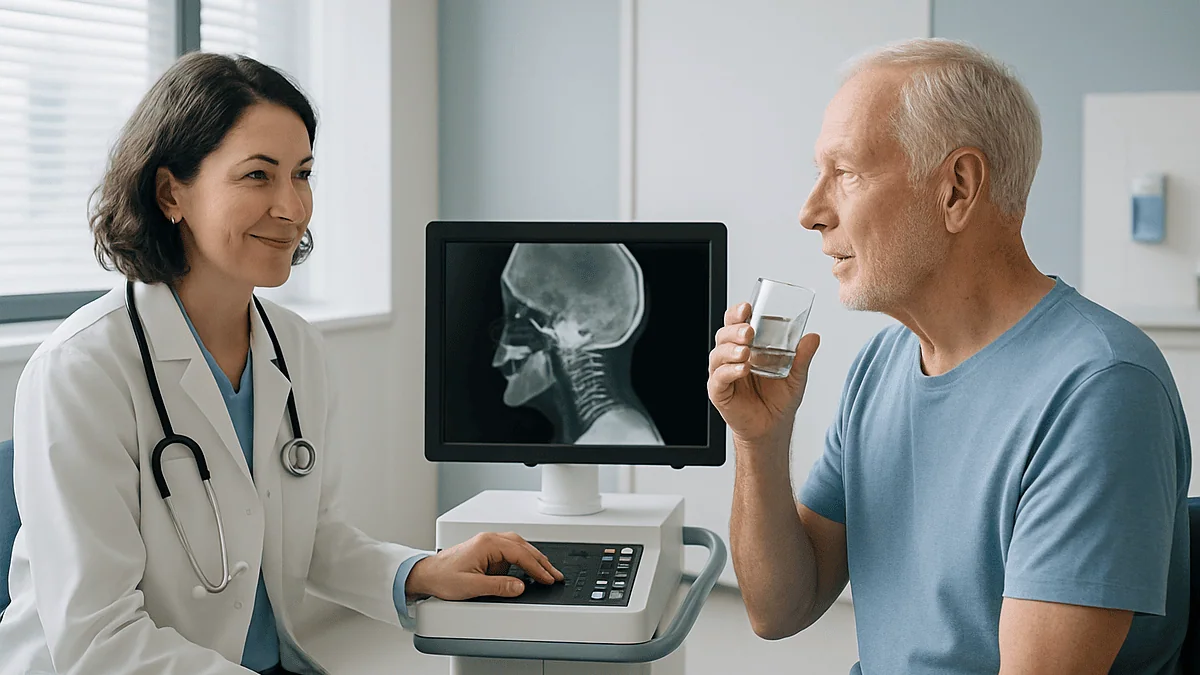
- A modified barium swallow films the swallow with X-ray video while you take small amounts of barium-mixed foods, whereas FEES uses a thin camera through the nose and ordinary food with no radiation.
- The two exams are complementary: videofluoroscopy shows the exact moment liquid may enter the airway, while FEES whites out at that instant but shows residue and throat anatomy in detail.
- Silent aspiration, where food enters the airway without any cough, cannot be detected at the bedside and is a main reason instrumental studies exist.
- Clinicians test fixes live during the study, such as a chin tuck or thicker liquid, so many recommendations are already tried and seen to work before the report is written.
- Penetration means material reaches the voice box entrance but stays above the vocal folds; aspiration means it passes below them, and reports often grade this on a numbered scale.
- The NIDCD estimates about one in 25 US adults has a swallowing problem each year, and the NHS lists aspiration pneumonia, dehydration and weight loss as key complications of untreated dysphagia.
A swallow study test is an imaging exam that watches food and liquid move from the mouth to the stomach in real time. The two main versions are the modified barium swallow, which uses X-ray video while you swallow barium-coated foods, and FEES, which uses a thin camera passed through the nose. Results guide swallowing rehabilitation; the treating team decides which test suits each person.
It usually starts small. A cough that arrives halfway through a glass of water. A second, longer chew before the bread will go down. A spouse who notices that soup has quietly become the default dinner. Then a clinic letter uses a word nobody says at the table, videofluoroscopy, and the appointment for a swallow study test suddenly feels bigger than it should.
The word is long, but the idea is not. Swallowing is one of the few things the body does hundreds of times a day without asking permission, and when it falters, listening from the outside cannot show where the trouble sits. The study lets a speech-language pathologist and a radiologist watch the swallow happen, frame by frame, and see exactly what a stethoscope or a bedside sip test cannot.
What follows is a walk through both versions of the exam, the X-ray one and the camera one, what the team is looking for, and how the pictures turn into a rehabilitation plan.
What is a swallow study test, in plain language?
A swallow study test is a live recording of you swallowing. Instead of asking how it feels, the team watches the mechanics: where the food goes, how quickly, whether any of it slips toward the airway, and what is left behind afterward. The medical term for trouble swallowing is dysphagia, and the study is the standard way of finding out which part of the swallow is misbehaving.
Two exams dominate. The first is the modified barium swallow, sometimes called a videofluoroscopic swallow study. Fluoroscopy is X-ray video rather than a single still image, and barium is a chalky, harmless mineral paste that shows up bright white on X-ray. You eat and drink small amounts of barium-coated foods while the X-ray camera records the whole route from lips to upper esophagus.
The second is FEES, short for fiberoptic endoscopic evaluation of swallowing. An endoscope is a slim flexible tube with a light and camera at its tip. Passed gently through one nostril, it sits just above the voice box and films the throat from the inside while you eat ordinary food.
Both exams are usually run by a speech-language pathologist, a clinician trained in swallowing and communication, often with a radiologist reading the X-ray version. The point is not simply to label the problem. The Mayo Clinic describes these studies as tools to see how food moves through each phase of the swallow and to identify weakness or poor coordination, which is exactly the information a therapist needs before designing exercises, changing food textures, or teaching a safer swallowing technique.
In other words, the study is the map, and rehabilitation is the journey drawn on it.
Why swallowing goes wrong: the four stages the study watches
Swallowing looks like one action but runs as a relay. The National Institute on Deafness and Other Communication Disorders (NIDCD) notes that it involves roughly 50 pairs of muscles and many nerves, all firing in a sequence measured in fractions of a second. A swallow study test is built around the four stages of that relay.
The oral preparatory stage is chewing and mixing food with saliva into a soft ball called a bolus. The oral stage is the tongue pushing that bolus to the back of the mouth. The pharyngeal stage is the fastest and riskiest: the soft palate seals the nose, the voice box lifts and tilts, a flap called the epiglottis folds over the airway, the vocal folds close, and the throat squeezes downward, all in about a second. The esophageal stage is the muscular tube carrying the bolus to the stomach.
Trouble can live in any of these. A stroke can weaken the tongue or slow the reflex that closes the airway. Parkinson’s disease and other neurological conditions can blunt coordination. Surgery or radiation to the head and neck can stiffen tissue. Simple aging can reduce muscle reserve. Structural problems, such as a narrowing in the esophagus, change the picture entirely.
The consequences of a mistimed relay are why clinicians take dysphagia seriously. Aspiration, meaning food or liquid entering the airway below the vocal folds, can lead to aspiration pneumonia, a lung infection the NHS lists among the complications of untreated swallowing problems, alongside dehydration and weight loss. Some people aspirate without coughing at all, a pattern called silent aspiration, which is invisible at the bedside and one of the main reasons the study exists.
How a modified barium swallow study works, step by step
The room looks like an ordinary X-ray suite, with one difference: a chair or table positioned so the camera sees you from the side, in profile, the angle that best shows the airway and the food path at the same time. You sit as upright as you safely can. A lead apron may cover parts of your body not being imaged.
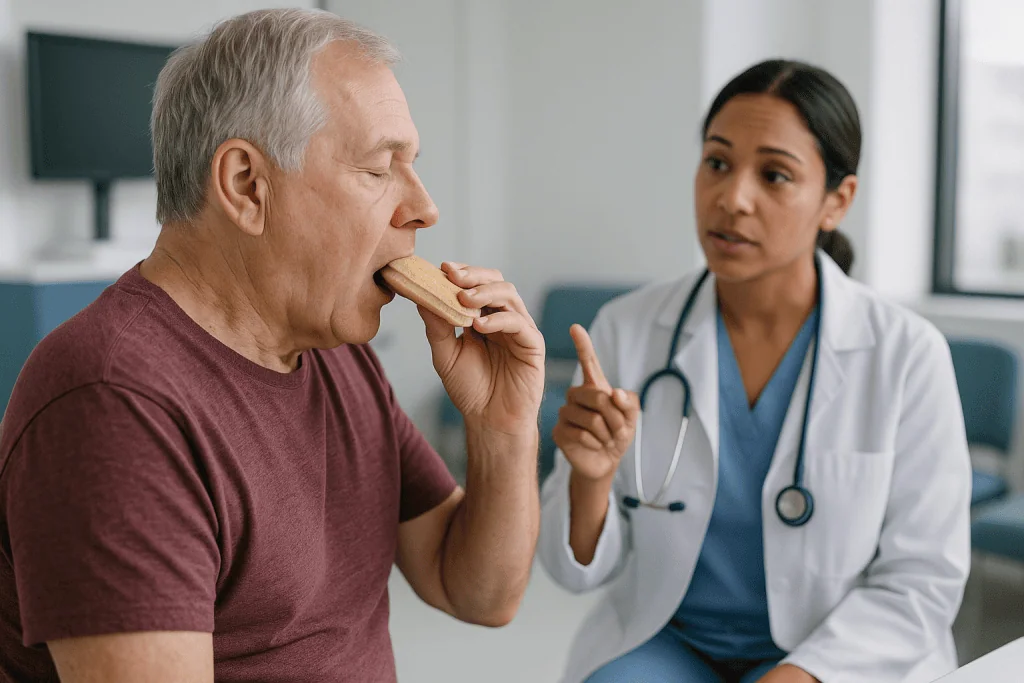
The speech-language pathologist stands beside you with a tray. On it are the same foods you might meet in a hospital kitchen, each mixed with barium so it glows on screen: a thin liquid, a thicker liquid, a pudding-like puree, and often a soft solid such as a cracker or a piece of cookie with barium paste. Sometimes a barium tablet stands in for medication.
You are asked to take a sip or bite and swallow when told, or sometimes to swallow naturally. As you do, the radiologist runs the fluoroscope in short bursts and the video records. The team watches the white bolus travel, pause, and clear. If a thin liquid causes trouble, they may try a thicker one, a smaller volume, a chin-down posture, or a cued hard swallow, testing strategies right there rather than guessing later.
The imaging portion is brief. Johns Hopkins describes a standard barium swallow as taking around 30 minutes, and the modified version is often shorter because the camera concentrates on the mouth and throat rather than following barium all the way to the stomach. Radiation exposure is kept low by keeping the beam on only during swallows.
Afterward you can usually eat and drink as before unless the team advises otherwise, and the barium leaves the body in stool over the following day or two, sometimes pale in color. The recording is then reviewed slowly, often frame by frame, before a written report is produced.
What happens during a FEES swallow test with the camera through the nose
FEES swaps the X-ray suite for a chair, a screen and a very thin endoscope. It can be done in a clinic room or, importantly, at the bedside for someone too unwell to travel to radiology. There is no radiation and no barium; you eat and drink foods in their normal form, often tinted with a few drops of food coloring so they stand out against pink throat tissue.
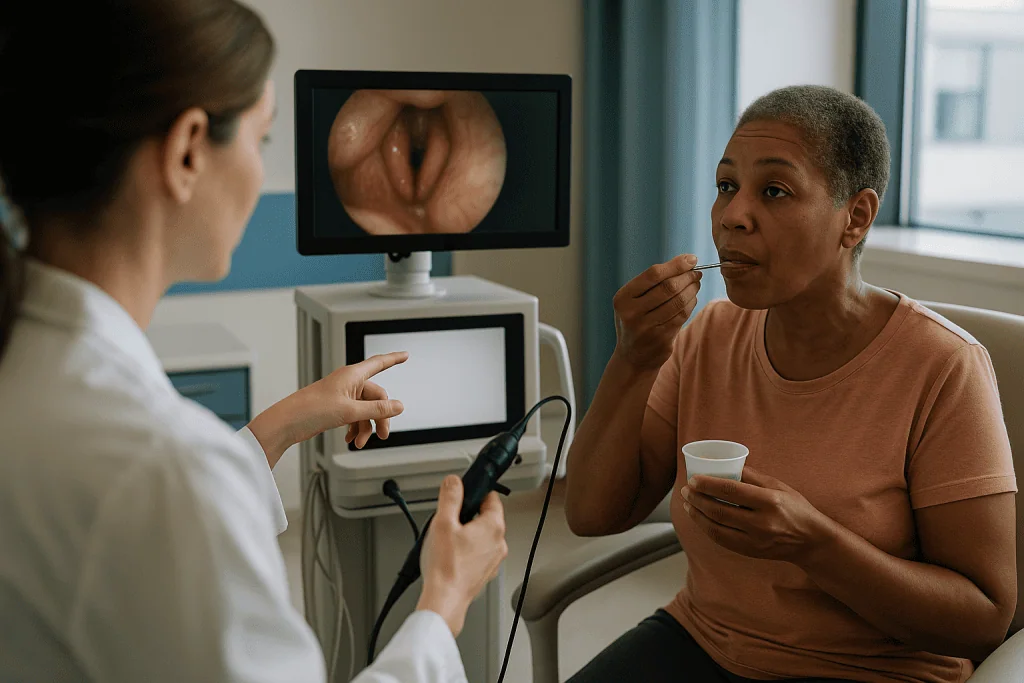
The clinician may apply a numbing spray or gel to one nostril, then guides the scope through the nose and along the back of the nasal passage until the tip rests above the voice box. Most people describe pressure or an urge to sneeze rather than pain, and the tube is roughly the width of a piece of cooked spaghetti. Once in place, the camera shows the base of the tongue, the epiglottis, the vocal folds and the entrance to the esophagus.
Before any food arrives, the clinician watches you breathe, speak and swallow saliva, checking whether the vocal folds move symmetrically and whether secretions are pooling. Then the same graded sequence begins: a sip of thin liquid, a thicker liquid, a puree, a solid. The camera records what happens before and after each swallow.
One quirk worth knowing: at the peak of the swallow, the throat closes around the scope and the screen briefly whites out. That means FEES cannot show the exact moment food might pass into the airway, but it shows very clearly what is left in the throat afterward and whether anything sits on or below the vocal folds. It also shows structures directly, which is useful after head and neck surgery.
The scope is withdrawn in seconds. Because FEES uses real food and no radiation, clinicians can repeat it more freely to track progress through rehabilitation.
Barium swallow vs modified barium swallow vs FEES: what's the difference?
The names blur together, and the confusion is understandable because two of the three involve barium. A plain barium swallow is primarily an esophagus test: you drink a larger volume of barium and the radiologist follows it down to the stomach, looking for narrowing, pouches, reflux damage or a growth. The modified barium swallow, by contrast, uses tiny volumes of many textures and points the camera at the mouth and throat, because its question is about safety and coordination rather than anatomy alone. FEES answers a similar question from inside the throat.
| Feature | Barium swallow | Modified barium swallow | FEES |
|---|---|---|---|
| Main question | Is the esophagus structurally normal? | Is the swallow safe and efficient across textures? | Is the swallow safe; what does the throat look like? |
| Imaging | X-ray video, mouth to stomach | X-ray video, mouth to upper esophagus | Camera via nose, above the voice box |
| What you swallow | Larger volume of barium liquid | Small amounts of barium-mixed foods and liquids | Ordinary food and drink, often colored |
| Radiation | Yes, low dose | Yes, low dose | None |
| Sees the moment of aspiration | Partly | Yes | No (view whites out mid-swallow) |
| Sees residue after swallow | Limited | Yes | Yes, in detail |
| Where it is done | Radiology suite | Radiology suite | Clinic or bedside |
Which one you get depends on the question. The Mayo Clinic lists the barium swallow, the videofluoroscopic study and endoscopy as complementary tests, and it is common for someone to have more than one. A person with food sticking mid-chest may start with a barium swallow, while someone coughing on water after a stroke goes straight to a modified study or FEES.
Who is usually referred for a swallow study test, and who is asked to wait
The typical referral comes from a doctor, nurse or speech-language pathologist who has already seen warning signs: coughing or throat clearing while eating, a wet-sounding voice after drinking, repeated chest infections without an obvious cause, unintended weight loss, or food that feels lodged. In hospital, screening after a stroke is routine. The NHS notes that dysphagia is a common consequence of stroke and that people are usually assessed before eating or drinking.
Other frequent candidates include people with Parkinson’s disease, multiple sclerosis, motor neuron disease and dementia, people recovering from head and neck cancer treatment, people who have spent time on a breathing tube in intensive care, infants with feeding difficulties, and older adults whose swallow has simply become less reliable. The NIDCD estimates that about one in 25 adults in the United States experiences a swallowing problem each year, so the referral is far from unusual.
Not everyone is sent straight for imaging. A bedside clinical swallow evaluation often comes first: the clinician watches you drink water and eat a few textures, listens to your voice, checks your cough, and decides whether an instrumental study will add information. Someone whose difficulty is clearly a sore throat from a viral infection may be asked to wait and be reviewed. Someone too drowsy or medically unstable to sit upright and follow instructions is usually deferred until they can participate safely, because the study requires cooperation.
People with a true allergy to barium products, which is rare, or those who cannot tolerate anything through the nose, may be steered toward one exam over the other. Pregnancy prompts a discussion about radiation and often a preference for FEES. None of these are fixed rules; they are judgments the treating team makes for each person.
How to prepare for a swallow study: the day before and the morning of
Preparation is lighter than for many hospital tests, but a few details matter. For the modified barium swallow, most teams ask you to eat normally beforehand unless told otherwise, because a completely empty stomach can make swallowing feel unnatural and an overly full one can cause reflux during the exam. Some departments prefer nothing for a short period before; follow the specific instructions on your appointment letter rather than a general rule.
Bring your dentures if you use them, and wear them during the test. Chewing without them changes the swallow you are trying to measure. Bring glasses or hearing aids too, since you will need to follow cues. If you take medicines that must be swallowed at a fixed time, ask whether to take them as usual; do not change your routine on your own.
Tell the team about anything that could affect the exam: recent surgery, a pacemaker, pregnancy or the possibility of it, previous reactions to barium or to nasal sprays, a bleeding disorder, or a very narrow nasal passage from an old injury. For FEES, mention if you are on blood-thinning medicines, since minor nosebleed is the most common side effect.
It helps to think about your own experience in advance. Which foods cause the most trouble? Does it happen more at the end of the day? Is there a food you have stopped eating altogether? The clinician will often try to reproduce those situations, so specific examples are more useful than a general sense that something is wrong.
Wear something comfortable without metal at the neck for the X-ray version. Plan for the appointment to take longer than the imaging itself, because the consent conversation, positioning and immediate feedback add time. A companion is welcome in most departments, and for children a familiar adult beside the chair is part of the plan rather than an extra.
What the team is actually watching for on the screen
To a first-time viewer the X-ray video looks like a gray ghost swallowing a white cloud. To the clinician it is dense with information, and knowing what they are tracking makes the report far easier to read later.
Timing comes first. How long does the bolus sit in the mouth before the swallow triggers? Once it reaches the back of the throat, does the airway close within the expected fraction of a second, or does liquid arrive at the voice box before the door has shut? Delays of even half a second matter with thin liquids, which travel fastest.
Direction comes next. The team watches whether any material heads toward the airway. Two words describe this. Penetration means food or liquid enters the entrance of the voice box but stays above the vocal folds. Aspiration means it passes below the vocal folds into the trachea, the windpipe. Clinicians also note whether you cough or clear your throat in response, because a swallow with silent aspiration is treated as higher risk than one where a strong cough ejects the material.
Efficiency is the third thread. After the swallow, is there residue left in the mouth, on the base of the tongue, in the small pockets beside the voice box called the valleculae and pyriform sinuses, or at the top of the esophagus? Residue that sits there can spill into the airway with the next breath.
Finally, the team tests what helps. A chin tuck, turning the head to one side, a slow small sip, a thicker liquid or a deliberate effortful swallow are tried live. If a strategy visibly clears the problem on screen, it becomes a candidate for rehabilitation. The Cleveland Clinic describes this process of trial and adjustment during the study as central to planning treatment, and it is the part most people never realize is happening.
Reading your swallow study results: what the terms in the report mean
Reports are written for other clinicians, so the vocabulary can be intimidating. A few definitions turn most of it into plain English.
Oral phase findings describe chewing and tongue movement: reduced lingual control means the tongue struggles to gather and push the bolus; premature spillage means liquid trickles into the throat before the swallow is ready. Pharyngeal phase findings describe the throat: delayed swallow initiation, reduced laryngeal elevation (the voice box does not rise enough), reduced epiglottic inversion (the protective flap does not fold fully), and pharyngeal residue (food left behind). Esophageal phase comments, if present, may mention slow clearance or a narrowing at the junction with the stomach.
Many reports use a scale for airway safety, often the Penetration-Aspiration Scale, which grades each swallow from no entry into the airway through to aspiration with no cough response. A higher number means material went deeper and the body defended itself less. Seeing a high number for thin liquid and a low one for puree is exactly the kind of pattern that shapes recommendations.
The report usually ends with three things: a description of which textures were safe, which strategies helped, and whether further tests are suggested. It may recommend a particular consistency of drink, a specific posture, or a program of exercises. It may also recommend a gastroenterology referral if the esophagus, rather than the throat, looks like the source of trouble.
What the report deliberately does not do is diagnose the underlying disease on its own. Dysphagia is a symptom with many causes, and the Mayo Clinic notes that additional tests, such as endoscopy of the esophagus or measurement of muscle pressure called manometry, are sometimes needed to explain why the swallow is behaving as it does. Your treating team puts the swallow findings together with the rest of your history before deciding on next steps.
What the following days and weeks usually look like
Immediately after a modified barium swallow you are usually free to leave. Drinking a little extra fluid over the following day helps the barium pass, and pale or white stools for a day or two are expected. Constipation is possible, especially in older adults or people already prone to it; let your team know if bowels have not moved after a couple of days. After FEES, a mildly sore or runny nose and an occasional small streak of blood are the most common aftereffects, and any numbing agent wears off within the hour, so it is sensible to wait until sensation returns before eating.
Often the most important conversation happens before you leave the room. Because the clinician has watched the swallow live, they can frequently give provisional advice on the spot: which drinks are currently safe, whether to switch to softer textures, and whether a posture or technique should start immediately. The formal written report follows once the video has been reviewed in detail.
Over the next one to two weeks, most people meet their speech-language pathologist to build the plan the study pointed toward. That plan may include exercises aimed at specific muscles, practice with compensatory techniques, adjustments to food and fluid texture, and guidance on posture and pacing at meals. The NHS describes this combination of swallowing therapy and dietary changes as the mainstay of managing dysphagia, with the exact mix depending on cause.
Follow-up studies are common. Someone recovering from a stroke may be re-imaged to check whether a restriction on thin liquids can be lifted. Someone with a progressive neurological condition may have periodic studies to catch changes early. FEES, having no radiation, is often chosen for repeat checks. How often depends entirely on the individual, and the treating team sets the schedule.
How the study shapes swallowing rehabilitation
Rehabilitation works best when it targets a specific weakness, and this is the payoff of the study. A therapist who has seen that the voice box lifts late and only partway will choose exercises that strengthen the muscles responsible for that lift. One who has seen residue pooling at the top of the esophagus will work on the opening of the upper esophageal sphincter, the ring of muscle that must relax at the right moment.
Treatment broadly falls into two families. Compensatory strategies change the conditions of the swallow without changing the body: thickening liquids so they travel more slowly, tucking the chin to narrow the airway entrance, turning the head toward a weaker side to redirect the bolus, taking smaller sips, or alternating solids with liquids to clear residue. These often work the same day and are the strategies tested live during the study.
Rehabilitative exercises aim to change the muscles and the nervous system over weeks. Effortful swallows, tongue-strengthening drills, exercises that hold the voice box high during the swallow, and head-lift exercises for the sphincter are commonly prescribed. Their effect builds gradually, in the same way that a strengthening program for a knee does, and the follow-up study is how progress is measured objectively rather than by feel.
Diet changes bridge the two. Standardized texture frameworks describe drinks from thin to extremely thick and foods from regular to puree, so that a recommendation made in radiology means the same thing in the ward kitchen and at home. The Mayo Clinic lists diet modification, swallowing exercises and, where appropriate, procedures such as dilation of a narrowed esophagus among the treatments matched to the underlying problem.
It is worth saying plainly that outcomes vary with cause. Recovery after a stroke can be substantial; progressive conditions call for a plan that adapts over time. The study does not change that reality, but it makes every decision along the way better informed.
Risks, discomfort and radiation: what the evidence says
Both tests are considered low-risk, but low is not zero, and a candid account is more useful than reassurance.
The modified barium swallow involves X-ray radiation. Because the beam runs only during swallows and the study is short, the dose is small; Johns Hopkins notes that the exposure from a barium study is low, while advising that pregnant people and children are assessed individually because their tissues are more sensitive. The barium itself is not absorbed by the body. Its main nuisances are constipation and pale stools. The rare but real concern is that if barium is aspirated into the lungs during the test, it can irritate the airway. This is one reason volumes are kept tiny and a clinician sits beside you ready to stop the moment the screen shows trouble. Allergic reaction to barium preparations is very uncommon.
FEES carries no radiation. Its discomforts are the passage of the scope through the nose, which most people find tolerable with or without a numbing spray, and a small chance of nosebleed, gagging, or a brief spasm of the vocal folds that resolves on its own. Fainting related to the vagus nerve is rare. The camera does not enter the airway itself. Because you eat real food, there is the same small chance of aspiration during testing as during any meal, and the clinician watches for it directly.
Neither test is painful in the usual sense, and neither requires sedation for adults; that matters because sedation would blunt the very reflexes being measured. Children may need extra time, play-based preparation and a parent in the room.
The alternative to an instrumental study is relying on bedside assessment alone. The NIDCD and NHS both describe imaging as the way to detect silent aspiration, which bedside checks can miss. For most people the small risks of the study are outweighed by the value of knowing what is really happening.
What people often get wrong about swallow studies
Myths gather around any test that involves X-rays and a tube through the nose. Several deserve a direct correction.
The first is that the study is a pass-or-fail exam. It is not. A report showing aspiration on thin liquids but a safe swallow on thicker ones is a good result, because it identifies a workable path. The purpose is to describe the swallow, not to grade the person.
The second is that a modified barium swallow is the same as the barium swallow a relative had for heartburn. As the comparison table shows, they ask different questions. One looks at the shape and emptying of the esophagus; the other looks at the safety of the mouth and throat with many textures. Having had one does not mean the other is redundant.
The third is that if you do not cough, you are not aspirating. Silent aspiration is well documented, particularly after stroke and in some neurological conditions. Absence of coughing is precisely why imaging is needed rather than a reason to skip it.
The fourth is that thickened liquids are a punishment or a permanent sentence. They are a compensatory tool, chosen because the study showed thin liquids traveling faster than the airway can close. Many people move back to thinner drinks as rehabilitation progresses, and follow-up studies are how that decision is made safely.
The fifth is that the test will find the diagnosis. It finds the mechanism. Explaining why the mechanism failed may take a neurologist, a gastroenterologist or an ear, nose and throat specialist, and sometimes more than one.
The last is that FEES is the lesser test because it has no X-ray. In reality the two are complementary; FEES shows anatomy, secretions and residue in detail and can be repeated freely, while videofluoroscopy shows the exact moment of the swallow. Neither is second-best.
Questions to ask your care team before and after the study
A ten-minute conversation with your speech-language pathologist or referring doctor can make the whole process less opaque. These questions tend to produce the most useful answers.
- Which type of study am I having, and why was it chosen over the other?
- Should I eat or drink normally beforehand, and should I take my usual medicines at the usual times?
- Do I need to bring dentures, glasses, hearing aids or a list of the foods that trouble me most?
- Will I get any feedback in the room, or should I wait for the written report?
- If the study shows aspiration, what happens next, and who will explain the recommendations to me and my family?
- Will the recommended food and drink textures be temporary, and what would allow them to change?
- Which exercises or strategies are being suggested, what do they target, and how will progress be measured?
- Do I need any other tests, such as an endoscopy of the esophagus or a manometry study, to explain the cause?
- When and how might the study be repeated, and would it be the same type?
- Who do I contact if swallowing suddenly worsens or I develop a chest infection between appointments?
Bring a notebook or a companion; reports contain a lot of new vocabulary, and hearing it twice helps. Ask the clinician to point at the screen if they show you the video, because seeing residue or a delayed swallow with your own eyes often does more for motivation in rehabilitation than any explanation. If anything in the written report is unclear, ask for a plain-language summary. Every recommendation that follows the study, from texture changes to exercise programs to further tests, is a decision for you and your treating team together.
When to call your doctor
Most people have no problems after a swallow study, but swallowing difficulty itself can turn urgent, and the days around a study are a good time to know the warning signs.
Seek emergency help immediately if you cannot breathe, cannot swallow your own saliva, or something feels completely stuck in the throat and you cannot speak or cough it clear. These are choking emergencies, not swallow-study side effects.
Call your doctor or care team the same day if you develop any of the following:
- Fever, chills, a new or worsening cough, or breathlessness in the days after the study, which can signal aspiration pneumonia.
- Chest pain or a burning sensation behind the breastbone that is new or severe.
- Nosebleed after FEES that does not stop with gentle pressure within a reasonable time, or that recurs.
- No bowel movement for several days after barium, or abdominal pain and bloating that is getting worse.
- Sudden inability to swallow foods or drinks that were manageable at the time of the study.
- Rapid weight loss, signs of dehydration such as very dark urine or dizziness on standing, or drooling you cannot control.
- A wet, gurgly voice after meals or coughing during most drinks when this is new.
The NHS advises that anyone with ongoing difficulty swallowing should be seen by a doctor, and that difficulty combined with weight loss, pain on swallowing or regurgitation of food needs prompt assessment. Do not adjust food textures, stop prescribed medicines or begin new exercises on your own in response to symptoms; report them and let the treating team decide. If you are unsure whether a symptom counts, calling is always the right choice.
Frequently asked questions
What is a swallow study and why would I need one?
A swallow study is a real-time imaging test that shows how food and liquid move from your mouth toward your stomach. You might need one if you cough or choke while eating, have a wet voice after drinking, get repeated chest infections, lose weight without explanation, or have a condition such as stroke or Parkinson’s disease that commonly affects swallowing. It shows the mechanism of the problem so therapy can target it.
How long does a modified barium swallow study take?
The imaging itself is usually brief. Johns Hopkins describes a standard barium swallow as taking about 30 minutes, and the modified version is often shorter because it focuses on the mouth and throat rather than following barium to the stomach. Allow extra time for the consent conversation, positioning, and the immediate feedback the clinician may give you before you leave. The full video review and written report follow afterward.
Does the FEES swallow test hurt?
Most people describe FEES as uncomfortable rather than painful. A slim flexible scope, roughly the width of cooked spaghetti, is passed through one nostril after an optional numbing spray. You may feel pressure, an urge to sneeze, or brief gagging. A minor nosebleed is the most common side effect. The scope sits above the voice box and does not enter the airway, and it is removed within seconds once the swallows are recorded.
What is the difference between a barium swallow and a modified barium swallow study?
A barium swallow mainly examines the esophagus: you drink a larger volume of barium and the radiologist follows it to the stomach looking for narrowing, pouches or growths. A modified barium swallow uses tiny amounts of several textures and focuses the X-ray video on the mouth and throat to judge whether swallowing is safe and coordinated. They answer different questions, and some people need both.
Can I eat before a swallow study test?
Usually yes, unless your appointment letter says otherwise. Many teams prefer you to eat normally so the swallow you perform is realistic, while a few ask for a short period without food. Follow the specific instructions you were given, take your regular medicines as usual unless told to change them, and bring your dentures, glasses and hearing aids so the test reflects how you normally eat.
Is the radiation from a swallow study dangerous?
The dose is low. The X-ray beam runs only while you swallow, and the study is short, so exposure is kept small; Johns Hopkins notes that barium studies involve low radiation. Pregnant people and children are assessed individually, and clinicians may prefer FEES, which uses no radiation, when repeated checks are needed. Tell the team if you are or might be pregnant before the exam begins.
How do I read my swallow study results?
Reports describe each stage of the swallow. Terms like reduced laryngeal elevation mean the voice box does not lift fully; pharyngeal residue means food is left in the throat; penetration means material reached the voice box entrance; aspiration means it passed below the vocal folds. The report ends with which textures were safe, which strategies helped, and any further tests suggested. Ask your clinician for a plain-language summary.
What happens if the swallow study shows aspiration?
Aspiration on the study means food or liquid entered the airway below the vocal folds during at least one swallow. The team looks at which textures caused it and whether a strategy prevented it. Recommendations may include thicker liquids, softer foods, specific postures, swallowing exercises, and sometimes further tests to find the cause. The treating team, not the report alone, decides the plan with you.
Will I need thickened drinks forever after a swallow study?
Not necessarily. Thickened liquids are a compensatory tool chosen because the study showed thin liquids moving faster than your airway can close. As rehabilitation strengthens the swallow, especially after a stroke, many people return to thinner drinks. That change is usually confirmed by a follow-up study rather than by feel. In progressive conditions the plan is reviewed and adjusted over time by the care team.
Can children have a swallow study test?
Yes. Infants and children with feeding difficulties are commonly assessed with a modified barium swallow or FEES adapted to their age, using familiar foods, bottles or cups and with a parent beside them. Preparation focuses on comfort and play-based explanation, and sedation is avoided because it would change the swallow being measured. Radiation is minimized, and the pediatric team decides which exam suits the child.
References
This article is for general information only and is not a substitute for professional medical advice. Please consult a qualified doctor about your individual situation.

More from the Blog

What a Pulmonary Rehabilitation Session Involves: Exercise, Breathing Training and Education
Pulmonary rehabilitation is a supervised program for people with chronic lung disease that combines exercise training, breathing techniques and education. A typical session includes…
Daily Life After Vision Rehabilitation: Practicing Contrast Strategies and Orientation Skills
Living with low vision after rehabilitation works best when contrast and orientation skills become daily habits: use dark-on-light or light-on-dark pairings for food, stairs,…

Shockwave Therapy for Plantar Fasciitis: What the Trials Show
Shockwave therapy shows moderate evidence of benefit for chronic plantar fasciitis. Randomized trials and meta-analyses find it relieves heel pain better than sham treatment…

Inside a Bobath Treatment Session: Guided Handling, Positioning and Task Practice
A Bobath therapy session is a hands-on neurological rehabilitation appointment, usually with a physiotherapist or occupational therapist, in which the therapist guides your movement,…
Who Is Vision Rehabilitation For? Making the Most of Remaining Sight After Vision Loss
Vision rehabilitation is for anyone whose sight loss cannot be fixed with glasses, contact lenses, medicine or surgery, and who finds reading, moving around,…

Physical Therapy Myths: No Pain No Gain, Machines Do the Work and Other Misconceptions
Physical therapy myths often come from a kernel of truth stretched too far. Some effort and mild, short-lived soreness can be part of rehabilitation,…