

How ACL Reconstruction Is Performed: Graft Harvest, Tunnels and Fixing the New Ligament
Key Takeaways
- ACL reconstruction replaces the torn ligament with a tendon graft rather than stitching it, because the ligament sits inside the joint with a poor blood supply and frays rather than tears cleanly.
- The four mainstream graft options are patellar tendon, hamstring tendons, quadriceps tendon and donor (allograft) tissue, each trading harvest-site symptoms against strength and healing characteristics.
- Tunnel position in the native footprints on the femur and tibia is a key technical detail, since a graft placed millimeters off can either bind the knee or leave it loose.
- Fixation with screws, flip buttons or cross-pins carries the load early while the graft weakens, remodels and slowly becomes living ligament over many months.
- Surgery is often delayed until swelling settles and the knee straightens fully, because operating on a stiff, hot knee is linked to more postoperative stiffness.
- NHS guidance describes six months to a year before returning to sport, and the original injury raises long-term osteoarthritis risk even after a successful reconstruction.
ACL reconstruction is a keyhole (arthroscopic) operation in which a surgeon replaces the torn anterior cruciate ligament with a graft, most often a strip of the patient's own patellar, hamstring or quadriceps tendon, or donor tissue. Small tunnels are drilled in the shin and thigh bones, the graft is threaded through them and fixed with screws, buttons or similar devices, then the knee is rehabilitated over many months.
The sound is what people remember. A pop, sometimes loud enough for a teammate to hear, then a knee that swells like a water balloon within an hour and a sudden distrust of your own leg. Weeks later, with the MRI report in hand and the word “reconstruction” on the table, the question that keeps surfacing at the kitchen counter is simple: how is ACL reconstruction done, and what exactly will a surgeon be doing inside my knee?
Most explanations stop at “we replace the ligament with a graft.” That is true and almost useless. The operation is really three craft decisions, made in sequence: which tissue to borrow, where to drill the tunnels that anchor it, and how to lock it in place so it can slowly turn into a living ligament.
This explainer walks through each step in plain language, says what the evidence supports and what it does not, and is honest about pain, timelines and the long view. Every decision, as always, belongs with your treating team.
What does the ACL do, and why can't a torn one simply be stitched back?
The anterior cruciate ligament (ACL) is a short, tough cord in the center of the knee that runs diagonally from the back of the thigh bone (femur) to the front of the shin bone (tibia). Its job is to stop the shin sliding forward and twisting too far under the thigh. Think of it as the seatbelt that engages during a sudden stop, cut or landing. When it ruptures, the knee may still bend and straighten fine, but it loses that stabilizing catch, which is why people describe the joint “giving way” on stairs or when changing direction (Mayo Clinic).
Why not sew the torn ends together, the way a surgeon repairs a cut tendon in the hand? Two reasons. The ACL lives inside the joint, bathed in joint fluid that dilutes the clot a healing injury normally depends on, and it has a modest blood supply. Most complete tears fray like a rope rather than snapping cleanly, leaving nothing solid to stitch. Direct repair was tried for decades and largely abandoned because the ligament tended to stretch out again (MedlinePlus). Newer repair techniques exist for a narrow group of tears close to the bone, but they remain under study and are not the standard route.
Reconstruction takes a different approach: rather than mending the old ligament, the surgeon builds a new one from a tendon graft and anchors it where the original sat. That is why the operation is described as a replacement, not a repair, and why the choice of graft, the position of the bone tunnels and the method of fixation matter so much.
How is ACL reconstruction done? What happens during ACL surgery in plain language
Strip away the jargon and the operation has a clear sequence. You are given anesthesia, usually a general anesthetic (medicine that puts you to sleep) often combined with a regional nerve block (local anesthetic placed around the nerves of the leg to numb it afterwards). A tourniquet, a tight cuff around the thigh, may be inflated to keep the view clear (MedlinePlus).
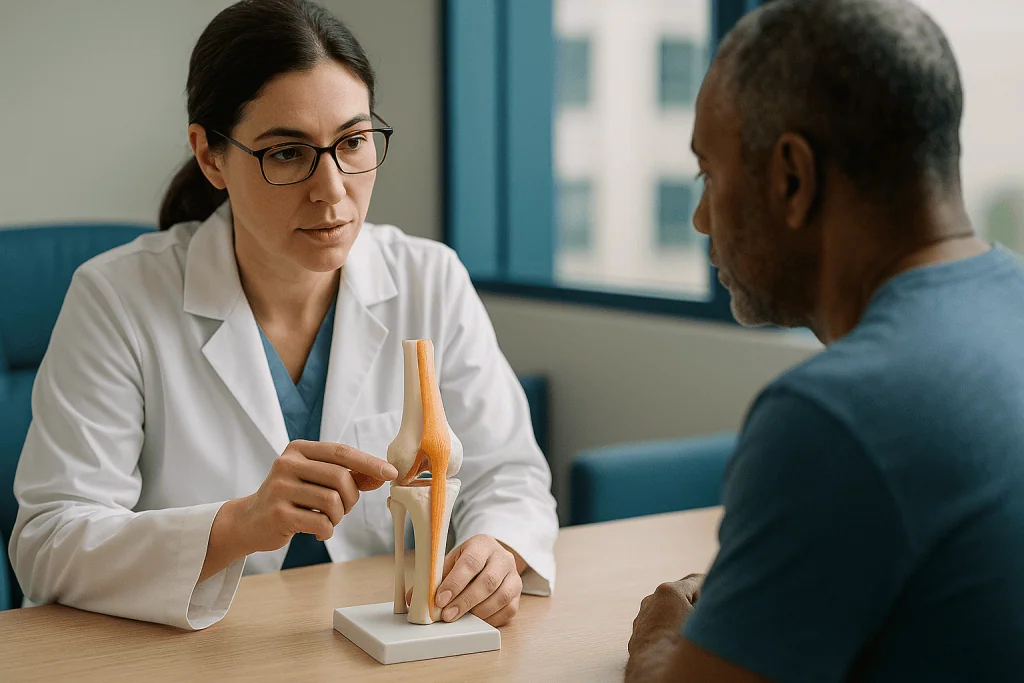
The surgeon makes two or three incisions the width of a fingertip around the kneecap and inserts an arthroscope, a pencil-thin camera that projects the inside of the joint onto a screen. Through the other portals come slender instruments. The first job is a careful look around: the torn ACL is trimmed away, and the menisci (the two C-shaped cartilage shock absorbers) and the joint surfaces are checked, because those are often injured in the same twist (Mayo Clinic).
Next comes the graft. If it is your own tissue, a separate small incision allows the surgeon to take a strip of tendon, which an assistant prepares on a side table while the knee is readied. Tunnels are then drilled, one angling up into the femur and one up through the tibia, aiming for the footprints where the original ligament attached. The graft is pulled through both tunnels and tensioned with the knee at a chosen angle, then fixed at each end with a screw, a button that flips flat against the outer bone, or a similar device (Johns Hopkins Medicine).
The joint is washed out, incisions closed and the leg wrapped, sometimes in a brace. NHS guidance describes the operation taking roughly an hour to an hour and a half, and most people go home the same day (NHS).
Who is ACL reconstruction usually for, and who is often asked to wait?
A torn ACL is not an automatic ticket to the operating room. NHS guidance frames surgery as the usual recommendation when the knee keeps giving way, or when someone’s work or sport demands pivoting, cutting and jumping that an unstable knee cannot tolerate (NHS). Combined injuries also push toward surgery: a torn meniscus that is repairable, or damage to several ligaments at once, is harder to protect without a stable ACL.
At the other end, people whose lives involve walking, cycling, swimming or straight-line running and whose knee feels steady day to day may be offered structured physiotherapy first, with surgery held in reserve if instability appears. Age by itself is not the deciding factor; activity goals and knee behavior are.
Timing within the surgical group matters too. Operating on a hot, swollen knee that cannot straighten fully is associated with more postoperative stiffness, so surgeons commonly ask patients to wait until the swelling has settled and range of motion has returned, which NHS guidance puts at several weeks after the injury (NHS). This waiting period is used for “prehabilitation,” supervised exercises to restore straightening, quadriceps activation and a normal walking pattern, a stronger starting point for recovery.
Children and teenagers whose growth plates (the soft zones at bone ends that lengthen during growth) are still open are a special case. Standard tunnels can cross those plates, so pediatric specialists use modified techniques and weigh the timing carefully.
None of this is a formula. The decision rests on an examination of how loose the knee actually is, imaging, what else was injured and a frank conversation about the life you want your knee to support, led by your treating team.
ACL surgery graft options: patellar tendon, hamstring, quadriceps or donor tissue?
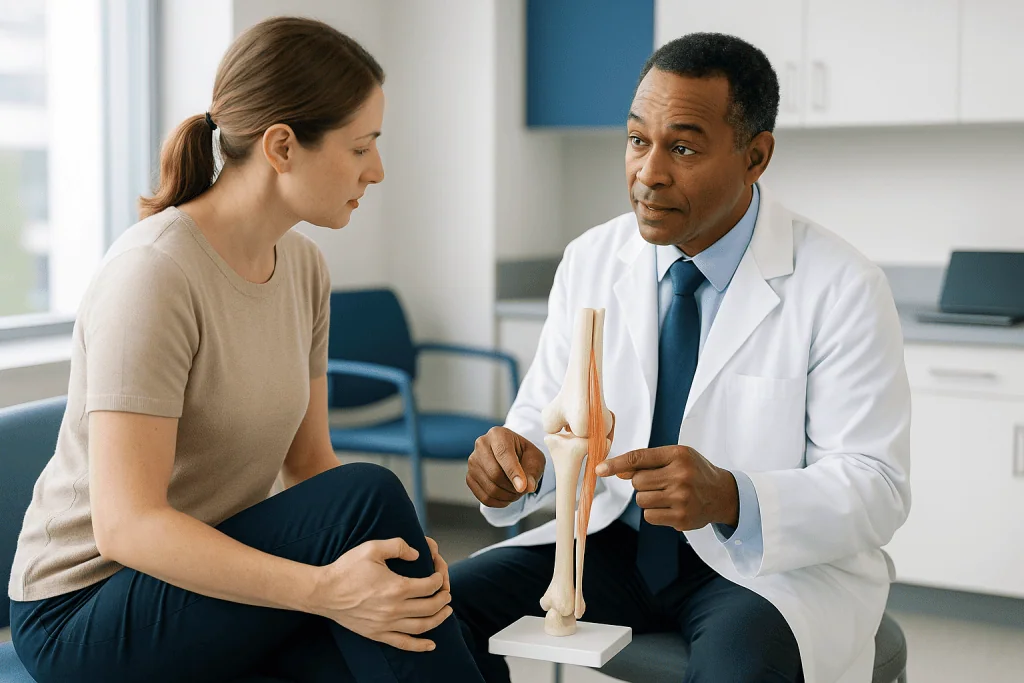
A graft is simply the tissue used to build the new ligament. An autograft is taken from your own body; an allograft comes from a deceased tissue donor and has been screened and processed by a tissue bank (MedlinePlus). The four mainstream choices each trade one thing for another, and no guideline names a single winner for everyone.
| Graft | What is taken | Commonly cited advantages | Commonly cited trade-offs |
|---|---|---|---|
| Patellar tendon (bone-tendon-bone) | Middle third of the tendon below the kneecap, with bone plugs at each end | Bone plugs heal bone-to-bone in the tunnels; long track record | Pain at the front of the knee and with kneeling is more frequently reported |
| Hamstring tendons | One or two tendons from the inner back of the thigh | Smaller harvest incision; less front-of-knee pain | Possible hamstring weakness; a patch of numb skin on the shin is common |
| Quadriceps tendon | Strip of the thick tendon above the kneecap, with or without a bone plug | Thick, robust graft; increasingly used | Shorter history in the research literature; possible quadriceps weakness early |
| Allograft (donor) | Tendon from a tissue donor | No harvest pain; shorter operation | Processing can weaken tissue; higher reoperation rates reported in young athletes |
Autografts are widely preferred for younger, high-demand athletes, while allografts are often considered for revision operations, when several ligaments need rebuilding, or for lower-demand adults (Johns Hopkins Medicine). Surgeons also factor in your sport, your job, whether you kneel for a living, prior injuries and their own experience with a technique. Ask which graft is being proposed and why; a good answer will be specific to you rather than a general preference.
How is the graft harvested and prepared before it goes into the knee?
Harvest is the part of the operation patients rarely picture, yet it accounts for a good share of the early soreness. For a patellar tendon graft, the surgeon makes an incision over the front of the knee, below the kneecap, and removes the central third of the tendon together with a small block of bone from the kneecap at one end and from the shin at the other. Those bone plugs are shaped to slide snugly into the tunnels (MedlinePlus).
For a hamstring graft, a shorter incision is made on the inner side of the upper shin where two hamstring tendons attach. A tool called a tendon stripper is slid along each tendon to release it from the muscle belly high in the thigh. Because the tendons are long and relatively thin, they are usually folded two or four times to create a graft thick enough to match the original ligament. A branch of a skin nerve runs through this area, which is why many people are left with a patch of numbness on the outer shin that often shrinks over time but may not disappear completely.
A quadriceps tendon graft comes from an incision above the kneecap. The surgeon takes a strip from the thick central part of the tendon, sometimes with a sliver of kneecap bone, leaving the deeper layer intact so the joint stays sealed.
Whatever the source, the tissue is taken to a side table, trimmed of muscle, measured, sized with a set of cylinders so the tunnels can be drilled to match, and stitched at both ends with strong sutures that will be used to pull it into place and attach it to fixation devices. The graft is kept moist throughout; dry tissue is weaker tissue.
Drilling the tunnels: where the new ligament sits and why millimeters matter
If graft choice is the headline debate, tunnel position is where surgeons spend their attention in the operating room. The goal is to place the new ligament in the “footprints,” the oval patches on the femur and tibia where the native ACL attached. Put it there and the graft tightens and relaxes with the knee the way the original did. Place it too far forward on the femur and the graft can bind as the knee bends; too far back and it may slacken, leaving the joint loose (Johns Hopkins Medicine).
Working through the arthroscope, the surgeon first clears the soft tissue from the footprint and identifies bony landmarks. A thin guide pin is drilled, its position checked on the screen, and then a cannulated reamer (a hollow drill that runs over the pin) creates a tunnel matched to the measured width of the graft, typically close to the diameter of a pencil.
The femoral tunnel can be drilled in two main ways. The transtibial technique drills up through the tibial tunnel into the femur, which keeps the two tunnels in line. The anteromedial portal or “independent” technique drills the femoral tunnel through a separate front portal with the knee bent deeply, giving freer access to the native footprint. Both are mainstream; each has advantages and limitations that surgeons weigh case by case.
In growing adolescents, surgeons may route tunnels to avoid the growth plates or use techniques that spare them. In revision surgery, old tunnels may have widened or sit in the wrong place, and the surgeon may need bone graft to fill them, sometimes as a staged first operation before the new ligament goes in.
Fixing the new ligament: screws, buttons and what else gets repaired
Fixation is the method that holds the graft under tension in the tunnels while bone and tendon grow together over the following months. It must be strong enough to survive early rehabilitation, because the graft itself is at its weakest in the first weeks as it loses its original blood supply and is slowly repopulated by new cells, a process sometimes called ligamentization.
Three device families dominate. Interference screws are threaded into the tunnel alongside the graft, pressing it against the bone wall; they may be metal or a bioabsorbable material that gradually dissolves. Suspensory buttons are small plates attached to the graft by a loop; the loop is pulled through the tunnel and the button flips flat against the outer surface of the femur, like a toggle on a duffel coat, suspending the graft in the tunnel. Cross-pins pass sideways through the bone and the folded graft. On the tibia, screws, staples or screw-and-washer posts are common (MedlinePlus). Fixed and adjustable-loop buttons are both widely used; neither has been shown in guideline-level evidence to be clearly superior for every patient.
Before locking the tibial end, the surgeon cycles the knee through its range to seat the graft, then tensions it at a set angle of bend. Too tight and the knee may struggle to straighten; too loose and stability suffers.
This is also the moment to address companions to the injury. A torn meniscus may be stitched or, if beyond repair, trimmed. Some surgeons add a lateral extra-articular tenodesis, a reinforcing strip of tissue on the outside of the knee, in people considered at higher risk of re-injury; its selective use is an area of active research rather than settled practice. Loose cartilage fragments are removed, the joint is irrigated and the portals closed with a few stitches or adhesive strips.
Is ACL surgery painful? Anesthesia, nerve blocks and what the first nights feel like
Two of the most searched questions about this operation are how painful the tear is on a scale of one to ten, and how painful the surgery is. There is no validated number for either. Pain is shaped by the person, the injury pattern, the graft and the anesthetic plan, so any single score you read online is one individual’s experience, not a benchmark.
What can be said honestly: the moment of injury is often described as sharp and alarming, followed by deep, throbbing swelling as blood collects in the joint (hemarthrosis). Oddly, some people report the knee feeling better within a day or two, which is one reason tears are sometimes missed early (Mayo Clinic).
After surgery, discomfort typically peaks in the first two to three days, then eases steadily over the following weeks as swelling subsides (NHS). Harvest sites frequently hurt more than the joint itself. Most centers now use multimodal pain control, meaning several approaches combined so that no single one has to do all the work: a regional nerve block placed before or during the operation that numbs the leg for many hours, local anesthetic infiltrated around the incisions, anti-inflammatory and simple analgesic medicines, cold therapy and elevation. Stronger opioid medicines, which act on pain receptors in the brain and spinal cord, may be reserved for breakthrough pain and for as short a period as possible because of side effects and dependence risk. Which medicines you receive, and for how long, is a decision for your prescribing clinician.
A practical note: when a nerve block wears off, often in the first night at home, pain can rise quickly. Ask your team in advance how they want you to prepare for that transition.
What do the first days and weeks after ACL reconstruction usually look like?
You will almost certainly go home the same day with the leg bandaged, perhaps in a hinged brace, and a pair of crutches (MedlinePlus). The early priorities read like a short list but fill the days: control swelling, get the knee fully straight, wake up the quadriceps muscle, and protect the wounds.
Swelling control means elevation above heart level for stretches of the day and regular cold therapy as directed. Full extension is the quiet hero of early rehabilitation; a knee that cannot straighten in the first weeks tends to walk with a limp and is harder to loosen later. Physiotherapists often prescribe heel props and gentle hangs within days. Quadriceps activation exercises, such as pressing the back of the knee into a towel, begin almost immediately because the muscle switches off reflexively after joint surgery.
Weight-bearing varies with what else was done. After an isolated reconstruction many people are allowed to put weight through the leg early with crutches for balance; after a meniscus repair, loading or bending may be restricted for several weeks to protect the stitches. Follow your own team’s instructions rather than a friend’s.
Stitches or clips are removed, or absorb, around two weeks, when the wounds are checked (NHS). Driving depends on which leg was operated, whether you are still on sedating medicines and whether you can perform an emergency stop; your surgeon will tell you when, and your insurer may have conditions. Desk-based work is often possible within two to three weeks, while manual jobs take considerably longer (NHS).
Expect fatigue. The body spends real energy healing, and poor sleep from a sore knee compounds it. Build rest into the plan rather than treating it as a failure of willpower.
ACL reconstruction recovery time: the months, and the return-to-sport question
Recovery from ACL reconstruction is measured in months, not weeks, and the honest timeline is longer than most people expect when they sign the consent form. NHS guidance describes six months to a year before a return to sport, and many rehabilitation programs now lean toward the later part of that range for pivoting sports (NHS).
Why so long, when the wounds heal in a fortnight? The graft is remodeling. In its first weeks it weakens as its old cells die off; over the following months blood vessels and new cells colonize the tissue and reorganize its collagen fibers along the lines of stress. Bone grows into the tunnels around it. This biological conversion continues long after the knee looks and feels normal, which is why a knee that feels “ready” at four months is not the same as a graft that is ready.
Rehabilitation progresses in phases rather than by the calendar. Early work restores motion and walking. The middle months build strength, with the quadriceps on the operated side compared against the other leg. Later phases introduce running, hopping, cutting and sport-specific drills. Progression is increasingly gated by objective tests rather than time alone: strength within a target proportion of the uninjured leg, hop tests, movement quality on landing, and psychological readiness, since fear of re-injury is a real and measurable barrier (Mayo Clinic).
Return-to-sport decisions are shared decisions. Your surgeon, physiotherapist and, where relevant, coach will weigh test results, the demands of your sport and your age; younger athletes returning to cutting sports carry the highest re-injury risk to either knee. Treat the long timeline as protection for the investment you have already made, not as a punishment.
What happens 20 years after ACL surgery? The long view on knee health
It is a fair question, and the research answers it with nuance rather than a tidy verdict. Mayo Clinic’s patient guidance is direct: people who tear an ACL carry a higher risk of developing osteoarthritis (the wearing of joint cartilage) in that knee over the following decades, and this risk persists even when the ligament has been reconstructed (Mayo Clinic). The operation restores mechanical stability; it does not fully undo the bruising of bone and cartilage that occurred in the original impact, nor does it erase any damage to the meniscus.
The meniscus turns out to be a central character in the long story. Knees in which the meniscus was preserved tend to fare better over time than knees where a large portion was removed, which is one reason modern practice favors repairing torn menisci whenever the tissue allows, even though repair means a slower early rehabilitation.
What else shapes the two-decade picture? Body weight, because every extra kilogram multiplies through the knee during walking and stairs. Quadriceps strength, which cushions the joint. Whether a second injury occurs. Whether someone returns to high-impact pivoting sport for years or shifts toward cycling, swimming and strength work as they age. None of these are guarantees in either direction, and many people with reconstructed knees remain active and comfortable into later life.
The practical message is not fatalism but stewardship. A reconstructed knee is a joint worth looking after deliberately: keep the surrounding muscles strong, maintain a healthy weight, respect persistent swelling as a signal rather than background noise, and keep the knee moving. If stiffness, aching or swelling creep in years later, that is a conversation to have with your doctor, not a cause for alarm or self-blame.
What are the risks of ACL reconstruction, and what are the alternatives?
Every operation carries risk, and this one is no exception, though serious complications are uncommon. MedlinePlus lists the principal ones: infection, bleeding, blood clots in the leg veins, injury to nearby nerves or blood vessels, knee stiffness or loss of motion, pain at the front of the knee, weakness of the harvested muscle, and failure of the graft to heal or a later re-tear (MedlinePlus). Numbness around the incisions is common, particularly after hamstring harvest. Anesthesia itself carries small risks that your anesthetist will review.
Graft re-rupture deserves a frank word. It is more frequent in younger athletes returning to cutting sports, and the opposite knee is also at raised risk of a first tear, which is one argument for thorough, test-based rehabilitation rather than a race back to the pitch (Mayo Clinic). Stiffness, including a condition called arthrofibrosis in which excess scar tissue forms inside the joint, is more likely when surgery is performed on a swollen, immobile knee, which is why the pre-operative waiting period exists.
Alternatives are real, not token. Structured physiotherapy without surgery suits some people, especially those with lower pivoting demands and a knee that does not give way; a brace may be used for selected activities. Some programs offer rehabilitation first with surgery available later if instability emerges, and research continues to compare early surgery with this delayed, as-needed approach. For a small number of specific tear patterns, direct repair or bridge-enhanced techniques are being studied, but these remain investigational rather than standard.
Choosing between these paths is not about bravery or caution. It is about matching the treatment to the knee you have and the life you want it to carry, with your treating team laying out the trade-offs plainly.
What people often get wrong about how ACL reconstruction is done
A handful of myths circulate in locker rooms and comment sections, and they shape expectations in unhelpful ways.
“They stitch the ligament back together.” Almost never. The torn ligament is removed and replaced with a tendon graft, which is why the operation is a reconstruction rather than a repair (MedlinePlus).
“The new ligament is strong on day one.” The fixation devices are strong early; the graft itself is not. It weakens before it strengthens as living cells replace the original tissue over months. The long recovery timeline exists to protect that biology, not to pad the schedule.
“An MRI tear means surgery is mandatory.” Imaging confirms the diagnosis; it does not make the decision. Instability, activity demands and associated injuries decide, and some people do well without an operation (NHS).
“Six months and you’re back.” Six months sits at the early edge of the range NHS guidance describes, and many programs test readiness objectively rather than releasing people by date (NHS).
“Donor grafts are weaker, so they are a bad choice.” Processing can reduce allograft strength, and reoperation rates are higher in young athletes, but for revision surgery, multi-ligament injuries and lower-demand adults an allograft can be a reasonable, evidence-supported option (Johns Hopkins Medicine).
“A brace will prevent a tear or a re-tear.” Evidence that routine bracing prevents ACL injury is weak; neuromuscular training programs that teach landing and cutting mechanics have better support for prevention (Mayo Clinic).
“Surgery stops arthritis.” Reconstruction stabilizes the knee; the raised long-term osteoarthritis risk from the original injury remains, which is why joint care continues for life (Mayo Clinic).
Questions to ask your care team before ACL reconstruction
A consultation goes better with a written list. These are the questions that, in our experience, lead to the most useful answers. None has a single right response; the point is to understand the reasoning behind your plan.
- Based on my examination and imaging, how unstable is my knee, and what would happen if I chose rehabilitation without surgery?
- Which graft are you recommending for me, and why that one over the alternatives for my age, sport and job?
- Is my meniscus or cartilage also injured, and if so, will you repair or trim it? How does that change my rehabilitation restrictions?
- Are you considering any additional procedure, such as a lateral reinforcement, and what evidence supports it for someone like me?
- How do you want me to prepare the knee before surgery, and what range of motion or swelling target do I need to reach first?
- What anesthetic plan do you propose, including a nerve block, and how should I manage the night the block wears off?
- What will I be allowed to do in the first two weeks: weight-bearing, brace use, bending, showering, driving?
- How will you decide when I can run, pivot and return to sport? Are those decisions based on tests or on time?
- What are the specific complications you worry about most for me, and how would I recognize them early?
- Who do I contact after hours if something feels wrong?
Bring someone with you if you can, because recall after a consultation is imperfect, and ask for written or digital information you can re-read. If a question is met with a dismissive answer, it is reasonable to ask again or to seek a second opinion. A surgeon confident in a plan will usually welcome the chance to explain it.
When to call your doctor after ACL reconstruction
Some discomfort, swelling and bruising are expected in the weeks after surgery. Certain signs are not, and they need a same-day call to your surgical team or, if you cannot reach them, urgent medical attention.
Call promptly if you notice any of the following (MedlinePlus; NHS):
- Fever or chills, or an incision that becomes increasingly red, hot, swollen or leaks cloudy or foul-smelling fluid.
- Pain that escalates rather than easing after the first few days, or pain that is not controlled with the plan you were given.
- Calf pain, tenderness or swelling in the operated leg, or warmth and redness along the calf, which can signal a blood clot in a deep vein.
- Sudden breathlessness, chest pain or coughing up blood. Treat these as an emergency and call your local emergency number, because a clot can travel to the lungs.
- Numbness, tingling or weakness in the foot that is new or worsening, or toes that are cold, pale or blue.
- A knee that suddenly swells tightly, locks, or gives way with a new pop in the weeks or months after surgery.
- Inability to straighten the knee, or motion that is clearly going backwards despite physiotherapy.
- Bleeding that soaks through the dressing.
Before surgery, the same principle applies to the injured knee: a joint that locks and will not straighten, a leg you cannot bear weight on, or a knee that feels grossly deformed warrants prompt assessment rather than waiting for a scheduled appointment.
When in doubt, call. Teams would far rather hear about a false alarm than see a treatable problem arrive late. Your surgeon and physiotherapist remain the right people to interpret what your knee is doing, and every adjustment to your plan should come from them.
Frequently asked questions
How painful is an ACL reconstruction surgery?
Pain is usually most noticeable in the first two to three days and eases steadily over the following weeks, with graft harvest sites often sorer than the joint itself. Most teams use a combination of a regional nerve block, local anesthetic, anti-inflammatory and simple pain medicines, cold therapy and elevation. Ask in advance how to manage the night the nerve block wears off, when pain can rise quickly.
Is ACL reconstruction a difficult surgery?
It is a routine, well-established arthroscopic procedure for specialist knee surgeons, typically completed in around an hour to ninety minutes with same-day discharge. Its technical demands lie in placing the bone tunnels accurately and tensioning the graft correctly. For patients, the demanding part is not the operation but the months of structured rehabilitation afterward.
What happens 20 years after ACL surgery?
Many people remain active, but the knee carries a higher long-term risk of osteoarthritis than an uninjured knee, and reconstruction does not remove that risk, according to Mayo Clinic. Outcomes decades later are shaped by whether the meniscus was preserved, body weight, muscle strength, re-injury and activity choices. Ongoing strength work and attention to persistent swelling help protect the joint.
How painful is tearing your ACL on a scale of 1 to 10?
There is no validated score; experiences vary widely. People commonly describe a pop followed by sharp pain and rapid swelling within an hour as blood collects in the joint. Some find the knee settles within a day or two and feels deceptively fine until it gives way, which is why tears are sometimes diagnosed late. Any knee that swells quickly after a twist deserves medical assessment.
What happens during ACL surgery, step by step?
After anesthesia, the surgeon inserts a camera through small portals, removes the torn ligament and checks the menisci and cartilage. A tendon graft is harvested and prepared, tunnels are drilled in the femur and tibia at the original attachment sites, the graft is pulled through, tensioned and fixed with screws or buttons, any meniscus tear is addressed, and the incisions are closed.
What are the main ACL surgery graft options?
Patellar tendon with bone plugs, folded hamstring tendons, quadriceps tendon, or donor tissue (allograft). Autografts from your own body are generally favored for younger, high-demand athletes; allografts are often considered for revision operations, multi-ligament injuries or lower-demand adults. Each option has characteristic trade-offs in harvest-site pain, strength and healing, and the choice should be explained for your situation.
What is the typical ACL reconstruction recovery time?
NHS guidance describes six months to a year before returning to sport, with desk-based work often possible within two to three weeks and manual jobs taking longer. Rehabilitation progresses through phases of motion, strength, running and sport-specific drills, and many programs release athletes based on strength and hop tests rather than the calendar.
Is ACL surgery painful compared with the injury itself?
Many people find the days after surgery more uncomfortable than the days after the tear, largely because of the graft harvest site and the controlled trauma of drilling bone, while the injury itself is remembered more for its suddenness and swelling. Modern multimodal pain control shortens the worst period considerably, and your prescribing clinician will tailor the plan to you.
Can an ACL heal without surgery?
A complete tear rarely heals into a functional ligament because of its poor blood supply and position inside the joint. However, some people manage well without reconstruction through structured physiotherapy, especially if the knee does not give way and their activities involve little pivoting. Whether to operate depends on instability, associated injuries and activity goals, decided with your treating team.
Why do surgeons wait a few weeks before ACL reconstruction?
Operating on a swollen knee that cannot straighten fully is associated with more postoperative stiffness. NHS guidance describes waiting several weeks until swelling settles and motion returns. That window is used for prehabilitation exercises to restore extension, quadriceps control and normal walking, which gives rehabilitation a stronger starting point.
References
This article is for general information only and is not a substitute for professional medical advice. Please consult a qualified doctor about your individual situation.

More from the Blog
Stiffness, Swelling or Giving Way After ACL Surgery: What Is Expected and What Is Not
After ACL reconstruction, some stiffness, swelling and a sense of unsteadiness are expected for weeks while the graft heals and the thigh muscles recover.…
How Recovery Differs After Knee, Shoulder and Ankle Arthroscopy: Milestones by Joint
Arthroscopy recovery differs by joint because each one carries a different load. Knee procedures usually allow walking within days, with sport weeks to months…
Wrist Tenosynovitis After Pregnancy: Why New Parents Get It and How Treatment Is Adapted
Tenosynovitis after pregnancy, usually de Quervain's, is irritation of the sheath around two thumb tendons at the wrist, aggravated by repeated lifting of a…

Does a Torn Rotator Cuff Heal on Its Own? Common Rotator Cuff Myths, Corrected
A torn rotator cuff rarely reattaches itself. Partial-thickness tears can settle with rest and guided exercise, and pain often improves even when the tendon…
Tendon Surgery for Athletes and Manual Workers: How Return to Load Is Planned
Tendon surgery for athletes and manual workers stitches or reconstructs a torn tendon, then relies on a staged rehabilitation plan that adds load gradually.…
Meniscus Surgery After Fifty: Why Degenerative Tears Are Treated Differently From Sports Tears
After 50, most meniscus tears are degenerative: slow wear in cartilage that is already thinning, often alongside early arthritis. Randomized trials show that for…