

The First Days Home After Meniscus Surgery: Crutches, Bracing and How a Companion Can Help

Key Takeaways
- Whether the meniscus was trimmed or stitched decides almost everything about the first days: a partial meniscectomy usually allows early weight-bearing and bending, while a repair often means a hinged brace and crutches for around 4–6 weeks according to MedlinePlus discharge guidance.
- Numbness from local anesthetic and nerve blocks can hide pain for hours, so the second day is often harder than the first evening and does not signal a complication.
- Elevating the whole leg above heart level, with the knee relaxed rather than propped on a single pillow, is the simplest evidence-supported way to limit swelling that NHS guidance says can last weeks.
- Ankle pumps and quadriceps sets every waking hour, plus short crutch walks and fluids, are the main defenses against deep vein thrombosis, whose warning signs the NHS lists as calf pain, swelling, warmth and color change.
- Crutch weight belongs on the hands, never the armpits, and on stairs the good leg leads going up while the surgical leg leads coming down, ideally with a companion one step below.
- A companion's most valuable act is writing down four things at discharge: which operation was done, the weight-bearing instruction, the brace rules and the follow-up date, because patients recovering from anesthesia forget most of what they are told.
In the first days after meniscus surgery, most people manage at home with crutches, a cold pack, elevation and the pain plan their surgical team prescribed. How much weight the knee may take, and whether a brace is worn, depends on whether tissue was trimmed or stitched. A companion helps most with stairs, meals, ice schedules and watching for warning signs such as calf pain, fever or a hot, red wound.
The car door is the first surprise. Getting out of it with a bandaged knee, one crutch already sliding on the driveway, takes longer than the whole drive home did. Then there is the front step, the hallway that suddenly feels narrow, and the kitchen chair that is too low. Nobody warned you that the first days after meniscus surgery would be mostly about furniture.
Knee arthroscopy is one of the most common orthopedic operations, and the procedure itself is often over in under an hour. Yet the questions people ask afterward are rarely about the surgery. They are about crutches, braces, sleep, stairs and who is going to carry the laundry basket.
This article walks through what those early days usually look like, what the evidence supports, and how a friend or family member can make a real difference without taking over. Every plan still belongs to your surgical team; think of this as the briefing you wish you had read in the waiting room.
What actually happens during meniscus surgery, in plain language
The meniscus is a C-shaped pad of cartilage, two in each knee, that cushions the joint and spreads load between the thigh bone and shin bone. When it tears, a surgeon can look inside the knee with an arthroscope, a pencil-thin camera inserted through a small cut, and work through one or two more small cuts with slender instruments. That is why the procedure is called knee arthroscopy, and why the scars are usually the size of a fingernail.
Two things can happen once the surgeon sees the tear. In a partial meniscectomy, the frayed or loose portion is trimmed away and the smooth edge is left behind. In a meniscus repair, the torn edges are stitched back together so they can heal. Mayo Clinic explains that the choice depends on the shape and location of the tear and on blood supply: the outer rim of the meniscus has a blood supply and may heal after suturing, while the inner portion largely does not, which is why many inner tears are trimmed rather than repaired.
The distinction matters enormously for the days that follow. A trimmed meniscus has nothing to protect, so the knee is usually allowed to move and bear weight early. A stitched meniscus is a fresh repair that needs time, so the knee is often braced, kept straighter and loaded more cautiously. Many people only learn which operation they had when the surgeon speaks to them in the recovery room, so it is worth asking directly, and asking a companion to write the answer down.
Anesthesia is usually general or spinal, and according to NHS guidance most people having knee arthroscopy go home the same day. Some surgeons also use a nerve block, an injection of local anesthetic near the nerves of the leg, which can leave the limb numb or heavy for several hours afterward.
Who usually goes home the same day, and who is asked to wait
Day-case discharge is the norm, but it is not automatic. Recovery staff typically check a short list before letting someone leave: pain controlled with oral medicine, no nausea, able to pass urine, able to walk a short distance with crutches, and a responsible adult to accompany them home. NHS advice on arthroscopy is explicit that you should not drive yourself and should have someone with you for the first 24 hours after a general anesthetic.
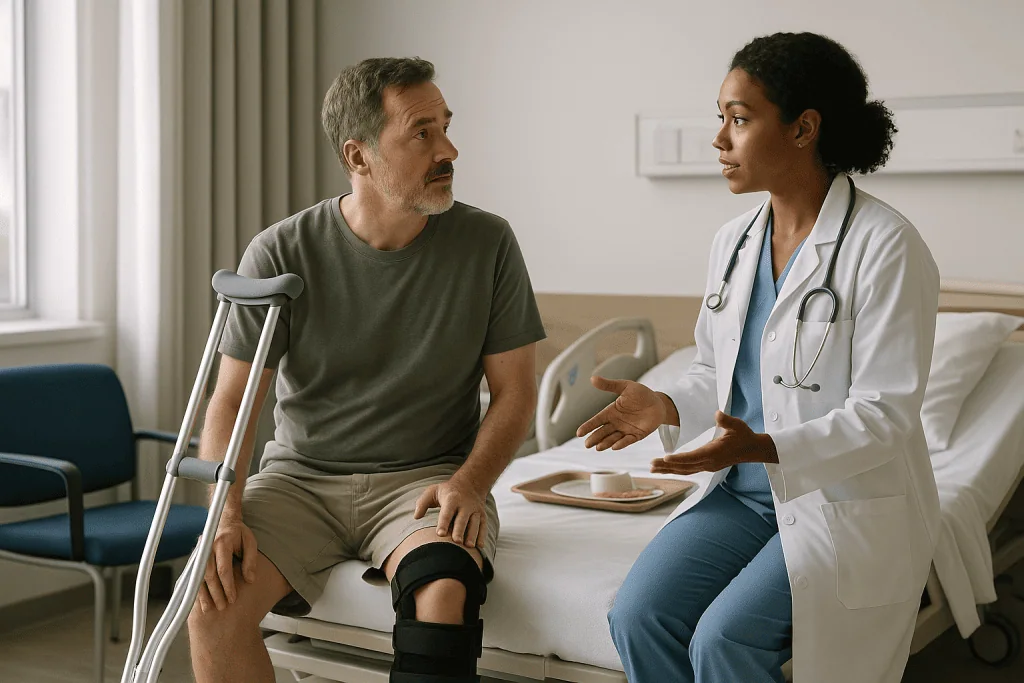
People who had a meniscus repair with a locked brace sometimes need extra time with a physiotherapist before discharge, simply to practice stairs and transfers with a leg that will not bend. Someone whose nerve block has not worn off may also be kept until they can safely feel and control the limb. Neither delay signals a problem; it reflects a safety threshold rather than a complication.
A smaller group is asked to wait longer, or is admitted overnight. Typical reasons include a long-standing medical condition such as heart or lung disease that makes anesthesia recovery slower, a history of blood clots that calls for closer monitoring, uncontrolled pain or vomiting, or living alone without anyone to help in the first night. Occasionally a procedure turns out to be more extensive than expected, for example when a repair is performed alongside other work inside the joint, and the surgeon prefers a monitored night.
Who the operation is for in the first place is also worth stating plainly. Mayo Clinic notes that many meniscus tears, particularly degenerative tears in older adults, are first managed without surgery through rest, activity modification and physical therapy. Surgery is generally considered when mechanical symptoms such as locking persist, or when conservative care has not helped. That decision, like every decision in this article, sits with the treating team and the person living with the knee.
The first days after meniscus surgery: what the first 72 hours usually look like
The first evening tends to be easier than people fear, and the second day harder than they expect. Local anesthetic injected into the joint and any nerve block can keep the knee comfortable for several hours; when they wear off, usually overnight or the next morning, the ache arrives and the knee feels stiff and tight. This is not a setback. It is the predictable curve of a numbed joint waking up.
Expect a bulky dressing or a compression bandage over the small incisions. MedlinePlus discharge guidance for knee arthroscopy advises keeping the dressing clean and dry and following the surgeon’s instructions on when it can be changed and when showering is allowed. A little pink or red staining on the dressing is common in the first 48 hours; soaking through, or bleeding that will not stop with pressure and elevation, is not.
Swelling is the headline feature of these days. The joint was filled with fluid during the operation, and the tissues respond to any surgery with inflammation. NHS information on arthroscopy notes that swelling can persist for days to weeks, so the goal in the first 72 hours is to keep it from climbing rather than to make it disappear.
Most people spend these days moving between a bed and a chair, with short trips on crutches to the bathroom and kitchen. Early gentle movement is encouraged by most teams: ankle pumps, where you flex and point the foot to keep calf muscles working, and quadriceps sets, where you tighten the thigh muscle and hold it for a few seconds. Both are usually taught before discharge and are low-risk ways to reduce stiffness and support circulation.
Appetite can be low and sleep disrupted. A companion who keeps water, light meals and the medication schedule organized will do more for recovery in these three days than any gadget.
Crutches after meniscus surgery: how much weight can the knee take?
The phrase to listen for is weight-bearing status, which is simply how much of your body weight the surgical leg is allowed to carry. It is set by the surgeon, not by how the knee feels, and it is the single instruction most worth clarifying before leaving.
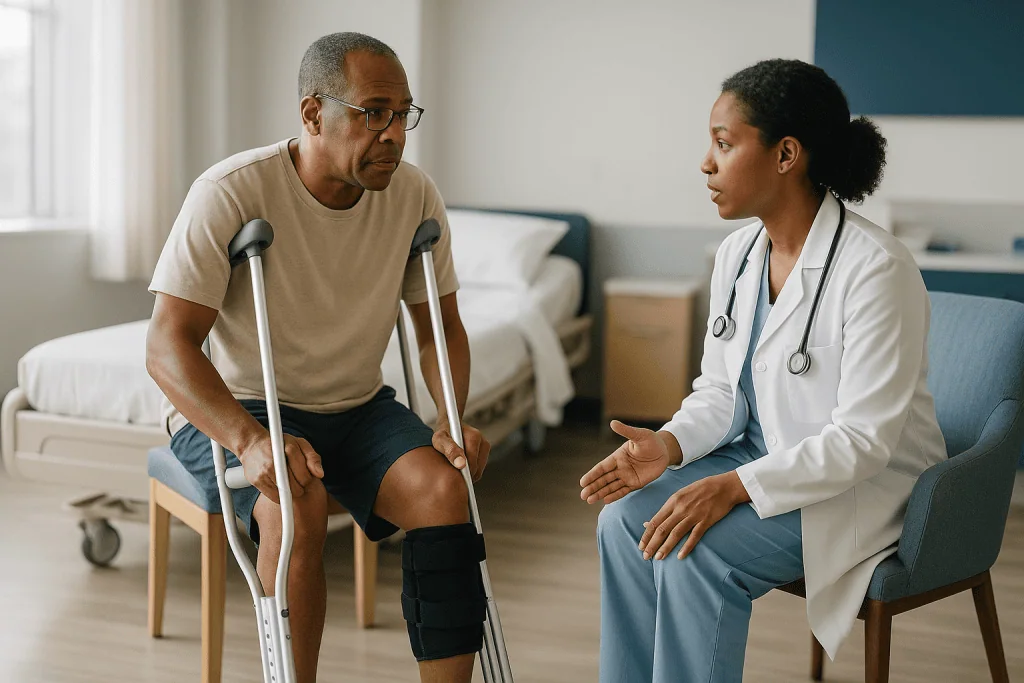
After a partial meniscectomy, many surgeons permit weight-bearing as tolerated from the first day, meaning you put down as much weight as is comfortable and use crutches mainly for balance and confidence. MedlinePlus notes that people who have had the torn portion removed often walk with crutches for only a short period. After a meniscus repair, the picture changes: the sutures must not be stressed, so the leg is often kept partial weight-bearing or, for some tear patterns, touch-down weight-bearing, where the foot rests on the floor for balance but carries almost no load. MedlinePlus guidance describes crutch use for roughly 4–6 weeks after repair, although individual protocols vary and the treating surgeon decides.
Crutch technique is taught in minutes and forgotten in hours, so a companion should watch the first few trips. The essentials:
- Weight goes through the hands on the grips, never through the armpits, which contain nerves that bruise easily.
- Crutches move forward first, then the surgical leg, then the healthy leg steps up to meet them.
- On stairs, the good leg leads going up and the surgical leg leads coming down; a companion standing one step below on the way down is sensible.
- Sitting down means backing up until the chair touches the legs, then lowering with the surgical leg extended.
Rugs, pets, cables and wet floors cause more early falls than the knee itself. Clearing a path the day before surgery is unglamorous but genuinely protective.
Knee brace after meniscus repair: why some knees are locked straight
Not everyone leaves with a brace, and that surprises people who expected one. After a partial meniscectomy, there is no stitched tissue to protect, so most surgeons use only a compression bandage and encourage the knee to bend as comfort allows. The brace question really belongs to meniscus repair.
A hinged knee brace is a lightweight frame with adjustable hinges at the sides. The surgeon can lock it so the knee stays straight, or set a range, for example allowing bending to 90 degrees but no further. The reason is mechanical: deep knee bending under load compresses the back of the meniscus, exactly where many repairable tears sit. Keeping the knee straighter while walking protects the sutures during the early weeks when the repair is weakest.
The rules that come with a brace are specific to each surgeon and should be written down before discharge. Common variations include wearing it locked for walking but unlocked for seated exercises, removing it for showering, and loosening it at night. Some teams restrict bending for several weeks after repair, which is why a companion may hear the patient complain about sitting in a car with one leg straight out across the back seat.
Skin checks matter. Straps that are too tight above or below the knee can cause pressure marks or numbness; a companion can look at the skin under each strap once a day and adjust padding. Numbness, tingling or color change in the foot that improves when the brace is loosened should be reported anyway, since it can mean the fit needs changing.
Removing a brace early because the knee feels fine is a common temptation. Feeling fine is not evidence that sutured cartilage has healed, and a clinician’s examination or imaging is the only way to judge that. The brace schedule is a decision for the surgical team, and any change should go through them.
Swelling, ice and elevation: what the evidence actually supports
Ice, compression and elevation are so widely recommended after knee arthroscopy that it is worth separating what is well established from what is tradition. Elevation has a clear mechanism: raising the leg above heart level lets gravity help fluid drain from the joint. MedlinePlus discharge guidance for knee arthroscopy advises propping the leg up on pillows and keeping it raised when sitting or lying down in the early period. The practical detail people miss is that the whole leg, not just the knee, should be supported, with pillows under the calf and foot and the knee relaxed, not perched on a single pillow that forces it to bend.
Cold packs reduce the sensation of pain and may limit swelling in the first days. Cleveland Clinic and Mayo Clinic both include ice in standard post-arthroscopy advice. The evidence on how much swelling it truly prevents is modest, so the honest summary is that cold is a safe comfort measure with a plausible benefit rather than a guaranteed one. Wrap the pack in a cloth, keep sessions to a short stretch at a time, and never place ice directly against skin that is numb from a nerve block, because numb skin cannot warn you about frostbite.
Compression, usually the bandage applied in the operating room, supports the tissues and limits fluid build-up. It should feel snug, not painful. Toes that go cold, pale or tingly mean the wrap is too tight and should be loosened, which is one of the simplest jobs a companion can take on.
Swelling that keeps rising after the third day, or that comes with increasing warmth and redness, is a different conversation and belongs in the section on warning signs below. Expect the knee to look fuller than the other one for weeks; NHS guidance describes swelling that can take several weeks to settle.
Pain in the first days after meniscus surgery: what is normal and who decides the plan
Pain after knee arthroscopy is usually described as a deep ache with sharper moments on movement, worst in the first two or three days, then easing steadily. It is rarely the dramatic pain people picture; many describe stiffness and pressure more than agony. What catches people out is the timing, because the numbness from surgical local anesthetic and any nerve block can mask discomfort for hours before it surfaces.
Surgical teams typically build a layered plan. Acetaminophen, a pain reliever that works mainly in the central nervous system, is often the base. Non-steroidal anti-inflammatory drugs, which reduce inflammation at the tissue level, may be added if kidney, stomach and cardiovascular history allow. For some people a short course of an opioid is prescribed for the first days, with instructions to stop as soon as the ache is manageable with the other layers. Which medicines are used, how they are timed and when they are stopped are decisions for the prescribing clinician, and nothing in this article changes a prescribed plan.
Two practical points help regardless of the regimen. First, taking medicine on the schedule the team set, rather than waiting for pain to peak, generally keeps the ache smoother in the first 48 hours; a companion with a simple written log avoids both missed and doubled doses. Second, opioids can cause drowsiness, constipation and nausea, which is one reason a responsible adult is required at home and why fluids and fiber matter.
Pain that climbs rather than falls after the third day, that comes with fever, or that is out of proportion to what the team described, is a reason to call rather than to add more medicine. Nerve blocks occasionally leave patchy numbness for a day or two; persistent numbness or weakness beyond what you were told to expect also warrants a call.
Sleeping after meniscus surgery: getting through the first nights
Nobody mentions sleep in the consent conversation, yet it is often the hardest part of the first week. The leg has to be elevated, the brace may not allow a comfortable bend, and the knee throbs each time it slips off a pillow. Expect two or three broken nights; they do not mean anything has gone wrong.
Position is the first problem to solve. Lying on the back with the whole leg supported on a stack of pillows, heel slightly higher than the knee and knee slightly higher than the hip, keeps swelling down and the joint relaxed. Side sleepers can lie on the non-surgical side with a long pillow between the knees so the surgical leg rests straight rather than hanging. Sleeping on the stomach is usually discouraged in the early days because it twists the knee as you turn.
Timing the evening routine around the medication schedule the team provided helps. Many people find the last planned medicine, a fresh cold pack for a short session, and a bathroom trip just before lying down produce the longest unbroken stretch. A night light along the route to the bathroom and crutches placed within reach of the bed, handles up, prevent the half-asleep stumble that leads to falls.
Companions sometimes sleep in a separate room so neither person is woken by the other, and that is reasonable after the first night, provided the patient can reach a phone. On the first night after a general anesthetic, NHS advice is clear that an adult should stay with you.
Night sweats, restlessness and odd dreams in the first days are commonly linked to anesthesia and to any opioid use. Fever, chills with a hot red wound, or new calf pain in the night are not sleep problems; they are reasons to call.
How a companion can help: a practical division of labor
The most useful companion is not the one who hovers but the one who takes specific tasks off the table so the patient can concentrate on resting, elevating and doing the exercises. Dividing the work before surgery turns a stressful week into a manageable one.
Before the operation, the companion can prepare the house: move a bed or recliner to the ground floor if stairs are difficult, raise a low chair with a firm cushion, place a sturdy chair in the shower if the surgeon permits showering, clear rugs and cables, and set up a station beside the main chair with water, phone charger, remote, cold packs in the freezer and a notebook.
On the day of surgery, the companion drives, listens at the discharge briefing and writes down four things: which operation was done, the weight-bearing instruction, the brace rules, and the follow-up appointment. People coming out of anesthesia forget most of what they are told.
In the first 72 hours, the companion’s jobs cluster into a few groups:
- Movement safety: spotting on stairs, steadying transfers, keeping the floor clear.
- Logistics: meals, fluids, laundry, pets, children, and fetching anything that would require a trip on crutches.
- Schedules: the medication log, cold pack timing, and reminders to do ankle pumps and quadriceps sets every hour or so while awake.
- Surveillance: a daily look at the dressing, the skin under brace straps, the calf, and the color and warmth of the foot.
Equally important is what a companion should not do. Changing the weight-bearing instruction because the patient seems fine, loosening brace settings, or adjusting medicines are all decisions for the surgical team. A companion who calls the clinic with a clear description of a concern is more valuable than one who guesses.
Meniscus surgery recovery timeline: from day one to the first follow-up
Timelines after meniscus surgery are ranges, not promises, and they split along the same line as everything else: trimmed versus stitched. Mayo Clinic states that recovery from a partial meniscectomy is generally faster than from a repair, and NHS guidance on arthroscopy describes overall recovery ranging from a few weeks to several months depending on what was done. The table below summarizes the broad pattern described by these sources; the surgeon’s own protocol always takes precedence.
| Phase | Partial meniscectomy (tear trimmed) | Meniscus repair (tear stitched) |
|---|---|---|
| First 72 hours | Crutches for comfort, weight as tolerated, ice and elevation, gentle bending allowed | Crutches with restricted weight, hinged brace often locked or limited, ice and elevation |
| Week 1–2 | Many walk without crutches indoors; dressing check and stitches review at follow-up | Crutches continue; brace rules unchanged; seated exercises within allowed range |
| Week 2–6 | Physical therapy for strength and motion; return to desk work as comfort allows | Gradual increase in weight and bending as directed; crutches typically continue for around 4–6 weeks per MedlinePlus |
| Beyond 6 weeks | Progressive return to sport under guidance | Strengthening continues; sport return decided by the surgeon, often months later |
The first follow-up, usually within the first two weeks, is when the dressing is removed, incisions are inspected, and the plan is adjusted. Physical therapy, which is supervised exercise to restore motion and strength, is typically introduced around this point, although some teams start it earlier.
Returning to driving depends on which leg was operated on, whether a brace restricts bending, and whether any sedating medicine is still being taken. NHS advice is to avoid driving until you can control the car fully and perform an emergency stop, and to check with the surgeon and insurer. Returning to work follows the same logic: a desk job may be possible within days with the leg elevated, while manual work waits for strength and clearance.
Blood clots, infection and stiffness: the risks worth understanding
Knee arthroscopy is considered a low-risk operation, and NHS guidance describes complications as uncommon. Low risk is not no risk, and three problems deserve a plain explanation because a companion is often the first to notice them.
Deep vein thrombosis, a clot in a deep leg vein, is the one to take most seriously. Surgery, reduced movement and a swollen leg all slow blood flow. The NHS lists the warning signs as throbbing or cramping pain in one leg, usually the calf, swelling, warm skin around the painful area, and redness or darkened skin. A clot that travels to the lungs causes sudden breathlessness or chest pain and is an emergency. Prevention is mostly movement: ankle pumps every hour while awake, short walks on crutches, staying hydrated. Some people with higher risk are prescribed an anticoagulant, a medicine that reduces clotting; whether that applies is a decision for the surgical team based on individual history.
Infection shows itself as increasing pain, spreading redness, warmth, pus from an incision or fever. The small incisions of arthroscopy make deep infection unusual, but a joint infection is serious and needs prompt treatment, so the threshold for calling should be low.
Stiffness is the quiet risk. A knee that is held still and swollen for too long can lose motion, and regaining it later is slow. This is why teams encourage early gentle movement within the limits they set, and why the exercises taught at discharge are not optional extras. Numbness around the incisions is common because small skin nerves are cut; it usually fades over months, although some people keep a small numb patch.
Finally, a repaired meniscus can fail to heal, and a trimmed meniscus leaves less cushion in the joint. Mayo Clinic notes both as recognized limitations, which is why the surgeon weighs each option before choosing.
What people often get wrong about the first days after meniscus surgery
Myths cluster around small operations, perhaps because people assume small scars mean a small recovery. A few corrections, grounded in what the mainstream sources actually say.
Myth one: no pain means the knee is healed. Numbness from local anesthetic and nerve blocks can last hours; a stitched meniscus takes weeks to gain strength. Comfort is a poor guide to tissue healing, which is why weight-bearing and brace instructions are set by the surgeon rather than by how the leg feels.
Myth two: the knee should be kept completely still. Rest is important, but MedlinePlus and NHS guidance both encourage gentle early movement within the limits given, because stillness invites stiffness and blood clots. The skill is in moving the right way, not in not moving.
Myth three: more ice is always better. Cold is a comfort measure with a plausible benefit; it is not a treatment that shortens recovery in proportion to how long it is applied, and prolonged direct icing can damage skin, especially numb skin.
Myth four: crutches can be abandoned as soon as walking without them is possible. After a repair, the crutches protect sutures, not balance. Walking well without them is not the test; the surgeon’s protocol is.
Myth five: a brace means something went wrong. A brace usually means a repair was done, which many surgeons consider the preferable option when the tear allows it.
Myth six: swelling should be gone in a week. NHS guidance describes swelling that can last weeks. Rising swelling with heat and redness is a concern; stable fullness that slowly recedes is the norm.
Myth seven: supplements or wraps sold for cartilage healing speed recovery. No mainstream guideline supports any such product for post-arthroscopy recovery, and anything new should be discussed with the prescribing clinician before it is taken alongside prescribed medicines.
Questions to ask your care team before you leave
The discharge conversation is short and happens when the patient is least able to remember it, so a companion with a written list is the practical answer. Most teams welcome specific questions because they prevent phone calls later. These are the ones that shape the first days most.
- Which operation was done: partial meniscectomy, repair, or both? Was anything else treated inside the joint?
- What is my weight-bearing status, in plain words, and when is it expected to change?
- If a brace was fitted, is it locked or set to a range, when must it be worn, and may it be removed for sleep or showering?
- Which exercises should I start now, how often, and which movements must I avoid?
- When can the dressing be changed, when may I shower, and should the incisions be covered in the shower?
- What does the pain plan look like, when should each medicine be stopped, and who do I call if it is not working?
- Do I need any medicine or stockings to reduce blood clot risk, and for how long?
- What are the specific signs that mean I should call the clinic, and what is the out-of-hours number?
- When is the first follow-up, and when does physical therapy begin?
- When can I drive, return to work and return to sport, and who decides?
Two further questions are worth asking the companion rather than the clinician. Who is available on the second and third day, when the anesthetic has worn off and the novelty has faded? And who will do the school run, the dog walk and the shopping for the first week? Writing those answers on the same sheet as the surgical instructions keeps the whole plan in one place.
When to call your doctor
Most of the first week after meniscus surgery is uncomfortable but uneventful. A short list of signs should prompt a same-day call to the surgical team, and a shorter list means emergency services. Keep the clinic’s number and the out-of-hours number beside the bed, and let the companion make the call if the patient is drowsy or unsure.
Call the surgical team the same day if any of the following appears, drawing on the discharge guidance published by MedlinePlus and the NHS:
- A fever, chills, or feeling generally unwell beyond ordinary post-anesthetic tiredness.
- Increasing pain that is not controlled by the prescribed plan, or pain that rises after the third day rather than falling.
- Redness spreading from an incision, increasing warmth, pus or cloudy fluid, or a dressing that soaks through with blood.
- Swelling that keeps climbing, a knee that becomes hot and tense, or a leg that looks much larger than the other.
- New numbness, tingling, weakness or coldness in the foot that does not improve when the bandage or brace is loosened.
- Pain, cramping, swelling, warmth or color change in the calf, which the NHS lists as signs of a deep vein thrombosis.
- Nausea or vomiting that stops you keeping fluids or medicines down.
Call emergency services immediately for sudden shortness of breath, chest pain, coughing up blood, fainting or confusion. These can signal a clot that has moved to the lungs and are treated as emergencies.
If something feels wrong but does not fit the list, calling is still the right move. Surgical teams would rather hear about a false alarm than miss a true one, and the person who asked the question is never the problem. Every decision about changing the plan, from loosening a brace to stopping a medicine, belongs to the treating team, and a phone call is how it reaches them.
Frequently asked questions
How long do you need crutches after meniscus surgery?
It depends on the operation. After a partial meniscectomy, where torn tissue is trimmed, many people use crutches only for a few days for balance, with weight allowed as tolerated. After a meniscus repair, where the tear is stitched, MedlinePlus describes crutch use for roughly 4–6 weeks to protect the sutures. Your surgeon sets the exact weight-bearing instruction, and it should not be changed because the knee feels fine.
Do you always need a knee brace after meniscus repair?
Most surgeons use a hinged brace after a repair to limit bending while the stitched cartilage heals, often locked straight for walking in the early weeks. After a partial meniscectomy a brace is usually unnecessary, and only a compression bandage is applied. Brace settings, wearing times and whether it comes off for sleep or showering are decided by the treating team and written into the discharge instructions.
What is the typical meniscus surgery recovery timeline?
NHS guidance describes recovery from knee arthroscopy as ranging from a few weeks to several months depending on what was done. Mayo Clinic notes that recovery from a partial meniscectomy is generally faster than from a repair. Follow-up usually falls within the first two weeks, physical therapy begins around then, and return to sport after a repair is decided by the surgeon, often months later. These are ranges, not promises.
What is the best position for sleeping after meniscus surgery?
On your back with the whole leg elevated on pillows, heel slightly above the knee and knee slightly above the hip, keeps swelling down and the joint relaxed. Side sleepers can lie on the non-surgical side with a long pillow between the knees. Stomach sleeping is usually discouraged early because turning twists the knee. Keep crutches and a phone within reach and expect a few broken nights in the first week.
How much swelling is normal in the first days after meniscus surgery?
A fuller, tighter knee than the other side is expected, and NHS guidance notes swelling can take weeks to settle. The aim in the first 72 hours is to stop it climbing with elevation, compression and short cold-pack sessions. Swelling that keeps rising after day three, becomes hot and red, or comes with fever or calf pain is different and should be reported to the surgical team the same day.
Can I shower in the first days after meniscus surgery?
Usually not until the surgeon says so, and MedlinePlus discharge guidance advises keeping the dressing clean and dry until you are told it can be changed. Many teams allow showering after the first dressing review if the incisions are covered and not soaked. Baths and swimming wait longer. A shower chair and a companion nearby reduce the fall risk that comes with crutches, soap and wet floors.
When can I drive after meniscus surgery?
NHS advice is to avoid driving until you can control the car fully, including an emergency stop, and to check with your surgeon and insurer. In practice this depends on which leg was operated on, whether a brace restricts bending, and whether any sedating medicine is still being taken. Nobody should drive on the day of surgery or while taking opioid pain medicine.
What exercises should I do in the first days after meniscus surgery?
Most teams teach two before discharge: ankle pumps, flexing and pointing the foot to keep calf muscles working, and quadriceps sets, tightening the thigh muscle and holding briefly. Both support circulation and reduce stiffness. Bending exercises depend on the operation and any brace limits, so follow the specific range your surgeon allowed. Physical therapy usually starts around the first follow-up and progresses from there.
How can a companion help after knee arthroscopy?
The biggest contributions are practical: driving home, writing down the discharge instructions, clearing the house of trip hazards, managing meals and the medication log, spotting on stairs, and checking the dressing, brace straps and calf daily. NHS advice requires a responsible adult for the first 24 hours after a general anesthetic. A companion should never change weight-bearing, brace or medicine instructions; the right move is to call the clinic.
What are the warning signs of a blood clot after meniscus surgery?
The NHS lists throbbing or cramping pain in one leg, usually the calf, swelling, warm skin around the painful area, and redness or darkened skin as signs of deep vein thrombosis. Sudden shortness of breath, chest pain or coughing up blood can mean a clot has reached the lungs and is an emergency. Regular ankle pumps, short walks and fluids reduce the risk; some people are also prescribed clot-preventing medicine by their team.
References
- MedlinePlus: Knee arthroscopy
- MedlinePlus: Knee arthroscopy – discharge
- NHS: Arthroscopy
- NHS: Deep vein thrombosis (DVT)
This article is for general information only and is not a substitute for professional medical advice. Please consult a qualified doctor about your individual situation.

More from the Blog

When Does Bursitis Need a Doctor? Rest and Ice First, Then the Signs That Call for a Visit
Most bursitis settles with rest, ice, padding and avoiding the movement that caused it, usually within a few weeks. See a doctor if pain…

When to See a Doctor for a Sprain or Strain: The Signs That Call for a Specialist Assessment
See a doctor for a sprain or strain if you cannot bear weight on the joint, the limb looks misshapen, you felt or heard…

Rotator Cuff Repair vs Reverse Shoulder Replacement: How Surgeons Decide for Massive Tears
For a massive rotator cuff tear, surgeons usually attempt repair when the torn tendons can still be brought back to bone and the muscles…

Prehab Before ACL Reconstruction: Why Swelling and Range of Motion Are Settled First
Prehab before ACL surgery is a period of guided physical therapy, often lasting several weeks, in which swelling is reduced and full knee straightening…

Living With Shoulder Impingement: Posture, Desk Setup and the Overhead Habits to Change
Living with shoulder impingement usually means managing a painful arc of movement rather than enduring permanent damage. Most people improve over weeks to months…

When Is Arthroscopy Enough and When Is Open Surgery Needed? How Surgeons Decide
Arthroscopy is usually enough when the problem is inside the joint, limited in size, and reachable with a thin camera and small instruments, such…