

When Is Arthroscopy Enough and When Is Open Surgery Needed? How Surgeons Decide

Key Takeaways
- Arthroscopy suits soft-tissue problems inside the joint space, such as meniscal, labral, rotator cuff and cruciate ligament injuries; fractures, joint replacement and tendon transfers remain open operations.
- Randomized trials summarized in a 2017 BMJ Rapid Recommendation found no lasting benefit from arthroscopic surgery over exercise therapy in degenerative knee disease, leading to a strong recommendation against it in that group.
- The NHS estimates serious complications after arthroscopy at fewer than one in a hundred procedures, but infection, clots and nerve injury are shared risks with open surgery.
- Wound healing is faster after keyhole surgery, yet the repair inside heals on the same biological timetable as it would after an open operation; a repaired rotator cuff still needs months of protection.
- Surgeons routinely plan for conversion from arthroscopic to open surgery if the view inside reveals a larger or more retracted injury than scans suggested, and this should be discussed at consent.
- Calf pain, sudden breathlessness, fever with a hot swollen joint, or a pale cold limb after any joint surgery are emergencies, not symptoms to monitor overnight.
Arthroscopy is usually enough when the problem is inside the joint, limited in size, and reachable with a thin camera and small instruments, such as a torn meniscus flap or loose cartilage. Open surgery is generally chosen when the repair is large, deep, involves broken bone or a major reconstruction, or when the surgeon needs direct access and a wide view. The decision rests with the treating team.
The knee gives out on a staircase, and three weeks later a scan report lands in an inbox full of words like “complex tear” and “partial-thickness.” Sitting across from the surgeon, the question that matters most is not what the tear is called. It is what the fix will look like, and whether it means a few small cuts or a long one.
That is the arthroscopy vs open surgery question, and surgeons answer it dozens of times a week. What surprises many patients is how rarely it is a coin toss. The choice follows from a handful of practical facts about the injury, the joint, and the person carrying it.
This explainer walks through those facts the way a surgeon weighs them: what each approach can and cannot reach, where the evidence is firm, where it is honestly thin, and which questions are worth asking before anyone books a theatre slot.
What is arthroscopic surgery, in plain language?
Arthroscopy means looking inside a joint with a camera. The instrument, an arthroscope, is a rigid metal tube roughly the length and width of a drinking straw, with a lens at one end and a light source and camera feed at the other, as the NHS describes it. The surgeon slides it through a small cut in the skin, fills the joint with sterile fluid to open up the space, and watches the inside of the knee, shoulder, hip, ankle, wrist or elbow on a screen.
Looking is only half of it. Through one or two more small openings, the surgeon passes slim instruments: graspers to remove loose fragments, shavers to trim frayed tissue, and anchors with sutures to stitch tissue back to bone. Because the joint is viewed magnified on a monitor, structures a few millimeters across can be seen more clearly than the naked eye would manage through an open wound.
People often ask whether this is “real” surgery. It is. Arthroscopy is performed in an operating room under general, regional or local anesthesia, with the same sterile precautions as any operation, according to Mayo Clinic. The difference lies in the route, not the seriousness.
Two other terms come up constantly. “Minimally invasive” is the umbrella phrase for any operation done through small openings with cameras or guidance. “Keyhole surgery” is the everyday nickname for the same idea. Neither describes what is actually done inside; a keyhole procedure can be a quick tidy-up or a demanding ligament reconstruction. The label tells you about the door, not the room.
Open surgery, by contrast, means a single longer incision that lets the surgeon see and touch the structures directly. Some open operations still use a camera as an aid, and some arthroscopic ones add a small open cut. The two approaches sit on a spectrum rather than on opposite sides of a wall.
Arthroscopy vs open surgery: what actually happens in the operating room
Picture two knees on two operating tables. In the first, the surgeon makes two or three small cuts around the kneecap, each shorter than a fingertip. Fluid pumped into the joint lifts the tissues apart like water inflating a tent. The arthroscope goes in one opening; instruments go in the others. The surgeon works while looking at the monitor, and the team can often see the same picture. Loose cartilage is removed, a torn meniscus edge is trimmed or stitched, and the fluid is drained. The openings are closed with a stitch or adhesive strip and covered with a dressing.
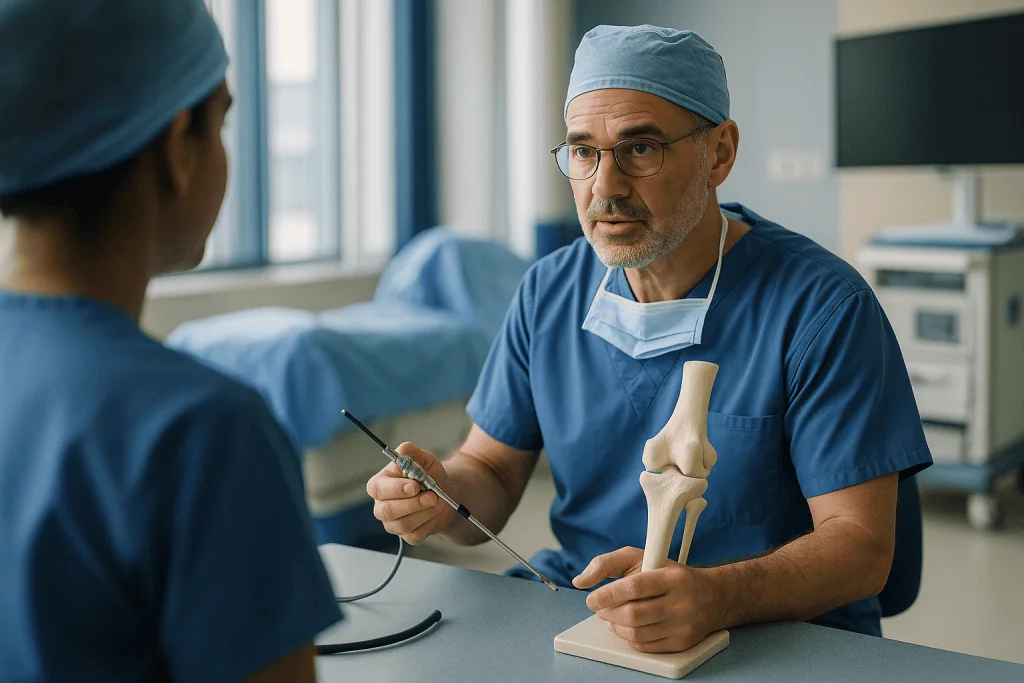
In the second knee, the surgeon makes one incision several centimeters long, opens the joint capsule, and moves structures aside to reach the problem. Direct vision and direct touch make it possible to realign broken bone, fix it with plates and screws, replace a joint surface, or rebuild several structures at once. The wound is closed in layers, and healing has to happen through skin, fat, capsule and sometimes divided muscle.
Timing differs less than people expect. Arthroscopic procedures commonly take from about half an hour to a couple of hours depending on the joint and the work needed, per the NHS. Complex open reconstructions run longer. Most arthroscopies are day-case procedures, meaning the person goes home the same day, while many open operations involve a hospital stay.
What happens to the tissues around the joint matters as much as what happens inside it. A small opening disturbs less skin, fewer nerve endings and less muscle, which is why early pain and swelling are usually lower after arthroscopy. But the healing of the actual repair, a stitched tendon or a reattached ligament, follows biology, not incision length. That distinction runs through every decision that follows.
How do surgeons decide between arthroscopy vs open surgery?
Ask an experienced joint surgeon how they choose, and the answer usually comes down to five questions asked in roughly this order.
Can I reach it? Arthroscopy works best for structures that sit inside the joint space and can be viewed once the joint is filled with fluid: menisci, cartilage surfaces, the lining, ligaments within the knee, the labrum and rotator cuff in the shoulder. Problems outside the capsule, or those buried under thick tissue, may be easier through an open approach.
Can I fix it well enough this way? Trimming, removing and stitching soft tissue suit small instruments. Realigning a shattered bone, inserting a metal implant, or moving a tendon to a new attachment usually needs hands and direct view.
What is the state of the rest of the joint? If the surrounding cartilage is already badly worn, cleaning up one torn edge may not change how the joint feels. This is where the evidence on degenerative knees becomes decisive, and it is covered later in this article.
What does this person need the joint to do? A climber’s shoulder and a retiree’s shoulder can carry the same tear yet call for different operations, because the demands on the repair differ.
What if the plan needs to change? Surgeons think ahead to whether they may need to convert from keyhole to open once they see the true picture, and they discuss that possibility beforehand.
Imaging feeds this reasoning but rarely settles it alone. MRI shows the shape of a tear; it does not show pain. The Johns Hopkins overview notes that arthroscopy can serve both to diagnose and to treat, which is exactly why a surgeon may say “we will decide the final approach once we see inside.” That is not indecision. It is honesty about the limits of a picture taken through skin.
Which joint problems are usually treated arthroscopically?
The list of conditions handled routinely through a camera has grown steadily, and for good reason: the targets are small, soft, and sit in a space that fluid can open up. The Mayo Clinic and Cleveland Clinic both describe the same core group.

In the knee, the classic arthroscopic jobs are a torn meniscus in someone whose cartilage is otherwise healthy, a loose fragment of cartilage or bone floating in the joint, a torn anterior cruciate ligament (the central stabilizing rope, usually reconstructed with a graft passed through small tunnels), and inflamed joint lining that needs sampling or removal.
In the shoulder, arthroscopy is used for many rotator cuff tears (the cuff is the group of tendons that hold the ball of the shoulder in its socket), for a torn labrum (the rim of cartilage that deepens the socket), for repeated dislocation, and for shaving bone that pinches tendons overhead.
The hip has become an arthroscopic joint for labral tears and for reshaping bone edges that catch during movement. In the ankle, surgeons remove bone spurs and loose bodies and treat cartilage damage. The wrist and elbow see arthroscopy for ligament injuries, loose fragments and stiffness.
Two features unite these examples. First, each involves soft tissue or small bony contours rather than major bone breaks. Second, each sits inside or immediately around the joint space. When both conditions hold, keyhole surgery usually offers the same repair with less disturbance to the tissues around it.
Arthroscopy also has a purely diagnostic role. When examination and scans disagree, a look inside can settle whether cartilage is intact or a ligament is truly torn. The MedlinePlus knee arthroscopy entry lists this alongside the treatment uses. Increasingly, though, MRI answers most of those questions before anyone picks up a scope, so diagnosis-only arthroscopy is less common than it once was.
When is open surgery the safer choice?
Open surgery is not the old-fashioned option that arthroscopy replaced. It is the tool for jobs where a camera and thin instruments simply cannot do the work safely.
Fractures head the list. When bone breaks into or near a joint, the pieces have to be put back in their exact positions and held with plates, screws or pins until they knit. That takes hands, direct sight and often a wide field to check alignment from several angles. Some surgeons use an arthroscope alongside an open approach to confirm the joint surface is smooth, but the fixation itself is open work.
Joint replacement is open by definition. Removing worn bone ends and fitting a new bearing surface cannot be done through a straw-sized tube.
Large or retracted tendon tears sometimes need open access too. A rotator cuff that tore months ago and has pulled back and shrunk may need to be mobilized and reattached under direct tension control. When a tendon is transferred from one place to another to compensate for a tear that cannot be repaired, that is an open operation.
Deep infection in a joint, or a tumor within or beside a joint, generally calls for open exposure so that the surgeon can clear tissue thoroughly and see the margins.
Previous surgery matters. Scar tissue from earlier operations can distort the joint space and make safe camera placement hard. Distorted anatomy from long-standing arthritis or from conditions present since birth can have the same effect.
Finally, some problems are simply outside the joint. A ruptured tendon at the front of the knee or a torn ligament on the outer ankle lies beneath skin and fat but outside the fluid-filled capsule, so an arthroscope offers no advantage and a small open incision does the job cleanly.
None of this makes open surgery a lesser choice. It is the right approach when the alternative would mean an incomplete repair through a small hole.
Is arthroscopy still enough when the joint is already worn?
Here the evidence is unusually clear, and it changed practice. For decades, “cleaning out” an arthritic knee with an arthroscope, trimming frayed cartilage and washing out debris, was one of the most common operations performed. Then a series of randomized trials compared that operation with exercise therapy, or with a sham procedure in which patients received incisions but no actual treatment inside the joint.
The results were consistent: in people with degenerative knee disease, meaning wear-related cartilage thinning with or without a degenerative meniscal tear, arthroscopic surgery did not produce lasting improvements in pain or function over exercise-based care. In 2017 a BMJ Rapid Recommendation panel, reviewing this body of trials, issued a strong recommendation against arthroscopic surgery for nearly all patients with degenerative knee disease, regardless of whether imaging showed a meniscal tear or mechanical symptoms such as catching. The recommendation is indexed on PubMed.
This does not mean arthroscopy is useless in a worn knee. It means the expected benefit is small and short-lived when the underlying problem is wear rather than a discrete injury. A younger person who twists the knee and tears an otherwise healthy meniscus is in a different category; the tear is the whole story, and repair or trimming addresses it directly.
Why does wear change the equation? A meniscal tear in a healthy knee is a fault in an otherwise smooth machine. In an arthritic knee, the tear is one of many changes, and pain arises from bone, lining and cartilage all at once. Removing a flap of meniscus leaves the rest of the picture untouched.
So when a surgeon says the scan shows a meniscal tear but recommends physiotherapy first, that advice reflects the evidence, not reluctance to operate. For worn joints, the conversation often moves to a different question altogether: not arthroscopy vs open surgery, but continued non-operative management versus, eventually, joint replacement.
Arthroscopy vs open surgery at a glance
A table cannot replace a consultation, but it can show where the two approaches genuinely differ and where they do not. The pattern below draws on the general descriptions from NHS, Mayo Clinic and Cleveland Clinic; individual cases vary widely.
| Feature | Arthroscopy (keyhole) | Open surgery |
|---|---|---|
| Incision | Two to four small cuts | One longer incision, sometimes more |
| How the surgeon sees | Camera image on a monitor, magnified | Direct view and touch |
| Typical targets | Meniscus, cartilage fragments, ligaments inside the joint, labrum, rotator cuff | Fractures near joints, joint replacement, large or retracted tendon tears, tendon transfers, infection, tumors |
| Anesthesia | General, regional or local | Usually general or regional |
| Hospital stay | Often same-day discharge | Often one or more nights |
| Early pain and swelling | Generally less | Generally more |
| Healing of the actual repair | Set by tissue biology, not incision size | Same |
| Main limitation | Cannot manipulate bone fragments or place large implants | More tissue disturbance; longer wound healing |
Two rows deserve emphasis. The “healing of the actual repair” row is identical on both sides on purpose. A stitched rotator cuff needs the same protected weeks whether it was reached through three small holes or one long cut. Patients who assume keyhole means fast often run into trouble here.
The “main limitation” row is the honest heart of the comparison. Arthroscopy trades access for gentleness. Open surgery trades gentleness for access. A good decision is the one that matches the trade to the injury.
Arthroscopic vs open surgery recovery: the first days and weeks
The first week after arthroscopy is usually about swelling and small wounds. The Mayo Clinic describes a typical pattern: keeping the dressings dry for the first days, elevating the limb and applying ice to limit swelling, using crutches or a sling if instructed, and expecting some fluid to leak from the small openings early on. Desk-based work and light activity often resume within days, driving typically returns within about one to three weeks, and more strenuous activity waits several weeks, though Mayo stresses that the timeline depends entirely on what was done inside.
The NHS gives a similar spread: some people are back to normal within a few weeks, while others, especially after repairs rather than trimming, need several months and a structured rehabilitation program.
After open surgery the early phase is longer. There is more to heal in the skin and deeper layers, pain tends to be greater for the first one to two weeks, and a hospital stay is common. Wound checks and stitch or staple removal fall around the two-week mark in many pathways. Physical therapy usually starts in hospital or within the first week.
Then the curves converge. Whether an anterior cruciate ligament was reconstructed through small tunnels or a fracture was plated through a long incision, the tissue underneath dictates when it can be loaded. Bone knits over weeks to months. Tendon reattached to bone is protected for a similar span. The MedlinePlus shoulder arthroscopy entry notes that recovery after a repair can take several months and depends on the extent of the work.
What this means practically: ask not “how long until I recover from keyhole surgery” but “how long until this particular repair can take weight, then strain, then sport.” The care team’s answer will usually be a range with milestones, not a date.
Can a keyhole operation turn into an open one?
Yes, and surgeons plan for it. Conversion from arthroscopic to open surgery happens when the view through the scope reveals something the scans did not show, or when the intended repair cannot be completed safely with small instruments.
Common reasons include a tear that is larger or more retracted than imaging suggested, bone quality too poor to hold an anchor, bleeding or swelling that obscures the camera view, dense scar tissue from earlier surgery, or an unexpected finding such as a fragment lodged where the scope cannot reach. In each case, the surgeon weighs continuing through the keyhole against opening the joint to finish the job properly.
Consent conversations should cover this possibility beforehand. A well-run pre-operative discussion typically includes a phrase along the lines of “if I find that the repair cannot be done arthroscopically, I may need to make a larger incision.” Agreeing to that in advance avoids an interrupted operation and a second anesthetic. If a surgeon has not mentioned it, it is fair to ask how likely conversion is for this particular injury and what it would change about recovery.
Conversion is not a failure. It reflects the diagnostic side of arthroscopy: the surgeon has learned something about the joint that changes the right plan. The reverse also occurs. Some surgeons begin with an arthroscopic look to confirm the state of the cartilage before committing to a larger open reconstruction, and occasionally that look shows the open operation is not needed.
Hybrid procedures blur the line further. An anterior cruciate ligament reconstruction is arthroscopic inside the joint but requires a small open incision to harvest the graft tendon. Many shoulder stabilization operations are entirely arthroscopic, while others add a short open step to move bone. The Johns Hopkins overview notes that arthroscopy may be combined with open techniques when appropriate. The category on the consent form matters less than what the surgeon expects to do and why.
What are the risks of arthroscopy compared with open surgery?
Every operation carries risk, and honesty about the numbers helps more than reassurance. The NHS states that serious complications after arthroscopy are rare, estimated at fewer than one in a hundred procedures. The most common problems are minor: temporary swelling, stiffness, bruising around the small openings, and short-lived numbness near an incision.
The less common but more serious risks, described by the NHS and Mayo Clinic, are shared by both approaches. Infection inside a joint is uncommon but significant because joints tolerate infection poorly. Blood clots in the leg veins can follow any lower-limb operation, particularly with reduced mobility afterward. Nerves or blood vessels near the joint can be injured. Bleeding into the joint, persistent stiffness, and reactions to anesthesia round out the list.
Open surgery adds exposure-related risks in proportion to the size of the wound: more skin to heal, a higher chance of wound problems, more blood loss, and more tissue that can form scar and restrict movement. Longer hospital stays bring their own risks, including clots and hospital-acquired infection.
Arthroscopy has a few risks of its own. Fluid pumped into the joint can track into surrounding tissues and cause temporary swelling. Instruments passed through small openings can occasionally damage cartilage they were meant to preserve. Small instrument fragments breaking off inside a joint is rare but documented.
Risk also depends on the person. Diabetes, smoking, obesity, immune-suppressing medicines and previous joint infection all raise complication rates for both approaches. Preparing for surgery, including good blood sugar control and stopping smoking, is something the care team will raise, and it is worth taking seriously because it changes outcomes more than incision length does.
Medicines to prevent clots are sometimes used after joint surgery, particularly of the lower limb; whether, which and for how long are decisions for the prescribing clinician based on individual risk.
Who is usually asked to wait, or to try something else first?
Surgery is rarely the first move for joint pain without a clear structural injury, and several groups are routinely steered toward non-operative care before any operation, keyhole or open.
People with degenerative knee pain, as covered above, are generally offered exercise-based physiotherapy, weight management where relevant, and activity modification first. The BMJ Rapid Recommendation indexed on PubMed applies here: the trial evidence does not support arthroscopy in this group.
Shoulder pain from tendon irritation without a full tear is another common example. Structured strengthening of the rotator cuff and shoulder blade muscles is the usual first step, with surgery considered if months of proper rehabilitation fail.
Partial-thickness tendon tears, small labral tears in the hip that appear on scans of people with no symptoms, and mild ankle instability often fall into the same category. The scan finding is real; whether it explains the pain is a separate question, and a trial of rehabilitation helps answer it.
Timing also matters for people who are good candidates for surgery. A swollen, stiff knee immediately after injury may benefit from a few weeks of movement and swelling control before ligament reconstruction, because operating on a stiff knee risks lasting stiffness. Someone with active infection elsewhere, uncontrolled diabetes, or recent heart problems may be asked to wait until those are managed.
Smokers are frequently encouraged to stop before elective joint surgery; smoking impairs healing of both wounds and tendon-to-bone repairs.
Being asked to wait is not the same as being turned away. It usually means the team believes the odds of a good result improve with preparation, or that the problem may settle without an operation. A reasonable question when told to wait is “what would need to be true for us to revisit surgery, and when?” That keeps the plan concrete rather than open-ended.
What people often get wrong about keyhole surgery for the knee and shoulder
Several beliefs about arthroscopy are widespread and quietly wrong.
“Keyhole means quick recovery.” The wounds heal fast. The repair inside does not. A rotator cuff stitched arthroscopically needs the same months of protection as one repaired through an open incision. The MedlinePlus shoulder arthroscopy entry is blunt that recovery after repair can take months.
“If the scan shows a tear, surgery will fix the pain.” Tears seen on MRI are common in people with no pain at all, especially with age. A tear is a finding; pain is a symptom. Matching one to the other is the surgeon’s job, and sometimes the honest answer is that the tear is a bystander.
“Cleaning out an arthritic knee buys years.” The trial evidence, summarized in the BMJ Rapid Recommendation indexed on PubMed, does not support this for degenerative disease.
“Open surgery is outdated.” Fractures, joint replacement and tendon transfers are open procedures because they need to be. Choosing open surgery for those is choosing the right tool.
“Arthroscopy is just a look; nothing gets done.” Most modern arthroscopy is treatment, not diagnosis. Ligament reconstruction, tendon repair and bone reshaping are all done through the scope.
“Smaller scars mean lower risk of everything.” Wound complications are lower. Infection inside the joint, clots and nerve injury are shared risks, as the NHS explains.
“The surgeon can tell from the scan exactly what will happen.” Imaging guides the plan; the scope confirms it. Surgeons who say “we will know more once we see inside” are being accurate, not evasive.
Correcting these ideas matters because expectations shape recovery. Someone who believes a keyhole shoulder repair will be back to overhead sport in a month is likely to push too early and undo the stitches. Someone who believes open surgery is a last resort may delay a fracture fixation that works best done promptly.
Questions to ask your care team before choosing an approach
A good consultation leaves room for questions, and the ones below tend to surface the reasoning behind an arthroscopy vs open surgery recommendation.
- What exactly is the problem you intend to treat, and how confident are you that it explains my symptoms?
- Why is this approach the right one for this injury? What would make you choose the other?
- Is there a reasonable chance you would need to convert from keyhole to open during the operation? What would that change?
- What is the non-surgical alternative, and what does the evidence say about how it compares for someone like me?
- If I wait, what is the risk that the problem becomes harder to treat?
- What will the first two weeks look like? When can I expect to drive, work, and put full weight through the joint?
- What are the milestones for rehabilitation, and who will guide it?
- What are the specific risks for me, given my health, medicines and previous surgery?
- What signs after surgery should make me call you immediately?
- What do you expect the joint to be able to do in six months, and what would you consider a disappointing result?
Notice that none of these ask for a promise. Surgeons cannot promise outcomes, and a careful one will answer in ranges and probabilities. What you are looking for is a clear line of reasoning from the injury to the plan, an acknowledgment of the alternatives, and a description of recovery that sounds like work rather than a timetable.
It also helps to bring a second person to listen and to write down the answers. Consultations move quickly, and terms such as “debridement” (trimming away damaged tissue) or “fixation” (holding bone in place with hardware) are easy to nod at and hard to remember later. Asking for each term in plain words is entirely reasonable, and the Cleveland Clinic overview offers a useful glossary to review beforehand.
When to call your doctor after arthroscopy or open joint surgery
Most recoveries are uneventful, but a small number of problems need prompt attention, and the same red flags apply whether the operation was keyhole or open. The Mayo Clinic and NHS list the signs that should prompt a call to the surgical team or, if severe, urgent care.
Contact your care team the same day if you notice:
- Fever, chills or feeling generally unwell in the days after surgery.
- Increasing redness, warmth, or spreading swelling around a wound, or discharge that is cloudy, colored or foul-smelling.
- Pain that worsens rather than eases after the first two or three days, or pain not controlled by the plan you were given.
- A wound that opens or bleeds persistently despite pressure.
- Numbness, tingling or weakness in the limb that is new or getting worse.
Seek emergency care without waiting if you develop:
- Calf pain, swelling or tenderness in one leg, which can signal a blood clot.
- Sudden shortness of breath, chest pain, or coughing up blood, which can indicate a clot that has traveled to the lungs.
- A limb that turns pale, blue or cold, or a foot or hand you cannot move.
- Severe, rapidly increasing swelling of the joint with inability to bend it.
Joint infection deserves a special word. It can develop days to weeks after surgery, and early treatment protects the cartilage. A joint that becomes hot, swollen and too painful to move, particularly with fever, is an emergency rather than something to watch overnight.
Beyond emergencies, keep every scheduled follow-up. Wound checks, imaging after fracture fixation, and rehabilitation reviews are where slow-developing problems such as stiffness or a repair that is not holding are caught early. If something feels wrong and does not match what you were told to expect, a call costs nothing; the team would rather hear from you than not.
Frequently asked questions
What is arthroscopic surgery and how is it different from open surgery?
Arthroscopic surgery treats a joint through two to four small cuts using a thin camera and slim instruments, while open surgery uses one longer incision that gives the surgeon direct sight and touch. The camera route disturbs less skin and muscle, so early pain and swelling are usually lower. Open surgery allows work that small instruments cannot do, such as fixing broken bone or fitting an implant. Both are performed in an operating room under anesthesia.
Open surgery vs keyhole: which one heals faster?
The wounds heal faster after keyhole surgery, but the repair inside heals at the same pace either way. A stitched tendon or a reconstructed ligament needs weeks to months of protection regardless of how the surgeon reached it. Mayo Clinic notes that after arthroscopy light activity often resumes within days and strenuous activity waits several weeks, yet the true timeline depends on what was done inside the joint rather than on incision size.
Is keyhole surgery for the knee always the better option?
No. Keyhole surgery is the usual choice for meniscal tears in an otherwise healthy knee, loose cartilage fragments and cruciate ligament reconstruction. It is generally not recommended for wear-related knee pain, where trials found no lasting benefit over exercise therapy, and it cannot fix fractures or replace a worn joint. The better option is the one that matches the specific injury, which is a judgment for the treating team.
Why did my surgeon recommend physiotherapy when my MRI shows a tear?
Because a tear on a scan does not always explain pain, and in worn joints removing it often changes little. Degenerative meniscal tears are common in people with no symptoms, and a BMJ Rapid Recommendation advised against arthroscopy for degenerative knee disease after trials showed exercise therapy did as well over time. A period of rehabilitation helps test whether the tear is truly the cause before committing to an operation.
Can arthroscopy turn into open surgery during the operation?
Yes. If the surgeon finds a larger or more retracted injury than the scans suggested, poor bone quality, dense scar tissue, or a view too obscured to work safely, they may make a longer incision to complete the repair properly. This possibility is normally discussed and agreed to before the operation so that a second anesthetic is avoided. Conversion reflects new information about the joint, not a failure of the plan.
How long does an arthroscopy take and will I stay in hospital?
Arthroscopic procedures commonly take from about half an hour to a couple of hours depending on the joint and the work required, according to the NHS, and most are day cases with same-day discharge. Open joint operations tend to take longer and often involve one or more nights in hospital. Your surgeon will give a more specific estimate once the plan for your particular joint is settled.
What are the main risks of arthroscopy?
The NHS estimates serious complications at fewer than one in a hundred arthroscopies. Minor problems such as swelling, stiffness and bruising are more common and usually settle. Less common but important risks include infection inside the joint, blood clots in the leg, injury to nearby nerves or vessels, bleeding into the joint and reactions to anesthesia. These serious risks are shared with open surgery; open procedures add more wound-related complications.
Does arthroscopic vs open surgery recovery differ for a rotator cuff repair?
The early weeks differ; the overall timeline largely does not. After an arthroscopic repair the small wounds settle quickly and early pain is usually lower, whereas an open repair involves a larger wound and often a hospital stay. In both cases the tendon must reattach to bone, which MedlinePlus notes can take several months of protected movement and structured rehabilitation. The repair, not the incision, sets the pace.
Who is usually asked to wait before joint surgery?
People with wear-related joint pain, partial tendon tears, or scan findings that may not explain their symptoms are usually offered exercise-based rehabilitation first. Those with a stiff, swollen joint immediately after injury may wait for swelling to settle before ligament reconstruction. Uncontrolled diabetes, active infection, recent heart problems or smoking may also prompt a delay so that healing conditions improve. Waiting is a strategy for a better result, not a refusal.
What red-flag signs after joint surgery need urgent attention?
Call emergency services for calf pain or swelling in one leg, sudden breathlessness or chest pain, coughing up blood, or a limb that turns pale, blue, cold or cannot be moved. Contact your surgical team the same day for fever, spreading redness or discharge from a wound, pain that worsens after the first few days, or new numbness or weakness. A hot, swollen joint too painful to move with fever may indicate infection and needs immediate assessment.
References
This article is for general information only and is not a substitute for professional medical advice. Please consult a qualified doctor about your individual situation.

More from the Blog

The First Two Weeks After ACL Surgery: Crutches, Bracing, Ice and Bending the Knee
The first two weeks after ACL surgery usually focus on four jobs: walking safely with crutches, wearing any brace the surgeon has prescribed, controlling…

Rotator Cuff Surgery Cost: Pricing the Repair, Honestly
In our August 2026 guide, rotator cuff repair for international patients typically runs EUR 4,700–11,050, compared with roughly GBP 4,400–8,500 for private surgery in…

Arthroscopic Surgery for Shoulder Impingement: What Subacromial Decompression Involves
Shoulder impingement surgery, usually arthroscopic subacromial decompression, is a keyhole operation that removes inflamed bursa and shaves a few millimeters of bone from the…

How Tenosynovitis Starts: Why a Tendon Sheath Swells and How Care Is Planned
Tenosynovitis usually starts when the thin, fluid-lined sheath around a tendon becomes irritated, most often from repeated gripping, twisting or lifting, and less often…

Running and Squatting After Meniscus Surgery: How Return to Sport Is Cleared Stage by Stage
Running after meniscus surgery is cleared in stages rather than on a fixed date. Surgeons and physical therapists typically look for a knee that…
Arthroscopy Complications Explained: Portal Infections, Swelling, Clots and When to Call
Arthroscopy complications are uncommon but real. Most people have some bruising, swelling and soreness for one to two weeks, which is expected. Warning signs…