Rotator Cuff Treatment
Rotator cuff treatment repairs torn shoulder tendons to reduce pain, restore strength, and improve movement, often using minimally invasive arthroscopic techniques when appropriate.
Quick answer
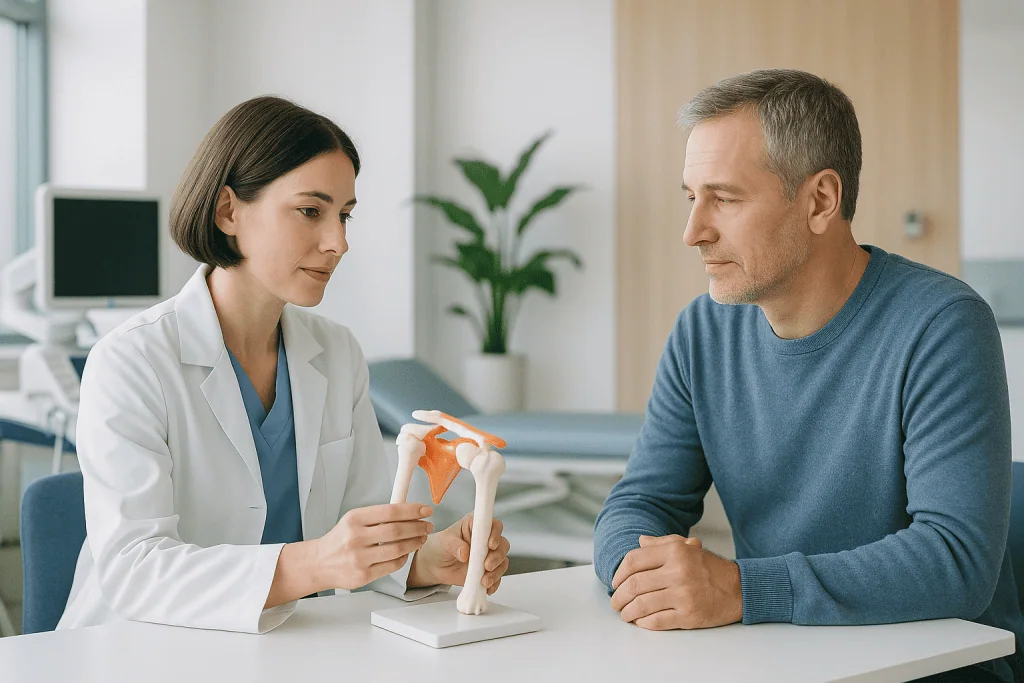
Rotator cuff treatment covers the rehabilitation, injections and surgery used to manage damaged shoulder tendons. Many tears are managed first with structured physiotherapy; persistent pain, weakness or a full-thickness tear may lead to arthroscopic repair, in which the surgeon reattaches the torn tendon to the bone through small incisions. Recovery is gradual, because tendon-to-bone healing takes months rather than weeks.
Rotator Cuff Injuries: What You Are Dealing With
The rotator cuff is a group of four muscles and their tendons that surround the shoulder joint, keep the ball of the joint centred in its socket, and let the arm lift and rotate with control. Rotator cuff treatment covers everything used to manage damage to these tendons, from structured physiotherapy and image-guided injections through to arthroscopic surgical repair. It is relevant to anyone whose shoulder pain, weakness or disturbed sleep has stopped responding to rest and time.
A rotator cuff injury can make ordinary movements feel surprisingly difficult. Reaching for a cabinet, fastening a seat belt, lifting a suitcase, sleeping on one side or returning a tennis serve can become painful or unreliable. For many people, the frustration is not only the pain itself but the uncertainty around it. Is the tendon actually torn? Will it heal on its own? Is surgery necessary, and if so, how long would recovery take? These are reasonable questions, and the honest answers depend on details of your particular shoulder rather than on general rules.
The shoulder has the widest range of motion of any joint in the body, and it pays for that mobility with exposure. The rotator cuff tendons absorb repeated stress every time the arm lifts, rotates or reaches, so injuries develop in several ways: gradually from wear over years, suddenly after a fall onto an outstretched arm, or during sports and heavy lifting. Some tears cause only mild discomfort. Others lead to night pain, weakness, stiffness and a loss of function that does not improve with medication or physiotherapy.
Treating rotator cuff problems properly matters because untreated tendon tears can enlarge, the attached muscles can weaken, and the mechanics of the whole shoulder can deteriorate. The aim of treatment is not to “fix an MRI finding” but to reduce pain, restore strength, preserve movement and support a safe return to daily activities, work and sport wherever that is realistic. Which treatment fits you depends on the size and age of the tear, the quality of the tendon tissue, the condition of the muscle, your age and activity level, and what you actually want your shoulder to do.
At Acibadem, rotator cuff care is planned with that broader perspective. Orthopaedic specialists examine the shoulder in detail, review the imaging carefully, and weigh both surgical and non-surgical options before recommending a path. When repair is advised, minimally invasive arthroscopic techniques are often used where appropriate, supported by modern imaging, anaesthesia, perioperative care and a structured rehabilitation plan. For international patients, the pathway also includes language support and appointment coordination before and after arrival, so that the clinical decisions stay clear and practical.
What Are the Rotator Cuff Muscles?
The rotator cuff muscles are four small muscles, the supraspinatus, infraspinatus, teres minor and subscapularis, whose tendons blend together into a continuous cuff over the head of the humerus, the upper arm bone. Each has a job. The supraspinatus helps begin lifting the arm away from the body. The infraspinatus and teres minor rotate the arm outwards, the movement you use to reach behind your head. The subscapularis, at the front of the shoulder, rotates the arm inwards, as when you reach behind your back. Together they connect the shoulder muscles to the upper arm and hold the ball of the joint firmly in the socket during movement.
This holding role is why cuff damage is felt so widely. The large deltoid muscle provides raw lifting power, but it can only work efficiently if the cuff keeps the joint centred beneath it. When one or more cuff tendons become inflamed, partially torn or completely torn, that balance is disturbed: the humeral head can ride upwards, soft tissues get pinched during elevation, and the shoulder starts to hurt or fail during movements that used to be automatic.
Why does the supraspinatus tear most often?
The supraspinatus is the tendon most commonly involved in rotator cuff tears. It passes through a narrow space beneath the acromion, the bony roof of the shoulder, where it is compressed each time the arm is raised. The zone near its attachment to bone also has a relatively limited blood supply, which makes age-related degeneration more likely to concentrate there. This combination of mechanical load and slower tissue repair explains why many tears begin in the supraspinatus and, if the process continues, extend backwards or forwards into the neighbouring tendons.
Rotator Cuff Tear: Types and Causes
A rotator cuff tear is a disruption of one or more of the cuff tendons at or near their attachment to the bone. Tears are described as partial-thickness, meaning only part of the tendon’s depth is involved, or full-thickness, meaning the tendon is torn through its entire depth. Some tears are small and localised. Others are large, have pulled back (retracted) from the bone, and are accompanied by wasting of the muscle and fatty change within it, details that matter, because they influence whether a tendon can still be repaired and how well it is likely to heal.
Causes fall into broad groups that often overlap. Degenerative tears develop slowly with age and repetitive use, sometimes with no single memorable injury. Traumatic tears follow a fall onto an outstretched arm, a heavy lift, a sudden pull, a sporting incident or a shoulder dislocation. Work that involves sustained overhead activity adds cumulative load. In many patients an already-worn tendon finally fails during a modest event that a younger tendon would have tolerated.
Rotator cuff treatment also addresses conditions short of a complete tear. Rotator cuff tendinopathy is a chronic state in which the tendon becomes painful and structurally weakened without tearing through. Shoulder impingement, irritation of soft tissues as the arm elevates, frequently coexists with tendon disease. Inflammation or instability of the biceps tendon is common when the front portion of the cuff is involved, and bone spurs or an inflamed bursa can add to the pain. For older patients with massive tears that cannot be repaired, especially alongside arthritis, alternatives such as tendon transfer or shoulder replacement may be evaluated instead.
How can you tell if you have a torn rotator cuff?
You cannot confirm a torn rotator cuff from symptoms alone; the pattern of symptoms raises suspicion, and a clinical examination with imaging confirms or excludes the tear. The suggestive pattern is pain on the outer side of the shoulder or upper arm, discomfort when lifting the arm, pain at night, weakness with overhead use, difficulty reaching behind the back, clicking or catching, and reduced endurance during work or exercise. It is worth knowing that the reverse is also true: imaging sometimes shows a tear in a shoulder with only modest symptoms, which is why treatment decisions rest on both the examination and the scan, never on the scan alone.
What does a torn rotator cuff feel like?
Most commonly, a torn rotator cuff feels like a dull ache on the outside of the shoulder that radiates part-way down the upper arm, sharpening with specific movements such as reaching overhead, behind the back or across the body. Degenerative tears tend to announce themselves gradually, with soreness that builds over weeks and increasingly disturbed sleep. Traumatic tears feel different: a sudden sharp pain during the injury, often followed by immediate weakness, sometimes described as the arm feeling heavy or “dead” when lifting. Some tears, particularly small degenerative ones, are surprisingly quiet and are discovered only when the shoulder is imaged for another reason.
What are two warning signs of a rotator cuff tear?
Two of the most characteristic warning signs are night pain that makes lying on the affected side difficult, and weakness when lifting or rotating the arm. Neither is specific on its own, several shoulder conditions cause night pain, but the combination, persisting for weeks rather than days, is the pattern that most often leads to a specialist examination and imaging of the cuff.
Is a rotator cuff tear a serious injury?
A rotator cuff tear can be serious, though the spectrum is wide. It is rarely an emergency, but it is consequential over time: some tears remain stable for years, while others enlarge, the tendon retracts farther from the bone, and the muscle weakens and develops fatty change. Those changes can make a later repair more difficult and, in some cases, no longer possible. Traumatic tears in active people generally deserve prompter assessment than slowly developed degenerative tears in low-demand shoulders. The seriousness of a particular tear is judged from the examination and imaging together, not from how intense the pain happens to be, which correlates poorly with tear size.
How a Rotator Cuff Injury Is Diagnosed
Diagnosis begins with a detailed medical history and a physical examination. The orthopaedic specialist assesses range of motion, strength in each direction, points of tenderness, shoulder stability, posture, neck-related symptoms and the way the shoulder blade moves during elevation. This breadth is deliberate: shoulder pain can come from the rotator cuff, the biceps tendon, the joint cartilage or labrum, the acromioclavicular joint, frozen shoulder, arthritis or even the cervical spine. A precise diagnosis is the foundation of everything that follows, because treating the wrong structure wastes months.
Imaging then confirms the type and extent of injury. X-rays do not show tendons directly, but they reveal bone spurs, arthritis, shoulder alignment and the bony changes associated with long-standing tears. Ultrasound, in skilled hands, can assess tendon continuity and how the tissues move dynamically. Magnetic resonance imaging is the workhorse for surgical planning: it shows tear size, how far the tendon has retracted, the quality of the muscle, inflammation, associated labral or biceps problems and the overall condition of the joint. In selected cases, additional imaging is used to clarify bone detail or complex anatomy.
One point deserves emphasis. Because tendon changes on scans become more common with age, an imaging finding is not automatically the cause of your pain. A careful clinician correlates what the scan shows with what the examination finds and what you actually experience. This is also why a second opinion can be genuinely useful when different doctors have offered different recommendations for the same shoulder: the disagreement is often about interpretation, not about the images themselves.
Rotator Cuff Pain: Treating the Shoulder Without Surgery
Rotator cuff pain does not automatically lead to an operation, and for many shoulders it should not. A carefully guided non-surgical programme may include activity modification, anti-inflammatory medication when the treating doctor judges it suitable, physiotherapy, posture and scapular-control exercises, and image-guided injections in selected cases. This approach works well for tendon irritation, small partial tears, degenerative tears where strength is preserved, and patients whose general health makes surgery less suitable.
The purpose of non-surgical care is not simply to wait and hope. It is to improve the mechanics of the shoulder, how the blade moves, how the remaining cuff and surrounding muscles share the load, and to find out whether function can be restored without repairing the tendon. If pain decreases, strength improves and daily activities become manageable, continued rehabilitation and monitoring may be all that is needed. If symptoms remain limiting or weakness persists, the question of repair is revisited with better information than before.
How do you fix rotator cuff pain?
Fixing rotator cuff pain starts with identifying its source, then treating in stages: settle the irritation, restore comfortable motion, strengthen the cuff and shoulder-blade muscles, and correct the movement habits that overload the tendon. Injections can reduce inflammation enough to make rehabilitation possible, though their timing and frequency are chosen carefully, particularly if surgery may be needed later, because they can affect tissue quality. When pain persists despite structurally sound treatment, a dedicated pain management assessment can add options. When weakness rather than pain is the dominant problem, the conversation usually turns towards repair.
Can a torn rotator cuff heal naturally?
A full-thickness rotator cuff tear does not reattach itself to the bone; once the tendon has pulled away, no exercise, supplement or device regrows it into its footprint. What can happen naturally, and often does, is meaningful improvement in symptoms. Inflammation settles, the surrounding muscles learn to compensate, and many people with confirmed tears return to comfortable daily function through rehabilitation alone. Partial tears and tendinopathy have more genuine capacity to settle, because the tendon remains in continuity. So when people ask how to heal a torn rotator cuff naturally, the honest reframing is this: the realistic natural goal is a shoulder that works well despite the tear, and for many patients that is an entirely legitimate outcome. The trade-off is that some tears enlarge over time, which is why a monitored plan is better than an unmonitored one.
How can you relieve rotator cuff pain at night?
The most reliable ways to relieve rotator cuff pain at night are to avoid lying on the affected side, place a pillow under the upper arm so it rests slightly away from the body rather than dropping across the chest, sleep in a semi-reclined position during the worst weeks, and pace overhead activity during the day so the tendon is less irritated by evening. Night pain happens because lying down removes gravity’s help in keeping the humeral head down and because lying on the shoulder compresses the inflamed tissue directly. Night pain that persists for weeks despite these adjustments is one of the commonest findings that leads clinicians to image the cuff, because it correlates with genuine tendon pathology more strongly than daytime ache alone.
Who May Need Rotator Cuff Surgery
Surgery enters the discussion in a few well-defined situations: when pain and functional limitation persist despite an appropriate course of conservative treatment; when a traumatic full-thickness tear has caused clear weakness; when the tear is large or demonstrably progressing; or when your work or athletic goals require stronger shoulder function than rehabilitation alone is delivering. For active patients with acute tears, repair may be discussed earlier rather than later, because tendon quality and muscle condition can deteriorate while waiting, narrowing the surgical options.
Equally, not every tear needs an operation. Tears with controlled pain, acceptable strength and manageable daily function can often be monitored and managed with rehabilitation. The decision is individual, and a trustworthy treatment plan makes it transparently: it explains the diagnosis, the likely natural course of your particular tear, the options with their respective risks, and, importantly, the rehabilitation commitment each option demands, because a repair without months of structured therapy afterwards rarely achieves its purpose.
Rotator Cuff Surgery: How Repair Is Performed
Rotator cuff surgery reattaches the torn tendon to its footprint on the upper part of the humerus. The repair may be performed arthroscopically through small incisions using a camera and specialised instruments, through a mini-open approach, or with open surgery in more complex situations. Arthroscopic repair is commonly preferred when the tear pattern allows, because it lets the surgeon view the joint and surrounding structures under magnification, treat associated problems in the same sitting, and repair the tendon with less soft-tissue disruption than traditional open techniques.
Preparation before the operation
Before any repair, the specialist reviews your symptoms, medical history, current medications, previous injections, response to physiotherapy and activity goals. Preoperative assessment may include blood tests, anaesthesia evaluation and, when needed, cardiac or internal medicine review. Conditions that can affect tendon healing, diabetes, smoking, osteoporosis, inflammatory disease, are identified and factored into the plan. For patients travelling from abroad, much of this can begin before the journey: medical records, imaging and previous treatment notes are reviewed in advance so the team knows whether additional tests will be needed and whether surgery is genuinely likely after the in-person examination, and so the recommended length of stay and follow-up schedule can be discussed realistically.
You will also be prepared for the recovery itself, and this preparation matters more in cuff repair than in many other operations, because the tendon must be protected while it heals to bone. Sensible steps include arranging help at home, planning time away from work, preparing clothing that is easy to put on with one arm, and understanding how the sling works before you need it.
What happens during arthroscopic rotator cuff repair?
Although every repair is tailored to the tear, the operation follows a recognisable sequence:
- Anaesthesia. The procedure is usually performed under general anaesthesia, often combined with a regional nerve block that continues to numb the shoulder for hours after surgery.
- Positioning. You are positioned to give the surgeon clear access to the shoulder from several angles.
- Inspection. Small incisions are made around the shoulder and a slender camera is inserted into the joint, projecting magnified images onto a monitor. The surgeon evaluates the cartilage, labrum, biceps tendon, joint lining and the rotator cuff from inside.
- Preparation. The space above the cuff is examined, inflamed tissue is removed where necessary, and the tendon edge and bone surface are prepared for healing.
- Repair. Small fixation devices are placed in the bone, and sutures are passed through the tendon to secure it back onto its attachment site. The repair pattern depends on tear size, tissue quality, tendon mobility and surgical judgment.
- Associated problems. Biceps tendon disease, significant bursitis or bone spurs may be addressed during the same procedure when clinically relevant.
- Closure. The small portals are closed and the arm is placed in a sling or immobiliser.
The technology involved is there to improve visualisation, precision and safety rather than for its own sake. High-definition arthroscopic imaging lets the surgeon inspect structures that a small open incision cannot fully expose; specialised instruments allow tissue preparation, suture passage and fixation through narrow portals; imaging before surgery defines the tear so the repair can be planned rather than improvised; and modern anaesthesia monitoring with regional pain control supports comfort through the early recovery period.
How long does the operation take, and will you stay in hospital?
The operating time varies with tear complexity, tendon quality and any additional procedures, but many arthroscopic repairs are completed within a few hours. The total time in the surgical unit is longer, because it includes preparation, anaesthesia, recovery-room monitoring and postoperative instructions. Some patients go home the same day; others stay overnight, depending on medical factors, pain control, the extent of the procedure and, for international patients, travel logistics.
Immediately after surgery, pain is managed with a combination of medications and, where one was used, the continuing effect of the nerve block. Before discharge, the treating team explains how pain relief will be organised over the first days, so that this part of recovery is predictable rather than a source of anxiety. The first phase of recovery concentrates on protecting the repair, controlling swelling, and keeping the hand, wrist and elbow moving safely while the shoulder itself rests.
Rotator Cuff Recovery Timeline
Rotator cuff recovery varies with tear size, repair technique, tendon quality, general health and how rehabilitation progresses, but most patients move through a staged pathway broadly like this:
| Time Period | What Patients Can Expect |
|---|---|
| Day 1 | The shoulder is protected in a sling. The focus is pain control, swelling management, wound care and safe movement of the hand, wrist and elbow. |
| First week | Rest, medication instructions from the treating team, correct sling use and early approved exercises. A follow-up confirms wound healing and reviews the rehabilitation plan. |
| First month | Passive or assisted motion may progress according to the repair. The tendon is still healing, so lifting and active shoulder use remain restricted. |
| Two to three months | Active motion usually increases, and early strengthening may begin if healing and mobility allow. Day-to-day comfort tends to improve gradually. |
| Three to six months | Strength, endurance and functional training take priority. Many patients resume a broader range of daily activities, depending on work and sport demands. |
| Longer term | Continued strengthening and shoulder conditioning may be needed for several months. Return to heavy labour or overhead sport requires medical clearance and gradual progression. |
How long does it take to recover from a rotator cuff injury?
Recovery is measured in months, not weeks, and the honest answer depends on which treatment you are recovering from. A non-surgical programme for tendon irritation or a small tear typically produces its improvement over weeks to a few months of progressive rehabilitation. After surgical repair, the timeline is longer because tendon-to-bone healing itself takes months, regardless of how good the patient feels; the sling phase, the motion phase and the strengthening phase each have their place, and strength often continues to improve well beyond the early recovery period. Physically demanding work and overhead sport come last, after clearance from the treating team.
The pacing of physiotherapy is a genuine balancing act. Early exercises are often passive, meaning the shoulder is moved without the repaired tendon actively contracting; active motion and strengthening are added once healing has progressed. Returning to lifting too quickly can jeopardise the repair, while avoiding movement for too long invites stiffness. This is why adherence to the protocol and attendance at follow-up matter as much as the operation itself. It also helps to know in advance which early sensations, soreness around the small incisions, mild swelling, disturbed sleep while adjusting to the sling, are an ordinary part of the first weeks, so the normal course of recovery does not cause unnecessary worry.
Why Acting Early Matters
Shoulder pain that persists or worsens deserves a proper diagnosis, particularly after an injury that caused sudden weakness. Some rotator cuff tears remain stable for years, but others enlarge. As a tear grows, the tendon retracts farther from its attachment and the muscle can weaken and develop fatty change. These are not cosmetic details on a scan: they make repair technically harder and, in some shoulders, eventually make repair impossible, leaving only more invasive alternatives.
Delay carries quieter costs too. Ongoing pain disturbs sleep, and compensatory habits creep in: the neck, upper back and opposite arm start doing work the injured shoulder avoids, which creates its own discomfort and erodes overall function. For athletes and people in physically demanding jobs, a late diagnosis usually means longer away from activity and a more complicated rehabilitation than an early one would have required.
To be clear, early assessment does not mean early surgery. It means understanding the injury precisely and then choosing a plan based on the anatomy, the symptoms, the evidence and your goals. In many shoulders a supervised non-surgical programme is exactly right. In others, a timely repair preserves tendon mobility and muscle quality that would otherwise be lost. What early assessment prevents is the third scenario: drifting for a year with a tear that was quietly narrowing your options.
Benefits of Rotator Cuff Treatment
What treatment can offer depends on the injury and the option chosen, but the goals centre on pain, function and durable shoulder mechanics.
| Benefit | What It Means for You |
|---|---|
| Reduced shoulder pain | Treatment can decrease pain during reaching, lifting, dressing and sleeping, provided the true pain source has been identified accurately. |
| Improved strength | Repairing a significant tear may restore the tendon’s ability to transmit muscle force, supporting better arm control and endurance. |
| Better range of motion | Rehabilitation and, when needed, surgery help patients regain safer, more comfortable shoulder movement over time. |
| Return to daily activities | The aim is to make routine tasks, driving, household activity, work duties, personal care, easier and less painful. |
| Protection from progression in selected cases | Timely treatment may reduce the risk of worsening tendon retraction, muscle weakness or long-term dysfunction in tears likely to progress. |
| Personalised care planning | A tailored plan matches treatment intensity to your tear pattern, medical condition, recovery goals and travel circumstances. |
Factors That Influence Outcomes
A good result after rotator cuff treatment depends on several interconnected factors, and it is worth understanding them before choosing a path. The first is the nature of the tear itself. Small or moderate tears with good tendon mobility and healthy muscle offer a more favourable healing environment than massive, chronic, retracted tears with poor tissue quality. Acute traumatic tears behave differently from long-standing degenerative ones, and a sound treatment plan reflects that difference rather than applying one recipe to both.
The second factor is you. Smoking, poorly controlled diabetes, obesity, osteoporosis, inflammatory disease and certain medications can all affect healing and recovery, which is one reason the preoperative review is thorough rather than a formality. Age is a consideration, but it is not the deciding one: activity level, tendon quality, medical status and personal goals usually matter more than the number itself. Nutrition, sleep and honest adherence to postoperative restrictions contribute more than most patients expect.
The third factor is fit between technique and tissue. A repair that is too aggressive for fragile tendon may not hold; an overly limited repair may not restore function. Rehabilitation has the same tension, early stiffness is frustrating, but excessive early loading stresses the repair, so clear, continuing communication between surgeon, physiotherapist and patient is not a courtesy, it is part of the treatment.
Finally, expectations should be realistic before consent, not adjusted afterwards. Rotator cuff repair often improves pain and function, but the improvement is gradual, tendon healing takes months, and strength can continue building beyond the early recovery period. Some patients, particularly those with large chronic tears or coexisting arthritis, may retain some weakness or limitation even after well-executed treatment. A responsible team tells you this at the planning stage and explains what is likely for your specific shoulder, so the decision you make is genuinely informed.
Rotator Cuff Care at Acibadem
Rotator cuff care at Acibadem is organised around one idea: understand the entire shoulder, not just the torn tendon. Orthopaedic physicians work alongside radiology, anaesthesiology, rehabilitation medicine, physiotherapy, internal medicine and nursing teams, and in complex cases the plan is discussed across specialties before a recommendation is made. Associated conditions, biceps tendon disease, stiffness, arthritis, instability, neck-related pain, can change the right treatment entirely, which is why the diagnostic stage takes the time it takes. This breadth is particularly valuable for patients who have already received differing recommendations elsewhere and want the disagreement resolved rather than repeated.
When surgery is appropriate, experienced orthopaedic surgeons use contemporary arthroscopic and open techniques matched to the tear pattern and tissue condition, rather than one method for every patient. Arthroscopy, when suitable, allows detailed visualisation through small incisions and can reduce soft-tissue disruption. Anaesthesia and pain teams support comfort before, during and after the procedure; the approach is described in detail in how Acibadem controls pain after surgery and invasive procedures.
Rehabilitation is built into the pathway from the start, not appended to it. Patients receive concrete instructions on sling use, wound care, allowed movements, sleeping positions, travel precautions and the expected stages of therapy. For international patients, Acibadem International assists with scheduling, interpretation and hospital coordination, so that clinical decisions remain clear while the practical side of an unfamiliar healthcare system is handled around you. Personalisation is the point throughout: a competitive athlete, an office professional, a manual worker and an older patient with a chronic tear have genuinely different needs, and the plan should reflect anatomy, pain level, work demands, sporting goals, medical history and travel logistics rather than a template.
Continuing Rehabilitation After You Return Home
For patients treated away from home, continuity of rehabilitation is one of the strongest predictors of how the whole journey feels afterwards. Before travelling back, you should understand which movements are allowed at your current stage, when therapy is due to progress, how to manage the sling day and night, and how follow-up will be coordinated across the distance. Operative notes and the rehabilitation protocol are shared so your local physiotherapist can pick up the programme exactly where the hospital team left it, rather than guessing at the repair’s requirements. Remote follow-up and review of progress can then keep the surgical team involved through the months when the tendon is quietly doing its most important healing.
Making a Decision You Can Stand Behind
Rotator cuff injuries are common, but the right treatment is highly individual. Some shoulders improve convincingly with focused rehabilitation; others benefit from timely repair, particularly when a full-thickness tear or a traumatic injury has reduced strength. Second opinions are a normal part of shoulder care, especially when surgery has been recommended, when a tear is large or has recurred, or when the symptoms do not match the current treatment plan, and a good specialist will welcome the scrutiny rather than resent it. Whatever path you take, the measure of a trustworthy plan is the same: it names the diagnosis precisely, sets out the realistic options with their limits as well as their benefits, and describes the rehabilitation commitment honestly, so that the shoulder you are working towards is one your daily life can actually rely on.
Preparation
- Evaluation usually includes a physical examination and shoulder imaging such as MRI or ultrasound to define the tendon injury. Patients may be asked to stop blood-thinning medications, avoid smoking, and fast before surgery. A personalized anesthesia and rehabilitation plan is prepared before the procedure.
Aftercare
- The arm is usually supported in a sling for several weeks, followed by a structured physiotherapy program. Pain control, wound care, and follow-up visits help monitor healing and shoulder mobility. Return to sports or heavy lifting is gradual and guided by the orthopedic team.
Frequently Asked Questions
What affects the cost of rotator cuff treatment?
The final cost depends on the diagnosis, imaging needs, whether treatment is non-surgical or surgical, the complexity of the tear, implant or anchor use, anesthesia, hospital stay if needed, medications, and rehabilitation planning. Travel, accommodation, and interpreter support may also affect the overall budget for international patients.
How can I get a personalised quote for rotator cuff treatment at Acibadem?
You can request a free consultation and share your medical records, imaging reports, and a description of your symptoms. An orthopedic shoulder specialist can review the case and the international patient team can prepare a personalised estimate based on the recommended treatment plan.
Is arthroscopic rotator cuff repair always the most suitable option?
No. Arthroscopy is commonly used when the tendon is repairable and the patient is medically suitable, but some patients may benefit from rehabilitation, injections, open repair, revision techniques, or shoulder replacement. Suitability is decided by a specialist after examination and imaging review.
What is usually included in an international treatment package?
A package may include specialist consultation, review of imaging, surgical planning, the procedure if required, anesthesia, standard hospital services, translator assistance, and follow-up planning. Items such as advanced imaging, rehabilitation, extra hospital stay, companion services, and travel arrangements may be quoted separately depending on the case.
Will I need physiotherapy after rotator cuff treatment?
Physiotherapy is commonly part of recovery, especially after surgery, because shoulder movement and strength usually return gradually. The rehabilitation plan depends on the repair type, tendon quality, surgeon instructions, and healing progress.
Are waiting times different for international patients?
Waiting times vary by country, hospital capacity, surgeon availability, insurance or approval processes, and clinical urgency. International self-pay pathways may allow coordinated scheduling of consultation, imaging, and treatment when medically appropriate, but timing should be confirmed after specialist review.
Medically reviewed by the Acıbadem International Medical Board September 13, 2026
See our medical review board →
Update history
- PublishedJune 8, 2026
- Medical review approvedSeptember 13, 2026
- Last content updateSeptember 12, 2026
References2
- Rotator Cuff Injuries medlineplus.gov
- Rotator Cuff Tear my.clevelandclinic.org
Trusted care for international patients
From the Acibadem Blog

Why Surgeons Ask You to Stop Smoking Before Rotator Cuff Repair: Tendon Healing Explained
Surgeons ask patients to stop smoking before rotator cuff surgery because nicotine narrows small blood vessels and carbon monoxide displaces oxygen, starving the repaired…

How Long Is the Sling Worn After Rotator Cuff Repair? The Healing Phases That Set the Timeline
After rotator cuff repair, most people wear a sling for about 4 to 6 weeks, because the repaired tendon needs that long to begin…

Driving, Desk Work and Lifting After Rotator Cuff Repair: How Daily Life Returns in Stages
Most surgeons ask people to avoid driving after rotator cuff surgery until the sling is no longer required, which is commonly four to six…

Rotator Cuff Surgery Recovery: Why It Takes Longer Than You Think
Full recovery from rotator cuff surgery typically takes 6 to 12 months. Most people wear a sling for four to six weeks, begin true…