

How Long Is the Sling Worn After Rotator Cuff Repair? The Healing Phases That Set the Timeline

Key Takeaways
- Mainstream patient guidance from MedlinePlus and Johns Hopkins Medicine describes a typical sling period of about 4 to 6 weeks after rotator cuff repair, adjusted by the surgeon for tear size and tissue quality.
- Stitches and anchors hold the tendon in place, but the biological bond between tendon and bone forms over weeks, and mature strength takes months, so the sling protects a repair that cannot yet protect itself.
- The day the sling comes off marks the point the repair can tolerate gravity and gentle motion, not the point the tendon is healed; heavy lifting and overhead work typically wait months longer.
- An abduction pillow sling holds the arm several inches from the body to reduce tension on tendons at the side and back of the cuff, which is why removing the wedge changes the position of the repair.
- Trials comparing early passive motion with strict immobilization have found modest early gains in movement with no consistent difference in healing for small and medium tears, while larger tears are often protected longer.
- A sling for a rotator cuff tear treated without surgery is usually helpful only for a few days after injury, because prolonged immobilization causes stiffness and a detached tendon cannot reattach on its own.
After rotator cuff repair, most people wear a sling for about 4 to 6 weeks, because the repaired tendon needs that long to begin reattaching to bone. The exact time depends on the size of the tear, the strength of the repair and the surgeon's protocol. Some smaller repairs come out of the sling sooner; larger or revision repairs may be protected longer. Your surgical team sets the timeline.
The first thing many people notice after shoulder surgery is not the pain. It is the strap. A padded sling, sometimes with a firm foam wedge tucked under the elbow, becomes a constant companion at the dinner table, in the car and, most annoyingly, in bed. Within a day or two the same question surfaces: how long does this have to stay on?
The honest answer is that the sling after rotator cuff surgery follows biology, not the calendar on the kitchen wall. A repaired tendon does not glue itself back to bone overnight. It heals in stages, and each stage tolerates a different amount of movement. Understanding those stages makes the sling feel less like a punishment and more like a piece of the operation that simply happens after you leave the operating room.
This explainer walks through why the sling is there, what typical timelines look like, where surgeons disagree, and the questions worth asking your own care team.
What the sling after rotator cuff surgery is actually doing
The rotator cuff is a group of four muscles and their tendons that wrap around the top of the upper arm bone and hold the ball of the shoulder centered in its shallow socket. When one of those tendons tears away from bone, a surgeon reattaches it, most often through small incisions using a camera, a technique called arthroscopic repair. The tendon is pulled back to its footprint on the bone and held there with small anchors and stitches.
Here is the part people underestimate. Those anchors and stitches are scaffolding, not healing. They hold the tendon in position while the body slowly grows new tissue across the gap between tendon and bone. Until that biological bond forms, the stitches are doing all the work, and a strong contraction of the repaired muscle can pull the tendon off the bone again. This failure is called a retear.
The sling exists to stop that. It keeps the arm at the side or slightly forward, with the elbow supported, so the repaired muscle rests in a shortened, relaxed position. It also acts as a reminder. Most of us reach for a coffee mug or catch a closing door without a conscious thought. A sling interrupts that reflex.
Some slings include an abduction pillow, a foam wedge that holds the arm a few inches away from the body. Surgeons often choose this when the repaired tendon sits on the side or back of the shoulder, because resting the arm slightly outward reduces tension on those particular fibers and improves blood flow to the repair, according to patient guidance from Johns Hopkins Medicine.
Put simply: the sling protects a repair that cannot yet protect itself. Everything about its timeline flows from how long that protection is needed.
How long is the sling worn after rotator cuff repair? The typical range
Patient information from MedlinePlus and Johns Hopkins Medicine describes a sling period of roughly 4 to 6 weeks after rotator cuff repair. That range shows up so consistently across mainstream sources because it maps onto the early biology of tendon-to-bone healing, which is covered in the next section.
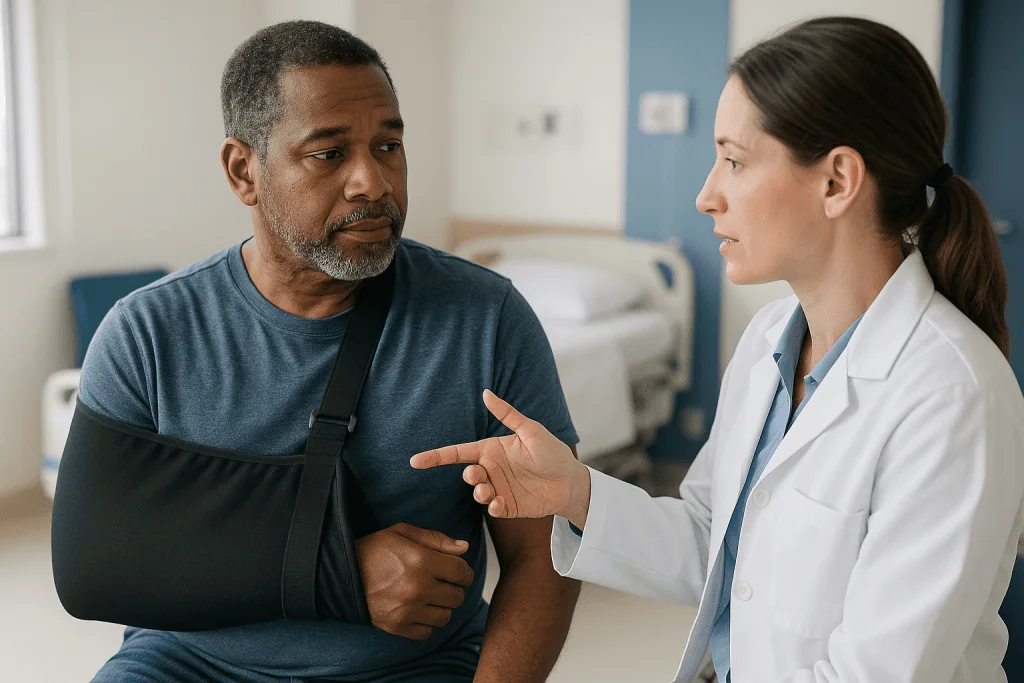
Treat the range as a frame, not a promise. In practice, surgeons hand patients a written protocol that spells out several stages: how many hours a day the sling stays on at first, when it can come off for hygiene and gentle exercises, when it is worn only outdoors or in crowds, and when it is retired altogether. A person with a small tear and strong tissue may be told to start easing out of the sling early in that window. A person with a large tear, thin or degenerated tendon, or a revision of a previous repair may be asked to keep it on toward the longer end or beyond.
Three variables tend to drive the decision:
- The size and number of tendons repaired, since bigger repairs carry more tension across the stitches.
- Tissue quality, because tendon that has been torn for years is often thinner and retracts, making the repair more fragile.
- Any extra procedures done at the same time, such as repairing the biceps tendon, which can lengthen the protection period.
Age, smoking status, diabetes and overall health also influence how quickly tissue heals, which is why two people who had the same operation on the same morning may be given different sling schedules. According to the Mayo Clinic and Cleveland Clinic, full recovery of strength after repair typically takes several months, often 6 months to a year, so the sling is only the opening chapter.
The three healing phases that set the sling timeline
Tendon healing to bone is usually described in three overlapping phases, and each one changes what the shoulder can safely tolerate. Understanding them explains why protocols look the way they do.
The first phase is inflammation. In the first days after surgery the body floods the repair site with cells that clear debris and lay down a fragile clot. Nothing structural has formed. The stitches carry the entire load, which is why the sling is worn almost constantly and why surgeons ask patients not to actively lift the arm at all.
The second phase is proliferation, roughly the first several weeks. Cells called fibroblasts arrive and produce collagen, the protein that gives tendon its rope-like strength. This new collagen is laid down in a disorganized tangle, strong enough to hold a little tension but nowhere near the strength of mature tendon. This is the window when most sling protocols begin loosening: the sling comes off for gentle, therapist-guided movement in which someone else or the other arm moves the shoulder, known as passive range of motion, while the repaired muscle stays switched off.
The third phase is remodeling, and it is long. Over months, that tangled collagen reorganizes along lines of stress and gradually approaches normal tendon strength. The sling is usually gone well before remodeling finishes, which is why patients are told to avoid heavy lifting long after the strap is retired.
The practical lesson is that the day the sling comes off is not the day the tendon is healed. It is the day the repair is judged strong enough to tolerate gravity and gentle motion without the strap doing the work. That distinction matters for every decision in the months that follow.
What the first six weeks in a sling usually look like
The early weeks have a rhythm that surprises people who expected to be sidelined entirely. There is a lot to do, just not with the operated arm.
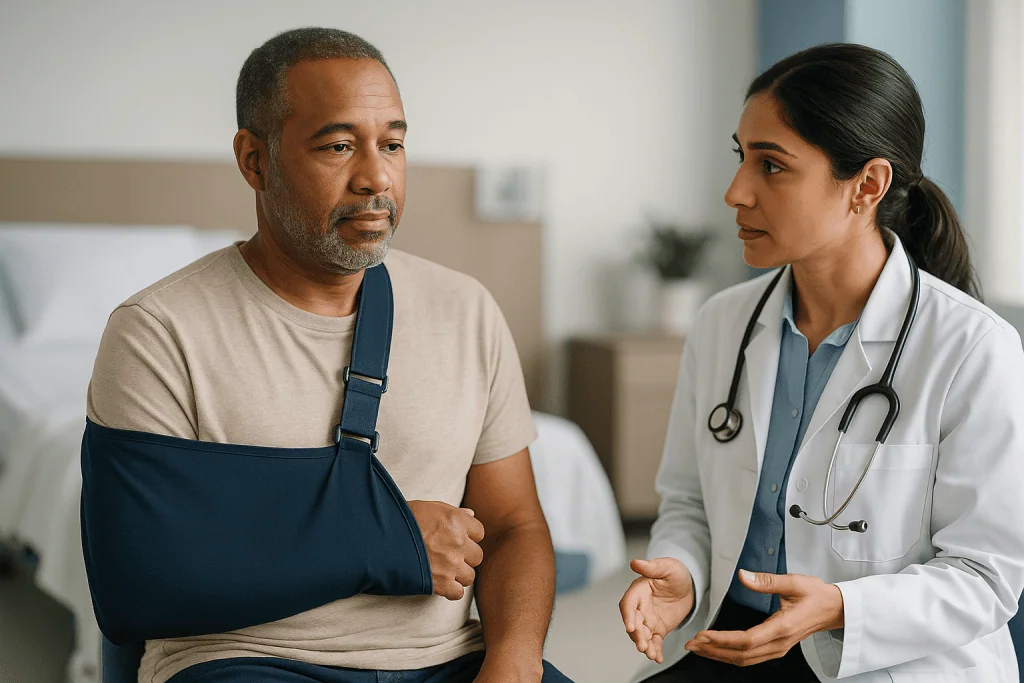
In the first few days the sling stays on except for brief, supervised moments, such as bathing or changing clothes, with the arm kept still and close to the body. Cold packs, kept over a cloth rather than bare skin, are commonly used to ease swelling. Most people are given exercises for the hand, wrist and elbow from the start: squeezing a soft ball, bending and straightening the elbow with the arm supported, making gentle fists. These keep blood moving and prevent the stiffness that creeps into joints that are held still.
Around the end of the first week, many protocols introduce pendulum exercises, in which you lean forward and let the operated arm dangle and swing gently like a clock pendulum, powered by your body rather than the shoulder muscles. Physical therapy visits typically begin in this window, focused on passive motion within limits set by the surgeon.
Everyday life adapts. Buttons and bras become two-handed projects for someone else, or get swapped for front closures and pullover clothing a size larger. Reading glasses migrate to the non-operated side of the bed. Cooking shifts toward foods that need one hand.
According to MedlinePlus discharge guidance, patients are generally told not to drive while wearing the sling and not to lift, push or pull with the operated arm. Sleep is often the hardest part, covered in its own section below. By the end of week six, most people have a sense of whether their surgeon is planning an earlier or later exit from the sling, based on how the repair looks and feels at follow-up.
Who is asked to wear the sling longer, and who may come out sooner
Sling duration is a judgment call made by the surgeon who saw the tendon up close, and several factors tilt that judgment.
People who are often kept in the sling toward the longer end of the range, or beyond it, include those with large or massive tears involving more than one tendon; those whose tendon tissue was thin, frayed or retracted, which is common in tears that have been present for years; those having a revision after a previous repair failed; and those with medical conditions that slow healing, such as diabetes or a history of smoking. The Mayo Clinic notes that larger tears and older age are associated with a higher chance of the repair not healing, so surgeons protect those repairs more conservatively.
People who may be eased out earlier include those with small, acute tears in good-quality tissue, those whose surgeon found a strong, low-tension repair at the time of surgery, and, in some practices, those enrolled in early-motion protocols that begin gentle passive movement within days.
A separate group is worth mentioning: people whose surgery did not involve a tendon repair at all. Some shoulder operations only trim frayed tissue or remove bone spurs, procedures called debridement or decompression. Because nothing is stitched to bone, the sling may be needed only for comfort for a matter of days. Patients sometimes compare notes in waiting rooms without realizing they had different operations.
Whether a sling is used at all after small repairs has been studied. Some surgeons now skip it for select patients, arguing that a well-fixed small repair tolerates gentle motion, while others keep it as a safeguard against the unplanned reach. The evidence, discussed next, does not yet settle the question for everyone, which is exactly why individual protocols vary.
Standard sling, abduction pillow or no sling: what the evidence says
Ask five shoulder surgeons about slings and you may hear five thoughtful, slightly different answers. That is not carelessness; it reflects genuine uncertainty about the best balance between protecting the repair and preventing stiffness.
Randomized trials comparing early passive motion with strict immobilization after arthroscopic repair have generally found that early motion produces modest early gains in range of movement, with no consistent difference in how well the tendon heals for small and medium tears. For large tears, several studies have leaned toward more caution, and many surgeons still favor longer immobilization there. Frank summaries of this literature appear in patient guidance from the Cleveland Clinic and Mayo Clinic, both of which stress that protocols are tailored to tear size and tissue quality.
| Option | How it positions the arm | Typical reasoning | Common trade-offs |
|---|---|---|---|
| Standard sling | Arm at the side, elbow supported | Protects repair, reminds patient not to reach | Can encourage a hunched posture; underarm skin irritation |
| Sling with abduction pillow | Arm held several inches from the body | Reduces tension on tendons at the side or back of the cuff; may aid blood flow | Bulkier; harder for sleeping and clothing |
| No sling or very brief use | Free, with strict activity rules | Selected small, strong repairs; aims to limit stiffness | Relies heavily on patient discipline; not studied in large tears |
What does this mean for a patient? Mainly that a neighbor who was out of the sling in two weeks and a coworker who wore it for eight were probably both following sensible advice for their own shoulders. The strongest predictor of a good result is not the brand or style of sling but following the protocol written for your specific repair.
Can I sit without my sling after rotator cuff surgery?
This is one of the most searched questions after shoulder surgery, and the answer depends on which week you are in and what your protocol allows.
In the earliest days, most surgeons want the sling on even while seated, because the risk is not sitting itself but what a seated person does without thinking: leaning on the armrest, reaching for the remote, pushing up from the chair with both hands. Each of those movements fires the repaired muscle.
As the protocol loosens, usually somewhere in the second half of the sling period, many patients are told they can take the sling off while sitting quietly at home, provided the arm rests supported on a pillow or armrest with the elbow bent and the hand in the lap. The key word is supported. An unsupported arm hanging from a chair pulls on the shoulder through gravity, and a tired shoulder tends to hitch upward, creating tension the repair does not need.
A practical setup used in many recovery guides: sit in a chair with armrests or place a firm pillow across the lap, let the forearm rest on it with the palm up or neutral, and keep the sling within arm’s reach of the other hand so it goes back on before standing. Avoid low sofas that require pushing up to exit.
Two situations deserve extra caution even when sitting is allowed without the sling. The first is the car, where a sudden stop can throw the arm forward; most protocols keep the sling on as a passenger. The second is any crowd or busy household with children or pets, where a bump or a tug can arrive unannounced.
If your written instructions do not address sitting, that is a good question for the next therapy visit rather than something to decide alone.
Sleeping with a sling after shoulder surgery: what actually helps
Nearly everyone who has had rotator cuff repair says the same thing: the nights are the hardest part. Lying flat pulls the shoulder blade back and lets the arm drift, which tightens the repair and wakes people with a deep ache.
Guidance from sources including the Cleveland Clinic and Johns Hopkins Medicine converges on one strategy: sleep propped up. A reclining chair, a wedge pillow or a stack of ordinary pillows that raises the torso to roughly a 30 to 45 degree angle keeps the shoulder in a more relaxed position and makes getting in and out of bed easier without pushing with the operated arm. Many people spend the first two or three weeks in a recliner and only return to bed once the sling schedule loosens.
The sling generally stays on at night during the early weeks, even if it is allowed off for short periods during the day. Sleep is when the arm is least under conscious control, and rolling onto the operated side or flinging an arm overhead can happen without waking. Some protocols allow the sling off at night later in the period; that is a surgeon’s call.
Placing a pillow under the operated elbow and forearm, so the arm is level with or slightly ahead of the body, takes strain off the front of the shoulder. Another pillow behind the back discourages rolling. Loose, front-opening sleepwear avoids wrestling with the sling in the dark.
A few people find that a small pillow tucked between the arm and the chest, where an abduction wedge would sit, eases the ache. Cold packs before bed can help some people settle, applied over a cloth for a limited time as advised.
Poor sleep for a few weeks is common and usually improves as swelling settles. Persistent sleeplessness with escalating pain, though, is worth reporting rather than enduring.
The worst things to do after rotator cuff surgery
Most retears do not come from dramatic accidents. They come from small, ordinary movements repeated before the tendon is ready. Knowing the highest-risk habits helps more than a long list of rules.
Actively lifting the arm sits at the top. Raising the operated arm under its own power, even to shoulder height, contracts the repaired muscle directly. Protocols allow someone else to move the arm long before they allow you to move it yourself, and the distinction is deliberate.
Pushing up from a chair, bed or bathtub is a close second. The motion loads the shoulder in a way that mimics a press, and people do it dozens of times a day without noticing.
Reaching behind the back, whether to tuck in a shirt, fasten a bra or grab a seatbelt, twists the shoulder into internal rotation and puts specific tension on the repaired tendon. This movement is typically among the last to be reintroduced.
Carrying anything with the operated hand, even a light bag, transmits load straight to the cuff. Weight limits in protocols often start at roughly a coffee cup and rise only gradually over months, per MedlinePlus discharge guidance.
Driving while in a sling is generally discouraged, both for safety and because the sudden corrections driving demands are exactly the movements the sling is meant to prevent.
Skipping physical therapy or the home exercises is a quieter risk. Stiffness in the shoulder capsule, sometimes called frozen shoulder, can set in when a shoulder is held still without the gentle motion that protocols build in.
Finally, smoking slows tendon healing, and mainstream sources including the Mayo Clinic list it among the factors linked to repairs that fail to heal. If that applies to you, it is worth raising with your team as part of the recovery plan.
Should you wear a sling for a torn rotator cuff if you have not had surgery?
Not everyone with a rotator cuff tear has an operation. The NHS and Mayo Clinic both note that many tears, particularly partial tears and degenerative tears in older adults, are managed without surgery through activity modification, physical therapy and pain control. That raises a fair question: does a sling help a torn tendon heal on its own?
For most non-surgical tears, the answer is usually no, and prolonged sling use can cause harm. A sling for a torn rotator cuff may be suggested for a few days after an acute injury to ease pain and let inflammation settle. Beyond that, keeping the shoulder immobile invites stiffness and weakness in the surrounding muscles, which tend to make the shoulder feel worse rather than better. Therapy programs for non-surgical tears deliberately keep the shoulder moving within comfort.
There is also a biological point. A torn tendon that has pulled away from bone does not reattach itself simply because the arm is held still; without surgical fixation there is nothing holding the tendon against the bone for healing to bridge the gap. The goal of non-surgical care is therefore not to heal the tear but to keep the shoulder strong, mobile and comfortable enough that the tear does not limit daily life. Many people manage well this way for years.
Where a sling may be reasonable without surgery is short term: the first days after a fall, or during a flare when pain is limiting sleep. Even then, most clinicians advise removing it several times a day to move the elbow, wrist and hand and to let the shoulder swing gently.
If a shoulder feels weak enough that you want to keep it in a sling for comfort week after week, that is a reason for assessment, not a reason to buy a sling. Sudden weakness after an injury in particular deserves prompt evaluation.
Pain, medicines and the sling: how they fit together
The sling and pain relief work as a team in the early weeks, and understanding how helps people use both sensibly.
Much of the pain after rotator cuff repair comes from two sources: inflammation at the surgical site and muscle guarding, the reflexive tightening of muscles around a sore joint. The sling addresses both indirectly by supporting the weight of the arm, which otherwise hangs from inflamed tissue all day. Many people notice that pain climbs sharply during the brief moments the sling is off for washing and settles once the arm is supported again.
Medicines are typically layered. Many surgeons use a nerve block during the operation, in which local anesthetic is placed around the nerves that supply the shoulder. This can leave the arm numb and heavy for many hours afterward, sometimes into the next day, according to Johns Hopkins patient guidance. The sling matters most during this window, because a numb arm cannot protect itself.
Once sensation returns, prescribed pain relievers may include anti-inflammatory medicines, which reduce the chemical signals driving swelling, and, for a short period, stronger prescription analgesics that act on pain pathways in the nervous system. Cold packs and positioning are used alongside them. How these are combined, for how long, and when they are stepped down is a decision for the prescribing clinician, and any changes should go through that team rather than being made at home.
A useful pattern to watch: pain that is worst in the first days and steadily improves week by week is the expected course. Pain that plateaus and then climbs again, or new pain in a different location, is not, and belongs in a conversation with the surgical office.
The sling also earns its place at physical therapy sessions, where it comes off for controlled movement and goes back on before the walk to the car.
What weaning off the sling usually looks like
Coming out of the sling is rarely a single moment. It is a taper, and understanding its usual shape helps people resist the temptation to rush it.
The first loosening typically arrives partway through the protected phase: the sling comes off for physical therapy and prescribed home exercises, then goes back on. Next come short sling-free periods at home while seated with the arm supported. After that, the sling is often dropped indoors but kept for outdoors, crowds, car travel and sleep. Finally it is retired altogether.
What changes underneath is the exercise program. Around the point the sling is retired, many protocols move from passive motion, in which the arm is moved for you, to active-assisted motion, in which you begin to help with the movement using the other arm or a pulley, and then to active motion, in which the operated arm lifts itself with no weight. Strengthening with resistance usually waits until several weeks after the sling is gone, and heavier lifting waits longer still.
Patient information from the Cleveland Clinic and MedlinePlus describes full recovery as a process of roughly 6 months to a year, with strength returning gradually through the second half of that period. Overhead sports and heavy manual work typically sit at the far end of the timeline.
Several signs suggest the taper is going as planned:
- Pain during sling-free periods is mild and settles quickly once the arm rests.
- Passive motion at therapy keeps improving from visit to visit.
- The shoulder does not feel unstable or as though it is catching.
A common mistake is treating sling removal as a green light for normal life. The tendon is strong enough for gravity, not for groceries. Keeping that image in mind through the following months is one of the most protective things a patient can do.
What people often get wrong about the sling after rotator cuff surgery
Several myths circulate in waiting rooms and online forums. Setting them straight prevents real harm.
“If it does not hurt, it must be fine to move.” Pain is a poor guide in the first weeks. Nerve blocks numb the arm, prescribed medicines dull sensation, and a tendon under tension does not necessarily hurt until it fails. The protocol, not comfort, sets the limits.
“Longer in the sling always means a stronger repair.” Prolonged immobility beyond what the surgeon prescribes invites stiffness and muscle wasting, and the evidence on early controlled motion suggests that gentle movement within limits does not harm healing in smaller tears. More is not automatically safer.
“My neighbor was out in two weeks, so I should be too.” Different tear sizes, tissue quality and even different operations produce different timelines. Comparisons are rarely apples to apples.
“The sling is what heals the tendon.” The sling protects; the body heals. Once the sling is off, the tendon is still remodeling for months and still needs protection from heavy loads.
“Slings cause frozen shoulder, so I should skip mine.” Stiffness after surgery is real, which is why protocols build in early elbow, wrist and pendulum exercises and therapist-guided passive motion. The remedy is following the movement plan, not discarding the sling.
“I can drive if I take the sling off for the trip.” The sling is off, but the repair is unchanged, and steering demands exactly the reaching and gripping the protocol forbids. Most surgeons advise against driving until cleared.
“The pillow is optional.” An abduction wedge is prescribed for a mechanical reason: it positions the arm to reduce tension on specific tendon fibers. Removing it changes the position of the repair.
When advice online conflicts with the printed protocol from your surgeon, the printed protocol wins.
Questions to ask your care team about your sling
Recovery goes more smoothly when expectations are explicit. These questions turn a general protocol into one you can follow with confidence.
- How many tendons were repaired, how large was the tear, and how did the tissue quality look? This shapes everything about your timeline.
- What is my planned sling schedule, week by week, and when will you reassess it?
- Is the sling to stay on at night, and if so, until when?
- May I remove it while sitting at home with the arm supported, and from which week?
- Is an abduction pillow part of my sling, and what happens if it is uncomfortable?
- Which exercises should I start now, and which movements are off limits entirely?
- When will physical therapy begin, and how often?
- What weight can I lift with the operated hand, and when does that limit rise?
- When may I drive, return to desk work, and return to physical work or sport?
- How should I bathe and dress in the first weeks?
- Which signs mean I should call the office rather than wait for my next appointment?
- Do any of my medical conditions or medicines change my healing timeline?
Writing the answers down, or asking for them in a printed protocol, matters more than it sounds. Post-anesthesia memory is unreliable, and a family member who attends the appointment often catches details the patient misses.
One more question is worth asking early: what does a normal week of recovery feel like, and what would worry you? Surgeons and therapists see hundreds of shoulders and can describe the expected arc of pain and progress. Knowing that arc makes it far easier to notice when something falls outside it.
These conversations are not second-guessing your surgeon. They are how a protocol written for a typical patient becomes a plan that fits the person actually wearing the sling.
When to call your doctor
Most of the early recovery is uncomfortable but predictable. A short list of signs falls outside that pattern and warrants a call to the surgical team the same day, or emergency care where noted.
Call the surgeon’s office promptly for:
- Fever, or increasing redness, warmth, swelling or drainage from the incisions, which can signal infection.
- Pain that steadily worsens after the first few days rather than easing, or pain that no longer responds to the prescribed plan.
- A sudden pop, tearing sensation or abrupt new weakness in the shoulder, particularly after a fall or an unplanned reach, which may indicate the repair has pulled loose.
- Numbness, tingling, coldness or a pale or bluish color in the hand or fingers that does not resolve with repositioning, which may indicate pressure on nerves or blood vessels.
- A sling that no longer fits or holds the arm in the prescribed position.
Seek emergency care immediately for:
- Chest pain, sudden shortness of breath or coughing up blood, which can be signs of a blood clot in the lungs.
- Pain, swelling or warmth in the calf, which can indicate a clot in the leg.
- Severe, uncontrolled bleeding from an incision.
Blood clots after shoulder surgery are uncommon compared with hip or knee surgery, but they occur, and staying mobile, walking daily and keeping the fingers and elbow moving reduces the risk. Anyone with a personal or family history of clots should discuss this with the team before surgery.
Beyond emergencies, do not hesitate to call about things that simply feel wrong. A repair that is progressing normally has a recognizable rhythm, and the people who know that rhythm best are the surgeon and therapist following your case. Every decision about the sling, the exercises and the return to activity rests with them.
Frequently asked questions
How long will I need to wear a sling after rotator cuff surgery?
Most people wear a sling for about 4 to 6 weeks after rotator cuff repair, according to patient guidance from MedlinePlus and Johns Hopkins Medicine. Smaller repairs in good tissue may be eased out earlier, while large tears, revision repairs or repairs combined with other procedures may be protected longer. Your surgeon sets the schedule based on what was found and fixed during your operation.
Can I sit without my sling after rotator cuff surgery?
Often yes, but usually not in the first days and only once your protocol allows it. When permitted, sit with the arm resting on a pillow or armrest, elbow bent, hand in the lap, and avoid pushing up from the chair or reaching. Keep the sling on as a car passenger and in crowded settings. If your written instructions do not address sitting, ask your therapist or surgeon rather than guessing.
What are the worst things to do after rotator cuff surgery?
The highest-risk habits are actively lifting the operated arm under its own power, pushing up from chairs or beds, reaching behind the back, carrying anything in the operated hand and driving while in the sling. Skipping physical therapy and smoking also work against healing. Most retears come from small everyday movements repeated too early rather than from dramatic accidents.
Should you wear a sling if you tore your rotator cuff but are not having surgery?
Usually only briefly. A sling for a torn rotator cuff can ease pain for a few days after an acute injury, but wearing it for weeks tends to cause stiffness and weakness without helping the tendon reattach, since nothing holds a detached tendon to bone without surgical fixation. Non-surgical care focuses on keeping the shoulder mobile and strong, and persistent weakness after injury warrants assessment.
How do I sleep with a sling after shoulder surgery?
Sleep propped up in a recliner or on a wedge of pillows so the torso is raised, with a pillow under the operated elbow and forearm to keep the arm level with the body and another pillow behind the back to prevent rolling. The sling generally stays on at night in the early weeks. Front-opening sleepwear and a cold pack before bed, as advised, help many people settle.
Why does my sling have a big foam pillow attached?
That wedge is an abduction pillow. It holds the arm several inches away from the body, which reduces tension on tendons at the side and back of the rotator cuff and may improve blood flow to the repair. Surgeons choose it for specific tear patterns, so the wedge is part of the treatment rather than optional padding. Talk to your team before removing or modifying it.
Does wearing the sling longer make the repair stronger?
Not beyond what your surgeon prescribes. Immobilization protects the repair during early healing, but excess stillness leads to stiffness and muscle wasting, and studies of early controlled motion have not shown harm to healing in small and medium tears. The tendon gains strength through months of remodeling and gradual loading, not through extra weeks in the strap.
When can I drive after rotator cuff surgery?
Most surgeons advise against driving while wearing the sling, both because a sling limits control of the vehicle and because sudden steering movements are exactly the reaching and gripping the repair must avoid. Clearance to drive typically comes after the sling is retired and the arm can move actively and comfortably, and it is a decision for your surgical team rather than a fixed date.
Is the tendon healed when the sling comes off?
No. Sling removal means the repair is judged strong enough to tolerate gravity and gentle active motion, but the collagen bridging tendon and bone is still immature and continues remodeling for months. Cleveland Clinic and MedlinePlus describe full recovery as roughly 6 months to a year. Lifting limits and activity restrictions therefore continue well after the sling is gone.
What signs after rotator cuff surgery mean I should call my surgeon?
Call the same day for fever, spreading redness or drainage at the incisions, pain that worsens after the first few days, a sudden pop or new weakness, or numbness or color change in the hand that does not resolve with repositioning. Seek emergency care for chest pain, sudden breathlessness or calf pain and swelling, which can signal blood clots.
References
This article is for general information only and is not a substitute for professional medical advice. Please consult a qualified doctor about your individual situation.

More from the Blog

Living With Hip Bursitis: Sleeping, Sitting and Exercise Choices That Calm the Flare
Living with hip bursitis mostly means managing load on the outer hip: avoid lying directly on the sore side, stop crossing your legs or…
The Brostrom Procedure: Fixing Chronic Ankle Instability, Step by Step
The Brostrom procedure is an outpatient operation that tightens and reattaches the stretched outer ankle ligaments, usually the anterior talofibular and calcaneofibular ligaments, to…
When an ACL Graft Fails: Re-Rupture Causes and How Revision ACL Reconstruction Differs
ACL graft failure means a reconstructed ligament has torn, stretched or loosened enough that the knee is unstable again. Causes fall into three groups:…

How Quickly Does Tenosynovitis Settle? Healing Phases From Splint to Full Use
Tenosynovitis usually settles over weeks rather than days. With early rest and a splint, mild overuse cases often ease within a few weeks, and…

Shoulder Impingement vs Rotator Cuff Tear: How Doctors Tell the Two Apart and Why It Matters
Shoulder impingement is irritation of the rotator cuff tendons and the bursa as they pass beneath the bony roof of the shoulder blade; a…
Anesthesia for Arthroscopy: General, Regional or Spinal and Why Same-Day Discharge Is Usual
Arthroscopy is usually done under general anesthesia (fully asleep), spinal anesthesia (numb from the waist down, often with sedation), or a regional nerve block…