

Bankart Repair and Labrum Surgery: Stabilising the Dislocating Shoulder
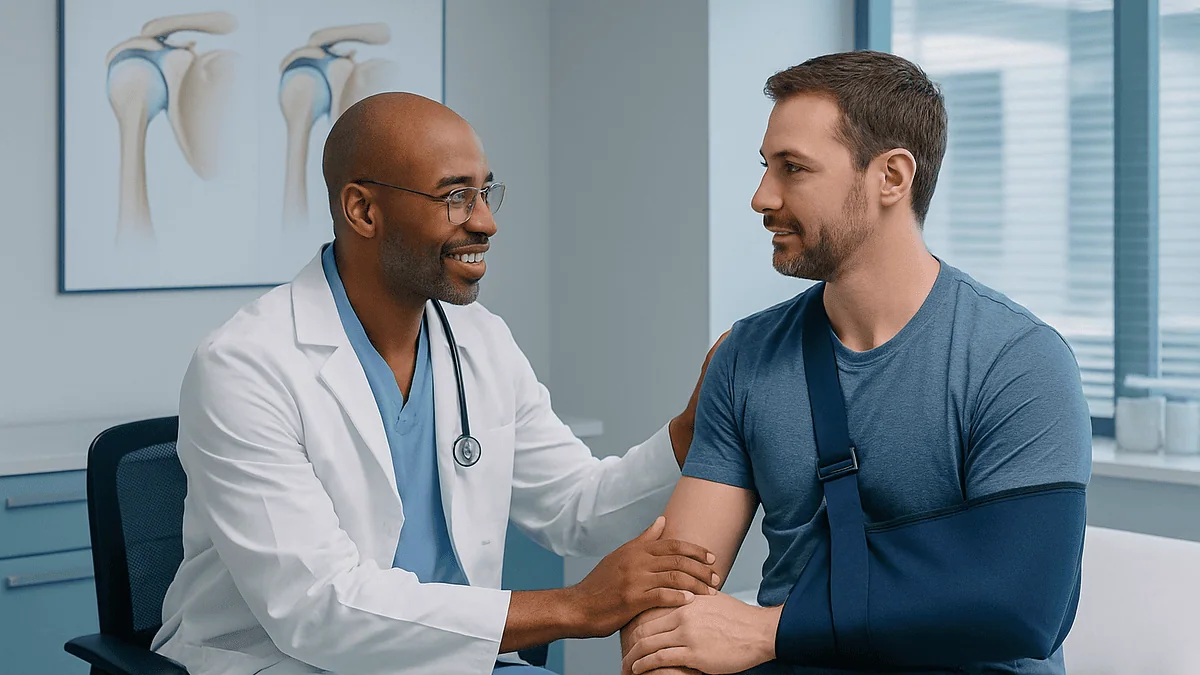
Key Takeaways
- A Bankart lesion, the labrum torn from the front-lower socket rim, is found in the large majority of traumatic anterior shoulder dislocations, making it the signature injury behind recurrent instability.
- Age drives recurrence: some studies report that more than 80 percent of athletes who first dislocate under age 20 will dislocate again without surgery, while first-timers over 40 rarely do.
- Arthroscopic Bankart repair typically uses two to four small suture anchors, takes about 60 to 90 minutes, and is usually done as a day procedure under general anesthesia with a nerve block.
- Recovery follows a fixed biological clock, roughly three to six weeks in a sling, three months before serious strengthening, and six or more months before collision sports, regardless of how good the shoulder feels early.
- Published redislocation rates after arthroscopic repair run roughly 5 to 15 percent, versus recurrence rates that can exceed 80 percent in young athletes treated without surgery.
- Repeated dislocations erode bone from the front of the socket, and once loss reaches roughly 15 to 20 percent, a standard soft-tissue repair fails too often: a bone-transfer procedure like the Latarjet becomes the better-supported option.
Bankart repair is surgery that reattaches the torn front rim of the shoulder socket's cartilage (the labrum) after dislocation, usually through keyhole incisions with small suture anchors. It typically takes about an hour, is often done as a day procedure, and needs roughly four to six months of rehabilitation. For people with repeated dislocations, evidence shows it substantially lowers the chance of the shoulder coming out again.
The rec-league volleyball player felt it before she heard it. Arm cocked for a spike, a defender’s hand on her wrist, and then that sickening lurch: the ball of her shoulder sliding out of its socket for the second time in fourteen months. In the emergency department, the reduction took seconds. The question she asked next takes an entire article to answer honestly: will this keep happening?
For a lot of people, the truthful answer is yes. A shoulder that dislocates once, especially in someone young and active, has often torn the very structure designed to keep it in place. That structure is the labrum, and the operation most often used to fix its front edge carries the name of a British surgeon who described the injury back in 1923.
Here’s what the procedure actually involves, what recovery genuinely feels like, and, because this is elective surgery, when it’s worth doing and when it isn’t.
What actually happens when a shoulder dislocates?
Your shoulder trades stability for range of motion, and it trades aggressively. The joint is often compared to a golf ball sitting on a tee: the humeral head (the ball) is large, and the glenoid (the socket) is a shallow dish covering only about a quarter to a third of it. That geometry lets you throw, swim, and reach the top shelf, and it’s also why the shoulder dislocates more often than any other major joint in the body.
What keeps the ball on the tee isn’t bone. It’s soft tissue: the labrum, a ring of firm fibrocartilage that deepens the socket like a bumper around its rim, plus the joint capsule and ligaments that anchor into that labrum. Roughly 95 percent of traumatic dislocations are anterior: the ball driven forward and down, classically when the arm is forced backward while raised and rotated outward, the position of a blocked throw or an arm tackle.
When the humeral head plows forward with that much force, something has to give. Usually it’s the front-lower portion of the labrum, which peels off the bone and takes the attached ligaments with it. According to Johns Hopkins Medicine, the shoulder’s mobility is precisely what makes it vulnerable; the labrum tear is the price of the escape.
What is a Bankart lesion, and why won't it heal on its own?
A Bankart lesion is that specific injury: the labrum and its ligament attachments torn away from the front-lower rim of the glenoid, typically between the three o’clock and six o’clock positions on a right shoulder. Imaging and arthroscopy studies find it in the great majority of first-time traumatic anterior dislocations: it is, in effect, the signature wound of the injury.
The healing problem is mechanical and biological at once. Fibrocartilage has a limited blood supply, so its capacity to knit back to bone is modest to begin with. Worse, a torn labrum doesn’t sit and wait. The pull of the capsule drags it away from the rim, and it often scars down in the wrong position, lower on the glenoid neck, where it deepens nothing and tensions nothing. The bumper is now parked beside the driveway instead of at its edge.
Two variants matter for planning. A bony Bankart means a fragment of the socket rim broke off with the labrum. A Hill-Sachs lesion is a dent in the back of the humeral head, stamped in where it jammed against the socket edge during dislocation. Both change the maths of stability, and both influence whether a standard soft-tissue repair will be enough: a point we’ll come back to.
Is a Bankart repair the same as a labrum repair?
Close, but the terms aren’t interchangeable, and the confusion is understandable. A Bankart repair is a labrum repair, but of one specific region: the front-lower rim, the part torn by anterior dislocation. Think of “labrum repair” as the category and “Bankart repair” as the most common item in it.
The labrum can tear in other places for other reasons:
- SLAP tears (Superior Labrum, Anterior to Posterior) involve the top of the labrum where the biceps tendon anchors. They come from repetitive overhead throwing or a fall onto an outstretched arm, and they usually cause pain and clicking rather than dislocation. Johns Hopkins notes these are a distinct injury with different treatment logic.
- Posterior labral tears (sometimes called reverse Bankart lesions) sit at the back of the socket, seen in football linemen and weightlifters who load the arm in front of the body.
The distinction matters practically. If a friend had “labrum surgery” for throwing pain, their operation, rehab, and outcome tell you little about surgery for a dislocating shoulder. Repairs for instability are judged on one blunt outcome, does the shoulder stay in?, while SLAP surgery is judged mostly on pain and throwing function, where results are frankly more mixed. When you read recovery stories online, check which repair the writer actually had.
Why does a dislocated shoulder keep dislocating?
Age at first dislocation is the single most powerful predictor of whether there will be a second, and the numbers are stark. In studies of patients under 20, recurrence rates after a first traumatic dislocation run high; several long-term series report that most young, active patients dislocate again, with some cohorts above 80 percent. Past 40, the pattern flips: recurrence becomes far less common, though rotator cuff tears become the bigger worry.
The mechanics explain the gloom. Once the labral bumper has peeled off, the socket is shallower and the front ligaments hang slack, so the force needed for the next dislocation drops. Each episode can stretch the capsule further and, critically, grind away small amounts of bone from the front of the socket. Surgeons describe advanced bone loss as an “inverted pear” glenoid: a socket that has lost the wide lower portion that resists the ball sliding forward.
That erosion is why the keep-waiting strategy carries a hidden cost. A soft-tissue Bankart repair works best on a socket with its bone intact; once meaningful bone has gone, failure rates for the standard repair climb, and bigger reconstructive operations enter the conversation. The NHS advises that recurrent dislocation generally warrants specialist assessment rather than repeated trips to the emergency department, and the bone-loss problem is a large part of the reason.
Who actually needs Bankart repair surgery?
Not everyone who dislocates once. Mayo Clinic notes that many first-time dislocations, particularly in older adults or people with lower physical demands, do well with a short period of immobilization followed by structured physical therapy to rebuild the rotator cuff and shoulder-blade muscles that provide dynamic stability. Muscles can compensate, at least partly, for a damaged bumper.
Surgery moves up the list when the risk profile changes:
- Recurrent dislocations or subluxationsthe shoulder that comes out, or half-out, with less and less provocation.
- Young, athletic patients, especially in collision or overhead sports, where the recurrence odds after nonsurgical care are poorest.
- Persistent apprehensiona shoulder that never fully dislocates again but can’t be trusted, that makes its owner flinch away from a throwing position or a reach behind the car seat.
- A significant bony Bankart fragment, where early fixation can restore the rim before it erodes.
There’s an honest debate in sports medicine about operating after a first dislocation in high-risk athletes, and randomized trials have generally found lower recurrence with early repair in that specific group. The counterargument, some patients would have been fine without surgery, is also legitimate. What the evidence doesn’t support is drifting through four or five dislocations before seeking an opinion, because each one can make the eventual fix harder.
Is Bankart repair a major surgery?
It occupies a middle ground worth describing precisely: a real operation with a long rehabilitation, but not “major surgery” in the sense of an open chest or a hospital week. Most Bankart repairs today are arthroscopic, performed through two or three incisions about the size of a shirt buttonhole, and, per MedlinePlus, patients typically go home the same day.
A few honest markers of scale:
- Anesthesia: general anesthetic, very often combined with a regional nerve block that numbs the arm for hours afterward.
- Operating time: commonly in the range of one to one and a half hours.
- Hospital stay: usually none beyond the recovery room.
- Time in a sling: generally three to six weeks.
- Full recovery: four to six months for most activities, often longer for collision sports.
That last line is where the “minor keyhole procedure” framing misleads people. The surgical trauma is small; the biological task is not. Reattached labrum has to heal to bone, and healing tissue can’t be rushed by enthusiasm. Patients who breeze through the first two weeks sometimes conclude the operation was trivial and push too hard in month two, which is exactly when the repair is still vulnerable. Small scars, serious timeline. Hold both ideas at once and the recovery goes better.
What happens during the operation, step by step
Knowing the sequence takes some of the mystery, and the anxiety, out of consent day.
After anesthesia, you’re positioned either seated in a “beach chair” or lying on your side with the arm in gentle traction. The surgeon inflates the joint with sterile fluid, inserts a pencil-thin camera through one small incision, and works instruments through the others. The first act is diagnostic: a systematic tour of the joint confirming the Bankart tear and checking for companions: a Hill-Sachs dent, a stretched capsule, cartilage wear, biceps anchor damage.
Then the repair itself, in three movements. The torn labrum is mobilizedfreed from any scar tissue holding it in the wrong position on the glenoid neck. The bone of the socket rim is prepared, lightly abraded until it bleeds, because bleeding bone is what biology needs to accept the tissue back. Finally, the labrum is fixed: typically two to four small suture anchors, each a few millimeters wide, are set into the rim, and their attached stitches loop through the labrum and cinch it firmly back onto the socket edge, often re-tensioning the slack capsule in the same stitch.
The anchors stay in permanently; modern versions are usually absorbable or made of a plastic-like polymer, and there’s no hardware to feel or remove later. Skin closure takes a couple of stitches per portal. From first incision to dressing, most repairs finish inside ninety minutes.
Arthroscopic vs. open repair, and when bone surgery enters the picture
Open Bankart repair, done through a single larger incision at the front of the shoulder, was the gold standard for decades and still has advocates for specific situations. Modern arthroscopic techniques, though, have largely closed the historical gap in redislocation rates, and keyhole repair now dominates because it causes less disruption to the overlying muscle, allows a full inspection of the joint, and tends to preserve slightly more rotation. For a standard tear with good bone, the choice today often comes down to surgeon experience, and asking your surgeon which approach they do most, and why, is a fair and useful question.
The bigger fork in the road is bone loss. When repeated dislocations have eroded a meaningful portion of the front socket, many surgeons treat somewhere around 15 to 20 percent as the caution zone, measured on CT or MRI: a soft-tissue repair alone fails too often to be the right offer. The commonly used alternative is the Latarjet procedure, which transfers a small piece of bone (the coracoid, with its attached tendon) to the front of the socket, rebuilding the rim and adding a muscular sling across the joint.
A large Hill-Sachs dent that “engages” the socket edge changes the plan too, sometimes prompting an added step called remplissage that fills the defect with adjacent tissue. None of this needs memorizing. The takeaway is simpler: preoperative imaging isn’t box-ticking: it decides which operation you should actually have.
How painful is Bankart repair surgery, honestly?
Painful enough to plan for; rarely as bad as people fear. Here’s the realistic arc, drawn from what surgical teams consistently tell patients.
Days 0–3: the deceptive phase. A regional nerve block often keeps the arm numb for 12 to 24 hours, so the first evening can feel almost suspiciously easy. When the block wears off, frequently in the middle of the night, the shoulder aches deeply, and this is the window when the short course of pain relief your team prescribes earns its keep. Ice and keeping the arm supported in the sling do real work here.
Days 4–14: steady descent. Most people transition to simpler pain control within the first week. Sleep is the honest complaint, lying flat pulls on the repair, and many patients spend two to four weeks sleeping semi-upright in a recliner or propped on a wedge of pillows.
Weeks 3–8: the character of the pain changes. Rest pain fades; stretch pain arrives, because physical therapy begins coaxing back motion that the healing capsule resists. It’s discomfort with a purpose, and therapists deliberately keep it within limits that protect the anchors.
Beyond: occasional deep aches with weather, fatigue, or a hard rehab session, tapering over months. Compared with larger shoulder operations, rotator cuff repair is the usual benchmark, Bankart repair sits toward the more manageable end. The struggle most patients remember isn’t pain at all. It’s the sling.
The recovery timeline, week by week
Protocols vary between surgeons, and your own instructions always win. But the broad architecture of Bankart rehabilitation is remarkably consistent, because it’s built around one biological fact: labrum-to-bone healing takes roughly three months to become strong, and pushing rotation too early is the classic way to undo a good repair.
| Phase | Timeframe | What’s happening | Everyday milestones |
|---|---|---|---|
| Protection | Weeks 0–4/6 | Sling nearly full-time; hand, wrist, and elbow exercises; gentle pendulum motion; external rotation strictly limited | Typing, eating, short walks; desk work often possible in 1–2 weeks |
| Motion | Weeks 4/6–12 | Sling weaned; therapist-guided range of motion, gradually restoring rotation; light isometric strength | Dressing normally, driving (with surgeon clearance), most daily tasks |
| Strength | Months 3–4/5 | Progressive resistance for rotator cuff and scapular muscles; endurance work; motion nearly full | Gym training with restrictions, jogging, swimming build-up |
| Return to sport | Months 4–6+ | Sport-specific drills, throwing progressions, contact readiness testing | Non-contact sport ~4–6 months; collision sport often 6+ months |
Two practical notes hide inside that table. Driving usually returns somewhere in the six-to-ten-week range, once the sling is gone and you can control the wheel confidently, insurers and surgeons both expect genuine arm function, not optimism. And manual workers should budget for three months or more away from heavy lifting and overhead tasks, while office workers often return within a week or two, sling and all.
What rehab really looks like, and why the sling phase matters
Rehabilitation after Bankart repair is a study in restraint before it’s a study in effort. The early weeks are governed by one arithmetic problem: the sutures holding your labrum are strong, but the position that tore it in the first place, arm out to the side, rotated backward, as if signaling a turn or reaching for the back seat, loads the repair directly. So that motion, external rotation in abduction, is rationed carefully for weeks.
Expect the work to arrive in layers. First come pendulum swings and elbow and grip exercises to keep the arm from stiffening wholesale. Then a therapist begins moving the shoulder for you, passive motion, before handing control back gradually. Strengthening starts with isometrics (pushing against an immovable hand) around week six, graduates to elastic bands, and only later to free weights. A surprising amount of the program targets the shoulder blade rather than the shoulder itself, because a well-controlled scapula gives the socket a stable platform and measurably offloads the repair.
The psychological curve is real and worth naming. Around weeks eight to twelve, the shoulder feels good, deceptively good, while the repair is still consolidating. This is the classic window for a re-injury born of confidence: the casual throw, the heavy overhead press, the pickup game “just at half speed.” Patients who treat the protocol as a floor rather than a ceiling, attend their sessions, and do the tedious home program are the ones whose six-month shoulders match their expectations.
When can you get back to sport?
The answer depends less on the calendar than on what your sport asks of the shoulder, though the calendar sets a hard minimum, because tissue healing won’t negotiate.
- Running and cycling: often around three months, once the repair no longer needs protection from a fall or arm swing.
- Swimming: a graded return typically starting around three to four months, with strokes that force rotation (butterfly, aggressive freestyle catch) added last.
- Overhead and racquet sports: throwing and serving progressions usually begin around four months, with full competitive intensity closer to six.
- Collision sportsrugby, football, wrestling, judo: most surgeons hold the line at six months minimum, and some prefer nine for athletes whose sport involves being tackled by surprise.
Time served isn’t the real gate; testing is. Sensible return-to-play criteria include full pain-free range of motion, strength on the operated side within roughly 90 percent of the other arm, no apprehension in the throwing position, and successful completion of sport-specific drills at match intensity. Athletes who skip the testing and go by feel are over-represented in the re-dislocation statistics.
One more honest expectation: some athletes, particularly throwers, notice a small permanent loss of external rotation, often a few degrees, because the repair deliberately re-tensions a capsule that instability had stretched. For most sports it’s irrelevant. For elite pitchers and javelin throwers, it’s a genuine trade-off worth discussing before surgery, not after.
Is a Bankart repair worth it? What the numbers say
For the right shoulder, the evidence is about as favorable as elective orthopedic surgery gets. Published series of arthroscopic Bankart repair in appropriately selected patients, good bone stock, competent rehab, report redislocation rates broadly in the range of 5 to 15 percent, against recurrence rates that can exceed 80 percent in young athletes managed without surgery. High proportions of patients return to their sport, most at or near their previous level. Framed as a bet, trading a coin-flip-or-worse chance of the next dislocation for a roughly one-in-ten chance is the kind of odds shift few interventions deliver.
The honest caveats belong in the same paragraph. Results are worse with significant glenoid bone loss (where a bone procedure is often the better offer), in collision athletes, in people who dislocated many times before surgery, and in patients under about 20, whose tissue quality and activity levels both work against them. Surgery also cannot promise a specific outcome for any individual, statistics describe groups, not you, and it demands four to six months of genuine rehabilitation effort to cash in its advantages.
Where the calculation tilts against surgery: the person over 40 with a single dislocation and no instability since, the low-demand shoulder that behaves itself, the patient unwilling or unable to complete rehab. Where it tilts toward: the young athlete on their second dislocation, the tradesperson whose shoulder gives way on ladders, anyone whose imaging shows bone starting to erode. The worth of the operation is really the worth of matching it to the right problem.
Risks and complications worth knowing about
Every honest consent conversation covers the same territory, so here it is in plain language.
Recurrent instability is the headline risk: the operation’s own failure mode. That 5-to-15-percent redislocation range isn’t randomly distributed: it concentrates in young collision athletes, in shoulders with unrecognized bone loss, and in early returns to sport. A repair that fails usually declares itself with a new traumatic event, not a slow unraveling.
Stiffness is the trade-off in the other direction. Tightening a stretched capsule costs some motion, usually a few degrees of external rotation; occasionally the shoulder over-scars and needs months of extra therapy to loosen. It’s the mirror-image complication of instability, and surgeons aim between the two.
The rarer entries: infection (uncommon in arthroscopy, typically well under 1 percent in published series), blood clots (rare in shoulder surgery compared with hip or knee procedures), nerve irritation from positioning or the regional block (usually temporary), anchor problems such as loosening, and, over decades, a modest association between instability itself and earlier joint arthritis. That last one deserves fair framing: repeated dislocations damage cartilage too, and current evidence doesn’t show that a well-done repair accelerates arthritis compared with a shoulder left to dislocate.
Contact the surgical team promptly, don’t wait for a scheduled visit, for fever, spreading redness or discharge at the portals, calf pain or swelling, chest symptoms, or numbness that persists beyond what you were told to expect from the block.
When to see a doctor about an unstable shoulder
Some shoulder situations are emergencies; others are appointments you shouldn’t keep postponing. Both deserve spelling out.
Go to emergency care now if:
- Your shoulder is visibly out of place, intensely painful, and you can’t move the arm: a dislocated joint needs prompt professional reduction. Both Mayo Clinic and the NHS are unambiguous: don’t let anyone pop it back at the sideline, because untrained reduction can fracture bone or injure nerves and vessels.
- The hand or arm is numb, tingling, cold, or discolored after an injury, possible nerve or blood-vessel involvement.
- A dislocation happened with major trauma, such as a car crash or a fall from height.
Book a medical review soon if:
- Your shoulder has dislocated or partially slipped more than once, recurrence changes the treatment conversation, and each episode can cost socket bone.
- You avoid certain arm positions out of fear the joint will give way; apprehension is a symptom, not a personality trait.
- Pain, clicking, catching, or weakness persists weeks after a dislocation that was supposedly “back to normal.”
- A first dislocation happened after age 40, rotator cuff tears accompany dislocation far more often in this group and are easy to miss without examination.
The pattern worth resisting is normalization: the athlete who learns to relocate their own shoulder and stops mentioning it. Each of those episodes is quietly reshaping the joint. An examination and imaging cost an afternoon; eroded bone can cost the chance of a simpler repair.
Frequently asked questions
Is Bankart repair a major surgery?
It’s a moderate operation rather than major surgery in the traditional sense. Most repairs are arthroscopic, done through buttonhole-sized incisions in about 60 to 90 minutes, and patients typically go home the same day. What makes it feel significant is the recovery: three to six weeks in a sling and four to six months of rehabilitation before full activity, because the reattached labrum needs months to heal firmly to bone.
Is a Bankart repair the same as a labrum repair?
A Bankart repair is one specific type of labrum repair: it fixes the front-lower portion of the labrum torn by anterior dislocation. The labrum can also tear at the top (a SLAP tear, common in throwers) or the back, and those repairs have different techniques, rehab plans, and success measures. So every Bankart repair is a labrum repair, but not every labrum repair is a Bankart.
How painful is Bankart repair surgery?
Most patients describe moderate pain that is worst in the first two to four days, especially the night the nerve block wears off, then improves steadily over one to two weeks. Sleeping is the most common complaint, many people spend a few weeks semi-upright. Later, stretch-related discomfort during physical therapy replaces rest pain. Compared with larger shoulder operations such as rotator cuff repair, it’s generally considered more manageable.
Is a Bankart repair worth it?
For the right candidate, the evidence strongly favors it. Young, active people with recurrent dislocations face repeat rates that can exceed 80 percent without surgery, while published redislocation rates after arthroscopic repair run roughly 5 to 15 percent. It’s less clearly worthwhile for older adults after a single dislocation, low-demand shoulders that stay stable with rehab, or shoulders with major bone loss, where a bone procedure works better.
Can a Bankart lesion heal without surgery?
Usually not in its original position. The torn labrum has a limited blood supply and is pulled away from the socket rim, so it often scars down lower on the bone where it no longer deepens the socket. The shoulder can still become functionally stable without surgery, strong rotator cuff and shoulder-blade muscles compensate for many people, especially older or less active patients, but the anatomical tear itself rarely reattaches correctly on its own.
How long do you wear a sling after Bankart repair?
Typically three to six weeks, depending on the surgeon’s protocol and the size of the repair. The sling protects the reattached labrum during its most fragile healing window and specifically prevents the arm position, rotated outward and away from the body, that loads the repair directly. Hand, wrist, and elbow exercises usually start immediately, and the sling is weaned gradually rather than removed all at once.
When can I drive after Bankart repair?
Most people return to driving somewhere between six and ten weeks, once the sling is off, motion is sufficient, and they can control the steering wheel confidently in an emergency maneuver. Driving one-handed while still in a sling is unsafe and may not be covered by insurance. Your surgeon’s clearance is the deciding factor, and it’s worth asking directly at the follow-up visit rather than assuming.
Can the shoulder dislocate again after Bankart repair?
Yes, published redislocation rates after arthroscopic repair generally fall between 5 and 15 percent. Risk is higher in athletes under 20, collision-sport players, people who had many dislocations before surgery, and shoulders with unrecognized socket bone loss. Most failures follow a new traumatic event rather than gradual loosening, and returning to sport before completing rehabilitation and strength testing is a well-documented contributor.
What's the difference between a Bankart lesion and a SLAP tear?
Location and consequence. A Bankart lesion sits at the front-lower socket rim, is caused by dislocation, and produces instability: a shoulder that comes out of joint. A SLAP tear sits at the top of the labrum where the biceps tendon anchors, usually comes from repetitive overhead throwing or a fall on an outstretched arm, and causes pain, clicking, and throwing problems rather than dislocation. Treatment and rehab differ accordingly.
How long before I can return to contact sports after Bankart repair?
Most surgeons require at least six months, and some prefer nine for collision sports such as rugby, football, or wrestling. The calendar alone isn’t enough: sensible clearance also requires full pain-free motion, strength within roughly 90 percent of the other arm, no apprehension in vulnerable positions, and completed sport-specific drills at match intensity. Athletes who return early or skip testing account for a disproportionate share of re-dislocations.
References
- NHS: Dislocated Shoulder
- MedlinePlus: Shoulder Arthroscopy
- MedlinePlus: Shoulder Injuries and Disorders
This article is for general information only and is not a substitute for professional medical advice. Please consult a qualified doctor about your individual situation.

More from the Blog

Living With Hip Bursitis: Sleeping, Sitting and Exercise Choices That Calm the Flare
Living with hip bursitis mostly means managing load on the outer hip: avoid lying directly on the sore side, stop crossing your legs or…
The Brostrom Procedure: Fixing Chronic Ankle Instability, Step by Step
The Brostrom procedure is an outpatient operation that tightens and reattaches the stretched outer ankle ligaments, usually the anterior talofibular and calcaneofibular ligaments, to…
When an ACL Graft Fails: Re-Rupture Causes and How Revision ACL Reconstruction Differs
ACL graft failure means a reconstructed ligament has torn, stretched or loosened enough that the knee is unstable again. Causes fall into three groups:…

How Quickly Does Tenosynovitis Settle? Healing Phases From Splint to Full Use
Tenosynovitis usually settles over weeks rather than days. With early rest and a splint, mild overuse cases often ease within a few weeks, and…

Shoulder Impingement vs Rotator Cuff Tear: How Doctors Tell the Two Apart and Why It Matters
Shoulder impingement is irritation of the rotator cuff tendons and the bursa as they pass beneath the bony roof of the shoulder blade; a…

Anesthesia for Arthroscopy: General, Regional or Spinal and Why Same-Day Discharge Is Usual
Arthroscopy is usually done under general anesthesia (fully asleep), spinal anesthesia (numb from the waist down, often with sedation), or a regional nerve block…