

How Does Laser Liposuction Work? Liquefying Fat and the Skin Tightening It May Add
Key Takeaways
- Laser liposuction is standard liposuction with a heating stage: a fiber ruptures fat cells before a suction cannula removes the liquefied fat.
- The laser may add a modest skin-tightening effect through collagen heating, but the evidence comes mostly from small studies without controlled comparisons.
- Only subcutaneous, pinchable fat can be treated; visceral fat inside the abdomen is unreachable by any liposuction technique.
- Removed fat cells do not regenerate, but the Mayo Clinic notes that remaining cells enlarge with weight gain, so results hold only with stable weight.
- Swelling can mask the contour for weeks, and the NHS puts full recovery at up to about six months, so early judgments reflect swelling rather than surgery.
- External "laser lipo" pads are a different, non-invasive category with weak evidence, not a gentler version of the surgical procedure.
Laser liposuction, also called laser-assisted liposuction or laser lipolysis, is a surgical procedure in which a thin fiber inserted under the skin delivers laser energy that heats and ruptures fat cells before the liquefied fat is suctioned out through a small tube. The heat may also stimulate collagen, which some studies link to modest skin tightening, though evidence for that benefit remains limited.
The consultation is over, and the paperwork uses two names for the same idea: “laser-assisted liposuction” on the consent form, “laser lipo” in the brochure. Somewhere between those two phrases sits the question most people carry into the parking lot. What is the laser actually doing in there, and does it earn the extra syllables?
It is a fair thing to want answered before letting anyone near your abdomen with a fiber-optic wire. So this explainer works through how does laser liposuction work at the level of cells, heat and suction, where the promise of skin tightening comes from, and what the evidence honestly supports.
Along the way it separates the surgical version from the external “laser” pads that borrow its name, and lays out who tends to be a candidate, who is usually asked to wait, and what the first few weeks look like. The decisions stay with you and your surgical team. The understanding, at least, can be yours today.
How does laser liposuction work, step by step?
Strip away the branding and laser liposuction is conventional liposuction with an extra heating stage. Liposuction is surgery that removes fat from under the skin using a cannula, a thin hollow tube attached to suction. The laser version adds a hair-thin optical fiber that goes in first.
The sequence runs roughly like this. After skin markings and anesthesia, the surgeon makes small incisions, usually a few millimeters long. Through them, a tumescent solution is infused: a large volume of salt water containing a local anesthetic and a drug that narrows blood vessels. Tumescent means the tissue becomes firm and swollen, which cushions the area and limits bleeding.
Next, the laser fiber slides into the fat layer inside a slim cannula. The surgeon sweeps it back and forth while it emits energy at wavelengths absorbed by water and fat. Fat cells, called adipocytes, absorb that energy, heat up and rupture. Their oily contents spill into the surrounding fluid, a process called lipolysis, which simply means the breaking down of fat. Small blood vessels seal from the heat, one reason surgeons cite for less bruising, although the size of that effect is debated.
Then comes the part that has not changed for decades: a suction cannula removes the liquefied fat and fluid. In some smaller treatment areas the surgeon may leave a portion for the body to clear on its own over weeks, but for meaningful contour change, suction still does the heavy lifting.
The Mayo Clinic lists laser-assisted liposuction alongside tumescent, ultrasound-assisted and power-assisted techniques as variations on a single operation rather than a different category of treatment. That framing matters: the laser refines the method; it does not replace the surgery.
What happens to fat cells when the laser heats them?
Think of a fat cell as a tiny water balloon filled with oil and wrapped in a membrane. Subcutaneous fat, the layer just under the skin, is mostly these balloons packed together, threaded with blood vessels, nerves and connective tissue.

Laser energy travels down the fiber as a narrow beam. At the tip it scatters into the tissue, where two things absorb it: water in and around the cells, and the lipid inside them. Absorption converts light into heat. When a fat cell’s temperature climbs past the point its membrane can tolerate, the membrane fails and the cell ruptures. Nearby collagen fibers in the connective scaffold also feel the heat, which is where the skin-tightening story begins.
Temperature control is the entire game. Too little heat and the fat stays intact; too much and you risk a burn to the skin from beneath, a thermal injury to nerves, or hardened areas of damaged fat known as fat necrosis. Modern devices often include a temperature sensor on the cannula tip and shut off the energy when a preset limit is reached. Surgeons also monitor the skin surface by hand and sometimes with an infrared thermometer.
Once ruptured, the cell is gone for good. Adults do not readily grow new fat cells in most areas, so a removed cell is not replaced. What can happen, and what the Mayo Clinic spells out plainly, is that the fat cells that remain expand if you gain weight. The result is a smaller number of cells that can still become larger cells.
That biology explains both the appeal and the limitation. Laser liposuction reshapes where fat sits. It does not change appetite, metabolism, or the fat inside the abdomen around the organs, which no liposuction of any type can reach.
Where does the skin tightening come from, and how strong is the evidence?
Here is the claim that sells the laser: heat stimulates collagen, so skin retracts more than it would after traditional liposuction alone. The mechanism is plausible. Collagen is the protein that gives skin its structure, and warming it causes immediate fiber contraction followed, over months, by new collagen laid down by cells called fibroblasts in response to controlled injury.
The catch is the gap between a plausible mechanism and a proven clinical difference. Studies measuring skin retraction after laser-assisted liposuction have generally been small, often without a randomized comparison group, and the measurement tools vary from surgeon judgment to skin-elasticity meters. A review published in the peer-reviewed literature and indexed by the NIH describes histologic evidence of collagen remodeling and reports of improved skin tone, while noting that larger controlled trials are lacking. That is a cautious verdict, and it deserves to be repeated cautiously.
What the evidence does not show is that laser liposuction turns loose, stretched or sun-damaged skin into firm skin. Patient guides from hospital systems such as the Cleveland Clinic and the Mayo Clinic make the same point about liposuction generally: it removes fat, and skin with poor elasticity may look looser afterward, not tighter. If skin laxity is the main concern, the alternative is excisional surgery, such as an abdominoplasty (a tummy tuck), which removes skin rather than trying to shrink it.
A reasonable way to hold this: the laser may add a modest retraction benefit in people whose skin already has decent elasticity. It is a possible bonus, not a reason on its own to choose the procedure, and any surgeon who describes it as guaranteed is ahead of the data.
Does laser lipo work for belly fat specifically?
The abdomen is the most requested area, and it is also where the biggest misunderstanding lives. Belly fat comes in two layers. Subcutaneous fat sits between skin and muscle and can be pinched. Visceral fat sits deeper, inside the abdominal cavity around the intestines and liver, and cannot be pinched or suctioned.
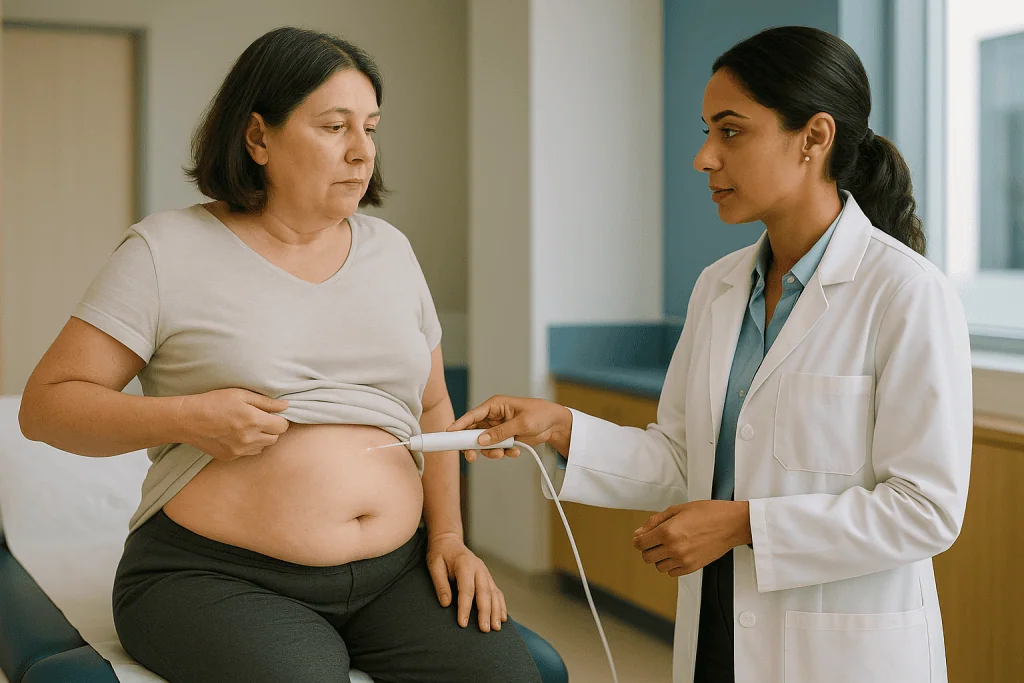
Laser liposuction works only on the pinchable layer. If a belly is firm and rounded rather than soft and foldable, much of that volume is likely visceral, and no laser or cannula can reach it. For that kind of abdominal fat, the evidence-backed routes remain the unglamorous ones: dietary change, physical activity and, when appropriate, medical management guided by a clinician. Visceral fat also carries most of the cardiometabolic risk, which is why the American Heart Association emphasizes waist circumference as a health marker, not appearance.
For subcutaneous belly fat, laser-assisted liposuction can remove a localized pocket and refine the contour of the lower abdomen or flanks. Whether the result looks smooth depends heavily on skin quality. Abdominal skin stretched by pregnancy or major weight change may not retract fully even with laser heat, and the Mayo Clinic notes that loose skin can appear more noticeable once the underlying fat is gone.
There is also the question of how much can safely be removed in a single session. Hospital patient guides describe an upper volume limit measured in a few liters, because larger removals raise the risk of fluid shifts and complications. Liposuction, in the Mayo Clinic’s words, is not a treatment for obesity and is not a substitute for weight loss.
So the honest answer to “does laser lipo work for belly fat” is: for a pocket of soft fat under reasonably elastic skin, it can reshape the area; for a large or firm abdomen, it is the wrong tool.
Laser lipo vs traditional liposuction: what actually differs?
Because both procedures end with the same suction cannula, the differences are narrower than marketing suggests. They sit in three places: the heat stage, the handling of small blood vessels, and the potential collagen effect.
Traditional tumescent liposuction relies on the surgeon’s arm to break up fat mechanically, moving the cannula through the tissue thousands of times. Power-assisted versions vibrate the cannula to ease that work. Ultrasound-assisted liposuction uses sound energy to emulsify fat, especially useful in fibrous areas such as the male chest or upper back. Laser-assisted liposuction uses light energy in the same role.
The table below summarizes what patient guides from the Mayo Clinic, the Cleveland Clinic and the NHS describe, along with the external non-invasive devices that share the “laser lipo” name.
| Feature | Traditional tumescent liposuction | Laser-assisted liposuction | External “laser” or light pads |
|---|---|---|---|
| Skin incision | Yes, small | Yes, small | None |
| Fat removed from body | Yes, by suction | Yes, by suction after heating | No; relies on body clearance |
| Anesthesia | Local, sedation or general | Local, sedation or general | None |
| Thermal injury risk | Low | Present; depends on technique | Minimal |
| Skin-tightening claim | Not a stated goal | Possible modest effect; evidence limited | Claimed; evidence weak |
| Recovery | Days to weeks; months for final shape | Similar range | None required |
Notice what is missing from the table: a proven difference in final contour. Well-conducted comparisons are scarce, and the surgeon’s experience with a given technique tends to matter more than the energy source. The NHS makes no distinction between methods in its guidance on risks and recovery, treating them as one operation.
Who is laser liposuction usually for, and who is usually asked to wait?
Surgeons tend to describe the ideal candidate in similar terms across hospital guides. The person is at or near a stable weight they have held for months. They have one or a few localized pockets of fat that resist diet and exercise. Their skin has reasonable elasticity, which usually means it snaps back when pinched. They do not smoke, or have stopped well in advance, because nicotine narrows the small vessels that skin depends on to heal. And their expectation is refinement, not transformation.
Laser-assisted liposuction is sometimes favored for smaller, more delicate areas where a slim fiber is easier to control: the neck and jawline, the upper arms, the inner knees, the bra line. Some surgeons also choose it in areas that have been treated before, where scar tissue makes mechanical suction harder.
Who is usually asked to wait, or offered a different route? The Mayo Clinic and Cleveland Clinic list several situations. People who are still losing or gaining weight, because the contour will shift under them. People with significant skin laxity, who may be better served by excisional surgery. People with uncontrolled diabetes, heart disease, bleeding disorders or a weakened immune system, since liposuction is elective and the risks rise with these conditions. People who are pregnant or recently postpartum. And people who hope liposuction will treat obesity, which it cannot; it removes a limited volume of fat and leaves the drivers of weight untouched.
Age alone is not a disqualifier, but skin elasticity declines with age, and that changes what a surgeon can promise. A candid assessment of your skin is one of the most valuable things a consultation can offer, and a candidate who is told to wait has received good medicine, not a rejection.
What does the day of surgery look like?
Most laser-assisted liposuction takes place in an outpatient surgical setting, and the choice of anesthesia depends on how much fat is being removed and from how many areas. A single small area may be done under local anesthesia with the tumescent solution alone. Larger or multiple areas often involve intravenous sedation or general anesthesia, and an anesthesia professional monitors you throughout.
Before anything happens, the surgeon photographs and marks the treatment zones while you stand, because fat shifts when you lie down. You will have been told to stop certain medicines and supplements that raise bleeding risk, such as aspirin-type drugs and some herbal products; those instructions come from the surgical team and should never be improvised.
Once you are comfortable, the incisions are made and the tumescent fluid goes in. The laser fiber is passed through, and you may hear the device’s tone as energy is delivered. Under local anesthesia people often describe warmth and pressure rather than pain. The surgeon repeatedly checks skin temperature by hand. The suction phase follows, and the surgeon assesses symmetry by feel and sight, sometimes asking you to change position.
Incisions may be closed with a stitch or left open to drain, which reduces fluid collection. A compression garment goes on before you leave. Total time ranges from about an hour for a small area to several hours for multiple zones, according to the Cleveland Clinic’s liposuction guide.
You will need someone to drive you home if sedation or general anesthesia was used, and most surgeons ask that an adult stay with you the first night. Overnight hospital stays are uncommon and reserved for large-volume cases or people with other health conditions.
Laser lipo recovery time: what the first days and weeks usually look like
The first 48 hours are about fluid. Tumescent solution tinged with blood drains from the incisions, sometimes generously, so absorbent pads and old towels are part of the kit. Swelling peaks around day two to three. Bruising follows its usual arc, darkening before it yellows and fades over a couple of weeks.
Compression is the recurring theme. The NHS advises that a compression garment or elastic bandage is typically worn for several weeks to limit swelling and help the skin settle against its new contour. Most people find the garment more tiresome than painful.
Discomfort tends to be described as a deep ache or the soreness of a hard workout rather than sharp pain, and it is usually managed with medicines the surgical team prescribes or recommends; the choice of medicine is theirs to make. Walking from the first day is encouraged because it reduces the risk of blood clots in the legs.
Return to desk work commonly falls within a few days to a week or two, depending on the areas treated, and strenuous exercise is typically held for several weeks, per the Mayo Clinic and NHS guides. Numbness or altered sensation over the treated area is common and usually improves over weeks to months.
The shape you see at two weeks is not the final shape. Swelling masks the contour, and small firm areas can persist. The Mayo Clinic notes that swelling generally subsides over a few weeks and that the treated area may look leaner within several months. The NHS puts full recovery at up to about six months. Anyone judging the result before then is judging swelling, not surgery.
How long does laser liposuction last?
The cells removed do not come back. That single fact underpins the durability of any liposuction result, laser-assisted or otherwise. Adults generate new fat cells slowly and mostly in response to sustained weight gain, so a treated area starts its post-surgical life with a permanent deficit of adipocytes.
What changes over time is the size of the cells that remain and the fat everywhere else. Gain weight, and the remaining cells in the treated area enlarge, while untreated areas may gain proportionally more, sometimes producing a distribution that looks unfamiliar. Lose weight, and the treated area generally stays ahead of its neighbors. The Mayo Clinic describes this plainly: results are generally long lasting as long as your weight remains stable.
Skin behaves independently of fat. Whatever tightening the laser contributed, skin continues to age, and elasticity declines with time, sun exposure and smoking. A contour that looked crisp in the first year may soften as the skin over it loosens, especially in areas like the neck and upper arms.
Pregnancy, menopause and certain medicines that affect fat storage can all redistribute fat regardless of prior surgery. None of these reverse the procedure; they change the canvas around it.
The question hidden inside “how long does it last” is usually “will I need it again.” Some people return for a touch-up to smooth an irregularity, typically not before six months so that swelling has fully resolved. Others never do. What no one can offer is a number of years, because the variable that decides longevity is not the laser or the surgeon; it is the decades of eating, moving and aging that follow.
What are the downsides and laser lipo side effects to weigh?
Every liposuction technique shares a core set of risks, and the laser adds one of its own. Reading them in neutral language is more useful than either the glossy version or the horror-story version.
Common and usually temporary effects, described by the Mayo Clinic, Cleveland Clinic and NHS, include swelling, bruising, numbness or tingling, drainage from incisions and soreness that lasts days to weeks. Contour irregularities such as lumps, dents or asymmetry are among the most frequent lasting complaints, and they are more likely in people with poor skin elasticity or when fat is removed unevenly.
Fluid collections called seromas, pockets of clear fluid under the skin, sometimes need draining with a needle. Infection is uncommon but possible, as with any incision. Scars at the entry points are small and usually fade but do not disappear.
Less common but serious risks include damage to deeper structures if the cannula passes through the abdominal wall, fat embolism in which loosened fat enters the bloodstream and lodges in the lungs, blood clots in the legs, and reactions to the local anesthetic in the tumescent fluid if the dose is high. Fluid shifts during large-volume removal can strain the kidneys and heart, which is why volume limits exist.
The laser-specific downside is heat. Skin burns, blisters, and hardened areas of fat necrosis have all been reported when the fiber is held too long in one place or too close to the surface. Device temperature sensors reduce but do not eliminate this risk.
Alternatives exist at every point on this spectrum, from doing nothing to excisional surgery, and a surgeon should walk through them without steering. The choice of technique belongs to you and your treating team.
Why do results vary so much between people?
Two people can have the same surgeon, the same device and the same volume removed, and walk away with different results. The variability is mostly biology, and it is worth understanding before deciding.
Skin elasticity sits at the top of the list. Skin that has been stretched by weight change or pregnancy has fewer intact elastic fibers and retracts less, whatever the laser does. The Mayo Clinic is direct about this: people with thin skin and poor elasticity may see loose or dimpled skin after any liposuction.
Fat distribution matters too. Fibrous fat in the back or male chest resists suction and heat differently from the softer fat of the outer thigh. Areas with abundant connective tissue can develop firmer scarring under the skin.
Body weight trajectory shapes the outcome more than any device. Someone whose weight is stable for a year before and after surgery sees a stable result. Someone in the middle of a weight change sees a moving target.
Healing tendencies differ. Some people bruise heavily and swell for months; others recover in weeks. Smokers heal more slowly and face higher risks of skin problems. People with diabetes are more prone to infection and slow healing even when their blood sugar is well managed.
Finally, the surgeon’s judgment about how much to remove, and where to stop, influences smoothness. Removing too much from one area, chasing a flat surface, is a classic cause of dents. The most experienced hands often remove slightly less than a patient asks for, precisely to avoid that.
None of this is a reason for pessimism. It is a reason to have a specific conversation about your skin, your history and your goals rather than a generic one about a machine.
What people often get wrong about laser lipo
Some myths about laser liposuction are harmless. Others lead people into the wrong procedure, or into no procedure at all when a different one would have helped. These come up most often.
“Laser lipo is non-surgical.” The surgical version involves incisions, a fiber inside the fat, and suction. The confusion comes from external low-level laser or light devices marketed with the same name. Those sit on the skin, involve no incision, and rely on the body to clear any released fat. Their evidence base is weak, and hospital guides such as the Cleveland Clinic’s body-contouring overview describe non-invasive treatments as producing subtle changes at best. They are a different category, not a gentler version of the same thing.
“The laser melts fat, so there’s no need for suction.” For any visible contour change, the liquefied fat still has to be removed. Leaving large volumes behind risks prolonged swelling and firm areas.
“It tightens loose skin.” As discussed above, the collagen effect appears modest and depends on skin that already has some elasticity. Significant laxity calls for excision.
“It’s a weight-loss treatment.” Liposuction removes a limited volume of fat, and the Mayo Clinic states that it is not a treatment for obesity. Bathroom-scale changes are usually small.
“Results are instant.” Swelling hides the contour for weeks, and the final shape takes months to settle.
“Fat comes back in the same place.” Removed cells do not regenerate, but weight gain enlarges the cells that remain and can favor untreated areas.
“The laser makes it safer.” It changes the risk profile, adding thermal injury while possibly reducing bruising. Safer is not the same as different.
How do laser liposuction and non-invasive fat reduction compare?
The comparison people most often type into a search bar is between laser liposuction and the non-invasive devices they have seen advertised: cooling applicators that freeze fat cells, external ultrasound, radiofrequency and the low-level light pads. Understanding the trade-off helps clarify which conversation to have.
Non-invasive devices work from the outside. Cryolipolysis, the freezing approach, chills a pinch of fat so that some cells die and are cleared by the immune system over the following weeks. External ultrasound and radiofrequency heat the fat through intact skin. None removes fat from the body directly; all depend on gradual biological clearance.
What they offer is no incision, no anesthesia and no downtime. What they cannot offer is the degree of change a surgeon controls with a cannula in hand. The Cleveland Clinic’s body-contouring overview describes non-surgical options as suited to small, subtle reductions and surgical liposuction as the route for larger or more precise reshaping. Multiple sessions are typical for external devices; a single surgical session is typical for liposuction.
Risk profiles differ in kind. Non-invasive devices carry a small risk of a paradoxical response in which the treated fat enlarges rather than shrinks, along with temporary numbness and redness. Laser liposuction carries the surgical and thermal risks described earlier.
Neither is “better.” They answer different questions. Someone with a small pocket of fat and a strong preference to avoid surgery has one option set; someone with a clear contour goal and tolerance for a recovery period has another. A clinician who offers both and explains the boundary between them, rather than steering toward one, is giving you the more useful consultation.
Questions to ask your care team before laser liposuction
A good consultation should leave you with fewer unknowns than you arrived with. These questions, drawn from what hospital patient guides suggest asking about any liposuction, tend to surface the information that matters.
- Which technique do you recommend for my area and skin, and why this one rather than traditional, power-assisted or ultrasound-assisted liposuction?
- How do you assess my skin elasticity, and what do you honestly expect it to do after fat is removed?
- What type of anesthesia will be used, who administers it, and where will the procedure take place?
- How do you monitor skin temperature during the laser stage, and what happens if the device reaches its limit?
- How much fat do you expect to remove, and what is your upper limit for a single session?
- Which of my medicines and supplements need to be paused, and for how long, according to my prescribing clinician?
- What does the first week look like in practical terms: drainage, compression, walking, driving, showering?
- Which signs should prompt me to call you immediately, and how do I reach someone after hours?
- How often do you see contour irregularities, and how do you manage them if they occur?
- When would you consider a touch-up, and what is your policy on revisions?
- Would excisional surgery or a non-invasive option serve my goal better, and why or why not?
Bring a notebook or ask permission to record the answers. Ask to see photographs of the surgeon’s own results for your specific area, both typical and less-than-ideal, rather than a highlight reel. And notice how the questions are received. A team that welcomes them, and answers the awkward ones about complications without flinching, is showing you something about how they will handle your care if anything goes off script.
When to call your doctor: red-flag signs after laser liposuction
Most recovery is uneventful, and some discomfort, drainage and bruising are expected. Certain signs are not. The Mayo Clinic, Cleveland Clinic and MedlinePlus guides on liposuction agree on a short list that should prompt a same-day call to your surgical team, or emergency care if the team cannot be reached.
Call promptly if you notice a fever, spreading redness or warmth around an incision, thick or foul-smelling drainage, or pain that worsens rather than eases after the first few days. These can signal infection, which is treatable but time-sensitive.
Seek emergency care immediately for chest pain, sudden shortness of breath, coughing up blood, a racing heart, confusion or fainting. These can indicate a blood clot that has traveled to the lungs or a fat embolism, both of which are rare but life-threatening.
Call if one leg becomes painful, swollen, warm or discolored compared with the other, which may signal a clot in the deep veins. Call if a treated area develops a rapidly enlarging, tense swelling, which may indicate bleeding under the skin. Call if the skin over a treated area turns dusky, blistered, blackened or strangely numb and cold, which can signal a burn or compromised blood supply, the complication most specific to laser-assisted techniques.
Persistent nausea, vomiting, dizziness, ringing in the ears or an unusual metallic taste in the hours after surgery deserve an urgent call too, since they can reflect a reaction to the local anesthetic used in the tumescent fluid.
None of these signs means something has gone wrong for certain. They mean the people who know your case should be the ones to decide. Keep the after-hours number where you can find it, and use it without hesitation; surgical teams would far rather answer a false alarm than miss an early one.
Frequently asked questions
Does laser lipo work?
Surgical laser-assisted liposuction does remove fat, because the liquefied fat is suctioned out, and results in localized subcutaneous pockets are comparable to other liposuction techniques. The laser’s added skin-tightening effect is less certain, with evidence limited to small studies. External non-invasive “laser lipo” pads are a separate category with a weak evidence base and, at best, subtle changes.
What are the downsides of laser lipo?
The downsides include the usual liposuction risks of swelling, bruising, numbness, contour irregularities, fluid collections, infection and, rarely, blood clots or fat embolism, plus a laser-specific risk of heat injury such as skin burns or hardened areas of damaged fat. Recovery takes weeks, final shape takes months, and results depend on stable weight and skin elasticity.
How long does laser liposuction last?
The fat cells removed do not come back, so the change is long lasting as long as weight stays stable, according to the Mayo Clinic. Weight gain enlarges the remaining cells and can favor untreated areas, and skin continues to age and loosen over time. No fixed number of years can be promised, because lifestyle after surgery decides longevity.
How much does laser lipo typically cost?
This magazine does not publish price figures for any treatment, because charges vary by region, setting, anesthesia type, number of areas and what is included in follow-up care. The useful step is to ask the surgical team for a written, itemized quote that specifies surgeon, facility and anesthesia components, garment costs, and how revisions or complications are handled.
Does laser lipo work for belly fat?
It can reshape a localized pocket of soft, pinchable fat under the skin of the abdomen or flanks, provided the skin has reasonable elasticity. It cannot reach visceral fat inside the abdominal cavity, which makes a belly firm and round, and it is not a treatment for obesity. A firm abdomen usually calls for weight management rather than any liposuction.
Laser lipo vs traditional liposuction: which is better?
Neither is proven better. Both end with suction through a cannula; the laser adds a heating stage that may reduce bruising and modestly encourage skin retraction while introducing a risk of thermal injury. Well-designed comparisons are scarce, and the surgeon’s experience with a given technique generally matters more than the energy source. The choice belongs with your treating team.
What is the laser lipo recovery time?
Swelling and bruising peak in the first few days and fade over a couple of weeks; desk work often resumes within days to a week or two, strenuous exercise is usually held for several weeks, and a compression garment is typically worn for several weeks, per the NHS. The Mayo Clinic notes the leaner contour appears over several months, with full settling taking up to about six months.
Is laser liposuction the same as non-surgical laser lipo?
No. Laser-assisted liposuction is surgery with incisions, a fiber inside the fat and suction removal. Non-surgical “laser lipo” uses external low-level light pads on intact skin, removes nothing directly and relies on the body to clear any released fat. Hospital guides describe non-invasive fat reduction as producing subtle changes at most, and the evidence for light pads specifically is weak.
Does laser liposuction tighten skin?
It may produce modest skin retraction by heating collagen, and small studies have reported improved skin tone, but larger controlled trials are lacking. The effect depends on skin that already has some elasticity. Significantly loose skin generally does not tighten enough after any liposuction, and excisional surgery such as a tummy tuck is the evidence-supported route for laxity.
Who should not have laser liposuction?
Hospital guides list people who are still losing or gaining weight, those with poor skin elasticity, people with uncontrolled diabetes, heart disease, bleeding disorders or weakened immunity, smokers who have not stopped, and anyone pregnant or recently postpartum. People hoping to treat obesity are also usually redirected, since liposuction removes only a limited volume of fat. The final decision rests with the surgical team.
References
This article is for general information only and is not a substitute for professional medical advice. Please consult a qualified doctor about your individual situation.

More from the Blog
How Hi Def Liposuction Is Performed: Mapping Muscle Lines Before Fat Is Sculpted
Hi def liposuction is performed by first marking the patient standing up, with muscles flexed, to map where the abdominal, chest and flank muscle…

Can Body Contouring Be Done in One Operation? How Surgeons Sequence Multiple Stages Safely
Body contouring after major weight loss can sometimes be completed in a single operation, but surgeons often split it into two or more stages…

Do You Need a Reverse Tummy Tuck? Upper Abdominal Laxity and Who Actually Qualifies
A reverse tummy tuck is usually considered only for people whose loose skin sits mainly above the navel, in the upper abdomen, while the…

How Fat Transfer Works Step by Step: Harvesting, Purifying and Injecting Your Own Fat
Fat transfer, also called fat grafting, is done in three stages during one procedure. A surgeon removes fat from an area such as the…
Is Body Aesthetics Surgery Right for You? Weight Stability, Skin Quality and Overall Health
A body aesthetics surgery candidate is usually an adult whose weight has held steady for months, who does not smoke, whose long-term conditions are…

Does Hi Def Liposuction Build Muscle? Separating Fact From Marketing on Sculpted Abs
No. Hi def liposuction does not build muscle. It removes fat from the thin layer under the skin and sculpts what remains so that…