

How Does Phototherapy Help Atopic Dermatitis? What Sessions Involve and Who May Be Offered Them
Key Takeaways
- Narrowband UVB, the light most often used for atopic dermatitis, is a filtered band around 311 to 313 nanometers, a precision no sunbed, window or household lamp reproduces.
- Phototherapy works by reducing the activity of immune cells in the upper skin, slightly thickening the skin barrier and lowering surface bacteria, which is why itch often eases before redness fades.
- Guidelines position phototherapy after emollients and topical treatments have been properly tried, and as an alternative to systemic medicines for moderate to severe disease.
- A course typically involves two to three brief clinic visits a week over weeks to months, with each exposure adjusted by trained staff according to how your skin responded last time.
- Long-term risks of premature skin aging and skin cancer are tied to cumulative lifetime exposure, so units log every session and anyone treated should have new or changing skin spots checked for life.
- Unregulated herbal eczema creams have repeatedly been found to contain undeclared potent steroids, and some plant compounds increase light sensitivity, so disclose every product before starting phototherapy.
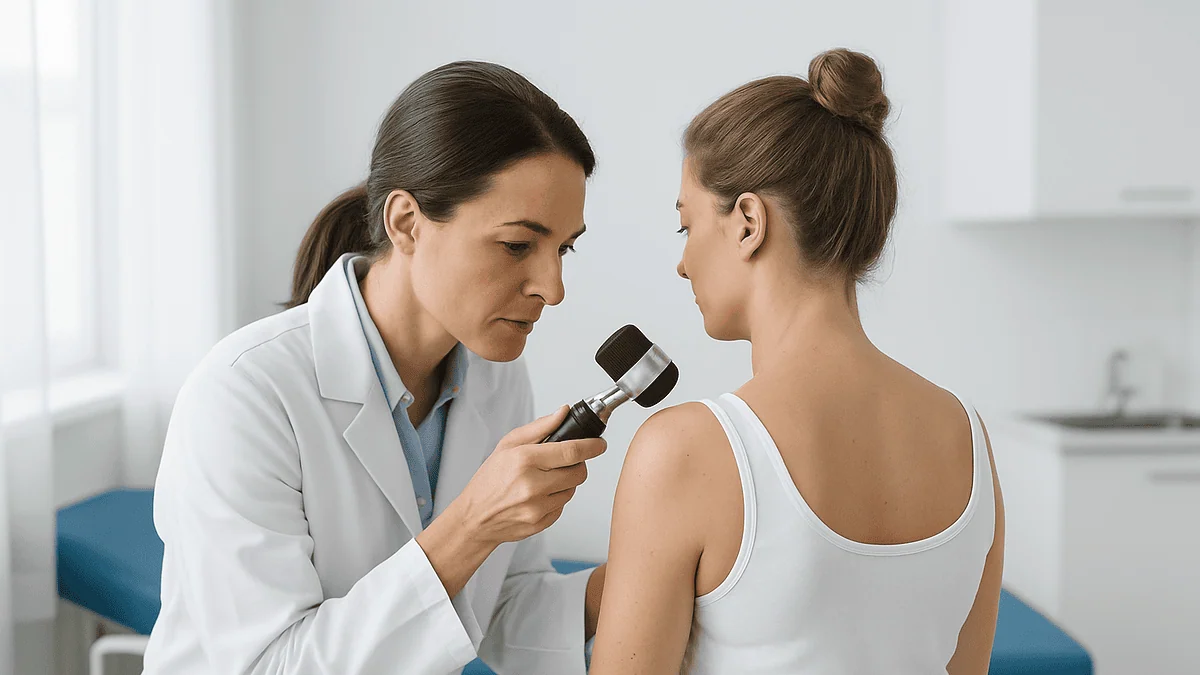
Phototherapy for atopic dermatitis exposes affected skin to carefully measured ultraviolet light, usually narrowband UVB, in a clinic cabinet several times a week for a course of weeks to months. It works by dampening the overactive immune cells in the skin and reducing itch. It is generally considered when creams and good skin care are not enough, and its use, timing and safety are decided with a dermatologist.
The appointment letter says one word she has never seen on her own medical paperwork before: phototherapy. She has spent a decade layering moisturizer over cracked elbows, timing steroid creams around work, and learning to sleep with cotton gloves so the scratching stops before it draws blood. Now a dermatologist is suggesting she stand in what looks like an upright tanning booth, in a hospital, three times a week.
Her first question is the obvious one. Sunlight already seems to help in summer, so why not simply sit outside? The second follows quickly: is this safe, and does it actually work, or is it another thing to try before the real treatment starts?
Those are fair questions, and the honest answers are more interesting than either the hype or the fear. Phototherapy for atopic dermatitis is an old idea refined by modern physics, with real benefits, real limits, and a clear place in the treatment ladder that guidelines lay out.
What is phototherapy for atopic dermatitis, and why does light calm inflamed skin?
Phototherapy is the medical use of ultraviolet light, delivered in measured amounts by a machine, to treat skin disease. Atopic dermatitis, the most common form of eczema, is a condition in which the skin barrier leaks moisture and the immune system in the skin overreacts, producing red, dry, intensely itchy patches that come and go. The two problems feed each other: scratching damages the barrier, and a damaged barrier invites more inflammation.
Ultraviolet light interrupts that loop in several ways. It reaches the immune cells that sit in the upper layers of the skin and reduces their activity, so fewer inflammatory signals are released. It thickens the outer layer of skin slightly, which helps with barrier function. It also lowers the numbers of certain bacteria on the skin surface, including the staphylococcus species that tend to colonize eczema and worsen flares. Many people notice the itch settling before the redness does, and that order makes sense: nerves in the skin respond to the reduced inflammatory chemistry fairly early.
None of this is the same as a tanning session or a beach holiday. The light in a clinic cabinet is filtered to a narrow band of wavelengths chosen because they treat inflammation with the least damage to healthy cells, and the exposure time is calculated from your skin type and adjusted visit by visit. The NHS lists phototherapy among the treatments a dermatologist may offer when standard care has not controlled atopic eczema, and the Mayo Clinic describes it as an option for people whose eczema does not improve with topical treatments or who flare again quickly once they stop. Both framings matter. Phototherapy is a step on a ladder, not a first move and not a last resort.
Narrowband UVB for eczema, UVA1 and PUVA: which types of light are used?
Ultraviolet light is divided by wavelength, and the differences are not academic. Shorter wavelengths carry more energy and act mostly in the outer skin; longer wavelengths penetrate deeper. Dermatology has learned, over decades, which slice of the spectrum offers the best balance for eczema.
| Type | What it is | Where it tends to be used |
|---|---|---|
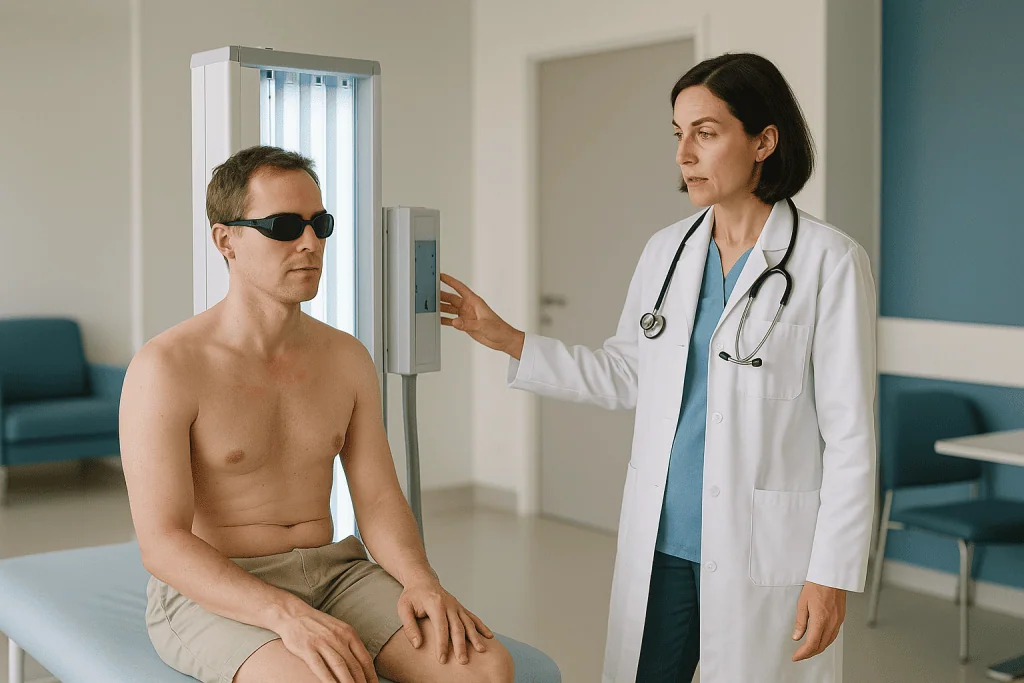
| Narrowband UVB | A thin band of UVB light around 311 to 313 nanometers, filtered to remove wavelengths most likely to burn | The usual first choice for adults and older children with widespread atopic dermatitis |
| Broadband UVB | A wider range of UVB wavelengths, an older technology | Largely replaced by narrowband because it burns more readily |
| UVA1 | Longer-wavelength UVA light, roughly 340 to 400 nanometers, reaching deeper into the skin | Sometimes used during acute severe flares; equipment is less widely available |
| PUVA | UVA light combined with a light-sensitizing medicine taken by mouth or applied to the skin | Reserved for selected cases because the sensitizer adds risks and precautions |
A nanometer is one billionth of a meter, and the point of quoting these numbers is that a clinic cabinet delivers a precisely chosen band, something no window, lamp or sunbed replicates. The Mayo Clinic notes that treatment may use UVA, narrowband UVB, or light combined with medication, and that the choice depends on the person and the disease pattern. Your dermatologist picks the type based on how severe and widespread the eczema is, your skin’s sensitivity, your age, your other medicines, and what equipment the unit has. Narrowband UVB is where most people start, because it has the longest track record for eczema and the most reassuring safety data when courses are kept within recommended limits.
Who is usually offered phototherapy for atopic dermatitis, and who is asked to wait?
Phototherapy is generally offered to people whose atopic dermatitis is moderate to severe, covers a fair proportion of the body, and has not been controlled despite a genuine trial of the basics: generous daily emollients, appropriate topical anti-inflammatory creams used correctly, trigger management and treatment of any skin infection. The Mayo Clinic frames the candidate as someone who does not get better with topical treatments or who flares rapidly after stopping them. NHS guidance similarly positions it as a specialist option once first-line care has been tried.
Practical factors count almost as much as clinical ones. A course means visiting a clinic two or three times a week for weeks, so the treatment suits people who can realistically get there. It suits generalized eczema better than a few stubborn patches, which are usually managed with targeted creams. It is often favored for someone who would rather avoid, or cannot take, immune-suppressing tablets or injections.
Some people are usually asked to wait or offered something else. Infants are not treated with medical phototherapy, and the Mayo Clinic notes it is less commonly used in young children generally, partly because standing still in a cabinet is hard and partly because of lifetime ultraviolet exposure. People with a history of skin cancer, a strong family history of melanoma, or conditions that make skin abnormally light-sensitive, such as lupus, are typically steered away. Those taking medicines that increase sun sensitivity may need those reviewed first, a decision that belongs to the prescriber. Eczema that is currently infected is treated before light is considered, since ultraviolet exposure on broken, weeping skin is neither comfortable nor wise. Where a person has had many previous courses, cumulative exposure becomes the deciding factor.
What actually happens at a phototherapy session, step by step
The first visit is usually longer than the rest. A nurse or dermatology technician records your skin type, checks your medicines and history, and often performs a test in which small squares of skin receive increasing amounts of light to find the smallest exposure that produces faint pinkness the next day. That number sets your starting point and takes the guesswork out of the early sessions.
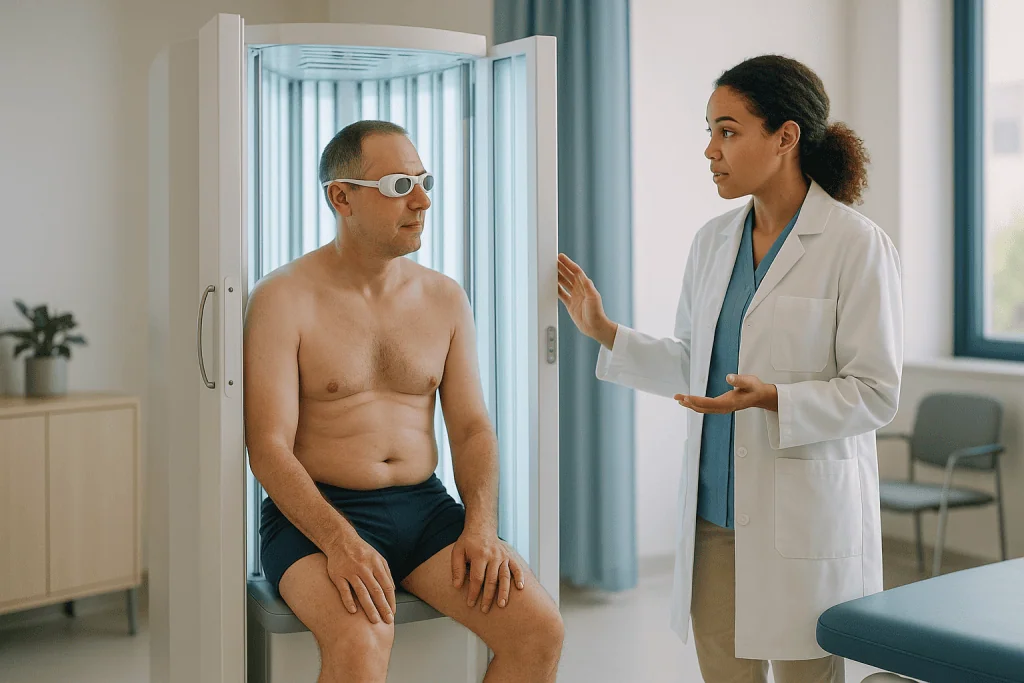
Treatment visits themselves are short. You undress to the extent needed, put on wraparound goggles that block ultraviolet light, and step into a cabinet lined with fluorescent-style tubes. Men are asked to cover the genital area because that skin is more prone to ultraviolet damage. Any area you want protected, such as the face if it is clear, can be shielded with clothing or sunscreen. The door closes, the tubes hum on, and the exposure runs for a period that is often well under a minute at first and grows over subsequent visits as your skin adapts. Then the lights click off and you are done. Many people are in and out of the building within fifteen or twenty minutes.
Staff usually ask you to apply a plain emollient before treatment because dry, scaly skin scatters light and reduces its effect; they will advise on timing. Perfumed products, and anything that could increase light sensitivity, are avoided beforehand. At each visit the team checks your skin for excess redness or tenderness and adjusts the next exposure up, down or not at all. That constant recalibration is the quiet heart of safe phototherapy, and it is why the treatment is delivered by trained staff rather than by a timer on a lamp.
How many phototherapy sessions for eczema are usually needed, and what do the following weeks look like?
A course is a rhythm rather than a single event. The typical pattern described by major medical centers is two to three sessions a week, and the Mayo Clinic notes that light therapy is generally continued for a period of weeks to months rather than days. Your own schedule will be set by the treating team based on your skin’s response, so treat these as ranges rather than promises.
The first two or three weeks often feel unremarkable, and that is normal. Exposure times are being built up cautiously, and the skin’s inflammatory chemistry takes time to shift. Some people notice a mild pink flush a few hours after a session, a little like a light day in the sun, that fades by the next morning. Itch is frequently the first symptom to ease, sometimes within the first month. Visible redness, thickening and scaling generally lag behind.
Around the middle of a course, many people report that they are reaching for their steroid creams less often. That is worth recording, because your dermatologist will want to know whether the light is doing work that the creams were doing before. Through it all, the everyday routine continues: emollients, trigger management, and any prescribed topical treatments unless the team changes them.
Courses do end. Dermatologists usually stop once the skin is clear or has plateaued, or when a preset ceiling of total sessions is reached, because lifetime ultraviolet exposure is what governs long-term risk. Once treatment stops, improvement often persists for a while, though eczema is a relapsing condition and flares can return over the following months. Whether a further course is appropriate later is a judgment for your care team, weighed against how many treatments you have already had.
Does light therapy get rid of eczema? What the evidence actually shows
This is the question behind every other question, so it deserves a straight answer. Phototherapy can control atopic dermatitis, often substantially, but it does not remove the underlying tendency of the skin to react. Atopic dermatitis is a chronic condition rooted in genetics and immune function; light treats the inflammation of the moment, not the blueprint.
Systematic reviews of randomized trials, indexed in PubMed, have generally found that narrowband UVB improves clinician-assessed signs and patient-reported itch compared with no light or placebo light, with the certainty of that evidence rated as low to moderate because trials have been small and short. UVA1 has shown benefit in acute flares in some studies. Comparisons between the different types of light are less conclusive, and long-term outcomes have rarely been measured. That is the honest shape of the literature: encouraging, consistent in direction, and thinner than anyone would like.
Guidance from national bodies reflects that. Both the NHS and the Mayo Clinic present phototherapy as a recognized specialist option rather than a definitive answer, positioned after topical treatment has failed and alongside systemic medicines as alternatives. Nobody credible offers a percentage of people who will clear, and this article will not either, because such figures vary with severity, skin type, adherence and how clearance is defined.
What phototherapy can realistically offer is a period of calmer skin that lets you rebuild the barrier with emollients, reduce reliance on steroid creams, sleep better, and break the scratch cycle. For many people that shift is meaningful even if it is not permanent. Understanding that from the outset prevents the disappointment of expecting a permanent fix from a treatment designed to manage.
Light therapy for eczema side effects: what is common, what is rare, and what builds up over years
Every effective treatment has costs, and phototherapy’s are well characterized because the treatment has been used for decades. They fall into two groups: what happens in the days around a session, and what may accumulate over a lifetime.
The short-term effects are those of controlled ultraviolet exposure. Redness resembling mild sunburn is the most common and is usually a sign the exposure was slightly generous; the team adjusts the next session. Dryness and tightness are frequent, which is why emollients are emphasized. Some people find their itch flares briefly before it improves. Less commonly, a person develops an itchy bumpy reaction to light itself, or a dormant cold sore virus is reactivated. Tanning and freckling are expected with any UV exposure. Eye protection prevents the most avoidable problem, ultraviolet irritation of the eye surface, which is why goggles are non-negotiable.
Long-term effects are the ones that shape how phototherapy is prescribed. The Mayo Clinic states plainly that long-term light therapy has harmful effects, including premature skin aging and an increased risk of skin cancer. The size of that risk for narrowband UVB appears smaller than for PUVA and is related to total lifetime exposure, which is why units keep a running count of sessions and why dermatologists limit how many courses a person has. Photoaging shows up as fine lines, uneven pigment and loss of elasticity in treated areas.
Two practical consequences follow. First, anyone who has had phototherapy should have a low threshold for showing a dermatologist any new or changing skin lesion for the rest of their life. Second, sun protection on non-treatment days matters more, not less, because the clinic is already using up part of your skin’s ultraviolet budget.
Can you do home phototherapy for eczema, and is it safe?
The search phrase how to do phototherapy at home for eczema pulls up everything from medical-grade panels to blue LED wands and, alarmingly, advice about tanning beds. Sorting these apart is a safety matter.
Home phototherapy in the medical sense means a prescribed narrowband UVB unit used in your own home under the ongoing supervision of a dermatology team. It exists because clinic travel three times a week is a real barrier, and for suitable people it can deliver the same treatment with the same light. It is not self-treatment. The dermatologist assesses suitability, the device is calibrated to deliver measured doses, exposure schedules are set and adjusted by the clinical team, sessions are logged, and skin checks continue at follow-up visits. Whether this is appropriate for you, and how it is arranged, is a conversation for your specialist; it varies by health system and is not something to organize independently.
Everything else marketed for home use sits in a different category. Tanning beds emit mostly UVA at intensities designed for pigmentation, not treatment; they carry the cancer and aging risks of ultraviolet exposure without the wavelength selection or dose control that make medical phototherapy justifiable. Health bodies including the NHS advise against sunbeds for skin conditions. Red or blue LED devices sold for eczema are not ultraviolet at all; they do not reproduce the mechanism described earlier, and there is no good evidence they control atopic dermatitis.
Natural sunlight is the oldest form of light therapy, and the Mayo Clinic acknowledges controlled sun exposure as its simplest version. The catch is the word controlled. Sunlight is variable, unfiltered and hard to dose, and heat and sweat trigger many people’s eczema. If you want to try it, ask your dermatologist how, rather than experimenting.
How phototherapy fits with creams, emollients and systemic medicines, and what the alternatives are
Think of atopic dermatitis treatment as a ladder that everyone climbs from the bottom. The first rungs never go away. Emollients, meaning plain moisturizers applied liberally and often, repair the leaky barrier; guidelines from the NHS and others place them at the foundation of care at every severity. Topical anti-inflammatories, principally corticosteroid creams and the calcineurin inhibitors, which are non-steroid creams that quiet immune signaling in the skin, treat flares where they appear. Bathing habits, avoiding irritants and treating infection round out the base.
Phototherapy sits on the next rung, for people whose disease is too widespread or too persistent for creams alone. It has a particular advantage here: it acts on the whole skin at once without exposing the rest of the body to a medicine, which appeals to people wary of systemic drugs or who have conditions that complicate them. It also pairs naturally with continued topical care; light and emollients work on different parts of the problem.
Above it are systemic treatments for severe disease. Older immunosuppressant tablets, in classes such as calcineurin inhibitors and antimetabolites, dampen immune activity throughout the body and require blood monitoring. Newer biologic injections and Janus kinase inhibitor tablets target specific immune pathways involved in atopic dermatitis; the Mayo Clinic and NIH describe these as options for moderate to severe disease not controlled by other treatments. Each carries its own risks and monitoring needs, and each is chosen by a specialist for a particular person.
So when people ask what the most effective treatment for atopic dermatitis is, the truthful answer is that it depends on the severity and the person. For most people, consistent emollients and correctly used creams are the most effective thing they will ever do. For the minority whose disease is severe, phototherapy and systemic medicines are alternatives to be weighed together, and the choice between them is precisely the discussion to have with your dermatologist.
How do Chinese people treat eczema, and do herbal or traditional approaches replace phototherapy?
This question turns up in search data often enough to deserve a respectful answer rather than a shrug. It usually comes from two places: curiosity about traditional Chinese medicine, and a suspicion that other cultures have solved a problem Western medicine has not.
The first thing to say is that dermatologists in China treat atopic dermatitis with the same evidence-based toolkit used everywhere: emollients, topical corticosteroids and calcineurin inhibitors, narrowband UVB phototherapy, and, for severe disease, systemic and biologic medicines. Phototherapy units are standard equipment in Chinese hospital dermatology departments. The idea of a fundamentally different mainstream approach is a myth.
Traditional Chinese medicine, which uses herbal formulas taken by mouth or applied to the skin along with practices such as acupuncture, is also used by many people in China and elsewhere, sometimes alongside conventional care. What does the evidence show? Trials of oral and topical herbal preparations for eczema exist, and systematic reviews indexed in PubMed have generally judged them small, variable in quality and inconsistent in results, so no firm conclusion about effectiveness can be drawn. That is different from saying they do nothing; it means the evidence needed to recommend them has not been produced.
Safety is the more pressing issue. Unregulated herbal creams sold for eczema have repeatedly been found to contain undeclared potent corticosteroids, which can cause skin thinning and, in children, systemic effects. Some oral herbal products have been linked to liver injury. The NHS and other bodies advise telling your doctor about any complementary product you use, particularly if you are considering phototherapy, because certain plant compounds increase light sensitivity and could turn a routine session into a burn. Curiosity about other traditions is healthy; substituting them for a supervised, evidence-based plan is where risk enters.
Phototherapy for children with atopic dermatitis: pathway, preparation and comfort
Parents of a child with severe eczema arrive at the phototherapy question with a particular weight: they have watched sleepless nights and bleeding sheets, and they are also acutely aware that a child’s skin has a long future ahead of it. Both instincts are right, and dermatologists hold them in the same balance.
Medical phototherapy is not used in infants. For older children and adolescents with widespread atopic dermatitis that has not responded to good topical care, narrowband UVB is an established option that pediatric dermatology teams do offer, and the Mayo Clinic notes it is less commonly used in young children rather than never. The practical threshold is often the child’s ability to stand still in a cabinet with goggles on for the exposure time, usually feasible from around school age, and it is judged child by child.
Preparation is mostly about familiarity. A tour of the cabinet with the door open, a chance to try the goggles, and a clear explanation that the lights are warm but not hot go a long way. Many units allow a parent to stand just outside the cabinet talking through the door. Sessions are brief, so most children tolerate them well once the first visit has demystified the process. Emollient application beforehand and a plain, comfortable outfit afterward reduce dryness and irritation.
The team will discuss the trade-off openly: relief now against a small contribution to lifetime ultraviolet exposure, which matters more in someone with decades ahead. Courses for children are therefore planned carefully, often with a defined ceiling, and the alternatives, including systemic medicines approved for pediatric atopic dermatitis, are weighed alongside. Any medication decision for a child, including how any treatment is given, rests entirely with the treating team.
What people often get wrong about phototherapy for eczema
Myths gather around any treatment that involves standing in a glowing box, so it is worth clearing a few away.
The first is that phototherapy is just a medical tan. Tanning is a side effect, not the mechanism, and the clinic light is a narrow, filtered band chosen to treat inflammation while minimizing burning. Sunbeds and beach sessions deliver neither the wavelength nor the dose control, and no reputable source recommends them for eczema.
The second is that it works fast. Most people feel little change in the first few weeks while exposures are cautiously built up; expecting an overnight difference leads to abandoning a course just before it starts to help.
The third is that once light has cleared the skin, the creams can be thrown away. Emollients remain the foundation at every stage, and topical treatments are usually continued or tapered under guidance rather than stopped abruptly.
The fourth is that phototherapy is either harmless or dangerous. It is neither. Short courses of narrowband UVB, kept within session limits and monitored by trained staff, have a reassuring record; unlimited lifetime exposure does not. The truth sits in the counting, which is why every unit logs your total.
The fifth is that it offers a permanent fix. Atopic dermatitis is relapsing by nature; light manages inflammation, and flares can return later.
A final misunderstanding runs the other way: that phototherapy is an old-fashioned option now that biologic injections exist. Guidelines still list it as a legitimate alternative to systemic treatment for people who prefer to avoid medication or cannot take it. Newer is not automatically better for every person, and having options is the point.
Questions to ask your care team before starting phototherapy for atopic dermatitis
A good consultation is a two-way exchange, and arriving with specific questions turns a rushed appointment into a plan you understand. These are the ones dermatology teams say they wish more people asked.
- Which type of light are you recommending for me, and why that one rather than another?
- How many sessions a week, roughly how many weeks, and how will we decide when the course ends?
- What should I do with my current creams and emollients during treatment, and who will tell me if that changes?
- Which of my medicines, supplements or herbal products could increase light sensitivity, and do any need reviewing first?
- Have I had phototherapy before, and how does that count toward a lifetime limit?
- What signs after a session mean I should call before my next appointment?
- If the light does not help enough, what would the next options be, and how would we compare them?
- Is supervised home phototherapy something you would consider for me, and how would monitoring work?
- How should I protect my skin from the sun on non-treatment days and after the course?
- What ongoing skin checks should I have in the years after treatment?
Write the answers down or ask whether the unit provides a written information sheet, since much of what is said in a first visit evaporates by the time you reach the parking lot. Bring a list of everything you put on or into your body, including over-the-counter creams. And if anything about the plan does not sit right, say so. Phototherapy asks a real commitment of time, and a course you understand and agree with is far more likely to be completed than one you drift through. The decision to start, adjust or stop remains with you and your treating team together.
When to call your doctor during or after phototherapy
Most phototherapy courses pass without incident, but knowing which changes are routine and which need a call keeps a small problem from becoming a large one. Mild pinkness that fades within a day, dryness, and a brief increase in itch early in the course are expected and are handled by the team adjusting your next exposure.
Contact the phototherapy unit or your dermatologist promptly if you notice any of the following:
- Painful, bright red or blistering skin after a session, or redness that is still worsening the next day, which suggests a burn that needs assessment before further exposure.
- Eczema that suddenly becomes weepy, crusted, or dotted with small pus-filled spots, or that develops honey-colored crusts, since infected eczema needs treatment and light is usually paused.
- Clusters of small punched-out blisters or sores spreading quickly across eczema, especially with fever or feeling unwell; this can indicate a herpes virus infection of the skin, which needs same-day medical attention.
- Eye pain, gritty sensation, redness or light sensitivity after treatment, which may indicate ultraviolet exposure to the eyes.
- Fever, feeling faint, or a widespread new rash unlike your usual eczema.
- Any new mole or skin spot that is growing, changing color, bleeding or failing to heal, during the course or at any time in the years afterward.
Seek urgent care the same day if you have a rapidly spreading skin infection with fever, or if swelling of the face or lips, difficulty breathing, or a widespread hive-like rash develops. If your eczema is worsening despite treatment, or the schedule is becoming impossible to keep, that is also a reason to speak up rather than skip sessions silently. Your team can only adjust a plan they know is not working.
Frequently asked questions
Does light therapy get rid of eczema permanently?
No. Phototherapy controls the inflammation of atopic dermatitis and can produce a sustained period of calmer skin, but the underlying tendency remains and flares can return months later. Trials indexed in PubMed show narrowband UVB improves signs and itch compared with placebo light, with low to moderate certainty, and long-term outcomes have rarely been measured. Think of it as management rather than a permanent fix.
How many phototherapy sessions for eczema are typical?
Major medical centers describe a typical course as two to three sessions a week continued over weeks to months, with the exact number set by your dermatologist according to how your skin responds and a ceiling on lifetime exposure. Early visits are short and cautious, and most people notice change only after several weeks. Your team decides when a course ends.
What is the most effective treatment for atopic dermatitis?
It depends on severity. For most people, consistent emollients and correctly used topical anti-inflammatory creams are the most effective measures, and guidelines place them at the foundation of care. For moderate to severe disease that resists these, phototherapy and systemic medicines, including biologics and Janus kinase inhibitors, are alternatives a dermatologist weighs for each individual.
How to do phototherapy at home for eczema safely?
Only as prescribed home phototherapy: a medical narrowband UVB unit arranged and supervised by a dermatology team, with exposure schedules set by them and skin checks continued. Tanning beds and consumer LED devices are not substitutes; sunbeds carry ultraviolet risks without dose control, and red or blue LEDs do not use the mechanism that treats eczema. Ask your specialist whether supervised home treatment suits you.
What are the main light therapy for eczema side effects?
Short-term effects include sunburn-like redness, dryness, tanning, freckling and occasionally a brief itch flare or reactivated cold sore; goggles prevent eye irritation. Over the long term, the Mayo Clinic notes premature skin aging and increased skin cancer risk, linked to cumulative exposure. That is why sessions are counted, courses are limited and lifelong skin checks are advised.
Is narrowband UVB for eczema the same as a tanning bed?
No. Narrowband UVB delivers a filtered band of ultraviolet light around 311 to 313 nanometers at exposures calculated from your skin type and adjusted each visit by trained staff. Tanning beds emit mostly UVA at intensities designed to darken skin, with none of that control. Health bodies including the NHS advise against sunbeds for skin conditions.
How do Chinese people treat eczema?
Dermatologists in China use the same evidence-based approach as elsewhere: emollients, topical corticosteroids and calcineurin inhibitors, narrowband UVB phototherapy and systemic medicines for severe disease. Traditional Chinese herbal medicine is also widely used, but systematic reviews find the trials small and inconsistent, and unregulated herbal creams have been found to contain undeclared steroids, so tell your doctor about any product you use.
Can children have phototherapy for atopic dermatitis?
Infants are not treated with medical phototherapy, and the Mayo Clinic notes it is used less commonly in young children. Older children and adolescents with widespread eczema unresponsive to good topical care may be offered narrowband UVB by a pediatric dermatology team, provided they can stand still in the cabinet with goggles. Courses are planned with a defined ceiling because of lifetime exposure.
Do I keep using my creams during phototherapy?
Usually yes. Emollients remain the foundation of eczema care throughout and are often applied before sessions because dry, scaly skin scatters light. Topical anti-inflammatory treatments are generally continued or tapered under guidance rather than stopped abruptly. Never change a prescribed treatment on your own; ask the phototherapy team what to do with each product and when.
Why does my dermatologist ask about supplements and herbal products before phototherapy?
Because certain medicines and plant compounds increase the skin’s sensitivity to ultraviolet light, which can turn a routine session into a burn. Some antibiotics, diuretics and herbal products such as St John’s wort are known examples. A full list of everything you take or apply lets the team adjust exposures or ask a prescriber to review a medicine before you start.
References
- NHS: Atopic eczema: Treatment
- NIH NIAMS: Atopic Dermatitis
- MedlinePlus: Atopic dermatitis
- Cleveland Clinic: Eczema
This article is for general information only and is not a substitute for professional medical advice. Please consult a qualified doctor about your individual situation.

More from the Blog
A Daily Routine That Supports Atopic Dermatitis Treatment: Bathing, Moisturizing and Nail Care
A supportive atopic dermatitis daily routine rests on three anchors: a short, lukewarm bath or shower with a gentle, fragrance-free cleanser; a generous layer…
Is Coconut Oil Good for Your Hair? The One Oil That Penetrates
Coconut oil can genuinely help hair, and the reason is unusual: its main fatty acid, lauric acid, is small enough to penetrate the hair…
Peptides in Skincare: What Signal Peptides Do and What the Studies Show
Peptides in skincare are short chains of amino acids applied topically to signal skin cells, most often to encourage collagen production or soften expression…
How to Get Clear Skin: What Actually Works, According to Dermatology Trials
Dermatology trials show that clear skin comes mainly from treating acne consistently: a gentle cleanser, benzoyl peroxide, an adapalene retinoid, daily sunscreen, and patience…

Why Is Cellulitis Not Improving? Spreading Redness, Fever and When to Contact Your Care Team
Cellulitis usually begins to improve within about 48 hours of starting antibiotics, although redness can spread slightly at first. When it keeps worsening after…

Why Does Shingles Appear Years After Chickenpox? How Herpes Zoster Is Diagnosed and Treated
Shingles appears years after chickenpox because the varicella-zoster virus never leaves the body. After the childhood infection clears, it lies dormant in nerve-root clusters…