

How Food Poisoning Is Treated in Hospital: IV Fluids, Testing and Antibiotics Only When Needed

Key Takeaways
- Hospitals treat food poisoning first by restoring fluid and salts, and intravenous fluid is a delivery route for water and electrolytes rather than a medicine.
- The CDC estimates about 48 million Americans get food poisoning each year, but only around 128,000 are hospitalized, so most cases are managed at home.
- Antibiotics are avoided in suspected Shiga toxin-producing E. coli because they may raise the risk of hemolytic uremic syndrome, a kidney complication.
- Stool testing often does not change treatment, so it is reserved for bloody diarrhea, severe illness, outbreaks and higher-risk patients.
- Anti-diarrheal medicines are not given to children and are avoided in anyone with fever or blood in the stool, according to NHS guidance.
- The NHS advises staying away from work or school until 48 hours after the last episode of vomiting or diarrhea because germs are still shed after symptoms stop.
Hospitals treat food poisoning mainly by replacing lost fluid and salts, usually with oral rehydration and, when someone cannot keep fluids down or shows signs of severe dehydration, with intravenous fluids. Doctors check blood counts, kidney function and electrolytes, and may send a stool sample to identify the germ. Antibiotics are reserved for specific bacterial or parasitic infections and vulnerable patients, because most cases settle on their own.
It is a little after two in the morning and Maria is sitting on the bathroom floor with her phone in one hand and a glass of water she cannot face in the other. The potato salad from the afternoon barbecue was the likely culprit; three other guests have already texted the family group. Her question is the one thousands of people type into a search bar every night: is this a wait-it-out illness, or the kind that needs a hospital?
Understanding how doctors treat food poisoning takes a lot of the fear out of that decision. The reality is far less dramatic than most people imagine. There is no stomach pump, no miracle antidote, and in the great majority of cases no antibiotic. What there is, instead, is a careful assessment of how dry a person has become, a handful of targeted tests, and a plan that leans on the body’s own ability to clear the infection.
This explainer walks through exactly what happens from the triage desk to discharge, why intravenous fluids matter so much, when antibiotics genuinely help, and which warning signs should never be slept on.
How doctors treat food poisoning: what actually happens
Strip away the equipment and the plan for food poisoning rests on three questions. How much fluid has this person lost? Is there any sign the infection has moved beyond the gut? And is there a specific reason to identify or attack the germ rather than let the illness run its course?
Food poisoning, in medical language, is a gastrointestinal infection or toxin illness acquired from contaminated food or drink. The gut responds by pouring water and salts into the bowel and expelling them, which is why vomiting and diarrhea dominate. That fluid loss, not the germ itself, is what most often lands people in hospital. The Mayo Clinic describes treatment as centering on replacing lost fluids and minerals, with medicines added only for particular situations.
So the first hands-on step is a physical check: pulse, blood pressure lying and standing, how dry the mouth looks, how quickly the skin springs back, whether the person is passing urine. A nurse will often ask the patient to try sipping an oral rehydration solution, a measured mix of water, sugar and salts designed to be absorbed even by an irritated gut. If that stays down, treatment may never progress beyond a drip stand.
When it does not stay down, or when dehydration is already severe, intravenous fluids take over. Blood tests run alongside to check kidney function and electrolytes, the dissolved salts such as sodium and potassium that keep the heart and muscles working. A stool sample may go to the laboratory if the picture suggests a bacterial or parasitic cause, blood is present, or the patient belongs to a higher-risk group.
Only after that groundwork does anyone talk about antibiotics, and in many cases the conversation ends with a deliberate decision not to use them. That restraint is not neglect. It reflects decades of evidence that most foodborne illness clears within days without them.
What do doctors do to see if you have food poisoning?
There is no single test that stamps a chart with the words “food poisoning.” Diagnosis is largely a matter of history and pattern, which is why the questions at triage can feel oddly detailed.

Expect to be asked what you ate over the past few days, not just the last meal. Different germs have different incubation periods, the gap between swallowing the organism and feeling ill. Some toxin-producing bacteria cause vomiting within hours; others take days to declare themselves. Whether companions are also sick, whether you have traveled recently, whether the stool contains blood, and whether you have taken antibiotics in the past few months all shape the picture. That last question matters because Clostridioides difficile, a bacterium that flourishes when antibiotics disturb normal gut flora, can mimic food poisoning and needs a different approach.
The examination is quick but purposeful. The doctor will press on the abdomen to check for tenderness that might point away from simple gastroenteritis and toward appendicitis or another surgical problem. Signs of dehydration are logged carefully because they drive the treatment plan more than anything else.
Tests, when ordered, follow the same logic. The Mayo Clinic notes that doctors may use stool tests to look for bacteria, viruses or parasites, and blood tests to check for dehydration or complications, adding that in many cases the specific cause is never confirmed. That surprises people. The honest truth is that naming the germ often changes nothing about care, so laboratories are reserved for the cases where a result would alter the plan: severe illness, bloody diarrhea, a suspected outbreak, or a patient with a weakened immune system.
In short, doctors diagnose food poisoning mostly by listening well, examining carefully and testing selectively.
Who is admitted, and who is asked to recover at home
Most people who walk into an emergency department with vomiting and diarrhea walk out again the same day. The CDC estimates that around 48 million Americans get sick from contaminated food each year, and roughly 128,000 of them are hospitalized, so admission is the exception rather than the rule.
Admission is usually considered when one or more of the following applies:
- Dehydration is moderate to severe and the person cannot keep oral fluids down despite anti-nausea treatment.
- Blood tests show kidney strain or electrolyte levels that are dangerously high or low.
- There are signs the infection may have spread into the bloodstream, such as high fever with a racing heart, confusion or very low blood pressure.
- The stool is bloody and the clinical team is concerned about complications such as hemolytic uremic syndrome, a rare condition in which certain E. coli toxins damage red blood cells and the kidneys.
- The patient is very young, very old, pregnant, or has a condition or medicine that weakens the immune system.
- Home circumstances make safe recovery unlikely, for example someone living alone who is too weak to manage fluids.
Everyone else is typically asked to recover at home, and that is not a brush-off. The NHS advises that most food poisoning can be managed at home with rest and fluids, and that symptoms usually pass within about a week. The discharge conversation should cover which fluids to drink, when to reintroduce food, and the specific signs that should bring the person straight back.
A middle path exists, too. Many departments have observation areas where a patient receives a bag or two of intravenous fluid and an anti-nausea medicine, is reassessed after a few hours, and goes home once they can drink. The decision about which pathway fits sits with the treating team, who weigh the numbers on the chart against the person in front of them.
Food poisoning IV fluids: why rehydration is the core of treatment
Watch a busy emergency department for an hour and you will see more bags of clear fluid than any other treatment. There is a reason intravenous fluid sits at the heart of how doctors treat food poisoning.
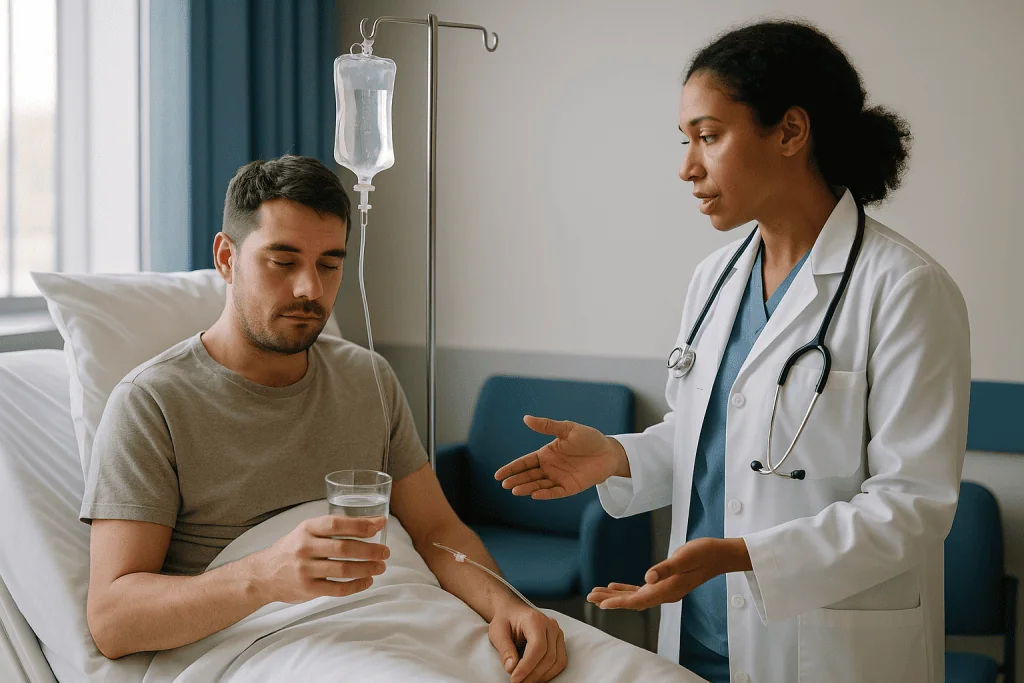
Vomiting and diarrhea can remove liters of water in a day, and the water leaves with sodium, potassium and bicarbonate dissolved in it. As the volume of blood circulating falls, the heart beats faster to compensate, blood pressure drops, and the kidneys, which depend on steady flow, begin to falter. MedlinePlus lists dehydration as the most common serious complication of foodborne illness.
Oral rehydration is tried first whenever possible because it is safe, cheap in resources and surprisingly effective. The sugar in the solution is not there for energy; it hitches sodium across the gut wall through a shared transport channel, and water follows the salt. This is the mechanism that has saved millions of lives in cholera outbreaks worldwide and it works just as well after a bad batch of chicken.
Intravenous fluids step in when the gut cannot cooperate. The usual choice is a balanced salt solution that mirrors the composition of blood. A cannula is placed in a vein in the hand or forearm, the first portion is often given quickly to restore circulating volume, and the rate is then adjusted according to repeat checks of pulse, blood pressure, urine output and blood results. Potassium may be added if levels have fallen, since low potassium can disturb heart rhythm.
Patients often ask whether the drip contains medicine. Usually it does not. It is water and salt, delivered in a way that bypasses a rebellious stomach. The improvement people feel within a couple of hours, the headache easing and the room steadying, is simply the body regaining the volume it lost. There is nothing more sophisticated to it, and nothing more important.
What the blood and stool tests are actually looking for
A blood draw and a stool pot can feel like the hospital is fishing. In fact each test answers a specific question, and knowing what they are makes the wait for results less anxious.
The blood panel typically includes a complete blood count and a chemistry set. A raised white cell count hints at bacterial infection but is not conclusive; a falling platelet count alongside anemia is a red flag for hemolytic uremic syndrome. Sodium and potassium reveal how badly the salt balance has shifted. Creatinine and urea measure how well the kidneys are clearing waste, which is the most direct read-out of dehydration’s toll. Some departments add a lactate level, a marker that rises when tissues are short of oxygen, as an early warning of sepsis. Sepsis is the body’s overwhelming and dangerous response to infection, and although rare in food poisoning, it is the complication clinicians are most keen not to miss.
Stool testing has changed considerably. Traditional culture, growing bacteria on plates over two or three days, is still used, particularly when an outbreak needs a confirmed organism for public health reporting. Many hospitals now run molecular panels that detect genetic material from a dozen or more pathogens within hours. The Cleveland Clinic notes that stool tests can identify bacteria, viruses and parasites and that results guide whether antimicrobial treatment is appropriate.
Speed matters most in one scenario: bloody diarrhea. Distinguishing a Shiga toxin-producing E. coli, which must not be treated with antibiotics, from Shigella or Campylobacter, which sometimes should be, changes management.
Imaging is uncommon. An abdominal scan is reserved for cases where the examination raises doubt about the diagnosis itself, such as severe localized pain or a rigid abdomen. For straightforward gastroenteritis, the laboratory tells the team what they need.
Antibiotics for food poisoning: when they help and when they can hurt
Ask most people how a hospital treats a serious infection and antibiotics come first. For food poisoning the order is reversed, and that reversal rests on solid evidence.
Many foodborne illnesses are viral, most often norovirus, and antibiotics do nothing against viruses. A further group is caused not by living bacteria multiplying in the gut but by toxins those bacteria produced in the food before it was eaten; the classic rapid-onset vomiting after a rice dish or a cream cake falls here. Killing bacteria that have already done their damage achieves nothing.
Even for genuine bacterial gut infections, the Mayo Clinic states that antibiotics are not usually needed and are reserved for certain bacterial infections, severe illness, or people at higher risk of complications. Two concerns drive that caution. Antibiotics disturb the gut’s normal bacteria and can open the door to C. difficile. More specifically, in infections with Shiga toxin-producing E. coli, antibiotics may increase the release of toxin and are associated with a higher risk of hemolytic uremic syndrome, so they are actively avoided while that organism is a possibility.
So when are antibiotics used? Typically when a stool test confirms an organism that responds well, such as Shigella or severe Campylobacter; when Salmonella is found in a patient who is very young, older, pregnant or immunocompromised; when there is evidence of bloodstream spread; or when a parasite such as Giardia is identified, in which case an antiparasitic rather than a conventional antibiotic is chosen. Listeria, a bacterium that can cross the placenta and infect the brain, is another exception where treatment is given promptly.
Which drug, for how long, and whether to start before results return are judgments for the prescribing clinician, weighing the patient’s risk against the harms of unnecessary treatment.
What about anti-nausea and anti-diarrhea medicines?
Two classes of medicine sit in a gray zone: helpful in some hands, unhelpful or risky in others.
Antiemetics, medicines that suppress the vomiting reflex, are widely used in emergency care. Their purpose is practical rather than curative. A patient who stops vomiting can begin to drink, and a patient who can drink may avoid an intravenous line or an admission altogether. The Cleveland Clinic lists anti-nausea medicines among the treatments a clinician may offer when vomiting prevents rehydration. Most work by blocking signals from the gut or the brainstem’s vomiting center. They are generally given as a single dose in the department, with the decision to repeat left to the team.
Anti-diarrheal medicines are more contentious. They slow the movement of the bowel, which reduces the number of trips to the toilet but also keeps the organism and its toxins inside for longer. The NHS advises against them for children and warns adults not to use them when there is blood in the stool or a high fever, precisely because those features raise the chance of an invasive bacterial infection where holding things in could do harm. In hospital they are rarely the first move. A clinician may consider one for an adult with watery, non-bloody diarrhea once infection with a dangerous organism is thought unlikely.
Probiotics, live bacteria taken to support the gut, come up constantly. The evidence is mixed and generally modest; some studies suggest a slightly shorter illness, others show no benefit, and hospital guidelines do not routinely include them.
Painkillers deserve a mention. Simple analgesics may ease cramps and fever, but anti-inflammatory drugs can stress kidneys that are already struggling with dehydration, so teams choose carefully. Every one of these decisions belongs to the prescribing clinician, informed by the individual’s tests and history.
Home care, emergency visit or admission: a side-by-side view
The pathway a person follows depends less on how miserable they feel and more on a few measurable things. This table summarizes how the three levels of care differ in practice. It is a general guide, not a triage tool; the treating team makes the call.
| Feature | Home care | Emergency department | Hospital admission |
|---|---|---|---|
| Typical picture | Vomiting and diarrhea, able to sip fluids, passing urine | Cannot keep fluids down, dizzy on standing, bloody stool, high fever | Severe dehydration, abnormal kidney or electrolyte results, suspected sepsis, high-risk patient |
| Rehydration | Water and oral rehydration solution in small, frequent sips | Oral rehydration trial, then intravenous fluid if needed | Intravenous fluid adjusted to repeat blood tests and urine output |
| Tests | None | Blood count, kidney function, electrolytes; stool test if bloody, severe or outbreak suspected | Above plus repeat monitoring, blood cultures if sepsis suspected |
| Medicines | Usually none; avoid anti-diarrheals if fever or blood | Possibly a single anti-nausea dose | Antibiotics only for confirmed or strongly suspected specific infections |
| Usual duration | Symptoms settle within days to about a week (NHS) | A few hours of observation | Until able to drink, kidney results recovering and safe for home |
Two patterns stand out. First, the tests and treatments escalate in step with objective dehydration and risk, not with the intensity of symptoms alone. Someone who has vomited ten times but can now hold down sips may need less intervention than someone who has vomited twice and is confused. Second, antibiotics appear only in the final column and only conditionally, which is the single most misunderstood point in the whole topic.
How long does it take to flush out food poisoning?
The phrase “flush it out” captures a real intuition but a false mechanism. Nothing a hospital gives speeds the germ’s exit; the body does that work itself. What treatment does is keep the person safe while it happens.
Duration depends on the organism. The CDC notes that symptoms of food poisoning can start anywhere from a few hours to several days after eating contaminated food, and that most people recover without treatment. Toxin illnesses often burn through in a day or so. Norovirus typically lasts one to three days. Bacterial infections such as Salmonella or Campylobacter may run for a week, occasionally longer. Parasites can linger for weeks until treated. The NHS gives the broad rule that symptoms usually pass within a week.
Intravenous fluids change how a person feels within hours, not how long the infection lasts. It is common to walk in gray and shaky and leave the same evening feeling largely human, only to have loose stools for several more days. That is expected, not a sign the treatment failed.
People sometimes ask about inducing vomiting or taking laxatives to hurry the process. Clinicians advise against both. Vomiting on purpose risks aspiration and further dehydration, and laxatives strip more fluid from an already depleted body. Activated charcoal, a staple of poison-control for certain drug overdoses, has no role in infectious food poisoning and is not used.
The most useful thing a patient can do to shorten the ordeal is unglamorous: keep sipping, rest, and reintroduce bland food as appetite returns. Fasting for days is unnecessary and slows recovery of the gut lining. The infection ends when the immune system and the bowel clear it, and for most people that happens within the ranges above without any medicine at all.
What the following days and weeks usually look like
Discharge is not the end of the story, and knowing the ordinary course of recovery prevents unnecessary alarm.
The first day or two at home are usually about fluids and sleep. Appetite tends to return before the bowel fully settles, so it is normal to want toast while still making frequent trips to the bathroom. The Mayo Clinic suggests easing back into eating with bland, low-fat, easy-to-digest foods and avoiding alcohol, caffeine and very fatty or spicy meals until symptoms resolve. Dairy can be poorly tolerated for a short stretch because the gut lining temporarily produces less lactase, the enzyme that digests milk sugar; this passes.
Fatigue lingers longer than most people expect. A week of feeling washed out after a moderate bout is common and reflects fluid shifts, disrupted sleep and calorie deficit rather than ongoing infection.
A minority develop what clinicians call post-infectious irritable bowel syndrome, a pattern of cramping, bloating and altered bowel habit that continues after the infection has cleared. It is well described after bacterial gastroenteritis and usually improves over months, though it can be frustrating. Reactive arthritis, joint pain appearing a few weeks after certain infections such as Campylobacter or Salmonella, is rarer and also generally self-limiting. Guillain-Barré syndrome, a nerve condition occasionally triggered by Campylobacter, is rare but serious and is one reason new weakness or tingling after food poisoning should be reported promptly.
Follow-up is not routine for uncomplicated cases. It may be arranged if kidney results were abnormal, if a notifiable organism was found and public health teams need to confirm clearance, or if the patient works in food handling or healthcare and needs guidance about returning. The NHS advises staying off work or school until at least 48 hours after the last episode of vomiting or diarrhea, a rule aimed at protecting others rather than the patient.
How treatment differs for children, in pregnancy and for older adults
The principles do not change across ages, but the thresholds for acting do, because some bodies have far less reserve.
Children lose proportionally more fluid than adults and can slide from mildly unwell to significantly dehydrated within hours. Pediatric teams lean heavily on oral rehydration solution given in small, frequent amounts, sometimes by syringe or spoon in a toddler who refuses a cup. An anti-nausea medicine may be used to make that possible. Intravenous fluids follow if oral attempts fail or the child is already floppy, has sunken eyes, or has stopped producing wet diapers. Anti-diarrheal medicines are not given to children. Weighing the child on arrival and again before discharge gives an objective measure of fluid recovered. Parents should expect to be shown how to continue rehydration at home and told precisely which signs mean coming back.
In pregnancy the concern shifts partly to the baby. Dehydration can provoke contractions, so the bar for intravenous fluids is lower. The organism matters more, too: Listeria, found in some unpasteurized dairy, deli meats and ready-to-eat foods, can cross the placenta and cause miscarriage or serious infection in the newborn, so a pregnant patient with fever and flu-like symptoms after a suspicious meal will often have blood cultures taken and may be treated before results return. That decision rests with the obstetric and medical teams.
Older adults face two problems at once. Their sense of thirst is blunted, so they under-drink, and many take medicines such as diuretics or blood pressure tablets that magnify the effect of fluid loss on the kidneys. The CDC identifies adults aged 65 and older as a group at higher risk of severe illness and hospitalization from foodborne infection. Clinicians may temporarily adjust or pause certain regular medicines during the acute illness; patients should never do this themselves without instruction.
What is the #1 food that causes food poisoning?
Patients ask this in the emergency department almost as often as they ask how long the drip will take, and the honest answer disappoints anyone hoping for a single villain.
There is no one food. Different organisms favor different foods, and the ranking shifts depending on whether you count total illnesses, hospitalizations or deaths. Public health surveillance in the United States has repeatedly pointed to a handful of categories: raw or undercooked poultry, which is strongly linked to Salmonella and Campylobacter; leafy greens, which have been at the center of several large E. coli outbreaks; raw or undercooked eggs; unpasteurized milk and soft cheeses, associated with Listeria; raw sprouts; and raw shellfish, particularly oysters, which can carry norovirus and Vibrio bacteria. The CDC describes these as foods that are more likely to cause illness when handled or cooked improperly.
Globally the picture broadens. The WHO estimates that unsafe food causes around 600 million illnesses and 420,000 deaths worldwide each year, with the heaviest burden falling on young children and on regions with limited access to clean water and refrigeration.
Why does this matter in a treatment article? Because the food history genuinely shapes care. A patient who ate raw oysters points the team toward Vibrio, which can be dangerous in people with liver disease and is one of the situations where antibiotics are considered early. A pregnant patient who ate soft cheese raises the Listeria question. A child with bloody diarrhea after an undercooked hamburger or a trip to a petting zoo makes clinicians think of Shiga toxin-producing E. coli, where the priority is fluids and careful monitoring rather than antibiotics.
So when a nurse asks what you ate for the past three days, it is not curiosity. It is one of the more useful diagnostic tools available.
What people often get wrong about food poisoning treatment
Some of the most persistent ideas about treating food poisoning are not just wrong but occasionally harmful. Here are the ones clinicians correct most often.
“They will pump my stomach.” Gastric lavage is essentially never used for foodborne infection. By the time symptoms appear the food has long left the stomach, and the procedure carries real risks. It belongs to a narrow set of drug and chemical poisonings, not to a bad burrito.
“Antibiotics will knock it out faster.” For viral and toxin-mediated illness they do nothing, and for certain E. coli infections they may increase the risk of kidney complications. When a doctor declines to prescribe one, that is the evidence talking, not indifference.
“Starving it out helps.” Prolonged fasting slows recovery of the gut lining and deepens fatigue. Small amounts of bland food as soon as appetite allows are encouraged by the Mayo Clinic and the NHS alike.
“Stopping the diarrhea is the goal.” Diarrhea is unpleasant but it is also the body’s exit route for the organism. Suppressing it with medicine when there is fever or blood in the stool can prolong or worsen certain infections, which is why the NHS warns against it in those circumstances.
“Sports drinks are the same as rehydration solution.” They are not. Sports drinks generally contain far more sugar and less sodium than oral rehydration solution, and excess sugar can worsen diarrhea. They are better than nothing but not the tool designed for the job.
“It was the last thing I ate.” Incubation periods range from hours to days, so the meal before symptoms is often innocent. This misattribution is why outbreak investigations rely on structured food histories rather than instinct.
“Once I feel better I am no longer contagious.” Many organisms are still shed in stool for days after symptoms resolve, which is the reason for the 48-hour rule before returning to work or school.
Questions to ask your care team
A hospital visit for food poisoning moves quickly, and the questions that matter tend to surface after discharge. Having a short list ready helps you leave with answers rather than assumptions. These are the ones experienced clinicians say they wish patients asked more often.
- How dehydrated am I, and what did my blood tests show about my kidneys and salts? A plain-language answer to this tells you why the team chose the plan they did.
- Are you sending a stool sample, and if so, will someone contact me with the result or do I need to follow up? Results sometimes arrive after discharge.
- Is there a reason I am, or am not, being given antibiotics? Understanding the logic prevents the assumption that something was missed.
- Which of my regular medicines should I keep taking while I am unwell, and are there any I should pause? This is particularly important for blood pressure medicines, diuretics and diabetes treatments, and the answer must come from the prescriber.
- What should I drink at home, how much, and how will I know it is enough?
- When can I start eating normally again, and are there foods to avoid for now?
- What exact signs mean I should come back or call, and who do I call outside office hours?
- How long should I stay away from work, school or caring for others, and is there anything specific to my job I should know?
- Do I need any follow-up, and when?
- Is this an illness that should be reported to public health, and is there anything I should do to protect people I live with?
Write the answers down or ask for them in the discharge paperwork. Fatigue and dehydration make memory unreliable, and the details about fluids and warning signs are the ones you will most need at three in the morning.
When to call your doctor
Most food poisoning settles at home, but a specific set of signs means the balance has tipped and medical assessment should not wait. Seek care promptly, by calling your doctor, an urgent care line or emergency services depending on severity, if any of the following occur.
- You cannot keep any fluids down for more than a day, or a child cannot keep fluids down for several hours.
- Signs of significant dehydration: very little or no urine, dark urine, dizziness or fainting on standing, a racing heart, extreme thirst, confusion, or in a baby no wet diaper for many hours, sunken eyes or unusual drowsiness.
- Blood in the stool or vomit, or stool that is black and tarry.
- Diarrhea lasting more than three days, or symptoms that are getting worse rather than better.
- A high fever, particularly with shaking chills.
- Severe or localized abdominal pain, or a belly that is hard and tender to touch.
- Neurological symptoms: blurred or double vision, difficulty swallowing or speaking, new muscle weakness or tingling. These can indicate botulism or a post-infectious nerve condition and need urgent evaluation.
- You are pregnant, over 65, have a weakened immune system, or have chronic kidney, liver or heart disease and are unwell after a suspect meal, even if symptoms seem mild.
- You suspect you ate something in an outbreak that has been publicly announced, or several people who shared a meal are ill.
The Mayo Clinic and the CDC both list persistent vomiting, dehydration, bloody stool, high fever and prolonged diarrhea among the reasons to seek care. Trust the pattern rather than the intensity of any single symptom: a person who is getting steadily drier and quieter is more concerning than one who is loudly miserable but drinking. Whatever the situation, the treating team makes the final decisions about tests, fluids and medicines. Your job is to get to them in time.
Frequently asked questions
How would a hospital treat food poisoning?
A hospital treats food poisoning by assessing dehydration, giving oral rehydration solution if it can be kept down and intravenous fluids if it cannot, and running blood tests for kidney function and electrolytes. A stool sample is sent when the illness is severe, bloody or affects a higher-risk patient. Anti-nausea medicine may be offered. Antibiotics are used only for specific confirmed or strongly suspected infections, at the treating team’s discretion.
What do doctors do for food poisoning if I cannot stop vomiting?
Persistent vomiting is the most common reason for a trip to the emergency department. Clinicians usually give an anti-nausea medicine to calm the vomiting reflex, then retry small sips of oral rehydration solution. If fluids still will not stay down or dehydration is already marked, intravenous fluid is started through a cannula in the arm. Most people are reassessed within hours and go home once they can drink.
How long does food poisoning last after hospital treatment?
Intravenous fluids relieve dehydration within hours, but they do not shorten the infection itself. Toxin illnesses often clear in about a day, norovirus in one to three days, and bacterial infections such as Salmonella or Campylobacter over roughly a week, according to CDC and NHS descriptions. Loose stools and fatigue commonly continue for several days after discharge and are not a sign that treatment failed.
Do you need antibiotics for food poisoning?
Usually not. Many cases are viral or caused by toxins already present in the food, and antibiotics do nothing for either. The Mayo Clinic notes antibiotics are reserved for certain bacterial infections, severe illness or higher-risk patients. In suspected Shiga toxin-producing E. coli they are actively avoided because they may increase the risk of kidney complications. The prescribing clinician decides based on tests and individual risk.
What is the #1 food that causes food poisoning?
There is no single top food. Surveillance repeatedly implicates raw or undercooked poultry, leafy greens, raw eggs, unpasteurized dairy, raw sprouts and raw shellfish, each linked to different organisms. Which ranks highest depends on whether illnesses, hospitalizations or deaths are counted. The CDC describes these as foods more likely to cause illness when handled or cooked improperly, and the food history helps doctors decide which germ to suspect.
Are food poisoning IV fluids just water?
Essentially yes, with salts added. The usual intravenous fluid is a balanced solution of water, sodium, chloride and sometimes potassium designed to mirror the composition of blood. It contains no medicine unless a drug is deliberately added. The purpose is to restore circulating volume and correct electrolyte imbalances that vomiting and diarrhea have caused, which is why patients often feel markedly better within a couple of hours.
What tests are done in hospital for food poisoning?
Blood tests typically include a full blood count, kidney function and electrolytes, with lactate or blood cultures added if sepsis is a concern. Stool tests, either traditional culture or rapid molecular panels, identify bacteria, viruses or parasites but are ordered selectively because the result often does not change treatment. Imaging is uncommon and reserved for cases where the diagnosis itself is in doubt.
Can I take anti-diarrhea medicine for food poisoning?
Not always. The NHS advises adults to avoid anti-diarrheal medicines if there is blood in the stool or a high fever, because slowing the bowel can keep harmful bacteria and toxins inside longer. They are not recommended for children. In hospital they are rarely a first-line treatment. If you are unsure, ask the clinician assessing you rather than taking one before you are seen.
How long should I stay off work after food poisoning?
The NHS recommends staying away from work or school until at least 48 hours after your last episode of vomiting or diarrhea. Many organisms continue to be shed in stool after you feel better, so this gap protects colleagues and classmates. People who handle food or work in healthcare may be given additional guidance by their employer or public health team before returning.
When should food poisoning be treated as an emergency?
Seek urgent care for inability to keep fluids down, very little urine, dizziness or confusion, blood in stool or vomit, high fever, severe or localized abdominal pain, or any new weakness, tingling, vision or swallowing problems. Pregnant people, adults over 65 and anyone with a weakened immune system should have a lower threshold for seeking help. The treating team will decide what tests and treatment are needed.
References
- NHS: Food poisoning
- CDC: About food poisoning
- Cleveland Clinic: Food poisoning
- MedlinePlus: Food poisoning
This article is for general information only and is not a substitute for professional medical advice. Please consult a qualified doctor about your individual situation.

More from the Blog

How Long Does Recovery From Acute Pancreatitis Take? First Weeks, Food and Strength
Recovery from acute pancreatitis usually takes about a week for mild cases, which make up roughly four in five episodes according to the NHS,…

How Is a Hiatal Hernia Repaired Laparoscopically? Keyhole Steps and How Long It Takes
Laparoscopic hiatal hernia repair is keyhole surgery done under general anesthesia through several small abdominal cuts. The surgeon pulls the herniated stomach back below…

Which Blood Tests Confirm Hepatitis A and What Liver Function Results Mean
Hepatitis A is confirmed by a blood test for IgM antibodies to the hepatitis A virus, which appear shortly before symptoms and fade over…
Keeping a Symptom and Food Diary Before Your IBS Appointment: What to Record and Why
An IBS symptom and food diary is a daily record of what you ate and drank, when, and how your gut and body responded…

How Long Does Gastroenteritis Usually Last? What Shapes Recovery From a Stomach Bug
Most gastroenteritis clears on its own within a few days. Vomiting typically settles in one to two days and diarrhea within five to seven…

Diverticulitis Recovery Timeline: From Antibiotics to Feeling Yourself Again
Most people with mild, uncomplicated diverticulitis start to feel better within about 2 to 3 days of starting treatment, and many feel close to…