

How Long a CT Scan Takes: Preparation, the Scan Itself and the Wait for Results
Key Takeaways
- The CT scan itself usually takes 10 to 20 minutes according to NHS guidance, and the X-ray beam is actually on for well under that.
- Contrast dye is the main reason appointments stretch to 60-90 minutes: oral contrast is typically taken about an hour before scanning, and IV contrast may be followed by a short observation period.
- Results are not given in the scanner room; a radiologist writes a formal report that usually reaches your referring doctor within days to a few weeks, with emergency scans read within minutes.
- Wearing soft clothes without zippers, underwire or metal fastenings often means you can skip the gown entirely and shorten your visit.
- CT can show many tumors and is central to staging cancer, but confirming a diagnosis almost always needs a biopsy, and a normal scan does not rule out every cause of symptoms.
- Facial or tongue swelling, wheezing, widespread hives or fainting after a contrast injection are red-flag signs that need urgent care, though serious reactions are rare.
A CT scan itself usually takes about 10 to 20 minutes, and the moment the X-ray beam is actually on often lasts under a minute. The full appointment runs closer to an hour when contrast dye is used, because you may drink it or have an injection and wait for it to circulate. Results typically arrive days to a few weeks later, sooner in emergencies.
The most common thing radiographers hear when the table slides back out is some version of “That’s it?” People arrive braced for an ordeal and leave slightly disoriented that the loud part was over before they had finished counting ceiling tiles. Then the second surprise lands: the letter or portal message with the result may take a week or two, sometimes longer, and nobody warned them the waiting would be the hardest part.
That mismatch is worth taking seriously. A CT appointment is really three clocks running at different speeds: the preparation clock (hours, if contrast is involved), the scanner clock (minutes), and the results clock (days to weeks). Knowing which clock you are on at any given moment turns a vague, anxious morning into something you can plan around, from what to eat to when to expect a call.
How long does a CT scan take, minute by minute?
Strip the day down to its parts and the picture becomes clear. The scanner is the fast bit. The NHS puts the scan itself at roughly 10 to 20 minutes, and Mayo Clinic describes the whole in-room experience as typically about 30 minutes, with the actual imaging taking far less. The rest is logistics: checking in, changing, a needle if contrast is planned, and a short wait to make sure you feel well before leaving.
| Stage | Typical time | What is happening |
|---|---|---|
| Check-in and safety questions | 10-15 minutes | Pregnancy, kidney and allergy checks; consent |
| Changing and removing metal | 5 minutes | Gown if needed; jewelry, belts, glasses off |
| Oral contrast (some abdominal scans) | About 1 hour before scanning (NHS) | Drink coats the bowel so it shows clearly |
| Cannula for IV contrast | 5 minutes | Small needle placed in arm or hand |
| Positioning and practice breaths | 5 minutes | Lying still on the table; test run of instructions |
| The scan (beam on) | Seconds to a few minutes, within a 10-20 minute slot (NHS) | Table moves through the ring in passes |
| Observation after IV contrast | Up to 30 minutes at some departments | Watching for a reaction before you go |
Add those rows up and a plain head CT without contrast can be a 20-minute visit door to door, while an abdomen and pelvis scan with both oral and IV contrast realistically fills an hour and a half. Same machine, very different mornings.
Why does a 10-minute scan turn into a 90-minute appointment?
Contrast is the usual culprit, and it deserves the time it takes. When the radiologist needs to distinguish a loop of bowel from a lymph node, or see how blood moves through the liver, plain tissue density is not enough. A drink taken about an hour beforehand, as the NHS describes, lines the gut so it stands out. An injection through a vein lights up blood vessels and organs within seconds, but the scan has to be timed to that flow, so the radiographer will place the cannula, check it runs freely, and then wait for the exact moment to start.
Safety questions eat minutes too, and rightly so. Before IV contrast, staff will ask about kidney problems, previous reactions to dye, asthma and whether you might be pregnant (Mayo Clinic; NHS). Some people with reduced kidney function need a recent blood test on file, and if it is missing the appointment can stall while it is arranged. Certain diabetes medicines are sometimes paused around contrast on a clinician’s instruction, which is another conversation that happens at the desk rather than in the scanner.
Then there is the machine schedule. Emergency patients arriving by ambulance jump the queue, because a suspected stroke or internal bleed cannot wait for the 2:40 slot. If your scan is running late, that is usually why, and it is the system working as intended.
What should you not do before a CT scan?
The honest answer is that for many CT scans you need to do almost nothing special, and the instructions on your appointment letter overrule anything you read online, including this. That said, patterns are consistent across major guidance.
If contrast is planned, you will probably be asked not to eat for a few hours beforehand; the NHS notes you may be told to avoid food and drink for a period before some scans, and Mayo Clinic gives similar advice. The reasons are practical: a full stomach can blur abdominal images, and on the rare occasion someone feels nauseated after an injection, an empty stomach is safer. Clear water is usually fine unless told otherwise, and staying hydrated actually helps your kidneys clear the dye afterward.
Skip the metal. Underwired bras, zippers, hairpins, dentures with metal clasps and piercings all scatter the X-ray beam into bright streaks that can hide exactly what the radiologist is looking for. Dress in soft clothes without fasteners and you may not need a gown at all.
Do not stop your usual medicines on your own. Take them as normal unless the department specifically instructs otherwise, and bring a list. The exceptions, such as some diabetes tablets around contrast, are decisions for the prescribing clinician or the radiology team, not for the car park.
Finally, do not hide information out of embarrassment or haste. A possible pregnancy, a past reaction to dye, kidney disease, or a fear of enclosed spaces all change how the team prepares. Telling them saves time; it never costs it.
Do I take my clothes off for a CT scan?
Often not entirely, and sometimes not at all. The rule is metal and thickness, not modesty. If you arrive in leggings or sweatpants and a plain T-shirt with no metal trim, many departments will scan you as you are for a head, chest or limb study. Trousers with a metal zip or a belt buckle will need to come off for an abdominal or pelvic scan, and you will be offered a gown and a private cubicle.
Bras with underwire are the most common reason women are asked to change for a chest CT; a soft sports bra without clasps frequently passes. Glasses, hearing aids, removable dentures and hairpins come out for head scans. Watches, rings and necklaces are best left at home, both because they interfere with images and because departments cannot always secure valuables.
Cleveland Clinic and Mayo Clinic both describe the gown as a possibility rather than a certainty, and that reflects real practice. Dressing deliberately for the appointment is the single easiest way to shave five or ten minutes off your visit and stay comfortable while you wait.
Once on the table you lie on your back, occasionally on your stomach or side depending on the area, with a pillow under your knees or a strap across your body to help you stay still. A sheet or blanket is standard. The room is kept cool for the equipment, so ask for a blanket if you run cold; nobody will think twice.
What to expect when you get a CT scan: the scan itself
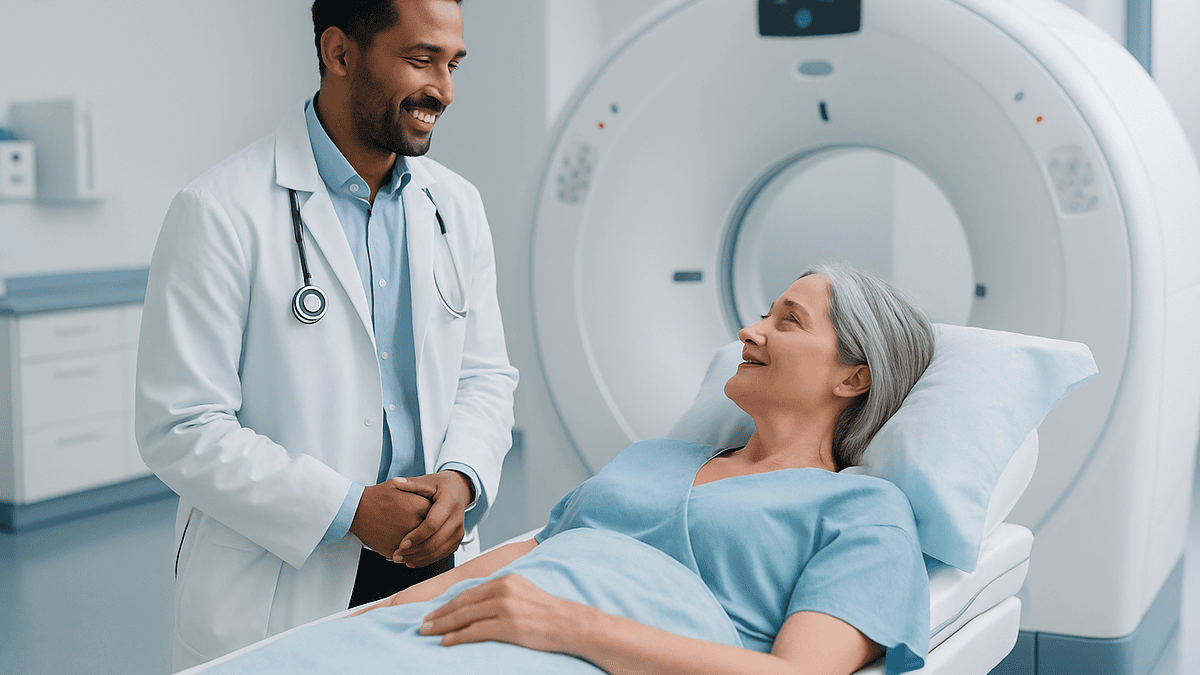
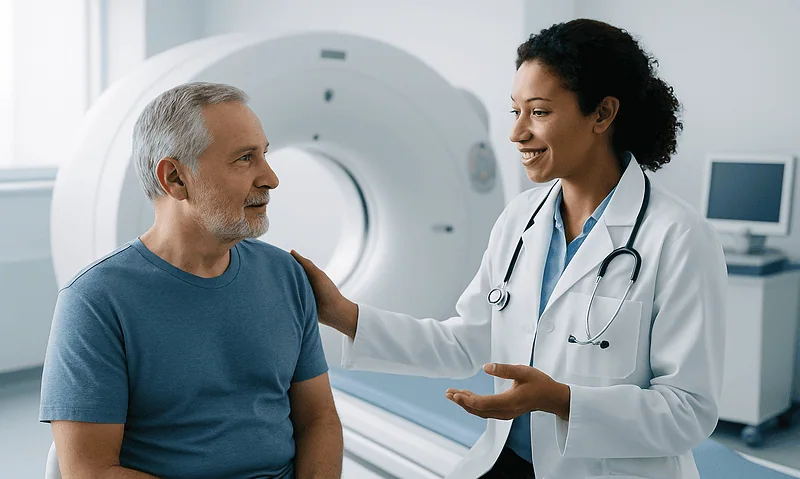
A CT scanner looks less like a tunnel and more like a large doughnut standing on its edge. You lie on a narrow motorized table that glides through the opening while an X-ray tube and detectors spin around you inside the ring. Each rotation captures a thin slice of the body; a computer stacks the slices into cross-sectional images and, when needed, a three-dimensional model (NIH NIBIB; MedlinePlus).
You will hear whirring and clicking, quieter than an MRI, and a recorded or live voice will ask you to hold your breath for perhaps five to ten seconds at a time. Breath-holds matter more than people expect: even the gentle rise of the chest can smear a lung nodule across several slices. The radiographer watches from a glass-walled control room and can hear you through an intercom the whole time.
The table typically moves through the ring two or three times. The first is a quick low-resolution pass to plan the scan; the diagnostic passes follow. If you are having IV contrast, an automated pump pushes the dye through your cannula partway through, and the scan is timed to catch it in the arteries, then the veins and organs.
Total table time, as the NHS notes, is usually 10 to 20 minutes, and the periods when the beam is on add up to well under that. Most people find the hardest parts are keeping arms raised over the head for chest and abdominal scans, and resisting the urge to shift when told to stay still.
How contrast dye works and what it feels like
CT contrast is iodine-based. Iodine atoms are heavy enough to block X-rays, so wherever the dye travels, tissue appears brighter on the image. That simple physics is why a contrast scan can show a blocked artery, a bleeding vessel, an abscess ringed by inflamed tissue, or the blood supply of a tumor in ways a plain scan cannot (MedlinePlus; Mayo Clinic).
Injected contrast produces sensations that are odd but expected. Within seconds you may feel a wave of warmth spreading through the chest and pelvis, a metallic taste, and a strong impression that you have wet yourself. You have not. The feeling passes in a minute or two, and radiographers warn everyone about it because the surprise otherwise makes people jolt.
Serious reactions are uncommon. The NHS describes it as rare for contrast to cause serious problems, and mild effects such as a brief rash, itching or a feeling of sickness usually settle on their own. Because reactions, when they happen, tend to appear quickly, some departments keep you for a short observation period before removing the cannula. That is the wait after the scan that nobody mentions.
The dye leaves the body through the kidneys within hours. Mayo Clinic advises drinking plenty of fluids afterward to help flush it out, unless you have been told to restrict fluids for another reason. If you are breastfeeding, ask the team; current guidance from major centers generally does not require interrupting feeds, but the conversation is worth having before the injection rather than after.
Does the type of CT scan change how long it takes?
Yes, and knowing which scan you have been booked for is the best predictor of your morning. A non-contrast head CT for headaches or a fall is among the quickest studies in the department; the imaging takes seconds and there is no cannula, so you may be in and out in 15 minutes. A sinus or bone CT is similarly brisk.
Chest CTs add a breath-hold routine but rarely need oral contrast. If a clot in the lung arteries is suspected, an IV injection is timed precisely to the pulmonary vessels, which adds set-up minutes but not much scanning time.
Abdomen and pelvis scans are the long ones. Oral contrast taken about an hour before, an IV injection, and several timed passes through the ring can push the visit to 90 minutes or more (NHS timings for oral contrast). Scans of the urinary tract sometimes require a delayed pass 10 or 15 minutes after the injection to catch dye reaching the bladder, so you may be asked to wait on the table or in the corridor and come back.
Cardiac CT and CT angiography of the heart are a special case. Because the heart is moving, the scan is synchronized to your heartbeat, and a clinician may give a medicine beforehand to slow the pulse for a clearer picture. That preparation, decided by the prescribing team, can add a half-hour of monitoring before the scan itself.
Whole-body trauma CT in an emergency department is the opposite extreme: a single sweep from head to thighs in well under a minute, because speed is the whole point.
How long does it take to get CT scan results?
Here the clocks diverge sharply, and this is the part of the process that deserves more honesty than it usually gets. The images exist the moment the table stops. What you are waiting for is interpretation: a radiologist, a doctor who specializes in reading scans, has to review hundreds of slices, compare them with any previous imaging, and write a formal report. The NHS is plain that results are not usually available straight away and can take days or a few weeks to reach the doctor who requested the scan.
Urgency changes everything. In an emergency department, a preliminary read on a suspected stroke or internal bleed happens within minutes, because treatment decisions hang on it. A routine outpatient scan sits in a queue behind those cases. Cancer pathways often have target turnaround times built into them, so a scan requested to investigate a suspicious finding is typically prioritized over a follow-up of a stable, known condition.
Then the report has to travel. It goes to the referring clinician, not to you, and that clinician decides how to share it: a phone call, a letter, a portal message, or a follow-up appointment already in the diary. A two-week wait often breaks down as three days of radiology time and eleven days of administrative routing.
Practical advice: before you leave the department, ask who will contact you and roughly when. If that date passes, call the requesting doctor’s office rather than the scanner, since the report is already in their hands.
Who reads the scan, and what the report actually says
The radiographer who ran your scan is trained to acquire images, not to diagnose from them, which is why asking “did you see anything?” in the room rarely gets an answer. That is not evasiveness; it is professional boundary. The radiologist reads the study later, often in a darkened room with two or three monitors and your previous scans loaded alongside for comparison (Johns Hopkins Medicine describes this workflow in its patient guidance).
A report has a recognizable shape. It opens with the clinical question, notes the technique used, including whether contrast was given, then works through each organ system in view. The final paragraph, usually labeled impression or conclusion, is the part your doctor reads first. It ranks findings by importance and often includes recommendations, such as a follow-up scan in a set number of months or a different test to clarify something uncertain.
Two features of reports surprise people. First, they nearly always describe incidental findings: a small liver cyst, a benign-looking kidney lesion, mild spinal wear. These are common in adults and most are harmless, but each may be documented for completeness. Second, radiology language is probabilistic. Phrases like “likely benign”, “cannot exclude” and “correlate clinically” are not hedging for its own sake; they reflect that a picture shows shape and density, not certainty.
If you receive a copy of the report before your appointment, read it with that in mind, and bring your questions to the clinician who knows your history.
Can doctors see cancer on a CT scan?
CT is one of the main tools for finding, measuring and staging tumors, and the evidence-based answer is that it can show many cancers, but it cannot on its own prove that something is cancer. MedlinePlus lists detecting tumors and monitoring their response to treatment among the core uses of CT, and the NHS describes CT as a way to diagnose and guide treatment for a range of conditions including cancer.
What the scanner sees is a mass of a certain size, shape, density and blood supply. Some patterns are highly suggestive; a spiculated lung nodule or a liver lesion that enhances in a characteristic way with contrast will prompt urgent next steps. Other findings sit in a gray zone. A small lung nodule, for instance, is common in people who have never had cancer, and guidelines typically call for a repeat scan after an interval to see whether it changes rather than an immediate biopsy.
Confirming cancer almost always requires tissue. A biopsy, sometimes guided by the CT itself, lets a pathologist look at cells under a microscope. Staging, meaning how far a confirmed cancer has spread, is where CT excels, because a single study can survey chest, abdomen and pelvis for enlarged lymph nodes or distant deposits.
Limits matter too. Very small tumors, some early cancers of the digestive tract, and certain brain and pelvic conditions are better shown by MRI, endoscopy or ultrasound. A clear CT is reassuring; it is not a guarantee, which is why symptoms that persist after a normal scan still deserve a second conversation.
Is the radiation from a CT scan something to worry about?
CT uses more radiation than a standard X-ray because it takes many images from many angles rather than one. Mayo Clinic describes the exposure as low-dose in the context of medical imaging and notes that the benefit of an accurate diagnosis generally outweighs the small potential risk. The NIH’s National Institute of Biomedical Imaging and Bioengineering makes the same point while acknowledging that the dose is higher than for conventional radiography and varies by body part scanned.
The useful mental model is cumulative rather than catastrophic. A single scan adds a small increment to lifetime exposure, comparable to a period of natural background radiation from soil, rocks and cosmic rays that everyone receives anyway. The theoretical increase in long-term cancer risk from one scan is small, and it is set against the very real, immediate risk of missing a bleed, a clot, or a tumor.
Where caution genuinely applies is repetition and age. Children are more sensitive to radiation and have more years ahead in which any effect could emerge, so pediatric departments use lower-dose protocols and consider ultrasound or MRI first when those would answer the question. Pregnant patients are asked about pregnancy precisely so the team can weigh alternatives; a CT of the head or chest exposes the fetus to very little, while abdominal scanning is approached more carefully (NHS; Mayo Clinic).
The right question is not “is CT dangerous?” but “is this scan going to change what happens next?” A scan that answers a real clinical question is well worth its dose. One ordered for reassurance alone is the kind to discuss.
After the scan: what to expect, and when to seek care
Most people walk out and get on with their day. If you had no contrast, there are no restrictions at all. If you had an IV injection, Mayo Clinic’s advice is to drink plenty of fluids over the following hours to help your kidneys clear the dye, and to keep the small dressing on the cannula site for a few hours. A little bruising where the needle went in is common and fades within days.
Oral contrast can loosen stools for a day. That is expected and passes without any action on your part. Some people feel tired or mildly headachy after a long, anxious morning, which says more about the morning than the scanner.
Delayed contrast reactions are uncommon but real, appearing hours to a day or two later, most often as an itchy rash. The NHS reassures that serious problems from contrast are rare, and mild skin reactions generally settle by themselves; mention them to your doctor so they are recorded for any future scan.
Seek urgent care if, after a contrast injection, you develop swelling of the face, lips or tongue, difficulty breathing or wheezing, a widespread hive-like rash, dizziness or fainting, or a fast heartbeat. Also contact a clinician promptly if the injection site becomes hot, increasingly painful or swollen, or if you pass very little urine over the following day, since that can signal a kidney problem in people already at risk. None of these are common, but they are the signs that should not wait for a routine appointment.
Claustrophobia, children and staying still: how to make the scan easier and faster
The most common reason a CT takes longer than planned is not the machine. It is a person who cannot lie still, whether from anxiety, pain or age, and every repeated pass adds minutes and radiation. A few practical moves help.
If enclosed spaces frighten you, say so at booking. CT rings are short and open at both ends, far less confining than an MRI tube, and many people who dread the scan find the reality anticlimactic (Cleveland Clinic and Mayo Clinic both note the open design). You can usually keep your eyes shut, ask for the room lights up, and have the radiographer talk you through each step over the intercom. A companion can often sit in the control room where you can hear their voice.
Pain is a bigger obstacle than fear. If lying flat with arms raised is agony because of a shoulder or back problem, tell the team; they can adjust positioning, pad the table, or plan a shorter protocol. Taking your usual pain relief as normally prescribed before you come is sensible, but that is a decision for you and your clinician, not something to improvise.
Children need preparation of a different kind. Pediatric departments often use play, practice sessions with a toy scanner, and parents in the room. Very young children who cannot stay still may need sedation arranged in advance, which adds observation time before and after. Older children generally manage a head or chest CT in the same 10 to 20 minutes as adults once they know the noises are coming.
Whatever your age, a full explanation before the table moves is the single best time-saver in the building.
Frequently asked questions
How long does a CT scan take from start to finish?
Plan for 15 minutes to 90 minutes depending on the type. The scan itself typically takes 10 to 20 minutes per NHS guidance, and the imaging passes last seconds to a few minutes. A non-contrast head CT can be a quick visit, while an abdomen and pelvis scan with oral and IV contrast adds an hour of drinking, cannula placement and a short observation period afterward. Your appointment letter is the best guide to your specific timing.
What should you not do before a CT scan?
Follow your appointment instructions above all. Commonly, you are asked not to eat for a few hours if contrast is planned, to avoid wearing metal such as underwired bras, zippers and jewelry, and to keep taking your usual medicines unless told otherwise. Do not stop any medicine on your own, and do not withhold information about possible pregnancy, kidney problems or past reactions to dye, since these change how the team prepares.
Do I take my clothes off for a CT scan?
Not always. If your clothes have no metal fasteners, many departments scan you as you are, especially for head, chest or limb studies. Metal zippers, belts, underwire and hairpins create streaks on images, so you may be asked to change into a gown for the relevant area. Glasses, hearing aids and removable dentures come out for head scans. Dressing in soft, metal-free clothing is the easiest way to stay comfortable and save time.
How long does it take to get CT scan results?
Usually days to a few weeks for routine outpatient scans, according to the NHS, because a radiologist must review the images and write a report that then goes to your referring doctor. Emergency scans for suspected stroke, bleeding or clots are read within minutes. Suspected cancer investigations are typically prioritized. Before you leave, ask who will contact you and when; if that date passes, call the doctor who requested the scan.
Can doctors see cancer on a CT scan?
CT can show many tumors, measure them and check whether a cancer has spread, which is why it is central to staging. It cannot by itself confirm that a finding is cancer; that generally requires a biopsy examined under a microscope. Some small or early cancers are better detected by MRI, endoscopy or ultrasound, and small incidental nodules are common and usually benign, often needing only a follow-up scan to check for change.
What does the contrast injection feel like?
Most people feel a spreading warmth through the chest and pelvis, a metallic taste, and a brief, convincing sensation of having wet themselves. These pass within a minute or two and are entirely expected. Mild reactions such as a short-lived rash or nausea are uncommon and usually settle on their own; serious reactions are rare according to NHS guidance. Tell staff immediately if you feel your throat tightening or have trouble breathing.
Can I eat and drink before a CT scan?
For scans without contrast, usually yes, with no restrictions. If IV or oral contrast is planned, you are often asked not to eat for a few hours beforehand, both for clearer abdominal images and for comfort if the injection causes brief nausea. Clear water is generally allowed and helps your kidneys clear the dye afterward. Your appointment letter overrides general advice, so check it and call the department if anything is unclear.
Is it safe to have a CT scan while pregnant?
Tell the team about any possible pregnancy before the scan. CT of the head, neck or chest exposes the fetus to very little radiation, while abdominal and pelvic scans are approached more cautiously, and alternatives such as ultrasound or MRI may be considered when they can answer the question. When a CT is clearly needed to protect the mother’s health, the benefit generally outweighs the small risk, but the decision is made with you, not for you.
Why do I have to wait after the contrast injection before leaving?
Because the uncommon serious reactions to iodine-based contrast tend to appear quickly, some departments keep you for a short observation period, often up to 30 minutes, with the cannula still in place. If you feel well, the needle is removed and you can go home, drive and eat normally. Drinking extra fluids over the following hours helps your kidneys clear the dye, as Mayo Clinic advises.
Can I drive home after a CT scan?
Yes, in nearly all cases. Neither the scan nor standard contrast affects your ability to drive. The exceptions are when a sedative has been arranged in advance for severe anxiety or for a young child, or when a cardiac CT involved medicine to slow the heart, in which case the team will give specific instructions. If you felt faint or unwell during the scan, wait until you feel steady and tell the staff before leaving.
References
- NHS: CT scan
- MedlinePlus: CT Scans
- Cleveland Clinic: CT (Computed Tomography) Scan
- NIH National Institute of Biomedical Imaging and Bioengineering: Computed Tomography (CT)
This article is for general information only and is not a substitute for professional medical advice. Please consult a qualified doctor about your individual situation.

More from the Blog
CT Coronary Angiogram Explained: What It Shows, Preparation and What Results Mean
A CT coronary angiogram is a non-invasive heart scan that combines an iodine-based contrast dye injected into an arm vein with a fast, heartbeat-timed…

Recovery After a Stereotactic Biopsy: Headache, Pin-Site Soreness, Driving and Results
Stereotactic biopsy recovery is usually short. After a breast biopsy, most people go home the same day and have bruising or soreness for a…
After a PET-CT Scan: Clearing the Tracer, Contact Precautions and When Results Arrive
After a PET-CT scan, most people go home the same day, drink extra fluids and empty their bladder often to help clear the radioactive…
Preparing for an MRI: Eating, Metal, What to Wear
For most MRI scans you can eat and drink normally beforehand, because the magnet images tissue, not stomach contents. The exceptions are scans of…

What Does a Comprehensive Check-Up Include? Blood Work, Imaging and the Follow-Up Plan
A comprehensive check-up usually includes a medical and family history, a physical examination with blood pressure and body measurements, and blood and urine tests…
What a CT Scan Shows, and Why Doctors Order One
A CT scan shows detailed cross-sectional images of bones, organs, blood vessels and soft tissue by combining many X-ray views into slices. Doctors most…