

How Long Does Sensitivity Last After Restorative Dental Treatment? Numbness and Temporaries
Key Takeaways
- Sensitivity after a filling comes from inflammation of the living pulp inside the tooth, and Cleveland Clinic guidance describes it typically easing over a few days to a few weeks.
- Numbness from dental local anesthetic usually wears off within a few hours, lasts longer after a lower-jaw nerve block than an upper injection, and warrants a call if it persists beyond a day.
- A sharp stab on every bite after a filling most often means a high spot, a restoration sitting fractionally tall, which a dentist can adjust in minutes.
- Temporary crowns feel more sensitive than permanent ones because they are thinner, held with deliberately weak cement, and cover a large area of freshly exposed dentin.
- Brief cold sensitivity that stops within seconds points to a recovering pulp, while pain that lingers for minutes, arrives spontaneously or is worse with heat suggests inflammation that may not settle on its own.
- How deep the decay reached predicts postoperative sensitivity far better than whether the filling material is white composite or metal amalgam.
Mild sensitivity after restorative dental work, such as a filling or crown, is common and usually eases over a few days to a few weeks as the tooth's inner tissue settles; numbness from local anesthetic typically wears off within a few hours. Sensitivity that worsens, lingers for minutes after a trigger, wakes you at night, or comes with swelling should be checked by your dentist.
The appointment went fine. Two fillings, one temporary crown, a lower lip that still felt like a borrowed piece of rubber in the parking lot. Then, at dinner, a sip of iced water lands on the new filling and a bright, electric zing shoots up toward the eye. It is gone in a second. But now a question is stuck in your head: is this what sensitivity after restorative dental work is supposed to feel like, and how long am I signing up for?
Dentists hear this question every week, often in a voicemail left at nine at night. The honest answer is more reassuring than the internet suggests, and more specific than a shrug. A tooth that has just been drilled, dried, bonded and rebuilt is a living structure that has been through something, and it reacts in predictable ways.
This explainer walks through what is happening inside the tooth, how long each kind of sensation usually lasts, why temporaries behave differently from permanent work, and which signals mean it is time to pick up the phone rather than wait it out.
Why does sensitivity after restorative dental work happen at all?
A tooth is not an inert peg. Under the hard outer enamel sits dentin, a softer living layer riddled with microscopic fluid-filled tubes that run inward toward the pulp, the soft core of nerve fibers and blood vessels. Enamel has no feeling of its own. Dentin does, indirectly: when hot, cold, sweet or pressure makes the fluid in those tubes shift, nerve endings at the pulp end register the movement as a sharp jolt. Cleveland Clinic describes this exposed-dentin mechanism as the common thread behind most tooth sensitivity.
Restorative treatment, which simply means rebuilding a tooth that has lost structure to decay, wear or fracture, cannot avoid touching that living layer. Removing decay means cutting into dentin. A drill produces heat and vibration. The tooth is rinsed, dried, etched with a mild acid, and coated with bonding resin before the filling material is placed. Every one of those steps is a stimulus the pulp notices, and it responds the way any tissue responds to a bump: with a short bout of inflammation. Dentists call this reversible pulpitis, inflammation of the pulp that is expected to settle on its own.
Depth matters enormously. MedlinePlus notes that as decay advances it moves closer to the nerve, and a filling placed a hair’s breadth from the pulp will have a livelier recovery than a shallow one near the surface. Material plays a smaller part than people assume. White composite resin shrinks very slightly as it hardens, which can leave a microscopic gap that lets fluid move; metal amalgam conducts temperature more readily for a while. Both effects are real, both are usually modest, and both tend to fade as the tooth lays down a protective layer of new dentin from the inside over the following weeks.
How long does tooth sensitivity after a filling usually last?
For a routine filling, patient guidance from Cleveland Clinic puts the typical window at a few days to a few weeks, with the sensation easing steadily rather than switching off overnight. That is a range, not a promise, and it hides a lot of individual variation. A small filling on a chewing surface may feel completely ordinary within two or three days. A deep one that reached near the pulp can grumble at cold for several weeks before the tooth quiets down.

The pattern is more informative than the calendar. Sensitivity that follows the expected course has three features. It is triggered by something, usually cold air, cold drinks or biting pressure, rather than arriving out of nowhere. It stops within a second or two of the trigger being removed. And week by week it is a little less intense and a little less frequent. A tooth doing that is behaving exactly as the biology predicts.
Why the wide range? The pulp is repairing itself, and repair depends on how much dentin was left between the filling and the nerve, how inflamed the tooth already was before treatment, whether several teeth were treated in one visit, and how much the person clenches or grinds. Evidence on postoperative sensitivity comes largely from observational studies of patients receiving fillings, which report that most people describe mild, short-lived symptoms and a smaller group have longer-lasting cold sensitivity, particularly after deep restorations. Precise percentages vary so widely between studies and materials that quoting one figure would be misleading.
One useful rule of thumb used in dental teaching: if a filled tooth is still sharply reactive at about the one-month mark and is not clearly improving, that is a reasonable moment to book a check rather than keep waiting.
How long does numbness last after the dentist?
Local anesthetic works by temporarily blocking the channels that let nerve fibers send electrical signals. Nothing is damaged; the message simply cannot travel. Cleveland Clinic’s patient information on fillings notes that the numbness generally wears off over a few hours, and most people find their lip, cheek and tongue return to normal in that window.
The location of the injection changes the experience. For upper teeth, dentists usually place anesthetic right beside the tooth being treated, so the numb patch is small and fades relatively quickly. For lower back teeth, the anesthetic is often placed further back to block the main nerve of the lower jaw before it branches. That single injection numbs half the lower lip, the chin, the tongue on that side and all the lower teeth, and because it has to wear off from a larger nerve trunk it typically lasts longer than an upper injection.
The practical hazard during this period is not pain but injury without pain. A numb lip is easy to bite, a numb tongue is easy to chew, and a hot drink can scald tissue that cannot report the heat. Children are especially prone to nibbling a numb lip out of curiosity, and a swollen, raw lip the next morning is a common and avoidable outcome. Waiting until sensation returns before eating anything hot or chewy is the simplest protection.
Numbness that persists beyond a day is uncommon. When it happens, it usually reflects irritation of the nerve near the injection site or from dental work close to the nerve canal, and most cases recover over weeks. It is still something to report to the treating dentist promptly, because the timing and pattern help them decide whether monitoring or referral is appropriate.
Why does a temporary crown feel more sensitive than the real thing?
A crown is a cap that covers the whole visible part of a tooth after it has been reshaped. Between the reshaping visit and the fitting of the permanent crown, a temporary crown, sometimes called a provisional, protects the prepared tooth. Cleveland Clinic explains that this placeholder is usually worn for a couple of weeks while the laboratory makes the final restoration.
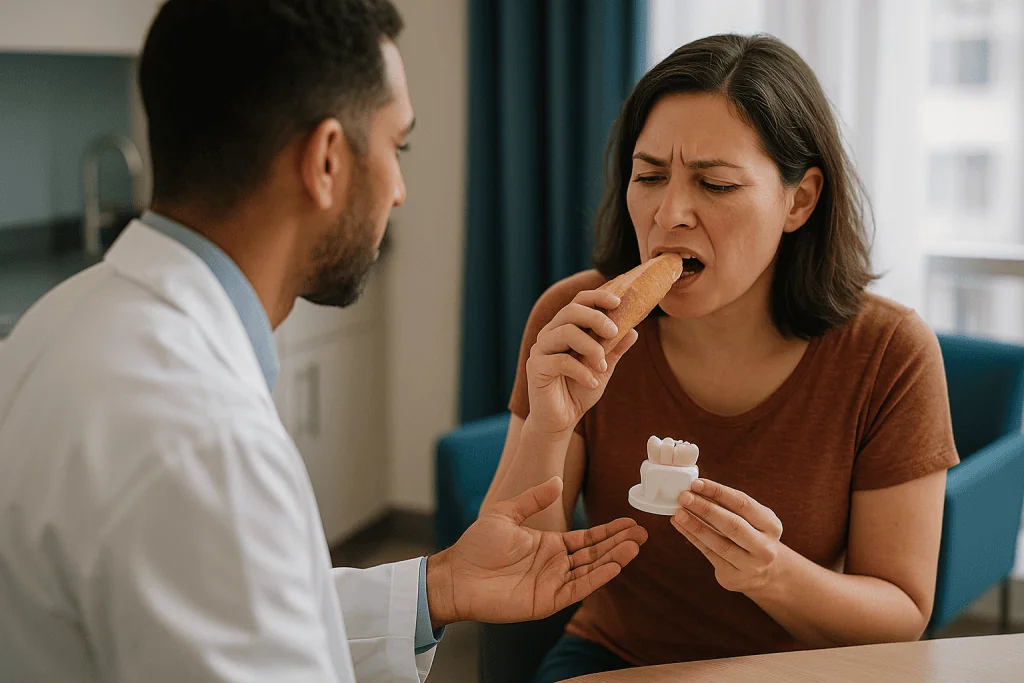
Temporary crown sensitivity has several distinct causes, and knowing them helps set expectations. The tooth underneath has been trimmed on every side, which exposes far more dentin than a small filling does. The temporary itself is made of an acrylic or resin material that is thinner and less insulating than a permanent ceramic or metal crown. The cement holding it in place is deliberately weak so the dentist can remove it later without damaging the tooth, and that softer seal allows more temperature and fluid movement at the edges. Its margins are also less precise, so a sliver of exposed dentin near the gum line is common.
Put together, a mild cold sensitivity and a slightly odd bite are ordinary for the life of a temporary. What is not ordinary is throbbing, pain that arrives without a trigger, or a temporary that has lifted or cracked. A loose temporary lets bacteria and saliva reach the prepared tooth and can allow neighboring teeth to drift, which may mean the permanent crown no longer fits.
Chewing on the other side, avoiding very sticky or hard foods, and sliding floss out sideways rather than lifting it up through the contact all reduce the chance of dislodging it. Most patients report that the sensitivity drops noticeably once the permanent crown, with its tighter fit and stronger cement, is in place.
Sharp pain when chewing after a filling: what a high spot means
Cold sensitivity is one thing. A sudden, sharp stab every time the teeth come together is another, and it has a different, very fixable cause more often than not. Dentists call it a high spot: a filling or crown that sits a fraction of a millimeter taller than the tooth it replaced, so that when you close, that tooth meets its partner first and takes the whole load.
Occlusion, the way upper and lower teeth fit together when you bite, is checked at the end of every restorative visit, usually with a thin colored paper you tap on. The problem is that a numb jaw is a poor judge. People bite differently when half their mouth has no feeling, and the tiny discrepancy only shows itself over the next day or two once normal chewing resumes. The ligament that suspends the tooth in its socket becomes bruised from the overload, and the tooth may feel tender even when you are not eating.
Adjusting a high spot takes a dentist a few minutes with a fine polishing tip and is one of the most satisfying fixes in dentistry, because relief tends to follow within a day or two as the ligament recovers. Waiting it out, by contrast, rarely helps; the tooth does not sink to accommodate the filling.
Two other patterns deserve attention. Pain that appears not on biting down but on letting go can point to a hairline crack in the tooth, which needs a proper look. Pain that is diffuse, hard to localize and worse with heat suggests the pulp itself is inflamed rather than the bite being off. Describing exactly when the pain hits helps the dentist tell these apart quickly.
Which restorative treatments cause the most sensitivity? A comparison
Not all restorative work leaves the same afterglow. The table below summarizes what patient guidance from sources such as Cleveland Clinic and the NHS describes as typical, and where the biology explains the difference. Timeframes are usual ranges reported in patient information, not guarantees for any individual tooth.
| Procedure | What is commonly felt | Usual settling window | Why |
|---|---|---|---|
| Shallow filling | Brief cold twinge, gum tenderness at injection site | Days | Little dentin disturbed, pulp far from the work |
| Deep filling near the pulp | Stronger cold sensitivity, occasional bite tenderness | Weeks, sometimes longer | Pulp inflamed by proximity, needs time to form protective dentin |
| Inlay or onlay | Similar to a filling, sometimes bite awareness | Days to a few weeks | Bonded ceramic or composite, margins exposed to temperature |
| Temporary crown | Cold sensitivity, odd bite, mild ache | Until the permanent crown is fitted, usually a couple of weeks | Thin material, weak cement, large area of exposed dentin |
| Permanent crown | Mild cold response, gum soreness | Days to weeks | Better insulation and seal than a temporary |
| Root canal treatment | Tenderness to pressure rather than cold | A few days per NHS guidance | Nerve removed, so cold sensitivity ends; surrounding ligament is sore |
One counterintuitive point stands out. After root canal treatment, the pulp has been removed, so the tooth cannot feel cold at all. What lingers is a bruised feeling on biting from the ligament around the root, which is a different sensation and settles on a different timeline. If a root-treated tooth is sharply cold sensitive, it is worth asking whether the feeling is actually coming from a neighbor.
Across every row, the direction of travel matters more than the exact number of days. Improving week on week is reassuring; plateauing or worsening is not, whatever the procedure.
Who tends to feel more sensitivity, and who is usually asked to wait
Some mouths are set up for a bumpier recovery, and recognizing that beforehand removes a lot of anxiety afterward. People whose decay had already reached deep into the dentin, who had lingering pain before the appointment, or who had several teeth treated in one sitting are more likely to notice symptoms for longer. Existing gum recession, which exposes root surfaces that have no enamel at all, adds another source of cold sensitivity that the filling itself did not cause. Habitual clenching or night-time grinding loads new restorations before they have settled and keeps the ligament irritated.
Mayo Clinic notes that untreated decay can progress to involve the pulp, and a tooth that hurt spontaneously or throbbed at night before treatment may already have had irreversible inflammation. In that situation a filling alone sometimes fails to calm the tooth, not because anything went wrong in the chair but because the pulp was past the point of recovery. Dentists try to identify these teeth in advance with cold tests and x-rays, and they will usually say so if the outlook is uncertain.
Waiting is sometimes the deliberate plan rather than a delay. A dentist may place a soothing temporary filling in a very deep cavity and wait several weeks to see whether the pulp settles before committing to a permanent restoration. A permanent crown is often postponed on a tooth that is still symptomatic under its temporary, because cementing over an unhappy pulp can mean drilling through a new crown later for root canal access. Active gum infection or swelling is typically addressed before elective restorative work begins.
None of these judgments can be made from a general article. They depend on the specific tooth, the x-ray, and the response to testing, and the treating team is the right place for that decision.
What the first days and weeks after restorative dental work usually look like
Recovery from sensitivity after restorative dental work follows a recognizable arc, and knowing the shape of it makes the odd sensations less alarming.
The first few hours belong to the anesthetic. The lip and cheek feel swollen even though they are not, speech is a little clumsy, and there is a real risk of biting soft tissue. As feeling returns over a few hours, many people notice a dull ache at the injection site itself, which is the small puncture in the gum and muscle rather than the tooth.
Days one to three are when cold sensitivity typically announces itself. A breath of winter air, an iced drink, even toothpaste can produce a quick, sharp response that vanishes as soon as the trigger does. The gum around the tooth may be tender from the clamps and matrix bands used to shape the filling. Biting may feel slightly unfamiliar as the tongue explores the new surface. This is also the window when a high spot reveals itself, so a persistent sharp stab on chewing is worth an early call.
Through the first two weeks the cold response usually shrinks in both intensity and frequency. Toward the end of that period many shallow fillings feel like the tooth was never touched.
Weeks two to four are where deeper fillings and freshly crowned teeth are still catching up. A mild cold twinge persisting here is within the range Cleveland Clinic describes, provided it is clearly less than it was. Temporaries are usually replaced during this stretch, and the new permanent crown often feels calmer within days.
Beyond a month, the expectation is a tooth that feels normal or very nearly so. Ongoing sharp sensitivity, or any sensation that has grown rather than faded, is the signal to have it examined.
How to help nerve pain after a filling while the tooth settles
Most of what helps is about not provoking the tooth while it heals, and none of it requires anything exotic.
Temperature is the main trigger, so keeping drinks lukewarm and letting ice cream sit for a moment removes the sharpest stimuli. Chewing on the opposite side for the first several days spares a freshly bruised ligament. A soft-bristled brush used gently along the gum line cleans without scrubbing exposed dentin, and skipping whitening products for a few weeks avoids a known source of extra sensitivity.
Desensitizing toothpastes are the one over-the-counter category with a plausible mechanism and reasonable evidence. Cleveland Clinic lists them among first-line measures for sensitive teeth. Some work by calming the nerve endings so they respond less to fluid movement; others deposit minerals that partially block the dentin tubules. Both need consistent use for a couple of weeks before the effect is noticeable, so they are best thought of as a slow-acting support rather than a quick fix. Any product should be chosen with the dentist’s or pharmacist’s input if you have other dental work or allergies.
A warm salt-water rinse eases sore gums around the injection site and the clamped tooth. Over-the-counter pain relievers can take the edge off the first day or two, but which one is appropriate, and how much, depends on your medical history and any other medicines you take. That is a question for the dentist or pharmacist, not a general article, and nothing here should be read as a recommendation to start anything.
Two home remedies deserve caution. Placing an aspirin tablet against the gum burns the tissue and does nothing for the tooth. Clove oil applied directly can irritate soft tissue and, more importantly, can mask a problem that needs treatment rather than disguise. If comfort measures are not enough to get through a normal day, that itself is information the dentist wants.
Is it normal to feel sensitivity after tooth restoration, or is something wrong?
The distinction dentists rely on is between reversible and irreversible inflammation of the pulp, and you can learn to read some of the same clues.
Reversible pulpitis, the expected state after a filling, produces a short, sharp response to a clear trigger. Cold is the classic one. The pain ends within seconds of the cold being removed. The tooth does not hurt on its own, does not wake you, and is not especially bothered by heat. This pattern says the nerve is irritated but alive and recovering.
Irreversible pulpitis is different in character, not just degree. The pain lingers for minutes after a trigger, or arrives with no trigger at all. Heat often becomes worse than cold, and cold may even bring brief relief. The ache can be dull and throbbing, is frequently worse lying down at night, and may be hard to pin to a single tooth because the pulp has poor ability to localize. NHS toothache guidance flags pain lasting more than two days, pain that stops you sleeping or eating, and swelling as reasons to see a dentist promptly. A pulp in this state generally does not recover on its own, and the usual options are root canal treatment to remove the inflamed tissue or, less often, removal of the tooth.
Referred pain adds a wrinkle. Nerve pathways in the jaw overlap, so a problem in one tooth can feel like it belongs to another, or an upper tooth can register as a lower one. Sinus congestion can make upper back teeth ache in a way that mimics a failing filling. This is one reason a dentist tests several teeth with cold and tapping rather than trusting the one you point to.
Normal, then, is sharp, brief, triggered and fading. Concerning is lingering, spontaneous, heat-sensitive or growing. The second set of features is not an emergency in itself, but it is a reason to be seen rather than to wait another month.
What people often get wrong about sensitivity after restorative dental work
A handful of myths circulate widely enough that correcting them saves real worry.
The first is that any sensitivity means the filling has failed. In reality, a well-placed restoration on a tooth that has just been drilled commonly produces short-lived cold sensitivity; the pulp is reacting to the procedure, not to a mistake. Failure looks like pain that worsens, food packing into a gap, or a piece breaking away, not a two-second zing with iced water in the first week.
The second is that white fillings never cause sensitivity and metal ones always do. Composite resin shrinks slightly as it hardens and can leave a microscopic gap if the tooth is not kept perfectly dry during bonding, so it has its own well-documented postoperative sensitivity. Amalgam conducts temperature more readily for a while. Neither material is immune, and the depth of the cavity predicts sensitivity far better than the material does.
The third is that a root-treated tooth cannot hurt, so any pain must mean the treatment failed. The nerve inside is gone, so cold sensitivity should indeed disappear, but the ligament around the root is very much alive and is often tender to biting for a few days, as NHS guidance describes.
The fourth is that persistent sensitivity signals an allergy to the filling material. True allergy to dental materials exists but is rare and usually shows as gum or skin reactions, not as cold sensitivity in one tooth.
The fifth is that pain means the dentist hit the nerve. Every filling brings instruments closer to the pulp; that is the nature of removing decay. Sensitivity reflects how deep the decay already was, which is largely outside anyone’s control on the day.
The last is that toughing it out is the responsible choice. Sensitivity that is not improving after several weeks is information, and dentists would much rather adjust a bite or reassess a tooth than see a recoverable pulp tip into needing root canal treatment because the problem was left.
What your dentist may check if sensitivity after restorative dental work persists
A follow-up visit for lingering sensitivity is usually short and methodical, and it helps to know what the tests mean.
The bite comes first, because a high spot is the most common and easiest cause. Tapping on marking paper shows where the new filling meets its partner, and a few seconds of polishing often resolves the whole story. Next comes a cold test, in which a chilled cotton pellet is touched to the tooth and to its neighbors. A quick response that fades fast suggests a recovering pulp; a response that lingers or a complete absence of response points toward more advanced changes. Gentle tapping on the tooth checks the ligament, and a periodontal probe around the gum line looks for a deep pocket that might indicate a crack. An x-ray shows the depth of the filling relative to the pulp, whether the margins are sealed, and whether any change has begun at the root tip.
The options that follow are laid out in neutral terms. Waiting a few more weeks with comfort measures is a legitimate choice when the tooth is improving. Replacing the filling, sometimes with a protective liner under it, may be offered when a gap or a poorly sealed margin is suspected. Root canal treatment, which removes the inflamed pulp and seals the canal, is the standard option when tests indicate irreversible inflammation; the NHS describes it as a way to save a tooth whose pulp is damaged. Removal of the tooth is generally the last resort and carries its own consequences for chewing and neighboring teeth.
Each option has trade-offs in time, tooth structure and long-term outlook, and the balance depends on the individual tooth. A dentist will explain what the tests showed and why one path is proposed over another; the choice sits with you and the treating team together.
Questions to ask your care team before and after restorative treatment
Most sensitivity anxiety comes from not knowing what to expect. A few direct questions, asked before the anesthetic goes in or at the end of the visit, replace guesswork with a plan.
Before treatment, it is reasonable to ask how deep the decay appears on the x-ray and whether the filling will be close to the nerve, because that single fact predicts most of the recovery. Asking whether the tooth showed any signs of irreversible inflammation on testing tells you whether a filling is expected to settle it or whether root canal treatment may be needed later. If a crown is planned, ask how long the temporary will be worn and what to do if it loosens.
Immediately afterward, ask how long the numbness is likely to last for the injection you had, and when it is safe to eat and drink hot things. Ask what sensations are expected in the first week and which ones should prompt a call. Ask whether the bite was checked and what to do if it feels high once the anesthetic wears off. If you clench or grind, ask whether a night guard is worth discussing to protect the new work.
Around the two-to-four-week mark, if sensitivity is still present, ask whether the pattern you are describing fits a recovering pulp or suggests something else. Ask what the cold test and x-ray showed and what each option would involve. Ask what the dentist would want to know about at home that would change the plan, such as pain lasting minutes, night pain or swelling.
The list below is a starting point to bring along:
- How close is this filling or crown to the nerve?
- Which sensations are expected, and for roughly how long?
- What should prompt me to call before my next visit?
- Was the bite checked, and what if it feels tall later?
- If the tooth does not settle, what are the options and their trade-offs?
When to call your doctor or dentist about sensitivity after dental work
Most sensitivity after a filling or crown needs patience, not a phone call. Some signs, however, mean the situation has moved beyond the expected course, and NHS toothache guidance and hospital patient information agree on the main ones.
Contact your dentist promptly, within a day or so, if any of the following apply:
- Pain that lingers for minutes after a hot or cold trigger, or that arrives with no trigger at all
- Throbbing pain that wakes you at night or is worse lying down
- Sensitivity that is clearly increasing rather than fading after the first week or two
- A sharp stab every time you bite that has not eased within a few days, which may be a high spot needing adjustment
- A temporary crown or filling that has loosened, lifted or fallen out
- Numbness of the lip, tongue or chin that persists beyond a day after the appointment
- A filling that feels rough, has a gap that traps food, or has visibly chipped
Seek urgent care, through your dentist’s emergency line or an urgent care service, if you notice swelling of the face, jaw or gum, a fever, difficulty swallowing or opening your mouth, a bad taste with pus near the tooth, or pain that over-the-counter measures agreed with your dentist cannot control. Facial swelling that is spreading toward the eye or down the neck, or any difficulty breathing, is an emergency and should be treated as one. These signs can indicate infection that needs prompt treatment rather than observation.
People with heart valve disease, a weakened immune system, diabetes that is hard to control, or who take medicines affecting bleeding or bone should have a lower threshold for calling, because dental infection can carry extra risk in these situations and the treating team may want to act sooner.
If in doubt, call. A brief conversation that ends with reassurance costs nothing, and a dentist would far rather hear about a tooth early than see it late. Every decision about what happens next belongs with you and the team treating you.
Frequently asked questions
Is it normal to feel sensitivity after tooth restoration?
Yes, mild sensitivity is common after a filling, crown or similar restoration. Drilling, drying and bonding all irritate the living pulp inside the tooth, which responds with short-term inflammation. The typical pattern is a brief, sharp response to cold or pressure that fades within seconds and grows less frequent over days to weeks. Sensitivity that is worsening, lingering or spontaneous is a reason to have the tooth checked.
How long can tooth sensitivity after a filling last?
Patient guidance from Cleveland Clinic describes sensitivity after a filling typically settling within a few days to a few weeks. Shallow fillings often feel normal within days; deep fillings placed close to the nerve can stay cold-sensitive for several weeks. The key is the trend: steady improvement is reassuring, while sensitivity that plateaus or increases after about a month should be assessed by your dentist.
Is it normal to experience sharp pain when chewing after a dental filling?
A sharp stab on biting is common in the first day or two and usually means the new filling sits fractionally high, so that tooth takes the load before the others. A numb jaw makes this hard to detect at the appointment. A dentist can adjust it in minutes, and relief typically follows within a day or two. Pain on releasing the bite rather than closing may indicate a crack and needs examination.
How to help nerve pain after a filling at home?
Avoid very hot and cold foods, chew on the other side, brush gently with a soft brush, and consider a desensitizing toothpaste, which Cleveland Clinic lists among first-line measures and which needs a couple of weeks of regular use to work. Warm salt-water rinses soothe sore gums. Any pain reliever should be agreed with your dentist or pharmacist. Do not place aspirin against the gum, and do not use home remedies to mask pain that is not improving.
How long does numbness last after the dentist?
Numbness from local anesthetic generally fades over a few hours, according to Cleveland Clinic patient information. Upper-tooth injections placed beside the tooth wear off faster; lower-jaw nerve blocks numb the lip, chin and tongue and last longer. Avoid hot drinks and chewing until feeling returns, since a numb lip or tongue is easy to bite or scald. Numbness lasting beyond a day is uncommon and should be reported to your dentist.
Why is my temporary crown so sensitive to cold?
Temporary crown sensitivity is expected because the tooth beneath has been trimmed on all sides, exposing a large area of dentin, and the temporary is made of thin resin held with weak cement that seals less tightly than a permanent crown. Cleveland Clinic notes temporaries are usually worn for a couple of weeks. Most people find the sensitivity drops once the permanent crown is cemented. A loose, cracked or throbbing temporary should prompt a call.
What is the difference between reversible and irreversible pulpitis?
Reversible pulpitis is inflammation of the tooth pulp that is expected to recover: pain is sharp, triggered by cold or pressure, and stops within seconds. Irreversible pulpitis produces pain that lingers for minutes, arrives without a trigger, is often worse with heat and at night, and can be hard to localize. Dentists distinguish them with cold testing, tapping and x-rays. The second type usually needs root canal treatment or, less often, extraction.
Can a filling be too deep and damage the nerve?
A filling has to go as deep as the decay, so a very deep cavity necessarily brings the work close to the pulp. This raises the chance of longer sensitivity and, in some teeth, of the pulp failing to recover, but it reflects how advanced the decay was rather than an error. Dentists often place a protective liner or a soothing temporary in deep cavities and may wait to see how the pulp responds before finishing.
Why does my tooth hurt more with hot than cold after a filling?
Heat sensitivity that outlasts cold sensitivity, especially if the pain lingers for minutes or throbs, is one of the patterns dentists associate with more advanced pulp inflammation that may not settle on its own. Cold sensitivity alone, fading within seconds, is more typical of normal recovery. Heat-dominant pain after a restoration is worth reporting so the tooth can be tested, since earlier assessment keeps more options open.
When should I go back to the dentist about sensitivity after dental work?
Book a check if sensitivity is not clearly improving after about a month, if a sharp bite pain has not eased within a few days, or if a temporary comes loose. Call promptly for pain that lingers for minutes, wakes you at night or arrives spontaneously. Seek urgent care for facial swelling, fever, difficulty swallowing or opening the mouth, or pain that agreed measures cannot control, as these can signal infection.
References
- Cleveland Clinic: Dental Fillings
- Cleveland Clinic: Dental Crowns
- Cleveland Clinic: Teeth Sensitivity
- NHS: Dental treatments
This article is for general information only and is not a substitute for professional medical advice. Please consult a qualified doctor about your individual situation.

More from the Blog

Flying After a Tooth Extraction: How Long to Wait and How to Protect the Clot
Most dental teams prefer that you avoid flying for at least 24 hours after a simple tooth extraction, and many suggest 48 to 72…
Wisdom Teeth Removal Myths: Age Limits, Face Shape and Other Claims Worth Correcting
Most wisdom teeth removal myths do not hold up to the evidence. There is no upper age limit for extraction, although healing tends to…

What Happens in Orofacial Myology Sessions: Posture Checks, Exercises and Progress Reviews
Myofunctional therapy sessions are short, structured appointments with a trained therapist who checks how your tongue, lips and jaw rest and move, teaches targeted…
How a Dental Anatomy Evaluation Guides Your Plan: Tooth Charts, Bite Checks and Imaging
A dental anatomy evaluation is a structured, tooth-by-tooth assessment in which a dentist records each tooth on a numbered chart, checks how your upper…

Tooth Decay Myths: Sugar-Free Means Safe, Brushing Harder Helps and Other Errors
Most tooth decay myths fall apart under evidence. Sugar-free does not mean safe, because acidic drinks and starchy snacks still feed decay or erode…

Chipped or Loose Porcelain Veneer: Repair, Rebonding or Replacement Explained
A chipped or loose porcelain veneer can often be managed without replacing it. Small edge chips may be smoothed or patched with tooth-colored composite…