

How Long Targeted Therapy Continues: Cycles, Scans and What Decides When It Stops

Key Takeaways
- The length of targeted therapy is set by its goal: courses given after surgery usually have a planned end, while treatment for advanced cancer continues cycle by cycle while it keeps working.
- A cycle is a fixed block of weeks that repeats, and it is the unit oncology teams use to schedule blood tests, scans and side-effect reviews.
- The NHS describes a standard HER2-directed antibody for early breast cancer as generally given for around a year after other treatment, with heart checks during the course.
- Scans compared against a baseline, tumor markers in blood and routine organ-function tests are the evidence that decides whether treatment rolls forward, pauses or changes.
- Targeted drugs stop working mainly through resistance, when cancer cells acquire new changes that bypass the blocked pathway; repeat biomarker testing may reveal a different option.
- Short pauses for surgery, infection or side effects are routine, but longer breaks and any decision to stop should always be planned with the treating team so that monitoring continues.
Targeted therapy has no single length. Courses given after surgery to lower recurrence risk usually have a set end point, commonly around a year for some breast cancer regimens. For advanced cancer, treatment typically continues in repeating cycles for as long as scans and blood tests show it is helping and side effects stay manageable. The treating team decides when it stops.
The pharmacy bag sits unopened on the kitchen counter. Beside it, a wall calendar with one date circled: the first scan. Maria has been told her lung cancer carries a specific gene change, that a targeted drug is the right first step, and that she should take it every day. What nobody has quite spelled out is the question she keeps turning over: every day until when?
It is one of the most common questions in an oncology clinic, and one of the hardest to answer in a sentence. People want to know how long does targeted therapy last because a timeline makes the unknown feel survivable. Six months has a shape. “Until it stops working” does not.
The truth sits somewhere in between. Some courses have a firm finish line written into the plan from day one. Others are open-ended by design. Understanding which kind you are on, and what your team watches to decide, turns a vague sentence into something you can actually live with.
How long does targeted therapy last? The honest short answer
Ask three people on targeted therapy how long they expect to be on it and you may get three different answers, all correct. That is because the length is set by the goal, not by the drug.
Targeted therapy is a cancer treatment that acts on specific molecules, often abnormal proteins or gene changes, that help cancer cells grow and spread. Because these drugs are aimed at a feature of the tumor rather than at all fast-dividing cells, they are usually given in one of two broad patterns, according to the National Cancer Institute’s overview of targeted therapies.
The first pattern is a defined course. When the drug is used alongside or after surgery, radiation or chemotherapy to reduce the chance the cancer returns, the plan usually has a stated end. The NHS, for example, describes a common HER2-directed antibody for early breast cancer as typically given for around a year after other treatment.
The second pattern is open-ended. When cancer has spread or cannot be removed, the aim shifts from clearing it to controlling it. Treatment then continues cycle after cycle while it keeps the disease in check and the person tolerates it. There is no pre-set finish; the calendar is written as you go.
A third, smaller group takes a targeted drug indefinitely for a chronic form of cancer, much as someone might manage a long-term condition, with periodic checks that the disease remains quiet.
So the honest answer is a question back: what is this treatment for? Once you know whether the goal is prevention of recurrence, control of active disease or long-term suppression, the shape of the timeline becomes clear, even if the exact date does not.
What targeted therapy actually does inside a cancer cell
Picture a cancer cell as a factory running on a jammed accelerator. A mutation, a permanent change in a gene, has left a growth signal switched on. Targeted drugs are designed to reach that specific switch.

Most fall into two families. Small-molecule drugs are tiny enough to slip inside the cell and block an enzyme, often a kinase, the protein that passes growth signals along like a relay runner. Many are taken by mouth. Monoclonal antibodies are larger, lab-made proteins that attach to a target on the cell surface, either blocking a signal, flagging the cell for the immune system, or delivering an attached drug directly. Mayo Clinic’s explainer on monoclonal antibodies describes these as intravenous treatments given in a clinic.
That difference in size and route matters for the timeline. A daily oral drug keeps a steady level in the body, so the pattern is continuous. An infused antibody is given at intervals, so treatment is naturally counted in visits.
Crucially, the drug only helps if the target is present. That is why treatment starts with biomarker testing, in which a sample of tumor or blood is checked for the gene changes or proteins a drug is designed to hit. The National Cancer Institute notes that without a matching biomarker, a targeted drug is unlikely to be offered at all.
Targeted does not mean side-effect-free. Healthy cells sometimes use the same signaling pathways, which is why skin, gut, liver, blood pressure and heart rhythm are watched. How well those tissues cope is one of the two things that governs how long the treatment can continue. The other is whether the target itself changes, a point we return to later.
What is a targeted therapy cycle, and why treatment is counted that way
Oncology rarely speaks in months. It speaks in cycles, and the word confuses almost everyone at first.
A cycle is a fixed block of time that includes a period of treatment and, in many regimens, a period of recovery before the next block begins. The National Cancer Institute describes targeted therapy as given daily, weekly or monthly depending on the drug and the cancer, with some regimens built around these repeating blocks. A cycle is measured in weeks, not days, and the pattern repeats so that the body has a predictable rhythm to settle into.
For an infused monoclonal antibody, one cycle might mean one clinic visit followed by weeks at home. For a daily oral kinase inhibitor, the tablets may continue without a break and the “cycle” is simply the bookkeeping unit the team uses to schedule blood tests and decide when the next scan is due.
Why not just say months? Because cycles are how side effects are tracked and how decisions are made. A nurse asking “how was cycle three?” is asking a precise question: did anything change in that block compared with the last? Dose adjustments, lab checks and scan timing are all pinned to cycle numbers.
Cycles also make the two treatment patterns visible. A fixed course might be described as a certain number of cycles, written into the plan from the start. An open-ended course has no number; the team says “we will keep going and reassess after the next scan,” and the count simply rises.
If your plan sheet lists cycles, ask two things: how long is one, and is there a planned total? Those answers tell you more about your timeline than any general article can.
How scans and blood tests decide whether treatment continues
Nothing on the treatment calendar carries more weight than scan day. It is the moment the plan either rolls forward or changes course.
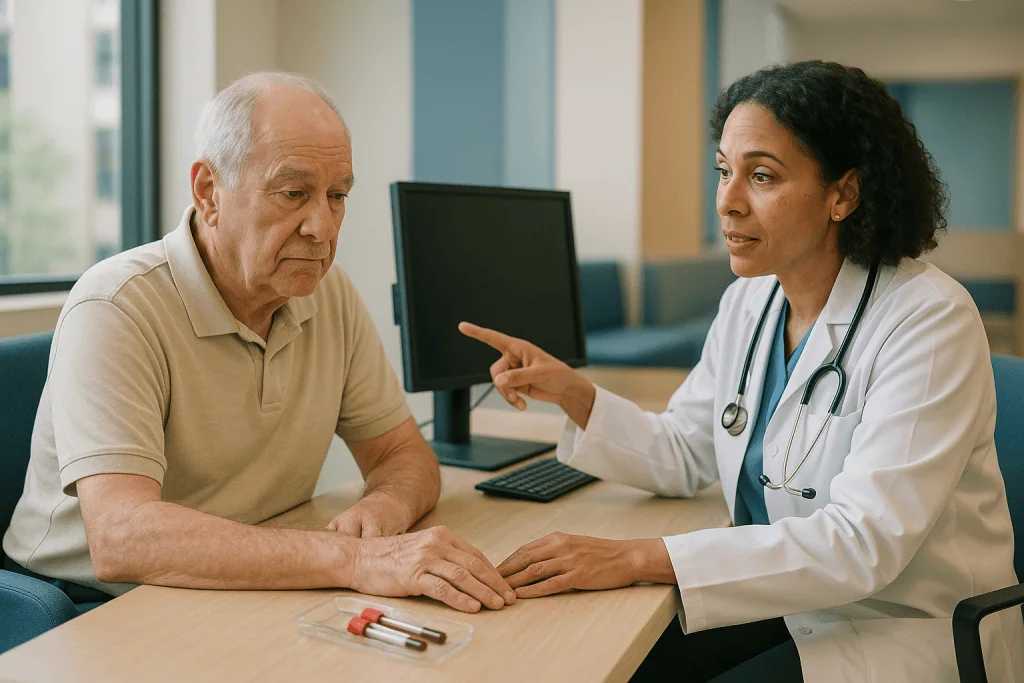
The first scan on targeted therapy is a baseline, a snapshot of the cancer before the drug has acted. Every later scan is compared against it. Radiologists measure the largest tumors and report whether they have shrunk, stayed the same or grown, and whether any new spots have appeared. Clinicians summarize this as response, stable disease or progression. Progression, meaning measurable growth or new lesions, is the finding most likely to prompt a change of treatment.
Imaging is not the only signal. Some cancers release tumor markers, substances measurable in blood that tend to rise or fall with the amount of cancer present. The National Cancer Institute’s tumor markers fact sheet explains that these can help monitor how well a treatment is working, though they are interpreted alongside scans rather than alone, because levels can shift for reasons unrelated to cancer.
Routine blood work checks the other half of the equation: whether the body is tolerating the drug. Liver enzymes, kidney function, blood counts and, for some drugs, heart tests are reviewed each cycle. A treatment that is controlling the cancer but straining the liver may need to pause or change.
Symptoms count too. Less breathlessness, less pain, more energy are all recorded, and worsening symptoms can prompt an earlier scan.
How often scans happen is set by your team based on the cancer type, the drug and how you are doing; there is no universal interval. What matters is that each scan is a scheduled decision point. Knowing when the next one falls tells you when the next real answer about your timeline arrives.
Who usually gets targeted therapy, and who is asked to wait
Targeted therapy sounds like something everyone with cancer should have. In practice, the door opens only when a matching target is found.
Biomarker testing comes first. A piece of the tumor, or in some cases a blood sample, is analyzed for specific gene changes, protein levels or chromosome rearrangements. The National Cancer Institute explains that these results determine whether a targeted drug is likely to help. Someone whose lung cancer carries a particular receptor mutation may be offered a drug aimed at it; someone with the same cancer type but no such mutation usually will not, because the drug has nothing to act on.
Beyond the biomarker, the team weighs the cancer’s stage and the person’s overall health. Some targeted drugs are used only after surgery for early disease; others only when cancer has spread. Kidney and liver function, heart health and other medicines being taken all influence whether a particular drug is safe to start.
Who waits? Several groups, for good reasons.
- People whose test results are still pending, since starting the wrong drug wastes time and adds side effects.
- People recovering from surgery or another treatment, where the body needs to heal first.
- People with a very slow-growing cancer where careful observation is a recognized option and treatment can be held for when it is actually needed.
- People with an active infection or an uncontrolled medical problem that the drug could worsen.
Waiting can feel like inaction. It is usually the opposite: sequencing. Getting the right test result, the right recovery and the right starting point is what allows the treatment, once begun, to run for as long as it usefully can.
Targeted therapy after surgery: why some courses have a fixed end date
When targeted therapy is given after a cancer has been removed, it is called adjuvant treatment, an extra step intended to destroy any cells too small to see and lower the chance the cancer comes back. This is the setting where the timeline is most likely to have a firm end written in from the start.
The logic is straightforward. The cancer that could be seen is gone. The drug is now guarding against a possibility rather than fighting something measurable. Clinical trials that established these treatments tested a specific duration, and that duration becomes the standard. Give less and the protection may be incomplete; give more and side effects accumulate without proven added benefit.
The clearest everyday example is early breast cancer that overexpresses a protein called HER2, a receptor that drives cell growth. The NHS describes the standard HER2-directed antibody as generally given for around a year following surgery and chemotherapy, with heart function checked during that time because the drug can affect the heart muscle.
Fixed does not mean rigid. The course may be shortened if side effects become unsafe or if a scan during treatment shows the cancer has returned, at which point the goal and the plan change. It may also pause for illness or surgery and then resume, with the end date shifting accordingly.
People on a fixed course often describe a strange mix of feelings as the end approaches: relief at finishing, and unease at stopping something that felt protective. That is normal, and worth saying aloud to your team. Finishing on schedule is not the treatment being taken away. It is the treatment doing exactly what the plan intended.
Targeted therapy for advanced cancer: why “as long as it is working” is the plan
For cancer that has spread or cannot be removed, the finish line disappears, and that is intentional. The aim is to control the disease and keep the person well for as long as possible, and a drug that is achieving that is not stopped simply because a certain number of months has passed.
Cleveland Clinic’s overview of targeted therapy describes this pattern plainly: for many cancers, treatment continues as long as it is working and side effects remain manageable. Two questions are asked at every review, and both must be answered yes for the course to continue. Is the cancer still controlled? Is the person still tolerating the drug?
This is where the daily oral kinase inhibitors come into their own. A person can take a tablet at home, work, travel and attend clinic for blood tests and scans at intervals. The treatment becomes part of the background of life rather than its center.
Some people move onto a related approach called maintenance therapy, in which a gentler or single agent continues after a more intensive combination has done its work, keeping the disease quiet with fewer side effects. Others with chronic forms of blood cancer take a targeted drug for years, with the National Cancer Institute noting that certain leukemias are managed this way over the long term.
Open-ended treatment asks something different of the person taking it. Instead of counting down, you learn to live in the space between scans. Many people find it helps to reframe each clear scan as a renewed permission to plan the next stretch of ordinary life, rather than as a stay of execution. Your team can help set that rhythm, and your care plan should say clearly which pattern you are on.
Targeted therapy timelines at a glance: what usually decides the length
The patterns above can be hard to hold in your head during a clinic visit. The table below sets them side by side. It describes typical structures, not promises; your own plan may differ, and the treating team decides every detail.
| Goal of treatment | Typical structure | What usually decides when it stops | Example setting |
|---|---|---|---|
| Lower risk of return after surgery (adjuvant) | Fixed course set from the start; often described as around a year for some regimens (NHS) | Reaching the planned end, unsafe side effects, or cancer returning | Early HER2-positive breast cancer |
| Control cancer that has spread | Open-ended repeating cycles | Scans show progression, side effects outweigh benefit, or the person chooses to stop | Lung, kidney, colorectal and other solid tumors with a matching biomarker |
| Long-term suppression of a chronic cancer | Continuous, potentially for years | Loss of response, intolerable side effects, or a supervised trial of stopping in selected people | Certain chronic leukemias |
| Maintenance after intensive treatment | Single agent continued after a combination | Progression or side effects | Some ovarian and blood cancers |
Two threads run through every row. First, the decision to continue is always made on evidence gathered from you: images, blood results and how you feel. Second, the person taking the drug has a voice at each review. Stopping because the burden of side effects has become too great is a legitimate clinical decision, not a failure of will.
If you cannot place yourself in a row, ask. The question “which of these is my treatment?” takes ten seconds and reshapes how you understand every appointment that follows.
What the first days and weeks on targeted therapy usually look like
The first cycle is less about the cancer and more about getting to know the drug. Nothing on the scan changes overnight; what changes is the body’s daily experience.
For an oral drug, the early days involve learning a routine: same time each day, with or without food as instructed, and a written record of anything new. For an infused antibody, the first visit is typically longer than later ones, because staff watch for infusion reactions such as chills, fever or a drop in blood pressure that can occur while the drug is going in. Mayo Clinic notes these reactions are most likely with early infusions.
Side effects that appear in the first weeks are often the ones that stay, in some form, for the length of treatment. The National Cancer Institute lists common effects of targeted drugs as diarrhea, liver changes, skin problems including rash and dry skin, nail changes, high blood pressure, fatigue and, for some drugs, effects on wound healing or the heart. Most are graded as mild to moderate and are managed with supportive measures rather than by stopping the drug.
Blood tests in the first cycle are usually more frequent than later, checking that liver, kidney and blood counts are holding steady. This is also when the team may adjust the plan if the body is reacting more strongly than expected.
Then comes the wait for the first scan. It is the longest stretch of uncertainty many people describe. Some feel better within weeks, particularly if the cancer was causing symptoms; others feel nothing different at all, and that is not a sign the drug is failing. Response is judged on the images and the labs, not on how the days feel.
By the second or third cycle, most people report that the routine has become ordinary. That ordinariness is the point.
When does targeted therapy stop working? Resistance, side effects and changing goals
There are three doors through which targeted therapy usually ends, and only one of them is the cancer’s doing.
The first is resistance. Cancer cells are genetically unstable, and over time some acquire new changes that let them bypass the blocked pathway. The National Cancer Institute describes this as the main limitation of targeted drugs: the target itself can mutate so the drug no longer fits, or the cell finds a different route to keep growing. On a scan this shows up as progression after a period of control. It is not something a person causes, and it does not mean the treatment was a mistake; the months or years of control were real.
Resistance rarely closes every door. Repeat biomarker testing, sometimes from a blood sample, can identify the new change, and a different drug aimed at that change may be an option. Chemotherapy, immunotherapy or a clinical trial may also be considered. The sequence is planned by the team based on what the new tests show.
The second door is side effects. If a drug is controlling the cancer but the person is losing weight, developing heart strain or living with relentless diarrhea or skin breakdown, the balance can tip. Clinicians will usually try a pause or a lower intensity first. If that does not restore quality of life, stopping is a reasonable decision.
The third door is a change of goal. Life circumstances shift. Someone may decide that clinic visits, blood draws and side effects no longer serve what they want from their time, and choose to stop with full understanding of the implications. That conversation deserves as much care as the one that started treatment.
Whichever door opens, stopping is a decision made together, on evidence, never a verdict handed down.
Can you take a break from targeted therapy? Pauses, holidays and supervised stopping
Yes, breaks happen, and they are more ordinary than most people expect. What matters is who decides and how they are watched.
Short pauses are common. A drug may be held for a week or two around surgery, during an infection, or while a side effect such as raised liver enzymes or a severe rash settles. Some oral regimens are designed with built-in rest days each cycle. These pauses are part of normal management and the team plans them.
Longer breaks, sometimes called treatment holidays, are a different matter. For people whose cancer has been stable for a long stretch, a deliberate pause can relieve side effects and restore a sense of normal life. The trade-off is that the cancer may begin to grow again during the break, and the team will want scans on a set schedule so that any change is caught early. Whether a holiday is sensible depends heavily on the cancer type and how it has behaved; it is a case-by-case discussion.
A third category is supervised discontinuation in certain chronic blood cancers. Research has examined whether people who have had a very deep and sustained response to a targeted drug over years can stop under close monitoring, with the drug restarted if the disease reappears. This is offered only in specific circumstances, with frequent blood tests, and never as a casual experiment.
What all three share is that they are planned. Simply stopping an oral drug because you feel fine, or running out and not mentioning it, removes the protection without the safety net of monitoring. If the routine is wearing you down, say so; a structured break may be possible, and the conversation itself often surfaces side-effect fixes that make continuing easier.
What people often get wrong about how long targeted therapy lasts
Misunderstandings about duration cause real distress, and most of them come from applying rules from one situation to another. Here are the ones clinicians hear most.
“If I feel fine, the cancer must be gone and I can stop.” Feeling well on an open-ended course usually means the drug is doing its job. The cancer is being held, not necessarily eliminated, and in most advanced-disease settings stopping allows regrowth. Only scans and blood tests can say what is actually happening.
“Targeted therapy is gentle, so it can go on forever without harm.” Targeted drugs spare more healthy cells than chemotherapy, but the National Cancer Institute is clear that they carry their own side effects, some of which build over time. Monitoring is not optional bookkeeping; it is what makes long courses safe.
“A longer course is always better.” For adjuvant treatment, the planned duration is the one shown to work. Extending it adds side effects without demonstrated extra protection. Finishing on time is the goal.
“Progression means the drug never worked.” Resistance develops after control, sometimes after years. The benefit already gained is not undone by the scan that ends the course.
“Everyone with my cancer gets the same length.” Two people with the same diagnosis may be on entirely different plans because their biomarkers, stage, other health conditions and tolerance differ. Comparing timelines in a waiting room or an online group rarely helps.
“Stopping is giving up.” Stopping for side effects, or because the treatment no longer fits what you want from your life, is a clinical decision made with full information. It is not surrender, and your team will support whatever comes next.
Questions to ask your care team about your treatment timeline
The best time to ask about duration is before the first cycle, when the plan is being explained. But it is never too late, and answers can change as the picture changes. Take this list, or a version of it, to your next appointment.
- Is this a fixed course with a planned end, or open-ended treatment that continues while it works? Which row of the table am I in?
- How long is one cycle for me, and is there a planned total number?
- What biomarker was found, and what would we do if it changes?
- When is my first scan after starting, and how often will scans and blood tests happen after that?
- What results would lead you to continue, and what would lead you to change or stop?
- Which side effects should I expect in the first weeks, which should I report the same day, and which mean I should stop taking the drug and call?
- If side effects become hard to live with, what are the options before stopping altogether?
- Is a planned break ever appropriate for my situation, and what monitoring would it need?
- If this drug stops working, what are the likely next steps, and would repeat testing be needed?
- Who do I call out of hours, and what number do I use?
Write the answers down or ask permission to record the conversation. Duration questions tend to produce long, nuanced replies, and the nuance is exactly what gets lost between the clinic and the car park.
One more question, less about medicine than about living: what should I plan around? Holidays, work, family events. A team that knows your calendar can often shift a scan or a visit so that treatment fits your life rather than the reverse.
When to call your doctor: red-flag signs during targeted therapy
Most side effects of targeted therapy are gradual and can wait for a scheduled call or visit. A few cannot. Your team will give you a contact number for use at any hour; the signs below are the reasons to use it without waiting.
- Fever, shaking chills or feeling suddenly very unwell, which can signal infection or an infusion-related reaction.
- Chest pain, a racing or irregular heartbeat, sudden breathlessness or fainting, since some targeted drugs affect heart rhythm, heart muscle or blood pressure.
- New or worsening shortness of breath or a dry cough that does not settle, which can indicate inflammation in the lungs.
- Severe or persistent diarrhea, especially with dizziness, dark urine or inability to keep fluids down, because dehydration can develop quickly.
- Yellowing of the skin or eyes, dark urine or pale stools, or pain under the right ribs, which may point to liver strain.
- A widespread rash with blistering, peeling skin or sores in the mouth or eyes.
- Unusual bleeding or bruising, blood in urine or stool, or a severe headache with confusion or vision change.
- Sudden swelling, pain or redness in a leg, or a wound that will not heal or starts to open.
- Any sudden weakness, numbness, difficulty speaking or a new seizure.
When in doubt, call. Oncology teams would far rather field an unnecessary call than miss an early warning. Have your treatment name, the date of your last dose or infusion and your most recent blood results to hand if you can.
Outside of emergencies, new or changing symptoms of any kind still belong in your symptom diary and in your next conversation with the team. Small changes noticed early are what allow treatment to continue safely for as long as it should.
Frequently asked questions
How long does targeted therapy last for advanced cancer?
For cancer that has spread, targeted therapy usually continues in repeating cycles for as long as scans show it is controlling the disease and side effects remain manageable. There is no fixed end date written into the plan. Treatment is reassessed at each scan, and the team decides whether to continue, pause or change based on those results and how you are doing.
What are targeted therapy cycles and how many will I have?
A cycle is a set block of time, measured in weeks, that includes treatment and often a rest period before the next block. Fixed courses list a planned number of cycles from the start; open-ended courses do not, and the count simply continues while treatment helps. Your care plan should state which applies to you, and your team can explain how long each cycle runs.
When does targeted therapy stop working?
Targeted therapy most often stops working when cancer cells develop resistance, acquiring new gene changes that let them bypass the blocked pathway. This can happen after months or years of control and shows up on scans as growth or new spots. Repeat biomarker testing may identify the new change, and a different drug, chemotherapy, immunotherapy or a clinical trial may be considered.
What are the most common targeted therapy side effects?
The National Cancer Institute lists diarrhea, liver changes, skin problems such as rash and dry skin, nail changes, high blood pressure, fatigue and, for some drugs, effects on wound healing or the heart. Infused antibodies can also cause reactions during the infusion. Most are mild to moderate and managed with supportive care, but some can become serious, which is why blood tests continue throughout treatment.
How is targeted therapy different from chemotherapy in terms of length?
Chemotherapy is usually given as a defined number of cycles because its effects on healthy cells accumulate. Targeted therapy, when used for advanced cancer, is more often continued indefinitely while it works, because it spares more healthy tissue. When either is given after surgery to lower recurrence risk, both typically have a planned end point set by the evidence for that regimen.
Can targeted therapy be given at the same time as chemotherapy or immunotherapy?
Yes, in some cancers targeted drugs are combined with chemotherapy, immunotherapy or hormone therapy, either together or in sequence. The National Cancer Institute notes that combinations depend on the cancer type and the biomarkers found. Combination plans may have different cycle lengths for each component, and the team will explain how long each part is expected to continue.
Do I have to take targeted therapy forever?
Not necessarily. Courses given after surgery have a planned end, commonly around a year for some breast cancer regimens according to the NHS. Open-ended treatment for advanced cancer continues while it works, which may be months or years. A small number of people with chronic blood cancers take a drug long term, and in selected cases supervised stopping is studied. Your team decides.
How often will I have scans while on targeted therapy?
Scan frequency is set by your team and depends on the cancer type, the drug and how you are responding; there is no single interval that applies to everyone. A baseline scan is taken before or at the start, and later scans are compared against it. Scans may be brought forward if symptoms change or blood tests raise a concern.
What happens if I miss a dose of my oral targeted therapy?
Contact your care team or pharmacist for instructions rather than guessing, because the right action differs between drugs. Never double up to make up for a missed dose unless specifically told to. Keep a note of the missed dose and the reason, since patterns of missed doses can affect how well the treatment works and are useful for your team to know.
Is it safe to stop targeted therapy if I feel well?
Feeling well on open-ended treatment usually means the drug is controlling the cancer, not that the cancer has gone. Stopping without a plan removes that control and the monitoring that goes with it. If side effects or the routine are wearing you down, raise it with your team; a structured pause or adjustment may be possible with scans scheduled to catch any change early.
This article is for general information only and is not a substitute for professional medical advice. Please consult a qualified doctor about your individual situation.

More from the Blog
Compression Garments and Cancer Rehabilitation: Managing a Swollen Arm or Leg Day to Day
Compression garments after cancer treatment are fitted elastic sleeves, gauntlets, stockings or adjustable wraps that apply graded pressure to a limb with lymphedema, helping…
Colon Cancer Surgery Step by Step: Removing the Segment, Rejoining the Bowel, Recovery
Colon cancer surgery, usually called a colectomy or bowel resection, removes the section of colon containing the tumor together with a margin of healthy…
Preparing for Pancreatic Cancer Treatment: Nutrition, Medication Review and Fitness
Preparing for pancreatic cancer treatment usually means three things done together: eating enough protein and calories to stop weight loss, having a clinician review…
Recovering After Breast Cancer Surgery: Arm Movement, Drains and Returning to Work
After breast cancer surgery, most people are encouraged to begin gentle arm and shoulder movement within a day or two, progressing to fuller stretches…

Why CyberKnife Planning Starts With MRI, CT or PET-CT: Mapping the Target First
CyberKnife planning starts with MRI, CT or PET-CT because the robot can only aim at what has been mapped in three dimensions. CT provides…
Recovery After Vulvar Cancer Surgery: Wound Healing, Hygiene and the First Weeks
Recovery after vulvar cancer surgery usually means a hospital stay of a few days, followed by several weeks of gradual healing at home. Gentle…