

How Prostatitis Is Diagnosed: Urine Tests, Prostate Examination and When Imaging Is Added

Key Takeaways
- The NIH classification divides prostatitis into four categories, and the tests ordered depend on which one is suspected, with the non-bacterial chronic pelvic pain form being the most common according to the NIDDK.
- A normal urine dipstick does not rule out prostatitis, because chronic prostatitis/chronic pelvic pain syndrome typically shows no bacteria and no abnormality in the urine.
- The Meares-Stamey four-glass test is the classic method for localizing bacteria to the prostate in chronic cases, but it is never performed in acute infection because massaging an infected gland can push bacteria into the bloodstream.
- PSA rises during prostatitis and after a rectal examination, so a level drawn mid-episode is usually rechecked after inflammation settles rather than treated as a cancer signal.
- Ultrasound, CT or MRI are added for specific triggers such as suspected abscess, urinary retention, blood in the urine or failure to improve, not as routine parts of the diagnosis.
- Chronic prostatitis is defined by symptoms lasting at least three months, which is why men in the early weeks are often reassessed rather than immediately labeled.
Prostatitis is diagnosed mainly through a detailed history, a urine test with culture, and a digital rectal examination of the prostate. Blood tests may check for infection markers, and a two-glass or four-glass urine test can localize bacteria to the prostate. Imaging such as ultrasound, CT or MRI is added only when an abscess, urinary blockage or another cause is suspected, or when symptoms do not respond as expected.
He has been sitting in the parking lot for ten minutes with the engine off. Three weeks of a dull, low ache that seems to move between the base of the spine and somewhere behind the pubic bone; a stream that starts and stops; a search history he would rather nobody saw. What finally gets him out of the car is not the pain. It is the not knowing.
That is the honest starting point for most men who end up asking about prostatitis diagnosis tests. The prostate sits deep in the pelvis, wrapped around the urethra, and it cannot be seen, pressed or checked in a bathroom mirror. So the diagnosis is built the way a good detective story is: a careful account of what happened, a few targeted samples, one brief physical examination, and imaging only when the first clues do not add up.
This explainer walks through each step, what it can and cannot tell you, and why two men with the same symptoms may leave with quite different test lists.
What prostatitis diagnosis tests are actually trying to find out
The prostate is a walnut-sized gland that makes part of the fluid in semen and sits just below the bladder, encircling the urethra, the tube that carries urine out of the body. Prostatitis simply means the gland is inflamed or painful. According to the National Institute of Diabetes and Digestive and Kidney Diseases (NIDDK), it is the most common urinary tract problem in men younger than 50 and the third most common in men over 50, so clinicians see it constantly.
What makes testing interesting is that “prostatitis” is not one disease. The NIH classification recognizes four categories: acute bacterial prostatitis, a sudden infection; chronic bacterial prostatitis, a lingering or recurring infection; chronic prostatitis/chronic pelvic pain syndrome (CP/CPPS), pelvic pain lasting at least three months with no bacteria found; and asymptomatic inflammatory prostatitis, inflammation discovered by chance during tests for something else. The NIDDK notes that CP/CPPS is the most common of the four.
Every test on the list is answering one of three questions. Are bacteria present, and if so, where? Is this the acute, potentially dangerous form that needs urgent treatment? Or is the prostate an innocent bystander while something else in the pelvis causes the symptoms? Because the answers push care in different directions, a doctor is less interested in confirming the word “prostatitis” than in sorting the patient into the right category.
That framing helps set expectations. A man with a fever and a sudden inability to pass urine may be tested and treated within the hour. A man with three months of on-and-off ache may leave a first visit with a urine result, a plan, and a follow-up appointment rather than a label. Neither is being under-served; they are simply at different points of the same map.
What happens at the appointment: history, questionnaire and the physical exam
The most useful diagnostic tool is still a conversation. Expect questions about when the discomfort started, whether it came on over hours or crept in over weeks, where exactly it sits, and whether it changes with urination, ejaculation, sitting or bowel movements. Recent urinary tract infections, catheter use, prostate biopsies, new sexual partners and any history of kidney stones all matter, because each points toward a different cause.

Many urology teams also use the NIH Chronic Prostatitis Symptom Index (NIH-CPSI), a short questionnaire scoring pain, urinary symptoms and impact on daily life. It is not a diagnostic test in itself. Its value is as a baseline: filled in again weeks later, it shows whether things are moving, which is far more reliable than memory.
The physical examination usually starts with the abdomen, checking for a tender or distended bladder, then the lower back, and the external genitalia, since epididymitis (inflammation of the coiled tube behind the testicle) or a hernia can masquerade as prostate pain. A brief check of the pelvic floor muscles through the abdomen or perineum may follow, because tight, tender muscles are a frequent contributor in CP/CPPS.
Then comes the part most men are quietly dreading: the digital rectal examination, covered in its own section below. Before it happens, a good clinician explains what they are checking for and, in suspected acute infection, may decide to make it especially gentle or skip firm pressure altogether.
You will typically be asked for a urine sample at this same visit, ideally a midstream sample collected after the first part of the stream has passed. Arriving with a reasonably full bladder, and mentioning any antibiotics taken in the previous few days, both make the results easier to interpret.
Prostatitis urine test: what a dipstick and culture can and cannot show
A urinalysis is a two-part test. The dipstick gives results in minutes and checks for white blood cells, nitrites (a by-product of many bacteria), blood and protein. The laboratory culture takes longer: the sample is placed on a growth medium to see which organism, if any, grows and which antibiotics it responds to. MedlinePlus describes urinalysis as a first-line test for urinary tract infections, and it plays the same role here.
What a positive result tells you is that infection is likely somewhere in the urinary tract. What it cannot do on its own is prove the infection is in the prostate rather than the bladder or urethra. That distinction becomes important in chronic cases, which is why localizing tests exist, and it is why a single negative dipstick does not rule prostatitis out. In CP/CPPS, the most common category, urine is often entirely normal.
Culture results are the part worth waiting for. In acute bacterial prostatitis, treatment often begins before the culture returns because delay is risky, and the result is then used to confirm or adjust the choice. In suspected chronic bacterial prostatitis, the culture may be the deciding piece of evidence, so clinicians sometimes ask for a repeat sample or a sample collected before any antibiotics are started.
Timing matters more than most people realize. Antibiotics taken for an unrelated reason in the preceding days can suppress growth and turn a true positive into a false negative. Very dilute urine, a contaminated sample or a long delay before it reaches the lab can also muddy the picture. If a result seems out of step with how you feel, ask whether a repeat is worthwhile; that is a normal question, not a challenge.
The prostate exam for prostatitis: what it involves and what the doctor feels for
A digital rectal examination (DRE) is exactly what the name describes: a gloved, lubricated finger inserted into the rectum for a few seconds so the clinician can feel the back surface of the prostate through the rectal wall. Both Mayo Clinic and the NHS list it as a standard part of prostatitis assessment. It is uncomfortable and slightly undignified rather than painful for most men, although in acute infection the gland itself can be exquisitely tender.
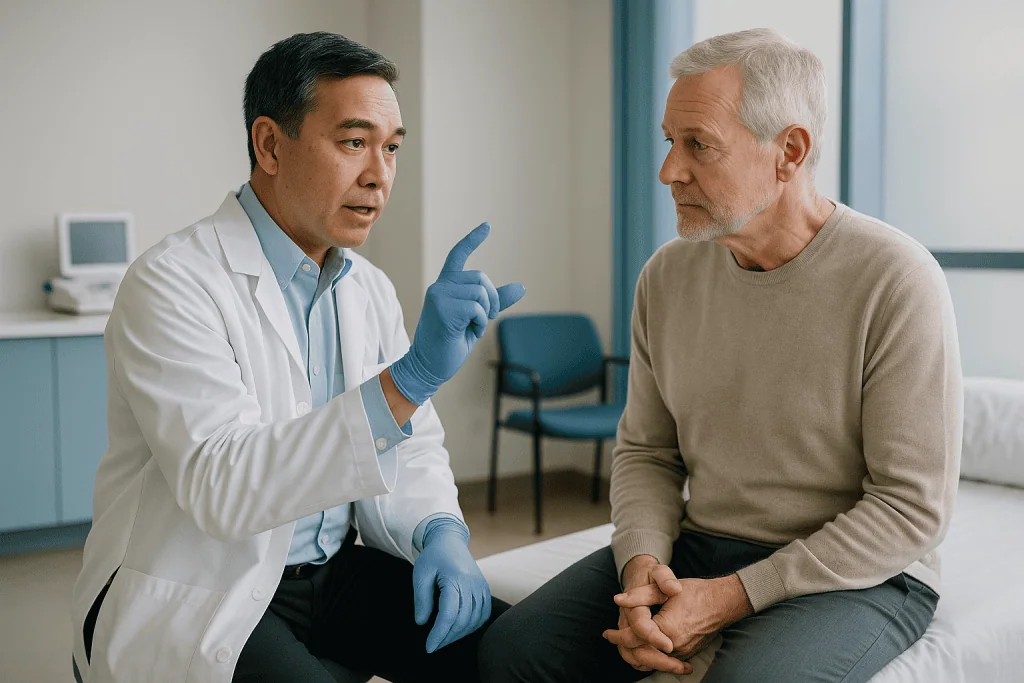
The examiner is judging four things: size, symmetry, texture and tenderness. A gland that feels warm, swollen and boggy and makes you flinch suggests acute bacterial prostatitis. A firm, enlarged, non-tender gland points more toward benign prostatic hyperplasia (BPH), the age-related growth of the prostate. Hard nodules or an irregular surface are not typical of prostatitis and would prompt a different conversation and further tests. A normal-feeling prostate with a tender pelvic floor around it is a common finding in CP/CPPS.
Two points about safety. If acute bacterial prostatitis is suspected, clinicians generally avoid vigorous massage of the gland because pressing on an infected prostate can push bacteria into the bloodstream. And a DRE can temporarily raise the PSA blood level, so if a PSA test is planned, the blood is usually drawn first or on another day.
Practical notes: lying on your side with knees drawn up is the usual position; breathing out slowly during insertion relaxes the muscles; and you are entitled to ask for a chaperone. The whole examination is over in well under a minute. Men often say afterward that the anticipation was worse than the event, which is probably the truest thing anyone can tell you about it.
Is there a gold standard for diagnosing prostatitis? The two-glass and four-glass tests
People searching for the “gold standard” usually have chronic symptoms and want the definitive test. The honest answer is that there is no single test that proves prostatitis in every category. For chronic bacterial prostatitis specifically, the classic reference method is the Meares-Stamey four-glass test, described by the NIDDK among the tests a urologist may use.
Here is how it works. You provide the first few milliliters of urine (sample one, reflecting the urethra), then a midstream sample (sample two, reflecting the bladder). The clinician then massages the prostate during a rectal examination to express a few drops of prostatic fluid onto a slide (sample three). Finally you pass urine again (sample four, which washes out any remaining prostatic fluid). Each sample is examined for white cells and cultured. If bacteria or inflammatory cells are far more concentrated in samples three and four than in one and two, the prostate is the source.
In everyday practice the four-glass test is time-consuming and many clinics use a simplified pre- and post-massage two-glass version, comparing urine collected before and after prostate massage. It loses some precision but keeps the central idea: the prostate is implicated when the post-massage sample is the one that lights up.
Neither version is used in acute bacterial prostatitis, for the bloodstream-infection reason explained above. And neither can diagnose CP/CPPS; they can only fail to find bacteria, which is itself informative. So if you are asked why the “definitive” test was not done, the likely answer is that in your situation it either was not safe or would not have changed the plan.
Prostatitis blood tests: infection markers and why PSA may be raised
Blood tests are supporting actors rather than leads. In a man who looks unwell, a complete blood count checks for a raised white cell count, a sign the body is fighting infection, and kidney function tests check that a blocked or infected system is not straining the kidneys. If there is fever or shaking, blood cultures may be drawn to see whether bacteria have entered the bloodstream, a complication that changes the urgency of care.
The test that generates the most anxiety is prostate-specific antigen (PSA), a protein made by prostate cells and measured in a blood sample. Mayo Clinic notes that PSA can rise with prostatitis, because inflamed prostate tissue leaks more of the protein. That means a high PSA taken during an episode of prostatitis does not carry the same meaning it would in a well man, and a raised value is not, on its own, evidence of cancer.
What clinicians usually do with that information is wait. Once inflammation has settled, the PSA is often rechecked several weeks later, and only a persistently raised or rising level prompts a separate work-up. Several guidelines specifically caution against interpreting a PSA drawn in the middle of a suspected infection, and against ordering it routinely for prostatitis symptoms, since it is a cancer-screening marker rather than a prostatitis test.
Depending on the history, other blood tests may be sensible. A blood glucose or HbA1c can matter because diabetes raises the risk of urinary infections. In men with recurrent infections, a test for HIV may be offered as part of a broader assessment. None of these diagnose prostatitis; they help explain why it happened and whether anything else needs attention.
When imaging is added: ultrasound, CT and MRI
Most men with prostatitis never need a scan, and that surprises people. Mayo Clinic lists imaging as an option for looking at the urinary tract and prostate in more detail, but the trigger is a specific clinical question, not the diagnosis itself.
A bladder ultrasound is the gentlest and often the first. A small probe on the lower abdomen measures how much urine remains after you have tried to empty, checking for retention, the inability to fully empty the bladder. It can also show a thickened bladder wall or a kidney that has become swollen from backed-up urine. Transrectal ultrasound, in which a slim probe is placed in the rectum, gives a closer view of the prostate and can detect a prostatic abscess, a pocket of pus within the gland.
CT (computed tomography) uses X-rays to build cross-sectional images. It is typically reserved for the acutely unwell patient whose fever is not settling as expected, where the question is whether an abscess has formed or whether the infection has spread beyond the prostate. MRI (magnetic resonance imaging), which uses magnetic fields rather than radiation, gives the most detailed soft-tissue picture and may be chosen when an abscess is strongly suspected or when the prostate feels abnormal on examination and cancer needs to be assessed separately.
Common reasons imaging enters the picture include:
- fever or symptoms persisting despite appropriate initial treatment
- a suspected abscess, blockage or kidney involvement
- blood in the urine that needs its own explanation
- a prostate that feels irregular or hard on examination
- recurrent infections where a stone or structural problem is suspected
If none of those apply, being told you do not need a scan is reassurance, not neglect.
Cystoscopy, urodynamics and swabs: the tests for ruling other things out
Once bacteria have been sought and the prostate examined, the remaining tests are mostly about excluding lookalikes. Mayo Clinic mentions two in particular: cystoscopy and urodynamic testing.
Cystoscopy uses a thin, flexible tube with a camera, passed along the urethra under local anesthetic gel, to look directly at the lining of the urethra, the prostate channel and the bladder. It is considered when there is blood in the urine, when symptoms have persisted for months without explanation, or when a stricture (a narrowing of the urethra from scarring) or bladder stone is suspected. It also allows the clinician to see whether the bladder lining is inflamed in a pattern that suggests interstitial cystitis, a painful bladder condition that overlaps heavily with CP/CPPS.
Urodynamic tests measure how the bladder fills and empties. The simplest is a flow rate, in which you pass urine into a special toilet that records the speed of the stream. A weak, prolonged flow points toward obstruction from an enlarged prostate or stricture rather than infection. More detailed pressure-flow studies, where small catheters measure bladder pressure during filling and voiding, are used less often and mainly when surgery or a specific bladder problem is under consideration.
Urethral swabs or a first-void urine sample tested for sexually transmitted infections such as chlamydia and gonorrhea are sensible when there is discharge, a new partner or urethral burning. Urethritis, inflammation of the urethra, can feel remarkably like prostatitis and is treated differently. The CDC recommends testing rather than guessing in this situation. Semen culture is occasionally used but is harder to interpret because of contamination, so most guidelines do not rely on it.
Who is tested straight away, and who is usually asked to wait
Diagnosis is paced by risk, and understanding that pacing spares a lot of frustration.
Tested and treated the same day: men with a sudden onset of fever, chills, pelvic or perineal pain and difficulty passing urine, the picture the NHS describes for acute prostatitis. In that setting the urine sample, blood tests and gentle examination are done promptly, and antibiotics, medicines that kill or halt bacteria, are commonly started before results are back because untreated acute infection can progress to bloodstream infection or urinary retention. Men who cannot pass urine at all may need a catheter placed, and those who are very unwell may be assessed in hospital.
Tested, then asked to wait: men with weeks or months of pelvic ache, urinary irritation or painful ejaculation but no fever and no signs of systemic illness. Here the first visit typically yields a urine test and an examination, and the plan is often to review results, treat any confirmed infection, and reassess. The NHS notes that chronic prostatitis is diagnosed when symptoms have lasted at least three months, so a man in week five is, by definition, still being observed rather than labeled.
Waiting in this context is not the same as being dismissed. It reflects two realities: bacterial forms are a minority of prostatitis, and many pelvic pain syndromes fluctuate on their own. Rushing to cystoscopy or MRI in the first fortnight rarely changes management and can generate incidental findings that create new worry.
Men who are asked to wait should still be told what would shorten the wait: fever, worsening pain, new blood in the urine or an inability to pass urine. Those triggers move anyone straight into the first group.
Prostatitis diagnosis tests at a glance
The table below summarizes what each test involves and the question it answers. It is a guide to the conversation, not a checklist that everyone should complete.
| Test | What it involves | What it can show | Usually ordered when |
|---|---|---|---|
| History and NIH-CPSI | Questions and a short symptom score | Type of prostatitis suspected; a baseline to track change | Every assessment |
| Urinalysis and culture | Midstream urine sample | Infection anywhere in the urinary tract; the organism and its sensitivities | Every assessment |
| Digital rectal exam | Brief gloved examination via the rectum | Tender, swollen, enlarged or irregular prostate | Every assessment; gentle in acute infection |
| Two- or four-glass test | Urine before and after prostate massage | Whether bacteria or inflammation localize to the prostate | Suspected chronic bacterial prostatitis; never in acute infection |
| Blood tests | Blood sample | Infection markers, kidney function, blood glucose; PSA (interpreted with caution) | Fever, systemic illness, recurrent episodes |
| STI testing | Swab or first-void urine | Chlamydia, gonorrhea and other urethral infections | Discharge, new partner, urethral symptoms |
| Bladder or transrectal ultrasound | External probe or slim rectal probe | Retained urine, abscess, kidney swelling | Poor emptying, suspected abscess, non-response |
| CT or MRI | Cross-sectional scan | Abscess, spread of infection, structural abnormality | Severe or persistent acute infection; abnormal exam |
| Cystoscopy | Camera passed along the urethra | Stricture, stones, bladder lining changes | Blood in urine, long-standing unexplained symptoms |
| Flow rate / urodynamics | Voiding into a measuring device | Obstruction versus irritation | Weak stream, suspected enlarged prostate |
Reading down the last column shows the pattern clearly: three tests belong to almost everyone, and the rest are earned by specific findings. If your list is short, that is usually because the first three answered the question.
What could be misdiagnosed as prostatitis?
Because prostatitis is so common and its symptoms so nonspecific, it functions as a diagnosis that other conditions hide behind. Clinicians keep a mental list; it is worth knowing what is on it.
Benign prostatic hyperplasia (BPH) is the most frequent overlap in men over 50. Both cause a slow stream, urgency and night-time trips to the bathroom. The difference is that BPH is rarely painful and the gland feels enlarged but not tender. A flow rate and residual urine measurement usually separate them.
Urinary tract infection confined to the bladder, and urethritis from a sexually transmitted infection, produce burning and frequency that feel identical to bacterial prostatitis. Urine culture and STI testing sort this out, which is why they sit near the top of the test list.
Interstitial cystitis, also called bladder pain syndrome, causes pelvic pain that worsens as the bladder fills and eases after emptying. It is more often considered in women but occurs in men, and it shares so much ground with CP/CPPS that some researchers regard them as neighbors on a single spectrum.
Pelvic floor muscle dysfunction, essentially chronic tension in the muscles that form the floor of the pelvis, is now recognized as a major driver of what used to be labeled non-bacterial prostatitis. A physical examination of those muscles is the test; there is no scan for it.
Less common but important: bladder or prostate cancer, particularly when there is visible blood in the urine or a hard, irregular gland; kidney or bladder stones; a urethral stricture; and epididymitis or a hernia presenting as groin and perineal pain. Cleveland Clinic and Johns Hopkins both emphasize that unexplained blood in the urine should be investigated rather than attributed to prostatitis by default.
Can you self-check for prostatitis, and what are the "5 warning signs"?
Two of the most searched questions deserve straight answers. First: there is no reliable way to self-check for prostatitis. The gland cannot be felt from outside the body, urine dipsticks sold for home use cannot distinguish a bladder infection from a prostate infection, and none of the localizing tests can be done without a clinician. Attempting a self-administered prostate examination is neither informative nor safe, particularly if infection is present.
Second: the “5 warning signs” is an internet construction, not a medical list. Prostatitis has no fixed number of signs, and the four categories present differently. What is genuinely useful is knowing which experiences should prompt a conversation with a doctor and which demand urgent care, and that is covered in the “When to call your doctor” section rather than as a self-scoring quiz.
What you can do at home is gather information that makes the appointment more productive. Keep a simple diary for a week: how often you pass urine, whether the stream is weak or interrupted, whether pain sits in the perineum (the area between scrotum and anus), lower back, penis or testicles, and whether ejaculation is painful. Note anything that makes symptoms better or worse, such as long periods of sitting, cycling, alcohol or spicy food. Record your temperature if you feel feverish.
Bring a list of medicines and supplements, any previous urine results, and a clear memory of when symptoms started. That diary does more for an accurate diagnosis than any home test kit, because the history is the part of prostatitis assessment that carries the most weight, and you are the only person who can supply it.
Chronic prostatitis diagnosis: what the following days and weeks usually look like
The timeline after a first visit depends entirely on which category you appear to be in.
For suspected acute bacterial prostatitis, urine culture results typically return within a couple of days, and the treating clinician uses them to confirm that the antibiotic already started is appropriate. Fever and pain usually begin easing within the first few days of effective treatment; if they do not, that is precisely the moment imaging enters the discussion to look for an abscess. A follow-up review is commonly arranged during or at the end of the course, and a repeat urine test may be requested to confirm the infection has cleared. The NHS notes that antibiotic courses for acute prostatitis are longer than for a simple bladder infection because the gland is harder for medicines to penetrate; the specific length is set by the prescriber.
For chronic symptoms, the weeks look different and quieter. The initial urine and culture results guide whether an infection is being treated at all. If bacteria are found and localize to the prostate, a longer course is typical and a repeat culture afterward checks for clearance. If cultures are negative, the emphasis shifts to characterizing the pain: repeating the NIH-CPSI, assessing pelvic floor tension, reviewing bladder emptying, and sometimes referral to a urologist or pelvic health physiotherapist. The NIDDK notes that CP/CPPS is often managed with a combination of approaches tailored to the individual pattern of symptoms; the diagnostic work in this phase is really about identifying which pattern applies.
Two practical expectations: results can arrive piecemeal rather than all at once, and it is normal to have a second appointment where the plan changes based on what came back. Neither means the first visit was wasted.
What people often get wrong about prostatitis testing
“A normal urine test means it’s not prostatitis.” It means bacteria were not detected in that sample. CP/CPPS, the most common category, characteristically produces normal urine. A negative result narrows the field; it does not close the case.
“A high PSA means cancer.” PSA rises with inflammation, infection, recent ejaculation and even a rectal examination. Mayo Clinic specifically lists prostatitis as a cause of elevated PSA. A value taken during an episode is usually rechecked after things settle before any conclusions are drawn.
“If they were taking it seriously, they would order a scan.” Imaging is added for specific reasons: suspected abscess, retention, blood in the urine, non-response or an abnormal examination. In the absence of those, a scan adds radiation or cost without changing the plan. A short test list is often a sign the picture is clear.
“The rectal exam is optional.” It is brief, and it is the only way to feel the gland directly. It also picks up findings that redirect the whole work-up, from a tender pelvic floor to a hard nodule. Declining it leaves a genuine gap.
“Prostate massage is a test everyone should have.” In acute infection it is avoided because it can drive bacteria into the bloodstream. In chronic cases it is a localizing test, not a treatment, and it is not needed when the question has already been answered.
“Prostatitis is a young man’s problem” or “an old man’s problem.” The NHS notes it can occur at any age, though it is more often seen between 30 and 50, while the NIDDK ranks it as the third most common urinary problem in men over 50. Age shifts the likely category, not the possibility.
Questions to ask your care team
Good questions turn a fifteen-minute appointment into a shared plan. These are the ones that tend to unlock the most useful answers.
- Which category of prostatitis do you think this is, and what makes you lean that way?
- Has my urine been cultured, and when should I expect the result? Will someone contact me, or should I call?
- Did the prostate feel tender, enlarged or irregular on examination? What did that tell you?
- Is a two-glass or four-glass test relevant in my case, and if not, why not?
- If I have been given an antibiotic before results are back, what happens if the culture shows something different?
- Do I need any imaging now, and what findings would make you order it later?
- Was a PSA test done? If it is raised, when will it be repeated, and how should I interpret it in the meantime?
- Have sexually transmitted infections been considered and tested for?
- Could my pelvic floor muscles be contributing, and is a physiotherapy assessment worth exploring?
- What specific symptoms should bring me back sooner than my scheduled follow-up?
It also helps to ask how results will be communicated and who to contact if a message does not arrive. Many of the frustrations men describe with prostatitis are really about silence between appointments rather than the tests themselves.
Write the answers down or ask permission to record them. Prostatitis assessment produces information in stages, and having the first-visit reasoning in front of you makes the second visit far easier to follow. Whatever emerges, the choices about which tests come next and what to do with the results sit with you and your treating team together, informed by the evidence rather than by the loudest search result.
When to call your doctor
Most prostatitis is uncomfortable rather than dangerous, but the acute bacterial form can deteriorate quickly, and a few symptoms should never be watched from home.
Seek urgent or emergency care the same day if you experience:
- fever, chills or shaking, especially together with pelvic, perineal or lower back pain
- inability to pass urine, or passing only small amounts with a painfully full bladder
- severe pain in the pelvis, perineum or lower abdomen that is escalating over hours
- confusion, rapid breathing, a racing heart or feeling faint, which can signal infection spreading to the bloodstream
- visible blood in the urine with fever or clots
Contact your doctor within a day or two, rather than waiting for a routine slot, if you notice new pain or burning on urination lasting more than a few days, painful ejaculation, blood in the urine or semen without fever, or worsening symptoms despite treatment you have already started. The NHS advises seeing a GP for any of these rather than waiting to see whether they pass.
Men who are already being treated for prostatitis should call if fever returns after initially improving, if pain intensifies rather than easing after the first few days, or if they develop new symptoms such as a swollen, painful testicle. Each of these can indicate an abscess, a resistant organism or a different diagnosis, and each is a reason for the treating team to reconsider imaging or testing.
If you are unsure whether a symptom qualifies, the safe rule is simple: fever plus urinary symptoms is always worth a call. Nobody on the receiving end of that call will think you overreacted.
Frequently asked questions
What is the gold standard for diagnosing prostatitis?
There is no single gold standard covering all types. For chronic bacterial prostatitis, the classic reference test is the Meares-Stamey four-glass test, which compares urine and prostatic fluid collected before and after prostate massage to see whether bacteria localize to the gland. Many clinics use a simplified two-glass version. Acute bacterial prostatitis is diagnosed clinically with a urine culture, and chronic pelvic pain syndrome is diagnosed by history and examination after infection has been excluded.
What does a prostatitis urine test actually show?
A urinalysis checks for white blood cells, nitrites and blood, which suggest infection somewhere in the urinary tract, and a culture identifies the organism and which antibiotics affect it. On its own, urine cannot prove the infection sits in the prostate rather than the bladder. In chronic pelvic pain syndrome the urine is usually normal, so a clear result narrows the possibilities without ruling prostatitis out.
What happens during the prostate exam for prostatitis?
A digital rectal examination involves a gloved, lubricated finger inserted into the rectum for a few seconds so the clinician can feel the back of the prostate. They assess size, symmetry, texture and tenderness. A swollen, tender gland suggests acute infection; a firm enlarged gland points more toward benign enlargement; hard or irregular areas prompt separate assessment. In suspected acute infection the examination is kept gentle, and vigorous massage is avoided.
Can a prostatitis blood test for PSA show whether I have cancer?
No. PSA is a protein released by prostate cells, and Mayo Clinic notes that it rises during prostatitis because inflamed tissue leaks more of it. A rectal examination and recent ejaculation can also raise it. A high PSA measured during an episode is usually repeated several weeks later once inflammation has settled, and only a persistently raised or rising value leads to separate cancer-focused investigation.
How is chronic prostatitis diagnosis different from acute prostatitis diagnosis?
Acute bacterial prostatitis is diagnosed quickly from sudden fever, pelvic pain and urinary symptoms, supported by a urine test and blood tests, and treatment usually starts before culture results return. Chronic prostatitis requires symptoms lasting at least three months, according to the NHS and NIDDK, and diagnosis unfolds over several visits: urine cultures, sometimes localizing two-glass or four-glass tests, symptom questionnaires and assessment of the pelvic floor and bladder emptying.
How can I self-check for prostatitis at home?
You cannot reliably self-check for prostatitis. The gland cannot be felt from outside the body, home urine dipsticks cannot separate a bladder infection from a prostate infection, and attempting a self-examination is unsafe if infection is present. What genuinely helps is keeping a week-long diary of urinary frequency, stream quality, pain location, painful ejaculation and any fever, then bringing it to an appointment where a clinician can examine and test properly.
What could be misdiagnosed as prostatitis?
Benign prostatic hyperplasia, bladder infection, urethritis from a sexually transmitted infection, interstitial cystitis, pelvic floor muscle dysfunction, urethral stricture, kidney or bladder stones, epididymitis and, less commonly, bladder or prostate cancer can all produce similar symptoms. This is why urine culture, STI testing, a rectal examination and, where indicated, flow studies or cystoscopy are part of the work-up, and why visible blood in the urine is always investigated separately.
When is imaging added to prostatitis diagnosis tests?
Imaging is added when a specific question arises rather than routinely. Bladder ultrasound checks for retained urine; transrectal ultrasound, CT or MRI look for a prostatic abscess or spread of infection when fever persists despite treatment; and scans may be used when the gland feels irregular, when blood appears in the urine, or when recurrent infections suggest a stone or structural problem. Many men with prostatitis never need a scan.
What are the warning signs of prostatitis that mean I should see a doctor?
Fever or chills combined with pelvic, perineal or lower back pain, difficulty or inability to pass urine, severe escalating pelvic pain, and visible blood in the urine warrant same-day care. New burning on urination lasting more than a few days, painful ejaculation, or blood in semen without fever should be discussed with a doctor within a day or two. There is no official list of five signs; these are the ones clinicians act on.
Why did my doctor start antibiotics before the test results came back?
In suspected acute bacterial prostatitis, delay carries a real risk of the infection spreading to the bloodstream or causing urinary retention, so treatment commonly begins on the basis of symptoms, examination and a urine dipstick. The culture, which takes longer, is then used to confirm the organism and check that the chosen medicine is appropriate, and the prescriber adjusts the plan if the result points elsewhere.
References
- NHS – Prostatitis
- NIDDK (NIH) – Prostatitis: Inflammation of the Prostate
- Cleveland Clinic – Prostatitis
This article is for general information only and is not a substitute for professional medical advice. Please consult a qualified doctor about your individual situation.

More from the Blog

What Happens After an Elevated PSA? From a Repeat Test to MRI and Urology Review
After an elevated PSA result, the usual next step is a repeat blood test once temporary causes such as infection, ejaculation or vigorous cycling…

Why Interstitial Cystitis Is Called a Pain Syndrome and How Care Is Personalized
Interstitial cystitis is called a pain syndrome because its defining feature is bladder-related pain or pressure with urinary urgency and frequency, usually lasting more…

Hypospadias Repair Recovery Day by Day: The Dressing, the Stent and Returning to Nursery
Hypospadias surgery recovery time is usually measured in days for the hardest part and weeks for the rest. Most children go home the same…

Catheter Hygiene, Fluids and Follow-Up: Daily Life After Bladder Drainage for Retention
Living with a urinary catheter after urinary retention means keeping the tube and bag clean with daily soap-and-water washing, drinking enough fluid that urine…

Fever, Pain or Low Urine Output After Hydronephrosis Treatment: When to Call Your Team
A mild, short-lived temperature in the first day after a ureteral stent or nephrostomy can occur, but a fever of 38°C (100.4°F) or higher,…

How Does Ureteroscopy Reach a Kidney Stone Without an Incision? A Step-by-Step Look
Ureteroscopy reaches a kidney stone by following the body's own urinary channel rather than cutting through skin. Under anesthesia, a urologist passes a thin,…