

How Sore Are Metal Braces in the First Days, and How Is Discomfort Eased?

Key Takeaways
- Braces soreness in trials typically peaks within the first 24–72 hours after wire placement and returns close to baseline by about day seven, with wide individual variation.
- The ache comes from inflammation in the periodontal ligament that suspends each tooth, not from damage to the tooth itself, which is why it fades even while the wire stays in place.
- Tooth ache and cheek soreness are different problems: soft cold food and clinician-approved pain relief target the first, while orthodontic wax and salt-water rinses target the second.
- A Cochrane review rated the evidence for chewing gum and low-level laser therapy as low certainty, so they are reasonable to ask about but not proven remedies.
- Soreness after routine adjustments follows the same pattern as the first week but is usually shorter and milder, except when something new such as elastics is introduced.
- Severe single-tooth pain, swelling, fever, pus, or soreness that worsens after day four are not features of normal braces discomfort and warrant a call to your orthodontic team.
Metal braces soreness is usually a dull ache and tenderness when biting, beginning a few hours after fitting, peaking around days two and three, and easing over roughly a week. Teeth feel tender because the ligament around each root is responding to gentle, constant pressure. Soft foods, cold drinks, orthodontic wax on rubbing brackets and salt-water rinses help most people; your orthodontic team can advise on pain relief.
The appointment itself is strangely anticlimactic. A chair that tilts back, a cheek retractor that makes you look surprised, the chemical tang of bonding glue, a blue light, and then forty minutes later you are standing at the reception desk running your tongue over a mouth that suddenly feels like it belongs to someone else. Nothing hurts yet. You drive home almost smug.
By dinner, the front teeth have started to throb in a quiet, insistent way. By breakfast the next day, a slice of toast feels like a dare. This is the arc of metal braces soreness that almost nobody warns you about precisely, partly because it varies so much from one mouth to the next, and partly because “it’ll be a bit uncomfortable” covers a wide range of experiences.
What follows is an honest account of those first days: what the ache is, why it peaks when it does, which comfort measures have actual evidence behind them, and which signs mean you should pick up the phone rather than wait it out.
What metal braces soreness actually feels like in the first days
People expect sharp pain and are often surprised to get something more like a bruise. The most common description is a dull, pressing ache across all the teeth, worse at the front, with a distinct tenderness when the upper and lower teeth meet. Biting into anything firm sends a jolt through the tooth, not unlike pressing on a sore fingernail. Between meals, many people barely notice it; at mealtimes, it is impossible to ignore.
Alongside the tooth ache there is a second, quite separate sensation: the inside of the lips and cheeks being rubbed raw by brackets they have never met before. Brackets are the small metal squares bonded to each tooth. The archwire is the thin wire that runs through them and does the actual moving. Together they introduce dozens of new edges to soft tissue that was perfectly happy with smooth enamel.
The NHS describes braces as potentially uncomfortable for a few days after fitting and after each adjustment, and that framing is accurate for most people. Cochrane reviewers who pooled trials on orthodontic pain found that discomfort typically rises within hours of a wire being placed, peaks within the first day or two, and declines steadily over the following week. Individual experience spreads widely around that average.
Two things are worth knowing from the start. First, the soreness is a sign of the ligament around each tooth doing what the wire asks of it, which is the whole point of treatment. Second, it is temporary in a very predictable way. Knowing roughly when the peak will come, and that it will pass, changes how it feels to live through it.
Why do braces hurt? What is actually happening to the tooth
A tooth is not fused to the jaw. It sits in its socket suspended by the periodontal ligament, a thin sling of fibers, blood vessels and nerve endings that cushions every bite. When an archwire applies light, continuous pressure, that ligament is squeezed on one side and stretched on the other.
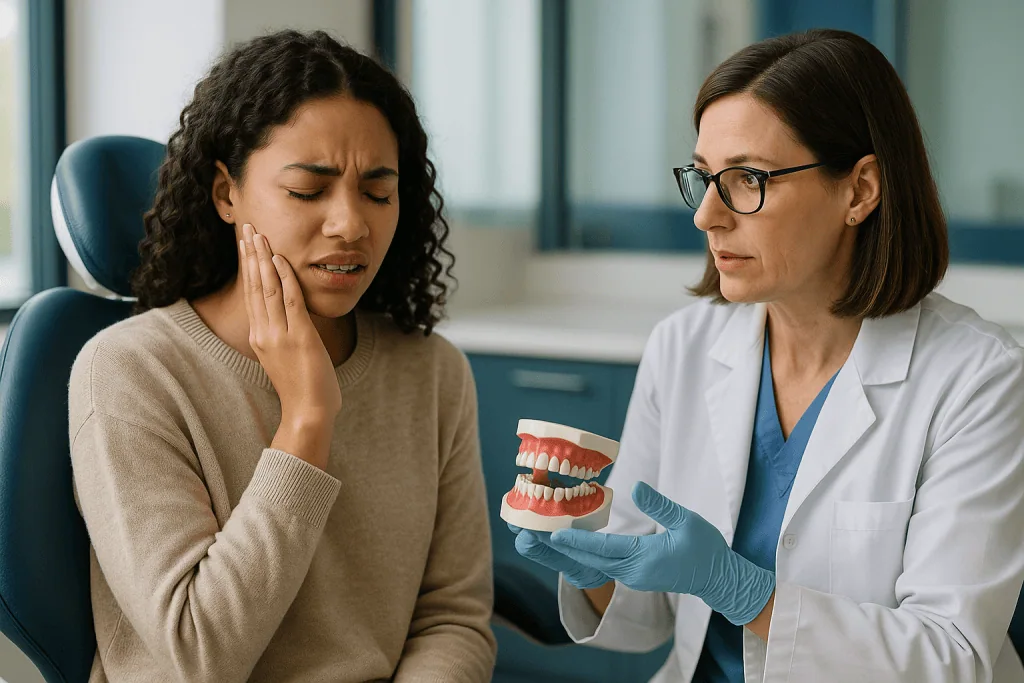
On the compressed side, blood flow drops and cells release inflammatory signaling molecules, among them prostaglandins, the same chemical messengers involved in a sprained ankle. These molecules sensitize the nerve endings in the ligament, which is why a tooth that felt nothing on Tuesday morning aches on Tuesday night. Over the following days, specialized cells remove a sliver of bone on the pressured side while new bone is laid down on the stretched side. That is how teeth move: not by being dragged through solid bone, but by bone quietly remodeling around them.
The timing explains the pattern of soreness. Inflammation builds for a day or two before the ligament adapts and the chemical signals subside, so the second and third days are usually the low point. As the wire’s force is gradually spent and the ligament settles, the ache fades even though the wire is still in place.
This mechanism also explains why the front teeth tend to hurt more than the back ones. Front teeth have single, slimmer roots and are often the most crooked at the start, so they receive proportionally more force. Molars, with their broad multiple roots, usually register only a mild tenderness.
It is worth separating this ligament ache from the tooth itself being damaged. Properly applied orthodontic force does not injure the enamel or the nerve inside the tooth. The sensation is the surrounding tissue reporting pressure, not the tooth reporting harm.
How long do braces hurt after they are first put on?
The honest answer is: a few days of real soreness, then a tail of mild tenderness that fades within about a week for most people. The NHS advice that braces may be uncomfortable “for a few days” after fitting matches what Cochrane reviewers observed across trials, where pain scores were highest in the first 24–72 hours and had returned close to baseline by day seven in most participants.
Within that pattern there is wide variation, and it is not a sign that something is wrong if you sit at either end of the range. Some people describe only a vague awareness of pressure and eat normally by the second evening. Others need a full week of soft food and feel the last tenderness lift closer to day ten. Studies have not been able to predict reliably who will fall where. Age, how crowded the teeth are at the start, pain sensitivity and even expectations all seem to play a part.
What does not predict pain well is the amount of eventual movement. A tooth that needs to travel a long way does not necessarily hurt more in the first week than one that needs a small correction. Modern archwires are designed to deliver a light, steady force rather than a strong push, which is one reason soreness is milder than many people fear.
If the question behind “how long do braces hurt” is really “when can I eat a sandwich again,” most people find that threshold around day four or five. If it is “when will I stop noticing them at all,” that takes longer: the hardware feels foreign for a few weeks, long after the ache has gone, until the lips and tongue learn the new terrain.
Braces pain in the first week: a day-by-day picture
Nobody’s week runs exactly to schedule, but the shape is familiar enough to sketch.
The afternoon of fitting usually feels fine. The teeth are aware of pressure, the cheeks are busy exploring metal, and eating a soft meal is manageable. By the evening, a dull ache has often started in the front teeth. Sleep is rarely disturbed, though some people notice their teeth pulsing faintly when they lie down.
Day one is where reality sets in. Biting hurts. Many people are startled by how tender the front teeth are when they simply close their mouth. This is the moment most people switch to yogurt, smoothies, soup and pasta without being told to. Cheek soreness is beginning as the lining starts to react to the brackets.
Days two and three are the usual peak, in line with the trial data summarized in Cochrane reviews. The tooth ache is at its most constant and small ulcers may appear where brackets rub the cheeks. This is also the stretch where people most often ask whether something has gone wrong. Almost always, nothing has.
From day four, the trend turns. The ache becomes intermittent and mostly bite-related. Firmer foods become possible. By days five to seven, most people describe tenderness only when biting something hard, and the cheek lining has started to toughen.
By the end of the first week, the tooth soreness has usually faded to near nothing. The hardware still feels strange, speech may still be slightly altered, and a stray wire end can still irritate, but the chapter of real soreness is generally over until the next adjustment, which tends to bring a shorter, milder repeat.
Is it the teeth or the cheeks? Two different kinds of soreness
Lumping all braces discomfort together leads people to try the wrong remedy. Pressure ache in the teeth and friction soreness in the cheeks have different causes and respond to different measures.
Tooth ache, as described above, comes from the periodontal ligament reacting to force. It is deep, diffuse and bite-triggered. Wax on the brackets does nothing for it, because the problem is beneath the gum, not on the surface. What helps is reducing the load on the teeth (soft foods), cooling the inflamed tissue (cold drinks or an ice pop) and, where a clinician agrees it is appropriate, medication that dampens the inflammatory signaling.
Cheek and lip soreness is mechanical. New brackets have edges; the lining of the mouth is thin and has spent a lifetime touching only smooth teeth. The result is irritation and, in many people, small painful ulcers in the first week or two. These look and behave like ordinary canker sores, which Mayo Clinic describes as shallow, round or oval ulcers with a white or yellow center and a red border that heal on their own within about one to two weeks. Minor trauma to the mouth lining is a recognized trigger.
For this second kind of soreness, orthodontic wax is the right tool. Wax is a soft, pliable material you press over a bracket to create a smooth dome between metal and cheek. Warm salt-water rinses soothe irritated tissue. Over the first few weeks the lining of the cheeks adapts and becomes less sensitive to the brackets, so the ulcers tend to stop appearing even though the hardware has not changed.
Knowing which type you are feeling at any moment tells you which measure to reach for.
How to relieve braces pain at home: what the evidence supports
A Cochrane review of non-drug approaches to orthodontic pain, led by Fleming and colleagues, is the most careful summary available, and its main conclusion is humbling: the evidence for most comfort measures is low in certainty. That does not mean they are useless. It means trials have been small, short and inconsistent, so claims should be modest.
Soft foods sit outside the trials but inside common sense. If biting is what hurts, biting less hurts less. Cool and cold foods appear to reduce the ache for many people, probably by narrowing blood vessels in the inflamed ligament and numbing nerve endings slightly. A cold drink, chilled yogurt or an ice pop in the worst hours is a reasonable first step.
Chewing has been studied more formally. Several trials gave participants sugar-free gum or a soft chewing wafer to use after wire placement, on the theory that gentle chewing increases blood flow around the ligament and clears inflammatory molecules faster. The Cochrane reviewers found some trials reporting lower pain scores, with low-certainty evidence overall. Many orthodontic teams discourage gum because it can stick to brackets, so this is one to ask about rather than assume.
Low-level laser therapy, in which a clinician applies a low-power light to the gums around the moving teeth, has also been studied. The same review found some reduction in pain scores but again rated the evidence as low certainty, so it should be described as promising rather than proven.
Salt-water rinses and wax target cheek soreness rather than tooth ache. They are simple, inexpensive in effort, and widely recommended by orthodontic teams and the NHS, even though they have not been subjected to the same trial scrutiny.
Comfort measures compared: what each one is for
The table below separates measures by the type of soreness they target and by how strong the supporting evidence is. Nothing here replaces advice from your orthodontic team, who know the specifics of your wire and your mouth.
| Measure | Targets | How it is thought to work | What the evidence shows |
|---|---|---|---|
| Soft, cut-small foods | Tooth ache | Reduces biting load on tender ligaments | Universal clinical advice; not trial-tested, biologically obvious |
| Cold drinks and foods | Tooth ache | Narrows vessels, dulls nerve endings in inflamed tissue | Widely recommended; limited formal trials |
| Gentle chewing (gum or wafer) | Tooth ache | May increase blood flow and clear inflammatory molecules | Low-certainty evidence of modest benefit (Cochrane); check with your team about gum |
| Orthodontic wax | Cheek and lip soreness | Smooths bracket edges against soft tissue | Standard advice from orthodontic teams and the NHS |
| Warm salt-water rinse | Cheek ulcers | Soothes irritated lining, keeps area clean | Long-standing clinical recommendation for mouth ulcers |
| Low-level laser therapy | Tooth ache | Light applied to gums may reduce inflammatory response | Low-certainty evidence; clinic-delivered only |
| Over-the-counter pain relief | Tooth ache | Reduces prostaglandin signaling or alters pain perception | Trials show short-term benefit; decision rests with your clinician |
Two patterns stand out. The measures with the best mechanistic logic for tooth ache are the ones that reduce load and inflammation. The measures for cheek soreness are mechanical and need no scientific controversy to justify them. Combining one from each group, soft cold food plus wax, covers the two most common complaints of the first week.
What the table cannot show is timing. Most people find that the first two or three days warrant the full toolkit, after which they can drop measures one by one as the ache recedes.
What about over-the-counter pain relievers for braces soreness?
This is where readers most want a simple instruction and where a responsible article has to decline to give one. Which medicine, how much and how often are decisions for the orthodontist, pharmacist or physician who knows your medical history, your age and anything else you take. What can be explained here is how the main options work and what trials have found.
Two classes of medicine are commonly discussed. Non-steroidal anti-inflammatory drugs, often shortened to NSAIDs, work by blocking the enzymes that produce prostaglandins, the inflammatory messengers that sensitize nerve endings in the periodontal ligament. Ibuprofen is the most studied generic example in orthodontic trials. Acetaminophen, the other common option, works mainly on pain processing in the central nervous system rather than on inflammation at the tooth.
A Cochrane review of drug approaches to orthodontic pain found that analgesics reduced pain scores in the hours after wire placement compared with placebo, with evidence of moderate to low certainty. Some trials compared the two classes directly without finding a clear winner, and a few explored taking a dose before the appointment rather than after. Those findings are interesting but not instructions; whether pre-emptive use is sensible for you is a conversation for your clinician.
A question people sometimes raise is whether anti-inflammatory medicines might slow tooth movement, since inflammation is part of how teeth move. Laboratory and animal work has suggested a theoretical effect; the clinical trials in humans have been short and have not shown a meaningful difference in treatment time. Orthodontic teams are aware of the debate and will factor it into their advice.
Whatever you and your clinician decide, medication is best thought of as a bridge over the worst two or three days, not a daily habit for the length of treatment.
Do braces hurt after tightening too?
Yes, usually, though the word “tightening” slightly misdescribes what happens. At a routine adjustment appointment, which the NHS notes typically falls every several weeks, the orthodontist may swap the archwire for a slightly stiffer or differently shaped one, bend the existing wire, change the small elastic ties that hold the wire in the brackets, or add elastics or springs. Each of these renews the gentle force on the teeth, and the periodontal ligament responds exactly as it did the first time.
The pattern of soreness after an adjustment mirrors the first week in miniature. Pressure is felt within hours, peaks over the next day or two and fades. Most people report that adjustment soreness is shorter and milder than the first episode, for two reasons. The cheeks have toughened, so friction ulcers are rare after the early weeks. And the teeth are no longer starting from scratch; the ligament is already in a remodeling state and adapts faster.
The exception is any appointment where something new is introduced. Adding elastics that run between the upper and lower jaws, placing a thicker working wire, or beginning to close spaces can each bring a noticeable bump in soreness, sometimes closer to the first-week experience. Your orthodontist will usually warn you when an appointment is likely to be one of those.
Timing appointments thoughtfully helps. Many people prefer a late-afternoon slot so the peak falls overnight and the following evening rather than across a workday or school day. Keeping soft food in the house for forty-eight hours after each visit is a low-effort habit that pays off repeatedly across a treatment that commonly runs well over a year.
Who is usually offered metal braces, and who is asked to wait
Metal braces are the longest-established orthodontic appliance and remain the default for many patterns of crowding, spacing, rotated teeth and bite problems. Malocclusion is the clinical term for teeth that do not meet properly; MedlinePlus describes it as a common condition, often inherited, sometimes caused by habits such as prolonged thumb sucking, injury or early loss of baby teeth.
In adolescents, treatment is often timed around the arrival of the permanent teeth, typically once most baby teeth have been lost and while the jaws are still growing, because growth can be guided. The NHS notes that orthodontic treatment is usually started once the permanent teeth have come through. Adults can and do have metal braces too; the biology of tooth movement is the same, though it tends to proceed somewhat more slowly, and adult treatment plans must account for existing gum health, fillings and crowns.
Several groups are commonly asked to wait or to complete other care first. Children whose permanent teeth have not yet arrived may be monitored rather than treated, or offered a short early phase to manage a specific problem. Anyone with active gum disease or untreated decay is usually asked to have that treated and stabilized, because moving teeth through inflamed gums risks bone loss. People who cannot yet maintain thorough brushing around brackets may be asked to demonstrate that first, since braces make cleaning harder and plaque accumulates around every bracket.
Alternatives exist. Clear aligners, which are removable plastic trays changed in sequence, suit some cases but not all; ceramic brackets look less visible but are bulkier and more brittle; lingual braces sit behind the teeth. Each has its own comfort profile. Which option fits your teeth and your life is a decision for you and your orthodontic team after a full assessment.
Eating with new braces: soft, cool, and cut small
Food is where the first week is won or lost. The teeth are not fragile, but the ligaments holding them are tender, and every bite reminds you of that. The practical goal is to keep eating properly while sparing the front teeth from heavy loading.
Texture matters more than type. Scrambled eggs, oatmeal, soup, mashed potato, yogurt, soft pasta, fish, well-cooked rice, smoothies and ripe bananas all require little biting force. Cold options double as comfort measures. Cutting firmer foods into small pieces and chewing with the back teeth, which are usually less sore, lets you keep a wider range of meals than a pure liquid diet.
Foods to avoid are mostly the ones your orthodontist will warn you about for the whole course of treatment, not just the first week. Hard items such as nuts, hard candy, ice and popcorn kernels can snap a wire or shear a bracket off the tooth. Sticky foods such as caramel and chewing taffy can pull at brackets and are difficult to clean away. Biting directly into whole apples, raw carrots or crusty bread with the front teeth puts the most force exactly where soreness is greatest; slicing them solves most of the problem.
Sugar deserves a mention beyond comfort. Brackets create dozens of new corners where plaque collects, and frequent sugary drinks during treatment raise the risk of permanent white marks on the enamel once braces come off. The NHS advice to limit sugary food and drink and to brush carefully after every meal applies from the very first day.
Appetite can dip during the peak days, especially in younger patients. A few days of softer, smaller meals is not harmful; a week of skipping meals is worth mentioning to your team.
What people often get wrong about metal braces soreness
The myths around braces pain are persistent, partly because so much advice travels by word of mouth from older siblings and classmates.
The first mistake is believing that more soreness means faster progress. The pain is a byproduct of inflammation in the ligament, not a measure of how far the tooth has moved. Two people with identical wires can report very different pain levels and end up with identical results. Equally, a mild first week does not mean the braces are not working.
The second is the idea that braces are tightened to be painful on purpose, or that an orthodontist can simply loosen them to stop the ache. Modern archwires deliver a light, steady force by design, and the discomfort that follows is the ligament’s inflammatory response, not something that can be dialed down without undoing the treatment.
Third, people often assume the soreness will last the whole course. In reality, as both the NHS and the trial literature describe, it comes in short episodes: a few days after fitting and a shorter, milder few days after each adjustment, with long stretches of comfort in between.
Fourth, cheek ulcers are frequently mistaken for infection. They are almost always mechanical, caused by rubbing, and heal as the cheek lining adapts, just as ordinary canker sores do. Wax and salt water are the answer, not antibiotics.
Finally, a common belief holds that adults suffer far more than teenagers. The evidence here is mixed. Adults sometimes report higher pain scores in trials, perhaps because they describe sensations more precisely or because adult bone remodels more slowly, but the difference is modest and far from universal. Age is a weak predictor compared with individual variation.
Questions to ask your care team before and after fitting
A ten-minute conversation at the fitting appointment can save a week of uncertainty. These questions are the ones patients most often wish they had asked.
- Which pain reliever, if any, is appropriate for me, and should I take anything before the appointment or wait until the ache begins? This is the single most useful question, because the answer depends on your health history and only your clinician can give it.
- How much soreness is normal for the wire you are placing today, and how long would you expect it to last for someone with my kind of crowding?
- Do you recommend chewing gum or a chewing wafer in the first days, or would you rather I avoid gum altogether?
- Can you show me how to apply orthodontic wax, and where the brackets most likely to rub are in my mouth?
- What should I do if a wire end pokes my cheek before my next appointment? Some teams are comfortable with you tucking it with a clean pencil eraser; others want to see you.
- How will I know the difference between normal soreness and a bracket that has come loose?
- Is there a number I can call outside office hours for a broken wire or a sore that will not settle?
- How soon after fitting should I return to my usual brushing and flossing routine, and are there tools you recommend for cleaning around brackets?
- Will the next adjustment introduce anything new, such as elastics, that might make that week more uncomfortable than usual?
Writing the answers down helps. The information given while you are lying back with a retractor in your mouth rarely survives the drive home intact.
When to call your doctor or orthodontist
Most first-week discomfort is expected and settles on its own, but a few signs mean you should contact your orthodontic team or a doctor rather than wait. The decision about what to do next always rests with them.
Call if the pain is severe, sharp or throbbing in a single tooth rather than a dull ache across many, especially if that tooth becomes sensitive to heat or keeps you awake. Properly applied orthodontic force does not cause this pattern, and it can signal a problem with the tooth’s nerve or an unrelated dental issue that happened to surface after fitting.
Call if soreness is clearly getting worse after day three or four instead of easing, or if it has not improved noticeably by the end of the first week. Steady improvement is the expected course; the opposite trend deserves a look.
Call if you notice swelling of the gum, face or jaw, a bad taste, pus, or a fever. These are not features of ordinary braces soreness and may indicate infection that needs assessment.
Call if a bracket feels loose, a wire has snapped, or a wire end is cutting into the cheek in a way wax cannot cover. A loose bracket is rarely an emergency but should be fixed before the next scheduled visit so treatment does not stall.
Call if a mouth ulcer is larger than usual, persists beyond about two weeks, or ulcers keep appearing in places not touched by brackets. Mayo Clinic advises medical review for canker sores that are unusually large, last more than two weeks or come with fever.
Seek urgent care if you have difficulty swallowing or breathing, spreading facial swelling, or if a piece of appliance has been swallowed or inhaled. These are rare, but they are the situations where waiting is the wrong choice.
Frequently asked questions
How long do braces hurt after you first get them?
Most people feel real soreness for two to three days, then mild tenderness that fades within about a week. Trials summarized by Cochrane reviewers show pain scores peaking in the first 24–72 hours after wire placement and approaching baseline by day seven. Some people barely notice the ache; others need closer to ten days before biting feels normal. Neither end of that range suggests anything is wrong.
What is the braces pain first week really like day by day?
The fitting day is usually comfortable, with an ache starting that evening. Day one brings tenderness when biting. Days two and three are the usual peak for both tooth ache and cheek irritation. From day four the pain becomes intermittent and mostly bite-related, and by days five to seven most people only notice tenderness on hard foods. The hardware itself feels strange for several weeks beyond that.
How do I relieve braces pain at home without medication?
Reduce the load on the teeth with soft foods cut into small pieces, use cold drinks or an ice pop to calm the inflamed ligament, press orthodontic wax over any bracket rubbing the cheek, and rinse with warm salt water for ulcers. Gentle chewing has low-certainty evidence of modest benefit, but ask your orthodontist before using gum. Most people need the full toolkit only for the first two or three days.
Do braces hurt after tightening the same way they did at first?
Usually the soreness after an adjustment is shorter and milder than the first week. The orthodontist renews the force on the teeth by changing or bending the wire, and the ligament responds with the same pressure-ache pattern, peaking over a day or two. Cheek ulcers are rare by then because the lining has toughened. Appointments that introduce elastics or a stiffer wire can bring a more noticeable bump.
How can I tell normal soreness from pain that means something is wrong?
Normal braces soreness is a dull ache spread across many teeth, worst when biting, that peaks around day two or three and steadily improves. Pain that is sharp or throbbing in a single tooth, sensitive to heat, worsening after day four, or accompanied by swelling, fever, pus or a bad taste does not fit that pattern. Those signs warrant a call to your orthodontic team rather than waiting it out.
Does more soreness mean my teeth are moving faster?
No. Soreness reflects the inflammatory response in the ligament around each tooth, which varies greatly from person to person, not the distance the tooth has traveled. Two people with identical wires can report very different pain and achieve identical movement. A mild first week does not mean the braces are failing, and a rough one does not mean the treatment is progressing unusually quickly.
Can I take painkillers for braces, and will they slow treatment?
Over-the-counter options such as NSAIDs and acetaminophen have been shown in trials to reduce orthodontic pain in the short term, but which one, how much and when are decisions for your orthodontist, pharmacist or physician. A theoretical concern that anti-inflammatory drugs slow tooth movement comes mainly from laboratory studies; short human trials have not shown a meaningful difference in treatment time. Ask your clinician before taking anything.
Why do I have ulcers on my cheeks after getting braces?
New brackets rub against a cheek lining that has only ever touched smooth teeth, producing small shallow ulcers that look and behave like ordinary canker sores. They typically heal within one to two weeks and become rare after the first month as the tissue toughens. Orthodontic wax over the offending bracket and warm salt-water rinses help. They are mechanical, not infectious, so antibiotics are not the answer.
Do adults feel more soreness from metal braces than teenagers?
The evidence is mixed. Some trials show adults reporting slightly higher pain scores, possibly because adult bone remodels more slowly or because adults describe sensations more precisely. The difference is modest and far from universal, and individual variation matters far more than age. Adults do tend to have somewhat slower tooth movement overall, but the first-week soreness follows the same peak-and-fade pattern at any age.
Should I stay home from school or work in the first days with braces?
Most people do not need to. The soreness is bite-related rather than constant, so it interferes with meals more than with concentration or conversation. Packing soft, cool food for the first two or three days is usually enough. Scheduling the fitting for later in the day means the peak falls overnight and the following evening. If pain is severe enough to prevent normal activity, contact your orthodontic team.
References
This article is for general information only and is not a substitute for professional medical advice. Please consult a qualified doctor about your individual situation.

More from the Blog
Dental Fillings During Pregnancy: Timing, X-Ray Shielding and Anesthesia Considerations
Dental fillings during pregnancy are generally considered safe and are often recommended rather than delayed, because untreated decay can progress to pain or infection.…

Can You Drink Coffee With Clear Aligners In? Eating, Drinking and the Water-Only Rule
Most orthodontic teams advise drinking only plain water while clear aligners are in. Coffee, tea and other drinks can stain the plastic, hot liquids…

Composite Bonding Aftercare: Coffee, Tea and Habits That Keep the Resin Looking Even
Composite bonding aftercare centers on protecting a resin surface that is softer and more porous than natural enamel. Most dentists advise avoiding coffee, tea,…
What Causes a Gummy Smile? Gum Overgrowth, Short Teeth, Jaw Position and Lip Movement
A gummy smile, which dentists call excessive gingival display, usually comes from one of four sources or a mix of them: gum tissue that…
What Laser Assisted Dental Procedures Can and Cannot Do: Realistic Results by Treatment Type
Laser dental treatment results depend on the procedure. For soft-tissue work such as gum reshaping, tongue-tie release and small biopsies, lasers cut precisely with…
Gum Graft vs Bonding for Gum Recession: Covering the Root or Protecting It
A gum graft and dental bonding address gum recession differently. A graft moves or places soft tissue to cover the exposed root and rebuild…