

How to Check for Fibroids, and What They Look Like
Key Takeaways
- Fibroids cannot be diagnosed at home; a pelvic exam followed by ultrasound is how they are confirmed, and even large ones are only sometimes palpable through the abdomen.
- The NHS estimates around 1 in 3 women develop fibroids, most often between ages 30 and 50, yet only about 1 in 3 of those experience symptoms.
- A period that lasts more than seven days, needs a change every one to two hours, or produces clots larger than about 2.5 cm meets the NHS definition of heavy bleeding and warrants evaluation.
- A fibroid belly is typically a firm, low, central fullness that does not change with meals or bowel movements, unlike the soft, shifting distension of bloating or weight gain.
- Location matters more than size: a small submucosal fibroid can cause flooding periods, while a large subserosal one may cause only a visible bump and bladder pressure.
- No food, supplement, or herbal remedy has been shown to shrink fibroids, but they often shrink naturally after menopause, and watchful waiting is a legitimate option for mild symptoms.
You cannot reliably check for fibroids at home. Fibroids are noncancerous growths in the muscular wall of the uterus, and they are usually confirmed by a pelvic exam and an ultrasound, not by touch. What you can do at home is track the clues: heavy or prolonged periods, pelvic pressure, frequent urination, constipation, and a firm, rounded lower belly. If those patterns persist, a clinician can check with imaging.
She noticed it in a changing-room mirror, turned sideways under unflattering light: a low, firm curve just above the pubic bone that had not moved in months. It was not there after a big meal and gone by morning. It was simply there. A friend called it bloating. Her jeans said otherwise, because the waistband still closed while the zipper strained.
Around the same time, her calendar had quietly reorganized itself around the second day of her period. Meetings got moved. Dark trousers got laundered on a schedule. None of this felt like an emergency, which is exactly why it went on for a year.
Fibroids often announce themselves this way, as a pattern rather than a moment. You cannot diagnose them in a mirror or with your fingertips, and anyone who says otherwise is selling something. What you can do is learn what the pattern looks like, collect it honestly, and know when it is time to hand that notebook to someone with an ultrasound probe.
Can you actually check for fibroids at home?
Not in the way people hope. A fibroid is a knot of smooth muscle and fibrous tissue growing within, on, or just under the surface of the uterus, an organ that sits low in the pelvis and is largely shielded by bone. Small fibroids are invisible from the outside and cannot be felt through the abdominal wall. Even a clinician with trained hands will usually feel only an irregular or enlarged uterus on pelvic exam, and then order an ultrasound to see what is actually there, as Mayo Clinic describes in its diagnostic guidance.
So the honest answer to the search query is no, and the useful answer is: home is where the evidence gets collected. A doctor sees you for fifteen minutes. You see your own body every day for months. The heavy day that arrives like clockwork, the third bathroom trip before lunch, the low ache that flares mid-cycle, the pad count that has crept from six to eleven: these are the data points a clinician cannot gather without you.
Think of the home check as a two-part job. First, learn which symptoms cluster around fibroids and which ones do not. Second, write them down for two or three cycles so that when you do sit in the consulting room, you are describing a pattern rather than a vague feeling. That record shortens the road to a diagnosis more than any self-exam ever could.
What are the first signs of fibroids?
Often, nothing at all. The NHS estimates that around 1 in 3 women develop fibroids at some point, and that only about 1 in 3 of those experience symptoms. Many fibroids are discovered by accident during a scan for something else and never cause trouble.
When symptoms do appear, bleeding usually changes first. Periods become heavier, longer, or both, and clots may show up where there were none before. Mayo Clinic lists heavy bleeding and periods lasting more than a week as the leading complaints, followed by pelvic pressure or pain, frequent urination, difficulty emptying the bladder, constipation, and backache or leg pain. Which of these you get depends less on how many fibroids you have than on where they sit, a point we come back to below.
Some early signs are easy to misattribute. Fatigue creeping in over months can be iron loss from heavier periods rather than a busy life. Waking at night to urinate may be a fibroid resting against the bladder rather than too much tea. A dull lower-back ache that has no obvious posture explanation is worth noting, too.
Pain during sex, particularly deep pain in certain positions, is another sign people rarely volunteer but the NHS specifically lists. If two or more of these have become part of your normal over the past year, that is a pattern worth taking seriously.
How to track period clues at home, the way a clinician would
Heavy bleeding is the symptom most likely to lead to a fibroid diagnosis, and it is also the hardest to judge from the inside, because everyone assumes their own periods are normal. The NHS gives concrete markers for heavy menstrual bleeding, and they make a good checklist. You may have heavy periods if you:
- need to change a pad or tampon every one to two hours, or empty a menstrual cup more often than recommended
- need two types of sanitary product at once
- have periods lasting more than seven days
- pass clots larger than about 2.5 cm, roughly the size of a large coin
- bleed through to clothes or bedding
- avoid everyday activities because of bleeding
For two to three cycles, keep a simple log. Record the first and last day of bleeding, how many products you used each day and how saturated they were, any clots and their approximate size, and pain scored from 0 to 10. Add a line for pressure symptoms: how many times you urinated, whether you felt you could not fully empty your bladder, whether you were constipated, and whether your lower belly looked or felt distended.
Photographs of the same spot on your abdomen, taken at the same time of day across a cycle, can settle the bloating-versus-bump question far better than memory. None of this diagnoses anything. All of it turns a hunch into something a clinician can act on in a single visit.
What does a fibroid belly look like?
This is one of the most searched questions about fibroids, and the answer starts with a caveat: most people with fibroids have no visible belly change at all. Mayo Clinic describes fibroids ranging from seedlings the eye cannot see to bulky masses that distort and enlarge the uterus, and only the latter show on the outside.
When a fibroid belly does appear, it tends to have a particular character. The fullness sits low and central, above the pubic bone and below the navel, rather than spreading across the whole abdomen. It feels firm rather than soft when you press on it. It does not deflate after a bowel movement or shrink overnight, and it does not swell after a large meal the way gas does. Some people describe it as looking like an early pregnancy that never progresses. Occasionally the bump is off-center, because a single fibroid has pushed the uterus to one side.
Compare that with the two things it is most often confused with. Weight gain is soft, distributes across the whole abdomen and hips, and moves when you shift position. Bloating comes and goes over hours and often follows eating.
In uncommon cases, Mayo Clinic notes, multiple fibroids can expand the uterus so much that it reaches the rib cage. That is the exception, not the rule. A modest, persistent, firm lower curve is the more typical picture, and it deserves a scan, not a diet.
Can you feel fibroids from the outside?
Sometimes, if they are large. Never, if they are small. Anyone who tells you every fibroid can be palpated is wrong, and anyone who says none can be is also wrong.
If you want to try, empty your bladder first, because a full bladder sits in exactly the same place and feels deceptively like a mass. Lie on your back with knees bent and feet flat so the abdominal muscles relax. Using flat fingers rather than fingertips, press gently just above the pubic bone and walk your hand slowly toward the navel. Normal findings are soft tissue and, depending on your build, the pulse of blood vessels or the give of bowel. A large fibroid or an enlarged fibroid uterus may feel like a smooth or slightly knobby firmness that does not yield and does not move much when you press.
Here is the honest limit of this exercise. You cannot tell a fibroid from an ovarian mass, a distended bowel loop, or an enlarged uterus of another cause by feel. Mayo Clinic notes that even on a professional pelvic exam, a clinician typically detects irregularities in uterine shape and then orders imaging to explain them.
Two rules follow. Feeling something firm and persistent is a reason to book an appointment. Feeling nothing is not a reason to dismiss heavy periods or pressure symptoms. The absence of a lump under your own hand rules out very little.
What do fibroids look like inside the uterus?
If you could hold one, a fibroid would feel like a firm rubber ball: dense, smooth, pale, with a whorled grain when cut. The NHS puts their size range at anywhere from a pea to a melon. Cleveland Clinic notes they can grow as a single nodule or in a cluster, and that growth rates vary widely, with some staying stable for years and some shrinking on their own.
On an ultrasound screen, a typical fibroid appears as a round, well-defined area that looks darker than the surrounding uterine muscle, sometimes with a shadow behind it. Where it sits determines what it does, which is why clinicians classify fibroids by location.
| Type | Where it grows | What it tends to cause |
|---|---|---|
| Intramural | Within the muscular wall | Enlarged uterus, heavier periods, pressure as it grows |
| Subserosal | On the outer surface, bulging outward | Bladder or bowel pressure, back pain; bleeding often unaffected |
| Submucosal | Just beneath the inner lining, bulging into the cavity | Heavy or prolonged bleeding even when small; fertility effects |
| Pedunculated | Attached by a stalk, inside or outside the uterus | Intermittent sharp pain if the stalk twists |
These four categories, which the NHS also uses, explain a puzzle many people run into: a small fibroid in the wrong place can cause flooding periods, while a large one on the outer surface may cause nothing but a visible bump. Size alone is a poor guide to how much trouble a fibroid will make.
What gets mistaken for fibroids?
Several conditions share the fibroid symptom list, which is one more reason home diagnosis fails. Adenomyosis, in which lining tissue grows into the muscular wall of the uterus, produces heavy painful periods and a bulky, tender uterus that can look and feel very similar on exam. Endometrial polyps, small soft growths of the lining, cause bleeding between periods and heavy flow, and can be confused with submucosal fibroids until a hysteroscopy or saline ultrasound tells them apart.
Ovarian cysts and other ovarian masses can present as a firm pelvic fullness on one side, exactly where a subserosal fibroid might sit. Pregnancy, including one that is unrecognized, enlarges the uterus and changes bleeding patterns. Bowel-related bloating and bladder conditions mimic the pressure symptoms without touching the uterus at all.
The reverse also happens: fibroids get blamed for symptoms that have another cause. Heavy bleeding can stem from bleeding disorders or hormonal changes around perimenopause, and finding a fibroid on a scan does not automatically make it the culprit.
Then there is the question everyone quietly asks. Mayo Clinic states that fibroids are not associated with an increased risk of uterine cancer and almost never develop into cancer. A rare cancerous growth of the uterine muscle does exist, and imaging cannot always distinguish it from a benign fibroid, which is why rapid growth, particularly after menopause, prompts closer evaluation. That caution reflects thoroughness, not probability.
How are fibroids diagnosed at the doctor's office?
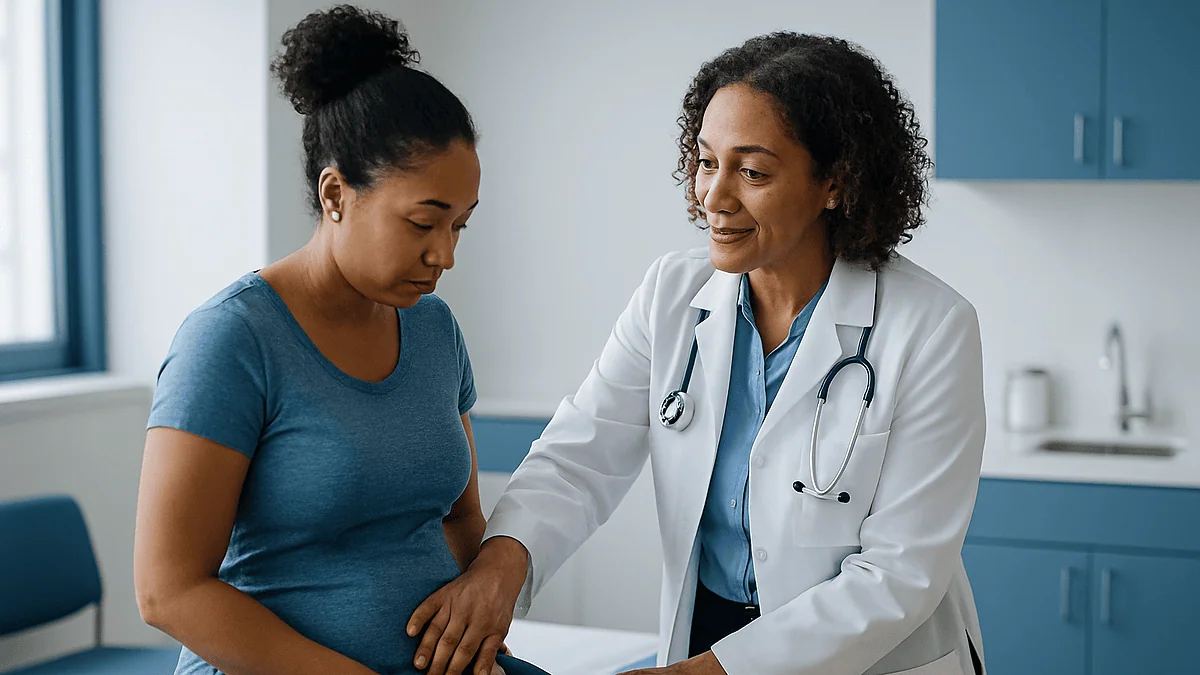
The process usually moves in a predictable order, and knowing it takes some of the anxiety out of the appointment. A clinician begins with your history, which is where that symptom log earns its keep, and a pelvic exam. During the exam, Mayo Clinic notes, they may feel that the uterus is enlarged or irregular in shape, which raises the suspicion of fibroids without confirming it.
Ultrasound is the workhorse test. A transducer is passed over the lower abdomen, placed in the vagina, or both, to produce images of the uterus and measure any fibroids. Transvaginal scanning brings the probe closer and gives sharper detail. The whole thing typically takes minutes and involves no radiation.
Blood tests often follow, chiefly a complete blood count to check for anemia from heavy bleeding, and sometimes thyroid or clotting tests to rule out other reasons for heavy periods.
If the ultrasound leaves questions, further imaging can map things more precisely. MRI shows fibroid size, number, and location in detail and is often used when a procedure is being planned. Hysterosonography fills the uterine cavity with sterile saline during ultrasound to outline submucosal fibroids and polyps. Hysteroscopy passes a thin lighted scope through the cervix to view the cavity directly. Each test answers a specific question, and most people will need only the first one or two.
Who is more likely to get fibroids?
Fibroids are common enough that having them is closer to ordinary than unusual. The NHS reports that around 1 in 3 women develop at least one during their lifetime, most often between the ages of 30 and 50, with the growths tending to shrink after menopause once estrogen levels fall.
Some people are more likely to develop them, or to develop them earlier and in greater numbers. Mayo Clinic notes that Black women are more likely to have fibroids than women of other racial groups, tend to develop them at younger ages, and are more likely to have more or larger fibroids with more severe symptoms. The NHS similarly observes that fibroids are thought to occur more frequently in women of African-Caribbean origin. The reasons are not fully understood.
Family history matters: having a mother or sister with fibroids raises your likelihood. Mayo Clinic also lists starting periods at an early age, obesity, vitamin D deficiency, and a diet higher in red meat and lower in green vegetables, fruit, and dairy as factors associated with higher risk, along with alcohol use.
None of these should be read as blame. Most people with fibroids did nothing to cause them, and most risk factors are things you cannot change. Their practical value is different: if several apply to you and your periods have shifted, lower your threshold for booking a scan.
What helps fibroids go away?
Start with the uncomfortable truth, because the internet will not tell you. No food, tea, herb, or supplement has been shown in mainstream medical evidence to shrink an existing fibroid. Sites promising natural cures are describing hope, not data. What the evidence does support is less dramatic and more useful.
Doing nothing is a legitimate option. Fibroids without symptoms usually need no treatment, and the NHS notes they often shrink after menopause, so someone in her late forties with mild symptoms may reasonably choose to watch and wait with periodic scans.
Medications work in two broad ways, and the specifics belong with your prescribing clinician. Some reduce bleeding without changing the fibroid, either by acting on the uterine lining or by helping blood clot more effectively during a period. Others temporarily lower the body’s estrogen and progesterone, which can shrink fibroids for a time, often before surgery, though the fibroids tend to regrow once treatment stops.
Procedures span a range of invasiveness. Uterine artery embolization blocks the blood supply so fibroids shrink. Focused ultrasound guided by MRI heats and destroys fibroid tissue from outside the body. Myomectomy removes fibroids and preserves the uterus. Endometrial ablation treats bleeding by destroying the lining. Hysterectomy removes the uterus and is the only option that guarantees fibroids will not return.
Each carries its own risks, recovery time, and implications for future pregnancy. Which fits depends on your symptoms, your plans, and your anatomy, and that conversation belongs with your treating team.
Do fibroids cause anemia, and do they affect pregnancy?
Both questions come up in almost every consultation, and both have clearer answers than the internet suggests.
Anemia is the most common complication, and it develops quietly. Each heavy period draws down iron stores a little further, and the body compensates for months before symptoms surface. Mayo Clinic lists fatigue from blood loss and anemia among the direct consequences of fibroid-related bleeding. Persistent tiredness, breathlessness on stairs that never used to bother you, pale skin, and a pounding heartbeat are the signs to watch. A simple blood count settles it, which is why that test sits so early in the diagnostic sequence.
On fertility, Mayo Clinic is reassuring: fibroids usually do not interfere with becoming pregnant. The exception is the submucosal type, which bulges into the cavity where an embryo needs to implant and can contribute to infertility or pregnancy loss. Location, once again, outweighs size.
During pregnancy, fibroids may raise the risk of certain complications. Mayo Clinic notes associations with placental abruption, restricted fetal growth, and preterm delivery. Fibroids can also grow during pregnancy under the influence of higher hormone levels, and occasionally cause pain if their blood supply is outstripped. Most pregnancies with fibroids proceed normally, but the presence of known fibroids is something your maternity team will want on the record from the first appointment.
When to see a doctor about fibroids
Book a routine appointment if your periods meet any of the heavy-bleeding markers above for more than a cycle or two, if you have pelvic pressure, urinary frequency, or constipation without another explanation, if you can feel a persistent firm fullness low in your abdomen, or if you are trying to conceive and have symptoms that could point to fibroids. Fatigue that has crept up alongside heavier periods deserves a blood count even if nothing else is bothering you.
Seek care urgently, the same day or through emergency services, if you experience any of the following red flags. Bleeding that soaks through a pad or tampon every hour for several hours in a row. Dizziness, fainting, a racing heart, or breathlessness alongside heavy bleeding, which can signal significant blood loss. Sudden, severe pelvic pain, which can occur when a pedunculated fibroid twists on its stalk or a fibroid outgrows its blood supply. Inability to pass urine. Any bleeding after menopause, which needs evaluation regardless of whether you have known fibroids. Pelvic pain or bleeding during pregnancy.
Rapid enlargement of the abdomen over weeks rather than years also warrants prompt assessment. The point is not that these signs mean something sinister. Most do not. The point is that they are the situations where waiting to see costs you something, and where a scan or a blood test provides an answer quickly.
What to bring to the appointment, and what to ask
Arrive with the log. Two or three cycles of dates, product counts, clot sizes, pain scores, and pressure symptoms give a clinician more to work with than any description you can improvise in the room. If you took photographs of your abdomen across a cycle, bring those too. Add a list of medications and supplements you take, your family history of fibroids or heavy periods, and your plans around pregnancy, because that last point shapes treatment options more than almost anything else.
Then ask questions that produce useful answers. How many fibroids are there, how large, and where exactly are they located? Which of my symptoms are likely caused by the fibroids and which might have another cause? Is my blood count normal, and if not, what does that change? Is watching and waiting a reasonable option for me, and how often would we rescan? If I want treatment, what are all the options, including the ones you do not perform yourself, and what are the trade-offs of each for someone who does or does not want future pregnancies?
You are allowed to take notes, to ask for a second appointment before deciding anything, and to say you want time to think. Fibroids are almost never urgent decisions. The best outcomes tend to follow from a good record, a clear scan, and a conversation in which you understand every option on the table.
Frequently asked questions
How can I check for fibroids at home?
You cannot confirm fibroids at home, but you can gather the evidence a clinician needs. Track your periods for two to three cycles, noting length, how often you change products, clot size, and pain. Record pelvic pressure, urinary frequency, constipation, and whether your lower belly looks or feels persistently firm and rounded. Bring that log to an appointment, where a pelvic exam and ultrasound can give a real answer.
What does a fibroid belly look like?
A fibroid belly is a firm, rounded fullness low in the abdomen, between the pubic bone and navel, that does not shrink overnight or after a bowel movement and does not swell after meals. Some people say it resembles an early pregnancy. Most people with fibroids, however, have no visible change at all; only large or multiple fibroids enlarge the uterus enough to show from the outside.
What are the first signs of fibroids?
The earliest sign is usually a change in bleeding: heavier periods, periods lasting more than a week, or clots where there were none before. Pressure symptoms follow as fibroids grow, including frequent urination, difficulty emptying the bladder, constipation, low back ache, and pain during sex. Many people notice fatigue first, which can reflect iron loss from months of heavier periods before anything else feels wrong.
What gets mistaken for fibroids?
Adenomyosis, endometrial polyps, ovarian cysts, pregnancy, and bowel or bladder conditions all produce symptoms that overlap with fibroids, which is why imaging rather than symptoms alone makes the diagnosis. The reverse also happens: fibroids found on a scan may be blamed for bleeding that actually has a hormonal or clotting cause. A rare cancerous growth of uterine muscle can resemble a fibroid, which is why rapid growth is evaluated carefully.
What helps fibroids go away?
Nothing you can buy or eat has been shown to shrink fibroids. They often shrink on their own after menopause. Medications can reduce bleeding or temporarily shrink fibroids by lowering hormone levels, though regrowth is common once treatment stops. Procedures range from blocking the fibroid blood supply, to focused ultrasound, to surgical removal of the fibroids or the uterus. The right choice depends on symptoms and pregnancy plans.
Can you feel fibroids from the outside?
Only if they are large or numerous. With an empty bladder, lying on your back with knees bent, you may feel a smooth or knobby firmness above the pubic bone that does not yield to pressure. You cannot distinguish this from an ovarian mass or other cause by touch. Feeling nothing does not rule fibroids out, and feeling something persistent is a reason to book a scan.
Are fibroids cancerous?
Fibroids are noncancerous growths and, according to Mayo Clinic, are not associated with an increased risk of uterine cancer and almost never turn into cancer. A rare malignant tumor of the uterine muscle does exist and can look similar on imaging, which is why clinicians pay closer attention to fibroids that grow quickly or enlarge after menopause. For the overwhelming majority of people, fibroids are a benign condition.
How do doctors diagnose fibroids?
Diagnosis typically starts with a symptom history and pelvic exam, during which an enlarged or irregular uterus may be felt. Ultrasound, performed over the abdomen or with a vaginal probe, confirms the fibroids and measures them. A blood count checks for anemia. If more detail is needed, MRI maps size and location, saline ultrasound outlines the uterine cavity, and hysteroscopy allows direct viewing of fibroids inside the cavity.
Do fibroids make it hard to get pregnant?
Usually not. Mayo Clinic notes fibroids generally do not interfere with becoming pregnant. The exception is submucosal fibroids, which protrude into the uterine cavity and can contribute to infertility or pregnancy loss. During pregnancy, fibroids may modestly raise the risk of placental abruption, restricted fetal growth, and preterm delivery, and they can grow under higher hormone levels. Known fibroids should be flagged to your maternity team early.
When should I worry about fibroid symptoms?
Seek same-day care if you soak through a pad or tampon every hour for several hours, feel dizzy or faint with heavy bleeding, develop sudden severe pelvic pain, cannot pass urine, or have any bleeding after menopause. Book a routine appointment for periods lasting more than seven days, persistent pelvic pressure, a firm lower-abdominal fullness, or fatigue alongside heavier periods, which may signal anemia.
References
This article is for general information only and is not a substitute for professional medical advice. Please consult a qualified doctor about your individual situation.

More from the Blog
Can Fibroids Be Cancerous, Burst, or Be Dangerous?
Fibroids are almost always benign and do not turn into cancer; a cancerous growth in the uterine wall (leiomyosarcoma) is found in fewer than…

Life After Robotic Hysterectomy: Scars, Bleeding That Is Expected and Returning to Work
Life after robotic hysterectomy usually involves a hospital stay of a night or less, a few small abdominal scars that fade over months, and…

Prolapse Surgery Recovery: Lifting, Constipation Prevention and When Intercourse Resumes
Prolapse surgery recovery usually unfolds over about six weeks, though heavy lifting is often restricted longer. Most surgeons advise avoiding lifting anything heavier than…

After Hysteroscopy: Heavy Bleeding, Fever or Severe Pain and When to Call Your Gynecologist
After a hysteroscopy, light spotting and period-like cramping for a few days are expected. Warning signs that need a same-day call to your gynecologist…
Why Do Pelvic Floor Assessment and Urodynamic Testing Come Before Prolapse Surgery?
Pelvic floor assessment and urodynamic testing come before prolapse surgery because a dropped bladder, uterus or vaginal wall can disguise how the bladder actually…

Is PCOS a Chronic Illness? Pain, Periods and Weight Explained
Yes. PCOS is widely classified as a chronic, lifelong hormonal and metabolic condition rather than a passing illness. It cannot be cured, but its…