

How to Read an FUE Treatment Plan: Zones, Graft Distribution and What the Numbers Mean

Key Takeaways
- One FUE graft is a follicular unit of one to four hairs, so a 2,000-graft plan may represent roughly 4,000 to 5,000 individual hairs depending on your donor hair.
- Density per square centimeter in a plan describes how tightly grafts are placed at surgery, not how full the area will look once hair has grown, thickened and been shaped by curl and color contrast.
- Transplanted hair typically sheds two to four weeks after surgery before regrowing, with most people seeing around 60% of new growth by six to nine months and final results taking up to twelve to eighteen months.
- The crown usually receives fewer grafts than its size suggests because its whorl pattern hides scalp poorly and because surgeons reserve donor hair for areas likely to thin later.
- Donor hair is a non-renewable lifetime budget; a plan should state how much of the estimated supply the first session uses and how much is held back.
- Fever, spreading redness, pus, uncontrolled bleeding or swelling that threatens vision after surgery are reasons to call the treating team the same day.
To read an FUE hair transplant plan, start with the scalp diagram: each labeled zone (hairline, frontal, mid-scalp, crown) carries a graft count and a target density. Remember that one graft is a follicular unit of one to four hairs, so graft totals are not hair totals. Check the donor assessment and staging notes, then treat every number as a surgical estimate your treating team will adjust.
The envelope arrives, or the PDF lands in an inbox, and inside is a drawing of a head seen from above. Dotted lines carve the scalp into puzzle pieces. One piece says 1,100. Another says 650. Somewhere near the bottom a line reads “donor capacity: adequate,” and a figure with “per cm²” after it sits there like a bank balance you were never taught to interpret.
Most people read that document the way they read a car repair quote: eyes drifting straight to the biggest number, then skimming the rest. That instinct misses what the plan is actually for. Learning how to read a hair transplant plan properly means understanding why the numbers sit where they do, what the zones are protecting, and which figures are measurements versus informed guesses.
This explainer walks through an FUE plan section by section, in plain language, with the evidence that sits behind the typical ranges. None of it replaces a conversation with the treating team, but it should make that conversation a much better one.
How to read a hair transplant plan: what the document actually is
A treatment plan is a map, not a contract for a result. It records what a surgeon observed at consultation, how they classified the pattern of loss, and how they propose to redistribute a limited supply of permanent hair across areas that are thinning.
Most FUE plans contain five elements. The first is a scalp diagram divided into recipient zones, the areas that will receive grafts. The second is a graft count beside each zone. The third is a target density, usually written as grafts or hairs per square centimeter. The fourth is a donor assessment describing the hair at the back and sides of the head, which is the supply. The fifth is a staging label, often from the Norwood scale (a seven-stage system describing how male-pattern hair loss typically advances) or the Ludwig scale (a three-stage system used for the diffuse thinning more common in women). Cleveland Clinic and Mayo Clinic both describe these patterns as the usual reason people seek a transplant.
What the plan is not is a prediction of how your hair will look in a photograph eighteen months from now. Density figures describe placement at the time of surgery; growth, caliber and future loss shape the visible outcome, and no plan can fix those variables in advance.
Read the document in this order: staging first, donor notes second, zones and distribution third, density last. That sequence mirrors the surgeon’s own logic. They decide how much hair exists before deciding where it goes, and where it goes before deciding how tightly to pack it. A reader who starts with the total graft number has started at the end of the argument.
How FUE works and what happens on the day
FUE stands for follicular unit extraction. A follicular unit is the natural grouping in which scalp hair grows, usually one to four hairs sharing a tiny bundle of tissue, and Cleveland Clinic notes that most grafts contain one to four hairs for exactly this reason. In FUE, each unit is removed individually with a small circular punch, typically well under a millimeter across, from the back and sides of the head where hair is genetically more resistant to pattern loss.
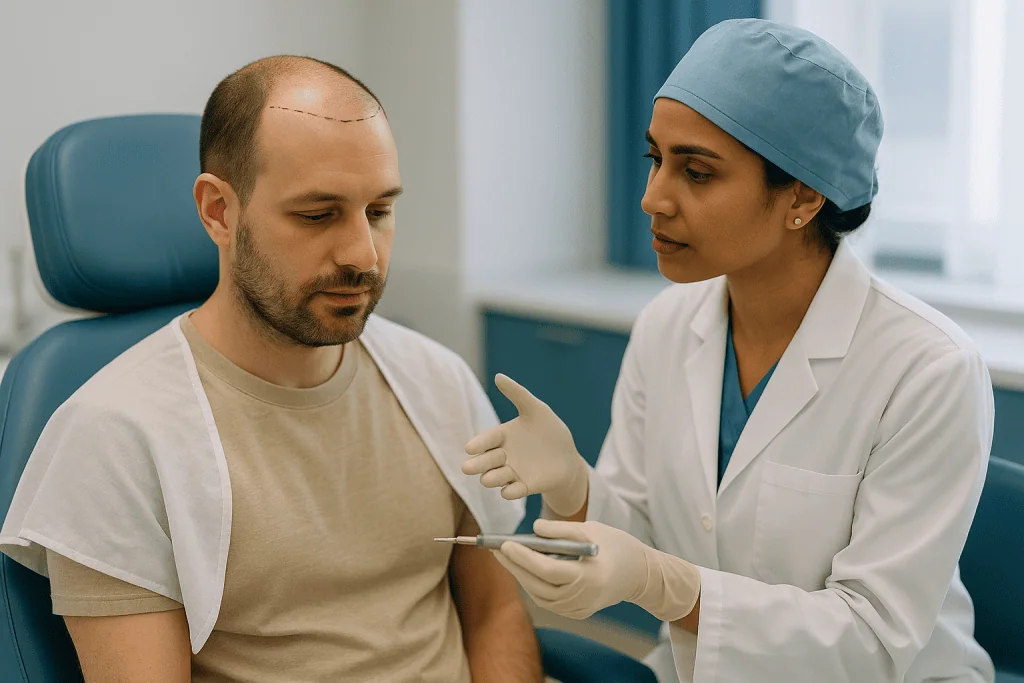
The alternative technique, follicular unit transplantation or FUT, removes a thin strip of scalp and then divides it into units under magnification. FUT leaves a linear scar; FUE leaves many small dot scars that are harder to see with short hair. MedlinePlus describes both approaches as standard methods that move hair rather than create new hair.
On the day, the donor area is usually trimmed short. Local anesthetic numbs the scalp, and extraction proceeds unit by unit. The grafts rest in a holding solution while the surgeon makes small recipient incisions, angled to match the direction and tilt of existing hair. Placement follows. The NHS describes FUE as a procedure that can take most of a day, and larger plans are sometimes divided across two consecutive days or separate sessions.
Why does the technique matter when reading the plan? Because FUE harvesting is scattered rather than concentrated, the donor notes will often describe a percentage of units that can be safely removed from a region without visible thinning. That figure, more than any total, governs what the rest of the plan can realistically propose.
How do you know if you're eligible for a hair transplant?
The honest answer is that eligibility is a judgment the treating team makes from several signals, and the plan usually records them in the staging and donor sections.
Mayo Clinic lists hair transplantation among options for permanent hair loss, most commonly androgenetic alopecia, the inherited pattern loss driven in part by sensitivity of follicles to a testosterone by-product called dihydrotestosterone. The procedure relies on the donor hair being resistant to that process. Where loss is diffuse across the whole scalp, including the back, the supply itself is affected, and surgeons are often cautious.
Several groups are commonly asked to wait rather than refused outright. Younger adults whose pattern has not yet declared itself are one; a hairline placed low in a person who later loses the hair behind it can look isolated. People with active inflammatory or scarring scalp conditions are another, since Cleveland Clinic notes that conditions such as alopecia areata or scarring alopecias behave differently from pattern loss and may not be suitable for grafting. Recent sudden shedding is a third, because telogen effluvium, a temporary shift of many follicles into the resting phase, often resolves on its own.
Plans sometimes mention medicines alongside surgery. Topical minoxidil is thought to prolong the growth phase of follicles, and oral finasteride lowers dihydrotestosterone in the scalp. These are described here only for mechanism; whether either belongs in your plan, and how, rests entirely with the prescribing clinician. A plan that mentions them is not a prescription, and no one should start, stop or change a medicine based on a diagram.
Hair transplant zones explained: hairline, frontal, mid-scalp and crown
Surgeons divide the scalp into zones because hair behaves differently in each, both cosmetically and biologically. Knowing the vocabulary turns the diagram from abstract shapes into a set of decisions you can question.

The hairline is the front border, usually drawn as a soft, slightly irregular line rather than a ruler-straight one, because natural hairlines are never straight. Single-hair grafts tend to be placed here. Immediately behind it sits the frontal zone, sometimes called the forelock region, which frames the face and carries most of the visual weight when someone looks at you from the front.
The mid-scalp runs from the frontal zone back toward the vertex. It is often the region where coverage looks most convincing with moderate density, because hair here can be combed in several directions and layered.
The crown, or vertex, is the circular area at the back where hair grows in a whorl. It is notoriously demanding. The spiral growth pattern means hair cannot be layered to hide the scalp as easily, and the surface area is larger than it appears in the mirror. Many plans deliberately assign the crown fewer grafts, or defer it to a later session, and that is usually a sign of restraint rather than neglect.
Temples and temple points are sometimes listed separately; they are small zones where angle and direction matter more than numbers.
Why do zones matter so much? Because pattern loss progresses. Mayo Clinic describes it as gradual and typically continuing over years. A plan that spends the entire donor supply on today’s bald areas leaves nothing for the areas that may thin next.
Graft distribution in a hair transplant plan: why the numbers are uneven
Readers often expect graft numbers to scale with the size of each zone. They rarely do, and the mismatch is deliberate.
Consider a hypothetical plan that lists 2,400 grafts split as 1,000 to the hairline and frontal zone, 900 to the mid-scalp and 500 to the crown. The crown may be the largest bald area by surface, yet it receives the smallest share. Three principles explain the imbalance.
The first is visual priority. The front of the scalp is what people see in conversation and in photographs. Evidence-based planning concentrates permanent hair where it changes appearance most per graft spent.
The second is donor conservation. Follicular unit extraction removes units that never grow back in the donor area. Because androgenetic alopecia continues, as Mayo Clinic and Cleveland Clinic both note, surgeons typically hold a reserve for future zones rather than exhausting supply in one plan.
The third is graft type. Plans sometimes break counts down by hairs per unit: single-hair grafts for the hairline, two-hair grafts behind it, three- and four-hair grafts in the mid-scalp where bulk matters more than refinement. Cleveland Clinic’s description of grafts containing one to four hairs is the basis for this sorting. A distribution that places multi-hair grafts at the very front edge is worth asking about, because it can produce a pluggy look.
When two surgeons propose different distributions for the same scalp, neither is automatically wrong. They may weigh the crown differently, or make different assumptions about future loss. Asking each to explain the reasoning behind the split is more useful than comparing the totals.
Grafts vs hairs difference: the number almost everyone confuses
If a plan says 2,000 grafts, you are not getting 2,000 hairs. You are probably getting somewhere between 4,000 and 5,000, and the exact figure depends on your own follicular units.
A graft in FUE terminology is one follicular unit. Cleveland Clinic describes these units as containing one to four hairs; MedlinePlus similarly notes that grafts hold one or more hairs. The average number of hairs per unit varies between individuals and between regions of the same scalp. Some people have a donor area dominated by two-hair units; others carry many three- and four-hair units, which is one reason donor hair is described as “rich” or “average” in plans.
This distinction changes how you compare documents. One plan quoting 2,500 grafts and another quoting 5,500 hairs may describe very similar surgeries. A thorough plan states both figures, or at least gives the average hairs per graft it measured in your donor area at consultation.
Hair caliber complicates the picture further. Thick, coarse hair covers scalp more effectively than fine hair at identical counts, and wavy or curly hair covers more than straight hair because it lies less flat. Color contrast matters as well: dark hair on pale scalp exposes gaps that gray or blond hair on a lighter scalp conceals. None of this appears in a graft total, which is why experienced surgeons describe graft numbers as a logistical figure for the operating day rather than a cosmetic promise.
So when a friend reports a transplant of a particular size, the number is almost meaningless without knowing whether they meant grafts or hairs, and what their hair is like.
Hair transplant density per cm²: what the figure measures and what it does not
Density is the figure most likely to be misread, because it sounds like a measurement of outcome when it is a measurement of placement.
In a plan, density per square centimeter describes how many grafts, or sometimes hairs, the surgeon intends to place in each unit of area at surgery. It does not describe how many will grow, how thick each hair will be, or how the area will look under bathroom lighting a year later. Those depend on survival, caliber and the patient’s own remaining native hair.
Why not simply match natural density everywhere? Because the supply does not allow it. Scalp hair in unaffected regions grows far more densely than any transplant can recreate across a large bald area, and the goal of planning is the illusion of fullness rather than a true restoration of original counts. Surgeons often place higher density at the hairline and frontal zone, where light hits the scalp directly, and accept lower density further back where hair can be layered.
Two cautions follow. A plan that proposes very high density in every zone deserves scrutiny: packing grafts too tightly can compromise blood supply to the recipient area and risk poorer survival, a concern described in surgical literature indexed on PubMed. A plan that proposes uniformly low density across a large area may produce a thin, see-through result that disappoints even when every graft grows.
Ask what density was measured in your existing hair at consultation, if any. Comparing the proposed figure with your own baseline is far more informative than comparing it with a number from someone else’s plan.
What the donor assessment tells you about supply
The donor section is the part most patients skip and the part surgeons care about most. It describes the region at the back and sides of the head, often called the safe zone because its follicles tend to resist the hormonal process behind pattern loss.
A good donor note records several observations. It may estimate the total follicular units available in the region, the average hairs per unit, hair caliber, and the proportion that can be extracted without visible thinning. Because FUE removes units individually and permanently, the area left behind becomes sparser with every harvest. Surgeons therefore talk about a lifetime donor budget rather than a per-session figure.
Terms you may see include “miniaturization,” which means hairs that have become finer and shorter than neighboring hairs and signal a follicle under hormonal stress. Miniaturized hair in the donor area is a warning sign, because transplanted hair keeps the behavior of the region it came from. If the donor region is itself thinning, as happens in diffuse patterns and in some women with female-pattern loss, the long-term result is less predictable.
You may also see a note on scalp laxity, which refers to how freely the skin moves. It matters more for strip surgery than for FUE but is often recorded anyway.
When reading this section, look for a relationship between supply and demand. If the plan proposes extracting a large share of the estimated donor units in a first session while the staging notes say loss is likely to progress, ask how future zones would be addressed. The question is not accusatory. It is the same question a careful surgeon asks themselves.
How to read a hair transplant plan line by line: a sample table
The table below uses an invented plan to show how a reader might interpret each line. The figures are illustrative only and describe no real patient.
| Plan line | What it usually means | Question it should prompt |
|---|---|---|
| Norwood stage IV | Frontal recession plus crown thinning, with a bridge of hair between them | Is the bridge expected to thin, and does the plan allow for that? |
| Donor: approx. 6,000 units, 2.3 hairs/unit | Estimated supply and average hairs per graft measured at consultation | What share of the donor is reserved for later sessions? |
| Hairline and frontal: 1,000 grafts | Priority zone, single and two-hair units at the edge | How was the hairline position chosen for my age and face? |
| Mid-scalp: 900 grafts | Coverage zone using multi-hair units | What density is planned here compared with the front? |
| Crown: 500 grafts | Lower allocation reflecting whorl pattern and donor conservation | Would the crown be revisited later, and what would trigger that? |
| Target density: 35 grafts/cm² (frontal) | Placement density at surgery, not guaranteed growth | How does this compare with my measured native density? |
Reading across a row rather than down the number column is the habit worth forming. Each line is an answer to a question the surgeon asked; your job is to reconstruct the question.
A few patterns tend to reassure. Zone totals that add up to the overall figure. A hairs-per-graft average written down rather than implied. A crown allocation that is modest or deferred. A donor reserve stated explicitly. Patterns that warrant more discussion include a total that seems to be a round marketing number rather than the sum of zone estimates, or density figures that are identical in every zone regardless of hair direction and visual priority.
Hair transplant timeline results: what the following weeks and months usually look like
The plan describes the operating day. The result unfolds over a year or more, and knowing the typical shape of that curve prevents a great deal of unnecessary alarm.
In the first week, small crusts form around each recipient site and the scalp may be tender, swollen or numb. The NHS and Cleveland Clinic both describe mild swelling of the forehead and some discomfort as common, and most people return to desk work within days, though the treating team’s own instructions on washing, sun exposure and exercise take precedence over any general timeline.
Then comes the part that nobody enjoys. MedlinePlus explains that the transplanted hairs fall out roughly two to three weeks after surgery, and the NHS gives a similar window of two to four weeks. This shedding is expected. The follicles remain in place; the hair shafts they carried simply enter a resting phase. Some nearby native hair can shed as well, a phenomenon often called shock loss, which usually recovers.
Months two to four are typically quiet. New growth often begins around the three- to four-month mark, initially fine and sometimes slightly different in texture before it normalizes.
MedlinePlus notes that most people see around 60% of the new growth by six to nine months. The NHS describes final results as taking up to twelve to eighteen months, as hair gains caliber and length. Photographs taken at six months frequently undersell the end point.
Hair follows a natural cycle; Mayo Clinic observes that people normally shed 50 to 100 hairs a day as part of it. Transplanted follicles join that cycle rather than escaping it, which is why patience, not panic, is the appropriate response to early shedding.
What the plan cannot tell you: texture, color, aging and future loss
Several factors shape the visible outcome more than any figure on the page, and a well-written plan acknowledges them in a notes section rather than pretending they do not exist.
Texture is the first. Transplanted hair grows with the character of the donor region, so if the back of the head carries coarse, wavy hair, the new hairline will too. Occasionally hair grows slightly kinked or finer in the first months; this generally settles as the cycle normalizes. Curl adds visual coverage because it lifts hair from the scalp, which is why some people with curly hair achieve a fuller look at modest density.
Color and contrast are the second. Dark hair against light skin reveals the spaces between units, while lower contrast, including gray hair, forgives sparser placement. As people go gray over the years, contrast drops and the result can look fuller, not thinner, in that respect.
Continuing loss is the third and most important. Mayo Clinic describes androgenetic alopecia as progressive. Native hair around and behind the grafts may continue to thin, which can leave a transplanted zone looking isolated if the plan did not anticipate it. This is the reason surgeons raise medicines that may slow loss, and the reason conservative hairline placement is so common in younger adults. Decisions about any such medicine stay with the prescribing clinician.
Finally, there is scalp health and healing. Smoking, uncontrolled diabetes and certain skin conditions can affect blood supply and healing, as Cleveland Clinic notes among general surgical considerations. A plan may record these as risk factors without being able to quantify their effect on your result.
What people often get wrong about FUE plans
The myths around transplant plans are remarkably consistent, and most come from treating the document as a receipt rather than a medical judgment.
The first mistake is believing a higher graft number is always better. Grafts are a finite, non-renewable resource. A plan proposing more grafts than the donor can comfortably spare trades a fuller result today for a visibly thinned donor area and no reserve for tomorrow.
The second is assuming the plan can be read as a hair count. As discussed, one graft holds one to four hairs; comparing totals across plans without the hairs-per-graft figure is comparing apples with fruit salad.
The third is expecting the density figure to describe the final look. Density is placement at surgery. Growth, caliber, curl and contrast do the rest, and none of them can be written down as a guarantee.
The fourth concerns celebrities. Public figures whose hair appears to change are routinely assumed to have had surgery, and plans are sometimes requested that “match” a famous hairline. Speculating about any individual’s medical history is neither respectful nor useful, and another person’s hairline cannot be copied onto a different face, age and donor supply.
The fifth is treating the crown as an afterthought that can be filled last with whatever remains. The crown is large, whorled and demanding; deferring it is often wise, but it should be a conscious decision recorded in the plan.
The sixth is believing that shedding at week three means the procedure has failed. MedlinePlus and the NHS both describe this shedding as expected, with regrowth following over months.
The last is assuming a transplant stops hair loss. It redistributes permanent hair; it does not alter the process acting on the rest of the scalp.
Questions to ask your care team before you sign anything
A plan is a draft for discussion. These questions tend to produce the most useful answers, and a confident team welcomes them.
- Which staging scale did you use, and what stage do you think I will reach over the next ten years?
- How many follicular units did you estimate in my donor area, and what average hairs per graft did you measure?
- What proportion of my donor supply does this plan use, and what is being held in reserve?
- Why is the crown allocated this number, and what would make you revisit it later?
- How did you decide the hairline height for my age and facial proportions?
- What density did you measure in my unaffected hair, and how does the planned density compare?
- Which grafts go where by hair count, and how do you avoid multi-hair units at the hairline edge?
- What do you expect the shedding phase to look like, and when would you want to see me if growth seems slow?
- Are there medicines you think belong alongside surgery, and what is their mechanism and typical timeline?
- What are the alternatives to surgery for someone with my pattern, including doing nothing for now?
Pay attention to how the answers arrive. Clear reasoning about trade-offs is a good sign. Reluctance to state a donor estimate, or insistence that any number of grafts can be placed, is worth noting. The NHS advises people considering any cosmetic procedure to check that the practitioner is appropriately registered and to allow a cooling-off period before deciding; a plan that pressures you to commit quickly is, by that standard, not a plan at all.
Write the answers down. A second consultation, with the same questions, will reveal how much of the first plan was judgment and how much was convention.
When to call your doctor after an FUE procedure
Most recovery is uneventful, and the typical experience of crusting, mild swelling, numbness and early shedding is described above. Some signs, however, should prompt a same-day call to the treating team rather than a wait-and-see approach.
Contact your care team promptly if you notice any of the following:
- Fever, or chills, in the days after surgery.
- Spreading redness, warmth, increasing pain or pus at the donor or recipient sites, which Cleveland Clinic and the NHS list among signs of possible infection.
- Bleeding that does not stop with gentle pressure as instructed in your aftercare sheet.
- Swelling that moves toward the eyes to the point of affecting vision, or that worsens sharply after the first few days instead of settling.
- Severe or escalating pain not relieved by the measures your team recommended.
- Signs of an allergic reaction to any prescribed medicine, such as rash, facial swelling or difficulty breathing; the last of these is an emergency and warrants calling emergency services.
- Numbness or altered sensation that persists well beyond the timeframe your surgeon described, or new weakness.
Seek care urgently, through emergency services if necessary, for chest pain, shortness of breath, calf pain or swelling, or fainting after any procedure, since these can signal rare but serious complications unrelated to the scalp itself.
Two further situations deserve a planned conversation rather than an emergency call. If little or no new growth is apparent by around six to nine months, the window in which MedlinePlus says most people see substantial growth, ask for a review. If the donor area looks visibly thin after healing, raise it; the team may want to document it before considering any future session.
Every decision about managing a complication, adjusting a medicine or scheduling further surgery belongs with the treating team who know your history and examined your scalp.
Frequently asked questions
How do you know if you're eligible for a hair transplant?
Eligibility is a judgment the treating team makes from your pattern of loss, its stability and the quality of your donor hair. Mayo Clinic lists transplantation as an option for permanent, pattern-type loss, while Cleveland Clinic notes that inflammatory or scarring scalp conditions behave differently and may not suit grafting. Younger adults, people with recent sudden shedding and those with thinning donor areas are often asked to wait and reassess.
What is the typical timeline for hair transplant results?
Transplanted hair usually sheds two to four weeks after surgery, according to MedlinePlus and the NHS, then regrows over months. New growth often appears around three to four months, MedlinePlus says most people see about 60% of new growth by six to nine months, and the NHS describes final results as taking up to twelve to eighteen months as hair gains caliber and length. These are typical ranges, not promises.
What is the grafts vs hairs difference on my plan?
A graft is one follicular unit, the natural bundle in which scalp hair grows, and Cleveland Clinic notes each contains one to four hairs. Hairs are the individual strands within those units. A plan quoting 2,500 grafts and another quoting 5,500 hairs may describe similar surgeries. Ask for the average hairs per graft measured in your donor area so you can compare documents fairly.
How much do 5000 hair grafts cost, and why doesn't my plan explain the price?
This explainer does not discuss prices, and a treatment plan is a clinical document rather than a quotation. The graft figure records how many follicular units a surgeon estimates can be moved safely given your donor supply and staging. Many people do not have 5,000 units available to spare in one session, so a very large number deserves a question about donor reserve before anything else.
What are hair transplant zones, explained simply?
Zones are the regions a surgeon draws on the scalp diagram to allocate grafts: the hairline, the frontal zone behind it, the mid-scalp, the crown or vertex, and sometimes the temples. Each has a different visual priority and growth pattern. The front receives more grafts per area because it frames the face, while the crown’s whorl pattern makes coverage harder, so it is often allocated less or deferred.
What does hair transplant density per cm² mean?
It is the number of grafts or hairs the surgeon plans to place in each square centimeter at surgery. It measures placement, not final appearance, which also depends on growth, hair thickness, curl and color contrast with the scalp. Very high density everywhere can strain blood supply to grafts, while uniformly low density can look see-through, so planned figures usually vary by zone.
Why does my plan give the crown so few grafts?
The crown is larger than it looks, grows in a spiral that hides scalp poorly, and sits in a region where pattern loss tends to keep expanding. Surgeons often allocate it conservatively to protect the donor supply for the front and for future thinning. A modest or deferred crown allocation is usually a deliberate choice; ask your team what would prompt them to revisit it.
Can all my grafts be done in one session?
Sometimes, but the limit is set by your donor area rather than by preference. FUE removes units permanently, and harvesting too many at once can leave the back and sides visibly thin. The NHS notes that FUE can take most of a day, and larger plans are sometimes split across days or separate sessions. Your surgeon’s donor assessment should explain what is realistic for you.
Will transplanted hair fall out again?
Transplanted hair sheds in the weeks after surgery as follicles rest, then regrows; MedlinePlus describes this as expected. Because donor follicles come from a region resistant to pattern loss, they generally keep growing long term, though they still cycle like all hair. The native hair around them, however, can continue to thin, which is why plans anticipate future loss.
Does a hair transplant stop hair loss?
No. A transplant redistributes existing permanent hair; it does not change the hormonal process acting on the rest of the scalp. Mayo Clinic describes pattern loss as progressive, so untreated areas may keep thinning. Some plans mention medicines that act on that process, such as a topical agent thought to prolong the growth phase or an oral one that lowers dihydrotestosterone; any decision about them belongs with the prescribing clinician.
References
This article is for general information only and is not a substitute for professional medical advice. Please consult a qualified doctor about your individual situation.

More from the Blog

What Happens on the Day of a Hair Operation: Check-In, Hairline Drawing and Graft Placement
On the day of a hair operation, you check in, confirm consent and your medical history, and the surgeon draws and agrees the new…
How Long to Stay in Istanbul After a DHI Hair Transplant: Washing Visits and the Flight Home
There is no guideline-fixed number of days to stay in Istanbul after a DHI hair transplant. Most care teams ask patients to remain nearby…
Why Washing, Heat and Intense Exercise Wait After PRP for Hair Loss: The First-Day Rules
After PRP for hair loss, most care teams ask patients to keep the scalp dry and untouched for a period measured in hours to…

Beard Transplant Myths: Will Transplanted Scalp Hair Look Different on Your Face?
Transplanted scalp hair keeps the traits of its origin, a principle called donor dominance, so hair moved to the face may differ slightly in…

When Can Makeup, Threading and Tinting Restart After an Eyebrow Transplant?
Most surgeons ask patients to keep makeup off a freshly transplanted eyebrow until the grafts have anchored and the small crusts have shed, which…

Preparing for a Female Hair Transplant: Scalp Analysis, What to Pause and the Days Before
Preparing for a female hair transplant usually begins weeks ahead with a scalp analysis to confirm the cause of thinning and check the donor…