

How vNOTES Surgery Works: The Vaginal Port, the Camera and Why the Abdomen Stays Uncut

Key Takeaways
- vNOTES enters the pelvis through a single incision at the top of the vagina, so no layer of the abdominal wall, including the slow-healing fascia, is cut.
- The soft vaginal port seals the pelvis so carbon dioxide gas can lift the bowel away and a camera can see the ovaries, ureters and bladder that a traditional vaginal hysterectomy leaves largely to feel.
- Known or suspected gynecologic cancer, deep endometriosis behind the uterus and prior rectal surgery are the commonest reasons a team chooses a different route.
- Rectal and bladder injury are the route-specific risks surgeons watch for, because the front and back vaginal incisions pass within millimeters of those organs.
- NHS guidance keeps intercourse and heavy lifting off the table for around 4 to 6 weeks after any hysterectomy, because the vaginal cuff can open before it has knitted.
- Randomized and observational studies indexed in PubMed suggest less early pain and shorter stays than conventional laparoscopy, but the evidence base is smaller and younger than for the other three approaches.
vNOTES, short for vaginal natural orifice transluminal endoscopic surgery, removes the uterus, ovaries or fallopian tubes through the vagina rather than through cuts in the abdomen. The surgeon opens the top of the vagina, seats a soft multi-channel port there, fills the pelvis with carbon dioxide gas and operates with a camera and slim instruments under video view. The organ leaves through the same opening, so the abdominal wall is never incised.
The consult notes are still on the kitchen table, one word circled twice in blue ink: vNOTES. Underneath it, in the gynecologist’s handwriting, five more words that keep pulling the eye back: “no cuts on your belly.” It sounds almost too tidy. A hysterectomy has always meant a scar somewhere, hasn’t it?
That instinct is fair, and it is exactly why understanding how vNOTES surgery works matters before the pre-op appointment. The approach is neither a gimmick nor magic. It borrows the oldest idea in gynecologic surgery, using the vagina as a natural doorway to the pelvis, and pairs it with the newest one, the high-definition camera that made keyhole surgery routine.
What follows is the plain mechanics: where the port sits, what the camera sees, why the abdomen is left alone, who this approach suits, who is usually steered elsewhere, and what the weeks afterward tend to look like. The decision, as always, sits with the treating team. The understanding can sit with you.
What is vNOTES, and how is vNOTES surgery different from what came before?
The name is a mouthful, so take it one piece at a time. “Natural orifice” means an opening the body already has. “Transluminal” means passing through the wall of that opening into the space behind it. “Endoscopic” means the surgeon works with a camera and instruments rather than a hand inside an open wound. Put a small “v” in front for vaginal, and you have the whole idea: keyhole surgery on the pelvis, entered through the vagina instead of the abdominal wall.
Gynecologic surgeons have long had two broad routes to the uterus. One is from above, through the abdomen, either a single open incision or several small laparoscopic ports. The other is from below, the traditional vaginal hysterectomy, in which the surgeon works by feel and direct sight through the vaginal opening without any camera. MedlinePlus and Mayo Clinic both describe these as the standard families of approach.
vNOTES is a hybrid of the second route and the first technology. The entry is vaginal. The vision is laparoscopic. That combination solves a real limitation of the classic vaginal operation, which is that the surgeon’s view of the upper pelvis, the ovaries and any unexpected scar tissue is restricted. Put a camera through the vaginal opening and that ceiling lifts.
It also matters what vNOTES is not. It is not robotic surgery, though robotic platforms are being explored for it. It is not a new way of removing fibroids while keeping the uterus. And it is not “no surgery.” A general anesthetic, an incision at the top of the vagina and a period of internal healing are all still part of the day. The abdomen is spared; the pelvis is not.
How vNOTES surgery works, step by step
Picture the operating room after the anesthetic has taken effect. You are asleep, lying on your back with your legs supported in stirrups, the same position used for a routine pelvic examination. The bladder is emptied with a catheter. The surgeon sits or stands at the foot of the table, exactly where a traditional vaginal surgeon would.
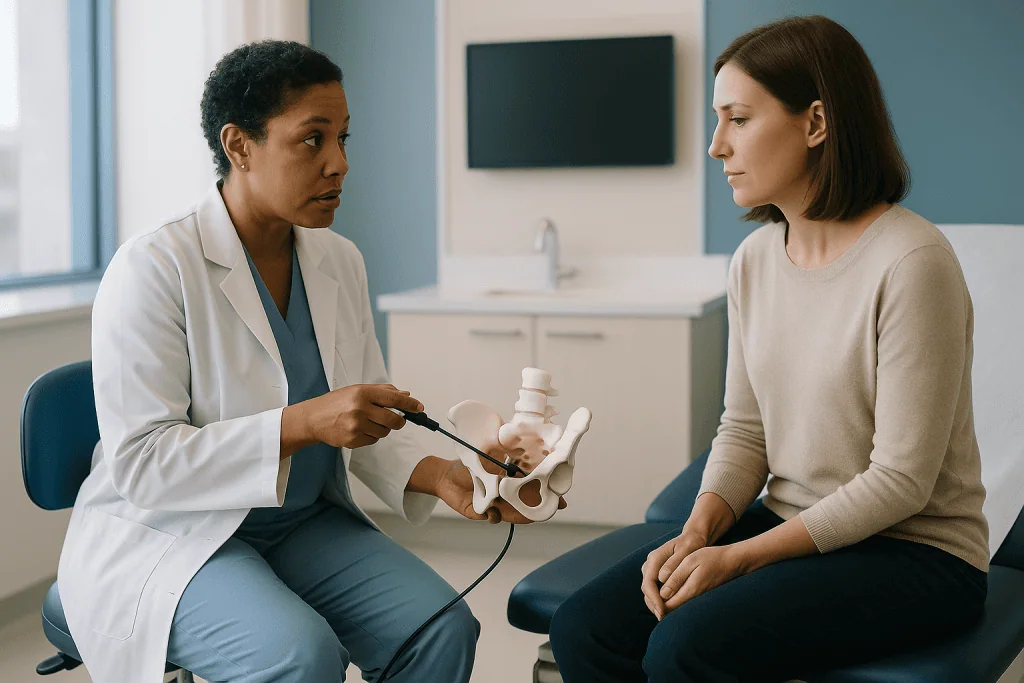
The first step is the colpotomy, which is simply the medical word for an incision in the vaginal wall. For a hysterectomy, the surgeon makes a circular cut around the cervix where it meets the vagina, then gently opens the thin tissue in front of and behind the cervix until the peritoneal cavity, the sealed space that holds the pelvic organs, is entered from both sides.
Next comes the port. A soft, flexible ring is folded, slipped through the incision and allowed to spring open inside the pelvis, with a second ring resting outside at the vaginal opening. A gel cap with several sealed channels clicks onto the top. Through those channels go a slim camera and two or three instruments.
Carbon dioxide gas is then pumped in at low pressure to lift the bowel and abdominal wall away from the pelvic organs, creating a dome of working space. This is the same insufflation used in every laparoscopic operation; only the entry point differs.
From there the operation follows familiar anatomy in reverse order. The surgeon seals and divides the ligaments and blood vessels that hold the uterus, using an energy device that heats tissue to close vessels as it cuts. Once the uterus is free, it is drawn out through the vaginal opening. If it is too large to pass whole, it can be divided into smaller pieces inside a containment bag. Finally the port is removed and the vaginal cuff, the top of the vagina, is stitched closed with dissolvable sutures.
The vaginal port: what it is and why it works as a doorway
Most people picturing a surgical port imagine a rigid metal tube. The vNOTES port is nothing like that. Think instead of a soft silicone sleeve with a ring at each end, closer to a collapsible cup than to a pipe. Its softness is the point. The vagina is elastic, tolerates gentle stretching well and returns to its resting shape, which is why obstetric surgeons have relied on it as an access route for generations.
The inner ring sits inside the pelvis, just beyond the colpotomy edge, and holds the incision open without tearing it. The outer ring rests at the vaginal opening. The sleeve between them is rolled down until the fit is snug, sealing the passage so that the carbon dioxide gas cannot leak out and the pelvis stays inflated.
The gel cap on top is what makes the operation possible. It is a firm, self-sealing disc with several channels spaced a few centimeters apart. Each channel grips an instrument tightly enough to keep gas in while still letting the surgeon slide, pivot and swap tools. A camera in one channel and two working instruments in the others is a typical setup, so three tools share a doorway that, on the abdomen, would have needed three separate incisions.
Why not simply use the classic vaginal hysterectomy technique without a port? Because the port does two things the bare approach cannot. It holds the entry open hands-free, and it seals the space for gas, which in turn lifts the bowel out of the way and lets a camera see. Those two gains are the whole engineering argument for vNOTES.
The device is removed at the end of the operation. Nothing is left inside except dissolvable stitches at the vaginal cuff.
The camera: how surgeons see the pelvis from below
Ask a surgeon who has done both, and the camera is usually the first thing they mention. A traditional vaginal hysterectomy asks the operator to work partly by touch, especially at the top of the pelvis where the ovaries and their blood supply sit. It is safe in experienced hands, which is why Mayo Clinic and the NHS still describe it as a standard option, but the view is limited to what a headlight and a retractor can reveal.

In vNOTES, a laparoscope, a thin rod with a lens and light at the tip, enters through the gel cap and transmits a magnified high-definition image to a screen. Because the lens sits inside the pelvis looking upward, the surgeon sees the underside of the uterus, the back of the bladder, both ovaries, the fallopian tubes and the ureters, which are the tubes carrying urine from kidney to bladder and lie close to the uterine vessels.
The angle is inverted compared with standard laparoscopy. From above, the surgeon looks down onto the pelvis like a map. From below, the same structures appear upside down and closer. That reversal is part of the learning curve, and it is why training pathways for vNOTES emphasize supervised early cases. Surgeons describe the orientation as similar to viewing a familiar room while lying on the floor.
Magnification adds a practical safety benefit. Small blood vessels can be sealed before they bleed, and the ureter can be identified rather than assumed. Where unexpected scar tissue, a large ovarian cyst or endometriosis is found, the camera lets the team see it and decide, rather than discover it by feel.
None of this makes the camera a guarantee. It gives information. Judgment about what to do with that information remains with the operating team, including the judgment to switch approach if the view is not good enough.
Why the abdomen stays uncut, and what that changes for healing
The abdominal wall is not one layer. Skin, fat, a tough fibrous sheet called the fascia, muscle and the thin inner lining all have to be cut to reach the pelvis from above. Each of those layers has nerves, each has to knit back together, and the fascia in particular heals slowly, which is why the NHS advises against heavy lifting for weeks after an abdominal hysterectomy.
Laparoscopic surgery shrinks those incisions but does not eliminate them. Two to four small ports still pass through every layer, and the incision used to remove the uterus, whether at the navel or through the vagina, still has to heal. Port-site pain, bruising and the small but real risk of a hernia at a port site are all described on the MedlinePlus and Mayo Clinic hysterectomy pages.
vNOTES sidesteps the abdominal wall entirely. The only incision is at the top of the vagina, tissue that has a rich blood supply, relatively few pain-sensing nerve endings compared with skin, and a long track record of healing after vaginal hysterectomy. Nothing on the outside of the body is cut, so there is no external wound to dress, no stitches to remove and no scar to form.
Does that translate into an easier recovery? The evidence is encouraging but still maturing. Randomized and observational studies indexed in PubMed have generally reported lower early pain scores and shorter hospital stays with vNOTES than with conventional laparoscopy for hysterectomy. Those findings come from a modest number of centers, mostly experienced ones, and larger long-term comparisons are ongoing. The NHS notes that recovery after any vaginal or keyhole hysterectomy is usually shorter than after an abdominal incision, and vNOTES sits within that family.
The honest summary: the abdominal wall is spared, which removes one source of pain and one set of wound complications. Internal healing, fatigue and the emotional adjustment after losing a uterus are unchanged by the route in.
Which operations can be done with vNOTES?
Hysterectomy is the headline, but it is not the only use. Any operation that targets the pelvic organs and ends with tissue being removed can, in principle, be done through a vaginal port. In practice the list looks like this.
- Hysterectomy, with or without removal of the cervix, for reasons such as heavy bleeding, fibroids, adenomyosis, prolapse or precancerous changes.
- Removal of one or both ovaries, often for benign cysts, or as risk-reducing surgery in people with an inherited predisposition to ovarian cancer, after genetics and oncology input.
- Removal of one or both fallopian tubes, whether for permanent contraception, for a fluid-filled or damaged tube, or because the tubes are increasingly removed alongside the uterus as a preventive measure.
- Treatment of an ectopic pregnancy in selected stable patients.
- Diagnostic look-around for pelvic pain when imaging is inconclusive.
Notice what is absent. Myomectomy, the removal of fibroids while keeping the uterus, is technically possible but not standard through vNOTES because the uterus has to be reconstructed and the angle is awkward. Surgery for known or suspected gynecologic cancer is generally not done this way; the containment principles of cancer surgery favor other approaches, and this is a firm line in most published guidance. Severe endometriosis that has fused the rectum to the back of the uterus, sometimes called an obliterated cul-de-sac, is another common reason to choose a different route, because the posterior colpotomy would risk the bowel.
The pattern is consistent: vNOTES suits benign conditions in which the anatomy is expected to be reasonably normal and the specimen can leave through the vagina. When the diagnosis is uncertain or the pelvis is likely to be scarred, teams tend to reach for approaches that give them more room to maneuver.
Who is a candidate for vNOTES, and who is usually asked to wait?
There is no single test that qualifies someone for vNOTES. Candidacy is a conversation between the surgeon’s experience, the reason for surgery, the size and mobility of the uterus, and the shape of the pelvis found at examination.
People commonly considered good candidates share a few features. The condition is benign. The uterus is not enormously enlarged by fibroids, or, if it is, the surgeon is comfortable removing it in pieces inside a containment bag. There is no history suggesting dense pelvic scarring. The vagina is roomy enough to admit the port comfortably, which is often the case after vaginal childbirth but is not restricted to it. A higher body mass index, which can make abdominal laparoscopy harder because of a thicker abdominal wall, is not a barrier to vNOTES and is sometimes cited as a reason to favor it, since the access route is unchanged by body weight.
Others are usually asked to wait or offered a different approach. Known or suspected cancer of the uterus, cervix or ovary is the clearest example. Deep endometriosis behind the uterus, prior pelvic radiation, previous rectal surgery or a history of severe pelvic infection all raise the risk of finding bowel stuck where the surgeon needs to cut. A very narrow or short vagina, or a uterus fixed in place and unable to be drawn down, can make port placement unsafe. Some surgeons are cautious after several prior cesarean deliveries, because scar between bladder and uterus can complicate the front incision; others proceed with care. The evidence on that specific question is still limited.
Two things to hold onto. First, “not a candidate today” often means “not with this diagnosis,” not a judgment about you. Second, when a surgeon says they would rather use laparoscopy or an abdominal incision, that is a safety decision grounded in what they expect to find, and it deserves the same respect as any other surgical recommendation.
vNOTES vs laparoscopic hysterectomy: how the four approaches compare
A side-by-side view clears up more confusion than paragraphs can. The four standard routes are described on the MedlinePlus, Mayo Clinic and NHS hysterectomy pages; the vNOTES column reflects how it is generally described in the published literature.
| Approach | Where the incisions are | How the surgeon sees | Typical notes |
|---|---|---|---|
| Abdominal (open) | One incision on the lower abdomen, horizontal or vertical | Directly, with hands and eyes in the wound | Longest recovery; NHS cites roughly 6 to 8 weeks to full activity; best for very large uteri or cancer surgery needing wide access |
| Laparoscopic or robotic | Several small abdominal ports, plus removal through the vagina or a slightly larger port | Camera from above | Shorter recovery than open; small external scars; small risk of port-site hernia |
| Vaginal (traditional) | Incision at the top of the vagina only | Directly, through the vaginal opening, no camera | No abdominal scars; limited view of ovaries and upper pelvis; suits prolapse and mobile uteri |
| vNOTES | Incision at the top of the vagina only, with a soft port | Camera from below, pelvis inflated with gas | No abdominal scars; full camera view; evidence base smaller and newer than the other three |
Read across the rows and the logic of vNOTES emerges. It keeps the single vaginal incision of the traditional operation while adding the camera and gas that make laparoscopy precise. Where it differs from laparoscopy is entirely in the entry: no ports through the abdominal wall, no external wounds and, for people with a thick abdominal wall, no struggle to reach the pelvis from above.
Where it lags is in evidence volume. Laparoscopic and vaginal hysterectomy have decades of outcome data behind them. vNOTES has a growing but younger body of studies, largely from experienced centers. That is not an argument against it; it is a reason to ask your surgeon about their own experience and how they decide when to convert.
vNOTES surgery risks: what the evidence actually shows
Every hysterectomy carries a core set of risks that do not change with the route in. MedlinePlus and the NHS list bleeding heavy enough to need transfusion, infection of the wound or urinary tract, blood clots in the legs or lungs, reaction to anesthesia and injury to nearby organs, particularly the bladder, ureters and bowel. Those risks apply to vNOTES exactly as they apply to any other approach.
A few concerns are specific to entering from below. The posterior colpotomy passes very close to the rectum, so rectal injury is the complication vNOTES surgeons watch for most carefully, and it is the main reason deep endometriosis or prior rectal surgery steers people away. The anterior colpotomy passes close to the bladder, so bladder injury is possible, especially where cesarean scar has drawn the bladder upward. Both are uncommon, both are usually recognized and repaired during the operation, and both are reasons the camera view matters.
Vaginal cuff dehiscence, which means the stitched top of the vagina opening before it has healed, is a recognized complication after any hysterectomy in which the uterus is removed through the vagina. It is rare, tends to happen in the first weeks, and is often linked to resuming intercourse or heavy straining before the tissue has knitted. This is why the NHS and Mayo Clinic advice to avoid intercourse and heavy lifting for several weeks is not fussiness.
Conversion is the last item, and it is not a complication so much as a safety valve. If the view is poor, bleeding is difficult to control or unexpected disease is found, the surgeon can add abdominal ports or open. Published series report that this happens in a minority of cases, more often early in a surgeon’s experience. Consent for vNOTES should always include consent for conversion.
What the evidence does not yet show is long-term data on pelvic floor function or cuff healing across large populations. Studies to date are reassuring; they are also relatively short and few. An honest surgeon will say so.
vNOTES hysterectomy recovery time: the first days and weeks
The first thing most people notice on waking is what is missing: no abdominal dressing, no tenderness along the belly when they shift in the bed. What they do feel is a deep, dull pelvic ache, sometimes a sore shoulder from the residual carbon dioxide irritating the diaphragm, and a wave of tiredness that belongs to the anesthetic rather than the surgery.
Hospital stay is decided by the team, not the technique. The NHS describes typical stays of one to a few days after hysterectomy, shorter after vaginal or keyhole approaches, and some vNOTES programs plan for same-day discharge in selected people. Whether that applies to you depends on pain control, passing urine normally, having someone at home and your own medical history.
The first week is about walking, resting and watching. Gentle movement from day one lowers the risk of blood clots, which is why nurses will have you up and about within hours. Light vaginal bleeding or brownish discharge is expected and can last several weeks as the cuff heals. Pain generally eases day by day; your team will give you a plan for pain relief, and the specifics of that plan belong to them.
Weeks two through six are about not undoing the internal work. The NHS advises against lifting anything heavy and against intercourse until discharge has stopped and the cuff has healed, which it puts at around 4 to 6 weeks. Driving is usually possible once you can sit comfortably in a seatbelt and perform an emergency stop without wincing, which the NHS says ranges from about 3 to 8 weeks depending on the person. Mayo Clinic describes full recovery after a vaginal hysterectomy at roughly 3 to 4 weeks, and vNOTES recoveries are generally described in a similar range, though individual timelines vary widely.
Fatigue often outlasts pain. Plan for that. A body that has had an organ removed under general anesthetic is busy, even when the outside looks untouched.
What happens months and years after a hysterectomy?
The question people search most often is not about the operation at all. It is about the long horizon: what changes at one year, at five, at ten. The route in, vNOTES or otherwise, matters little here. What matters is what was removed.
Without a uterus, menstrual periods stop permanently and pregnancy is no longer possible. That is true from the first day. If the cervix was also removed, routine cervical screening usually ends, though MedlinePlus notes exceptions for people whose hysterectomy was done for precancerous changes or who have a history of abnormal results, so confirm your own plan with your team.
If the ovaries were kept, hormones continue and menopause arrives on its own schedule. The NHS notes that some people who keep their ovaries may go through menopause somewhat earlier than they otherwise would, possibly because the uterine surgery affects ovarian blood supply, though the evidence on how much earlier is mixed. If both ovaries were removed before natural menopause, menopausal symptoms begin promptly, and options for managing them are a conversation for the prescribing clinician.
Pelvic floor support is a common worry at the five-year mark. Hysterectomy for prolapse can be part of a repair; hysterectomy for other reasons does not by itself cause prolapse, though age, childbirth history and connective tissue play their usual roles. Ongoing pelvic floor exercise remains sensible.
Sexual function is the question people are often shy to ask. The NHS and Mayo Clinic both note that most people report sexual function is unchanged or improved after hysterectomy for benign disease, largely because pain and heavy bleeding are gone. The vagina remains intact; its length is very slightly shortened by cuff closure, which most people do not notice.
Long-term studies specific to vNOTES are still accumulating. What exists is reassuring and short. The long-term picture is, for now, the general hysterectomy picture.
What people often get wrong about vNOTES
Myths gather quickly around anything described as scarless. Here are the ones that come up most, corrected against what the evidence supports.
“Scarless means no incision.” There is an incision; it is simply inside the vagina where it cannot be seen. It heals, it can bleed, it can become infected and it needs the same weeks of protection as any surgical wound.
“vNOTES is only for people who have given birth vaginally.” Vaginal delivery can make port placement easier, but it is not a requirement. Surgeons assess vaginal capacity and uterine mobility at examination rather than reading it off an obstetric history.
“It’s a lighter operation, so the risks are lower.” The organ removed is the same, the blood vessels divided are the same and the anesthetic is the same. What is lower is the burden on the abdominal wall. Risks to bladder, bowel and ureter remain, with rectal injury a specific concern of the vaginal route.
“Recovery is a few days.” Pain may settle faster, and the NHS confirms vaginal and keyhole approaches generally recover quicker than open surgery, but internal healing still takes weeks. Intercourse and heavy lifting are still off the table for around 4 to 6 weeks in NHS guidance, regardless of how good you feel at day ten.
“It’s experimental.” vNOTES is a recognized technique with randomized trial data and a growing number of trained surgeons. It is younger than laparoscopy and has a smaller evidence base, which is a reason to ask about your surgeon’s experience, not a reason to assume it is untested.
“If the surgeon switches to laparoscopy, something went wrong.” Conversion is a planned safety option, discussed before the operation, and choosing it is a sign of judgment rather than failure.
“Hysterectomy ends sexual pleasure.” Lubrication comes mainly from the vaginal walls and glands at the vaginal opening, not from the uterus. The NHS and Mayo Clinic note most people report unchanged or improved sexual function after hysterectomy for benign conditions.
Questions to ask your care team
A good consultation is a two-way exchange, and surgeons generally welcome specific questions. Bring these, or the ones among them that matter to you, and write the answers down.
- Why are you recommending vNOTES for me rather than laparoscopic, vaginal or abdominal surgery, and what in my examination or imaging supports that?
- How many vNOTES procedures have you performed, and how do you decide when to convert to another approach during the operation?
- Will my cervix be removed? Will my ovaries or fallopian tubes be removed, and what is the reasoning either way?
- What is the plan if you find endometriosis, adhesions or something unexpected once the camera is in?
- Do you expect me to go home the same day or stay overnight, and what would change that plan?
- What kind of vaginal bleeding or discharge should I expect in the weeks afterward, and what would be too much?
- When can I return to work, drive, exercise and have intercourse, and what are the signs I am doing too much too soon?
- Will I still need cervical screening afterward?
- If my ovaries are kept, should I expect any change in menopause timing? If they are removed, who will I talk to about managing menopausal symptoms?
- Who do I call, day or night, if something worries me at home?
Two habits make these questions more useful. Ask for the reasoning behind each answer, not just the answer itself; “because your uterus is mobile and there is no suspicion of cancer” tells you more than “yes.” And ask what would make the team change their mind. A surgeon who can describe the circumstances in which they would choose a different route is showing you the judgment you are relying on.
The decision about approach belongs to the treating team, informed by your priorities. Knowing why they have landed where they have is what turns consent into understanding.
When to call your doctor
Most recoveries are quiet. Some are not, and the cuff at the top of the vagina, the bladder and the bowel are the places where trouble tends to announce itself. The NHS and Mayo Clinic hysterectomy guidance agree on the signs that should prompt a same-day call to your surgical team or an urgent visit to an emergency department.
- Vaginal bleeding heavier than a normal period, soaking a pad an hour, or passing large clots.
- Fever, chills or sweats, especially with pelvic pain that is getting worse rather than better.
- Foul-smelling vaginal discharge, or a sudden gush of clear or bloody fluid from the vagina, which can signal the cuff has opened.
- Severe or steadily increasing abdominal or pelvic pain not eased by the pain relief your team prescribed.
- Difficulty passing urine, pain on urination, blood in the urine, or urine leaking continuously from the vagina, which may indicate a bladder or ureter injury.
- Persistent vomiting, a swollen tense abdomen or no bowel movement for several days with pain, which can suggest a bowel problem.
- A hot, swollen or painful calf, or sudden shortness of breath, chest pain or coughing blood, which are signs of a blood clot and need emergency care immediately.
- Feeling faint, a racing heart or looking pale, particularly alongside bleeding.
Call sooner rather than later. Teams would much rather hear about a discharge that turned out to be nothing than miss a cuff that has opened. Keep the emergency number you were given somewhere visible, tell whoever is with you what to watch for, and if a symptom on this list appears and you cannot reach your team, go to an emergency department and say you have had a recent hysterectomy. Your treating team remains responsible for every decision in your recovery; this list exists to help you bring the right things to them in time.
Frequently asked questions
What is the recovery time for a vNOTES hysterectomy?
Typically a few weeks, with early pain usually settling faster than after abdominal surgery. Mayo Clinic describes full recovery after a vaginal hysterectomy at roughly 3 to 4 weeks, and the NHS notes vaginal and keyhole recoveries are shorter than the 6 to 8 weeks after an open incision. vNOTES sits in that shorter range, but the vaginal cuff still needs about 4 to 6 weeks before intercourse or heavy lifting, per NHS guidance, and fatigue can outlast pain.
What happens 5 years after a hysterectomy?
Periods and the possibility of pregnancy are gone permanently, and cervical screening usually stops if the cervix was removed, with exceptions for those with a history of precancerous changes. If the ovaries were kept, menopause arrives on its own timeline, though the NHS notes it may come somewhat earlier for some. Most people report sexual function unchanged or improved. The surgical route, including vNOTES, makes little difference to these long-term changes.
Who is a good candidate for vNOTES hysterectomy?
Generally someone with a benign condition, a uterus that is not massively enlarged or fixed in place, no history suggesting dense pelvic scarring, and a vagina roomy enough to admit the port safely. A higher body mass index is not a barrier and is sometimes a reason to favor the approach. People with suspected cancer, deep endometriosis behind the uterus or prior rectal surgery are usually offered another route. The surgeon decides after examination.
Can a woman still get wet after having a hysterectomy?
Yes, in most cases. Vaginal lubrication comes mainly from fluid crossing the vaginal walls and from glands near the vaginal opening, not from the uterus, so removing the uterus does not switch it off. Cervical mucus contributes a small share, which may be missed by some. If both ovaries are removed before menopause, falling estrogen can cause dryness; managing that is a conversation with the prescribing clinician.
Is vNOTES really scarless?
There are no visible scars because there are no abdominal incisions. There is, however, an internal incision at the top of the vagina, closed with dissolvable stitches, which heals over several weeks like any surgical wound. It can bleed, become infected or, rarely, reopen if intercourse or heavy straining happens too early. “Scarless” describes what you see on the outside, not the absence of surgery.
How does vNOTES compare to a laparoscopic hysterectomy?
Both use a camera, carbon dioxide gas and slim instruments; the difference is where they enter. Laparoscopy uses several small abdominal ports, vNOTES uses one soft port in the vagina, so the abdominal wall is untouched. Studies indexed in PubMed generally report less early pain and shorter stays with vNOTES, though the evidence base is smaller and mostly from experienced centers. Which suits you depends on your diagnosis and anatomy.
What are the main vNOTES surgery risks?
The core hysterectomy risks apply: bleeding, infection, blood clots, anesthetic reactions and injury to bladder, ureters or bowel. Specific to the vaginal route are rectal injury, because the back incision passes close to the rectum, and bladder injury at the front, particularly after cesarean scarring. Vaginal cuff dehiscence, the stitched top of the vagina opening early, is rare and linked to resuming intercourse too soon. Conversion to laparoscopy or open surgery is a planned safety option.
Can vNOTES be done if I have had cesarean deliveries?
Often yes, but with extra care. Cesarean scar can draw the bladder upward and closer to the front of the uterus, making the anterior vaginal incision more delicate. Some surgeons proceed routinely, others are cautious after multiple cesareans, and the published evidence on this specific question is still limited. Expect your surgeon to weigh your obstetric history at the examination and to explain how it shapes their recommendation.
Will I be awake during vNOTES surgery?
No. vNOTES is performed under general anesthesia, so you are fully asleep. Regional anesthesia has been reported in a small number of cases but is not standard. The anesthetic, rather than the incision, is what causes much of the grogginess and fatigue in the first day or two. Your anesthesia team will review your medical history and any medicines you take beforehand; decisions about those medicines belong to them.
Is vNOTES new or experimental?
It is a recognized technique, not an experimental one, with randomized trial data and structured training programs for surgeons. It is younger than laparoscopy and traditional vaginal hysterectomy, so long-term outcome data are still accumulating and most studies come from experienced centers. That is a good reason to ask about your surgeon’s own case numbers and conversion approach, rather than a reason to assume the method is untested.
References
- NHS: Hysterectomy: Recovery
- MedlinePlus: Hysterectomy
- Cleveland Clinic: Hysterectomy
- PubMed, vNOTES hysterectomy studies
This article is for general information only and is not a substitute for professional medical advice. Please consult a qualified doctor about your individual situation.

More from the Blog

Robotic Hysterectomy for International Patients: How Long to Stay Before Flying Home
Most surgical teams ask international patients to remain near the hospital for roughly 7 to 14 days after a robotic hysterectomy before a long…

Completing Vaginal Infection Treatment: Irritants to Avoid and When Symptoms Settle
After vaginal infection treatment, most people notice itching, burning and discharge easing within a few days, with thrush symptoms typically settling within one to…

Can Prolapse Come Back After Surgery? Why Recurrence Happens and What Revision Involves
Yes, pelvic organ prolapse can come back after surgery, either at the repaired site or in a neighboring part of the vagina, sometimes years…

How Gynecologic Laparoscopy Is Performed: Small Incisions, Gas and the Camera Explained
A gynecologic laparoscopy procedure is keyhole surgery of the pelvis performed under general anesthesia. The surgeon makes a small incision near the navel, fills…

Preparing for Robotic Hysterectomy: Blood Thinners, Fasting and Bowel or Skin Preparation
Preparing for a robotic hysterectomy usually means a pre-operative assessment, a full review of every medicine and supplement you take, and written instructions from…

Excision vs Ablation for Endometriosis: How the Two Surgical Techniques Differ
Excision removes endometriosis tissue by cutting it out at its full depth so a pathologist can examine it, while ablation destroys the surface of…