

Implantable Hearing Aids or Cochlear Implants: Which Type of Hearing Loss Does Each Treat?

Key Takeaways
- Bone conduction and middle ear implants are implantable hearing aids that still depend on a working cochlea, while a cochlear implant bypasses the cochlea's hair cells and stimulates the auditory nerve directly.
- Cochlear implant candidacy hinges on speech-recognition scores with well-fitted hearing aids, not on the audiogram alone, so a fair trial of amplification comes first.
- Bone conduction implants suit conductive loss, mixed loss with a mild-to-moderate inner ear component, and single-sided deafness, and can usually be previewed on a headband before surgery.
- The Mayo Clinic lists loss of remaining natural hearing, facial nerve weakness, spinal fluid leak, device failure and, rarely, meningitis among cochlear implant risks, which is why the CDC recommends pneumococcal vaccination for recipients.
- Nothing is switched on at surgery; Cleveland Clinic describes activation roughly two to four weeks later, and speech typically sounds like beeps or a cartoon voice before the brain adapts over months.
- An absent auditory nerve rules out a cochlear implant entirely, and continued meaningful benefit from hearing aids usually means being asked to wait and re-test rather than proceed.
Implantable hearing aids and cochlear implants treat different problems. Bone conduction and middle ear implants are implantable hearing aids: they amplify or transmit sound vibrations for conductive or mixed hearing loss, single-sided deafness, or sensorineural loss when conventional aids cannot be worn. A cochlear implant bypasses damaged inner-ear hair cells and stimulates the hearing nerve directly, so it is considered for severe to profound sensorineural loss when hearing aids no longer give useful speech understanding.
The audiologist slides the report across the desk, and the shaded curve on the audiogram has drifted down again. Your hearing aids are turned up as far as they go. Restaurants have become a wall of noise, phone calls a guessing game, and your daughter has started texting instead of calling. Then the question you have been circling for months finally arrives: is it time to think about something surgical?
That is where the confusion begins. Friends mention a cousin with a cochlear implant. A search brings up bone-anchored devices, middle ear implants, and hybrid systems, all lumped under the heading of implantable hearing aid vs cochlear implant as though they were rival brands of the same thing. They are not. They treat different parts of the ear, different kinds of damage, and different people.
This explainer walks through what each device does, which type of hearing loss it is designed for, who is usually asked to wait, and what the weeks after surgery tend to look like. The goal is not to steer you toward a device. It is to make the conversation with your ear, nose and throat surgeon and audiologist feel less like a foreign language.
Why the type of hearing loss matters more than the device
Every conversation about implants should begin with a map of the ear, because the device that helps depends entirely on where the sound is getting stuck. Sound enters the outer ear, vibrates the eardrum, passes across three tiny bones in the middle ear, and reaches the cochlea, the fluid-filled spiral of the inner ear. There, thousands of hair cells convert vibration into electrical signals that travel along the auditory nerve to the brain.
Clinicians describe hearing loss by which link in that chain has failed. Conductive hearing loss means sound is blocked or dampened before it reaches the cochlea: chronic ear infections, a perforated eardrum, malformed ear canals, or stiffened middle ear bones are common reasons. Sensorineural hearing loss means the cochlea or the nerve itself is damaged, usually because hair cells have died from aging, noise, genetics, certain infections, or some medicines. Mixed loss is a combination of both. Single-sided deafness is a profound loss in one ear with usable hearing in the other.
The distinction is not academic. Amplifying sound louder will help a cochlea that still has working hair cells, which is why conventional hearing aids serve most people with mild to severe sensorineural loss. It does little for a cochlea whose hair cells are largely gone, and it cannot get around a middle ear that will not conduct. According to the World Health Organization, over 1.5 billion people worldwide live with some degree of hearing loss, and the fact sheet notes that a large share of cases are preventable or treatable when correctly classified.
So when someone asks which implant is better, the honest clinical answer is a question in return: better for which part of the ear?
Implantable hearing aid vs cochlear implant: what the labels actually mean
The phrase implantable hearing aid vs cochlear implant sounds like a head-to-head choice, but the two terms describe different categories of technology, and the overlap between them is narrow.
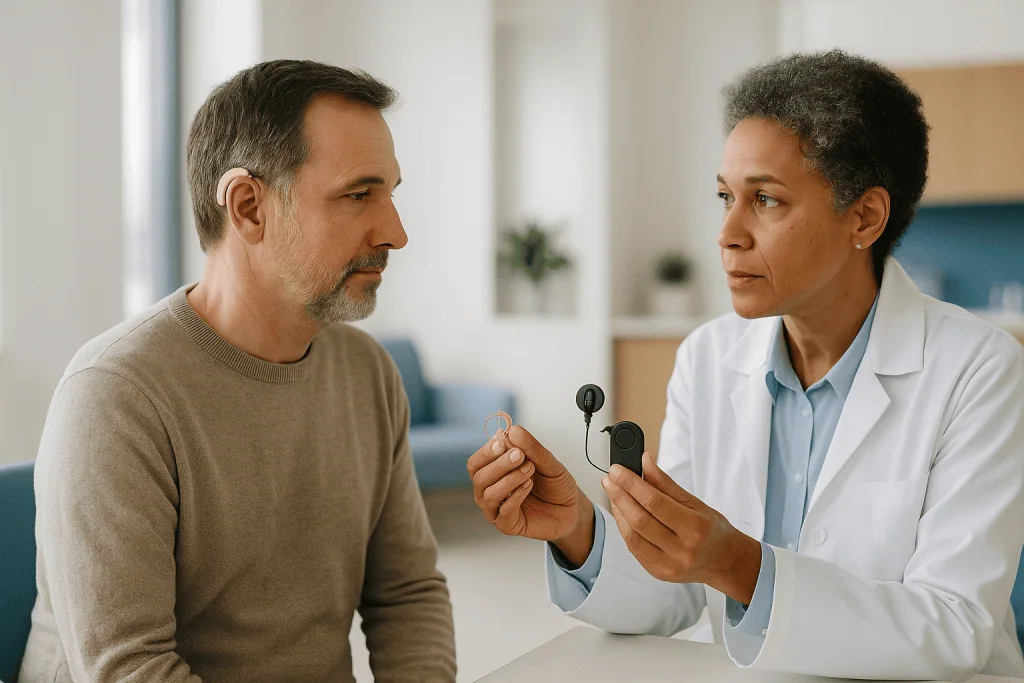
An implantable hearing aid is any device, surgically placed, that still relies on the ear’s own machinery to finish the job. Two main types exist. A bone conduction implant, sometimes called a bone-anchored hearing aid, sends vibrations through the skull bone directly to the cochlea, skipping a damaged outer or middle ear. A middle ear implant attaches a miniature vibrating component to the middle ear bones or to the membrane at the entrance of the cochlea, delivering mechanical energy more efficiently than a speaker in the ear canal. In both cases, the cochlea must still be able to turn vibration into nerve signals.
A cochlear implant is a different idea altogether. It does not amplify or transmit vibration. It converts sound into patterned electrical pulses and delivers them through a thin electrode array threaded inside the cochlea, stimulating the auditory nerve directly. The National Institute on Deafness and Other Communication Disorders (NIDCD) describes it as a device that bypasses damaged portions of the ear and provides sound signals to the brain, which is why it is reserved for people whose hair cells no longer respond usefully to amplification.
There is also a hybrid or electroacoustic system that combines a shorter cochlear electrode for high frequencies with conventional amplification for preserved low-frequency hearing. Your surgeon will mention it only if your audiogram has that particular ski-slope shape.
Put simply: implantable hearing aids help sound reach a working cochlea. Cochlear implants replace the work of a cochlea that has largely stopped.
How a conventional hearing aid works, and where it stops helping
Before any surgical option is considered, clinicians want to know how far a well-fitted conventional hearing aid can take you, because for most people it takes them a long way. A hearing aid is a microphone, a processor, and a tiny speaker. It captures sound, shapes it to match your audiogram (amplifying the frequencies you have lost while leaving the ones you hear well), and plays the result into the ear canal. Modern devices compress loud sounds, suppress steady background noise, and steer microphones toward speech.
The catch is that amplification depends on surviving hair cells. Hair cells are tuned to particular frequencies, and when the cells for a region have died, making sound louder in that region simply produces distortion rather than clarity. That is why people with severe high-frequency loss often say they can hear that someone is speaking but cannot tell what is said. Volume is present; information is not.
Audiologists therefore look beyond the audiogram to speech recognition testing: how many words or sentences you correctly identify with your best-fitted aids, in quiet and in noise. When those scores stay low despite properly programmed devices worn consistently, the NHS notes that a cochlear implant assessment may be offered, because hearing aids are no longer effective enough on their own.
Two other situations push people toward an implantable hearing aid rather than a cochlear implant. Chronic drainage, recurrent infections, eczema of the canal, or a canal that was never fully formed can make an earmold impossible to wear. Conductive losses from middle ear disease may also exceed what an air-conduction aid can overcome. In those cases the cochlea may be perfectly healthy; it is the route in that has failed.
How does a bone conduction implant work?
Press a humming electric toothbrush against the bone behind your ear and you will hear it clearly even with your fingers in your ear canals. That everyday experience is the whole principle of bone conduction. The skull carries vibration to both cochleas directly, bypassing the eardrum and middle ear bones.
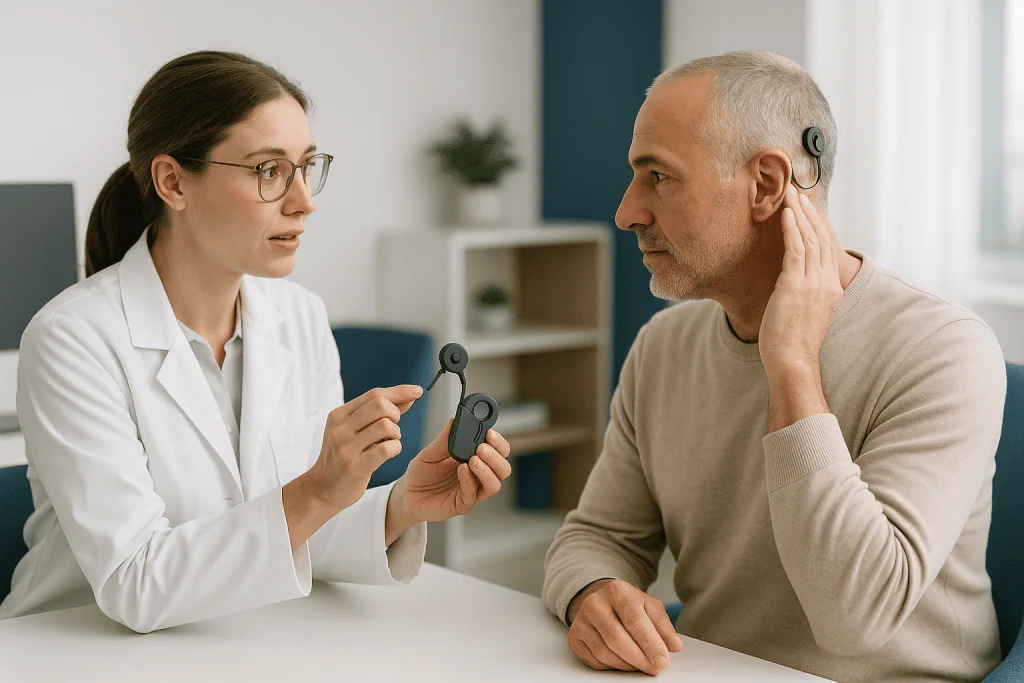
A bone conduction implant makes this permanent and efficient. A small titanium fixture is placed in the bone behind the ear during a short operation. Over several weeks the bone integrates with the titanium, a process called osseointegration, which simply means bone cells grow tightly onto the metal surface. An external sound processor then captures sound and turns it into vibration that passes through the fixture into the skull.
Two designs exist. In the percutaneous version, a small post called an abutment passes through the skin, and the processor clips onto it. In the transcutaneous version, a magnet sits under intact skin and the processor is held on by a matching magnet outside. The percutaneous design transmits vibration a little more directly; the transcutaneous design avoids an opening in the skin but can lose some energy through the tissue. Your surgeon will weigh skin health, skull thickness, and how much loss needs to be overcome.
Bone conduction implants are designed for three groups, as outlined by the NIDCD: people with conductive hearing loss that surgery or conventional aids cannot correct, people with mixed loss whose inner ear component is mild to moderate, and people with single-sided deafness. In that last case the device sends sound from the deaf side across the skull to the hearing ear, which does not restore true stereo hearing but reduces the head-shadow effect that makes conversations on the deaf side so hard.
Before surgery, many candidates trial the same processor on a soft headband. Because sound reaches the cochlea the same way, the trial gives a realistic preview.
What is a middle ear implant, and who considers one?
The middle ear implant is the least familiar member of the family, and the one most often confused with a cochlear implant because both involve surgery inside the ear. The mechanism, though, belongs firmly to the hearing aid side of the line.
A conventional aid moves air; the sound wave then has to move the eardrum, which moves the ossicles, which move the fluid in the cochlea. A middle ear implant cuts out the first two steps. A surgeon attaches a tiny transducer, essentially a miniature motor, directly to one of the middle ear bones or to the round window membrane at the cochlea’s edge. An external or fully implanted processor picks up sound and drives the transducer, so the ossicles or the cochlear fluid are moved directly and precisely.
The appeal is twofold. Nothing sits in the ear canal, so people who cannot tolerate earmolds because of chronic inflammation, allergy, drainage, or an abnormally shaped canal are no longer excluded from amplification. And because the drive is mechanical rather than acoustic, feedback whistling and the plugged-up feeling of an occluded canal are largely avoided.
The NIDCD lists middle ear implants among options for people with moderate to severe sensorineural hearing loss who cannot benefit from conventional aids for medical reasons, and some designs are also used for conductive and mixed losses when the middle ear anatomy allows. The device still depends on a cochlea that can respond to vibration, so it is not a route around profound hair cell loss.
Candidacy questions here are practical: Is the middle ear stable and free of active infection? Are the ossicles intact enough to attach to? Is the sensorineural component within the range the device can drive? Is the person medically fit for an operation under general anesthesia? Only an otologic surgeon with imaging in hand can answer them.
How does a cochlear implant actually work?
Imagine the cochlea as a piano keyboard rolled into a spiral, with high notes at the entrance and low notes deep inside. Healthy hair cells are the strings; when they are gone, no amount of striking the keys produces sound. A cochlear implant plays the keyboard a different way. It connects wires directly to the nerve endings beneath where the strings used to be.
The system has two parts. Externally, a sound processor worn behind the ear or on the head captures sound with microphones, breaks it into frequency bands, and encodes it as a digital signal. A transmitting coil, held to the scalp by a magnet, sends that signal through the skin. Internally, a receiver under the skin decodes it and sends timed electrical pulses to an array of electrodes that the surgeon has threaded into the cochlea. Electrodes near the entrance stimulate the nerve fibers that once served high pitches; deeper electrodes serve lower pitches.
The brain receives a pattern of electrical activity, not a sound wave. Early on, many recipients describe voices as robotic, cartoonish, or like beeps. Over weeks and months of listening practice, the brain learns to interpret the new pattern as speech and environmental sound. The NIDCD is careful to state that an implant does not restore normal hearing, but can give a useful representation of sounds and help a person understand speech.
Programming, often called mapping, is done by an audiologist who adjusts the current levels on each electrode so that soft sounds are audible and loud sounds are comfortable. Maps are revised repeatedly in the first year and tuned less often thereafter. The internal device has no battery of its own; the external processor supplies power through the coil, which is why nothing is heard when the processor is removed.
Which type of hearing loss does each device treat?
The table below sets the main options side by side. Think of it as a guide to which conversation you are likely to have, not as a decision tool. Overlaps exist, borderline audiograms are common, and the treating team weighs imaging, medical history, and speech testing that no table can capture.
| Device | Hearing loss it is designed for | Part of the ear it relies on | Typical reasons it is chosen |
|---|---|---|---|
| Conventional hearing aid | Mild to severe sensorineural; some conductive and mixed | Working cochlea reached through the ear canal | First-line for most hearing loss; non-surgical; adjustable |
| Bone conduction implant | Conductive, mixed (inner ear component mild to moderate), single-sided deafness | Working cochlea reached through skull bone | Ear canal or middle ear cannot conduct; ear canal cannot hold an aid |
| Middle ear implant | Moderate to severe sensorineural; some conductive and mixed | Working cochlea driven through the ossicles or round window | Medical reasons prevent wearing an earmold; feedback or occlusion problems |
| Cochlear implant | Severe to profound sensorineural with limited benefit from well-fitted aids | Intact auditory nerve; cochlea may be non-functional | Speech understanding stays poor despite optimized amplification |
| Hybrid (electroacoustic) implant | Severe to profound high-frequency loss with preserved low frequencies | Partially working cochlea plus nerve | Steeply sloping audiogram; aims to keep usable low-pitch hearing |
Two patterns are worth underlining. A cochlear implant is the only option here that does not need functioning hair cells, which is exactly why it is not offered while amplification still delivers meaningful speech scores. And every implantable hearing aid requires the cochlea to do its job, so when imaging or testing shows the inner ear itself has failed, those devices are not on the table no matter how appealing the smaller surgery sounds.
People with single-sided deafness sometimes qualify for either a bone conduction implant or a cochlear implant in the deaf ear. The first routes sound to the good ear; the second attempts to restore input from the deaf side itself. The Mayo Clinic notes that cochlear implants are increasingly considered for single-sided deafness, but the choice depends on how long the ear has been deaf, the state of the nerve, and what the person hopes to gain.
Who is a cochlear implant usually for, and who is not a good candidate?
Candidacy for a cochlear implant rests on a simple test of principle: has amplification been given a fair chance and still fallen short? The Mayo Clinic describes the typical adult candidate as someone with severe to profound sensorineural hearing loss in one or both ears who receives limited benefit from hearing aids, who has no medical condition that would make surgery unduly risky, and who is motivated to take part in the rehabilitation that follows. The NHS similarly frames implants as an option when hearing aids are not effective enough.
Several groups are usually asked to wait, or to look elsewhere. People who still score reasonably well on speech testing with optimized aids are generally told to continue with amplification and return for re-evaluation as hearing changes. Anyone whose auditory nerve is absent or severed, for example after certain tumors or congenital malformations, cannot benefit, because there is no nerve to stimulate; a different device called an auditory brainstem implant may be discussed instead. Advanced ossification, where the cochlea has filled with bone after meningitis or otosclerosis, can make electrode insertion difficult and is assessed on imaging before any decision.
Medical fitness matters too. General anesthesia lasting a few hours, an implanted device that must be protected from infection, and the need to attend repeated programming visits are not trivial for everyone. Clinicians also pay attention to expectations. Someone hoping for hearing that sounds exactly as it once did, or who is unwilling to persist through the months of listening practice, is often counseled further before proceeding.
None of this is a judgment on the person. Candidacy is a prediction about whether this particular device, in this particular ear, is likely to add something over what is already available. That prediction sits with the treating team, and it can change over time.
What happens on surgery day and in the weeks after
Cochlear implant surgery is done under general anesthesia and typically takes a few hours, according to the Mayo Clinic, with many people going home the same day or after one night. The surgeon makes an incision behind the ear, creates a shallow bed in the skull for the receiver, opens a path through the mastoid bone into the middle ear, and threads the electrode array into the cochlea through a small opening. The incision is closed, a dressing applied, and the internal parts are tested electronically before you wake up. Bone conduction and middle ear implant procedures are generally shorter and follow a similar pattern of incision behind the ear and fixation to bone or ossicles.
The first surprise for many is silence. Nothing is switched on at surgery. The skin needs to settle before the external processor can be fitted, and Cleveland Clinic describes activation as occurring roughly two to four weeks later. During that wait, most people manage soreness, some numbness around the ear, and mild dizziness in the first days; Mayo lists temporary taste disturbance and tinnitus as possible early effects that often ease. Keeping the wound dry and avoiding strenuous activity are standard instructions, tailored by the surgical team.
Activation day is quieter than the viral videos suggest. The audiologist connects the processor, measures how each electrode responds, and sets initial levels deliberately soft. Speech often sounds like whistles, beeps, or a cartoon voice. Over the following weeks, mapping sessions raise levels as the brain adapts. The NIDCD emphasizes that learning to interpret the signals takes time and practice, and structured listening exercises, reading aloud with a partner, and audiobooks are common homework.
For bone conduction implants with a percutaneous abutment, the fitting waits for osseointegration, which the surgeon will time to the individual. A headband processor can sometimes bridge the gap.
What is the downside of cochlear implants, and why do some people say no?
Any honest explainer has to sit with this question, because people who decline an implant are rarely being irrational. Their reasons cluster around four themes.
The first is loss of residual hearing. Inserting an electrode array can damage whatever hair cells remain, and the Mayo Clinic lists loss of remaining natural hearing as a recognized risk. Someone who still enjoys music through a hearing aid, even imperfectly, may weigh that trade carefully. Hearing-preservation techniques and hybrid devices exist, but preservation cannot be guaranteed.
The second is surgical and device risk. Mayo’s list includes bleeding, infection, facial nerve weakness, balance disturbance, spinal fluid leak, new or worse tinnitus, and device failure requiring revision surgery. The most serious, though rare, is meningitis, an infection of the membranes around the brain, which is why the CDC recommends that implant recipients be up to date on pneumococcal vaccination. Your team will discuss which vaccines apply to you.
The third is the lifelong commitment. The internal device is permanent hardware. External processors need batteries, upkeep, and periodic replacement. MRI scans require planning because most implants contain a magnet. Programming visits continue for life, and the sound quality, however useful, is not natural hearing.
The fourth is identity. Many Deaf people, particularly those who grew up with sign language, view deafness as a culture and a linguistic community rather than a deficit to be corrected. Choosing not to implant, for oneself or a child, can be a considered cultural decision, and respectful care teams treat it as one.
Weighed against these are the gains recipients describe: following conversation without lipreading, hearing a smoke alarm, using a phone. The NIDCD is clear that outcomes vary widely between individuals. Which way the balance tips is a personal judgment, made with the treating team, not a test to pass.
How the pathway differs for babies and children
Newborn hearing screening has changed the story for children. A baby who does not pass is referred for diagnostic testing, usually within the first weeks of life, and if permanent loss is confirmed, hearing aids are fitted as early as possible. The reason for urgency is the developing brain: the auditory pathways are shaped most powerfully by sound in the first years, and the NIDCD notes that children who receive implants early, followed by intensive therapy, tend to develop language skills more readily than those implanted later.
The decision sequence for children mirrors the adult one but with tighter timelines and more people at the table. Audiologists confirm the degree and type of loss with tests that do not require the baby to respond, such as auditory brainstem response testing. A trial of well-fitted hearing aids follows. If speech and language are not progressing as expected despite aids, and the loss is severe to profound sensorineural, a cochlear implant evaluation begins. The Mayo Clinic notes that implantation can be considered in infancy for eligible children, with the exact timing set by the surgical team based on the child’s health and imaging.
For conductive losses from conditions such as microtia or atresia, where the outer ear or canal did not form fully, a bone conduction processor on a soft headband is the usual starting point. It delivers the same signal the implant would, without surgery, and the implantable version is discussed when the skull bone is thick enough and the family is ready.
Preparation focuses on comfort. Child life specialists, tours of the recovery area, and practice wearing a mock processor help. After activation, speech and language therapists and early intervention teams take the lead, and parents become the primary listening coaches. Families who use sign language are encouraged to continue; spoken and signed language are not in competition.
What people often get wrong about hearing implants
Misconceptions cluster around this topic because the devices are invisible in daily life and the vocabulary is slippery. A few deserve correcting.
The most common error is that a cochlear implant is simply a stronger hearing aid. It is not. A hearing aid amplifies sound for hair cells to detect; a cochlear implant replaces the hair cells’ job with electrical stimulation of the nerve. If your hair cells still work reasonably well, an implant is not an upgrade; it is the wrong tool, and it can cost you the hearing you have.
A second myth runs the other way: that bone-anchored devices are for deaf people. They require a working cochlea. They exist for people whose problem lies in the outer or middle ear, or who cannot wear a conventional aid, or who are deaf in one ear only.
Third, the activation videos online, with tearful first words, set expectations that the NIDCD’s own language does not support. Most recipients hear beeps and buzzing first. Understanding speech is learned over months, and the amount of improvement varies from person to person.
Fourth, people assume implants are permanent in every sense. The internal receiver is, but the external processor is removable, and without it there is no hearing on that side. Swimming, sleeping, and MRI scanning all require thought about the hardware.
Fifth, there is a belief that once you have an implant, hearing aids are finished. Many people wear an implant on one side and a hearing aid on the other, a combination audiologists call bimodal hearing, because the aid contributes low-frequency information the implant represents less well.
Finally, no device stops the underlying cause. Progressive genetic loss, noise damage, and age-related change continue, which is why follow-up testing never really ends.
Questions to ask your care team before deciding
A good consultation should leave you able to describe your own hearing loss in one sentence and explain why a particular device fits it. If you cannot, ask again. The questions below are the ones patients tell audiologists they wished they had raised earlier.
- Which type of hearing loss do I have, and which part of my ear is failing? Ask to see the audiogram and, if imaging has been done, to have the scan explained.
- How much benefit am I currently getting from my hearing aids on speech testing, and what score or pattern would move me into implant candidacy?
- Is my auditory nerve intact, and is there anything on imaging, such as bone growth inside the cochlea, that would make the surgery more complex?
- For a bone conduction option, can I trial the processor on a headband first, and how closely does that trial predict the implanted result?
- What are the specific risks in my case, given my other health conditions, and how would a complication be managed?
- What happens to the natural hearing I have left, and is a hearing-preservation approach relevant to my audiogram?
- What does the follow-up schedule look like in the first year, and how far will I need to travel for programming visits?
- How will the device affect MRI scans, air travel security screening, swimming, and contact sports?
- If the device fails or technology improves, what does revision or upgrade involve?
- What would you expect my hearing to be like in six months if I do nothing, if I optimize my current aids, and if I proceed with an implant?
Write the answers down, or bring someone who will. Hearing-loss consultations are the one appointment where the patient is least equipped to catch every word, and clinicians know it. Asking for a written summary is reasonable and common.
When to call your doctor
Hearing loss itself is rarely an emergency, but a few situations should prompt a same-day call to your doctor or, in some cases, urgent care. Sudden hearing loss in one ear, developing over hours to a few days, is one of them. The NHS and Mayo Clinic both advise prompt assessment, because some causes are time-sensitive and the window for certain treatments is measured in days, not weeks. Do not wait for a scheduled audiology appointment.
After implant surgery, contact your surgical team without delay if you notice any of the following: fever, spreading redness, warmth, or discharge at the incision; a stiff neck, severe headache, sensitivity to light, or confusion, which together can signal meningitis; new facial weakness or drooping on the operated side; clear watery fluid draining from the nose or ear, which may indicate a spinal fluid leak; severe or worsening dizziness that prevents you from walking safely; or a sudden change in what you hear through the device that the audiologist cannot explain by a processor fault.
For bone conduction implants with an abutment, persistent soreness, thickening, or discharge around the skin post is the most common complication and is easier to manage early. For any implanted device, a direct blow to the head over the site warrants a check even if you feel fine.
Hearing changes in an unimplanted ear, ringing that arrives suddenly, ear pain with fever, or drainage from a previously dry ear should also be reported, since they may alter the plan for either ear. Every decision about investigation, treatment, or a change to your devices rests with your treating team; this article is background, not a substitute for their judgment.
Frequently asked questions
What is the difference between a cochlear implant vs hearing aid, in one sentence?
A hearing aid makes sound louder for surviving hair cells in the cochlea to detect, whereas a cochlear implant skips the hair cells and sends electrical pulses straight to the auditory nerve. That is why hearing aids serve mild to severe loss and implants are reserved for severe to profound sensorineural loss where amplification no longer delivers useful speech understanding.
Why do people choose not to get a cochlear implant?
Common reasons include the risk of losing the natural hearing that remains, the permanence of implanted hardware, lifelong programming visits, MRI and activity restrictions, uncertainty about how much speech understanding will improve, and, for many Deaf people, a cultural identity in which deafness is not a problem to be fixed. Each is a legitimate consideration to raise with the care team.
What is the downside of cochlear implants?
The Mayo Clinic lists loss of residual hearing, bleeding, infection, facial nerve weakness, balance problems, taste disturbance, tinnitus, spinal fluid leak, device failure and, rarely, meningitis. Beyond surgical risks, sound through an implant is not natural hearing, the external processor must be worn for any hearing on that side, and outcomes vary widely between individuals.
Who is not a good candidate for cochlear implants?
People who still gain meaningful speech understanding from well-fitted hearing aids, anyone whose auditory nerve is absent or severed, those whose cochlea is heavily filled with bone on imaging, people medically unfit for general anesthesia, and those unable or unwilling to attend rehabilitation and programming are usually not offered an implant. Candidacy is reassessed as hearing changes.
How does a bone anchored hearing aid vs cochlear implant decision work for single-sided deafness?
A bone conduction implant routes sound from the deaf side through the skull to the hearing ear, reducing the head-shadow effect without restoring hearing in the deaf ear. A cochlear implant tries to restore input from the deaf ear itself. The choice depends on how long the ear has been deaf, the nerve’s condition, imaging, and what the person hopes to gain.
How much does a cochlear implant hearing aid cost?
This magazine does not publish cost or price figures for any treatment, because they vary widely by country, insurer, and individual circumstances. The most reliable route is to ask the implant program’s coordinator for a written breakdown and to contact your insurer or health system directly about coverage for evaluation, surgery, the device, and ongoing programming visits.
Does a cochlear implant restore normal hearing?
No. The NIDCD states that a cochlear implant does not restore normal hearing but can give a useful representation of sounds and help with understanding speech. Early on, voices often sound mechanical, and the brain learns to interpret the signal over months of practice. How much benefit a person gains varies and cannot be predicted precisely before surgery.
Can you still wear a hearing aid in the other ear after a cochlear implant?
Yes, and many people do. Wearing an implant on one side and a hearing aid on the other is called bimodal hearing. The hearing aid contributes low-frequency and tonal information that the implant represents less well, which can help with music and locating sounds. Your audiologist will decide whether the combination suits your audiogram and adjust both devices together.
How long after implant surgery is the device switched on?
Nothing is activated during the operation. Cleveland Clinic describes the first fitting of the external processor roughly two to four weeks after surgery, once the incision has settled. Bone conduction implants with a skin-penetrating abutment wait for the titanium fixture to integrate with bone, a period the surgeon sets individually. The exact timing always rests with your surgical team.
Do babies get cochlear implants or hearing aids first?
Hearing aids come first. After newborn screening and diagnostic testing, infants with permanent loss are fitted with aids as early as possible. If speech and language do not progress despite well-fitted aids and the loss is severe to profound sensorineural, a cochlear implant evaluation follows. The Mayo Clinic notes implantation can be considered in infancy for eligible children, with timing set by the team.
References
- Cochlear Implants (NIDCD, National Institutes of Health)
- Hearing Aids, including bone-anchored and middle ear implants (NIDCD, National Institutes of Health)
- Cochlear Implants (Cleveland Clinic)
- Hearing loss: Treatment (NHS)
This article is for general information only and is not a substitute for professional medical advice. Please consult a qualified doctor about your individual situation.

More from the Blog

What Is Normal After Stapedectomy Surgery, and Which Symptoms Call for a Prompt Check?
After a stapedectomy, a blocked or muffled ear, mild ache, a metallic taste, brief unsteadiness when moving the head and faint blood-tinged discharge are…

Why Do Surgeons Ask for Voice Therapy Before Glottoplasty (Pitch-Raising Surgery)?
Surgeons ask for voice therapy before glottoplasty because surgery changes only one feature of a voice, its pitch, while listeners judge gender from resonance,…

What Results Can You Expect From Sleep Apnea Treatment? Sleep Quality, Energy and Snoring
Effective sleep apnea treatment usually reduces breathing pauses during sleep to a normal range, which in turn tends to improve sleep continuity, daytime alertness…

Nasal Sprays vs Saline Rinses for Sinusitis: Does Your Treatment Plan Need Both?
Saline rinses and nasal sprays treat sinusitis in different ways, so many care plans use both. A saline rinse physically flushes mucus and irritants…

Tympanoplasty Step by Step: How Surgeons Graft a Perforated Eardrum Under the Microscope
Tympanoplasty repairs a perforated eardrum with a small graft of the patient's own tissue, most often thin fascia from above the ear or cartilage…

After Professional Earwax Removal: Temporary Sensitivity and Symptoms Worth a Call
After professional earwax removal, most people notice a few brief effects: the ear may feel oddly open or ticklish, ordinary sounds can seem loud,…