

Is Body Aesthetics Surgery Right for You? Weight Stability, Skin Quality and Overall Health
Key Takeaways
- Mayo Clinic lists a BMI above 30, planned weight loss, possible future pregnancy, smoking and severe chronic illness as reasons a surgeon may caution against tummy tuck.
- Liposuction removes fat but cannot tighten skin; in people with poor elasticity it can make looseness more visible, which is why skin quality often decides between liposuction and skin removal.
- CDC BMI categories run from below 18.5 (underweight) to 30 and above (obesity), but BMI is a screening tool and does not account for redundant skin after major weight loss.
- Nicotine in any form narrows skin blood vessels and impairs wound healing, and many surgeons will not operate on active users for that reason.
- Deep vein thrombosis, pulmonary embolism and fat embolism are recognized serious risks of body contouring, which is why early walking after surgery is routinely encouraged.
- The NHS puts recovery from a tummy tuck at about six weeks, with strenuous activity avoided for around that period, while Mayo Clinic notes scars may take a year or more to fade.
A body aesthetics surgery candidate is usually an adult whose weight has held steady for months, who does not smoke, whose long-term conditions are well controlled, and whose skin and fat pattern match what the procedure can realistically change. Surgical teams often pause when BMI is above 30, when further weight loss or pregnancy is planned, or when expectations outrun what surgery does. The final decision always rests with the treating team.
The jeans finally fit. That was supposed to be the moment. Instead, a woman who has lost a large amount of weight stands in a fitting room and notices what the scale never told her: the skin around her waist folds over the waistband like a loose sleeve, and it stays that way whether she pulls the denim up or down.
She is not alone in that room, at least not figuratively. Every year, people who have changed their bodies through diet, exercise, illness, pregnancy or bariatric surgery arrive at the same question: is surgery the next step, and am I a reasonable body aesthetics surgery candidate? The honest answer depends less on wanting it and more on three things a surgeon will measure long before any scalpel appears.
Those three things are weight stability, skin quality and overall health. This explainer walks through each one the way a careful consultation would, without sales talk and without promises.
What does body aesthetics surgery actually cover?
The phrase is an umbrella. Underneath it sits a family of operations that surgeons more often call body contouring: procedures that reshape the trunk and limbs by removing fat, removing excess skin, or both. MedlinePlus groups them under plastic and cosmetic surgery, a category that also includes reconstructive work after injury or cancer, which is a useful reminder that the same techniques serve very different purposes.
The most familiar members of the family are liposuction, which suctions fat through small cannulas (thin hollow tubes) inserted through short incisions, and abdominoplasty, the formal name for a tummy tuck, which removes loose abdominal skin and often tightens the underlying muscle wall. A body lift extends the tummy tuck concept around the hips and back. Arm lifts and thigh lifts follow the same logic on the limbs. Fat grafting, sometimes marketed as a Brazilian butt lift, moves a person’s own fat from one area to another.
What these procedures share matters more than what separates them. None of them treats obesity. None of them lowers blood pressure, reverses diabetes or replaces a healthy diet. Mayo Clinic is blunt about this in its liposuction guidance: the operation is not a weight-loss method, and it is not a substitute for an active lifestyle. The Cleveland Clinic frames body contouring as a way to address what remains after weight has been lost, not a way to lose it.
Keeping that distinction in view is the single most useful thing a prospective patient can do. It reframes the question from whether surgery can fix a body to whether a specific operation can change a specific contour in a person who is otherwise well. That is a narrower question, and a far more answerable one.
How body contouring surgery actually works
Two mechanical problems sit at the heart of every body contouring case: too much fat in a place where it distorts shape, and too much skin that no longer snaps back. Each problem has its own surgical answer, and many operations combine them.
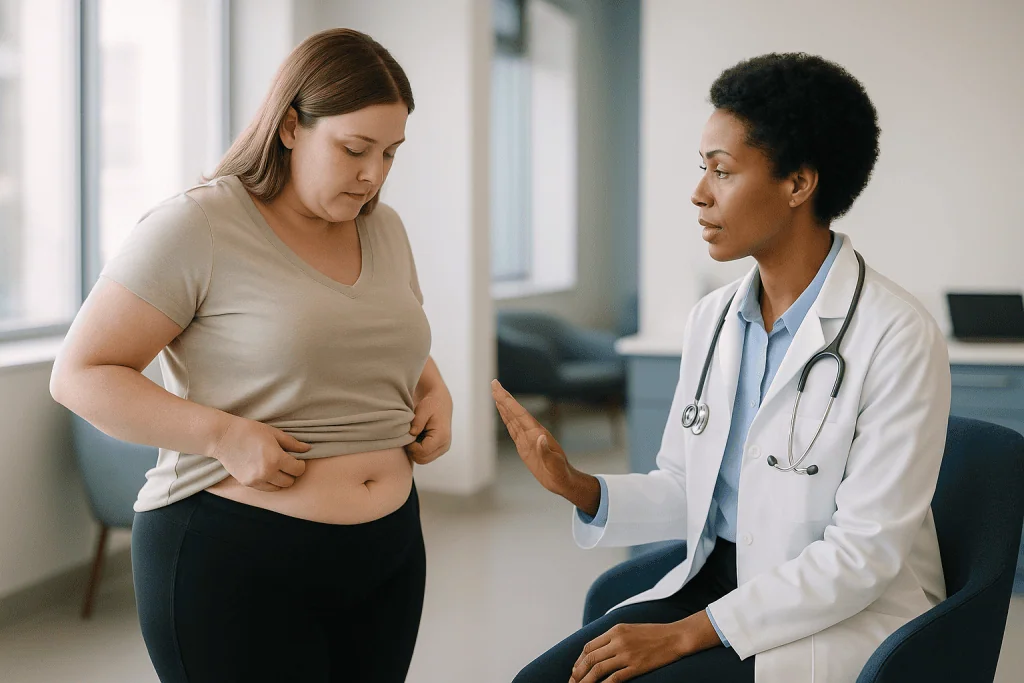
Fat is removed by suction. After the area is numbed or the patient is under general anesthesia, the surgeon infiltrates the tissue with a fluid solution that firms the fat and shrinks small blood vessels, then passes a cannula back and forth to break up and draw out fat cells. Some techniques add ultrasound or laser energy to loosen fat first; Mayo Clinic describes these as variations on the same core principle rather than fundamentally different procedures. Because adult fat cells removed this way do not regrow in the same numbers, the change in that region tends to persist as long as overall weight stays stable.
Skin is handled differently. Once collagen and elastin fibers have been stretched past their limit, no amount of suction, exercise or cream shortens them. The only reliable way to remove redundant skin is to cut it away and close the wound. In a tummy tuck, Mayo Clinic notes, the surgeon typically makes a horizontal incision low on the abdomen, lifts the skin, may stitch the separated abdominal muscles together, trims the excess, and repositions the navel. The trade is unavoidable: fewer folds in exchange for a permanent scar.
Understanding this trade explains why candidacy hinges on skin quality. A person whose skin still has recoil may do well with fat removal alone. A person whose skin hangs will usually be told that liposuction by itself would make the looseness more visible, not less. The operation must match the tissue, and the tissue is assessed by hand, in the consultation room, not by photographs alone.
What makes a good body aesthetics surgery candidate?
Ask a surgeon what they look for and the list is shorter than most people expect. Mayo Clinic, describing liposuction, puts it plainly: good health, no conditions that impair healing, and a weight within roughly 30 percent of ideal. For tummy tuck, the same source adds that the ideal patient is not planning further significant weight loss or pregnancy, does not smoke, and has a BMI at or below 30.
Behind those bullet points lies a pattern. A promising body aesthetics surgery candidate is someone whose body has stopped changing. Weight has held steady for months rather than weeks. Any chronic illness is monitored and controlled. Nicotine is out of the picture. The person can describe, in specific terms, which area bothers them and why, rather than hoping surgery will change how they feel about themselves in general.
That last point is not a soft add-on. The NHS advises anyone considering cosmetic surgery to reflect carefully on why they want it and to be honest about their expectations, because surgery changes shape, not mood. Surgeons routinely decline or postpone patients whose goals are vague, whose motivation comes from someone else, or who expect a result that the anatomy cannot deliver.
A few practical markers tend to accompany strong candidates:
- Weight has been stable long enough that clothes have fit the same way for months.
- Any diabetes, thyroid disease or high blood pressure is under regular medical review.
- Blood tests, where ordered, show no untreated anemia or nutritional deficiency.
- There is a realistic plan for time off work, help at home and follow-up visits.
None of this guarantees a green light. It does mean the conversation with the care team can focus on which procedure, rather than whether any procedure is sensible yet.
Why weight stability matters more than the number on the scale
Picture a tailor fitting a suit to someone whose weight is still falling. However precise the alterations, the jacket will be loose again within the season. Body contouring faces the same problem, only the fabric is living tissue and the alterations leave scars.

Skin removed during a tummy tuck or body lift is measured against the body as it is on the day of surgery. Lose another substantial amount afterward and new laxity appears above and below the scar line. Gain weight and fat returns, sometimes unevenly, because the treated area now holds fewer fat cells than its neighbors. Mayo Clinic explicitly cautions against tummy tuck for anyone planning to lose a significant amount of weight, and warns that weight fluctuations after liposuction can change the distribution of fat.
This is why surgeons care less about the absolute figure and more about its trend. Someone who has weighed the same for a year at a BMI of 29 is often a more sensible candidate than someone who has dropped rapidly to a BMI of 26 and is still losing. The Cleveland Clinic describes body contouring candidates as people whose weight loss has plateaued and held; many teams translate that into a stable weight for at least six months, and often longer after bariatric surgery, though thresholds vary from team to team and are set case by case.
Stability also signals something about the person behind the number. It suggests eating patterns and activity that have settled into habits, which is exactly what protects a surgical result in the years afterward. A body that has stopped moving toward a target is a body that surgery can be planned around. A body still in transit is better served by waiting, and a surgeon who says so is doing their job well.
BMI for body contouring: what number is too high for surgery?
Body mass index, or BMI, is weight in kilograms divided by height in meters squared. It is a crude screening tool that says nothing about muscle, fat distribution or fitness, and the CDC is careful to describe it as a screening measure rather than a diagnosis. Surgeons still use it, because across large groups it tracks with anesthesia risk, wound complications and blood clots.
There is no single legal cut-off. Mayo Clinic lists a BMI above 30 as a reason a surgeon might caution against tummy tuck. Many teams apply similar thinking to body lifts and large-volume liposuction, while treating smaller, localized fat removal more flexibly. The table below pairs CDC weight categories with how body contouring teams commonly interpret them; the right-hand column describes typical practice, not a rule, and your own team may set different limits.
| BMI range (CDC adult categories) | CDC category | How body contouring teams often view it |
|---|---|---|
| Below 18.5 | Underweight | Nutrition and healing reserve reviewed before any surgery |
| 18.5 to 24.9 | Healthy weight | Usually no BMI-related barrier |
| 25.0 to 29.9 | Overweight | Commonly acceptable if weight is stable and health is good |
| 30.0 and above | Obesity | Mayo Clinic notes surgeons may caution against tummy tuck; often asked to wait or reduce first |
Two caveats keep the table honest. First, BMI does not capture skin. A person with a BMI of 32 after massive weight loss may be carrying several kilograms of redundant skin that a scale counts as weight; some teams account for that. Second, BMI below 30 is not automatic clearance. A person with a healthy BMI but uncontrolled diabetes or a clotting disorder may be a weaker candidate than someone heavier and otherwise well. The number opens the conversation; it never closes it.
Skin elasticity after weight loss: why skin quality decides the procedure
Pinch the skin on the back of your hand and let go. In your twenties it flattens almost instantly. Decades later, or after years of stretching, it settles more slowly. That recoil is elasticity, and it is the property surgeons are quietly testing when they lift and release a fold of abdominal skin during an examination.
Elasticity depends on two structural proteins in the dermis, the deeper layer of skin. Collagen provides strength; elastin provides spring. Both are damaged by prolonged stretching, by age, by sun exposure and by smoking. Once elastin fibers have been broken, the body does not rebuild them to their original tension. Mayo Clinic notes that liposuction works best in people with good skin tone, and that skin which is thin and has little elasticity may appear loose after fat is removed.
This is the fork in the road for most people considering body aesthetics surgery. If skin quality is good, fat removal alone may produce a smooth result because the skin shrinks to fit. If skin quality is poor, the only way to achieve a smooth contour is to cut skin away, which means longer scars and a bigger operation. Stretch marks are a useful signal: they represent tears in the dermis and usually indicate that recoil is limited in that region.
Skin elasticity after weight loss is often the deciding factor between liposuction and a tummy tuck, or between a tummy tuck and a full body lift. It cannot be improved by creams, supplements or devices in any way that mainstream evidence supports, though maintaining a stable weight and avoiding nicotine protects what remains. A surgeon who spends several minutes examining skin rather than glancing at it is giving the question the attention it deserves.
Health conditions that change the plan
Body contouring is elective. That single fact reshapes how surgeons and anesthesiologists weigh risk: because the operation can wait, any condition that raises the odds of a complication is a reason to pause, not to press on.
Diabetes is the most common example. High blood glucose slows wound healing and raises infection risk, so teams generally want evidence of steady control before a long incision is planned. Mayo Clinic lists severe chronic conditions such as heart disease and diabetes among reasons a surgeon may advise against tummy tuck. Heart and lung disease matter for anesthesia; a body lift may take several hours under general anesthesia, and the heart has to tolerate that.
Clotting deserves its own paragraph. Deep vein thrombosis, a blood clot in a leg vein, and pulmonary embolism, a clot that travels to the lungs, are recognized risks of longer body contouring operations, and Mayo Clinic names them among the risks of both liposuction and tummy tuck. A personal or family history of clots, certain hormonal medicines, and long periods of immobility all raise the baseline. Teams may ask about these in detail and adjust the plan accordingly.
Nutrition is the quiet one. After bariatric surgery in particular, deficiencies of protein, iron, vitamin B12 and vitamin D are common, and each undermines healing. Blood tests before surgery often check these, and correcting a deficiency can be a prerequisite rather than an afterthought.
Mental health belongs on the list too, without stigma. The NHS encourages anyone considering cosmetic surgery to talk with their family doctor first, and surgeons may ask about mood, eating patterns and body image because these shape both safety and satisfaction. Where medication is part of the picture, whether for diabetes, blood pressure, clotting or mood, the prescribing clinician decides how it is managed around surgery. Patients should never adjust a prescription on their own.
Smoking, nicotine and why surgeons keep asking about it
A surgeon who asks about smoking three times in one consultation is not being repetitive. They are asking about the blood supply to the skin they are about to lift.
Nicotine narrows small blood vessels. Carbon monoxide from burning tobacco displaces oxygen from red blood cells. Together they starve the edges of a wound at exactly the moment they need oxygen to knit. In a tummy tuck, where a large sheet of skin is separated from its underlying blood supply and stretched down to a new position, the lowest part of that sheet already sits at the limit of what its remaining vessels can feed. Mayo Clinic states that smoking decreases blood flow in the skin and can slow healing, and that surgeons will likely ask patients to stop before surgery and during recovery. The NHS gives the same advice for tummy tuck: stop smoking to reduce complication risk.
The practical consequences are wound edges that break down, skin that darkens and dies at the incision, thicker scars, and infections that would otherwise have been unlikely. These are not rare curiosities; they are the reason many surgeons will not operate on active smokers at all.
Nicotine is the active problem, not just cigarettes. Vaping, nicotine gum, patches and pouches deliver the same vasoconstriction. Teams often ask about all forms and may test for nicotine metabolites before booking. How long to stop, and how to do it, is a conversation for the surgeon and the family doctor, who can also point toward support for quitting.
There is a hopeful edge to this section. Smoking is among the few candidacy barriers a person can remove entirely by their own action. A former smoker who has stayed nicotine-free is, for the purposes of skin healing, treated far more like a non-smoker than like the person they were.
Who is usually asked to wait, and why waiting is not a refusal
Being told to come back later is not the same as being turned away. In body contouring it is often the most protective advice a patient receives, and it tends to fall into a handful of predictable categories.
Weight still moving. Anyone in the middle of active weight loss, whether through diet, exercise, medication or recent bariatric surgery, is usually asked to reach a plateau and hold it. Operating on a body that is still shrinking wastes the result.
Pregnancy on the horizon. Mayo Clinic advises against tummy tuck for people who may consider future pregnancy, because the abdominal wall that was tightened will stretch again. Liposuction of the flanks is less affected, but most teams prefer to complete childbearing first.
Recently started weight-management medicines. Glucagon-like peptide-1 receptor agonists, a class of medicines that mimic a gut hormone to reduce appetite and slow stomach emptying, are increasingly common among people considering contouring. Their slowing of gastric emptying is relevant to anesthesia, and their effect on weight means the body may not yet be stable. How these medicines are handled before surgery is a decision for the prescribing clinician and the anesthesia team together, never for the patient alone.
Uncontrolled conditions. Diabetes with high glucose readings, untreated high blood pressure, active infection, or recent blood clots all prompt a pause while the underlying condition is brought under review.
Uncertain motivation. Surgeons listen for phrases such as wanting to feel worthy, or a partner wanting the change. The NHS suggests that people who are being pressured, or who are going through a difficult life event, may benefit from time before committing.
A short wait costs little. A complication or a disappointing result carries costs measured in scars, recovery and regret. Teams who say wait are usually weighing exactly that.
Tummy tuck candidate or liposuction candidate: which fits which body?
People often arrive asking for one procedure and leave having learned they need the other. The difference comes down to what is causing the shape they dislike.
A typical liposuction candidate has stubborn pockets of fat that resist diet and exercise, skin that still recoils when pinched, and a weight near their long-term normal. Mayo Clinic describes liposuction as suited to fat that does not respond to diet and exercise, in people with good skin elasticity and firm muscle tone. The operation reduces volume; it does nothing for loose skin or separated abdominal muscles, and it can make both more noticeable once the fat that was filling the skin is gone.
A typical tummy tuck candidate has a different problem: an apron of skin, often with stretch marks, that persists regardless of fitness, frequently combined with a bulge from abdominal muscles that separated during pregnancy or major weight gain. Mayo Clinic lists these as the changes a tummy tuck addresses, and notes the operation leaves a permanent scar that can be hidden below most waistlines. The NHS describes the same procedure and points out that it involves general anesthesia and a recovery measured in weeks.
Many bodies fall between the two. Surgeons frequently combine limited liposuction with skin removal to smooth the transition between treated and untreated zones. After massive weight loss, a circumferential body lift may be proposed because skin laxity wraps around the back and hips rather than stopping at the sides.
The rule of thumb a consultation will test is simple. If the issue lifts away when you gently pull the skin upward in a mirror, skin removal is probably part of the answer. If the shape stays the same when you pull but softens when you flex, fat is the main culprit. Only an examination confirms which, and the team makes that call.
What disqualifies you from a BBL or fat grafting?
Fat grafting to the buttocks, widely marketed as a Brazilian butt lift or BBL, uses liposuction to harvest a person’s own fat and then injects it to add volume and shape. Because it combines two procedures and involves injecting fat near large veins deep in the buttock, the candidacy questions are stricter than for liposuction alone.
Not enough fat to harvest. The procedure depends on having donor fat somewhere else. Very lean people may simply lack enough tissue, and a surgeon cannot manufacture it.
High BMI. The same anesthesia and clotting concerns that apply to other contouring operations apply here, with the added length of a combined procedure. Teams commonly apply BMI thresholds similar to those used for tummy tuck.
Smoking or nicotine use. Transferred fat survives only if it acquires a blood supply in its new location. Nicotine’s narrowing of blood vessels works directly against that, and many surgeons decline active nicotine users outright.
Clotting risk and heart or lung disease. Fat embolism, in which fat enters the bloodstream and travels to the lungs, is a recognized and serious risk of liposuction generally, listed by Mayo Clinic, and is of particular concern when fat is injected into the buttock. Any history of clots, or any condition that reduces cardiopulmonary reserve, weighs heavily.
Planned weight change. Transferred fat behaves like the fat it came from: it grows and shrinks with overall weight. Ongoing weight loss can undo the result.
Expectations shaped by social media. Surgeons are alert to requests for proportions that cannot be achieved safely, and an honest team will say so.
None of these is a judgment on a person. They are the conditions under which a particular operation carries risks that an elective procedure should not accept. The treating team decides where those lines sit for each individual.
What the following days and weeks usually look like
Recovery from body contouring is less dramatic than the operation and more tedious than most people expect. The timeline varies by procedure and by person; what follows describes typical ranges drawn from Mayo Clinic and NHS guidance, not a schedule anyone should hold a surgeon to.
The first days after a tummy tuck are usually spent moving carefully, often bent slightly at the waist to reduce tension on the incision. Mayo Clinic notes that small drainage tubes may be left in place for several days to remove excess fluid, and that patients typically wear a supportive abdominal garment for about six weeks. Pain and swelling are expected and are managed by the surgical team, who decide on any medicines. Early walking is encouraged from the first day to lower the risk of blood clots in the legs.
After liposuction, Mayo Clinic describes swelling that settles over a few weeks, with the treated area appearing less bulky within that time and the final contour emerging over several months as residual swelling resolves. Bruising is common and fades on its own. Compression garments are standard here too.
Returning to normal life happens in stages. The NHS advises that it takes about six weeks to recover from a tummy tuck, and that strenuous activity and exercise should be avoided for around that period. Desk-based work often resumes sooner, physically demanding work later; the team sets the pace.
Scars follow their own, slower clock. Mayo Clinic notes that tummy tuck scars may take a year or more to fade, and they never disappear entirely. Sun protection of the scar during that time helps limit darkening.
Follow-up appointments are not optional extras. They are where fluid collections, wound concerns and early contour irregularities are caught while they are easy to manage.
What people often get wrong about body aesthetics surgery
Myths cluster around body contouring more thickly than around almost any other branch of surgery, partly because the marketing is loud and partly because the procedures look simpler than they are.
Liposuction is not weight loss. Mayo Clinic is explicit: it is not a treatment for obesity and should not be expected to change the number on the scale meaningfully. The volume removed in a safe session is limited, and the goal is shape, not weight.
Fat does not come back in the same place. Removed fat cells are gone, but remaining cells anywhere in the body can enlarge with weight gain. Mayo Clinic warns that fluctuations in weight after liposuction can alter fat distribution. The result is protected by stable habits, not by the operation itself.
Loose skin cannot be tightened without an incision. Creams, wraps, supplements and most energy devices do not restore broken elastin fibers. Modest skin tightening from some technologies is a matter of ongoing research, and mainstream evidence does not support them as a substitute for skin removal when laxity is significant.
Scars are permanent. Every skin-removal procedure trades folds for a line. Good technique places and manages that line, but it does not erase it.
A healthy BMI is not automatic clearance. Health conditions, nicotine, clotting history and expectations all matter independently of weight.
Surgery does not change how a person feels about themselves in general. The NHS encourages people to consider whether they are hoping for something surgery cannot deliver. Changing a contour can be meaningful; treating low mood or anxiety is a separate task with separate tools.
Being asked to wait is not a rejection. It is usually the safest recommendation available, and a surgeon who says so is prioritizing the patient over the booking.
Body aesthetics surgery candidate checklist: questions to ask your care team
A consultation is a two-way examination. The surgeon assesses skin, weight and health; the patient should assess whether the plan is specific, honest and safe. These questions help. They are written to be asked, not answered here, because the answers belong to the team in front of you.
- Which specific problem are you proposing to address: fat, skin, muscle separation, or a combination?
- Why this procedure rather than the alternatives, including doing nothing for now?
- What does my skin quality tell you, and how does it limit what liposuction alone could achieve?
- How long would you want my weight to have been stable before you would schedule surgery?
- Is my BMI a concern for anesthesia or wound healing, and if so, what would change your view?
- How will my diabetes, blood pressure, thyroid condition or other medical history be managed around surgery, and who makes those decisions?
- What is your policy on nicotine, and how do you check?
- Where exactly will the scars be, how long, and what do they typically look like after a year?
- What are the serious risks for someone with my history, including blood clots and fat embolism?
- How long will the operation take, and will I stay overnight?
- What does a realistic recovery look like for my job and my home situation?
- Who do I call if something worries me at night or on a weekend?
- What would make you decide not to operate on me?
Pay attention to how the questions are received. A team that welcomes the last one, and can name the circumstances under which they would decline, is demonstrating the judgment that protects patients. A body aesthetics surgery candidate who leaves a consultation understanding both what surgery can and cannot do has already gained something valuable, whatever they decide next.
When to call your doctor
Most recovery from body contouring is uneventful, but a small number of complications are time-sensitive, and knowing them in advance is part of being a prepared patient. The following are red-flag signs that warrant contacting the surgical team or seeking emergency care without delay; they are drawn from the complications Mayo Clinic and the NHS describe for tummy tuck and liposuction.
Seek emergency care immediately for chest pain, sudden shortness of breath, coughing up blood, or a racing heartbeat, which can signal a pulmonary embolism or fat embolism. Do the same for confusion, fainting, or a fever with chills and rapid breathing, which can indicate a spreading infection.
Contact the surgical team the same day for:
- Pain, swelling, warmth or redness in one calf or thigh, which may indicate a deep vein thrombosis.
- Increasing redness, heat, spreading pain or foul-smelling discharge at an incision.
- Wound edges that open, or skin at the incision turning dark purple or black.
- A rapidly enlarging, tense, painful swelling under the skin, which can indicate bleeding or a fluid collection.
- A fever that persists or climbs.
- Persistent vomiting or inability to keep fluids down.
- Numbness or weakness that is new, spreading or worsening rather than settling.
Even outside these signs, uncertainty is a reason to call. Surgical teams expect questions during recovery, and an early phone call about something minor is always preferable to a late one about something that has grown. If you cannot reach the team and a symptom is severe or sudden, use emergency services. Every decision about investigation and treatment rests with the clinicians who know your case.
Frequently asked questions
What disqualifies you from getting a BBL?
Common reasons a surgeon declines or postpones fat grafting to the buttocks include too little donor fat, a high BMI, active nicotine use, a history of blood clots or heart and lung disease, ongoing weight loss, and expectations that cannot be met safely. Fat embolism is a recognized serious risk of liposuction generally and a particular concern with buttock injection, so cardiopulmonary health weighs heavily. The treating team makes the final call.
What is the most common aesthetic surgery?
Liposuction and breast procedures consistently appear at the top of professional society tallies of cosmetic operations, with tummy tuck and eyelid surgery also ranking highly, though exact order varies by year and country. Popularity says nothing about suitability for an individual. Mayo Clinic stresses that liposuction is not a weight-loss method, and the right procedure depends on whether fat, skin or muscle separation is causing the concern.
What BMI is too high for surgery?
There is no universal cut-off, but Mayo Clinic lists a BMI above 30 as a reason a surgeon may caution against tummy tuck, and many teams apply similar thresholds to body lifts and larger liposuction. CDC categories place 30 and above in the obesity range. BMI is a screening tool, not a verdict; skin weight after massive weight loss, controlled health conditions and clotting history all shape the decision alongside it.
Who is not a good candidate for a facelift?
People who smoke or use nicotine, have poorly controlled diabetes or high blood pressure, take medicines that impair clotting, or have unrealistic expectations are generally considered weaker facelift candidates for the same reasons that apply to body contouring: skin blood supply and wound healing. Facial skin quality and bone structure also matter. A surgeon assesses these in person, and the decision about suitability belongs to that team.
Am I a tummy tuck candidate if I still plan to lose weight?
Usually not yet. Mayo Clinic advises against tummy tuck for anyone planning to lose a significant amount of weight, because skin removed to fit the body on the day of surgery will loosen again as weight falls. Surgeons generally prefer to see weight stable for months first. Reaching a plateau and holding it protects both the result and the scar, and a team that asks you to wait is acting in your interest.
Does skin elasticity after weight loss ever recover on its own?
Only modestly. Skin that has been stretched for years loses elastin fibers that the body does not rebuild to their original tension, so significant laxity rarely resolves without surgery. Younger age, shorter duration of weight gain and no smoking history favor better recoil. Mayo Clinic notes that liposuction works best in people with good skin tone, which is why an examination of elasticity often decides between fat removal and skin removal.
How long should my weight be stable before body contouring?
Teams commonly want to see a plateau that has held for several months, often quoted as six or more, and frequently longer after bariatric surgery, though each surgeon sets their own threshold. Cleveland Clinic guidance describes candidates whose weight loss has stabilized rather than those still losing. The point is to operate on a body that has stopped changing, so the result is not undone by later loss or gain.
Can I have body contouring surgery if I take weight-loss injections?
Possibly, but timing is decided by your prescribing clinician and anesthesia team together. Glucagon-like peptide-1 receptor agonists slow stomach emptying, which matters for anesthesia safety, and they may still be changing your weight, which affects planning. Surgeons generally prefer weight to have plateaued. Never stop or adjust a prescribed medicine on your own before surgery; ask both teams how they want it handled.
Can people with diabetes have body aesthetics surgery?
Often yes, when the diabetes is well controlled and under regular medical review. High blood glucose slows wound healing and raises infection risk, so Mayo Clinic lists severe chronic conditions such as diabetes among reasons a surgeon may caution against tummy tuck. Teams typically check recent glucose control before scheduling. Management of diabetes medicines around surgery is directed by the prescribing clinician, not adjusted by the patient.
Is there an age limit for body contouring surgery?
There is no fixed upper age limit; overall health, skin quality and healing capacity matter more than years. Older adults are assessed for heart, lung and clotting risk in the same way as anyone else, and elasticity naturally declines with age, which can shift the plan toward skin removal. Most surgeons require patients to be adults and to have stopped growing. Suitability is judged individually by the treating team.
References
This article is for general information only and is not a substitute for professional medical advice. Please consult a qualified doctor about your individual situation.

More from the Blog

Does Hi Def Liposuction Build Muscle? Separating Fact From Marketing on Sculpted Abs
No. Hi def liposuction does not build muscle. It removes fat from the thin layer under the skin and sculpts what remains so that…

CoolSculpting vs Liposuction: What Each Can Remove, Downtime and Who Suits Which Approach
Cryolipolysis (the technique widely known by the trade name CoolSculpting) and liposuction both target pockets of fat under the skin, but they differ in…
Which Patients Suit Fat Grafting? Donor Areas, Skin Quality and Volume Goals Explained
A good fat grafting candidate is generally a healthy, non-smoking adult at a stable weight who has enough surplus fat in a donor area…

Does Laser Liposuction Hurt? Anesthesia Options and Managing Soreness in the First Days
Laser liposuction is usually done under local anesthesia, so most people feel pressure, warmth and tugging rather than sharp pain during the procedure. Soreness…

How Vaginoplasty Is Performed: Anesthesia, Tissue Repair and Time in the Operating Room
Vaginoplasty is performed under general anesthesia and takes several hours. In the most common technique, penile inversion, surgeons remove the testes, preserve the nerves…

How Lymphedema Microsurgery Is Performed: Tiny Vessels, the Microscope and Operating Time
Lymphedema microsurgery reroutes or rebuilds lymphatic drainage rather than cutting swelling away. Under a high-power microscope, a surgeon either joins lymphatic vessels under a…