

Is It Dandruff, Dry Scalp or Scalp Psoriasis? How Dermatologists Tell Flaking Causes Apart

Key Takeaways
- Dandruff flakes are typically greasy and yellowish on an oily scalp, while dry-scalp flakes are fine, white and powdery on skin that feels tight.
- Scalp psoriasis is marked by thick, raised plaques with sharply defined edges that often extend past the hairline onto the forehead, neck or behind the ears.
- In psoriasis the skin renews in roughly 3 to 4 days instead of 3 to 4 weeks, according to the NHS, which is why the scale piles up rather than shedding invisibly.
- Dermatologists check elbows, knees, lower back and nails, because pitted nails or a scaly elbow can settle the diagnosis when the scalp alone is ambiguous.
- The NHS suggests giving a suitable anti-dandruff shampoo about a month before judging it, while topical psoriasis treatments can take several weeks to show a noticeable effect.
- Neither dandruff nor psoriasis is contagious or caused by poor hygiene, but ringworm of the scalp is a true infection that can spread and needs a clinician's assessment.
Dandruff, dry scalp and scalp psoriasis all cause flaking but differ in how the flakes look and where they appear. Dandruff produces oily, yellowish flakes on an itchy but not dry scalp. Dry scalp gives small, powdery white flakes with tightness, often alongside dry skin elsewhere. Scalp psoriasis forms thick, well-defined, silvery plaques that may extend past the hairline. A clinician can confirm the cause.
The black sweater is the giveaway. You brushed your shoulders twice before leaving the house, and by the time you sit down at your desk there is a fresh dusting of white on each side. So you do what most people do: you buy a bottle with “anti-dandruff” on the label, use it for two weeks, and notice, with some frustration, that nothing has changed. Or it has changed, but the itch has moved to the back of your neck and there is a thick, crusted patch just behind one ear that was not there before.
The trouble with a flaky scalp is that three very different problems produce a similar mess on a collar. Sorting out dandruff vs dry scalp vs psoriasis is one of the most common puzzles a dermatologist is asked to solve, and the answer shapes everything that follows, from whether a shampoo is likely to help at all to whether the rest of your skin needs a look.
This explainer walks through how clinicians tell the three apart, what is happening in each case, and which signs mean it is time to stop guessing.
Why dandruff vs dry scalp vs psoriasis is harder to tell apart than it sounds
Flakes are flakes, at least from a distance. All three conditions end the same way: skin cells at the surface of the scalp come loose faster than they should and fall as visible scale. What differs is the reason they come loose, and that reason lives underneath the flake, not on it.
A useful way to think about it is to ask what the scalp is doing wrong. In dry scalp, the skin barrier has lost water and the top layer is cracking apart, much like the skin on your shins in winter. In dandruff, the scalp is usually oily rather than dry, and a yeast that feeds on that oil is irritating the surface. In scalp psoriasis, the immune system is driving skin cells to multiply far faster than normal, so they pile up into thick plaques before they can be shed one at a time.
Each of those mechanisms leaves clues: the size and color of the flake, whether the skin beneath is red and raised or simply flat and itchy, whether the problem stops neatly at the hairline or spills onto the forehead and ears, and whether anything similar is happening on the elbows, knees or nails.
None of these clues is decisive on its own. The NHS notes that dandruff and dry, flaky scalps are extremely common and that scalp psoriasis can look like severe dandruff, which is why so many people spend months on the wrong track. The value of a dermatologist is not a secret test; it is the habit of weighing all the clues together before deciding which story fits.
What is actually happening under the flakes
Healthy scalp skin renews itself quietly. New cells form at the base of the epidermis, the skin’s outer layer, and drift upward over roughly a month before flaking off in pieces too small to see. Each of the three conditions disrupts that rhythm in its own way.

Dry scalp is the simplest. Cold air, low humidity, hot showers and harsh cleansers strip lipids from the skin surface, water escapes, and the top layer becomes brittle. The cells still shed on schedule, but they shed as small, dry, powdery fragments, and the skin between them feels tight. The same thing usually happens on the arms and legs at the same time.
Dandruff, in the way most clinicians use the word, is the mild end of seborrheic dermatitis, an inflammatory condition of oil-rich skin. Mayo Clinic describes a yeast called Malassezia that lives on everyone’s scalp and thrives on sebum, the skin’s natural oil. In some people it triggers irritation that speeds up cell turnover. The result is larger, greasier flakes that cling to hair shafts and an itchy scalp that is oily rather than dry.
Scalp psoriasis is an immune-mediated disease. According to the NHS, the process that normally takes 3 to 4 weeks is compressed into 3 to 4 days, so cells reach the surface before they are mature and stack up into thick, raised plaques with a silvery surface. That stacking is what makes psoriasis plaques feel different under the fingertips: they have an edge you can trace, and they are noticeably thicker than the surrounding skin.
Once you understand the three mechanisms, the differences in appearance stop looking arbitrary and start looking inevitable.
Dandruff vs dry scalp: the tell-tale differences
These two are confused more often than any other pair, largely because the same shelf sells products for both. Yet a clinician can usually separate them in a minute with three questions.
First, what do the flakes look like? Dry-scalp flakes are small, fine and white, more like dust than confetti, and they fall freely. Dandruff flakes tend to be larger, slightly yellow or off-white, and have a greasy feel; they often stick to the hair near the root rather than dropping straight off.
Second, how does the scalp itself feel and look? A dry scalp feels tight and may sting when you apply product, but it does not usually look red or oily. A dandruff-prone scalp often feels itchy and looks slightly shiny or greasy at the parting, and in more inflamed cases there may be pink patches under the scale, particularly at the hairline and around the ears.
Third, what is the rest of your skin doing? Dry scalp rarely travels alone. If your hands, shins and forearms are also flaky and tight, especially in winter or after switching to a stronger shampoo, moisture loss is the likelier explanation. Dandruff, by contrast, keeps company with oiliness: an oily T-zone, flaking in the eyebrows or the folds beside the nose, or scale in the beard.
The NHS treatment advice reflects this split. For dandruff it suggests trying an anti-dandruff shampoo for about a month before judging whether it is helping. For a scalp that is simply dry, that approach can backfire, because many of those shampoos are designed to reduce oil and yeast rather than restore moisture, and a gentler wash routine is the more logical starting point. When a month of anti-dandruff shampoo has made a dry, tight scalp feel worse, that experience is itself a clue.
Scalp psoriasis vs dandruff: what dermatologists look for
This is the comparison that matters most, because it separates a nuisance from a chronic disease that may involve the rest of the body. Dermatologists rely on a handful of observations.
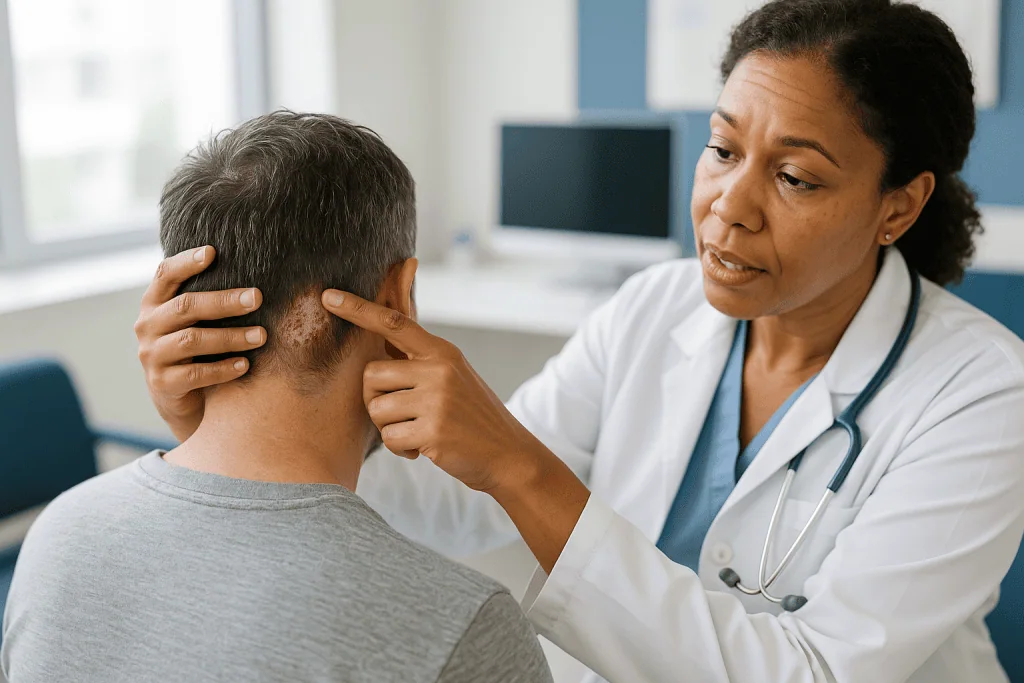
The edge of the patch is the first. Dandruff is diffuse; it spreads across the scalp with no clear border, and the skin fades gradually from pink to normal. Psoriasis plaques are sharply demarcated. You can often run a finger along the line where affected skin stops and healthy skin begins.
Thickness is the second. Dandruff sits on the surface as loose scale over relatively flat skin. Psoriasis builds up. Mayo Clinic describes plaques as raised, with a dry, silvery-white scale over red or, on darker skin, purple or gray patches. On the scalp, that scale can feel almost like a shell.
Where the problem goes is the third. Dandruff respects the hairline reasonably well, straying only into oily neighboring zones such as the eyebrows and ear creases. Scalp psoriasis frequently marches past the hairline onto the forehead, the back of the neck and the skin behind the ears, and it may leave a visible rim of plaque beyond the hair.
Finally, dermatologists look away from the head. The NHS lists elbows, knees, lower back and nails as classic sites for psoriasis, and describes nail changes such as pitting and lifting of the nail from its bed. A flaky scalp plus pitted nails or a scaly elbow is a very different picture from a flaky scalp alone. Family history counts too, since psoriasis often runs in families.
No one feature is required, and mild scalp psoriasis can look almost identical to dandruff, which is exactly why persistent or unusually thick scale deserves a professional look rather than another bottle.
Seborrheic dermatitis vs psoriasis on the scalp: the overlap that trips people up
Seborrheic dermatitis is the condition many people have without ever hearing the name. In plain terms, it is an inflammatory rash of the oily areas of the skin, and ordinary dandruff is its mildest scalp form. When it is more active, it produces pink, greasy patches with yellowish scale, most often at the hairline, in the eyebrows, beside the nose, in the ear canals and on the chest. In babies it is called cradle cap.
Mayo Clinic notes that seborrheic dermatitis can go away without treatment, or may need repeated treatments before symptoms settle, and that it tends to return. That pattern of flaring and fading is shared with psoriasis, which is one reason the two are mistaken for each other.
The overlap is real enough that dermatologists have a name for the in-between cases: sebopsoriasis, meaning a rash with features of both. Recognizing that gray zone is more honest than pretending every scalp fits one box.
Still, there are tendencies. Seborrheic dermatitis scale is greasy and yellowish and sits on skin that is only mildly thickened; psoriasis scale is drier, whiter and sits on genuinely raised plaques. Seborrheic dermatitis favors the central face and the folds beside the nose; psoriasis favors the extensor surfaces, meaning the outer elbows and front of the knees, along with the scalp margin and nails. Seborrheic dermatitis often improves with agents that target yeast; psoriasis does not respond to them in the same way, because yeast is not the driver.
When the picture stays ambiguous after examination, a dermatologist may take a small skin sample under local anesthetic, called a biopsy, to look at the tissue under a microscope. In practice this is uncommon for scalp flaking, but it exists for the cases that refuse to declare themselves.
Dandruff vs dry scalp vs psoriasis at a glance
Descriptions help, but a side-by-side view makes the pattern easier to hold in your head when you are standing in front of a mirror. The table below summarizes the features clinicians weigh, drawn from NHS and Mayo Clinic descriptions of each condition. Treat it as a guide to what to notice and mention at an appointment, not as a tool for diagnosing yourself.
| Feature | Dry scalp | Dandruff (mild seborrheic dermatitis) | Scalp psoriasis |
|---|---|---|---|
| Flake appearance | Small, fine, white, powdery | Larger, yellowish-white, greasy, clings to hair | Thick, dry, silvery-white scale in sheets |
| Skin under the flakes | Tight, may feel raw; usually not red or thickened | Oily, itchy; may be pink but mostly flat | Raised, firm plaque; red, purple or gray depending on skin tone |
| Borders | Diffuse | Diffuse, no clear edge | Sharply defined edge |
| Beyond the hairline | Rarely, unless the face is dry too | Eyebrows, sides of nose, ears, chest | Forehead rim, behind ears, back of neck |
| Elsewhere on body | Dry shins, hands, forearms | Oily facial folds, beard, central chest | Elbows, knees, lower back, nails |
| Timing and triggers | Cold, dry weather; hot showers; harsh cleansers | Stress, fatigue, cold weather; can wax and wane | Stress, infections, skin injury; long-term with flares |
| Family pattern | Not typically | Not strongly | Often runs in families |
Two caveats matter. The columns describe typical cases, and real scalps sit somewhere along a spectrum. And people of color may not see the redness that textbooks describe; psoriasis on darker skin can appear violet, brown or gray, and dandruff-related inflammation may be far less obvious than the scale itself. Texture and border are more reliable across skin tones than color.
Who tends to get which flaking cause
Age, skin type and family history shift the odds before anyone looks at a single flake.
Dry scalp can affect anyone but clusters in people who already have dry skin, in older adults whose skin holds less water, and in anyone who lives through a long, cold, low-humidity winter with indoor heating. People who wash with very hot water or use strongly degreasing products are more prone, as are those with eczema, a condition in which the skin barrier is inherently leakier.
Dandruff and seborrheic dermatitis follow oil. Mayo Clinic describes it as common in infants as cradle cap, then reappearing after puberty when sebum production climbs, and persisting through adulthood. Men are affected somewhat more often than women. Mayo Clinic also lists neurological and psychiatric conditions such as Parkinson’s disease and depression, a weakened immune system, and recovery from stressful medical events as factors that raise the likelihood or severity.
Psoriasis has a different profile. The NHS estimates it affects around 2 in 100 people in the UK and that it can start at any age, though it most often develops in adults between 20 and 30 and again between 50 and 60. A parent or sibling with psoriasis raises the chance considerably, and Mayo Clinic notes that triggers such as streptococcal throat infections, skin injury, certain medicines, smoking and heavy alcohol use can set off or worsen flares in people who are predisposed.
None of this tells you what you have. It tells a clinician which explanations to consider first. A teenager with an oily forehead and greasy flakes, an older adult with tight, itchy skin in January, and a thirty-year-old with a scaly elbow and a parent who has psoriasis are three different opening chapters, even if all three shoulders look the same.
Who should see a dermatologist, and who can reasonably wait
Most flaky scalps never need a specialist. The NHS advice for dandruff is straightforward: it is not usually a sign of anything serious, and a month of a suitable over-the-counter anti-dandruff shampoo is a reasonable first step before seeking help. Someone with fine white flakes, a tight scalp and dry skin elsewhere can equally try a gentler routine first: cooler water, a milder cleanser and less frequent washing during cold months.
So who is usually encouraged not to wait? A few situations stand out in NHS and Mayo Clinic guidance.
- Scale that is thick, raised and sharply bordered, or that extends onto the forehead, neck or behind the ears, because that pattern points toward psoriasis rather than dandruff.
- Flaking accompanied by patches on the elbows, knees or lower back, or by changes in the nails such as pitting, thickening or lifting.
- A scalp that has not improved after about a month of a suitable shampoo, or that got worse.
- Redness, swelling, oozing, crusting or pain, which can indicate infection or a different diagnosis altogether.
- Hair loss in the affected area, since several scarring scalp conditions begin with scale and itch.
- Symptoms that are affecting sleep, mood or confidence to the point that they are shaping daily life.
People with a weakened immune system, and parents of infants whose cradle cap is spreading or looks inflamed, are also usually advised to check in earlier rather than experiment.
Waiting is not the same as ignoring. It means giving one sensible change a fair trial while paying attention to the signs above. The decision about whether a scalp needs a specialist, and how urgently, sits with the clinician who examines it, and a primary care doctor is often the right first stop.
How to tell if you have scalp psoriasis: what happens at the appointment
People often expect a scalp examination to involve a machine. Mostly it involves a good light, a comb, a set of questions and experienced eyes.
The conversation comes first. Expect to be asked how long the flaking has been present, whether it comes and goes, what you have already tried and for how long, whether the itch keeps you awake, and whether anyone in your family has psoriasis or eczema. You may be asked about stress, recent illnesses, new medicines, joint stiffness in the mornings and changes in your nails. Joint questions can feel out of place, but psoriasis is associated with a form of arthritis, and the NHS notes that some people develop joint symptoms alongside skin disease.
Then the examination. The clinician parts the hair in several places to look at the skin, not the flakes, checking for raised plaques, the color and sharpness of the borders, and whether the scale is greasy or dry. They look at the hairline, behind the ears and at the back of the neck. They will usually ask to see your elbows, knees, lower back, nails and sometimes the scalp of the face, because a small plaque on an elbow can settle the question more decisively than anything on the head. Some dermatologists use a handheld magnifier called a dermatoscope to study the surface pattern.
In the large majority of cases, that is the whole process, and a working diagnosis is reached in the room. When the picture is genuinely unclear, when hair loss is present, or when a rarer scalp condition is a possibility, a small skin biopsy may be suggested, and a fungal scraping can be taken if ringworm of the scalp is suspected, particularly in children.
Bringing a phone photo of a bad flare and a list of everything you have used, with rough dates, genuinely helps.
How each cause is usually managed, and what the treatments actually do
Because the three conditions have different engines, they call for different tools. What follows describes what those tools do, not what any individual should use; that choice belongs to the clinician who has examined the scalp.
For dry scalp, the aim is to restore moisture and stop stripping it away. That typically means gentler, less frequent washing with milder cleansers, cooler water, and sometimes scalp moisturizers or oils that reinforce the skin barrier. Anti-dandruff formulas are often counterproductive here.
For dandruff and seborrheic dermatitis, the NHS and Mayo Clinic describe shampoos containing ingredients that work in one of three ways: antifungal agents such as ketoconazole or selenium sulfide reduce Malassezia yeast; zinc pyrithione has both antifungal and cell-turnover effects; and coal tar or salicylic acid slow shedding or soften scale so it lifts away. For inflamed patches, a clinician may prescribe a short course of a topical corticosteroid, a medicine that damps down inflammation, or a topical calcineurin inhibitor, which quiets the immune response in the skin by a different route.
For scalp psoriasis, yeast-targeting shampoos rarely help much, because yeast is not the problem. NHS guidance describes topical corticosteroids to reduce inflammation, vitamin D analogues that slow the overproduction of skin cells, and coal tar or salicylic acid preparations that thin thick scale so other treatments can reach the skin. When the scalp is severely affected or psoriasis is widespread elsewhere, dermatologists may consider phototherapy, meaning controlled exposure to ultraviolet light, or systemic medicines, including biologic drugs that block specific immune signals. Those decisions weigh the whole person, not just the scalp.
The through-line is diagnosis before treatment. The most common reason a scalp does not improve is not a weak product but the wrong target.
What the following weeks usually look like
Scalp conditions test patience, and knowing the typical rhythm prevents people from abandoning a sensible plan too early or clinging to a failing one too long.
For dandruff, the NHS suggests using an anti-dandruff shampoo for about a month before judging whether it is working, and Mayo Clinic notes that people often need to alternate between different types if one loses effect. During that month, flaking commonly eases gradually rather than vanishing overnight, and itch tends to settle before the shedding does. Once things are calmer, many people move to using the shampoo less often to keep the yeast in check. Flares with stress, illness or cold weather are normal and do not mean the approach has failed.
For dry scalp, improvement usually tracks the return of moisture, so the first sign is often that the tightness fades before the flakes fully disappear. Hair-washing habits set in winter may need to loosen again when humidity returns.
For scalp psoriasis, the timeline is longer and the language is different. NHS guidance describes psoriasis as a long-term condition with periods of no or mild symptoms followed by flares, and it notes that topical treatments can take several weeks before they have a noticeable effect. Thick scale usually has to be softened and lifted before anti-inflammatory treatments can work, so the first weeks may look like a lot of effort for little visible change. Many clinicians schedule a review a few weeks in to check progress, adjust the approach and watch for side effects.
Two things are worth planning for whichever diagnosis you have: a note of what you used and when, so the review appointment is based on facts rather than memory, and realistic expectations. The goal in each case is control, and control often looks like fewer, milder flares rather than a scalp that never sheds again.
What people often get wrong about scalp flaking
A handful of misunderstandings send people down the wrong path for months. Each has a simple correction.
“Flakes mean my scalp is dry, so I should wash less and oil more.” For genuinely dry scalp, yes. For dandruff, the opposite is often true: the scalp is oily, the yeast feeds on that oil, and Mayo Clinic lists regular washing as a way to reduce oil buildup. Adding oil to a seborrheic scalp can feed the very thing causing the flakes.
“Dandruff is a hygiene problem.” It is not. Malassezia lives on everyone’s scalp, and seborrheic dermatitis reflects how a particular person’s skin responds to it, not how often they shower. Shame has no place in this conversation.
“It’s contagious.” Neither dandruff nor psoriasis can be passed from person to person, as the NHS states plainly for psoriasis. Ringworm of the scalp, a true fungal infection, can spread and is one reason unusual scaly patches in children get checked.
“If it’s psoriasis, I’d have it on my elbows too.” Often, but not always. The scalp can be the only site for some time, which is why dermatologists rely on border, thickness and hairline spread rather than waiting for other patches to appear.
“Scratching or picking the scale off helps it heal.” Scraping thick plaques can cause pinpoint bleeding and, in psoriasis, skin injury itself can trigger new plaques. Softening scale with treatments a clinician recommends is the safer route.
“Sun fixes everything.” Mayo Clinic notes that small amounts of sunlight can improve psoriasis for some people, but too much can trigger a flare, and unsupervised sun exposure is not a substitute for prescribed phototherapy.
“Diet caused this.” There is no strong evidence that any specific food causes dandruff or psoriasis, though heavy alcohol use and smoking are recognized psoriasis triggers.
Questions to ask your care team
Appointments are short and scalps are hard to see for yourself, so a prepared list makes the time count. These questions are drawn from what patients most often say they wish they had asked.
- Which of the three do you think this is, and what did you see that pointed you there? Knowing the reasoning helps you notice changes later.
- Is there any feature that makes you want to rule something else out, such as eczema, a fungal infection or a scarring scalp condition?
- Should we look at my nails, elbows and joints today, and is there anything about my joints I should watch for over time?
- How is the treatment you are suggesting supposed to work, and what should I expect it to look like in the first few weeks?
- How long is a fair trial before we decide it is not working, and how would you like me to record progress?
- Are there ingredients or habits I should avoid while using this, including hair oils, styling products, hot water or specific shampoos?
- What are the possible side effects, and which ones mean I should stop and contact you?
- How should I adapt this for my hair type or texture, and for protective styles, braids or locs if I wear them?
- Will this affect hair coloring, relaxing or other chemical treatments?
- If this turns out to be psoriasis, who will be involved in my care over the long term, and what would prompt a change of approach?
A final question is worth asking of yourself before the visit: what outcome would make this worth it? For one person it is sleeping through the night without scratching; for another, wearing dark clothing again. Naming that goal helps the clinician tailor the plan, and it gives both of you a clear yardstick at the follow-up.
When to call your doctor
Most scalp flaking is uncomfortable rather than dangerous, and a month of sensible self-care is a reasonable first step for what looks like ordinary dandruff or a dry scalp. Certain changes, however, mean it is time to stop experimenting and be seen.
Contact your doctor or dermatologist if any of the following apply:
- The scalp becomes hot, swollen, very painful or starts weeping, oozing or forming honey-colored crusts, which can signal a bacterial infection that needs assessment.
- You develop a fever or feel unwell alongside a worsening scalp rash.
- Hair is falling out in the affected area, or you notice smooth, shiny bald patches, because some scalp conditions can scar and early treatment matters.
- Thick, raised plaques with sharp edges appear, spread beyond the hairline, or show up on your elbows, knees, back or nails.
- Your joints become stiff, swollen or painful, especially in the mornings, in someone with known or suspected psoriasis.
- A child has a round, scaly, itchy patch with broken hairs, which may be ringworm and can spread to others.
- Nothing has improved after about a month of a suitable over-the-counter approach, or the scalp has grown worse.
- The condition is affecting your sleep, mood or willingness to go out, or you feel low about it; that is a valid reason for help in its own right.
Seek same-day care if a scalp rash spreads rapidly across the body, if the skin becomes red and peels over large areas, or if you have a weakened immune system and any new, worsening rash.
Whatever the cause turns out to be, the plan should come from a clinician who has examined your scalp, knows your history and can follow how it responds. This article can help you describe what you are seeing; it cannot see it for you.
Frequently asked questions
What is the quickest way to tell dandruff vs dry scalp at home?
Look at the flake and feel the scalp. Dandruff flakes are larger, yellowish and greasy and cling to the hair on an oily, itchy scalp. Dry-scalp flakes are small, white and powdery on skin that feels tight, usually alongside dry skin on the shins or hands. If a month of anti-dandruff shampoo has made things worse, dryness is the likelier explanation, and a clinician can confirm.
How do doctors separate scalp psoriasis vs dandruff when both flake?
They look at the skin beneath the flakes rather than the flakes themselves. Psoriasis forms raised, firm plaques with sharp borders and dry, silvery scale that often spreads past the hairline, while dandruff produces diffuse, greasy scale on relatively flat skin. They also check elbows, knees, lower back and nails, and ask about family history, because psoriasis commonly appears in those places and runs in families.
Is seborrheic dermatitis the same as dandruff?
Dandruff is the mildest scalp form of seborrheic dermatitis. When the condition is more active, it causes pink, greasy patches with yellowish scale at the hairline, in the eyebrows, beside the nose, in the ears and on the chest. In infants it is called cradle cap. Mayo Clinic notes it can settle on its own or need repeated treatment and often returns, particularly with stress or cold weather.
Seborrheic dermatitis vs psoriasis on the scalp: can they overlap?
Yes. Dermatologists use the term sebopsoriasis for cases with features of both, and mild scalp psoriasis can look very similar to severe seborrheic dermatitis. Clues favoring psoriasis include drier, whiter scale on thicker plaques, sharp edges, involvement of the outer elbows or knees, and nail pitting. Clues favoring seborrheic dermatitis include greasy scale and patches in the oily facial folds. A skin biopsy is occasionally used when the picture stays unclear.
Can a dry scalp turn into psoriasis?
No. Dry scalp is a moisture and barrier problem, while psoriasis is an immune-mediated disease that people are genetically predisposed to; one does not become the other. Skin injury, including aggressive scratching, can trigger new plaques in someone who already has psoriasis, so a scalp that is scratched raw may look worse, but the underlying cause does not change. Persistent thick scale deserves a clinician’s assessment.
Is dandruff or scalp psoriasis contagious?
Neither can be passed from person to person. Dandruff reflects how an individual’s scalp reacts to a yeast that lives on everyone, and the NHS states that psoriasis is not contagious. Ringworm of the scalp is different: it is a true fungal infection that can spread through close contact or shared combs and hats, which is one reason a round, scaly patch with broken hairs in a child should be checked.
How long should I try a dandruff shampoo before seeing a doctor?
NHS guidance suggests using a suitable anti-dandruff shampoo for about a month to see whether the scalp improves. If there is no change after that, if the scalp has become more painful, red or crusted, if hair is falling out, or if thick plaques appear beyond the hairline or on other parts of the body, it is time to be seen rather than switching to yet another bottle.
How can I tell if I have scalp psoriasis when I have dark skin?
Focus on texture and borders rather than color. On darker skin, psoriasis plaques may look purple, brown or gray rather than red, and the redness described in textbooks may not be visible. The plaque itself will still feel raised and firm with a sharp edge you can trace, and the scale is typically dry and silvery. Nail pitting and patches on elbows or knees are useful additional clues for a clinician.
Does washing my hair more often help or hurt flaking?
It depends on the cause. For dandruff and seborrheic dermatitis, Mayo Clinic notes that regular washing reduces the oil that feeds the yeast, so washing more often can help. For a genuinely dry scalp, hot water and frequent washing strip moisture and can make flaking worse, so gentler, less frequent cleansing is usually the better direction. For psoriasis, washing habits matter less than treating the plaques themselves.
Will scalp psoriasis go away on its own?
Psoriasis is a long-term condition. The NHS describes periods of no or mild symptoms alternating with flares, so scalp plaques may quiet down for months and then return, often with stress, infection or skin injury. Treatment aims to control inflammation and slow skin turnover so flares are fewer and milder. How that is done, and whether more than topical treatment is needed, is a decision for the treating dermatologist.
References
This article is for general information only and is not a substitute for professional medical advice. Please consult a qualified doctor about your individual situation.

More from the Blog

What Folliculitis Looks Like, and Does It Go Away on Its Own?
Folliculitis usually looks like clusters of small red, pink, or skin-colored bumps, each centered on a hair, sometimes with a white or yellow pus-filled…

CO2 Laser and IPL: How Resurfacing and Light Treatments Differ and Who They Suit
A CO2 laser resurfaces skin by vaporizing thin layers and heating the tissue beneath, so it treats deeper wrinkles, acne scars and sun damage…

Why Does Folliculitis Keep Coming Back? How Dermatologists Investigate Recurrent Bumps
Folliculitis usually keeps coming back for an identifiable reason: bacteria such as Staphylococcus aureus carried on the skin or in the nose, repeated shaving…

When Alopecia Areata Returns After Regrowth: What a Relapse Means for the Next Treatment Step
An alopecia areata relapse means the immune system has again targeted hair follicles that had recovered. Relapse is common in this condition and does…

Fungal Acne: Why It Is Not Acne at All and Why Acne Treatments Make It Worse
Fungal acne is the everyday name for Malassezia folliculitis, an inflammation of hair follicles driven by overgrowth of a yeast that lives on nearly…

Does Psoriasis Affect the Joints? Why Dermatologists Ask About Stiffness and Adjust the Plan
Yes. Psoriasis can affect the joints through a related condition called psoriatic arthritis, which develops in up to about 30 percent of people with…