

Is PRK or SMILE Better for You? No Flap in Either, Very Different Recoveries

Key Takeaways
- PRK and SMILE both avoid a LASIK flap, but PRK removes the entire corneal surface layer while SMILE removes an internal disc through an incision only a few millimeters long.
- PRK recovery involves several days of grittiness and light sensitivity while the epithelium regrows, whereas SMILE typically produces a foggy first day and mild discomfort.
- SMILE is licensed in most countries only for nearsightedness with or without astigmatism, so farsighted patients are usually offered PRK or another approach.
- Thin corneas often favor PRK because it spends almost no structural tissue on access, though individual thickness and topography maps decide, not the rule.
- Corneal haze is a PRK-specific risk that rises with larger corrections and ultraviolet exposure during healing, which is why an anti-scarring medicine is often applied and strict sunglass use is advised.
- Mayo Clinic notes that vision after laser correction can take two to three months to stabilize, so early clarity after either procedure is not the same as being fully healed.
Neither PRK nor SMILE is better for everyone. Both reshape the cornea without a LASIK-style flap, but PRK removes the eye's surface layer and heals over days to weeks with more early discomfort, while SMILE removes a thin internal disc through a small incision and usually settles faster. Corneal thickness, prescription type, dry-eye history and lifestyle decide which fits, and that judgment belongs to your eye surgeon.
She had two printouts on the kitchen table. One consultation had leaned toward SMILE; a second opinion had suggested PRK because her corneas measured on the thin side and she plays goalkeeper on weekends. Both surgeons had used the same reassuring phrase: no flap. Neither had really explained why, if that was true, the two recoveries sounded like different procedures altogether.
That is the real prk vs smile question. It is rarely about which laser is newer or which name sounds friendlier. It is about where in the cornea the reshaping happens, how the surface heals afterward, and which trade-offs a particular pair of eyes can afford.
This explainer walks through what actually happens in each procedure, who tends to be steered toward one or the other, what the first days and weeks feel like, and where the evidence is genuinely thin. The aim is not to pick for you. It is to make the conversation with your care team a sharper one.
Why 'no flap' is true for both, and why it still isn't the whole story
The cornea is the clear, dome-shaped front window of the eye, and it does most of the eye’s focusing. Laser vision correction works by changing its curvature by a few hundredths of a millimeter so that light lands on the retina instead of in front of it (nearsightedness) or behind it (farsightedness).
LASIK, the procedure most people picture, does this by cutting a thin hinged flap in the cornea, folding it back, reshaping the tissue underneath with a laser, and laying the flap down again. The flap is what makes LASIK comfortable and quick to recover from, and it is also the source of a specific set of complications: flap wrinkles, dislodgement after a blow to the eye, and cells growing underneath it, which Mayo Clinic lists among LASIK’s recognized risks.
PRK and SMILE both avoid that flap, which is why they get bundled together in marketing copy. The similarity ends there. PRK works from the outside in, removing the cornea’s skin-like surface layer entirely so the laser can sculpt the tissue directly beneath. SMILE works from the inside out, carving a lens-shaped sliver within the cornea and drawing it out through a small side opening while the surface stays almost intact.
That single difference explains nearly everything that follows: why PRK stings for days and SMILE usually does not, why PRK can treat farsightedness and SMILE in most settings cannot, and why the two carry different risks if something needs adjusting later. Reading them as interchangeable ‘flapless’ options is the first mistake worth unlearning.
PRK vs SMILE: how each procedure actually works, step by step
Both take place awake, under numbing drops, with a small holder keeping the eyelids open. Most people describe pressure rather than pain during the procedure itself. From there the paths split.
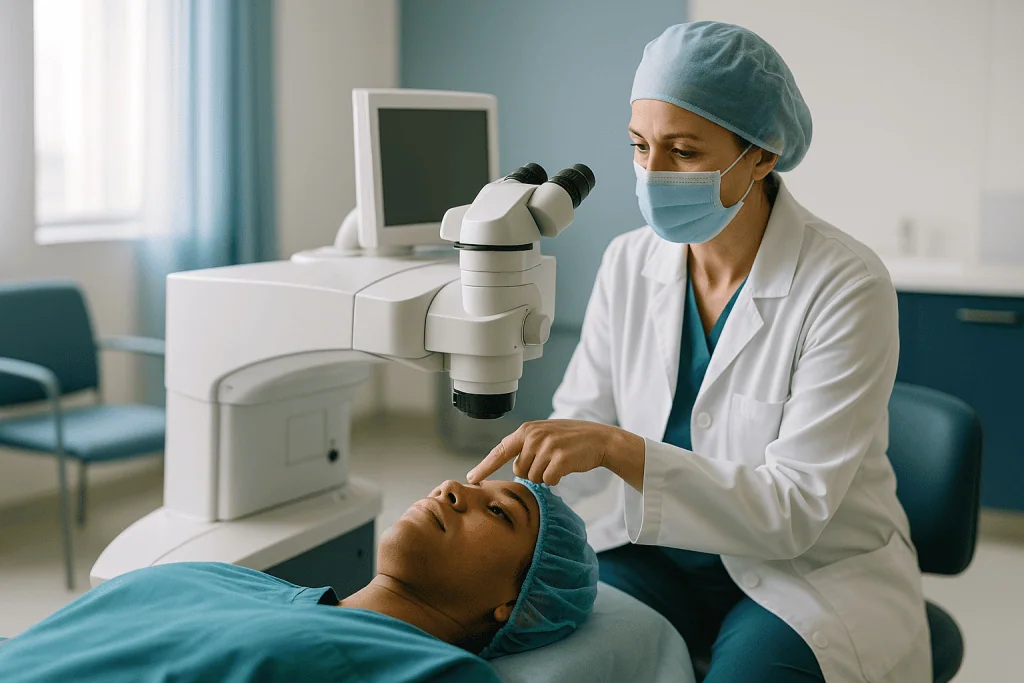
PRK stands for photorefractive keratectomy. The surgeon first removes the epithelium, the outermost layer of corneal cells, roughly the thickness of a sheet of paper. This can be done with a diluted alcohol solution, a soft brush, or the laser itself, an approach sometimes called transepithelial PRK. With the surface cleared, an excimer laser, an ultraviolet laser that vaporizes microscopic amounts of tissue without heat damage, reshapes the exposed layer according to a map of your prescription. In many cases the surgeon then briefly applies an antimetabolite medicine, a drug that slows scar-forming cells, to reduce the chance of haze. A clear bandage contact lens is placed to protect the raw surface while new epithelium grows across it.
SMILE stands for small incision lenticule extraction. A femtosecond laser, one that fires pulses lasting a quadrillionth of a second, creates two precise planes inside the cornea, defining a thin disc of tissue called a lenticule. The same laser makes a small arc-shaped opening at the edge, only a few millimeters long. The surgeon then loosens the lenticule with a fine instrument and slides it out through that opening. Removing the disc flattens the cornea by exactly the shape that was cut. No excimer laser is used, and the epithelium remains in place except at the incision.
The laser portion of either procedure lasts well under a minute per eye. What differs is what your eye has to rebuild afterward: in PRK, an entire surface; in SMILE, a small seam.
Who is usually offered PRK, who is offered SMILE, and who is asked to wait
Surgeons do not choose between these procedures by preference alone. Several measurements and history points push the decision.
PRK tends to be suggested when the cornea is thinner than average, because it spares the tissue that LASIK would spend on a flap and SMILE would spend on the cap above the lenticule. It is also the surface-based choice for people with irregular or fragile epithelium, for certain occupations and sports with a real risk of eye impact, and for farsightedness, which SMILE is not licensed to treat in most countries. PRK is frequently the tool used to fine-tune a previous laser procedure.
SMILE tends to be suggested for moderate to higher nearsightedness with or without astigmatism, an irregular curvature that blurs at all distances, in people who want a quick visual recovery and have a history of dry eye that makes surgeons wary of cutting more corneal nerves. Prescriptions at the very low end can be harder to treat with SMILE because the lenticule becomes too thin to handle cleanly.
Asked to wait or steered elsewhere are people whose prescription is still changing; the NHS notes that vision can continue to shift into the early twenties, and stability over a sustained period is expected before any laser surgery. Pregnancy and breastfeeding, uncontrolled diabetes, active eye inflammation, and autoimmune conditions that impair healing are common reasons to postpone. Keratoconus, a progressive thinning and bulging of the cornea, rules out both procedures; a cornea already weakening should not be made thinner. Very severe dry eye, cataract, and unrealistic expectations about reading without glasses in later life are also reasons a careful surgeon may say not yet, or not this.
SMILE vs PRK recovery: what the first days and weeks usually look like
This is where the two procedures feel least alike, and where patient forums are full of surprised people who expected the same experience.

After PRK, the first two to four days are the hard part. The epithelium has to regrow across the treated zone under the bandage lens, and until it does, the eye can feel gritty, watery, light-sensitive and sore. Vision is blurry and fluctuates. Cleveland Clinic describes the surface healing over roughly the first week, at which point the bandage lens is removed, while functional vision continues to sharpen over the following weeks. Many people plan several days away from screens and driving. Best corrected clarity can take longer still; Mayo Clinic notes that after laser correction it may be two to three months before vision fully stabilizes, and PRK generally sits at the slower end of that range.
After SMILE, most people notice a foggy, slightly smoky quality to their vision for the first day, sometimes described as looking through a steamed window. Discomfort is usually mild and short-lived because the surface is nearly intact. Vision typically clears substantially within the first days, though fine contrast and night vision can continue improving for weeks.
Both procedures involve a course of prescribed anti-inflammatory and antibiotic drops for a period your surgeon sets, along with lubricating drops. Both carry the same instructions: no rubbing, no swimming or hot tubs, no eye makeup, and protective shields while sleeping for the early stretch. Follow-up visits are scheduled in the first day or two and then at intervals over the following months. The difference is not whether you recover, but how many rough days sit between surgery and normal life.
PRK vs SMILE side by side: the comparison table
Numbers and timelines below are typical ranges drawn from the referenced patient resources, not promises for any individual eye.
| Feature | PRK | SMILE |
|---|---|---|
| Where reshaping happens | Surface, after epithelium is removed | Inside the cornea, under an intact surface |
| Laser used | Excimer (UV) laser | Femtosecond laser only |
| Incision or flap | None; entire surface layer regrows | Small arc incision of a few millimeters |
| Prescriptions treated | Nearsightedness, farsightedness, astigmatism | Nearsightedness with or without astigmatism (in most countries) |
| Early discomfort | Moderate for the first several days | Usually mild, first day or two |
| Functional vision returns | Days to a few weeks (Cleveland Clinic) | Often within the first few days |
| Full stabilization | Up to two to three months (Mayo Clinic) | Weeks to a few months |
| Bandage contact lens | Yes, until surface heals | Usually no |
| Haze risk | Present, especially with higher corrections | Low |
| Suitability for thin corneas | Often preferred | Depends on cap thickness and residual tissue |
| Impact-sport concern | No flap or pocket to displace | No flap; pocket generally considered stable |
| Retreatment options | Repeat surface treatment once healed | Usually a surface procedure rather than repeat SMILE |
Two lines deserve a second look. The prescriptions row explains why some people never get a genuine choice: if you are farsighted, SMILE is typically off the table. The retreatment row matters more than most patients realize, because a small percentage of any laser procedure needs fine-tuning, and the route back in differs.
Dry eye after PRK vs SMILE: what the evidence actually shows
Dry eye is the most common complaint after any corneal laser procedure, and Mayo Clinic notes it is often most noticeable in the first six months after LASIK. The mechanism is nerve injury. The cornea is one of the most densely innervated tissues in the body, and those nerves drive the blink reflex and tear production. Cut them and the eye’s moisture-management system loses part of its signal until they regrow.
LASIK severs nerves twice: around the whole circumference of the flap and again across the treated bed. SMILE’s appeal is that its small incision leaves most of the nerve fibers entering from the edge untouched, which is the biological argument for less dry eye. Several comparative studies of SMILE versus LASIK have reported milder or shorter-lived dryness after SMILE, though findings are not uniform and long-term differences tend to shrink as nerves recover.
PRK sits in a different place. It removes surface nerve endings across the treated zone but does not cut a deep side incision, so the fibers running in from the periphery are spared. Some patients experience marked dryness during the weeks the surface is healing, then improve as the epithelium matures.
Here is the honest gap: head-to-head trials of PRK against SMILE are fewer and smaller than SMILE-versus-LASIK studies, and they differ in how they measure dryness. There is no strong basis for telling someone that one is definitively gentler on tears than the other. What the evidence supports is asking your surgeon how your baseline tear film measured, whether any pre-existing dry eye was treated before surgery, and what the plan is if symptoms linger. Anyone already using artificial tears daily before a consultation should say so early.
What are the downsides of PRK surgery? An honest list
PRK is often described as the safest option for thin corneas, and that is partly fair. It is not free of trade-offs, and the ones below come up repeatedly in patient questions.
The recovery is uncomfortable. Removing the epithelium creates, in effect, a large corneal abrasion. Pain, tearing and light sensitivity for the first several days are expected rather than exceptional, and some people find those days harder than they were led to believe.
Vision takes longer to sharpen. Because the new surface layer has to smooth itself out, many people are not confident driving or reading fine print for one to two weeks, with continued fluctuation after that. Cleveland Clinic describes clarity improving over weeks, not hours.
Corneal haze is a specific PRK risk. As the surface heals, scar-forming cells can lay down slightly cloudy tissue in the treated zone. The intraoperative antimetabolite mentioned earlier was introduced largely to counter this, and the risk climbs with higher prescriptions and with too much ultraviolet exposure while healing, which is why strict sunglass use is advised.
Infection risk is front-loaded. An open surface under a bandage lens is more vulnerable in the first days than a SMILE eye with an intact epithelium, so drop schedules and hygiene instructions matter more than they might feel.
Regression can occur. Any laser procedure can drift partway back toward the original prescription as the cornea remodels, and surface treatments for larger corrections have historically shown more of this than deeper ones. This is why retreatment discussions belong in the initial consultation, not afterward.
None of these makes PRK a poor procedure. They make it a procedure that suits people who value tissue preservation and are prepared for a slower, sorer first week.
What are the downsides of SMILE? The other honest list
SMILE marketing leans hard on gentleness, and the early comfort is real. The procedure has its own limits, several of which are structural rather than rare complications.
It cannot treat farsightedness in most settings. Regulatory approvals in many countries cover nearsightedness and astigmatism only. If your prescription is plus-powered, this conversation is likely over before it starts.
Very low prescriptions are technically awkward. The lenticule must be thick enough to grasp and remove intact. For small corrections, surgeons may prefer a surface or flap procedure for that reason alone.
Centration depends on you. During the femtosecond laser portion, the eye is held gently against a curved contact glass. Unlike modern excimer platforms, most SMILE systems do not actively track eye movement, so a small shift in fixation during those seconds can offset the treatment slightly. Skilled surgeons manage this well, but it is a genuine difference in how the procedures handle a nervous patient.
Suction loss and incomplete lenticule removal are recognized intraoperative events. If suction breaks partway through, the procedure may be paused or converted, and a small tissue remnant left behind can cause irregular vision that needs correcting.
Enhancement is less straightforward. Because the cornea’s surface was never opened, fine-tuning usually means a surface treatment, a separate procedure with its own PRK-style recovery, rather than a repeat SMILE.
Early vision is foggy. The smoky quality on the first day is expected, but it surprises people who anticipated instant clarity, and it can persist longer in some eyes.
Long-term data now extend across many years, and stability appears comparable to established procedures, but SMILE remains the younger of the two techniques.
Which is better, PRK or SMILE, if you have thin corneas or play contact sports?
These two scenarios drive a large share of the prk vs smile debate, and they pull in slightly different directions.
Thin corneas. Every laser correction removes tissue, and surgeons want a comfortable margin of untouched cornea beneath the treatment to keep the structure strong. LASIK spends tissue on a flap before treatment even begins. SMILE spends it on the cap, the layer above the lenticule, which is typically thinner than a LASIK flap but still real. PRK spends almost nothing on access because the epithelium regrows rather than counting as lost structural tissue. That is why a borderline cornea often nudges the recommendation toward PRK. The counterargument some surgeons make is that SMILE leaves the strongest front layers of the cornea largely intact, potentially preserving biomechanical strength differently. The evidence on which approach better protects against ectasia, a rare late weakening and bulging of the cornea, is still developing and depends heavily on individual measurements rather than a general rule.
Contact sports, martial arts, military and emergency work. The traditional concern is flap displacement after LASIK, which can occur even years later after a direct blow. PRK has no flap and nothing to dislodge once healed, which is why it has long been favored in these groups. SMILE also has no flap, and its internal pocket is generally regarded as stable, but the body of evidence on blunt trauma after SMILE is smaller simply because the procedure is newer.
So the honest answer: thin corneas often favor PRK; impact risk favors either flapless option, with PRK carrying the longer track record. Your topography and thickness maps will matter more than either generalization.
What is the failure rate of PRK or SMILE? Rethinking the question
People searching for a failure rate usually want one number that tells them whether to worry. Laser vision correction does not produce one, because ‘failure’ can mean several different things.
Undercorrection or overcorrection. The cornea heals slightly differently in every eye, so a small proportion of people end up a bit short of, or beyond, the target. Mayo Clinic lists both among LASIK’s known outcomes, and the same applies to PRK and SMILE. Often the residual error is mild enough to live with; sometimes an enhancement is offered once the eye has stabilized.
Regression. Over months or years, the cornea can drift partway back. This is more likely with larger corrections and is one reason surgeons want a stable prescription before operating.
Visual quality problems. Glare, halos and starbursts around lights at night are a distinct category. Mayo Clinic notes these can last for weeks and occasionally longer. They are not a failure to correct the prescription, but they can matter more to a night driver than a line on an eye chart.
Complications. Infection, significant haze after PRK, ectasia, and, for SMILE, retained tissue or a torn cap are uncommon but real, and they are the events that a thorough consent discussion should cover.
Reputable sources avoid quoting a single satisfaction or success percentage for good reason: results vary with prescription size, age, technology and surgeon, and a headline figure from one study transfers poorly to your eye. The more useful questions are how often your surgeon’s patients need enhancement, how residual error is handled, and what happens if you are among the small group with persistent night symptoms. Those answers exist. A universal failure rate does not.
What people often get wrong about PRK vs SMILE
Myths in this area travel fast because both procedures are marketed by name. A few corrections, grounded in what the evidence supports.
‘No flap means no risk.’ Avoiding a flap removes flap-specific problems. It does not remove dry eye, night glare, under- or overcorrection, infection or, rarely, ectasia. Both PRK and SMILE carry these.
‘SMILE is the newest, so it must be the best.’ Newer means less long-term data, not more. SMILE has now accumulated years of follow-up and performs well, but PRK has decades. Neither fact makes one better for your cornea.
‘PRK is the old-fashioned option.’ Modern PRK, with transepithelial techniques, anti-haze medicine and refined laser profiles, is not the procedure of the early years. Surgeons still choose it deliberately for thin corneas and for retreatments.
‘Recovery means when I can see.’ Seeing well enough to drive and being fully healed are different milestones. Mayo Clinic notes stabilization can take two to three months regardless of early clarity.
‘Any laser surgery stops me needing reading glasses later.’ Neither PRK nor SMILE prevents presbyopia, the age-related stiffening of the eye’s lens that makes near focus harder in midlife. Both correct distance vision; reading glasses may still arrive on schedule.
‘The one my friend had is the one I should have.’ Another person’s corneal thickness, prescription and tear film are not yours. This is also the answer to the celebrity question in the FAQs below.
‘If the first surgeon pushes one option, I should be suspicious.’ Strong recommendations often reflect a specific measurement. Ask which finding drove it. A good answer names the number.
What happens at the pre-op assessment, and what your surgeon is weighing
The consultation is where the prk vs smile decision is genuinely made, and understanding the tests helps you follow the reasoning rather than just receive a verdict.
Refraction measures your prescription, often twice, including once with drops that relax focusing so that the true error is not hidden by effort. Corneal topography maps the curvature of the front surface point by point, hunting for the subtle asymmetry that can signal early keratoconus. Pachymetry measures corneal thickness, sometimes across the whole surface using optical scanning. Tear-film testing checks how quickly tears break up and how much the eye produces. Pupil measurement in dim light matters because a large pupil that expands beyond the treated zone at night is associated with glare and halos. A dilated examination of the retina and lens completes the picture.
Contact lens wearers are usually asked to stop lenses for a period before these measurements, since lenses temporarily mold the cornea and can distort the maps; the length of that break is set by the clinic and depends on lens type.
From these results the surgeon calculates how much tissue each procedure would remove and how much would remain, checks whether your prescription falls within each technique’s approved range, and looks at your life: occupation, sports, screen hours, driving at night, dry-eye history, and how many rough days you can realistically afford after surgery. Someone who cannot take a week away from detailed work may be steered toward SMILE if their corneas allow; someone with borderline thickness may hear PRK regardless of preference.
If you are told one option is off the table, ask which measurement decided it. The answer should be specific, and it should make sense.
Questions to ask your care team before choosing PRK or SMILE
Bring these written down. The value lies less in the answers themselves than in how clearly and specifically they are given.
- Which of my measurements most influenced your recommendation, and what were the actual numbers for corneal thickness and topography?
- How much corneal tissue would remain after PRK versus SMILE in my case, and what margin do you consider safe?
- Does my prescription fall inside the approved range for SMILE here, and is my astigmatism within what it treats well?
- How did my tear film measure, and would you want any dry-eye treatment before surgery?
- What does the first week realistically look like for each option, including time off work and driving?
- How often do your patients need an enhancement after each procedure, and how is that done if I choose SMILE?
- What is the plan if I develop haze after PRK, or if a lenticule cannot be fully removed during SMILE?
- How large are my pupils in dim light, and does that change my night-vision risk?
- Will I still need reading glasses in midlife, and would you approach my eyes differently with that in mind?
- Which drops will I use afterward, for how long, and who do I call if something feels wrong at night or on a weekend?
- What would make you cancel on the day, and is there a cooling-off period if I change my mind?
A confident surgeon welcomes this list. The answers should refer to your scans, not to a brochure, and should include at least one reason you might reasonably choose the other option, or neither. If every question is answered with reassurance and no numbers, a second opinion is a sensible next step, not an insult.
When to call your doctor after PRK or SMILE: red-flag signs
Some discomfort is expected, especially after PRK, and your surgeon will describe what normal healing feels like for the procedure you had. Certain symptoms fall outside normal and should prompt a same-day call to your surgical team, or a visit to emergency care if the team cannot be reached.
- Pain that is worsening rather than easing after the first two to three days, or severe pain at any point that drops do not touch
- A sudden drop in vision after it had been improving, or a new dense blur in one eye
- Increasing redness, especially with thick discharge, or a white or gray spot visible on the cornea, which can signal infection
- Marked light sensitivity that returns after settling, or a feeling that something is stuck in the eye that persists after the bandage lens is out
- A bandage contact lens that falls out or shifts in the first days after PRK; do not try to reinsert it yourself
- Any blow, poke or rub to the eye in the early weeks, even if it seems minor
- New flashes of light, a curtain or shadow across part of your vision, or a sudden shower of floaters, which point to the retina rather than the cornea and need urgent assessment
- Symptoms in an eye that seemed fully healed, weeks or months later, such as new distortion or worsening night halos
Corneal infections and retinal problems are uncommon after these procedures, but both are time-sensitive, and the cost of an unnecessary call is far lower than the cost of waiting. Keep the after-hours number your clinic gave you somewhere you can find it without your glasses. Do not stop or change any prescribed drops on your own; if a drop stings badly or seems to be causing a reaction, call and ask. Every decision about adjusting treatment sits with the team that operated.
Frequently asked questions
Which is better, PRK or SMILE?
Neither is better across the board; each suits different eyes. PRK is often chosen for thin corneas, farsightedness, high-impact lifestyles and retreatments, at the cost of a sorer, slower first week. SMILE suits many nearsighted people who want faster comfort and have dry-eye concerns, but it cannot treat farsightedness in most settings and is harder to fine-tune later. Your corneal measurements and prescription, reviewed by your surgeon, decide.
What eye surgery did Taylor Swift get?
The procedure widely reported in the press was LASIK, not PRK or SMILE, and the details were never medically confirmed in a way this article can verify. More to the point, a celebrity’s choice tells you nothing about your own corneal thickness, prescription or tear film. The right procedure is the one your measurements support, which is why the consultation matters more than any public example.
What are the downsides of PRK surgery?
The main downsides are a painful, light-sensitive first few days while the surface layer regrows, blurry and fluctuating vision for a week or more, a specific risk of corneal haze in the treated zone, a front-loaded window of infection risk while the surface is open, and the possibility of partial regression with larger corrections. Cleveland Clinic describes clarity improving over weeks rather than hours after PRK.
What is the failure rate of PRK?
There is no single failure rate, because outcomes are described in several ways: residual under- or overcorrection, regression over time, night glare and halos, and uncommon complications such as haze or infection. Mayo Clinic lists these categories as known risks of laser correction without a headline figure, since results vary with prescription, age and technology. Ask your surgeon how often their patients need an enhancement instead.
How does SMILE vs PRK recovery differ in the first week?
After PRK, expect two to four difficult days of grittiness, tearing and light sensitivity under a bandage contact lens, with the lens removed once the surface has healed around the end of the first week. After SMILE, most people describe a foggy first day and mild irritation, with useful vision returning within a few days. Both require prescribed drops and protection from rubbing, water and dust.
Is dry eye worse after PRK or SMILE?
The evidence does not clearly favor one over the other. SMILE spares many corneal nerves entering from the edge, which is the argument for less dryness, while PRK removes surface nerve endings but makes no deep side incision. Most comparative studies pit SMILE against LASIK rather than PRK, and results are mixed. Pre-existing dry eye should be measured and, where needed, treated before either procedure.
Can SMILE eye surgery treat astigmatism and farsightedness like PRK?
SMILE treats nearsightedness and nearsighted astigmatism, and it does that well within its approved range. In most countries it is not licensed for farsightedness, so plus-powered prescriptions are usually directed toward PRK, LASIK or lens-based options. PRK can treat nearsightedness, farsightedness and astigmatism. If you are farsighted, ask early whether SMILE is even available to you.
Which is safer for thin corneas, PRK or SMILE?
PRK is often preferred because it removes almost no structural tissue for access; the surface layer regrows rather than counting as lost cornea. SMILE spends tissue on the cap above the lenticule, though it leaves the strong front layers largely intact, and some surgeons weigh that differently. The deciding factors are your measured thickness, topography and how much tissue would remain, not a general rule.
What happens if I need a touch-up after SMILE or PRK?
After PRK, a repeat surface treatment can usually be performed once the eye has fully stabilized, which Mayo Clinic notes may take two to three months. After SMILE, fine-tuning typically means a surface procedure such as PRK rather than a second SMILE, so it comes with a PRK-style recovery. Ask your surgeon how enhancements are handled and how often they are needed before choosing.
Will PRK or SMILE stop me needing reading glasses later?
No. Both procedures correct distance vision by reshaping the cornea; neither prevents presbyopia, the age-related stiffening of the eye’s internal lens that makes close focus harder in midlife. Reading glasses may still be needed on the usual timetable. Some surgeons discuss adjusting the target in one eye for this reason, which is a separate decision to raise at your consultation.
References
This article is for general information only and is not a substitute for professional medical advice. Please consult a qualified doctor about your individual situation.

More from the Blog
How Trabeculectomy Lowers Eye Pressure: The Tiny Flap, the Bleb and the Operating Room Steps
Trabeculectomy lowers eye pressure by creating a new, controlled exit for the fluid inside the eye. The surgeon lifts a tiny trapdoor in the…

When a Chalazion Keeps Coming Back: Repeat Treatment and Why a Biopsy May Be Advised
A recurring chalazion is an eyelid oil-gland blockage that returns after it has settled or been drained. Repeat episodes are usually linked to ongoing…

When Does a Damaged Cornea Need Surgical Repair? Injuries, Infections and Thinning Explained
A damaged cornea needs surgical repair when the injury, infection or thinning threatens the eye's structure or cannot heal with medicines alone: a full-thickness…
Pain, Light Sensitivity or Blurred Vision With Pink Eye: Why These Need Same-Day Review
Most pink eye is mild conjunctivitis that settles on its own, but eye pain, sensitivity to light, or blurred vision that does not clear…

Oculoplastic Surgery Recovery: Cold Compresses, Sleeping Propped Up and Bruise Timelines
Oculoplastic surgery recovery, including eyelid procedures such as blepharoplasty, usually brings the most swelling and bruising in the first two to three days, with…

Is Your Keratoconus Progressing? How Specialists Read the Topography Map
Keratoconus is considered progressing when repeated corneal scans show a consistent trend rather than a single change: steepening of the front surface (often tracked…