

Is Sensitivity After a Dental Filling Normal? When a Bite Adjustment Helps
Key Takeaways
- Cold twinges that vanish within seconds and ease week by week are the expected response of a recently filled tooth, and Cleveland Clinic notes they can take a few weeks to settle.
- Pain every time you bite, or a tooth that feels tall, usually signals a high filling, which never lowers itself and is corrected with a short bite adjustment using colored marking paper.
- Pain that lingers for minutes after a trigger, arrives spontaneously, or wakes you at night points to a pulp that may not recover and needs prompt assessment rather than more waiting.
- Teeth localize pain poorly, so a filled tooth is often blamed for discomfort coming from a neighbor, the jaw, or, for upper molars, the sinus.
- Clenching or grinding loads a fresh filling first; Mayo Clinic lists increased tooth sensitivity among the signs of bruxism, and one tooth's soreness may reflect a whole-mouth force problem.
- Facial swelling, fever, pus, or difficulty swallowing or breathing are NHS red flags for a dental abscess and call for same-day care.
Mild sensitivity to cold, sweets, or pressure is common after a dental filling and usually fades over days to a few weeks as the tooth settles. Pain when biting down often points to a filling that sits slightly high; a brief bite adjustment by your dentist may be all that is needed. Sensitivity that worsens, lingers, throbs, or comes with swelling needs a dental review.
The filling appointment was uneventful. Forty minutes, some pressure, a numb lip that made lunch a clumsy affair. Two days later, Maria takes a sip of iced tea and a bright, electric zing shoots through the tooth on the lower left. She sets the glass down and thinks the thought everyone thinks: did something go wrong?
Almost certainly not. A tooth sensitive after filling is one of the most common experiences in dentistry, and most of the time it is a tooth doing exactly what an irritated tooth should do: complaining for a while, then quieting down. The nerve inside has just had a construction project happen a few millimeters from its front door.
Still, not every ache is the same ache. Cold twinges that fade in seconds mean one thing. Pain every time you chew means another, and that second kind often has a surprisingly simple fix that takes a dentist about five minutes. Knowing the difference is what this guide is for.
Why is my tooth sensitive after filling? What actually happens inside the tooth
Picture a tooth as three layers. Enamel is the hard outer shell. Underneath sits dentin, a softer, living tissue riddled with thousands of microscopic tubes called dentinal tubules. At the center lies the pulp, the soft core that holds the tooth’s nerve and blood supply. Decay eats through enamel and into dentin, so removing it means a dentist’s drill is working inside the dentin, sometimes close to the pulp.
Those tubules matter. Each one is filled with fluid and connects, in effect, to the nerve. When cold, sweet, or air touches freshly cut dentin, fluid inside the tubules shifts, and the nerve reads that movement as a sharp jolt. Cleveland Clinic describes this as the basic mechanism behind sensitive teeth generally, and a newly filled tooth is simply a concentrated version of it.
There is a second player: the pulp itself. Drilling produces heat and vibration, the tooth is dried and etched to bond the filling, and the pulp responds with mild inflammation. Dentists call this pulpitis, meaning an inflamed pulp. In its reversible form, the pulp calms down on its own and lays down a protective layer of new dentin over weeks, walling itself off from the disturbance.
Then there is the tissue around the tooth. The injection site can feel bruised. The gum beside the filling may have been pushed aside by a metal band or clamp used to shape the filling. The ligament that suspends the tooth in its socket may have been jostled. Each of these has its own small recovery clock.
Put together, a certain amount of post-filling sensitivity is not a complication. It is the expected response of living tissue to a necessary repair.
How long should a tooth be sensitive after a filling? What the first days and weeks usually look like
The first evening is mostly about the anesthetic wearing off. The lip and tongue tingle back to life, the injection site feels bruised, and the jaw may ache from being held open. None of this is the tooth talking yet.
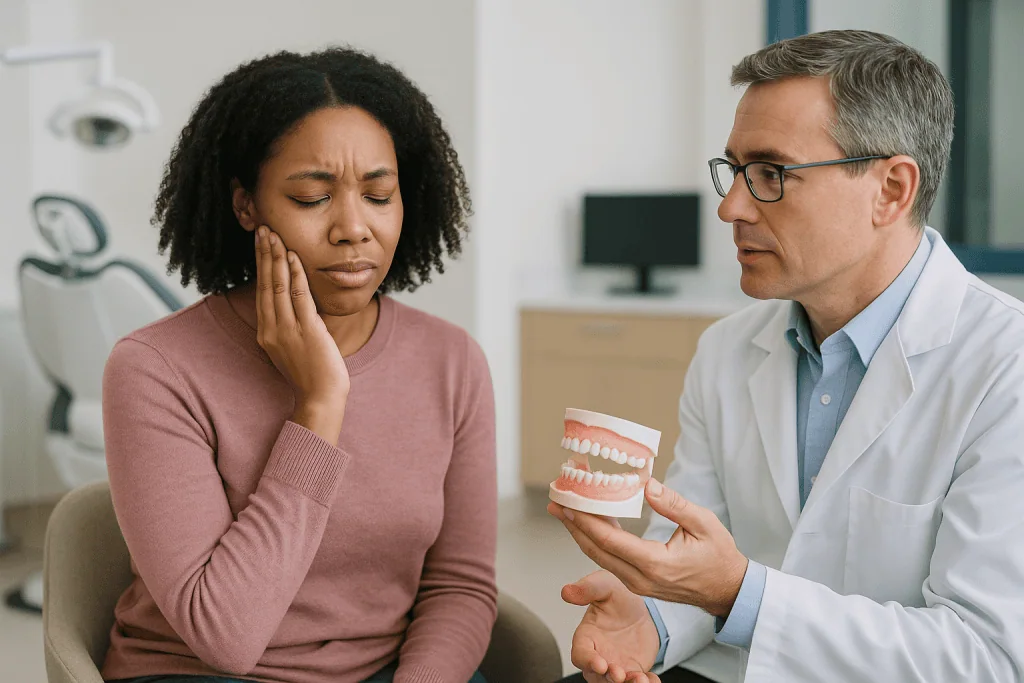
Over the following days, the tooth introduces itself. Cold drinks and cold air are the usual triggers. Sweet foods sometimes set it off. Brushing the area may sting. The classic pattern is a short, sharp sensation that arrives with the trigger and disappears within seconds once the trigger is gone.
From there, the trajectory is what matters more than any single day. Cleveland Clinic notes that it is common for a tooth to remain sensitive for a few weeks after a filling, and that people should contact their dentist if sensitivity does not improve over that period or grows worse. A good week is one where the zings are a little less frequent, a little less intense, or need a colder drink to set them off than the week before.
For general toothache, the NHS advises seeing a dentist if pain lasts more than two days. After a filling, dentists interpret that advice in context: brief, trigger-linked twinges are expected, but a constant ache that never lets up is not, and it deserves a phone call rather than a wait.
Two things should not be happening on this timeline. The tooth should not hurt spontaneously, out of nowhere, with no cold or pressure involved. And it should not be waking you at night. Those patterns belong to a different chapter, covered later.
What is a "high" filling, and what are high filling symptoms?
Occlusion is the dentist’s word for how the upper and lower teeth meet when you close. Ideally, dozens of small contact points land at once, spreading the force of a bite across many teeth. A filling that sits even slightly above its neighbors changes that. One tooth hits first and takes the full load alone.
Why would a skilled dentist leave a filling high? Because checking the bite at the end of an appointment is genuinely hard. Your mouth is numb, so you cannot feel whether the tooth is touching properly. You are lying back, which shifts the jaw. You have been open for a long stretch, and tired jaw muscles do not close the way they do at dinner. A discrepancy thinner than a sheet of paper can slip through.
The tooth notices immediately. Each time you chew, the periodontal ligament, the thin cushion of fibers that suspends the tooth in its bony socket, gets compressed harder than it is built for. Think of a pebble in a shoe: harmless for a few steps, miserable by the end of the day.
High filling symptoms tend to follow a recognizable script. The filled tooth feels tall, or as if it touches before anything else. Chewing on that side hurts, especially hard or crunchy food. Tapping the tooth with a fingernail is tender. The tooth may feel loose or bruised. Jaw muscles on that side ache from trying to avoid the contact. Sometimes the opposing tooth, the one it keeps slamming into, becomes sore too.
Cold sensitivity can appear alongside this, because a repeatedly overloaded tooth develops an irritated pulp. That overlap is why people often assume the whole problem is nerve-related when the root cause is mechanical.
When a bite adjustment after filling helps, and what the appointment involves
A bite adjustment, also called an occlusal adjustment, means reshaping the surface of a filling by a fraction so the tooth meets its opposite number in harmony with the rest of the mouth. It is one of the shortest visits in dentistry.
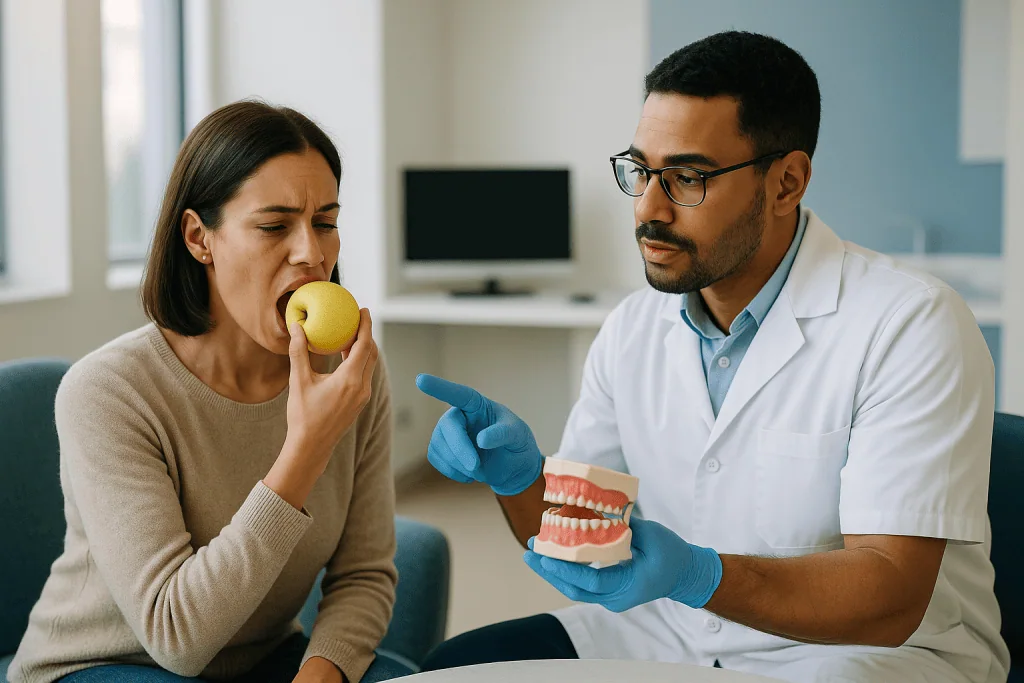
Here is what actually happens. The dentist places a strip of thin colored marking paper, called articulating paper, between your teeth and asks you to tap together, then slide side to side and forward. Where the teeth touch, the paper leaves a smudge. A high filling shows up as one dark, heavy mark while the neighboring teeth show faint marks or none at all.
The dentist then smooths the marked spot with a fine polishing instrument. Tap again, check the marks, smooth a little more. Most people need no anesthetic because the work stays within the filling material, not the tooth. The whole cycle usually takes a few minutes. The filling is polished at the end so the surface stays smooth.
Relief tends to be noticeable soon after, because the constant overload on the ligament stops. The bruised feeling itself fades as the ligament recovers, and the dentist will give you a sense of what to expect for your specific tooth rather than a fixed calendar.
People sometimes worry that an adjustment weakens the filling or means it was done badly. Neither is true. Fine-tuning after the anesthetic has worn off, when you can finally feel the bite, is a normal part of the process. Dentists build in a small margin during placement precisely because it is far easier to remove a whisper of material than to add it back.
Any decision to adjust, and how much, sits with the dentist who can see the marks and your bite together.
Who is usually offered a bite adjustment, and who is usually asked to wait
The strongest case for an adjustment is a tooth that hurts on biting, feels tall, and shows a clear heavy mark on the articulating paper, with the pain having started right after the filling was placed. In that scenario, most dentists act promptly, because there is little to gain from leaving a ligament under repeated strain.
Someone whose only complaint is cold sensitivity, with comfortable chewing and no high mark, is usually asked to give the tooth time. Adjusting a filling that is not high would remove material for no reason, and the pulp settling from the procedure is the more likely explanation. Cleveland Clinic’s guidance to allow a few weeks applies here.
A few other groups are often asked to hold off or are steered elsewhere:
- People who clench or grind their teeth, a habit called bruxism, may have soreness in several teeth rather than one. Mayo Clinic lists increased tooth sensitivity among bruxism’s signs, and reshaping one filling does not address a whole-mouth force problem.
- Someone whose bite has shifted for other reasons, such as a missing tooth elsewhere or a recent crown, may need a broader look before any single spot is touched.
- A filling that is already thin over the pulp may be left alone if further reduction risks exposing it; the dentist may prefer a different approach.
Being asked to wait is not being dismissed. It reflects a judgment that the tooth’s own recovery is the more probable route, with a clear plan to re-check if the picture changes. The treating dentist weighs these factors and makes the call.
Sensitivity to cold after filling, pain on biting, or a lingering ache? What each pattern usually means
Dentists listen for the character of a symptom more than its intensity. A sharp zing that vanishes and a dull throb that lingers can feel equally alarming to the person having them, but they point in very different directions. The table below is a reading guide, not a diagnostic tool; only an examination and, where needed, an X-ray can settle the question.
| What you feel | What it often points to | Typical course | What a dentist may consider |
|---|---|---|---|
| Sharp cold twinge that fades within seconds | Irritated but recoverable pulp; open dentinal tubules | Eases over days to a few weeks | Reassurance, desensitizing toothpaste, re-check if not improving |
| Pain when chewing or tapping; tooth feels tall | Filling sitting high; bruised ligament | Persists or worsens until corrected | Bite check with marking paper; bite adjustment |
| Ache after hot or cold that lingers for minutes | Pulp inflammation that may not be settling | Needs monitoring; may progress | Pulp testing, X-ray, discussion of options |
| Throbbing that arrives with no trigger, or wakes you | Pulp that may not recover; possible infection | Not expected to self-resolve | Prompt assessment; possible root canal treatment |
| Sharp pain on releasing a bite | Possible crack in the tooth | Variable | Crack detection, bite test, imaging |
| Sore gum beside the filling | Tissue pushed by clamp or band; rough edge | Days | Polish edges, check flossing contact |
Sensitivity to cold after filling that is brief and improving sits comfortably in the first row. The lower rows are the ones that earn a call rather than a wait. If your symptoms straddle two rows, describe both to your dentist; the combination is often the most useful clue of all.
Deep filling nerve pain: how long does a deep filling take to heal?
A deep filling is one where the decay reached close to the pulp, leaving only a thin floor of dentin between the filling material and the nerve. Dentists often warn about this at the appointment: “That was deep, so it may be sensitive for a while, and there’s a chance the nerve won’t settle.” That warning is not hedging. It reflects a genuine biological fork in the road.
On one path, the pulp is inflamed but alive and capable of recovery. This is reversible pulpitis. The tooth zings to cold, the zing fades fast, and week by week the tooth calms as new dentin forms beneath the filling. Dentists sometimes place a protective liner under a deep filling to encourage exactly this.
On the other path, the pulp was too damaged by the depth of decay or the disturbance of removing it, and inflammation tips past the point of recovery. This is irreversible pulpitis. The tell-tale signs are different: pain that lingers for minutes after a hot or cold trigger, pain that arrives on its own, throbbing that follows your heartbeat, pain that is worse lying down. A pulp on this path does not heal, and the usual next step is root canal treatment, a procedure that removes the pulp and seals the inner space so the tooth can be kept.
So how long does a deep filling take to heal? The honest answer is that recoverable pulps settle over the same few weeks Cleveland Clinic describes for fillings generally, often toward the longer end, and the direction of travel matters more than the date. Improving, however slowly, is good news. Flat or worsening is the signal to be seen. Deep filling nerve pain is not a verdict on anyone’s skill; it is the pulp casting its vote.
Tooth sensitive after filling for weeks: when does it stop being normal?
The most useful question is not “how many weeks has it been” but “which way is it heading.” A tooth that is sensitive at week three but noticeably better than week one is on the expected curve. A tooth that is exactly as sensitive at week three as on day two has stalled, and a stalled tooth deserves a look even if nothing dramatic is happening.
Cleveland Clinic frames it plainly: contact your dentist if sensitivity has not improved within a few weeks or is getting worse. The reasons a tooth might miss that window fall into a handful of categories.
The bite may be high, which never resolves by waiting. The filling margin, where material meets tooth, may not be sealed, letting fluid seep in and irritate the dentin; this often produces sensitivity to sweets and cold that stays stubbornly constant. There may be a crack in the tooth that the filling did not address, producing pain on release of biting pressure. The pulp may be on the irreversible path described above. Or the pain may not be coming from that tooth at all.
That last possibility surprises people. Teeth are poor at localizing pain. An upper molar can report discomfort that originates in the sinus above it. A lower tooth can ache because a neighboring tooth has a problem. A filled tooth becomes the obvious suspect simply because it was recently worked on. Dentists test individual teeth with cold and pressure precisely to sort this out.
None of these require heroics on your part. A short re-evaluation visit, sometimes with an X-ray, sorts most of them. What does not help is a fourth or fifth week of hoping, chewing on one side, and avoiding cold drinks while the underlying cause sits unaddressed.
Other reasons a filled tooth keeps complaining
Beyond bite height and pulp recovery, a few less obvious mechanisms can keep a filled tooth on edge.
Tooth-colored composite fillings, made of resin bonded directly to the tooth, shrink very slightly as they set. That shrinkage can put stress on the bond or the surrounding tooth structure, which some people feel as a pressure-sensitive twinge on biting. Dentists place composite in layers partly to minimize this, and the sensation usually fades as the tooth adapts.
A galvanic reaction is a small electrical current generated when two different metals in the mouth touch, for instance a new metal filling against an older metal restoration or a metal utensil. It produces a brief, odd, sharp sensation. It is uncommon with modern materials and tends to disappear as surfaces oxidize, but it is worth mentioning to your dentist if the timing fits.
Clenching and grinding deserve more attention than they usually get. Mayo Clinic notes that bruxism can cause increased tooth pain or sensitivity, tired jaw muscles, and teeth that feel loose. A freshly filled tooth is the weakest link in a grinding mouth and will report the strain first. If you wake with a sore jaw or your partner hears you grinding, tell the dentist; a night guard conversation may follow.
The gum alongside the filling can be sore because a rubber clamp or the thin metal band used to shape the filling pressed on it. This is a soft-tissue ache, worse when brushing, and settles quickly. A rough or overhanging edge that snags floss can prolong it and is easily smoothed.
Finally, sinus pressure from a cold or allergy can make upper back teeth ache in a way that mimics a tooth problem. If the whole row hurts when you bend forward, the sinus is a fair suspect.
How to get rid of tooth sensitivity after filling: what helps at home and what the evidence supports
Home measures cannot fix a high filling or rescue a failing pulp, and it helps to be honest about that up front. What they can do is make the recovery window comfortable while the tooth does its own settling.
Chew on the other side for the first several days. Skip very hot, very cold, very sweet, and very hard foods, not forever, but while the tooth is reactive. Room-temperature water instead of ice water is a small change that removes the commonest trigger. Breathing through the nose in cold weather spares the tooth a blast of chilled air.
Brush the area gently with a soft-bristled brush. Scrubbing hard at freshly cut dentin makes it more reactive, not less. Cleveland Clinic lists desensitizing toothpaste among the standard approaches for sensitive teeth; these products work by either blocking open dentinal tubules or calming the nerve’s response, and they typically need consistent use over time rather than producing an instant effect. Ask your dentist which type suits your situation.
Over-the-counter pain relievers are sometimes used for the first day or two of soreness. Which one, whether it is appropriate for you, and how to take it are questions for your dentist or pharmacist, especially if you take other medicines or have stomach, kidney, or heart conditions.
A few things to avoid: whitening products, which are known to increase sensitivity; sticky sweets that pull at a new filling; and any attempt to file or grind the filling yourself. People do try this with nail files. It removes the wrong spot, roughens the surface, and can crack the material.
If comfort measures are all you need, the tooth will tell you within a few weeks by simply going quiet. If they are not enough, that is information too.
What are the symptoms of a damaged dental filling?
Fillings are durable but not permanent. They wear, their edges can chip, and the seal between filling and tooth can break down over years. Sometimes the first sign is sensitivity in a tooth that has been quiet for a long time, which is why an old filling can suddenly behave like a new one.
Signs that a filling may be damaged or failing include:
- A rough or sharp spot your tongue keeps finding, where the surface used to be smooth.
- Floss that shreds or catches at the edge of the tooth, suggesting a chipped margin or an overhang.
- Food that packs between that tooth and its neighbor after every meal, when it did not before.
- New sensitivity to sweets or cold in a previously filled tooth, which can indicate fluid seeping beneath a leaking filling.
- A visible crack, chip, or missing piece, or a dark line where the filling meets the tooth.
- Sharp pain on releasing a bite rather than on pressing down, a pattern associated with a cracked tooth.
- A piece of hard material in your mouth after eating, which may be part of the filling itself.
A damaged filling is not an emergency in most cases, but it is not something to sit on either. Once the seal is broken, bacteria can reach dentin and decay can restart underneath, out of sight. The tooth may feel fine for a while during that process.
What happens next depends on what the dentist finds. A small chip may be smoothed or patched. A leaking or fractured filling is usually replaced. A tooth with a significant crack or very little natural structure left may be better served by a crown, a cap that covers the whole tooth. These are decisions for the treating dentist after an examination and, often, an X-ray.
What people often get wrong about tooth pain after a filling
“Any pain means the dentist made a mistake.” Post-filling sensitivity is the tooth’s biology at work, not a scorecard. A pulp that has had decay scraped away from near its surface is going to react. The exception is a high bite, which is a fit issue rather than an error, and one that is expected to need occasional fine-tuning after the anesthetic wears off.
“If it’s sensitive, I’ll need a root canal.” Most sensitive teeth recover. Root canal treatment becomes relevant when the pulp shows signs it cannot recover: lingering pain after triggers, spontaneous throbbing, pain at night. Brief cold twinges that are improving are not on that list.
“Pain when I bite will settle if I just wait.” A high filling does not lower itself. Waiting keeps the ligament bruised and can tip an otherwise recoverable pulp toward trouble. This is the one symptom where acting early is clearly better than patience.
“I should avoid the tooth entirely until it’s perfect.” Favoring the other side for a few days is sensible. Avoiding a tooth for weeks can mask a high spot, because you never load it enough to notice, and it lets the jaw muscles develop their own soreness from the lopsided chewing.
“The pain must be in the tooth that was filled.” Teeth refer pain to their neighbors and to the jaw and sinus. A recently filled tooth is the obvious suspect and often an innocent one.
“Filling material determines how much it hurts.” Depth of the cavity, closeness to the pulp, and bite fit have far more influence than whether the filling is metal or tooth-colored.
“I can smooth it down myself.” Home filing removes the wrong area and roughens the surface. The marking paper exists for a reason.
Questions to ask your care team
A short conversation at the end of the filling appointment, or a quick call afterward, sets expectations and gives you a clear threshold for when to come back. These questions are worth having in your pocket.
- How deep was the cavity, and how close did it come to the nerve? This tells you whether to expect the shorter or longer end of the recovery window.
- What kind of sensitivity should I expect, and what would be a sign it is not settling?
- The tooth feels tall or hurts when I chew. Could the bite be high, and can you check it with marking paper?
- Will a bite adjustment weaken the filling or expose the nerve in my case?
- Do I show signs of clenching or grinding, and would that explain soreness in more than one tooth?
- Is there a desensitizing toothpaste you would suggest, and how long should I give it before judging whether it helps?
- If I need pain relief in the first couple of days, what is appropriate given my other medicines and health conditions?
- Which symptoms mean I should call the same day rather than wait for a routine appointment?
- If the nerve does not recover, what are the options, and how would we know it has reached that point?
- When would you like to see the tooth again if it is still sensitive?
Write down the answers, or ask for them in the post-visit notes. Sensitivity has a way of feeling louder at eleven at night than it did in the chair, and a written plan is calmer company than a search engine. The dentist who placed the filling knows its depth and margins better than anyone, and that is the person best placed to interpret what your tooth is saying.
When to call your doctor
Most post-filling sensitivity never needs a phone call. Some of it does, and a small subset needs one urgently. This paragraph is the one to remember: seek same-day dental or medical care if you develop swelling of the face, jaw, or gum, a fever, a foul taste or pus near the tooth, or pain that is severe and unrelieved. The NHS describes these as signs of a dental abscess, a pocket of infection that needs prompt treatment. Go to an emergency department if swelling makes it hard to breathe or swallow, or if it is spreading toward the eye or the neck.
Beyond those emergencies, contact your dentist promptly, rather than waiting for a routine check, if:
- Pain arrives on its own with no hot, cold, or pressure trigger, or throbs in time with your pulse.
- Pain wakes you at night or is worse when you lie down.
- Pain after a hot or cold trigger lingers for minutes rather than fading in seconds.
- The tooth hurts every time you bite or feels tall, which usually means a high filling that will not fix itself.
- Sensitivity is not improving after a few weeks, or is getting worse week on week, the threshold Cleveland Clinic gives for a return visit.
- A constant toothache lasts more than two days, the NHS benchmark for seeing a dentist.
- The filling has cracked, chipped, or fallen out, or you feel a sharp edge or a piece in your mouth.
- You notice sharp pain when releasing a bite, which can suggest a cracked tooth.
- The gum near the tooth bleeds persistently or looks inflamed beyond the first few days.
Calling is not overreacting. Dentists would far rather smooth a high spot or check a pulp early than treat an infection later. Whatever the finding, the plan belongs to the treating dentist, who can see the tooth, test it, and image it in a way no article can.
Frequently asked questions
How long does it take for a deep filling to heal?
A deep filling settles over the same few weeks Cleveland Clinic describes for fillings generally, often toward the longer end, because the pulp sits closer to the work. The direction matters more than the date: steadily fading cold twinges suggest the nerve is recovering, while lingering, spontaneous, or nighttime pain suggests it may not be, and warrants a dental review rather than continued waiting.
How can I get rid of tooth sensitivity after a filling?
Comfort measures include chewing on the other side, avoiding very hot, cold, or sweet foods for a while, brushing gently with a soft brush, and using a desensitizing toothpaste as your dentist advises. These ease the recovery window but cannot fix a high bite or a failing pulp. If sensitivity is not improving after a few weeks, or hurts on biting, ask your dentist to check it.
What are the symptoms of a damaged dental filling?
Common signs include a rough or sharp spot your tongue keeps finding, floss that shreds at the edge, food packing between teeth, new sensitivity in a long-quiet tooth, a visible chip or dark line at the margin, or sharp pain when releasing a bite. A damaged filling can let decay restart underneath without obvious symptoms, so it is worth having your dentist examine it.
How can I help nerve pain after a filling?
Short-term soreness is commonly managed with the comfort steps above and, if appropriate for you, an over-the-counter pain reliever chosen with guidance from your dentist or pharmacist. Nerve pain that lingers after triggers, throbs on its own, or wakes you is a different matter and may mean the pulp is not recovering, which needs a dentist’s assessment rather than home management.
What are the signs of a high filling?
The classic high filling symptoms are a tooth that feels tall or touches first when you close, pain on chewing, tenderness when tapped, a bruised or loose sensation, and aching jaw muscles on that side. The opposing tooth may become sore too. Cold sensitivity can accompany it because the overloaded pulp becomes irritated. These signs point to a bite check rather than waiting.
Does a bite adjustment after a filling hurt or weaken the filling?
A bite adjustment is usually painless and needs no anesthetic, because the dentist reshapes only the filling material, guided by marks left on colored articulating paper. Removing a whisper of material to balance the bite does not weaken a properly placed filling; dentists deliberately leave a small margin at placement because it is easier to reduce than to add. Your dentist will judge how much to adjust.
Is sensitivity to cold after a filling normal?
Yes, brief cold sensitivity is one of the most common experiences after a filling. Cold shifts fluid inside microscopic tubes in the freshly exposed dentin, and the nerve reads that as a sharp jolt. The reassuring pattern is a zing that fades within seconds and grows less intense over days to weeks. Cold pain that lingers for minutes is the pattern to report.
Does sensitivity after a filling mean I need a root canal?
Usually not. Most sensitive teeth recover as the inflamed pulp settles. Root canal treatment becomes relevant when the pulp shows it cannot recover: pain that lingers after hot or cold, throbbing that arrives on its own, or pain that wakes you at night. If those appear, your dentist can test the tooth and discuss options; brief, improving twinges are not in that category.
Why does the tooth next to my filling hurt?
Teeth are poor at pinpointing pain, so discomfort from an irritated tooth often seems to come from a neighbor, and the recently filled tooth is the obvious suspect either way. The gum between the teeth may also be sore from the band or clamp used during the filling. Dentists test individual teeth with cold and pressure to identify the true source.
Can grinding my teeth cause sensitivity after a filling?
It can. Mayo Clinic lists increased tooth pain or sensitivity, tired jaw muscles, and a dull headache among signs of bruxism, the habit of clenching or grinding. A fresh filling is the first place a grinding mouth shows strain. If you wake with a sore jaw or someone hears you grinding, tell your dentist, since adjusting one filling will not address a whole-mouth force problem.
References
- Cleveland Clinic: Dental Fillings
- Cleveland Clinic: Teeth Sensitivity
- NHS: Toothache
- NHS: Dental abscess
This article is for general information only and is not a substitute for professional medical advice. Please consult a qualified doctor about your individual situation.

More from the Blog

Before Committing to an Aesthetic Dentistry Plan: What to Ask the Cosmetic Dentist
Before agreeing to any aesthetic dental plan, ask the cosmetic dentist whether your gums and teeth are healthy enough to treat, how much natural…

Is Gum Disease Contagious or Hereditary, and Does Vaping Cause It?
Gum disease is not contagious in the way a cold is, though the bacteria involved can pass between people through saliva; disease develops only…

Tooth Decay Treatment in Older Adults: Root Cavities, Dry Mouth and Medication Effects
Cavities in older adults are common and treatable at any age. They often form on exposed root surfaces, which are softer than enamel, and…

Life After a Root Canal: Why the Crown Matters and How to Chew on the Tooth Safely
A crown after a root canal protects a tooth that is now hollowed, dry and more brittle, especially a back tooth that takes heavy…

Are Fissure Sealants Only for Children? Who May Benefit and Which Molars Are Sealed
Fissure sealants are not only for children. They are most often placed on newly erupted permanent molars in children aged roughly 6 to 14,…

Porcelain Veneers for International Patients: Two Visits, Temporaries and Follow-Up
Porcelain veneers are usually completed over two clinical visits: the first covers examination, consent, tooth preparation, impressions or digital scans and temporary veneers; the…