

Is Surgical Tattoo Removal an Option for You? Size, Location and Skin Elasticity Explained
Key Takeaways
- Surgical excision removes tattoo ink regardless of color because the pigment-bearing dermis itself is taken out, which is why yellows, greens and cosmetic tattoos that resist lasers are not an obstacle to surgery.
- The Mayo Clinic describes excision as effective but scarring and most practical for small tattoos, because the wound must close under minimal skin tension.
- The final scar is a line longer than the tattoo's widest point, since surgeons remove a lens-shaped ellipse to prevent puckered ends called dog-ears.
- The inner upper arm, lower abdomen and upper thigh are among the most favorable sites, while the shin, foot, hands and skin over joints are among the least.
- Keloid scars, which grow beyond the original wound, are more common in people with darker skin and on the chest, shoulders and upper arms, making scarring history a decisive candidacy factor.
- Laser sessions are usually spaced 6 to 8 weeks apart according to the NHS, so a person combining laser with a small excision should expect a plan measured in months.
Yes, tattoos can be surgically removed, but excision suits a narrow group: small to medium tattoos on areas with loose, elastic skin, in people who are generally healthy, not prone to keloid scarring, and willing to trade ink for a permanent line scar. Large tattoos, sites over joints or tight skin, and certain health conditions usually point toward laser or a staged plan. The treating team decides.
She had already sat through three laser sessions. The bird on her inner forearm had faded to a gray ghost, but the yellow in its beak simply would not budge, and the appointments were starting to feel like a subscription she never meant to sign up for. So she asked the question people rarely ask out loud: could someone just cut it out?
It is a fair question, and the honest answer is more interesting than a yes or a no. Surgical tattoo removal candidates are chosen by geometry as much as by wish. How big is the tattoo? Where does it sit? How much does the surrounding skin give when you pinch it? Those three variables decide whether a surgeon can close the gap neatly, or whether the result would be a scar you like even less than the ink.
What follows is the version of that conversation a good dermatologic or plastic surgeon would have with you, minus the waiting room.
Can tattoos be surgically removed?
They can. Surgical removal, usually called excision, means the tattooed patch of skin is cut out and the healthy edges are stitched together. It is the oldest method there is, and it works for a reason that has nothing to do with lasers or chemistry: tattoo ink sits in the dermis, the tough middle layer of skin, and if that layer leaves the body, the ink leaves with it.
Laser removal takes a very different route. Pulses of light shatter pigment into fragments small enough for immune cells to carry away, which is why it needs several sessions and why some colors resist. Excision sidesteps all of that. Green, yellow, white, pale pink, cosmetic tattoos that darken under a laser beam, ink layered over old ink, tattoos with a stubborn allergic reaction to one pigment: none of it matters to a scalpel. The Mayo Clinic describes surgical removal as effective but scarring, and most practical for small tattoos, and that single sentence carries the whole trade-off.
So the question people actually need answered is not “can it be done” but “what will be there afterward.” Every excision produces a scar. A well-planned one is a thin, pale line that runs longer than the tattoo it replaced. A poorly chosen one can widen, thicken or pucker at the ends. Who ends up with which result depends far more on size, location and skin elasticity than on surgical skill alone.
The procedure is typically done under a local anesthetic, meaning the area is numbed with an injection while you stay awake. It belongs in the hands of a clinician trained in skin surgery, because judgment about where and how to cut is the entire craft.
How surgical tattoo removal actually works, step by step
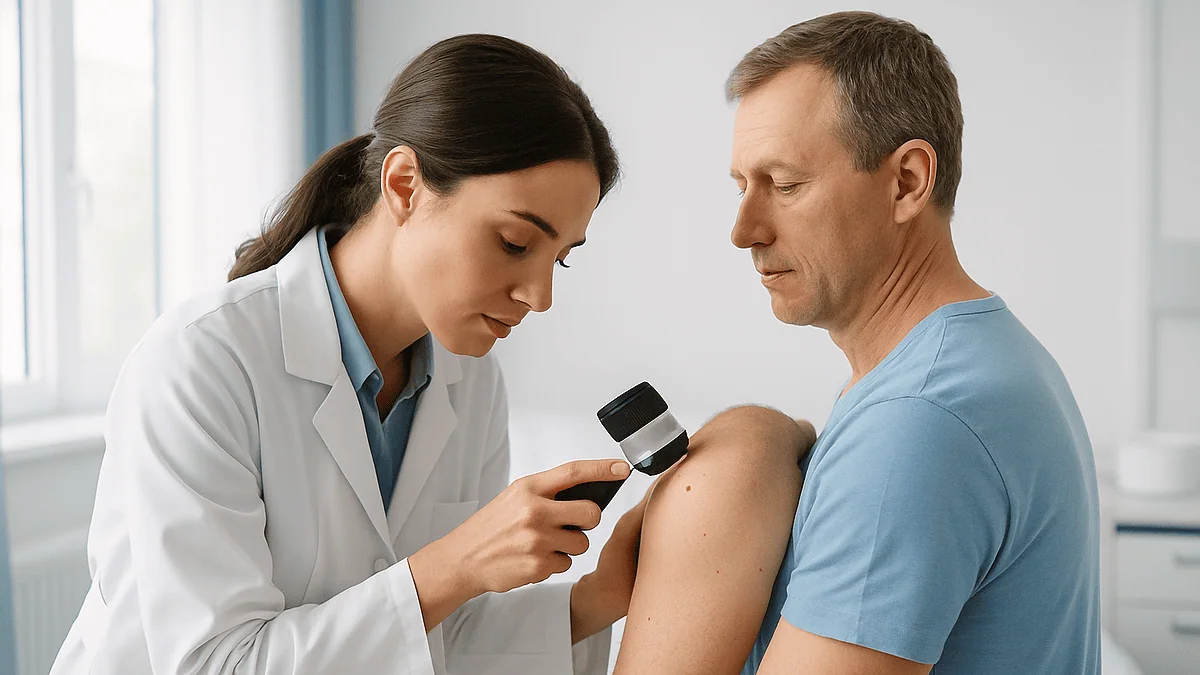
The most important part happens before anyone picks up a blade. At the consultation, the surgeon looks at the tattoo, pinches the skin around it in several directions, and asks you to move the nearby joint. They are testing two things: how much spare skin is available, and which way it stretches most easily. Skin has natural creases, sometimes called relaxed skin tension lines, and a scar hidden inside one of them tends to heal flatter and fade better than a scar that cuts across them.
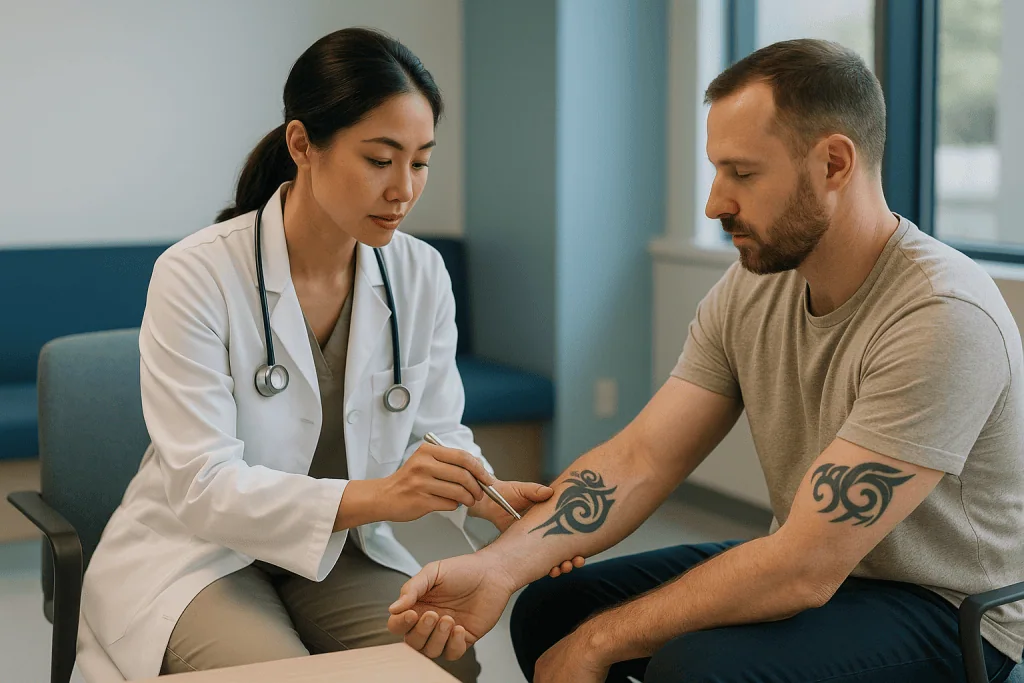
On the day, the tattoo is outlined in ink, then enclosed in an ellipse, a lens shape noticeably longer than the tattoo is wide. That extra length is not wasted skin. Closing a round hole with a straight line leaves little bunched-up cones at each end, which surgeons call dog-ears; the ellipse prevents them. The area is numbed, and you feel pressure and tugging rather than pain.
The surgeon removes the marked skin down to the fat layer beneath the dermis, seals any small bleeding vessels, and closes in layers. Deeper dissolving stitches take the tension so the surface edges meet without strain; finer stitches, or sometimes skin glue or adhesive strips, line up the top. A dressing goes on, and you walk out with the tattoo gone and a neat line in its place.
Aftercare instructions cover keeping the wound dry at first, when and how to change dressings, and what activity to avoid. Follow-up is scheduled to check healing and remove any non-dissolving stitches. If you are on any medicine that affects bleeding, the team will have discussed it beforehand; never adjust a prescription yourself on the assumption that it will help the surgery.
Who are good surgical tattoo removal candidates, and who is usually asked to wait?
The people who do best share a short profile. Their tattoo is small enough that the skin on either side can be brought together without pulling. It sits somewhere with natural give, such as the inner upper arm, the lower abdomen or the fleshy part of the forearm. Their skin has not been badly sun-damaged or stretched by rapid weight change. They heal ordinarily, with no history of raised or spreading scars. And they have a clear-eyed view of the bargain: a permanent line instead of a permanent picture.
Being asked to wait is not the same as being turned down. Surgeons commonly defer excision when there is an active skin infection or a flare of eczema or psoriasis at the site, because operating through inflamed skin raises the odds of a poor scar. Pregnancy is another typical reason to postpone elective skin surgery, not because excision is known to harm a pregnancy, but because non-urgent procedures are generally delayed until afterward. Someone whose diabetes is not well controlled, who smokes heavily, or who has recently lost or gained a lot of weight may be asked to come back once things have stabilized, since all three affect wound healing.
A history of keloids, which are scars that keep growing beyond the edges of the original wound, is one of the strongest reasons a team may steer away from excision altogether, or insist on a careful plan for scar management if they proceed. The Cleveland Clinic notes that keloids are more common in people with darker skin tones and tend to form on the chest, shoulders, earlobes, upper arms and cheeks, which happen to be popular tattoo sites.
None of these factors is a verdict you can pronounce on yourself. They are the checklist your treating team works through, and the final call is theirs to make with you.
Why tattoo size decides almost everything
Think of the skin around a tattoo as a fitted bedsheet. Cut out a coin-sized patch and you can tug the edges together without much trouble. Cut out a dinner plate and no amount of pulling will close the gap, and if you force it, the sheet tears or the mattress corners lift. Skin behaves the same way, except that forcing it produces a wide, stretched scar or, worse, edges that pull apart during healing.

This is why the Mayo Clinic frames surgical removal as most practical for small tattoos. The rule of thumb surgeons use is simple: the wound must close under minimal tension. A small name, a symbol, a single flower, a short line of text: these are the classic excision candidates. A half-sleeve, a full back piece or a large thigh tattoo is not, at least not in one sitting.
Size also dictates scar length. Because of the ellipse shape described earlier, the final line is longer than the tattoo’s widest point, often by a considerable margin. A tattoo the size of a postage stamp can leave a scar the length of a paperclip. People are often surprised by this, so it is worth seeing the proposed line drawn on your skin before you commit.
Shape matters alongside size. A long, narrow tattoo running along the arm is friendlier to excision than a round one of the same area, because the ellipse it needs is already close to the tattoo’s own outline. Irregular tattoos with satellite elements, such as a script with stars scattered around it, may need separate small excisions or may simply be better served by laser.
When a tattoo is too large for a single excision but the person still prefers surgery, the conversation turns to staged approaches, which have their own section below.
Location: why the same tattoo behaves differently on a shoulder, a finger and a shin
Two people can walk in with identical tattoos and leave with completely different recommendations, purely because of where the ink sits.
The kindest sites are those with loose, mobile skin over soft tissue: the inner and back of the upper arm, the lower abdomen and flanks, the buttock, the upper thigh. Skin here has slack to spare, so the wound closes easily and the scar tends to settle into a fine line. The forearm is usually acceptable for smaller tattoos, particularly on the inner surface.
The hardest sites are the shin, the ankle, the top of the foot, the fingers and the back of the hand. Skin there is thin, tightly bound to bone or tendon, and constantly moving. Wounds heal more slowly, tension is high, and scars are prone to widening. Many surgeons decline excision on the shin or foot for anything but tiny marks.
Joints are their own category. A tattoo over the elbow, knee or wrist crease will be pulled every time you bend, and a scar that crosses a joint at the wrong angle can tighten into a band that restricts movement. If excision is considered here at all, the scar is oriented to follow the crease rather than cross it.
The face and neck combine high visibility with delicate anatomy. Scars near the eyelid or lip can distort those structures if they contract. Cosmetic tattoos on eyebrows or lips are rarely excised for this reason; laser or camouflage is more often discussed.
Finally, there are the keloid-prone zones. The chest, shoulders, upper back and earlobes are where raised, spreading scars most commonly appear, according to both MedlinePlus and the Cleveland Clinic. A surgeon may hesitate to trade a tattoo on the sternum for a scar that could grow larger than the original design.
Skin elasticity explained: the pinch test and what it predicts
Elasticity is the property that lets skin stretch and snap back, and it is the quiet third factor in every excision decision. Two kinds of fibers in the dermis do the work: collagen provides strength, elastin provides recoil. Age, sun exposure, smoking, genetics and rapid changes in body size all alter that balance.
The test a surgeon performs is disarmingly simple. They pinch the skin beside the tattoo between thumb and forefinger and lift. Skin that tents up easily and glides over the tissue beneath has plenty of laxity; the surgeon can already picture the two edges meeting. Skin that barely moves, or that feels tethered, warns of a closure under tension and a scar likely to spread.
Elasticity is not simply good or bad. Very loose, thin, sun-weathered skin closes easily but can tear at the stitch line and may heal with a wider, shinier scar than expected. Firm, thick skin on a young adult holds stitches well but has less slack. The ideal is skin that moves freely yet still feels robust, which is one reason the inner upper arm is such a reliable site.
Stretch marks near a tattoo tell a story too. They are evidence that the dermis has been pulled past its limit before, and skin that has done that once often heals with a less predictable scar.
You can get a rough feel for your own laxity by pinching the skin next to your tattoo and then pinching the back of your hand for comparison, but treat it as curiosity, not diagnosis. The surgeon’s assessment weighs elasticity together with the direction of skin lines, the depth of tissue beneath, and how the area behaves when you move. That combination, not any single measurement, is what separates a promising excision from an ill-advised one.
Tattoo excision vs laser: how do they compare?
Most people arrive at the surgical question after hearing about, or trying, laser. Setting the two side by side makes the trade-offs plain.
| Factor | Surgical excision | Laser removal |
|---|---|---|
| Number of visits | Usually one procedure for a small tattoo, plus follow-up | Several sessions, typically spaced 6 to 8 weeks apart (NHS) |
| Ink colors | Irrelevant; all pigment removed with the skin | Some colors, notably yellows and greens, respond poorly (Mayo Clinic) |
| What remains | A permanent linear scar longer than the tattoo | Often lighter skin, texture change or faint ghost image; scarring possible |
| Anesthesia | Local anesthetic injection | Usually numbing cream or cooling; some discomfort |
| Best suited to | Small tattoos on lax skin | Larger tattoos, most body sites, people wanting to avoid a cut |
| Main limitation | Size and location | Time, incomplete clearance, pigment changes in darker skin |
The table hides one nuance worth stating outright. Laser and surgery are not rivals so much as tools chosen for different jobs, and they are sometimes combined. A person may have laser first to shrink and fade a design, then excise a small resistant patch. Another may have most of a tattoo excised and use laser on a fragment that sat over a joint.
Laser’s chief advantage is that it leaves no incision and suits almost any body site. Its chief drawback is uncertainty: the Mayo Clinic notes that complete removal is not guaranteed and that skin may end up lighter or darker than before. Excision’s chief advantage is certainty about the ink; its drawback is certainty about the scar.
Neither method should be sold as painless, quick or flawless. A team that lays out both honestly is doing its job.
Serial excision, tissue expansion and skin grafts: when one cut isn't enough
When a tattoo is too large to remove in a single ellipse but the person is set on surgery, three staged options exist. Each is a bigger undertaking than simple excision, and each is discussed far more often than it is chosen.
Serial excision means removing the tattoo in slices over several separate operations. The surgeon takes out a central strip, closes the wound, and waits for the skin to relax and stretch. Months later, another strip is removed alongside the first scar, and so on, until only a single line remains. It relies entirely on skin elasticity; every stage borrows slack from the surrounding skin. The approach can work on the trunk or upper arm but is rarely attempted where skin is already tight.
Tissue expansion borrows a technique from reconstructive surgery. A deflatable silicone balloon is placed under healthy skin next to the tattoo and gradually filled over weeks, coaxing the body to grow extra skin. At a second operation the balloon comes out, the tattoo is removed, and the new skin is draped across the gap. It produces good-quality matching skin but demands multiple visits, a visible bulge during expansion, and tolerance of two procedures.
Skin grafting, in which the tattooed skin is removed and replaced with a thin sheet taken from elsewhere on the body, is the option surgeons like least for purely cosmetic tattoos. Grafts often heal with a patch-like appearance, different color and texture, and a second wound at the donor site. Most clinicians consider the result no better looking than the tattoo it replaced, and laser is usually recommended instead.
These are the exceptions, not the rule. If a surgeon suggests one of them, ask what the alternative pathway with laser would look like, and how the final appearance of each is expected to compare.
What is the surgical tattoo removal scar really like?
Since the scar is the price of the procedure, it deserves a plain description rather than a reassurance.
In the first weeks a fresh excision scar is a raised, pink or red line, sometimes slightly firm to the touch. That redness is blood supply feeding the repair, not a sign of trouble. Over the following months the line typically flattens and fades toward a color paler than the surrounding skin. On darker skin tones the mature scar may instead be a shade darker than its surroundings, and in either case it usually lacks hair follicles and sweat glands, which gives it a smoother, slightly shiny finish. Scars keep remodeling for a long time; clinicians generally advise judging the final appearance only after many months, not weeks.
Two abnormal patterns can occur. A hypertrophic scar is one that becomes thick and raised but stays within the boundaries of the original wound; it often softens with time and simple measures. A keloid grows beyond those boundaries, can be itchy or tender, and may continue to enlarge. MedlinePlus notes that keloids can develop after even minor skin injury and are more common in people with darker skin, while the Cleveland Clinic points out they can appear months after the original wound. This is why a personal or family history of keloids weighs so heavily in candidacy.
Scar care is mostly about not sabotaging healing. Keeping the wound clean and covered as instructed, avoiding stretching or heavy lifting that pulls on the line, not smoking, and protecting the new scar from sun for at least its first year all help. Silicone gel or sheets are commonly suggested once the wound has fully closed; the evidence for them is modest but they are low risk. Anything more, including injections into a thickening scar, is a decision for the treating team.
Who should not get tattoo removal? Medical reasons your team will weigh
Some reasons to avoid excision are about the tattoo; others are about the person. The second group matters just as much and is easier to overlook.
Bleeding and clotting come first. People with an inherited bleeding disorder, or who take anticoagulant or antiplatelet medicines, which reduce the blood’s ability to clot, can still have minor skin surgery, but only with planning. The surgeon and the prescribing clinician decide together how to manage the medicine around the procedure. Stopping it yourself, even briefly, can carry serious risk and is never the right first step.
Healing capacity comes next. Poorly controlled diabetes, medicines that suppress the immune system, significant malnutrition, and heavy smoking all slow wound repair and raise infection risk. The MedlinePlus overview of tattoos also reminds readers that any break in the skin invites bacteria, which is precisely why teams postpone elective excision when healing conditions are not optimal.
Skin disease at or near the site is a common deferral. Active eczema, psoriasis plaques, acne cysts or an ongoing infection make a clean closure unlikely. A tattoo that has developed a persistent allergic reaction, usually to red ink, is sometimes a reason to prefer excision, but the surgeon will want the skin calm first.
A history of keloid or hypertrophic scarring is the factor most likely to end the surgical discussion, for the reasons covered above. Known allergy to local anesthetic agents is rare but must be disclosed. Pregnancy typically leads to postponement. And anyone under the legal age of consent needs a parent or guardian involved, with most teams reluctant to operate on a minor for a purely cosmetic reason.
Finally, there is the question of expectations. A person who wants the skin to look as if the tattoo never existed is not a candidate for excision, because excision cannot deliver that. Saying so kindly is part of good care.
What the days and weeks after excision usually look like
The first evening is the strangest part. The numbness fades over a few hours and is replaced by a dull ache or tightness along the line, usually manageable with whatever the team recommends. Some bruising and swelling around the wound is expected, and a small amount of blood-tinged fluid on the dressing is normal.
For the first day or two the wound is generally kept dry and covered. The team will tell you when you may shower and whether to pat the area dry or leave the dressing in place. During this period the deep stitches are doing the work of holding the edges together, so the instruction to avoid lifting, stretching or vigorous movement of that body part is not caution for its own sake. Tension on a fresh wound is what turns a fine line into a wide one.
Follow-up typically involves a wound check and, if non-dissolving stitches were used, their removal. Timing varies with the body site: skin on the face is often released sooner than skin on the leg or back, where tension is higher. Your team will give the specific interval; treat any general figure you read online as a guess about someone else’s wound.
Over the following weeks the scar passes through its red, firm phase. Itching is common and is a sign of healing nerves, not infection. Gentle activity resumes as the team advises, and once the surface is fully closed, scar care such as sun protection and silicone products can begin.
For people combining methods, the NHS notes that laser sessions are usually spaced 6 to 8 weeks apart to let skin recover; a surgeon will likely want an excision scar to be well settled before any laser is used nearby. Patience, in this procedure, is a clinical ingredient.
What people often get wrong about surgical tattoo removal candidates
Misunderstandings cluster around a few ideas, and each one can lead to a poor decision.
The first is that surgery leaves no trace. Laser removal is sometimes marketed in ways that imply skin returns to blank, and people assume excision must be cleaner still. It is the reverse. Excision always leaves a scar; the only question is how good a scar. Anyone who tells you otherwise is not describing the procedure.
A second error is treating surgery as the shortcut when laser feels slow. For a small tattoo on the right site, one visit is a genuine advantage. For anything larger, the staged surgical options take months to years and involve multiple operations, which is not a shortcut by any definition.
Third, people often believe a failed laser course means surgery is the only remaining option. Often the more useful conversation is about why the laser struggled: the wrong device for the pigment, sessions spaced too closely, or a color that simply resists. A different laser approach, camouflage tattooing, or acceptance of a faint ghost image are all legitimate paths.
Fourth, there is a widespread assumption that darker skin rules out surgery. It does not. Darker skin does carry higher keloid risk, and pigment change after laser is a real concern, but plenty of people with deeper skin tones are appropriate surgical tattoo removal candidates when the tattoo is small, the site is favorable and there is no scarring history. The decision is individual.
Finally, some believe any cosmetic practitioner can perform excision. Cutting skin is surgery, with the risks of bleeding, infection and nerve injury that surgery carries. It belongs with a clinician trained and credentialed in skin or plastic surgery, in a setting equipped for it.
Questions to ask your care team
A consultation is short and the questions you forget tend to surface in the car afterward. Bringing a written list changes the quality of the conversation.
Start with candidacy. Ask directly whether the surgeon considers you a good candidate for excision, and if not, what specifically makes them hesitate: the size, the site, your skin, your history. Then ask what they would recommend instead and why.
Move to the scar. Ask the surgeon to draw the planned ellipse on your skin so you can see the true length of the line. Ask what direction it will run and why. Ask what the scar is likely to look like at the early stage and once matured, and what would make it heal worse than expected. If you have any raised scars anywhere on your body, point to them and ask how they change the plan.
Cover the procedure itself. Will it be done in one stage or several? What anesthetic will be used? What are the specific risks at this site, including numbness or nerve involvement? What happens if the wound edges pull apart?
Then recovery. What activities are off limits, and for how long, for this particular location? When is the follow-up? Who do you contact out of hours if something looks wrong?
Do not skip your own health. Tell the team about every medicine and supplement you take, any bleeding tendency, diabetes, immune conditions, smoking, pregnancy or plans for it. Ask whether any of these should be optimized before scheduling, and make clear that you will change nothing without the prescribing clinician’s agreement.
Lastly, ask what the alternatives look like in this same room. A surgeon who can describe how laser, cover-up or simply leaving the tattoo would each play out for you is a surgeon thinking about you rather than the procedure.
When to call your doctor
Most excision wounds heal without drama, and the ache, mild swelling and pink line described earlier are part of ordinary repair. A short list of signs, however, means the team should hear from you the same day rather than at the scheduled follow-up.
Bleeding that soaks through the dressing and does not stop with firm, steady pressure for several minutes is the most urgent. So is rapidly increasing swelling or a tense, purple bulge under the wound, which can indicate blood collecting beneath the skin.
Infection tends to announce itself a few days in. Spreading redness that travels outward from the line, warmth, increasing rather than easing pain, thick yellow or green discharge, or an unpleasant smell all warrant a call. A fever, chills or feeling generally unwell alongside a sore wound should never be waited out.
Watch the edges. If the stitch line gapes, if the skin edges separate or if you can see fat or deeper tissue, the wound needs to be reviewed promptly; do not try to close it yourself with tape.
Numbness that persists beyond the anesthetic wearing off, tingling, weakness in a nearby muscle or a patch of skin that stays without feeling should be reported, since nerves can occasionally be affected at some sites.
Over the longer term, call if the scar becomes thick, raised, itchy or tender and continues to grow after the wound has closed, or extends beyond the original line. Early attention to a developing keloid or hypertrophic scar gives the team more options.
Any allergic reaction, such as hives, facial swelling or difficulty breathing, is an emergency and needs immediate emergency care, not a phone call to the clinic. When in doubt about any of the above, contact the team; they would far rather see a wound that turns out to be fine than miss one that is not.
Frequently asked questions
Can I get my tattoo surgically removed?
Possibly, if the tattoo is small, sits on skin with natural slack, and you heal normally without a history of raised scars. A surgeon will assess size, location and skin elasticity at a consultation and tell you whether excision is realistic or whether laser or a staged approach makes more sense. The decision rests with the treating team after that examination, not with any general rule.
Who should not get tattoo removal by surgery?
People with a history of keloid or hypertrophic scarring, active skin disease or infection at the site, poorly controlled diabetes, significant immune suppression, or unmanaged bleeding risk are usually advised against excision or asked to wait. Pregnancy typically leads to postponement. Anyone expecting the skin to look untouched afterward is also not a good fit, since every excision leaves a permanent scar.
What qualifications should the person removing my tattoo have?
Surgical excision is skin surgery and should be performed by a clinician trained and credentialed in dermatologic or plastic surgery, working in a setting equipped for sterile procedures and able to manage bleeding or complications. The NHS advises checking that any practitioner is properly qualified and registered. Ask directly about training, how often they perform excisions, and where you would be seen if a problem arose.
Does surgical tattoo removal hurt?
The procedure itself is done under local anesthetic, so you feel pressure and tugging rather than sharp pain. Once the numbness wears off, most people describe an ache or tightness along the wound for a few days, along with some bruising and swelling. Pain that keeps increasing rather than easing, especially with redness or discharge, is not typical and should prompt a call to your team.
Will a surgical tattoo removal scar fade completely?
No scar disappears entirely. A well-healed excision scar typically matures into a thin, flat line that is paler than the surrounding skin, or sometimes darker on deeper skin tones, and lacks hair and sweat glands. It continues to change for many months. Sun protection, avoiding tension on the line, not smoking and following your team’s scar-care advice all influence how inconspicuous it becomes.
Is tattoo excision better than laser?
Neither is better; they suit different situations. Excision usually finishes in one procedure and removes any ink color but leaves a permanent line scar and only works for small tattoos on lax skin. Laser needs several sessions, may leave a faint image or pigment change, but works on nearly any size and site. Many people use both, and the right choice depends on your tattoo and your skin.
Can a large tattoo be surgically removed?
Rarely in a single operation. Large tattoos exceed what surrounding skin can stretch to cover, so surgeons either recommend laser or discuss staged options such as serial excision over several operations or tissue expansion, which grows extra skin with an implanted balloon. Skin grafts are seldom advised for cosmetic tattoos because the patch tends to look worse than the tattoo. These are significant undertakings your team will explain in detail.
Does darker skin rule out surgical tattoo removal?
No. Darker skin carries a higher risk of keloid scarring, and laser can cause pigment changes, so the assessment is more careful, but many people with deeper skin tones are suitable candidates when the tattoo is small, the site is favorable and there is no personal or family history of abnormal scars. Your surgeon will weigh these factors individually rather than applying a blanket rule.
Should I stop my blood thinner before tattoo excision?
Never stop or change a prescribed anticoagulant or antiplatelet medicine on your own. These medicines reduce clotting, so bleeding during minor skin surgery is a real consideration, but stopping them can carry serious risks of its own. Tell the surgeon at the consultation; they will coordinate with the clinician who prescribes the medicine and decide together whether any adjustment is needed and how it would be managed.
How long after laser removal can I have surgical excision?
There is no single interval; the surgeon will want the treated skin fully calm, with no residual redness, blistering or pigment change still evolving. The NHS notes laser sessions themselves are spaced about 6 to 8 weeks apart to allow recovery, and a surgeon will typically want at least that settling period, often longer, before cutting through previously lasered skin. Your team sets the timing.
References
This article is for general information only and is not a substitute for professional medical advice. Please consult a qualified doctor about your individual situation.

More from the Blog

How Masseter Botox Is Injected: Locating the Chewing Muscle and What the Session Involves
In a masseter botox procedure, a clinician first asks you to clench your teeth so the masseter, the thick chewing muscle at the back…

Fibroblast Plasma Skin Tightening Results: What Changes, How Gradually and How Long It Lasts
Fibroblast plasma treatment results tend to be modest and gradual rather than dramatic. Small dark crusts usually lift within one to two weeks, pinkness…

How Long Does a Thread Lift Last? Honest Longevity and Who It Suits
A thread lift typically lasts one to three years, depending on the suture material, your age, skin quality, and how much lift was attempted.…

Preparing for Microsurgery: Imaging, Fitness for Anesthesia and Specialist Consultations
Preparing for microsurgery usually means three things running in parallel: imaging such as CT angiography or Doppler ultrasound to map the tiny blood vessels…

Recovery After Retinal or Glaucoma Laser Treatment: Blurry Hours, Follow-Up and Milestones
After most retinal or glaucoma laser treatments, vision is blurry or dazzled for a few hours, mainly because of dilating drops, the bright treatment…

Flap or Graft? How Reconstructive Surgeons Choose Between the Two Ways to Rebuild Tissue
A skin graft is tissue detached completely from one site and laid onto a wound, where it must grow a new blood supply from…