

Keloid Scars: What Flattens Them and What Does Not
Key Takeaways
- A keloid is dense, disorganized collagen produced by fibroblasts that never received the signal to stop, which is why it cannot be drained, dissolved, or exfoliated.
- Keloids typically appear three to twelve months after an injury and, unlike hypertrophic scars, grow beyond the original wound edges and do not flatten on their own.
- Silicone sheets worn 12 to 24 hours a day for several months are the only over-the-counter approach that appears in mainstream medical scar guidance.
- Cutting out a keloid with no follow-up treatment leads to recurrence in roughly 45% to 100% of cases, often with a larger scar than before.
- Massage helps hypertrophic and fresh surgical scars but is not recommended for true keloids, whose fibroblasts respond to mechanical tension by producing more collagen.
- Pressure earrings worn about 16 hours a day for six to twelve months after earlobe keloid removal are a standard part of preventing regrowth.
Keloid scars rarely flatten on their own, and no home remedy has been shown to shrink one reliably. Silicone sheets or gel and steady pressure can soften and slightly flatten some keloids over months, but the approaches with the strongest evidence are clinician-delivered: steroid injections, cryotherapy, and surgery combined with follow-up treatment. Massage, oils, and vinegar lack supporting evidence and may irritate the scar.
A woman I once interviewed described the moment she stopped trusting the internet about scars. She had spent eleven months rubbing a raised ridge on her shoulder with vitamin oil, then onion extract, then an aloe leaf she grew on the windowsill. The scar did not shrink. It grew, glossy and firm, until it was twice the width of the original cut from a minor cyst removal.
That is the frustrating logic of a keloid. It behaves less like a wound that healed badly and more like a small factory that never received the order to stop. Understanding that difference changes what you should try, what you should skip, and when it is worth booking an appointment rather than another tube of something from the pharmacy shelf.
What follows is a plain look at the evidence, including the parts that are uncertain.
What is inside a keloid bump?
Cut a keloid open under a microscope and you would not find fluid, pus, or trapped debris. You would find collagen, an enormous amount of it, laid down in thick, disorganized bundles that look nothing like the neat basket-weave of normal skin. Wrapped through those bundles are fibroblasts, the cells that manufacture collagen, and in a keloid they are working overtime long after the injury has closed.
Normal wound healing follows a rough script. Blood clots, inflammation clears the site, new tissue fills the gap, and then a remodeling phase slowly trims excess collagen over many months. In a keloid, the remodeling brake fails. Fibroblasts keep producing, the tissue keeps thickening, and the mass eventually spreads beyond the borders of the original wound into skin that was never injured. Mayo Clinic notes that this growth typically becomes visible three to twelve months after the injury, sometimes longer, which is why many people cannot connect the bump to a specific cut, piercing, or pimple.
The overgrowth has few elastic fibers, which is why keloids feel rubbery or hard rather than springy. A rich supply of small blood vessels explains the pink, red, or purple tint in earlier stages. Nerve endings caught in the dense tissue account for the itching and tenderness that many people find more bothersome than the appearance.
This is the crucial fact for anyone hoping to flatten one at home: you are not trying to drain, dissolve, or exfoliate anything. You are trying to persuade a stubbornly active population of cells to stand down. That is a tall order for a cream.
Keloid or hypertrophic scar? Why the difference decides your options
Two raised scars can look nearly identical in month three and follow completely different paths by year two. The distinction matters more than almost anything else in this article.
A hypertrophic scar is raised, often red and itchy, but it stays within the footprint of the original wound. It usually peaks in the first several months and then, according to the NHS, tends to improve gradually on its own, softening and flattening over time even without treatment. Massage, silicone, and patience genuinely help this type.
A keloid ignores the boundary. It extends sideways into healthy skin, may keep growing for months or years, and does not shrink back meaningfully on its own. The NHS describes keloids as scars that may continue to grow slowly for months or years before eventually stopping, and it is candid that they do not disappear.
A few clues favor keloid over hypertrophic:
- The scar is wider than the original injury, sometimes dramatically so.
- It appeared or enlarged well after the wound had closed, not during healing.
- It sits in a classic location: earlobe, chest, shoulder, upper back, or jawline.
- You or a close relative has had a similar scar before.
Age and skin type shift the odds. The NHS notes keloids are most common between the ages of 10 and 30 and occur more often in people with darker skin. None of this is a judgment about skin quality; it reflects differences in how fibroblasts respond to injury signals.
If you are unsure which type you have, that uncertainty alone is a reasonable reason to have a clinician look. The treatment ladder is different, and a hypertrophic scar wrongly labeled a keloid can lead to unnecessary intervention, while the reverse wastes months on remedies that were never going to work.
Do keloids eventually flatten on their own?
The honest answer is almost never in any way you would notice. Over years, a keloid may change color from red or purple toward your natural skin tone or a paler shade, and it may feel somewhat softer. Growth usually stops eventually. But the bulk remains. Both Mayo Clinic and the NHS state plainly that keloids do not go away without treatment.
This surprises people because the general advice about scars is so relentlessly optimistic. Wait a year, we are told, and it will fade. That advice is accurate for ordinary and hypertrophic scars, and it gets stretched to cover keloids where it does not apply.
There is a second reason the waiting strategy fails. Keloids often keep enlarging during the very period when someone is waiting for them to shrink. A small ridge on an earlobe after a piercing can become a marble-sized nodule over two or three years. Larger keloids are generally harder to treat than small ones, so the cost of waiting is not neutral.
None of this means panic. Keloids are benign; they do not turn into cancer, and plenty of people live with them comfortably for decades. What it means is that if a raised scar has crossed the edges of its wound and is still growing six months to a year later, the useful move is to have it assessed rather than to keep hoping.
One more nuance: the visual improvement that does happen over years, mainly the fading of redness, is real. If color is your main concern rather than height, time may deliver more than you expect. If height, width, or itch is the problem, time is unlikely to be on your side.
How to flatten keloid scars naturally: what the evidence supports
Searches for natural keloid remedies vastly outnumber the evidence behind them. Here is the honest inventory of what a person can do without a prescription that has any credible support.
Silicone. Silicone gel sheets or topical silicone gel are the closest thing to a proven at-home option. Mayo Clinic and the NHS both list silicone as a first-line self-care approach for raised scars, used consistently for months. It is not a plant extract, but it is non-medicated, non-invasive, and available without a prescription, which is what most people mean by natural.
Pressure. Sustained compression, most practical on earlobes using pressure earrings or clips, appears to limit blood flow and collagen production within the scar. Mayo Clinic describes it primarily as a way to prevent regrowth after a keloid is removed, though it is sometimes used on its own.
Sun protection. Covering the scar or using sunscreen does not flatten a keloid, but it reduces the darkening that makes many keloids more noticeable. Cleveland Clinic recommends this routinely.
Leaving it alone. Not picking, squeezing, rubbing, or re-piercing through a keloid is a legitimate strategy. Repeated minor trauma is one of the few things known to encourage keloid growth.
That is the complete list. Onion extract, tea tree oil, aloe vera, honey, apple cider vinegar, lemon juice, and baking soda do not appear in the guidance of any major medical body as effective treatments for keloids. Some are harmless and moisturizing. Others, especially acidic or abrasive ones, can irritate the skin and, by causing low-grade inflammation, may do the opposite of what you want.
What the evidence supports, in other words, is modest: soften, protect, and stop provoking. Actual flattening of an established keloid generally requires a clinician.
Can massaging a keloid flatten it?
This is one of the most common questions, and the answer depends entirely on which scar you are massaging.
For fresh surgical scars and hypertrophic scars, gentle massage is widely recommended once the wound has fully closed. The theory is that mechanical pressure helps align collagen fibers and keeps the tissue supple, and many surgical teams build it into aftercare. The evidence is modest but the practice is low-risk for those scar types.
For a true keloid, the picture is different. No major medical body lists massage as a treatment for keloids, and there is a plausible mechanical reason for caution. Keloid fibroblasts appear to be unusually sensitive to tension and mechanical stimulation. Skin under chronic stretch, such as the chest and shoulders, is exactly where keloids favor forming, which is one reason surgeons take care to minimize wound tension when they operate on keloid-prone patients. Vigorous or repeated rubbing of an established keloid may irritate it and, in some people, seems to provoke growth rather than shrinkage.
A reasonable approach:
- If a scar is within the original wound edges and less than a year or two old, gentle daily massage with a bland moisturizer is fine and may help.
- If the scar has clearly spread beyond the wound, is hard and shiny, or has been enlarging, do not massage it hoping to flatten it. Apply silicone instead and seek an assessment.
- Stop any massage that leaves the scar redder, itchier, or more tender afterward.
Massage feels like doing something, which is part of its appeal when a scar is upsetting. With a keloid, the more useful something is usually a phone call to a clinician.
Silicone sheets and gels: the quiet workhorse
If one non-prescription tool deserves its reputation, it is silicone. It is unglamorous, slow, and undeniably tedious, and it is also the only over-the-counter approach that appears in the scar guidance of essentially every major medical organization.
How it works is not fully settled. The leading explanation is hydration: silicone traps moisture in the outer skin layer, and a well-hydrated scar surface appears to send calming signals to the fibroblasts beneath, slowing collagen production. A secondary theory involves reducing tension and protecting the scar from friction. Whatever the mechanism, the effect is on softness, redness, and itch first, and height second.
The practical demands are real. Mayo Clinic advises wearing silicone sheets for 12 to 24 hours a day for several months, which means most of the day, most days, for a season or two. Gels are easier on the face, scalp, or joints where a sheet will not stay put, but they need to be applied and allowed to dry, usually twice a day.
Set expectations carefully:
- Silicone is more effective at preventing a scar from becoming raised than at flattening one that is already large and mature.
- Improvement, when it comes, is gradual. People who give up at week three rarely see it.
- It pairs well with clinical treatments and is often recommended after injections or surgery to help hold gains.
Skin irritation under a sheet is the main downside; washing the sheet and skin daily and taking short breaks usually solves it. Silicone will not make an established keloid disappear. It is, however, the most sensible first step for a new raised scar in a keloid-prone person, and it is the one thing on the natural list that seasoned scar specialists actually use.
Pressure therapy: why earlobe keloids get special treatment
The earlobe is the most common keloid site people bring to a clinic, thanks to piercings, and it happens to be the one place where pressure therapy is genuinely practical. You can clamp an earlobe. You cannot easily clamp a shoulder.
Pressure works by compressing the small blood vessels feeding the scar and by mechanically discouraging fibroblasts from laying down more collagen. Mayo Clinic describes pressure earrings worn for about 16 hours a day for six to twelve months after an earlobe keloid is surgically removed, which gives a sense of both the commitment required and the timeline over which regrowth risk stays high.
On its own, without surgery, pressure tends to soften and slightly flatten smaller keloids rather than eliminate them. Its real strength is prevention of recurrence, where it has become a routine part of care. Pressure garments play a similar role for large burn scars on the trunk and limbs, though those are usually hypertrophic rather than keloid.
A few practical points if pressure is suggested to you:
- The pressure should be firm but not painful. Numbness, color change in the surrounding skin, or skin breakdown means it is too tight.
- Consistency matters more than force. Wearing a device eight hours a day and skipping weekends undermines the point.
- Devices need to fit the specific scar; a generic clip that slides around is not doing much.
For someone who has already had an earlobe keloid removed once and watched it return, the combination of surgery plus months of pressure plus another adjunct such as injections is often what finally holds. Skipping the pressure phase to save hassle is one of the more common reasons a second attempt fails.
How do steroid injections deflate a keloid?
When people ask how to deflate a keloid, they have usually seen photos of a firm red nodule shrinking into a softer, flatter patch over a series of clinic visits. That transformation is almost always the work of corticosteroid injections placed directly into the scar tissue, and it remains the most widely used first-line clinical treatment.
The mechanism fits the problem. Corticosteroids suppress the inflammatory signals that keep keloid fibroblasts active, reduce the production of new collagen, and increase the breakdown of collagen already present. In effect they tell the overactive factory to slow down while the body’s own cleanup crew catches up. Because the medication is delivered into the scar rather than taken by mouth, the whole-body effects seen with oral steroids are largely avoided.
Timelines are measured in months, not days. Mayo Clinic describes a course of injections repeated at intervals of several weeks, with softening and some flattening typically becoming visible after the first few sessions and a full course often taking several months. Cleveland Clinic notes that injections can reduce size and relieve itch and pain but rarely make a keloid vanish entirely.
Side effects are local and worth knowing about. The treated skin may become thinner, lighter in color, or show fine visible vessels. On darker skin, lightening can be noticeable, which is one reason clinicians tend to start conservatively and adjust based on response.
Frequency, strength, and how many sessions to run are decisions for the clinician doing the injecting, based on how the scar responds. Injections are frequently combined with other approaches, such as cryotherapy immediately beforehand to soften the tissue, or silicone and pressure between sessions to hold the improvement. Used alone they help many people; used as part of a plan they help more.
Cryotherapy, lasers, radiation, and why surgery alone backfires
Beyond injections, the clinical toolbox is broad, and each option has a distinct job. The table summarizes what mainstream guidance says about how they are used.
| Approach | How it works | Where it fits | Main caveat |
|---|---|---|---|
| Cryotherapy | Freezing damages scar cells and shrinks vessels | Small keloids; often paired with injections | Can lighten skin, especially darker tones |
| Laser therapy | Targets blood vessels or resurfaces tissue | Redness, texture; usually combined with other treatments | Rarely flattens a large keloid on its own |
| Surgical removal | Cuts out the scar | Large or disabling keloids; earlobes | High recurrence if used alone |
| Radiation after surgery | Suppresses fibroblast regrowth at the wound | Recurrent or high-risk keloids | Reserved for selected cases due to long-term considerations |
| Pressure therapy | Compresses vessels and limits collagen | After surgery, mainly earlobes | Requires months of near-continuous wear |
The single most important number in keloid care concerns surgery. Cleveland Clinic reports that when a keloid is simply cut out with nothing else done, it comes back in roughly 45% to 100% of cases, and the new keloid is frequently larger than the original. The reason is obvious once you understand what a keloid is: excision creates a fresh wound in skin that has already proven it overreacts to wounds.
This is why surgeons who treat keloids almost never operate alone. Removal is paired with injections into the wound edges, pressure devices, silicone, or in stubborn cases a short course of superficial radiation to the site. Radiation understandably makes people uneasy; it is used in low doses to a small area and reserved for cases where recurrence is likely and disabling, and the decision belongs in a careful conversation with the treating team.
Lasers deserve a note of realism. Vascular lasers are good at fading redness and may ease itch. They are not a shortcut to flatness for a thick keloid, whatever a marketing photo suggests.
Preventing new keloids if you are prone to them
For someone who has grown one keloid, the most powerful intervention is the one that stops the next. Prevention is not glamorous, but it is where the odds are most in your favor.
Start with elective skin trauma. Mayo Clinic advises people who know they form keloids to avoid non-essential piercings, tattoos, and cosmetic procedures, especially on the chest, shoulders, upper back, and earlobes. A first keloid after an ear piercing is a strong signal about how the second ear will behave.
When a wound is unavoidable, care in the first weeks matters:
- Keep the wound clean and moist as your clinician directs; wounds that dry out and scab heavily tend to heal with more inflammation.
- Begin silicone sheets or gel as soon as the skin has fully closed, and continue for months. This is prevention’s strongest tool.
- Protect the area from stretch. Scars across joints or on the chest are under constant tension, and tension feeds keloids.
- Cover the healing area from the sun to limit darkening.
Tell every clinician who might cut your skin, from a dentist to a surgeon, that you form keloids. Surgeons can choose incision directions that follow skin tension lines, close wounds in layers to reduce surface tension, and plan preventive injections or pressure from day one. Cleveland Clinic notes that acne and chickenpox scars can also become keloids, so treating inflammatory acne early and resisting the urge to pick are part of prevention too.
Finally, resist the idea that a small keloid should be quietly shaved off at home or by someone without scar expertise. Every unnecessary wound on keloid-prone skin is a coin toss with poor odds.
Onion extract, oils, vinegar, and honey: what the evidence actually shows
People are not foolish for trying these. They are cheap, they feel gentle, and the internet insists they work. Here is what can honestly be said about each.
Onion extract. Scar gels containing onion extract have been studied, mostly on surgical and hypertrophic scars, with mixed and modest results. No major medical body recommends onion extract for keloids, and it does not appear in the treatment guidance from Mayo Clinic, the NHS, or Cleveland Clinic. It is unlikely to harm; it is also unlikely to flatten an established keloid.
Plant oils and vitamin E. Moisturizing a scar is reasonable and can ease dryness and itch. Evidence that any oil reduces keloid height is lacking, and vitamin E in particular has a track record of causing contact irritation in a meaningful share of users, which works against you.
Apple cider vinegar and lemon juice. These are acids. Applied repeatedly to a scar they can cause redness, stinging, and superficial burns. Inflammation is the fuel keloids run on, so an irritant is a poor choice even if a forum swears by it.
Honey and aloe. Both have a role in general wound care for soothing and moisture. Neither has evidence for shrinking keloids.
Baking soda and abrasive scrubs. Mechanically scrubbing a keloid is trauma, and trauma is what made it.
The pattern across all of these is the same: anything soothing and non-irritating is fine as a moisturizer, and nothing on the list flattens keloid tissue. If a remedy stings, burns, or leaves the scar redder, it is doing harm. The most useful home strategy remains silicone, sun protection, and no picking, with the rest of the work handed to a clinician.
Living with a keloid: itch, pain, and how it looks
Ask people with keloids what bothers them most and appearance is not always the first answer. Itch is. A keloid on the chest that flares every time a sweater brushes it, or an earlobe nodule that throbs in the cold, can be a daily irritation quite apart from how it looks.
The itch comes from nerve fibers embedded in dense, inflamed tissue and from the mast cells that gather in keloids and release histamine. Cool compresses, bland fragrance-free moisturizers, and silicone gel, which many people find calming, are reasonable first steps. Loose clothing over trunk keloids reduces friction. Scratching gives momentary relief and then feeds the cycle, so it is worth finding a substitute, such as pressing firmly with a flat palm.
Pain and tenderness are common, particularly in keloids on the chest, shoulders, and joints where movement tugs at them. Clinical treatments such as injections often relieve itch and pain before they visibly change size, and for some people that alone justifies treatment.
On appearance, two things help perspective. First, keloids fade in color over years, and once the red or purple hue settles toward your skin tone, many become far less conspicuous even if height is unchanged. Second, clinical treatment aims for improvement, not erasure. A keloid that goes from a hard, angry nodule to a soft, flat, slightly discolored patch is a success by any medical standard, even though it is not gone.
Keloids can also affect how people feel about their bodies, especially on the face, neck, or in visible spots during adolescence. That is a legitimate reason to seek care, and it is worth saying out loud in the appointment. Clinicians treat for comfort and confidence, not only for function.
When to see a doctor about a keloid
Most keloids are harmless, and seeing a clinician is often about options and comfort rather than danger. Still, there are clear moments to book a visit rather than wait.
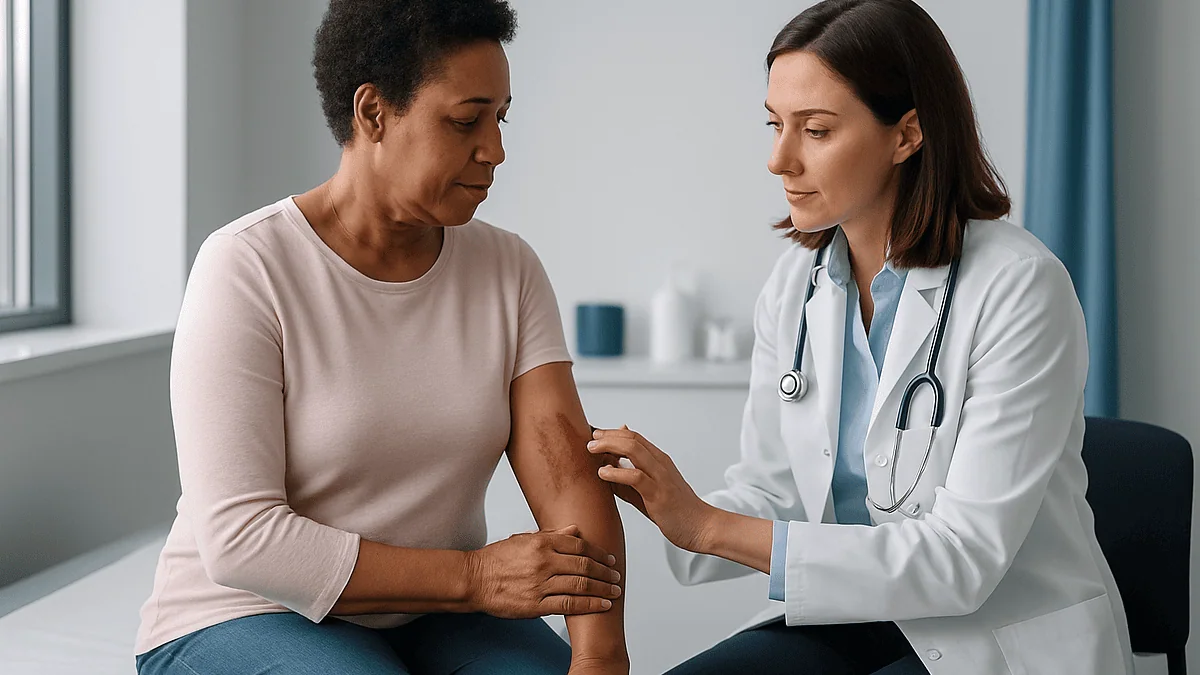
Make an appointment if a raised scar has grown beyond the edges of the original wound, is still enlarging six to twelve months after the injury, itches or hurts enough to disturb sleep or daily activity, or sits somewhere that restricts movement, such as over a joint or on the neck. Early keloids are generally smaller and respond better to treatment, so sooner is genuinely better than later. Bring a note of when the injury happened and any earlier scars that behaved the same way, and mention any treatments already tried.
Seek care promptly, within days rather than weeks, if the scar shows red-flag signs: rapid growth over a few weeks, bleeding or an open sore on its surface, spreading redness and warmth with fever that suggests infection, or a change in texture such as one area becoming hard and irregular while the rest stays the same. Keloids themselves do not become cancerous, but a small number of skin growths, including certain rare tumors, can resemble a keloid closely enough that a clinician may want to examine or sample tissue to be certain, especially if the growth appeared without any remembered injury.
A dermatologist or plastic surgeon with experience in scar management is the usual specialist, though a primary care clinician can begin the assessment and refer. Expect a conversation about goals first. Someone who mainly wants the itch gone needs a different plan from someone who wants an earlobe reshaped, and both differ from someone whose priority is preventing recurrence after a previous failed removal. Good keloid care starts with that question, and it is fair to arrive with your answer ready.
Frequently asked questions
Do keloids eventually flatten on their own?
No, keloids do not meaningfully flatten without treatment. Over several years the color usually fades from red or purple toward your skin tone, and the tissue may soften somewhat, but the raised bulk remains. Growth typically stops eventually, yet the scar does not shrink back. Hypertrophic scars, which stay within the wound edges, do improve on their own and are often mistaken for keloids.
How do you deflate a keloid?
The most common way clinicians reduce a keloid is with corticosteroid injections placed directly into the scar, which calm the overactive cells and encourage collagen breakdown. Softening and flattening appear gradually over a series of sessions spaced weeks apart. Cryotherapy is sometimes added for small keloids, and surgery combined with injections, pressure, or other follow-up is used for large ones. No home method deflates a keloid.
Can massaging a keloid flatten it?
Massage is not recommended for true keloids and may irritate them. Keloid tissue appears sensitive to mechanical tension, and rubbing can encourage growth in some people. Gentle massage is appropriate for fresh surgical scars and hypertrophic scars that stay within the wound edges. If a scar has spread beyond the original injury, use silicone and seek an assessment instead of massaging it.
What is inside a keloid bump?
A keloid is made of thick, disorganized bundles of collagen produced by fibroblasts that remain active long after the wound has closed. It also contains many small blood vessels, which give younger keloids their red or purple color, and nerve fibers and mast cells that cause itching and tenderness. There is no fluid, pus, or debris inside, so it cannot be drained.
Do silicone sheets really work on keloids?
Silicone sheets and gels are the only over-the-counter approach recommended by major medical bodies for raised scars, but expectations should be modest. They reliably soften scars and reduce redness and itch, and they help prevent new scars from becoming raised. Flattening an established, mature keloid is less likely. They must be worn 12 to 24 hours a day for several months to have a fair chance.
Why do keloids come back after surgery?
Surgery creates a new wound in skin that has already shown it overreacts to injury, so the same process starts again, often producing a larger keloid. Cleveland Clinic reports recurrence in roughly 45% to 100% of cases when surgery is used alone. That is why surgeons combine removal with injections, pressure devices, silicone, or in selected cases radiation to the wound site.
Does apple cider vinegar remove keloids?
No. Apple cider vinegar is an acid, and repeated application can sting, redden, and superficially burn the skin. Because inflammation drives keloid growth, irritating the scar may make it worse rather than smaller. No major medical organization lists vinegar, lemon juice, or other acidic home remedies as keloid treatments. Bland moisturizers or silicone are safer if you want to apply something.
Who is most likely to get keloids?
Keloids are most common between the ages of 10 and 30 and occur more often in people with darker skin, according to the NHS. A family history of keloids raises the risk substantially. Common trigger sites include the earlobes, chest, shoulders, upper back, and jawline, and triggers range from piercings and surgery to acne, chickenpox, and minor scratches.
How long does keloid treatment take to show results?
Months, in almost every case. Injections are repeated at intervals of several weeks and often continue for several months before the full effect is seen. Silicone typically needs several months of daily wear. After surgical removal, pressure devices are worn for six to twelve months to prevent regrowth. Anyone promising a keloid gone in days is not describing an evidence-based approach.
Can a keloid turn into cancer?
Keloids are benign and do not become cancerous. However, a few uncommon skin growths can look similar to a keloid, particularly if the bump appeared without any remembered injury. Rapid growth over weeks, bleeding, an open sore, or a hard irregular area within the scar are reasons to have it examined promptly so a clinician can confirm what it is.
References
This article is for general information only and is not a substitute for professional medical advice. Please consult a qualified doctor about your individual situation.

More from the Blog
Preparing for Face Aesthetics Surgery: Blood Tests, Anesthesia Review and Medicine Changes
Preparing for facial surgery usually means a pre-assessment visit where blood tests check clotting, blood count and kidney function, an anesthesia review covers your…

Supporting Someone After a Neck and Face Lift: Drains, Dressings and the First Days Home
In the first days after a neck and face lift, a helper's main tasks are keeping the head raised, emptying and recording any drains,…

Facial Augmentation With Fat Transfer or Implants: Which Option Suits Which Face?
Facial fat transfer uses a person's own fat, taken by gentle liposuction and injected into the face, to add soft, natural-looking volume; facial implants…

How Surgeons Sequence Combined Face Aesthetics Procedures: One Operation or Several?
Surgeons combine facial procedures in one operation when the areas heal on a similar timetable, the patient is medically well, and total anesthesia time…

How Surgeons Sequence Combined Face Aesthetics Procedures: One Operation or Several?
Surgeons may combine facial procedures such as a facelift, eyelid surgery and fat grafting in one operation when a person is healthy, does not…
Are Facial Implants Right for Your Face? Bone Structure, Skin Thickness and Age Considered
Facial implants are usually considered for adults whose bones have finished growing, who have a specific structural gap such as a recessed chin or…