

Keratin Treatments and Hair Botox: What the Salon Treatments Do and the Formaldehyde Question
Key Takeaways
- The smoothing effect of a keratin treatment comes from an aldehyde and flat-iron heat near 450°F, not from the keratin, which is mainly a conditioner.
- Methylene glycol on an ingredient list is formaldehyde dissolved in water, and it converts back to formaldehyde gas when the iron is applied.
- Hair botox contains no botulinum toxin and has no legal definition, so its risk depends entirely on whether the specific formula includes aldehydes.
- In the Sister Study, women using chemical straighteners more than four times a year had about 2.5 times the uterine cancer rate, an estimated 4.05 percent versus 1.64 percent by age 70.
- Occupational investigators measured formaldehyde above workplace limits in salons using products labeled formaldehyde-free, which makes ventilation and label-reading more useful than brand claims.
- Hair that looks thinner after a treatment is usually breakage along the shaft, but shedding from the root, a sore scalp patch or reduced urination after a glyoxylic acid treatment needs medical evaluation.
A keratin treatment coats hair with a protein-rich solution and seals it with a flat iron to reduce frizz for roughly 2–5 months; so-called hair botox is a similar deep-conditioning treatment that contains no botulinum toxin. Many formulas, including some labeled formaldehyde-free, release formaldehyde gas when heated. Formaldehyde is an established carcinogen with repeated exposure, and large observational studies link frequent chemical straightening to higher uterine cancer risk, so the evidence supports caution rather than alarm.
Walk past a salon on a humid Saturday in spring and you can smell it before you see it: a sharp, eye-watering note drifting out of the door while someone sits under a flat iron for the third hour. Keratin treatment appointments spike every year around now, but as of March 2026 the searches have a different edge. A federal proposal to ban formaldehyde and formaldehyde-releasing chemicals in hair-smoothing products has been delayed more than once, a large study linking frequent straightener use to uterine cancer is still being shared widely, and a newer label, hair botox, is being marketed as the gentle alternative.
The result is a tangle of half-true claims. Some people have canceled appointments out of fear; others have switched to products promising zero formaldehyde without knowing what that phrase legally means. This explainer walks through what the chemistry does to a strand of hair, what the evidence shows about risk and how strong that evidence is, and which symptoms after a salon visit deserve a doctor’s attention.
What does a keratin treatment actually do to hair?
Keratin is the tough structural protein that makes up hair, nails and the outer layer of skin. Each hair shaft is a bundle of keratin chains held in shape by chemical bonds, wrapped in overlapping scales called the cuticle. Frizz happens when those scales lift and let humidity swell the inner cortex unevenly.
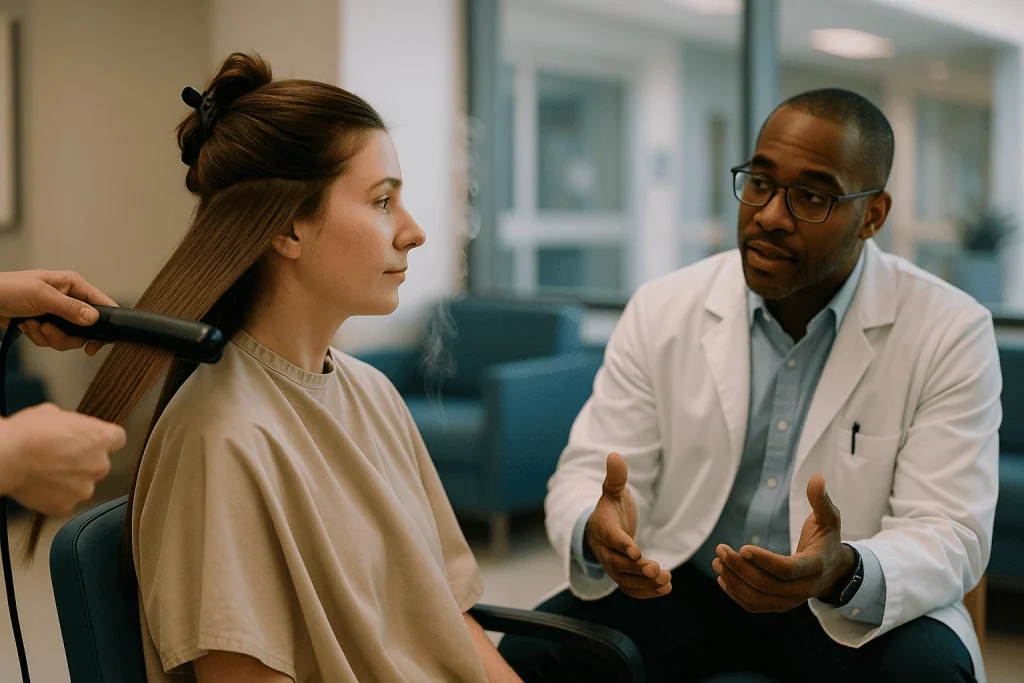
A salon keratin treatment follows a fairly standard script. The stylist washes the hair with a stripping shampoo, paints on a liquid rich in hydrolyzed keratin (keratin broken into small fragments) plus an active chemical, blow-dries it, then runs a flat iron through small sections at very high heat, often around 450°F (232°C). The heat does two things at once. It drives moisture out and triggers the active chemical to form new crosslinks between the protein chains, which lays the cuticle flat and locks a smooth coating around the shaft.
Two details matter for everything that follows. First, the treatment changes the hair that already exists, not the follicle below the scalp, so new growth arrives with your original texture and the effect fades over about two to five months as the coating washes away. Second, the smoothing power comes mostly from the active chemical and the heat, not from the keratin itself, which is largely a conditioning ingredient. In the original Brazilian-style formulas that chemical was formaldehyde dissolved in water. In newer products it is often an alternative aldehyde. That swap is the heart of the safety debate, and it is why a label reading keratin tells you very little about what is going to be heated next to your face.
What is hair botox, and does it involve botulinum toxin?
No. Hair botox contains no botulinum toxin and has nothing to do with the injectable medicine used for wrinkles or migraine. The name is marketing shorthand borrowed from the idea of smoothing and plumping, and because hair is not living tissue, a nerve-blocking protein would have nothing to act on anyway.
What the term usually describes is a deep-conditioning mask. Typical ingredient lists include hydrolyzed keratin, amino acids, collagen fragments, plant oils, vitamins and humectants such as hyaluronic acid, which is a molecule that holds water. The product sits on the hair for a set time, is rinsed or partly rinsed, and is often sealed with a blow-dryer and flat iron at lower heat than a keratin treatment. Marketing promises softer, shinier, less frizzy hair for anywhere from a few weeks to a couple of months.
Here is the catch. There is no legal or scientific definition of hair botox, so two products with the same name on the shelf can be chemically unrelated. Some are genuinely rinse-off conditioners with no straightening chemistry at all. Others contain glyoxylic acid or formaldehyde-releasing preservatives and behave like a mild keratin treatment, heat and fumes included. Because these are cosmetics rather than drugs, nobody is required to run a clinical trial before selling them, and none have been studied in randomized research.
The honest summary is that hair botox is a category name, not a treatment. Whether it is gentler than a keratin treatment depends entirely on the ingredient list, which is why the sections on reading labels later in this piece apply just as much to the gentle option as to the original.
What changed recently to put keratin treatments back in the headlines?
Three dated developments explain the current wave of interest.
The first was scientific. On October 17, 2022, the National Institutes of Health announced results from the Sister Study, which followed 33,497 women for about 11 years and found that those who used chemical hair straighteners more than four times in the previous year had roughly two and a half times the rate of uterine cancer of women who never used them. The study did not test individual brands or confirm which ingredients were responsible, but it was the first large prospective dataset tying straighteners to a hormone-sensitive cancer, and it has been circulating on social media ever since.
The second was regulatory. In 2023 the US Food and Drug Administration announced it intended to propose a ban on formaldehyde and formaldehyde-releasing ingredients in hair-smoothing and straightening products sold in the United States. The timetable for publishing that rule slipped repeatedly through 2024 and 2025. At the time of our last check it had not been finalized, so formaldehyde-based products remained legal to sell, and consumers should confirm the current status rather than assume a ban is in force.
The third was clinical. During 2024, physicians published case reports describing acute kidney injury in people who had recently undergone straightening with products containing glyoxylic acid, the most common formaldehyde-free substitute. Case reports are the weakest form of evidence and cannot prove cause, but they punctured the assumption that a formaldehyde-free label automatically means a risk-free product.
Underneath these headlines sit older facts that have not changed: the National Toxicology Program listed formaldehyde as a known human carcinogen in 2011, and workplace investigators measured formaldehyde above occupational limits in salons the same year.
The formaldehyde question: how a straightening liquid becomes a gas
Formaldehyde is a colorless gas with a pungent smell that is used in building materials, embalming fluid and some preservatives. In a bottle of straightening solution it rarely appears as formaldehyde. Instead the label often lists methylene glycol, which is simply formaldehyde dissolved in water. The two forms exist in a constant chemical balance: at room temperature most sits as methylene glycol, and as soon as heat is applied the balance tips and formaldehyde gas is released.
A flat iron at 450°F is a very efficient way to tip that balance. Workplace investigators from the National Institute for Occupational Safety and Health, part of the CDC, sampled salon air during smoothing services in 2011 and found formaldehyde levels that exceeded recommended exposure limits in several salons, including ones using products marketed as formaldehyde-free. Stylists reported burning eyes, sore throats and nosebleeds, the classic signs of airborne exposure.
The gas does not respect the chair. It drifts to the client, to the stylist, and to anyone at the next station. Exposure is highest during the flat-iron step, lasts for the length of the appointment, and is worsened by small rooms, closed doors and recirculating air.
Alternative formulas lean on glyoxylic acid, a different small aldehyde that bonds hair proteins through a related mechanism. Laboratory testing has suggested that some glyoxylic acid products still release measurable formaldehyde when heated, although generally less than methylene glycol formulas. Glyoxylic acid also brings its own irritant properties and the kidney case reports described above.
In practical terms, the question is not whether a product contains formaldehyde on paper. It is how much formaldehyde reaches the breathing zone once the iron comes out, and that depends on the formula, the heat and the room.
Is a keratin treatment safe? What the evidence actually says, graded
Safety is not one question but several, each resting on evidence of different strength. Grading them separately keeps the picture honest.
Strongest: formaldehyde causes cancer with long-term exposure. This rests on decades of occupational cohort studies, including a National Cancer Institute cohort of more than 25,000 industrial workers that found higher rates of myeloid leukemia and nasopharyngeal cancer among the most heavily exposed. The International Agency for Research on Cancer and the US National Toxicology Program both classify formaldehyde as a known human carcinogen. These are observational data, but they are large, repeated and biologically plausible.
Moderate: formaldehyde reaches harmful concentrations in salons. Direct air monitoring by occupational health investigators showed levels above workplace limits during smoothing services. Measurements, not surveys, but limited to a handful of salons and products.
Moderate but indirect: chemical straighteners and uterine cancer. The Sister Study is a single large prospective cohort with a consistent dose-response pattern. It could not isolate keratin treatments from other straighteners or identify the responsible chemicals, and it has not yet been replicated in an independent cohort of similar size.
Weak: acute irritation and respiratory symptoms in clients. Supported by case series, stylist surveys and consistent complaints to regulators, which is enough to accept the symptoms are real but not to estimate how common they are.
Weakest: glyoxylic acid and kidney injury, and claims of hair damage or hair loss. Case reports and expert opinion only.
There are no randomized controlled trials of keratin treatments or hair botox for any outcome, cosmetic or medical. Anyone claiming a trial proved either safe or dangerous is overstating what exists. What the evidence supports is precaution scaled to exposure: the stylist doing six services a week faces a different calculation than a client visiting twice a year.
Hair straighteners and uterine cancer: what the Sister Study found and did not find
Because this study drives much of the current fear, it deserves a careful reading. The Sister Study enrolled women aged 35 to 74 who had a sister with breast cancer but no breast cancer themselves, and tracked them for an average of 10.9 years. Among 33,497 participants, 378 developed uterine cancer.
Women who reported using chemical hair straighteners more than four times in the previous year had a hazard ratio of 2.55, meaning their rate of uterine cancer was about two and a half times that of never users. Less frequent use showed a smaller, non-significant increase, which is the dose-response pattern epidemiologists look for. The researchers estimated that by age 70, about 1.64 percent of never users would develop uterine cancer compared with about 4.05 percent of frequent users.
Those absolute numbers matter as much as the ratio. A doubling of a small risk is still a small risk for any one person, though it is meaningful across a population, and uterine cancer incidence has been rising in the United States for other reasons too.
What the study could not do is equally important. Participants reported straightener use without naming products, so the data cannot distinguish a keratin treatment from a lye relaxer or a hair botox mask. It did not measure formaldehyde or any other chemical; the authors suggested formaldehyde, parabens and other hormone-active ingredients as plausible culprits, absorbed through a scalp irritated by heat and chemicals. The findings also need confirmation in other populations. Roughly 60 percent of frequent users were Black women, a group with higher baseline rates of aggressive uterine cancer types, which raises both equity concerns and the possibility of confounding.
The appropriate conclusion is that frequent chemical straightening is associated with higher uterine cancer risk and the link is biologically plausible, not that any single treatment has been proven to cause it.
Keratin treatment side effects: scalp, eyes, airway, and the person holding the iron
The most common side effects are immediate and unglamorous. During the flat-iron step, airborne formaldehyde or glyoxylic acid can cause stinging, watery eyes, a raw or burning throat, coughing, a runny nose and headache. Some people develop nosebleeds, nausea or a tight, wheezy chest, especially if they already have asthma. These symptoms usually settle within hours of leaving a ventilated space, but they are a sign that exposure crossed an irritation threshold.
The scalp takes a double hit. Chemical irritation can produce redness, itching and small blisters, and the iron itself can cause thermal burns if it touches skin or heats product resting on the scalp. Allergic contact dermatitis, an immune reaction to an ingredient that appears a day or two after exposure as an itchy, weeping rash, has been reported with formaldehyde and related preservatives and can spread to the forehead, ears and neck where product dripped.
Hair itself can suffer. Repeated treatments at 450°F plus aldehyde crosslinking leave strands stiffer and more brittle, which shows up as mid-shaft breakage and split ends weeks later. People sometimes mistake this for hair falling out from the root; the distinction is covered in the next section.
The person at highest risk is rarely the client. A stylist who performs several smoothing services a week accumulates the kind of repeated exposure that occupational cancer studies describe. Investigators found that symptoms clustered among salon workers, and chronic exposure carries documented risks of occupational asthma and, over years, cancers of the nose and throat and blood.
Groups that should be especially cautious include people with asthma or chronic lung disease, people with eczema or a history of fragrance or preservative allergy, children and adolescents, and anyone who is pregnant, for whom avoiding avoidable formaldehyde exposure is a reasonable precaution even though direct pregnancy outcome data are lacking.
Do keratin treatments cause hair loss, or is it breakage?
Searches pairing keratin treatment with hair loss climb every year, and the answer depends on distinguishing two very different events.
Breakage is hair snapping along the shaft, leaving short, frayed pieces and a thinner-looking ponytail while the scalp itself still has a full density of growing hairs. It is the predictable result of heat near the upper limit of what keratin tolerates, repeated chemical crosslinking that reduces elasticity, and the protein-heavy products that can leave hair stiff when used too often. Breakage is common after smoothing treatments and is reversible as new hair grows, provided the cycle of damage stops.
True hair loss means hairs leaving the follicle. After a salon treatment this can happen in a few ways. A chemical or thermal burn on the scalp can inflame follicles and cause a patch of shedding; if the burn is deep enough to scar, that patch may be permanent. Tight sectioning and pulling during a long service can contribute to traction alopecia, hair loss from sustained tension, particularly in people who also wear tight styles. A sudden increase in shedding across the whole scalp two to three months after a stressful event, including an intense physical or chemical stress, fits telogen effluvium, in which many follicles shift into their resting phase at once; this usually resolves on its own.
No controlled study has measured how often keratin treatments or hair botox trigger shedding, so the evidence here is clinical observation and case reports. The pattern tells the story. Short broken hairs and split ends point to breakage; shedding from the root with visible bulbs, a widening part, or a sore, scabbed patch points to the follicle and needs a clinician’s eye.
Can a keratin treatment or hair botox treat thinning hair?
Not in any meaningful sense, and this is where marketing and medicine part ways. Both treatments can make hair look temporarily fuller by coating each strand so it reflects more light and sits with less frizz. That is a cosmetic effect on existing hair. Neither product reaches the follicle, alters the hair growth cycle, or addresses the causes of thinning, and there is no clinical research showing either one increases hair count or density.
The causes of thinning hair are varied and often treatable once identified. Pattern hair loss, the most common form in both men and women, is driven by genetics and hormone sensitivity in the follicle. Telogen effluvium follows illness, surgery, childbirth, rapid weight loss or major stress. Thyroid disorders, iron deficiency, certain medicines and autoimmune conditions such as alopecia areata each produce distinct patterns. Scarring forms of hair loss, which can be triggered or worsened by chemical and heat injury to the scalp, are the ones where delay costs the most, because destroyed follicles do not regrow.
Mainstream guidance from sources such as the NHS and Mayo Clinic is consistent: new or worsening hair loss deserves an evaluation that may include a scalp examination, blood tests and sometimes a biopsy, and there are medically studied treatments whose suitability depends on the diagnosis. Which of those, if any, is appropriate is a decision for the treating clinician.
For someone already noticing thinning, a smoothing treatment carries a particular trade-off. The heat and chemistry fall hardest on hair that is already finer and more fragile, and any scalp irritation adds inflammation to a scalp that may already be under strain. A conditioning mask that genuinely contains no aldehydes and uses modest heat is a reasonable cosmetic choice; a high-heat aldehyde treatment is a poor fit for hair that is thinning for a medical reason.
Keratin treatment vs hair botox vs chemical relaxer: how they compare
Confusion between these three is a major reason people underestimate or overestimate their exposure. The table lays out what the evidence and typical formulations show; individual products vary, so an ingredient list always overrides a category name.
| Feature | Keratin treatment | Hair botox | Chemical relaxer |
|---|---|---|---|
| Main purpose | Reduce frizz, loosen curl, add shine | Condition, add shine, mild smoothing | Permanently straighten |
| Typical active chemistry | Methylene glycol (formaldehyde) or glyoxylic acid | Proteins and humectants; sometimes glyoxylic acid or formaldehyde releasers | Sodium hydroxide (lye) or guanidine hydroxide (no-lye) |
| Heat required | High, often about 450°F (232°C) | Low to moderate, sometimes none | Minimal; chemistry does the work |
| How long it lasts | About 2–5 months, fades gradually | Weeks to about 2 months | Permanent on treated hair; new growth needs retouching |
| Formaldehyde concern | High with methylene glycol; lower but not zero with glyoxylic acid | Depends entirely on formula | Generally none; main risks are chemical scalp burns |
| Reversibility | Washes out over time | Washes out | Not reversible |
| Evidence base | Air monitoring, case series, observational cancer data | Essentially none | Case series for burns; included in Sister Study exposure |
A few observations follow from the grid. Relaxers break the bonds inside the hair permanently, which is why they straighten curls so completely and why the hair cannot go back. Keratin treatments add bonds and a coating rather than destroying the existing structure, which is gentler on curl pattern but relies on the fume-producing heat step. Hair botox occupies no fixed position: at its mildest it is a conditioner with a dramatic name, and at its strongest it is a keratin treatment that has changed its label.
What formaldehyde-free really means on a keratin treatment label
The phrase is technically true more often than it is meaningfully true. A product can carry a formaldehyde-free claim because formaldehyde gas is not listed as an ingredient, while containing a compound that becomes formaldehyde the moment it is heated.
Names to recognize on an ingredient list include methylene glycol, methanediol, formalin, methanal, formic aldehyde, oxomethane and oxymethylene, all of which are formaldehyde or its water-bound form. Preservatives such as DMDM hydantoin, quaternium-15, imidazolidinyl urea and diazolidinyl urea are formaldehyde releasers that slowly shed small amounts over time. Glyoxylic acid and glyoxyloyl carbocysteine mark the newer alternative chemistry.
Glyoxylic acid products deserve their own caution rather than a free pass. They are acidic enough to irritate the scalp and eyes, and some laboratory testing indicates they can release formaldehyde under flat-iron temperatures, though generally at lower levels than methylene glycol formulas. The 2024 case reports of acute kidney injury after glyoxylic acid straightening are of particular interest to physicians because glyoxylic acid can be metabolized into oxalate, a compound that forms crystals in the kidney. A handful of case reports cannot establish how often this happens or at what exposure, and most people who have had such treatments report no kidney problems, but it is a plausible mechanism and a reason to take unexplained symptoms after a treatment seriously.
Two practical points. Cosmetic products in the United States must list ingredients, so the label is available even when the salon only shows a brand name; a client is entitled to ask to see the bottle or the safety data sheet, the document manufacturers prepare describing hazards. And a product that makes your eyes sting or your throat burn is releasing something irritating regardless of what the front of the box promises.
Common myths about keratin treatments and hair botox
The viral claims around these treatments tend to fall into five patterns, each with a kernel of truth attached to a misleading conclusion.
Myth: the keratin is what smooths the hair, so more keratin means better results. Hydrolyzed keratin is a conditioner that fills surface gaps temporarily. The smoothing comes from the aldehyde and the heat. Piling on protein without the active chemistry gives softer hair, not straighter hair, and too much protein can leave hair stiff and prone to snapping.
Myth: hair botox is injected or works like cosmetic Botox. Nothing is injected, no botulinum toxin is involved, and hair has no muscles or nerves to relax. It is a conditioning mask with a borrowed name.
Myth: one keratin treatment gives you cancer. The cancer evidence concerns long-term, repeated exposure: industrial workers breathing formaldehyde for years, and women reporting straightener use more than four times a year over a decade. No study has measured risk from a single treatment, and the best available data suggest occasional exposure carries a small increment at most, with stylists bearing the greater burden.
Myth: formaldehyde-free means fume-free and risk-free. Air monitoring found formaldehyde above workplace limits in salons using products labeled formaldehyde-free, and the main substitute, glyoxylic acid, has its own irritant and kidney concerns.
Myth: keratin treatments regrow or thicken thinning hair. They coat existing strands. They do nothing for the follicle, and high heat and scalp irritation can worsen breakage and inflammation in hair that is thinning for a medical reason.
A sixth claim circulating now, that a federal ban has already taken effect, is also inaccurate as of our last check. The rule was proposed, not finalized, so the products remain on the market and the burden of checking ingredients still sits with the stylist and the client.
How to lower your exposure if you still choose a keratin treatment
Plenty of people weigh the evidence and decide the cosmetic benefit is worth an occasional treatment. The goal then is to shrink the exposure, and the levers follow directly from the chemistry.
Ventilation is the single biggest factor for airborne formaldehyde. A salon that performs smoothing services near an open door, under a working exhaust hood or with a portable source-capture fan removes gas before it reaches breathing height. A closed back room with recirculating air does the opposite. It is reasonable to ask where the service will be done and to decline a cramped space.
Ask to see the product label and safety data sheet before the appointment, and look for the names in the previous section. A stylist who knows exactly what is in the bottle and uses a lower iron temperature, dries the hair fully before ironing to reduce steam, and avoids letting product sit on the scalp is lowering your dose on several fronts at once.
Frequency matters more than any single session. The uterine cancer association appeared in women using straighteners more than four times a year; stretching treatments to twice a year, or alternating with a genuinely aldehyde-free conditioning mask, cuts cumulative exposure sharply.
Patch testing a small area of skin behind the ear 48 hours ahead can reveal allergic sensitivity before a whole-scalp reaction. Skip the appointment during pregnancy and while breastfeeding as a precaution, during an asthma flare, and whenever the scalp is sunburned, broken or irritated, since damaged skin absorbs more of whatever is applied.
Home kits deserve a separate warning. They put the highest-exposure step, the flat ironing of a chemically treated head, into a kitchen or bathroom with no ventilation plan and no one to notice if your breathing changes. Whatever the label, a professional in a ventilated space is the lower-risk setting.
When to see a doctor after a keratin treatment or hair botox
Most irritation from a smoothing service fades within a day once you are in fresh air. Some symptoms should not be waited out.
Seek emergency care immediately for difficulty breathing, wheezing that does not ease, chest tightness, swelling of the lips, tongue or throat, or a feeling of faintness during or after the appointment. These can indicate a severe airway reaction and are more likely in people with asthma.
Arrange same-day or next-day medical attention for any of the following:
- Scalp burns with blistering, open skin or pain that worsens rather than improves after 24 hours, since deep burns can scar follicles.
- A spreading, weeping or intensely itchy rash on the scalp, forehead, ears or neck appearing within one to three days, which suggests allergic contact dermatitis.
- Eye pain, blurred vision or light sensitivity that persists after rinsing; chemical exposure to the cornea needs prompt assessment.
- Nosebleeds, hoarseness or a cough lasting more than a few days, particularly in stylists with repeated exposure.
- Reduced urine output, flank or lower back pain, nausea, or swelling of the ankles in the days after a treatment, especially a glyoxylic acid product, because case reports have linked these to acute kidney injury and a simple blood test can check kidney function.
Book a routine appointment with a primary care clinician or dermatologist for hair shedding that continues beyond a few weeks, a widening part, a bald patch, a scalp that stays sore or scaly, or any new scalp symptom in someone with a history of eczema or allergies. Bring the product name or a photo of the ingredient list; it shortens the detective work considerably.
Any question about whether a treatment is appropriate alongside a medical condition, a pregnancy or a prescribed medicine belongs with the treating clinician. Online reassurances, including this article, are context, not clearance.
Frequently asked questions
Is a keratin treatment safe to have once or twice a year?
Occasional treatments in a well-ventilated salon carry a lower exposure than the frequent use linked to risk in research, but no study has defined a safe number. The uterine cancer association appeared at more than four uses a year, and formaldehyde’s cancer evidence comes from long-term exposure. People with asthma, allergies, pregnancy or scalp conditions should discuss it with their clinician first.
Does hair botox contain Botox or any botulinum toxin?
No. Hair botox is a marketing name for a deep-conditioning mask made of proteins, amino acids, oils and humectants. Nothing is injected and no botulinum toxin is present. Because the term has no legal definition, some products sold under the name also contain glyoxylic acid or formaldehyde-releasing ingredients, so the ingredient list matters more than the label.
How can I tell if a keratin treatment contains formaldehyde?
Read the full ingredient list and look for methylene glycol, methanediol, formalin, methanal, formic aldehyde or oxomethane, all of which are forms of formaldehyde, plus releasers such as DMDM hydantoin or quaternium-15. Glyoxylic acid signals the alternative chemistry, which can still release some formaldehyde when heated. A stinging smell during ironing is a practical warning regardless of the label.
Can a keratin treatment cause hair loss?
It more often causes breakage than true hair loss. High heat and repeated chemical crosslinking make hair brittle, producing short snapped hairs and split ends. Genuine shedding from the root can follow a chemical or heat burn on the scalp, heavy tension during the service, or a delayed stress response called telogen effluvium. Persistent shedding or a sore patch should be assessed by a clinician.
What did the Sister Study actually prove about hair straighteners and cancer?
It showed an association, not proof of cause. Among 33,497 women followed for about 11 years, frequent straightener users had roughly 2.5 times the uterine cancer rate of never users. The study did not identify products or chemicals and has not yet been replicated at similar scale. Scientists consider the link biologically plausible and a reason for caution.
Are formaldehyde-free keratin treatments actually safer?
Often somewhat, but not automatically. Many rely on glyoxylic acid, which generally releases less formaldehyde under heat than methylene glycol formulas yet is itself irritating and has been linked in 2024 case reports to acute kidney injury. Salon air monitoring has also found formaldehyde above limits with products labeled formaldehyde-free, so ventilation and ingredient checks still matter.
Is it safe to get a keratin treatment while pregnant?
There is no direct research on pregnancy outcomes after keratin treatments, which is itself a reason for caution. Formaldehyde is a known irritant and carcinogen, and avoiding avoidable exposure during pregnancy and breastfeeding is a reasonable precaution most clinicians would support. Anyone considering a treatment while pregnant should raise it with their obstetric clinician rather than rely on salon reassurance.
What are the most common keratin treatment side effects?
Stinging, watery eyes, a burning throat, cough, runny nose, headache and sometimes nosebleeds during the flat-iron step are the most frequently reported, along with scalp redness or burns and, less often, an itchy allergic rash appearing a day or two later. Hair may become brittle and break over following weeks. Stylists with repeated exposure face higher risks, including occupational asthma.
Can hair botox or keratin treatments help with thinning hair?
No. Both coat existing strands so hair looks smoother and temporarily fuller, but neither reaches the follicle or changes hair growth, and no research shows increased density. Thinning hair has many causes, from pattern hair loss to thyroid or iron problems, and several have medically studied treatments. A clinician can identify the cause and discuss options suited to it.
Has formaldehyde in hair smoothing products been banned in the United States?
Not as of our last check in early 2026. Regulators announced in 2023 that they intended to propose a ban on formaldehyde and formaldehyde-releasing ingredients in hair-smoothing products, but the rule’s publication was delayed repeatedly and had not been finalized. Products containing methylene glycol remained legal to sell, so checking current status and ingredient lists is still up to the consumer.
This article is for general information only and is not a substitute for professional medical advice. Please consult a qualified doctor about your individual situation.

More from the Blog
Hair Loss Concealers and Fibres: What They Do Well, and What They Cannot
Hair loss concealers, keratin fibers, tinted powders, sprays, and cream sticks, genuinely improve the appearance of thinning hair by reducing the color contrast between…
Traction Alopecia: How Tight Hairstyles Cause Hair Loss and Whether It Grows Back
Traction alopecia is hair loss caused by repeated pulling on the hair roots from tight braids, buns, ponytails, extensions, weaves or locs. It usually…
Receding Hairline: The Norwood Stages, Temple Thinning and the Options at Each Stage
A receding hairline is the gradual backward movement of the front hairline, usually starting at the temples, and in most men it is the…
How to Stop Hair Loss: The Treatments With Evidence, Ranked
The best-supported ways to stop or slow hair loss depend on its cause. For male and female pattern hair loss, topical minoxidil and, in…
Oral Minoxidil: Why Dermatologists Now Prescribe the Blood-Pressure Pill for Hair
Oral minoxidil is a prescription tablet approved to treat severe high blood pressure that dermatologists increasingly prescribe off-label, in amounts far below the blood-pressure…

Scalp Psoriasis vs Dandruff: How to Tell Them Apart and Treat Each
Scalp psoriasis is an immune-driven condition that produces thick, sharply bordered, silvery plaques that often extend past the hairline, while dandruff is a mild,…