Nasopharyngeal Cancer
Nasopharyngeal Cancer is a cancer behind the nose. Learn symptoms, risk factors, diagnosis, treatment options, and when to seek care.

Quick answer
Nasopharyngeal cancer is a malignant tumor that starts in the nasopharynx, the upper part of the throat behind the nose, and is usually treated according to its stage and spread. At Acibadem in Turkey, evaluation typically includes imaging, endoscopic examination, and biopsy, followed by a personalized treatment plan that may combine radiotherapy, chemotherapy, surgery, and supportive care.
What is nasopharyngeal cancer?
Nasopharyngeal cancer is a type of cancer that starts in the nasopharynx, which is the upper part of the throat located behind the nose and just above the soft palate (the soft back portion of the roof of the mouth). The nasopharynx is a small, box-like space that connects the nasal passages to the rest of the throat. Air passes through it every time you breathe through your nose, and the tubes that connect the middle ears to the throat (called the Eustachian tubes) open into it on each side.
Most cases of nasopharyngeal cancer are a form of carcinoma, meaning the cancer begins in the cells that line the surface of the nasopharynx. Because this area is hidden deep inside the head, tumors here can grow for some time without being seen or felt directly, which is one reason the condition is often found at a later stage than cancers in more visible locations.
Nasopharyngeal cancer is uncommon in most parts of the world, including North America and Europe. It is seen more frequently in parts of Southeast Asia, southern China, North Africa, and among certain populations in the Arctic region. It can occur at almost any age, including in teenagers and young adults, but it is diagnosed more often in adults, and men are affected more frequently than women. Understanding what is nasopharyngeal cancer, what warning signs it may cause, and how it is treated can help patients and families take part in decisions about care.
Symptoms of nasopharyngeal cancer
Nasopharyngeal cancer symptoms are often vague at first and can resemble common, harmless conditions such as colds, allergies, or ear infections. Many people do not notice anything unusual in the earliest stages. As the tumor grows, it can block the nasal passages, press on the Eustachian tubes, or spread to nearby lymph nodes (small, bean-shaped glands in the neck that filter fluid and help fight infection).
Common nasopharyngeal cancer symptoms include:
- A lump in the neckoften painless, caused by cancer spreading to lymph nodes; this is one of the most frequent first signs
- Hearing loss, ringing in the ear (tinnitus), or a feeling of fullness in one earusually on one side only
- Repeated ear infections, especially fluid buildup in the middle ear in an adult
- Nasal blockage or stuffiness, often on one side and not improving over time
- Nosebleeds or blood-tinged mucus, including blood noticed in saliva that drains from the back of the nose
- Headaches that are new or persistent
- Facial pain or numbness, or double vision, if the tumor affects nerves at the base of the skull
- Difficulty opening the mouth in more advanced disease
- Sore throat that does not go away
Symptoms often differ by stage. In early-stage disease, a person may have only mild ear symptoms or a slightly blocked nose on one side. In more advanced stages, neck lumps, nerve-related symptoms such as double vision or facial numbness, and persistent headaches become more common. If the cancer has spread to distant parts of the body (a process called metastasis), symptoms may include bone pain, unexplained weight loss, or ongoing fatigue.
It is important to remember that all of these symptoms are far more often caused by conditions other than cancer. However, symptoms that affect only one side of the head, persist for more than a few weeks, or keep coming back deserve a medical evaluation.
Causes and risk factors
The exact nasopharyngeal cancer causes are not fully understood, but researchers believe the disease develops through a combination of viral infection, inherited susceptibility, and environmental exposures. In most people, no single cause can be identified with certainty.
Recognized risk factors include:
- Epstein-Barr virus (EBV): This very common virus, which also causes infectious mononucleosis (“mono”), is strongly linked to nasopharyngeal cancer. Most people worldwide are infected with EBV at some point, yet only a very small number ever develop this cancer, so the virus alone does not explain the disease. It appears to act together with other factors.
- Geographic and ethnic background: The cancer is more common in people from southern China, Southeast Asia, North Africa, and some Arctic populations. Risk can remain somewhat elevated in people who move from higher-risk regions to lower-risk ones, suggesting both genetic and early-life environmental influences.
- Family history: Having a close relative with nasopharyngeal cancer increases risk, pointing to inherited factors.
- Diet: Diets high in salt-cured fish and preserved foods, particularly when eaten regularly from childhood, have been associated with higher risk in some populations. These foods can contain chemical compounds called nitrosamines, which may damage cells.
- Tobacco and alcohol: Smoking is linked to an increased risk of some types of nasopharyngeal cancer, and heavy alcohol use may also contribute.
- Male sex and age: Men are affected roughly two to three times more often than women, and risk tends to rise in adulthood, although the disease can also occur in younger people.
- Workplace exposures: Long-term exposure to wood dust and certain chemicals such as formaldehyde may raise risk.
Having one or more risk factors does not mean a person will develop nasopharyngeal cancer, and some people who develop it have no known risk factors at all. There is currently no proven way to prevent the disease, though avoiding tobacco and limiting heavily preserved foods are reasonable general health measures.
Diagnosis
Nasopharyngeal cancer diagnosis usually begins when a person sees a doctor about persistent symptoms such as a neck lump, one-sided ear problems, or nasal blockage. Because the nasopharynx cannot be seen by simply looking in the mouth or nose, specialized examinations are needed.
Steps in diagnosis typically include:
- Medical history and physical examination: The doctor asks about symptoms, risk factors, and family history, and examines the head, neck, ears, nose, and throat, feeling carefully for enlarged lymph nodes.
- Nasopharyngoscopy: A thin, flexible tube with a light and camera (an endoscope) is passed through the nose to look directly at the nasopharynx. This is usually done in the clinic with local numbing spray and is the standard way to see a tumor in this hidden area.
- Biopsy: A biopsy, the removal of a small sample of tissue for examination under a microscope, is the only way to confirm the diagnosis. It is usually taken through the endoscope. If a neck lump is present, a fine needle may also be used to sample cells from the lymph node.
- Imaging tests: Once cancer is confirmed, scans help determine how far it has grown or spread. Magnetic resonance imaging (MRI) shows the tumor and nearby soft tissues and skull base in detail. Computed tomography (CT) scans assess bone involvement and the chest. A PET scan (positron emission tomography), which highlights areas of active cancer cells, may be used to look for spread to lymph nodes or distant organs.
- Blood tests: Doctors often check general health with blood tests. In many centers, blood levels of Epstein-Barr virus DNA are measured, because they can support the diagnosis and may help track the response to treatment.
- Hearing and dental assessments: Because treatment can affect the ears, mouth, and teeth, hearing tests and a dental checkup are often performed before treatment begins.
Using these results, doctors assign a stage to the cancer, usually with the TNM system, which describes the size and extent of the tumor (T), whether lymph nodes are involved (N), and whether the cancer has spread to distant sites (M). Staging guides treatment decisions and gives a general sense of outlook.
Treatment options for nasopharyngeal cancer
Nasopharyngeal cancer treatment depends on the stage of the disease, the exact type of tumor cells, the person’s overall health, and personal preferences. Care is typically planned by a multidisciplinary team: a group of specialists that may include radiation oncologists, medical oncologists, ear-nose-and-throat surgeons, radiologists, and pathologists. In many hospital systems, including Acibadem, systemic drug therapy for this disease is coordinated through the Medical Oncology Department, working closely with radiation oncology.
Radiation therapy
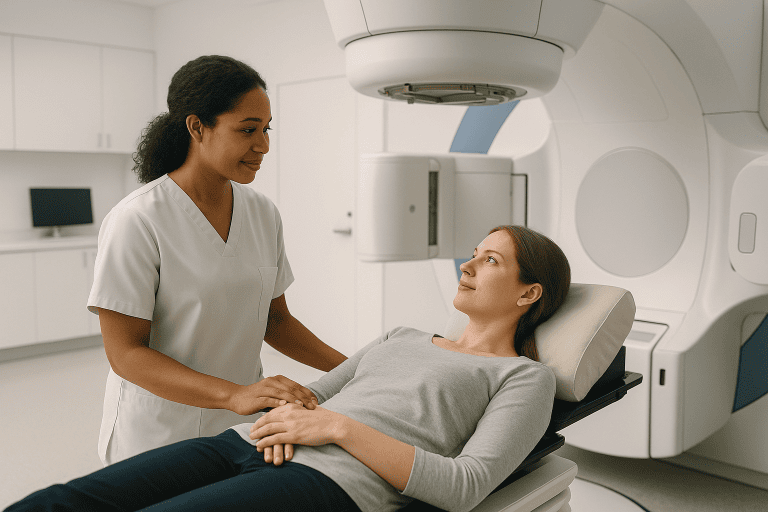
Radiation therapythe use of carefully targeted high-energy beams to destroy cancer cells, is the main treatment for nasopharyngeal cancer. This cancer tends to respond well to radiation, and the location deep in the skull makes surgery difficult, so radiation is usually preferred as the primary treatment. Modern techniques such as intensity-modulated radiation therapy (IMRT) shape the beams closely around the tumor to reduce damage to nearby structures such as the salivary glands, spinal cord, and eyes. For very early-stage disease, radiation alone may be sufficient.
Chemotherapy
Chemotherapy uses medications that kill rapidly dividing cells, including cancer cells. For most people whose cancer has grown beyond the earliest stage, chemotherapy is given together with radiation (called chemoradiation), because the drugs make cancer cells more sensitive to radiation. Chemotherapy may also be given before radiation (induction chemotherapy) or afterward (adjuvant chemotherapy) in certain situations. When nasopharyngeal cancer has spread to distant parts of the body, chemotherapy is often the main treatment.
Immunotherapy and targeted therapy
Immunotherapy refers to drugs that help the body’s own immune system recognize and attack cancer cells. Some immunotherapy medications may be used for nasopharyngeal cancer that has returned after treatment or spread to other organs, often alongside or after chemotherapy. Targeted therapies, which block specific molecules that help cancer cells grow, may be options in selected cases. Your doctor can explain whether these approaches are suitable for your particular situation and whether a clinical trial might be appropriate.
Surgery
Surgery is used less often for nasopharyngeal cancer than for many other head and neck cancers, because the nasopharynx sits close to major blood vessels, nerves, and the base of the skull. However, surgery may be recommended to remove lymph nodes in the neck that still contain cancer after radiation, or in selected cases where the tumor returns in the nasopharynx and can be reached safely, sometimes using endoscopic techniques through the nose.
Watchful waiting and supportive care
Active surveillance, or watchful waiting, is generally not used for confirmed nasopharyngeal cancer, because the disease usually requires treatment. However, careful monitoring with regular examinations and scans is a central part of care after treatment ends. Supportive (palliative) care, treatment focused on relieving symptoms such as pain, dry mouth, swallowing difficulty, and fatigue, is important at every stage and can be provided alongside curative treatment, not only in advanced disease.
Treatment can cause side effects, including dry mouth, taste changes, sore throat, skin irritation, hearing changes, fatigue, and nausea. Many side effects improve over time, though some may be long-lasting. Your care team can suggest ways to manage them, and dietitians, speech and swallowing therapists, and dentists often play a role in recovery.
Living with nasopharyngeal cancer / outlook
The outlook for nasopharyngeal cancer varies widely from person to person. In general, cancers found at an earlier stage, before extensive spread, tend to respond better to treatment, and many people with early-stage disease are treated with the goal of cure. Even some cancers that have spread to neck lymph nodes can often be controlled with combined chemoradiation. When the cancer has spread to distant organs, treatment usually aims to control the disease and relieve symptoms rather than cure it, though responses vary. No doctor can promise a specific outcome, and statistics describe groups of patients, not any one individual.
Life during and after treatment involves adjustment. Radiation to the head and neck commonly causes a dry mouth, which can affect eating, speaking, and dental health; regular dental care and staying well hydrated help. Some people experience hearing changes, neck stiffness, or thyroid gland underactivity (the thyroid is a hormone-producing gland in the neck that can be affected by radiation), so periodic blood tests and hearing checks are often part of follow-up. Eating well, staying as active as your energy allows, avoiding tobacco, and attending all follow-up appointments support recovery.
Follow-up visits typically include physical examinations, endoscopy of the nasopharynx, imaging when needed, and in some centers, blood tests for Epstein-Barr virus DNA, which may help detect a recurrence early. Emotional health matters as much as physical health: anxiety, low mood, and worry about recurrence are common and understandable. Counseling, support groups, and honest conversations with your care team and loved ones can make a meaningful difference.
Frequently asked questions
What is nasopharyngeal cancer in simple terms?
Nasopharyngeal cancer is a cancer that begins in the nasopharynx, the area at the very back of the nose and top of the throat. It usually starts in the cells lining this space and can grow into nearby tissues or spread to lymph nodes in the neck. Because the area is hidden, it is often discovered only after symptoms such as a neck lump or one-sided ear problems appear.
Can nasopharyngeal cancer be cured?
In many cases, particularly when the cancer is found before it has spread to distant organs, treatment with radiation therapy, often combined with chemotherapy, is given with the intention of cure, and many people do achieve long-term remission. Outcomes depend on the stage, the tumor type, and individual health factors, so no outcome can be guaranteed. Your oncology team can discuss what the goals of treatment are in your specific situation.
How serious is nasopharyngeal cancer?
Nasopharyngeal cancer is a serious diagnosis that requires prompt specialist care, but seriousness varies with stage. Early-stage tumors often respond well to radiation-based treatment, while advanced disease is harder to control. Because the tumor sits near nerves, the skull base, and the ears, even treatment can have lasting effects, which is why care is planned by an experienced multidisciplinary team.
What are the first symptoms of nasopharyngeal cancer?
The first noticeable sign is often a painless lump in the neck caused by cancer spreading to a lymph node. Other early nasopharyngeal cancer symptoms include hearing loss or fullness in one ear, ringing in the ear, repeated ear infections in an adult, one-sided nasal blockage, and nosebleeds or blood in the saliva. These symptoms have many harmless causes, but if they persist for more than a few weeks, they should be checked by a doctor.
Does the Epstein-Barr virus always cause nasopharyngeal cancer?
No. Epstein-Barr virus infection is extremely common worldwide, and the vast majority of infected people never develop nasopharyngeal cancer. The virus is one important factor among several nasopharyngeal cancer causes, which also include genetic background, diet, and environmental exposures. Having had EBV or mononucleosis does not mean you will develop this cancer.
How long does recovery from treatment take?
Recovery varies by person and treatment intensity. Side effects such as sore throat, fatigue, taste changes, and skin irritation are often most severe in the weeks during and just after chemoradiation and then gradually improve over the following months. Some effects, such as dry mouth or hearing changes, may improve slowly or persist long term. Most people need regular follow-up visits for several years so their team can monitor healing and watch for any recurrence.
Is nasopharyngeal cancer hereditary?
Nasopharyngeal cancer is not directly inherited in the way some genetic conditions are, but having a close family member with the disease does increase risk, and the cancer is more common in people from certain regions and ethnic backgrounds. Shared genes, shared early-life environment, and shared dietary habits may all contribute. If you have a strong family history, mention it to your doctor, especially if you develop persistent ear, nose, or neck symptoms.
When to see a doctor
Many symptoms linked to nasopharyngeal cancer are common and usually caused by minor conditions. However, you should arrange a medical evaluation promptly if you notice any of the following warning signs, especially if they persist for more than two to three weeks or occur on one side only:
- A lump or swelling in the neck that does not go away, even if it is painless
- Hearing loss, ringing, or a blocked feeling in one ear that persists, or repeated ear infections as an adult
- Nasal blockage on one side that does not improve with usual cold or allergy care
- Frequent nosebleeds or blood in mucus or saliva from the back of the nose
- Persistent or worsening headaches, particularly if new for you
- Double vision, facial numbness, or facial pain
- Difficulty opening the mouth or swallowing
- Unexplained weight loss or ongoing fatigue alongside any of the above
Seek urgent medical attention for sudden severe headache, sudden vision changes, heavy bleeding from the nose that will not stop, or difficulty breathing. Early evaluation does not mean you have cancer, most people with these symptoms will have another explanation, but if nasopharyngeal cancer is present, finding it at an earlier stage generally allows more treatment options and a better chance of a good outcome.
Medically reviewed by the Acıbadem International Medical Board September 3, 2026
See our medical review board →
Update history
- PublishedJune 8, 2026
- Medical review approvedSeptember 3, 2026
- Last content updateSeptember 2, 2026