

Laser Dentistry Myths: Does a Laser Replace Every Drill and Every Injection?

Key Takeaways
- Dental lasers remove decay by vaporizing the water inside softened tooth tissue, which is why they work well on shallow cavities and poorly on dense enamel or metal fillings.
- The Cochrane review of laser versus drill caries removal found less pain and less need for anesthesia with lasers, but graded the evidence as low to very low certainty.
- The same review found no significant difference in filling margin quality or failure between laser and drill treatment, so lasers have not been shown to make fillings last longer.
- Lasers cannot remove old amalgam or metal fillings, shape most crown preparations or reach decay between tightly packed teeth, so most laser fillings are finished with a rotary instrument.
- Soft-tissue lasers seal small blood vessels as they cut, reducing bleeding and often avoiding stitches, though the heat-sealed edge can slightly slow early healing.
- The main laser-specific risks are eye exposure and pulp overheating, both controlled by wavelength-specific goggles and continuous water cooling in trained hands.
No. Dental lasers can remove some decay, reshape gum tissue and treat certain gum pockets, and research suggests they may reduce the need for numbing injections in selected shallow cavities. They cannot remove old fillings, prepare teeth for most crowns, or work well between tight teeth, and deeper cavities usually still need local anesthetic. A laser is one tool among several, chosen case by case by the treating dentist.
The video arrives in a family group chat with the caption “no drill, no needle, no pain.” A child grins in a dental chair while a slim wand hums near a molar. By bedtime a grandparent who has avoided the dentist for a decade is wondering whether this is finally her way back, and a nephew with a chipped front tooth is asking whether he can skip the shot entirely.
Laser dentistry myths spread exactly like this, through hope and a thirty-second clip. The technology is real, it has been in regulated clinical use for decades, and in the right situation it can make a visit quieter and gentler. The trouble is the word “every.” Every drill. Every injection. Every patient.
What follows is an honest tour of what dental lasers do, what they do not do, and what the better studies actually found, so you can walk into your next appointment with sharper questions instead of borrowed expectations.
What is laser dentistry, and why do laser dentistry myths spread so easily?
A dental laser is a device that delivers a narrow, intense beam of light at a specific wavelength, which is the color of the light measured in nanometers. Different wavelengths are absorbed by different materials. Some are soaked up by water and the mineral in enamel, so they can chip away decayed tooth structure. Others are absorbed by pigment and blood, so they cut and seal soft gum tissue. The dentist chooses the device the way a carpenter chooses between a chisel and a plane.
Why do the myths cling so tightly to this one tool? Partly because dental fear is widespread and lasers promise an escape from its two most dreaded triggers, the whine of the handpiece and the sting of the needle. Partly because marketing language slips easily from “may reduce the need for anesthesia in some cases” to “no needles.” And partly because lasers genuinely feel different. There is no vibration through the jawbone. Instead of a high-pitched drone, patients hear a soft, rapid popping, which many describe as less alarming.
A sensation that is different is not the same as a procedure that is universally painless, and a tool that is useful is not the same as a tool that is universal. Mainstream dental references, including the overviews from Mayo Clinic and Cleveland Clinic on tooth decay and fillings, describe several ways to remove decay and restore teeth. Lasers appear in that list; they do not replace it.
Keeping that distinction in mind turns the question in the title from a yes-or-no debate into a far more useful one: in which situations does a laser help, in which does it fall short, and how would your own dentist decide?
How dental lasers actually work on teeth and gums
Picture two very different jobs. The first is removing a soft, decayed patch from the inside of a tooth. The second is trimming a small flap of gum that overhangs a molar. Lasers handle these with different physics.
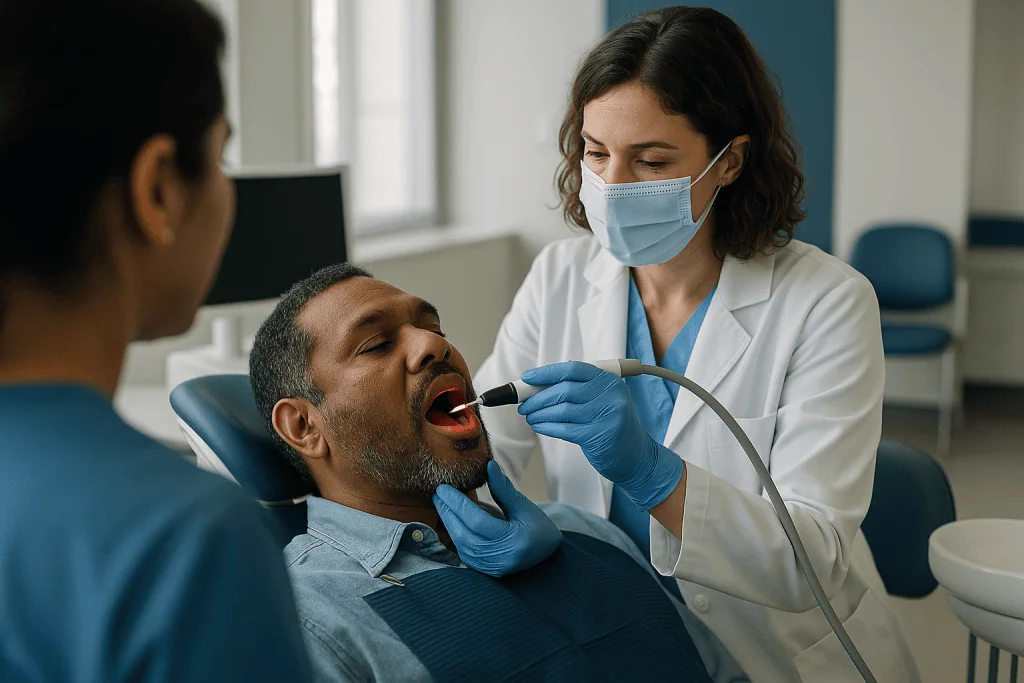
For hard tissue, dentists typically use erbium lasers, a family named for the element in their crystal. Their light is strongly absorbed by water. Decayed dentin holds more water than healthy enamel, so when the pulsed beam strikes it, the water inside flashes to vapor almost instantly. Each tiny burst, a process called ablation, blasts away a microscopic fleck of tooth. Thousands of pulses per second, with a cooling water spray, gradually excavate the cavity. Because healthy enamel contains less water, it resists the beam more, which is why some describe lasers as “selective.” The selectivity is relative, not absolute, and the dentist still confirms clean margins visually and with hand instruments.
For soft tissue, dentists often use diode or carbon dioxide lasers. Their wavelengths are absorbed by hemoglobin, the pigment in blood, and by water in gum cells. The beam cuts and simultaneously seals small blood vessels, which is why soft-tissue laser work tends to bleed less than a scalpel incision and often needs no stitches.
Neither type works like a science-fiction beam that passes through everything. Lasers remove tissue only at the surface they touch, a fraction of a millimeter at a time. That limits speed, and it also limits risk: a careful operator controls depth with pulse settings and hand movement.
One more mechanism matters for the injection question. Some clinicians report that the pulsing light has a numbing effect on nerve endings in the tooth, which may explain reduced pain in shallow cavities. The evidence for this, discussed later, is real but graded as low certainty by systematic reviewers.
Laser dentistry vs drill: can a laser replace every drill?
The short answer is that it cannot, and the reasons are mechanical rather than a matter of opinion.
A dental drill, more precisely a high-speed rotary handpiece, spins a tungsten-carbide or diamond bur at tens of thousands of revolutions per minute. It cuts enamel fast, shapes cavity walls with crisp angles, and gives the dentist tactile feedback through the fingers. Lasers deliver none of that touch. The dentist works by sight and sound, which is manageable for a shallow lesion but far harder when the goal is a precisely tapered crown preparation around an entire tooth.
Then there is the problem of existing dental work. Laser energy that excavates decay does not safely remove amalgam or metal; it can reflect or heat the material unpredictably. If a tooth already has an old filling that needs replacing, the rotary handpiece comes out.
Access is another limit. Decay often hides on the surfaces between teeth, where the beam cannot reach without first removing healthy tooth to open a path. The straight line of light simply does not bend around a neighbor.
Speed matters too. The Cochrane review of lasers for caries removal, which pooled randomized trials comparing laser excavation with conventional drilling, found that laser treatment generally took longer, while the quality of the finished filling margins was similar between the two approaches.
Where the laser shines, literally, is in small to moderate cavities in visible surfaces, in reshaping gum tissue, and in work for patients who find vibration and noise distressing. In practice many dentists use both tools in a single visit: the laser for the soft or decayed portion, the drill to finish and polish. That hybrid approach is closer to the clinical reality than any “drill-free dentistry” headline.
Does a laser replace every injection? What the anesthesia evidence shows
This is the claim people most want to be true, so it deserves the most careful handling.
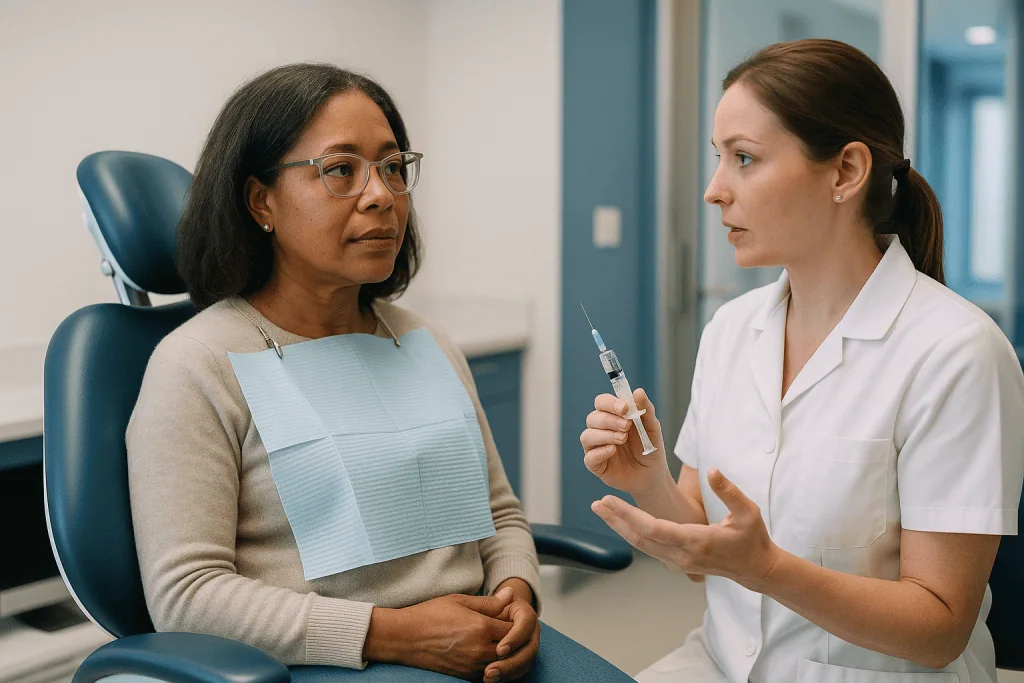
Local anesthetic, the class of medicines a dentist injects to numb a tooth and its surrounding gum, works by temporarily blocking nerve signals. Whether you need it depends less on the tool and more on the depth of the problem. Enamel has no nerve endings. Dentin, the layer underneath, carries fluid-filled tubules that transmit sensation, and the closer the decay sits to the pulp, the more a tooth feels.
The Cochrane systematic review on laser caries removal reported that patients treated with lasers were less likely to need local anesthetic and less likely to report pain during the procedure than those treated with a drill. The reviewers graded this evidence as low to very low certainty, largely because the trials were small and participants knew which treatment they were receiving. In plain language: the effect probably exists for shallow cavities in some patients, but the studies cannot tell you how reliably it will apply to you.
For deeper decay, teeth that are already aching, root canal treatment, or extractions, numbing remains standard regardless of whether a laser is involved. Soft-tissue procedures such as gum reshaping often still involve a topical numbing gel, and sometimes an injection, even when the laser does the cutting.
Two practical notes. First, a dentist who begins without anesthetic should always be willing to stop and numb the tooth if you feel more than cold or pressure, and you should feel free to raise a hand. Second, the goal of avoiding a needle should never push anyone to tolerate pain. Decisions about numbing belong to you and your dentist together, made before the procedure begins.
Is laser dentistry safe? Eye protection, heat and regulation
Dental lasers used in licensed practice are regulated medical devices, and the risks are well characterized. Safety depends less on the machine than on how it is used.
The first concern is the eye. Laser light can injure the retina or cornea, so every person in the room, including the patient, wears wavelength-specific protective glasses. If a clinic offers laser treatment and no one hands you goggles, that is a reasonable moment to ask why.
The second concern is heat. Although erbium lasers are paired with a water spray that cools the tooth, excessive energy or a dry field can raise the temperature of the pulp, the living core of the tooth containing nerves and blood vessels. Too much heat can inflame or damage the pulp, which is why operators are trained on pulse settings, exposure time and continuous cooling. The same principle applies to a conventional drill run without adequate water, so this is a shared risk rather than a laser-specific one.
Third, soft-tissue lasers can char tissue if moved too slowly, and the heat-sealed edge can slow early healing slightly compared with a clean scalpel cut. Dentists balance that against the benefit of reduced bleeding.
Fourth, the laser plume, the fine mist produced during ablation, is managed with high-volume suction, just as the aerosol from a handpiece is.
What the evidence does not show is any pattern of serious harm when lasers are used within their intended settings. The Cochrane reviewers found no meaningful difference in adverse events or in filling durability between laser and drill groups across the included trials. The honest summary: laser dentistry is considered safe when performed by a trained clinician with proper protection, and the relevant risks are predictable, visible and preventable.
Does dental laser actually work? Separating evidence from enthusiasm
Enthusiasm for a technology often runs ahead of its evidence base, and it is fair to ask whether lasers deliver clinically meaningful results or simply a different experience.
For removing decay, the best available synthesis is the Cochrane review on lasers versus drills, which examined randomized trials in both children and adults. Its findings were modest and balanced. Lasers were associated with less reported pain and less need for anesthesia during treatment, while the completed fillings showed no significant differences in marginal integrity, that is, how well the filling sealed to the tooth, or in longer-term failure. Treatment time tended to be longer with lasers. Crucially, the overall certainty of the evidence was rated low, so these conclusions could shift as larger, better-blinded studies appear.
For soft-tissue work, the picture rests more on clinical experience and smaller studies than on large trials. Reduced bleeding during cutting is a consistent and biologically plausible observation. Claims that lasers accelerate healing are less secure; the sealed wound edge can actually delay early epithelial closure slightly even as it reduces bleeding.
For gum disease, lasers have been studied as an addition to scaling and root planing, the deep cleaning that removes plaque and tartar beneath the gum line. Mainstream guidance from sources such as the NHS and Cleveland Clinic still describes mechanical cleaning as the foundation of periodontal treatment. Adding a laser has shown small or inconsistent extra benefit in trials, and professional bodies generally frame it as an adjunct whose value is not yet firmly established rather than a replacement.
So yes, dental lasers work, in the sense that they remove decay and cut tissue effectively. Whether they work better than established tools depends entirely on which outcome you measure. For comfort during small cavities, probably. For durability of the final result, no demonstrated advantage. For gum disease, the jury remains out.
Laser dentistry for cavities, gums and sensitivity: where each tool fits
Because the honest answer keeps coming back to “it depends on the job,” a side-by-side view helps. The table below reflects how mainstream dental references and the Cochrane evidence describe typical roles, not a recommendation for any particular case. Your dentist weighs the specifics of your tooth.
| Procedure | Where a laser is commonly used | Where the drill or scalpel usually remains | Injection usually needed? |
|---|---|---|---|
| Small to moderate cavity on a visible surface | Often suitable for decay removal | Finishing cavity shape; polishing | Sometimes avoided; low-certainty evidence |
| Deep cavity near the pulp | May remove soft decay | Shaping, lining, finishing | Usually yes |
| Replacing an old metal filling | Not used on the metal | Required to remove old material | Usually yes |
| Crown preparation | Occasional soft-tissue trimming at the margin | Required for shaping the tooth | Usually yes |
| Gum reshaping or frenectomy | Frequently used; less bleeding | Scalpel remains an accepted alternative | Often topical gel; sometimes injection |
| Gum pocket treatment | Adjunct to deep cleaning | Scaling and root planing remain the core | Depends on depth |
| Dentin hypersensitivity | Studied as one option to seal tubules | Desensitizing agents, bonding, fluoride | Typically no |
A frenectomy, mentioned above, is the release of a tight band of tissue under the tongue or lip. It is one of the clearest cases where a soft-tissue laser has become a routine option because the area is small, bleeding control matters, and sutures are often avoidable.
Dentin hypersensitivity is the sharp twinge from cold or sweet foods caused by exposed dentin. Cleveland Clinic lists several management routes, from desensitizing toothpaste to bonding and gum grafts. Lasers appear in the research literature as a way to seal exposed tubules, but they sit alongside, not above, simpler first-line measures.
Who laser dentistry is usually for, and who is usually asked to wait
Dentists tend to reach for a laser when its particular strengths line up with a patient’s particular needs, and to set it aside when they do not.
People who often benefit include those with small cavities in accessible surfaces, especially if the sound and vibration of a handpiece triggers distress. Children with early decay in baby teeth are frequently cited, since a shorter list of frightening sensations can make a first filling easier. Patients who need minor gum reshaping, a frenectomy, or removal of a small benign soft-tissue lump often do well with a laser because of reduced bleeding and the frequent absence of stitches. People taking anticoagulant medicines, the class that reduces blood clotting, may also be considered for laser soft-tissue work for the same reason, though that decision rests entirely with the dentist in discussion with the prescribing clinician; no one should alter a blood thinner for a dental appointment on their own.
Patients commonly asked to wait, or offered a different tool, include those whose decay runs deep toward the pulp, those whose main need is replacing old metal fillings, and anyone requiring a crown or bridge preparation. Decay between tightly packed teeth is another reason to choose the drill. People with certain photosensitizing conditions, or who have had recent eye surgery, may be asked to postpone laser work until their physician is consulted. Pregnancy is not a contraindication to dental lasers in itself, but many dentists defer elective procedures of any kind to a later trimester or after delivery, in line with general guidance from sources such as the NHS on dental care in pregnancy.
In every case, the deciding factor is not the patient’s preference for a modern tool but the match between the tool and the tooth. A good dentist will explain which applies to you and why.
What are the downsides of laser dentistry? Pros and cons laid out honestly
Every tool carries trade-offs, and a reader weighing laser dentistry pros and cons deserves both columns.
On the positive side, lasers produce no vibration and a quieter sound profile, which many anxious patients find easier. For shallow cavities, the Cochrane evidence points to less pain and a reduced need for numbing, albeit with low certainty. Soft-tissue cutting bleeds less and often avoids sutures. Because lasers remove tissue in tiny increments, they can be conservative, taking less healthy tooth than a bur might in careful hands.
Now the downsides. Speed is the first: laser excavation of decay usually takes longer than drilling, which can mean a longer time in the chair. Range is the second: lasers cannot remove metal fillings, prepare crowns efficiently, or reach decay between teeth without help from rotary instruments. Tactile feedback is the third: the dentist loses the sense of touch that signals the transition from soft decay to sound dentin, relying instead on sight and sound.
Heat is a fourth consideration. Without constant water cooling and correct settings, the pulp can be overheated. Properly used, this risk is low, but it is real and it is operator dependent. Soft-tissue healing can be marginally slower at a heat-sealed edge than at a scalpel cut, even though bleeding is less.
Finally, there is the issue of expectation. When patients arrive believing a laser guarantees no pain, any twinge feels like a broken promise, and that disappointment itself feeds dental anxiety. The best protection against this downside is a frank conversation before the first pulse: what the laser will do, what the drill will still do, and at what point numbing will be offered.
Laid out this way, lasers emerge as a valuable addition with specific strengths, not a wholesale upgrade.
Why don't more dentists use lasers?
If lasers are safe and sometimes gentler, the natural question is why every practice does not own one. The answer is a mix of economics, training and clinical judgment, and none of it suggests the technology is a gimmick.
Hard-tissue lasers are a significant capital investment and require maintenance, and a practice must perform enough suitable cases to justify the purchase. Many general practices find that the majority of their restorative work, replacing failed fillings, crowns and deeper decay, falls outside the laser’s sweet spot. Buying an instrument for a minority of cases is a business decision, not a safety one.
Training is the second factor. Laser dentistry demands a different skill set: judging depth without touch, selecting pulse energy for each tissue, and maintaining cooling. Dentists complete additional certification courses, and the learning curve is real. A clinician who is highly skilled with a handpiece may reasonably conclude that patients are better served by that mastery than by a newly acquired tool.
Evidence is the third. As the Cochrane review notes, laser decay removal has not demonstrated superior long-term outcomes for the filling itself. For a profession trained to adopt what is proven, a comfort benefit of low-certainty evidence, paired with longer treatment time, does not compel universal adoption.
Workflow matters as well. Because most laser cases still require a drill to finish, the laser adds a step rather than removing one. Practices with high patient volumes may find that time cost difficult to absorb.
So the absence of a laser in your dentist’s office tells you very little about the quality of care. Equally, the presence of one does not make a practice better. It tells you only that a particular tool is available for the cases where it fits, and a thoughtful clinician will tell you plainly whether yours is one of them.
What the following days usually look like after laser dental treatment
Recovery after laser work follows the same biology as recovery after conventional treatment, with a few differences patients notice.
After a laser filling, the most common experience is mild sensitivity to cold, heat or pressure in the treated tooth. Cleveland Clinic’s overview of dental fillings describes this sensitivity as typical and notes that it generally settles over a few weeks as the tooth adjusts. If no anesthetic was used, there is no numb lip to bite and eating can usually resume once the filling material has set, which your dentist will confirm. If anesthetic was used, the usual advice applies: avoid chewing on that side until feeling returns, to prevent biting the cheek or tongue.
After soft-tissue laser work such as gum reshaping, the treated area often looks pale or slightly grayish for the first days. That is the sealed surface layer, not infection, and it gradually sloughs as new tissue forms beneath. Bleeding is typically minimal. Mild soreness is common and tends to peak within the first couple of days before easing. Your dentist may suggest a gentle saltwater rinse and soft foods; follow their specific instructions rather than general internet advice.
For laser treatment of gum pockets as part of a deep cleaning, gums may feel tender and teeth temporarily more sensitive as inflamed tissue shrinks and exposes a little root surface. The NHS guidance on gum disease frames this as part of healing after periodontal therapy generally, not a laser-specific effect.
Across all of these, the trajectory should be steady improvement. Discomfort that plateaus is unremarkable in the first few days; discomfort that climbs, swelling that spreads, or a bad taste that develops are signals covered in the section on when to call your doctor.
Keep any scheduled review appointment even if everything feels fine. The dentist checks margins and healing that you cannot see.
What people often get wrong: laser dentistry myths corrected
Here are the misunderstandings that come up most often, each paired with what the evidence actually supports.
“Lasers mean no needles, ever.” The Cochrane review found a reduced need for anesthesia in laser cavity treatment, with low-certainty evidence, mostly for shallow lesions. Deep decay, root canals and extractions still routinely need numbing.
“Lasers mean no drill, ever.” Lasers cannot remove metal fillings, shape crown preparations or reach between tight teeth. Most laser fillings are finished with a rotary instrument.
“Laser fillings last longer.” Pooled trials show no significant difference in filling margins or failure rates between laser and drill excavation.
“Lasers are dangerous radiation.” Dental lasers emit light, not ionizing radiation like X-rays. The risks are eye exposure and heat, both controlled with goggles and water cooling.
“Lasers heal gums faster.” Soft-tissue lasers reduce bleeding, but the heat-sealed edge can slightly slow early closure. Faster overall healing is not well established.
“If my dentist does not use a laser, they are behind the times.” Adoption reflects cost, training and case mix. Many excellent clinicians use conventional tools exclusively.
“A laser can treat gum disease on its own.” Mechanical deep cleaning remains the foundation of periodontal care in mainstream guidance. Lasers are an adjunct with inconsistent added benefit.
“Lasers are only for children.” Children with early decay are frequent candidates, but adults with small accessible cavities or soft-tissue needs are treated just as often.
A useful habit when you encounter a new claim: ask whether it describes how the procedure feels or how the tooth fares afterward. Lasers have a credible story on the first. On the second, they match, rather than beat, the tools dentists have used for generations.
Questions to ask your care team before choosing laser treatment
A good consultation leaves you understanding not just what will happen but why this approach was chosen over the alternatives. These questions tend to produce the most useful answers.
- Which parts of my treatment would the laser perform, and which would still need a drill or scalpel?
- How deep is the decay, and based on that, how likely is it that I will need a numbing injection anyway?
- If we start without anesthetic, how will you check that I am comfortable, and how do I signal you to stop?
- What training have you completed in dental lasers, and how often do you use one for cases like mine?
- What eye protection and cooling will be used during the procedure?
- How does the expected treatment time compare with a conventional approach?
- Is there any evidence that the laser will change how long my filling or gum result lasts?
- What should healing look like day by day, and what signs would mean I should call?
- Given my medical history and current medicines, is there anything that makes a laser more or less suitable for me?
- If a laser is not the right fit, what alternatives would you suggest and why?
Notice what is not on the list. There is no question about whether lasers are “better,” because the answer is always “better for what.” There is also no question that requires you to choose a tool yourself. Your role is to understand the options and to share what matters to you, whether that is avoiding vibration, minimizing time in the chair or ensuring you never feel pain. The treating team then matches the tool to the tooth.
Write the answers down or bring someone with you. Dental consultations move quickly, and the details about numbing and finishing steps are exactly the ones that evaporate once the appointment is over.
When to call your doctor or dentist after laser dental treatment
Most people recover from laser dental work with nothing more than brief sensitivity. A few signs, however, mean the treating team should hear from you promptly rather than at your next routine check.
Call the same day, or seek urgent care, if you notice swelling of the face, jaw or neck that is spreading, difficulty swallowing or breathing, or a fever with facial pain. These can signal a spreading dental infection, which Mayo Clinic and the NHS describe as a situation that needs prompt professional assessment rather than watchful waiting at home. Trouble breathing is an emergency.
Contact your dentist within a day if bleeding from a laser gum site does not settle with firm, steady pressure on clean gauze, if pain is clearly increasing after the first couple of days instead of easing, or if you develop a persistent bad taste or discharge from the treated area. A filling that feels high when you bite, a sharp edge your tongue keeps finding, or a piece of filling that has come away also warrant a call, since an uneven bite can stress the tooth and the jaw.
Numbness that persists far beyond the time your dentist described, or a tingling or altered sensation in the lip, tongue or chin that lasts into the following day, should be reported. It is uncommon, but nerve irritation after dental work needs documenting and monitoring.
Finally, any sudden eye discomfort, light sensitivity or visual change in the hours after laser treatment should prompt an immediate call to your dentist and, if symptoms persist, an eye care professional. Protective goggles make this very unlikely, but it is never a sign to wait out.
When in doubt, call. Dental teams would far rather reassure you over the phone than see a small problem grow.
Frequently asked questions
What are the downsides of laser dentistry?
The main downsides are slower decay removal, a narrower range of uses and loss of tactile feedback for the dentist. Lasers cannot remove metal fillings, prepare crowns or reach between tight teeth, so a drill is usually still needed. Heat can damage the pulp without proper cooling, and soft-tissue edges can heal slightly slower than scalpel cuts. Pooled trials show no durability advantage for laser fillings over conventional ones.
Why don't more dentists use lasers?
Lasers are expensive to buy and maintain, require additional certification training, and suit only a portion of everyday restorative work. Because most laser cases still need a drill to finish, the laser often adds a step rather than removing one. With systematic reviews showing comfort benefits of low certainty and no improvement in long-term filling outcomes, many clinicians reasonably continue with conventional tools they have mastered.
Does dental laser actually work?
Yes, dental lasers effectively remove decay and cut soft tissue. The better question is whether they work better than established tools. For shallow cavities, trials suggest less pain and less need for numbing, with low-certainty evidence. For the finished filling, outcomes are similar to drilling. For gum disease, lasers are an adjunct to deep cleaning with inconsistent added benefit rather than a standalone treatment.
What is the most feared dental procedure?
There is no single authoritative answer, because surveys ask different questions and populations. Root canal treatment and extractions are frequently named, but when people describe what actually frightens them, the numbing injection and the sound and vibration of the drill come up most often. That is why laser dentistry draws so much interest: it removes vibration and may reduce injections for shallow cavities, though it does not eliminate them.
Is laser dentistry safe for children?
When performed by a trained dentist with eye protection and water cooling, laser treatment is considered safe for children and is often used for small cavities in baby teeth and for procedures such as releasing a tight tongue tie. The Cochrane review included pediatric trials and found no pattern of increased adverse events. As with adults, deeper decay may still need numbing, and the dentist decides case by case.
Laser dentistry vs drill: which hurts less?
For shallow cavities, randomized trials pooled in a Cochrane review found that patients treated with lasers reported less pain and needed anesthesia less often than those treated with a drill, though the certainty of that evidence was low. For deep decay, root canals or extractions, numbing is standard with either tool, so the difference largely disappears. Lasers also eliminate vibration, which many people find more distressing than pain itself.
Can laser dentistry treat gum disease on its own?
No. Mainstream guidance continues to describe scaling and root planing, the mechanical removal of plaque and tartar beneath the gum line, as the foundation of periodontal treatment. Lasers have been studied as an addition to that cleaning, with small or inconsistent extra benefit in trials. A dentist may offer laser therapy alongside deep cleaning, but not instead of it, and home care remains essential for controlling gum disease.
Is laser dentistry for cavities as durable as a regular filling?
Current evidence suggests the finished filling is comparable. The Cochrane review comparing laser and drill decay removal found no significant difference in how well fillings sealed to the tooth or in failure rates over follow-up. The laser changes how the decay is removed, not the filling material itself, which is the same composite or glass ionomer a dentist would place after drilling.
What are the laser dentistry pros and cons for anxious patients?
The pros are meaningful: no vibration, a quieter sound, and for shallow cavities a chance of avoiding the needle. The cons are longer treatment time and the risk of disappointment if a deeper cavity turns out to need numbing after all. The best approach for anxious patients is an upfront agreement with the dentist about when anesthesia will be offered and how to signal discomfort, regardless of the tool used.
Does laser dentistry emit harmful radiation?
No. Dental lasers emit focused visible or infrared light, not ionizing radiation like X-rays, so they do not carry radiation-related cancer risk. The relevant hazards are eye exposure, which is why everyone in the room wears wavelength-specific goggles, and heat buildup in the tooth, which is managed with water spray and correct pulse settings. Both are well understood and preventable with proper training and equipment.
References
- Dental Fillings (Cleveland Clinic)
- Gum disease (NHS)
- Tooth Decay (National Institute of Dental and Craniofacial Research, NIH)
- Tooth Decay (MedlinePlus)
This article is for general information only and is not a substitute for professional medical advice. Please consult a qualified doctor about your individual situation.

More from the Blog

Eating After a Tooth Extraction: Soft Foods, Straws to Avoid and Getting Back to Normal
After a tooth extraction, most people eat cool or lukewarm soft foods for the first 24 hours, move to semi-soft foods over the next…

How Gum Graft Surgery Treats Gum Recession: Where the Tissue Comes From and How It Is Placed
A gum graft procedure treats gum recession by moving a small piece of soft tissue onto the exposed root and thin gum margin so…

The First Weeks With Porcelain Veneers: Adjusting Your Bite, Speech and Sensitivity
In the first weeks with porcelain veneers, a slightly different bite, softer or hissier s sounds, and sensitivity to cold are common while the…
Is Wisdom Teeth Removal Different After 30? What Fully Formed Roots Change
Wisdom teeth removal after 30 is common and there is no age cutoff, but it is usually a slightly different operation. By the mid-twenties…

Impacted Tooth Treatment in Adults vs Teens: Why Timing Changes the Approach
An impacted tooth is one blocked from fully coming through the gum. In teens, roots are still forming and bone is more adaptable, so…

Keeping Up Orofacial Myology Exercises Between Visits: Why Daily Practice Shapes the Result
Daily myofunctional exercises matter because orofacial myology works through motor learning: the tongue, lips and jaw muscles only adopt a new resting posture and…