

LED Masks and Red Light Masks: What Home Devices Can Do, According to Trials
Key Takeaways
- The most-cited red light trial randomized 136 people to twice-weekly sessions for 15 weeks and found measurably denser collagen and smoother texture, not a transformed face.
- Blue light around 415 nanometers works by destroying acne bacteria through their own porphyrin pigments, a mechanism entirely separate from red light's effect on mitochondria.
- Light response follows a biphasic curve: too little does nothing and too much appears to blunt the benefit, so longer sessions do not deliver faster results.
- 'FDA-cleared' means a device was judged substantially equivalent in safety to an existing product, not that it was proven to reduce wrinkles or clear acne.
- Isotretinoin, doxycycline and St. John's wort all increase light sensitivity, so anyone taking them should ask the prescriber before using any LED device.
- Only blue, red and near-infrared have meaningful trial support; green and yellow settings on multi-color masks rest on little or no controlled human data.
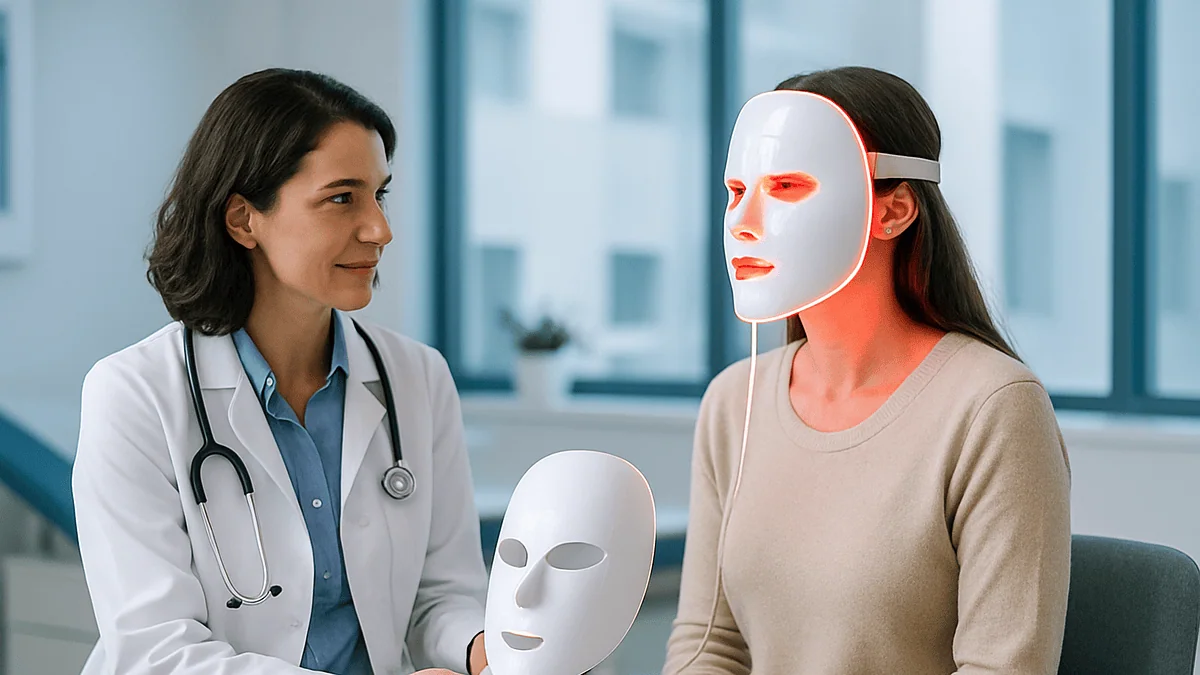
A red light mask is a home LED device that shines red and sometimes near-infrared or blue light onto the face. Small randomized trials show modest improvements in fine lines, skin texture and inflammatory acne after weeks of regular use, but effects are gentler than in-office treatments and vary between devices. It is generally safe for healthy skin when used with eye protection, and anyone with a skin condition or on photosensitizing medicine should check with a clinician first.
Somewhere between the toothbrush and the retinol sits a new object on a lot of bathroom shelves: a plastic face shield that glows the color of a car taillight. Scroll for five minutes and you will see it worn on couches, in airport lounges, on the school run. The red light mask has gone from a dermatologist’s back room to a nightly ritual, and as of this writing in 2025 it is one of the most-searched skin gadgets in the United States.
Three things pushed it there. Before-and-after videos with millions of views. A wave of devices stamped with the phrase ‘FDA-cleared,’ which sounds like a promise and is not one. And a genuine, if small, body of clinical research that manufacturers quote selectively.
This piece does something the videos do not: it separates what the trials actually measured from what the marketing implies, grades the evidence, and says plainly who should keep the mask in its box until they have talked to a clinician.
What changed recently: why the red light mask is everywhere
The science underneath home LED masks is older than the trend. The mechanism, called photobiomodulation, was described in a widely cited 2013 review by Avci and colleagues, which pulled together laboratory and clinical work on how low-level red and near-infrared light affects skin cells. Photobiomodulation simply means using light, not heat, to nudge how cells behave.
The trial most often quoted on packaging came a year later. In 2014, Wunsch and Matuschka published a controlled study of 136 volunteers who received red and near-infrared light treatments twice a week for 15 weeks. Measured by ultrasound and standardized photographs, treated participants showed increased collagen density in the dermis and smoother skin compared with a control group. In 2017, Hamblin summarized the anti-inflammatory side of the story, explaining why the same light seems to calm irritated tissue.
So the evidence base did not suddenly grow. What changed is the hardware. LEDs became cheap and bright enough to pack dozens or hundreds into a wearable shell, and manufacturers learned that a regulatory clearance letter makes a persuasive label. Most home masks are cleared through a pathway that judges a device substantially equivalent in safety to something already on the market; it does not require the company to prove the mask works as advertised.
Add social video, celebrity pre-event routines and a general appetite for skincare that feels like technology rather than cream, and you get the current moment. Cleveland Clinic’s own overview strikes the tone most dermatologists use: promising, generally safe, and not yet backed by the large, long trials that would settle the question. That is the honest headline, and it is the one this article will keep returning to.
How does a red light mask actually work on skin?
Think of a plant on a windowsill. It does not get warm from sunlight so much as it uses the light chemically. Skin cells have a smaller version of that trick, and it happens inside mitochondria, the tiny structures that make a cell’s energy.
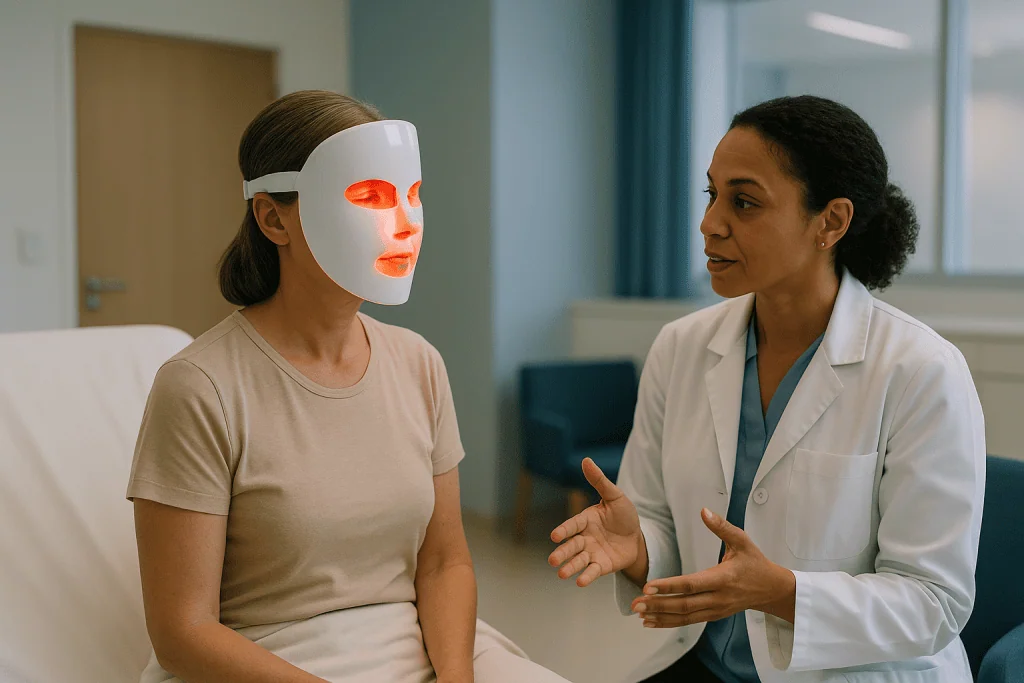
Red light, roughly 630 to 660 nanometers, and near-infrared light, roughly 800 to 850 nanometers, pass through the outer skin layers and are absorbed by an enzyme called cytochrome c oxidase. A nanometer is a billionth of a meter and is simply the way wavelength, or color, is measured. When that enzyme absorbs the right wavelengths, it works a little more efficiently. The cell produces more adenosine triphosphate, the molecule it spends as fuel, and releases small amounts of nitric oxide, which widens nearby blood vessels.
Downstream, laboratory studies show a cascade that looks useful for aging skin: fibroblasts, the cells that build collagen, become more active; certain inflammatory signaling molecules fall; and the enzymes that break collagen down become less active. Hamblin’s 2017 review describes this as a shift in the cell’s oxidative state, a small stress that triggers repair rather than damage.
Two caveats keep this from being a fairy tale. First, the response follows what researchers call a biphasic dose curve. Too little light does nothing; too much appears to cancel the benefit rather than multiply it. More is not better, which is one reason clinic and home devices differ in how they are used. Second, most of the mechanistic detail comes from cell cultures and animal tissue. It is coherent biology, and it explains why trials find anything at all, but a mechanism is a reason to run a trial, not a substitute for one.
Red, blue, near-infrared: what the colors on an LED mask mean
Open a mask’s instruction booklet and you will usually find a color chart. Each hue is a different wavelength, and each is aimed at a different job. Here is what the trial literature supports for each, and how deep it reaches.
| Light | Approximate wavelength | Skin depth reached | Main proposed use | Strength of trial evidence |
|---|---|---|---|---|
| Blue | 405–420 nm | Surface (epidermis) | Inflammatory acne | Moderate: several small randomized trials, mostly in-office or combined with red |
| Red | 630–660 nm | Upper dermis | Fine lines, texture, redness, healing | Moderate-to-low: a few controlled trials, short follow-up |
| Near-infrared | 800–850 nm | Deeper dermis | Collagen support, inflammation | Low-to-moderate: often paired with red, rarely tested alone in home devices |
| Green | ~520–530 nm | Superficial | Marketed for pigmentation | Very low: little controlled human data |
| Yellow / amber | ~570–590 nm | Superficial | Marketed for redness | Very low: mostly anecdotal or small pilot work |
Blue light does not work by the mitochondrial route described above. It is absorbed by porphyrins, pigments produced by the acne bacterium Cutibacterium acnes, and the reaction generates reactive oxygen that damages the bacteria. That is why blue is aimed at acne and not wrinkles.
Red and near-infrared are the pair with the most consistent data behind them. Green and yellow appear on many masks largely because adding LEDs is inexpensive and a seven-color chart looks impressive. When you evaluate a device, the reasonable question is not how many colors it offers but whether the two or three that matter are present at wavelengths the studies actually used.
What the evidence actually says, graded honestly
Medical evidence comes in tiers. At the top sit large randomized controlled trials, where people are assigned by chance to treatment or a convincing sham. Below them are small randomized trials, then observational studies that follow people without a comparison group, then expert opinion. Home LED masks live mostly in the second and third tiers.
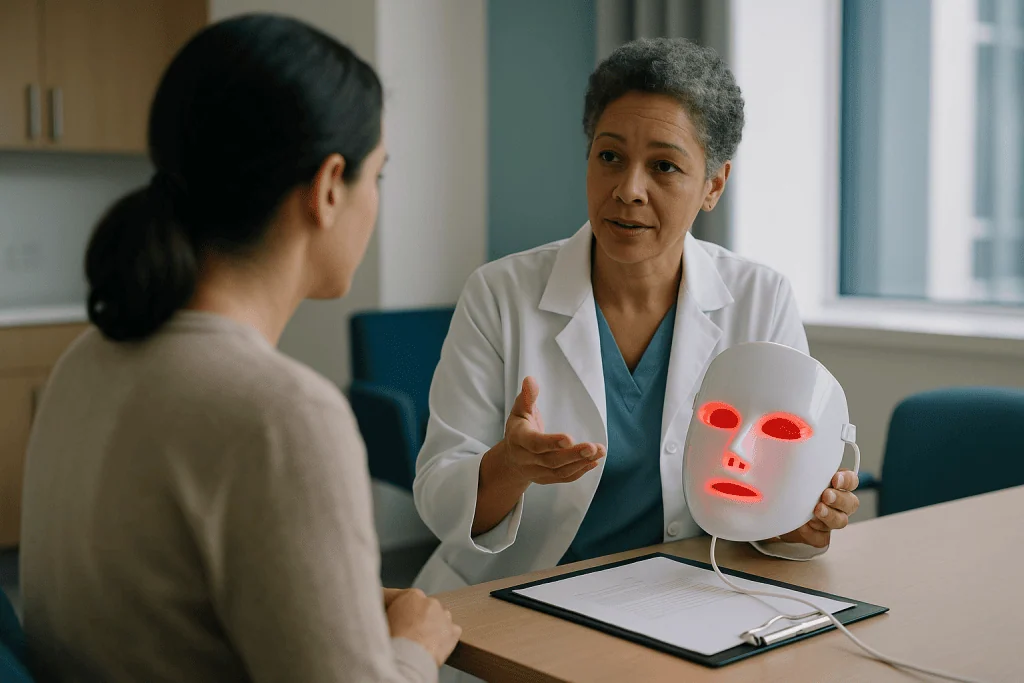
For photoaging, the Wunsch 2014 study is the strongest single piece: randomized, controlled, 136 participants, objective measurements. Its limitations are real. Participants used full-face panels in a clinic setting, not consumer masks. Follow-up ended when treatment ended, so nobody knows how long the gains lasted. And the effect, while statistically significant, was modest: smoother texture and measurably denser collagen, not a different face.
For acne, the picture is similar. Multiple small randomized trials of blue light, or blue plus red, show reductions in inflamed lesions over 8 to 12 weeks, typically in the range of a third to a half. Most were run with professional equipment. Consumer-device trials exist but tend to be manufacturer-sponsored, short and small.
For redness, wound healing and general ‘glow,’ evidence is thinner: pilot studies, case series and extrapolation from the mechanism.
Grading it plainly: fine lines and texture, moderate-quality evidence for a modest effect. Inflammatory acne, moderate-quality evidence for a modest-to-meaningful effect, mostly in-office. Redness, pigmentation, pore size and ‘lifting,’ low-quality evidence or none. Every reputable summary, from Cleveland Clinic’s patient overview to the academic reviews, lands in the same place: real biology, plausible benefit, and a gap between what trials tested and what home devices deliver. That gap is where the marketing lives.
Can a red light mask reduce wrinkles and boost collagen?
Collagen is the scaffolding protein that keeps skin firm, and it declines with age at roughly one percent a year from the mid-twenties onward. That slow slide is exactly what red light is claimed to interrupt, so it is worth being precise about what the trials found.
In the 2014 controlled study, treated skin showed a measurable increase in intradermal collagen density on high-frequency ultrasound, alongside reduced roughness on skin surface scans. Participants also rated their own skin as improved more often than controls did. Blinded assessors reviewing photographs agreed, though the changes were subtle enough that the researchers relied on instruments rather than the naked eye for their main findings.
Earlier and smaller studies point the same way: modest improvement in fine lines around the eyes and mouth after two to three months of regular sessions, with the best responses in people with mild photoaging rather than deep, established folds. Nobody has shown red light doing what a surgical lift or a resurfacing laser does, and no honest device maker claims it.
Two details matter for anyone hoping to reproduce those results at home. Consistency was the constant across every positive trial: sessions two or three times a week for months, not a single burst before an event. And power matters. The panels in clinical studies delivered more light per square centimeter than most consumer masks, which is why home devices are typically designed for more frequent, shorter sessions to approach a comparable total exposure.
The reasonable expectation, then, is a slightly smoother, slightly plumper surface that shows up in good light after about three months, and that fades if you stop. That is a genuine benefit for some people. It is not a rewind.
Does an LED mask help acne? The blue light evidence
Acne is the one condition where light therapy has a decades-long track record in dermatology, and it works by a completely different route than the anti-aging story. Cutibacterium acnes, the bacterium involved in inflamed pimples, produces porphyrins as part of its metabolism. Blue light around 415 nanometers excites those porphyrins, which then release reactive oxygen inside the bacterial cell and destroy it. Red light, often paired with blue, appears to reduce the inflammation of the surrounding tissue.
Randomized trials of blue or blue-plus-red light, mostly performed in clinics, have reported reductions in inflammatory lesions of roughly 40 to 60 percent over eight to twelve weeks, with smaller effects on blackheads and whiteheads, which are not driven by bacteria. Side effects were mostly mild dryness or temporary redness.
Home LED masks translate this unevenly. Several small consumer-device trials show benefit, but they are usually short, funded by the manufacturer, and compare the mask with nothing rather than with a sham device. That design tends to flatter the treatment.
Context matters too. NHS guidance on acne treatment notes that light therapies are an option but that the evidence for how well they work is limited compared with established topical and oral treatments. Most dermatologists position an LED mask as an add-on for mild to moderate inflammatory acne, not a replacement for a prescribed regimen.
One safety point deserves emphasis. Several acne medicines, including isotretinoin and doxycycline, make skin more sensitive to light. Anyone using them should not add a light device without the prescribing clinician’s agreement, and no one should stop or change an acne prescription because a mask seems to be helping. That decision belongs to the person who wrote the prescription.
Redness, rosacea and healing: where the evidence thins out
Type ‘red light for rosacea’ into a search bar and you will find confident claims. The trial literature is far quieter. Rosacea is a chronic condition that causes flushing, visible blood vessels and sometimes acne-like bumps across the central face, and MedlinePlus lists heat and sunlight among its common triggers. That alone is a reason for caution with any device that warms the skin.
What exists is a handful of pilot studies and case series suggesting that red or near-infrared light may reduce background redness and bumps in some people, plausibly through the anti-inflammatory effects Hamblin described. None are large, few are randomized, and several note that a minority of participants flushed more during treatment. Cleveland Clinic’s summary is representative: possible benefit, not proven.
Wound healing has a stronger laboratory story. In cell and animal models, red and near-infrared light speed the migration of skin cells across a wound and increase early collagen deposition. Human data come mostly from post-procedure settings, where light is used after laser resurfacing or minor surgery to shorten recovery. Those are supervised uses on freshly treated skin, not a home routine, and they should not be borrowed without a clinician’s direction.
Pigmentation is the weakest category. Melasma, the patchy brown discoloration common on the cheeks and forehead, can be worsened by visible light and by heat, and dermatologists generally advise people with melasma to be careful with LED devices, particularly those with blue settings. There is no good trial showing a home mask lightens dark spots.
The pattern is worth noticing. Where the biology is best understood and the trials are randomized, benefits appear. Where marketing has raced ahead of data, the honest answer is that we do not know yet.
Red light and hair growth: a different device, a different question
Because this magazine covers skin and hair together, the question comes up constantly: if red light helps the face, will it help a thinning scalp? The short answer is that the evidence is separate, and the devices are too.
Low-level red light for hair uses a similar wavelength range, roughly 630 to 680 nanometers, delivered by combs, caps or helmets rather than face masks. The proposed mechanism is the same mitochondrial boost, in this case aimed at follicle cells to lengthen the growth phase of the hair cycle. Several randomized, sham-controlled trials in androgenetic alopecia, the common pattern hair loss that runs in families, have found modest increases in hair density after about six months of regular use. The Avci review and later summaries grade this as moderate evidence for a modest effect, better established than most facial claims.
A face mask is not designed for this. It does not reach the scalp, and its LEDs are arranged and powered for facial skin. Using one against the hairline is unlikely to cause harm, but it is equally unlikely to reproduce what the hair trials measured.
Hair loss also has a longer list of causes than skin aging does: thyroid disease, iron deficiency, hormonal shifts, medications, autoimmune conditions and stress-related shedding among them. Light will not address any of those, and treating pattern loss without ruling them out means missing something a simple blood test could catch. For anyone noticing new or rapid thinning, the sensible first step is a clinician, not a helmet. Where light therapy is appropriate, it usually sits alongside established treatments rather than in place of them, and that combination is a decision for the treating doctor.
Home red light mask vs in-office LED panels: why power matters
The single most misunderstood fact about LED skincare is that the studies and the shelf products are not the same machines. Understanding two numbers explains most of the difference.
Irradiance is how much light energy lands on each square centimeter of skin per second, measured in milliwatts per square centimeter. Fluence, sometimes called dose, is the total energy delivered over a session, measured in joules per square centimeter. Professional panels used in trials typically sit a few inches from the face and deliver higher irradiance, so a session of ten to twenty minutes reaches the fluence researchers were studying. Home masks place LEDs almost against the skin, which helps, but usually at lower output.
Manufacturers handle this in three ways. Some publish irradiance figures and design session lengths to approximate clinical fluence. Some advise daily use to make up for lower power. Some publish nothing, which tells you something in itself.
Distance and fit matter as well. A rigid mask that hovers a centimeter above the cheeks delivers less light there than to the forehead it presses against. Flexible silicone designs solve that unevenly. None of this is a reason to dismiss home devices; it is a reason to expect gentler results and to be skeptical of a product that promises clinic outcomes from a low-power shell.
The in-office side has its own limits. Clinic LED sessions are supervised and more powerful, but they still produce modest, gradual change, and they demand repeat visits. For many people the realistic trade is a smaller effect they will actually keep up at home versus a larger one they abandon after two appointments. That is a lifestyle calculation, and it is fair to make it with open eyes.
How to read an LED mask label: cleared, approved and other slippery words
Marketing copy for light devices leans on a small vocabulary that sounds regulatory and often is not. Decoding it takes a minute and saves disappointment.
‘FDA-cleared’ means the device went through a pathway that judged it substantially equivalent in safety and intended use to a device already on the market. It is a meaningful safety signal, and it does mean the product was reviewed. It does not mean the agency evaluated whether the mask reduces wrinkles or clears acne to the degree the box suggests. ‘FDA-approved’ is a stricter standard requiring clinical evidence of effectiveness, and it is rarely, if ever, accurate for a consumer LED mask. ‘FDA-registered’ means the manufacturer filed paperwork listing its facility and says nothing about the device at all.
‘Clinically proven’ and ‘dermatologist-tested’ are not regulated phrases. The first sometimes refers to a small, company-funded study with no sham comparison; the second may mean a dermatologist used it once. Ask what the study was, how many people it enrolled and what it compared against.
Useful information on a label looks different. It states the wavelengths in nanometers, so you can check them against the ranges in the table above. It gives irradiance so you can gauge power. It specifies whether the device carries safety certification for electrical products and whether eye protection is included or built in. It lists contraindications, the medical situations in which the device should not be used, and a candid list is a sign of a serious manufacturer.
A final tell: seven-color light shows, ‘medical-grade’ with no numbers, and testimonials in place of data. Those are aesthetics, not evidence, and the trials that exist were not run on them.
Who should be cautious with a red light mask?
For healthy adult skin, the safety record of low-level red and near-infrared light is reassuring. Trials report mild, temporary redness or warmth and little else, and the wavelengths involved are not the ultraviolet ones that damage DNA. Still, a mask sits on the face for months, and a few groups should pause before starting.
People taking medicines that increase light sensitivity top the list. Isotretinoin, tetracycline-class antibiotics such as doxycycline, some diuretics and the herbal supplement St. John’s wort can all make skin react more strongly to light. Blue settings raise the most concern, but anyone on these should ask the prescribing clinician before using any LED device, and should never adjust the medicine to accommodate the mask.
People with photosensitive conditions, including lupus and porphyria, should treat light devices as off-limits unless a specialist says otherwise. Those with melasma or a history of post-inflammatory hyperpigmentation should be wary, particularly of blue and of anything that warms the skin.
Eyes need protection every session. LEDs are not lasers, but staring into bright red or blue light at close range for minutes is not sensible, and near-infrared is invisible, so the eye’s blink reflex does not defend against it. Use the goggles or built-in shields, and keep eyes closed regardless. Some people with migraine or epilepsy find flashing or pulsed modes uncomfortable or unsafe.
Pregnancy is a data gap rather than a known danger; there is simply little research, and many clinicians suggest waiting. Active skin cancer or suspicious lesions on the face are a clear stop sign, since light that stimulates cell activity should not be aimed at tissue that has not been evaluated. Children and teenagers were not included in the major trials, so acne treatment in adolescents belongs with a clinician.
Common myths about LED masks, corrected
Viral claims travel faster than trial results. Here are the ones dermatologists hear most, alongside what the evidence supports.
‘It replaces sunscreen and retinoids.’ No trial has tested a mask against either. Sunscreen prevents the ultraviolet damage that drives most visible aging; red light does not. Retinoids have decades of randomized data for fine lines. A mask is, at best, a supplement to those, and in the collagen studies it was measured on skin that continued normal care.
‘Red light tans or damages skin like the sun.’ Red and near-infrared wavelengths are outside the ultraviolet range and do not cause the DNA changes behind sunburn or skin cancer. Heat from prolonged use can flush the skin, which is different.
‘More sessions mean faster results.’ The biphasic dose response described earlier says otherwise. Overexposure appears to blunt the cellular effect rather than amplify it, and it adds heat, which some skin does not welcome.
‘You see results in a week.’ Collagen remodeling is slow. Every positive trial ran for two to four months. Anything visible after a single session is temporary blood flow, which fades within hours.
‘Seven colors are better than two.’ Only blue, red and near-infrared have meaningful trial support. Extra colors mostly add to the light show.
‘It works on deep wrinkles and sagging.’ The studies measured fine lines and surface texture. Structural laxity involves fat and bone changes that light cannot reach.
‘FDA-cleared means proven to work.’ It means reviewed for safety and equivalence, which is worth something, but effectiveness is a separate question the clearance does not answer.
None of these corrections means the devices are useless. They mean the honest version of the story is quieter than the viral one.
Using a red light mask realistically: consistency over intensity
If you own one, or intend to, the trials offer a rough template for using it in a way that could plausibly matter, without turning it into another source of skincare anxiety.
Start with clean, dry skin. Makeup, sunscreen and most creams sit on the surface and can absorb or scatter light before it reaches the cells you are aiming at. Apply serums and moisturizers afterward, not before. If you use a retinoid or an exfoliating acid, most clinicians suggest not layering them in the same session while the skin is warm, simply to limit irritation; the light itself does not interact chemically with them.
Follow the manufacturer’s session length and frequency. Those figures are set to approximate the exposure in the studies for that device’s power, and exceeding them offers no measured advantage. Missing a session occasionally is unimportant; missing most of them is the reason so many masks end up in drawers. In the positive trials, participants attended two to three sessions a week for at least eight weeks. That is the honest commitment.
Photograph your face in the same light, at the same angle, before you begin and every four weeks. Memory is a poor judge of gradual change in either direction, and a photo record is the only way to know whether the mask is earning its place in your routine.
Watch for unwanted effects: stinging, persistent redness that lasts more than an hour, new dark patches or a flare of an existing condition. Any of those is a reason to stop and check in with a clinician rather than push through. And keep the goggles on. The most common avoidable problem with home light devices is not the skin at all; it is tired, irritated eyes from people who skipped the shield.
When to see a doctor about your skin, with or without a mask
A red light mask is a cosmetic tool, and the conditions it is marketed for sometimes have causes that light cannot touch. Knowing when to hand the question to a professional is the most useful skincare skill there is.
See a dermatologist or your primary care clinician promptly if you notice a new or changing mole, particularly one that is asymmetric, has an irregular border, shows more than one color, is larger than a pencil eraser or is evolving in size, shape or feel. A sore that does not heal within a few weeks, a pearly or waxy bump, or a scaly patch that bleeds easily also warrants evaluation. Do not aim any light device at a spot you have not had checked.
For acne, seek care if breakouts are painful, deep or cystic, if they are leaving scars or dark marks, if over-the-counter products have not helped after about three months, or if acne appears suddenly in adulthood alongside irregular periods or excess facial hair, which can signal a hormonal cause. Prescription options are more effective than any home device, and NHS and MedlinePlus guidance both recommend professional care in these situations.
For redness and flushing, see a clinician if it is persistent, spreading, accompanied by eye irritation or burning, or worsening with your routine. Rosacea and other inflammatory conditions have specific treatments, and some are aggravated by heat and light.
Stop using a mask and get advice if you develop blistering, a rash that spreads beyond the treated area, new pigmentation, eye pain, or vision changes. Anyone taking a prescribed medicine, especially one that affects light sensitivity, should ask the prescriber before starting light therapy and should never alter a prescription because of a device. Every treatment decision, including whether a mask belongs in your plan at all, sits with the clinician who knows your history.
Frequently asked questions
Do red light masks really work for wrinkles?
Modestly, yes, according to a few controlled trials. The largest randomized study found increased collagen density and smoother skin texture after 15 weeks of twice-weekly sessions with professional panels. Home masks are less powerful, so results are gentler and take consistent use over two to three months. Deep folds and sagging did not improve in any trial, and benefits appear to fade when sessions stop.
How long does it take for an LED mask to show results?
Expect eight to twelve weeks of regular use before any change is visible, based on the timelines in published trials. Collagen remodeling is slow, and the temporary glow after a single session is increased blood flow that fades within hours. Taking photos in identical lighting every four weeks is the most reliable way to judge whether a device is doing anything for your skin.
Is it safe to use a red light mask every day?
For most healthy adults, daily use within the manufacturer’s stated session length appears safe, and many home devices are designed for it to compensate for lower power. More is not better, though: research shows a biphasic response in which excessive exposure blunts the effect. Stop and seek advice if you notice persistent redness, stinging, new dark patches or eye discomfort.
Can an LED mask help with acne?
Blue light, alone or combined with red, has moderate evidence from small randomized trials for reducing inflamed acne lesions over eight to twelve weeks, mostly with clinic-grade equipment. Home devices show smaller, less certain effects. It does little for blackheads and whiteheads. Dermatologists position it as an add-on to established treatment, and anyone on acne medication should check with their prescriber before adding light.
What is the difference between a red light mask and an LED mask?
An LED mask is any face device using light-emitting diodes, and it may offer several colors. A red light mask is an LED mask emitting primarily red and often near-infrared wavelengths, the pair with the most trial support for texture and fine lines. Many products are both. The useful question is whether the device delivers the specific wavelengths studied, not how many colors it lists.
Can red light therapy damage your eyes?
Bright LEDs held close to the face for minutes can cause eye strain and irritation, and near-infrared light is invisible, so your blink reflex does not protect against it. Serious injury from consumer masks is rare, but the risk is avoidable. Use the goggles or shields supplied, keep your eyes closed throughout, and stop if you experience eye pain, persistent afterimages or any change in vision.
Does a red light mask work on dark spots or melasma?
There is no good trial evidence that home red light lightens dark spots, and melasma is a reason for caution rather than a target. Melasma can be worsened by visible light and heat, and blue settings in particular concern dermatologists for people with darker skin tones or a history of post-inflammatory hyperpigmentation. Established treatments for pigmentation exist and belong in a conversation with a clinician.
Should I use a red light mask before or after skincare products?
Use the mask on clean, dry skin and apply serums and moisturizers afterward. Makeup, sunscreen and creams sit on the surface and can absorb or scatter light before it reaches skin cells. Most clinicians suggest not applying retinoids or exfoliating acids immediately before a session simply to limit irritation on warmed skin, though the light does not chemically interact with those ingredients.
Is red light the same as the light in tanning beds?
No. Tanning beds emit ultraviolet light, which damages DNA and drives sunburn, aging and skin cancer. Red light masks emit visible red and near-infrared wavelengths well outside the ultraviolet range, and they do not tan or burn skin. The two are unrelated in mechanism and risk, though prolonged LED use can warm and flush the skin, which is a separate and temporary effect.
Can I use a red light mask if I take isotretinoin or doxycycline?
Ask the clinician who prescribed the medicine before using any light device. Isotretinoin and tetracycline-class antibiotics such as doxycycline increase the skin’s sensitivity to light, and blue settings raise particular concern. Never stop, reduce or alter a prescribed medicine to make room for a mask. The prescriber can weigh your treatment plan and advise whether light therapy fits alongside it.
References
- Cleveland Clinic: Red Light Therapy
- NIH PMC: Hamblin MR. Mechanisms and applications of the anti-inflammatory effects of photobiomodulation (2017)
- NHS: Acne: Treatment
- MedlinePlus: Rosacea
This article is for general information only and is not a substitute for professional medical advice. Please consult a qualified doctor about your individual situation.

More from the Blog
Skin Barrier Repair: What a Damaged Barrier Looks Like and the Ingredients That Rebuild It
Skin barrier repair means restoring the outermost skin layer so it holds water in and keeps irritants out. A damaged barrier typically feels tight,…
Skin Flooding and Glass Skin: The Trends Explained, and What Hydration Layers Really Do
Glass skin is a cosmetic look of smooth, even-toned, well-hydrated skin that reflects light, and skin flooding is a method of layering water-based humectants…

Is Your Vitiligo Active or Stable? How the Answer Shapes the Treatment Plan
Active vitiligo means patches are still appearing, spreading, or changing, which tells the dermatologist the immune process is ongoing; stable vitiligo means the pattern…

What Cellulitis Recovery Looks Like Day by Day: The First Days on Antibiotics and Beyond
Cellulitis recovery day by day usually means the redness may look slightly larger and the skin hotter during the first 24 to 48 hours…
Crepey Skin and Neck Lines: The Collagen Story and the Options From Creams to Devices
Crepey skin is thin, finely wrinkled skin that looks like crepe paper, caused mainly by sun damage, aging and the gradual loss of collagen…
Under-Eye Filler and Tear Trough Filler: Who Suits It, the Risks and the Alternatives
Under eye filler, usually a hyaluronic acid gel placed in the tear trough, can soften a hollow groove between the lower eyelid and cheek…