

Life After Hemorrhoid Surgery: Fiber, Fluids, Stool Softeners and Sitz Baths as Routine

Key Takeaways
- Hemorrhoidectomy itself is usually a same-day operation, but full healing typically takes several weeks, in the range of about two to four according to MedlinePlus and Cleveland Clinic, with the first week the hardest.
- Mayo Clinic's general fiber guidance is roughly 21 to 25 grams a day for women and 30 to 38 grams for men, and most adults fall well short, which is why surgical teams often add a bulk-forming supplement.
- Bulk-forming fiber only softens stool when it has water to absorb; taken with too little fluid it can firm stool up and worsen constipation after surgery.
- Stool softeners such as docusate generally take one to three days to work, per MedlinePlus, so teams usually start them before or right after the operation rather than waiting for a problem.
- Warm sitz baths of about 10 to 15 minutes, two to three times a day and after bowel movements, relax sphincter spasm and clean the wound; they ease symptoms rather than speed healing.
- Streaks of bright red blood with stools are expected for a couple of weeks, but bleeding that drips, pools, clots or occurs between bowel movements is a same-day call to the surgical team.
After hemorrhoid surgery, most surgical teams build recovery around four daily habits: fiber from food or a bulk-forming supplement, enough fluid to keep that fiber soft, a stool softener or gentle laxative if your clinician prescribes one, and warm sitz baths after bowel movements. The goal is a soft, formed stool that passes without straining across the healing wound. Healing usually takes a few weeks, and your treating team sets the specifics.
The ride home from the surgery center is quiet. The anesthesia has worn off enough to think, and what most people think about is not the operation they just had but the bathroom door at the end of the hall. Someone in the recovery bay said the first bowel movement is the part to plan for. Nobody said exactly how.
That gap is where this guide lives. Surgeons tend to spend their explaining time on the procedure itself, and the aftercare sheet reduces weeks of recovery to four words: fiber, fluids, softeners, sitz baths. Fiber after hemorrhoid surgery is not a side note on that sheet; it is the mechanism that protects the wound every single day.
What follows is the honest version: what each habit does, what it cannot do, the timelines the evidence supports, and the signs that mean it is time to pick up the phone.
What happens during hemorrhoid surgery, and why the first bowel movement matters
Hemorrhoids are swollen veins in the lower rectum and anus, the same vascular cushions everyone has, just stretched and inflamed. When they bleed persistently, prolapse (slide out of the anus) or clot painfully, and simpler measures have failed, a surgeon may suggest removing or repositioning them. The operation most people mean by “hemorrhoid surgery” is a hemorrhoidectomy: under general or regional anesthesia the surgeon cuts away the swollen tissue, then either stitches the wound closed or leaves it open to fill in from the base, as MedlinePlus describes.
Two other procedures sit nearby. Stapled hemorrhoidopexy uses a circular stapling device to lift prolapsed internal hemorrhoids back into position and interrupt part of their blood supply. Hemorrhoidal artery ligation uses a Doppler probe to locate and tie off the arteries feeding the hemorrhoids. Both tend to hurt less than a conventional hemorrhoidectomy, Mayo Clinic notes, though they suit fewer patterns of disease and carry their own recurrence and complication profiles.
Whichever technique is used, the anatomy explains the entire recovery routine. The anal canal is a short muscular tube that must open several times a day, and the wound sits directly in its path. A hard, bulky stool drags across raw tissue, forces the sphincter to stretch and can reopen a fresh suture line. A soft, formed stool slips through with far less friction.
That is why surgeons talk about the first bowel movement almost as much as the operation. Fiber, fluids, stool softeners and warm soaks are not comfort extras. They are the tools that keep the wound from being injured again before it has had a chance to heal.
Who is usually offered hemorrhoid surgery, and who is asked to wait
Surgery is a late step, not a first one. The NIDDK describes a ladder of treatment that begins with more fiber, more fluid, avoiding straining and keeping toilet visits short, then moves to office procedures such as rubber band ligation (a small elastic band placed around an internal hemorrhoid so it shrinks and falls away), injection sclerotherapy or infrared coagulation. Most people never climb past those rungs. Mayo Clinic notes that nearly three in four adults experience hemorrhoids at some point, and only a small fraction need an operation.
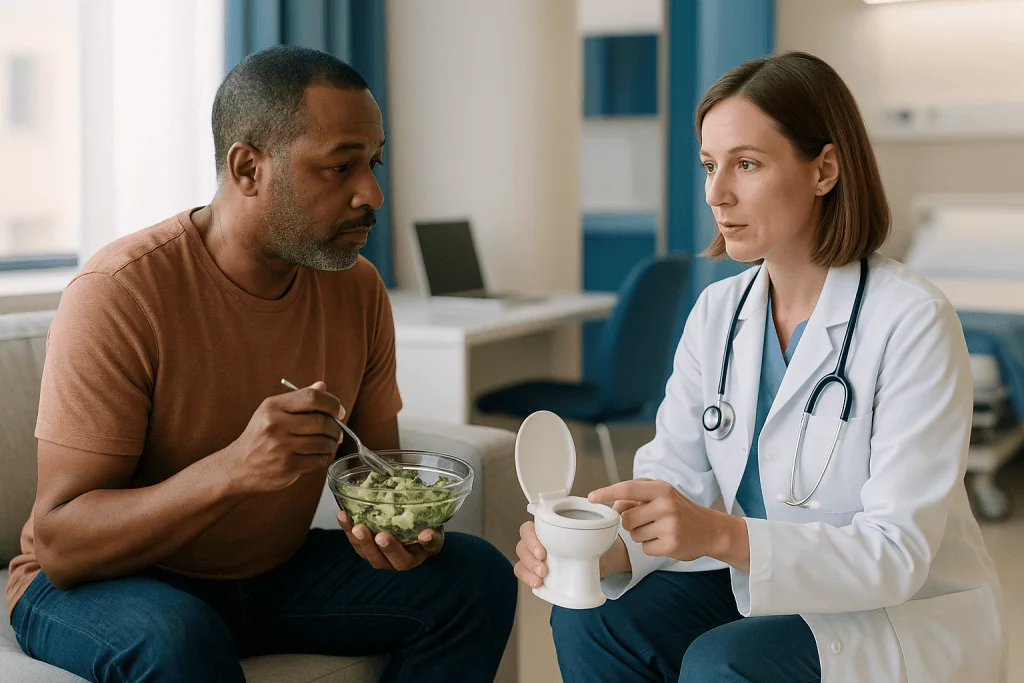
A surgeon usually raises hemorrhoidectomy when hemorrhoids are large, when internal hemorrhoids prolapse and cannot be pushed back, when internal and external disease coexist, when bleeding has been heavy enough to cause anemia, or when office procedures have been tried and the problem has returned. A thrombosed external hemorrhoid, one with a painful clot inside it, is sometimes removed within the first couple of days of symptoms; after that window the clot usually resolves on its own and surgery offers less benefit, according to Mayo Clinic.
Some people are asked to wait. Pregnancy is the common example, since hemorrhoids that appear in the third trimester often settle after delivery. Uncontrolled diabetes, active anal infection, bleeding disorders, blood-thinning medicines that cannot safely be paused, and inflammatory bowel disease with active rectal inflammation are all reasons a team may defer or choose a different approach. People with weakened sphincter muscles, often older adults or those who have had earlier anal surgery, may be steered toward procedures that remove less tissue in order to protect continence.
None of this is a checklist to apply to yourself. The decision rests on an examination, often a short scope of the lower bowel to rule out other causes of bleeding, and a frank conversation about what you can tolerate.
How long does it take to recover from a hemorrhoidectomy?
Honest answer: longer than most people expect, and unevenly. MedlinePlus describes hemorrhoid surgery as usually a same-day procedure, with most people home within hours. The operation is short. The recovery is measured in weeks, with complete healing after a conventional hemorrhoidectomy typically falling somewhere in the range of about two to four weeks according to MedlinePlus and Cleveland Clinic. The first week is almost always the hardest.
The reason is biology, not bad luck. An open anal wound heals by filling in from the base with new tissue, a process that cannot be hurried. Each bowel movement passes over that surface. Swelling in the first days narrows the canal. The internal sphincter, a ring of involuntary muscle, tends to go into spasm after surgery, and that spasm is responsible for much of the deep, aching pain people report. As spasm settles and the wound grows a new surface layer, the pain curve bends downward, often noticeably toward the end of the first week or during the second.
Walking, light activity and desk work are commonly resumed within one to two weeks; heavier lifting, cycling and vigorous exercise generally wait longer and depend on the surgeon’s judgment. Stapled hemorrhoidopexy and artery ligation usually allow a quicker return to routine, Mayo Clinic notes, because they leave no open external wound.
Recovery also depends on what you bring to it. Chronic constipation, long hours of sitting, smoking, poorly controlled diabetes and a low-fiber diet all slow wound healing or raise the odds of a hard stool. That is the practical case for treating fiber after hemorrhoid surgery, along with fluids, softeners and sitz baths, as a daily routine rather than a rescue plan.
Why fiber after hemorrhoid surgery is the foundation of recovery
Fiber is the part of plant food your gut cannot digest. Soluble fiber, found in oats, beans, apples and psyllium husk, dissolves into a gel that holds water. Insoluble fiber, abundant in whole grains, nuts and vegetable skins, adds bulk and speeds transit. Together they produce a stool that is larger, softer and easier to pass, which is precisely what a healing anal wound needs. The NIDDK lists fiber-rich eating and bulk-forming fiber supplements as first-line measures for hemorrhoids because they reduce straining, and that same mechanism matters even more once a wound is present.

What fiber does not do is heal tissue. It will not close a wound faster or shrink swelling. Its value is protective: fewer hard stools, less scraping, and less of the sphincter spasm that a painful passage triggers. Harvard Health identifies straining as the behavior most closely tied to hemorrhoid symptoms, and after surgery straining adds the extra risk of bleeding from the fresh site.
Timing matters. Many surgical teams ask people to raise their fiber intake in the days before the operation so the first post-operative stools are already soft. The gut needs time to adapt, and a sudden jump can cause gas and cramping. Afterward, fiber works best as a steady daily intake spread across meals rather than a large amount taken at once, because even distribution keeps stool consistency even.
Fiber is also the long game. Hemorrhoids can return after any procedure, and both the NIDDK and the NHS frame high-fiber eating as the main way to lower that risk. A routine that starts as wound protection usually becomes the habit that keeps you out of the operating room a second time.
How much fiber after hemorrhoid surgery, and which foods deliver it
Targets are dietary, not medical, so they are easier to talk about than drug doses. Mayo Clinic’s general guidance is roughly 21 to 25 grams of fiber a day for women and 30 to 38 grams for men, and the NIDDK gives a similar range of about 22 to 34 grams depending on age and sex. Most adults eat well under that, which is why a supplement is so often added after surgery.
The table below uses approximate values from Mayo Clinic’s fiber chart. Portions are ordinary servings, and the figures are rounded.
| Food | Serving | Approximate fiber (g) | Mostly soluble or insoluble? |
|---|---|---|---|
| Lentils, cooked | 1 cup | 15.5 | Both |
| Black beans, cooked | 1 cup | 15 | Both |
| Chia seeds | 1 ounce | 10 | Soluble |
| Raspberries | 1 cup | 8 | Both |
| Pear, with skin | 1 medium | 5.5 | Both |
| Broccoli, boiled | 1 cup | 5 | Insoluble |
| Oatmeal, cooked | 1 cup | 4 | Soluble |
| Apple, with skin | 1 medium | 4.5 | Both |
| Popcorn, air-popped | 3 cups | 3.5 | Insoluble |
A few practical notes. In the first days, when nausea or anesthesia aftereffects dull appetite, soft sources such as oatmeal, stewed fruit, blended soups and well-cooked beans go down more easily than raw salads. Psyllium-based bulk-forming supplements are the type most often suggested because they add soluble gel without much gas; the choice and timing belong with your team, especially if you take other medicines whose absorption fiber can affect. Increase gradually over several days, and pair every increase with fluid, which is the subject of the next section.
Fluids: why fiber without water can backfire
The most common first-week mistake is a fiber supplement taken with a sip of water. Soluble fiber softens stool only by absorbing liquid; if that liquid is not there, bulk-forming products can firm stool up and leave you worse off than before. The NIDDK pairs its fiber advice with a clear instruction to drink water and other liquids, and Mayo Clinic repeats the pairing in its hemorrhoid self-care guidance.
No single number fits everyone. Needs rise with warm weather, fever, exercise and the dry-mouth effect some people notice with opioid pain relief. A practical signal is urine that stays pale yellow through the day. Water is the simplest choice; broths, diluted juice, milk and herbal teas count. Caffeine in moderation is fine for most people. Alcohol is worth avoiding early on because it dehydrates and interacts with pain medicines.
Two cautions. Anyone with heart failure, kidney disease or another condition that limits fluid intake should ask the surgical team how to balance that restriction against the need for soft stool; the answer may lean more on softeners than on volume. And drinking a great deal at once does not help more than drinking steadily; the bowel draws water gradually, so spreading intake across the day is more useful than a large glass at bedtime, which mainly produces night-time trips to the bathroom.
Fluid also matters for a less obvious reason. Urinary retention, difficulty emptying the bladder, is a recognized early complication after anal surgery because pain and anesthesia inhibit the bladder reflex. Staying hydrated, walking, and running warm water or taking a sitz bath can help the first urination along. If you cannot pass urine within the window your team specified, that is a same-day call.
Stool softener after hemorrhoid surgery: what it does and what it doesn't
Most people leave the surgery center with a recommendation for a stool softener, a laxative, or both. The terms are used loosely, so it helps to know the mechanisms.
A stool softener in the strict sense is a surfactant such as docusate. It lowers the surface tension of stool so water and fat can mix into it, making it less hard. MedlinePlus notes that softeners generally take one to three days to work, which is why teams often start them before or immediately after surgery rather than waiting for a problem. They do little for stool that is already formed and sitting in the rectum.
Osmotic laxatives, such as polyethylene glycol or lactulose, pull water into the bowel by osmosis, increasing both volume and softness. They are commonly used when a softener alone is not enough, and they also work over hours to a day or more rather than minutes. Stimulant laxatives, such as senna or bisacodyl, trigger bowel contractions directly; they act faster but can cause cramping and urgency, which is exactly the forceful passage a wound does not want, so most teams keep them in reserve.
Opioids deserve a specific mention. They slow gut transit and are a leading cause of post-operative constipation, which is why a softener or osmotic agent is often paired with them from the first day. Reducing opioid use as pain allows, under your clinician’s direction, is itself a constipation strategy.
What none of these agents do is replace fiber and fluid; they are a bridge while the wound is rawest. Whether to use one, which type, and for how long are decisions for the prescribing clinician, who knows your other medicines and your kidney and heart status.
Sitz bath after hemorrhoidectomy: how warm water helps a healing wound
A sitz bath is a shallow soak in warm water that covers the hips and buttocks, taken either in a regular tub with a few inches of water or in a plastic basin that fits over the toilet seat. The name comes from the German word for sitting, and the practice is older than most of the surgery it now follows.
The mechanism is simple. Warmth increases local blood flow and relaxes the internal sphincter, easing the spasm that drives much of post-hemorrhoidectomy pain. Water also cleans the wound more gently than wiping, which matters when the area is too tender for toilet paper. Mayo Clinic’s self-care guidance for hemorrhoids suggests soaking for about 10 to 15 minutes two to three times a day, and surgical teams usually add a soak after each bowel movement during the first week or two.
Plain warm water is the standard. Salts, soaps, bubble bath and antiseptic additives are not needed and can irritate raw tissue; use them only if your team specifically advises. Keep the water comfortably warm rather than hot, since numbness from local anesthetic or nerve irritation can mask a burn. Afterward, pat the area dry with a soft towel or let it air-dry, and avoid rubbing.
The evidence for sitz baths is modest rather than dramatic. Studies have not shown that they speed wound closure, and most guidance frames them as symptom relief and hygiene rather than a treatment that changes the outcome. That is still a meaningful role. Less spasm means less pain, less pain means less fear of the next bowel movement, and less fear means less holding back, which is the loop that keeps recovery moving.
Is it painful to remove external hemorrhoids? What pain control usually involves
Yes, and it is better to know that before than after. Mayo Clinic is candid that hemorrhoidectomy is usually more painful than the alternatives, because the anal canal is densely supplied with sensory nerves and the wound sits on skin rather than on the less sensitive lining higher in the rectum. An office procedure to remove a clot from a thrombosed external hemorrhoid is quicker and done under local anesthetic, but the days afterward still bring soreness.
Pain control after a full hemorrhoidectomy is usually multimodal, meaning several approaches layered together so that no single one has to carry the load. A long-acting local anesthetic is often injected at the end of the operation. Non-opioid medicines such as acetaminophen and anti-inflammatory drugs are commonly the backbone of the first days. A short course of an opioid may be added for breakthrough pain, with a softener alongside it for the constipation it causes. Some surgeons prescribe a topical agent that relaxes the sphincter muscle, such as a nitrate or calcium-channel blocker ointment, to reduce spasm. Choices and schedules belong with your surgeon and pharmacist.
Non-drug measures matter as much as the prescriptions. Sitz baths relax spasm. Lying on your side rather than sitting takes pressure off the wound. Short walks several times a day keep bowels and bladder moving and lower clot risk. Ice wrapped in cloth helps swelling in the first day or two; warmth helps spasm thereafter.
Pain that climbs rather than fades after the first few days, or pain accompanied by fever or a foul discharge, is not a pain-control problem. It is a signal to call.
First bowel movement after hemorrhoidectomy, and what the following weeks usually look like
Timelines vary with the technique, the surgeon’s approach and the person, so treat the stages below as typical patterns drawn from MedlinePlus and Cleveland Clinic guidance, not a schedule you must match.
Days 0 to 2. Numbness from the local anesthetic wears off within hours and the deep ache sets in. Expect spotting of blood on dressings or in the toilet. The first bowel movement often comes within the first two or three days; it usually hurts, may bleed a little, and is followed by a sitz bath. Urinating can be slow at first. Walking indoors starts on day one.
Days 3 to 7. This is usually the low point. Swelling peaks, bowel movements are the most painful events of the day, and sleep is interrupted. Softeners and fiber should be fully in place by now. Small amounts of bright blood with each stool are expected. Many people stay home from work this week.
Week 2. Pain begins to separate from bowel movements; the background ache fades and discomfort concentrates around the passage itself. Desk work and light activity often resume. Some stitches, if used, begin to dissolve and may be noticed in the toilet.
Weeks 3 to 6. The wound fills in. Bleeding tapers to occasional streaks and stops. Bowel movements become routine. Heavier exercise is reintroduced with the surgeon’s agreement. A follow-up visit usually falls in this window to check healing and look for narrowing of the canal.
A bowel movement every one to three days with soft, formed stool is what the routine is aiming for. If more than a few days pass without one, or if stool becomes hard despite the routine, that is worth a call rather than a bigger dose of anything.
Difficulty passing stool after hemorrhoid surgery: breaking the fear loop
The most underrated complication of hemorrhoid surgery is not medical. It is psychological. The first bowel movement hurts, the brain registers that, and the next urge is met with clenching. Held stool loses water in the colon and hardens. The eventual passage hurts more, confirming the fear. Within days a person can be constipated not because the softener failed but because they stopped letting their body do its job.
Breaking the loop starts with expectation. Pain with the first few stools is normal and does not mean the wound has torn. The NHS advises against delaying when the urge comes, and that applies doubly after surgery. Go when your body says go, even if it means stepping out of a meeting.
Position helps. Raising the feet on a small stool so the knees sit above the hips straightens the angle between rectum and anal canal, reducing the effort needed. Lean forward slightly, breathe out slowly, and let the abdomen do gentle work rather than bearing down hard. Keep toilet time short; sitting and waiting pools blood in the anal cushions and tempts straining.
Soften the aftermath. A sitz bath immediately after, or a gentle rinse with warm water from a squeeze bottle, replaces painful wiping. Soft, unscented wipes or damp toilet paper are kinder than dry paper if rinsing is not possible.
Know when the loop has become a medical problem. No bowel movement for the number of days your team named, abdominal bloating with cramping, a sense of a blockage you cannot pass, or leakage of liquid stool around a hard mass (a sign of impaction) all call for advice the same day. Manual disimpaction or an enema after anal surgery should only ever be done by or on the instruction of a clinician, because the wound can be damaged.
What people often get wrong about recovery after hemorrhoid surgery
Myth: eating less means fewer painful bowel movements. Skipping meals shrinks stool volume but does not stop it forming, and small, dry stools are harder to pass than soft, bulky ones. Regular meals with fiber keep the bowel on a predictable rhythm.
Myth: any bleeding means something has gone wrong. Streaks of bright red blood with stools are expected for a couple of weeks, MedlinePlus notes. The concerns are volume and pattern: blood that drips or pools, clots, or bleeding unrelated to a bowel movement.
Myth: a stimulant laxative every day is the safe choice. Faster is not gentler. Forceful contractions and urgency push stool through a wound quickly and uncomfortably. Softeners and osmotic agents, which change the stool rather than the muscle, are usually preferred, and the choice belongs to your clinician.
Myth: sitz baths have to be hot to work. Comfortably warm is the target. Hot water can scald tissue that is partly numb and increases swelling.
Myth: a ring cushion is the best way to sit. Ring-shaped cushions can actually increase pressure around the anus by stretching the surrounding tissue. A flat soft cushion, or lying on your side, is usually more comfortable. Ask your team what they suggest.
Myth: once healed, the fiber can stop. Hemorrhoids are a recurring condition, and the NIDDK and NHS both place a high-fiber, adequate-fluid routine at the center of preventing their return. The habits of recovery are meant to outlast it.
Myth: surgery has settled the question for good. Operations treat the hemorrhoids that are present. They do not change the vein cushions that remain, the pressures of constipation or pregnancy, or the straining habits that stretched them in the first place.
Questions to ask your care team before and after hemorrhoid surgery
A ten-minute conversation before you leave the surgery center can prevent most of the confusion of the first week. These are the questions worth bringing, in roughly the order they tend to matter.
- Which procedure did I have, and is the wound open or closed? The answer shapes how much pain, bleeding and time to expect.
- What is my plan for pain, in what order should I use each medicine, and which ones cause constipation?
- Do you want me on a stool softener, an osmotic laxative, or both, and when should I start and stop?
- How much fiber are you aiming for, and should I use a supplement or rely on food? Is psyllium or another bulk-forming type what you prefer?
- How many days without a bowel movement is too many before I should call?
- How often and for how long do you want me taking sitz baths, and is plain water enough?
- How much bleeding is expected, and what would make you want to see me?
- When can I drive, return to work, lift, and exercise, and does that change if my job involves sitting all day?
- What is the plan if I cannot pass urine on the first day?
- Which of my regular medicines, especially blood thinners, should I resume and when?
- When is my follow-up, and what will you be checking for?
- What is the long-term plan to keep hemorrhoids from returning?
Write the answers down or ask for them on paper. Anesthesia dulls memory for hours after discharge, and the person driving you home is often the one who remembers what was said. Bring the same list to the follow-up appointment with notes on what worked and what did not; recovery routines are easier to adjust when the team hears specifics.
When to call your doctor: red-flag signs after hemorrhoid surgery
Most recoveries are uncomfortable but uneventful. A small number run into trouble, and the trouble is easier to manage when it is caught early. Contact your surgical team the same day, or seek emergency care if the team cannot be reached, for any of the following, which draw on MedlinePlus and Cleveland Clinic post-operative guidance.
- Bleeding that is heavy, drips or pools in the toilet, contains clots, soaks through dressings, or happens between bowel movements rather than with them.
- Inability to pass urine for the period your team specified, or a painfully full bladder.
- Fever, chills, or a wound that becomes increasingly red, swollen, hot or foul-smelling, which can signal infection or an abscess.
- Pain that worsens after the first few days instead of easing, or pain that no longer responds to the plan you were given.
- No bowel movement for longer than the number of days your team named, especially with bloating, cramping, vomiting or a sense of blockage.
- Leakage of liquid stool around a hard mass, which may indicate impaction.
- Difficulty passing even soft stool weeks after surgery, or stools that become pencil-thin, which can point to narrowing of the anal canal.
- New loss of control over gas or stool that does not improve as swelling settles.
- Dizziness, fainting, rapid heartbeat or shortness of breath, which can accompany significant blood loss or a blood clot.
- Calf pain or swelling on one side.
For milder concerns, the follow-up visit is the right place to raise them: persistent itching, a skin tag at the wound edge, mild discomfort with sitting, or a stool routine that still needs tweaking. None of these lists replaces the specific instructions on your discharge sheet, and every decision about changing medicines or adding treatments sits with the clinicians who operated on you and know your history.
Frequently asked questions
How long does it take to recover from a hemorrhoidectomy?
Complete healing after a conventional hemorrhoidectomy typically takes several weeks, roughly two to four according to MedlinePlus and Cleveland Clinic, with the first week usually the most painful. Light activity and desk work are often resumed within one to two weeks, while heavier exercise waits for the surgeon’s clearance. Stapled and artery-ligation procedures usually allow a quicker return because they leave no open external wound. Your treating team sets the timeline for you.
What are the symptoms of piles?
Piles, the British term for hemorrhoids, most often cause painless bright red bleeding with bowel movements, itching or irritation around the anus, discomfort or swelling, and sometimes a lump that pushes out when passing stool, according to the NHS and Mayo Clinic. A sudden painful lump can mean a clot in an external hemorrhoid. Rectal bleeding has other causes too, so any new bleeding should be assessed by a doctor rather than self-diagnosed.
How can I treat external hemorrhoids?
Most external hemorrhoids settle with self-care: more fiber and fluid to soften stool, avoiding straining and long toilet visits, warm sitz baths, and short-term over-the-counter creams, as the NIDDK and Mayo Clinic describe. A painfully clotted external hemorrhoid may be treated by removing the clot in an office procedure if seen early. Surgery is reserved for large or persistent disease. Which option fits your situation is a decision for the clinician who examines you.
Is it painful to remove external hemorrhoids?
Yes. Mayo Clinic notes that hemorrhoidectomy is generally more painful than other hemorrhoid procedures because the anal skin is richly supplied with nerves. Office removal of a clot from a thrombosed external hemorrhoid is quicker and done under local anesthetic, but soreness follows for several days. Pain after a full operation is usually managed with a layered plan of local anesthetic, non-opioid medicines, sometimes a short opioid course, sitz baths and positioning.
What is the first bowel movement after hemorrhoidectomy like?
It usually comes within the first two or three days, hurts, and may bring a little bright red blood, which is expected. Softeners and fiber started early make it easier, and a sitz bath immediately afterward eases the sphincter spasm that follows. Going when the urge arrives, raising the feet on a stool, and avoiding hard bearing down all help. Pain with the first few stools does not mean the wound has torn.
Should I take a stool softener after hemorrhoid surgery?
Most surgical teams recommend one, particularly if opioid pain relief is used, because opioids slow the bowel. Surfactant softeners let water mix into stool, while osmotic laxatives pull water into the bowel; both act over a day or more rather than minutes, which is why they are often started before or right after surgery. Whether you need one, which type, and for how long are decisions for your prescribing clinician.
How much fiber do I need after hemorrhoid surgery?
General targets from Mayo Clinic are about 21 to 25 grams a day for women and 30 to 38 grams for men, and the NIDDK suggests a similar range by age and sex. Most adults eat less than that, so a bulk-forming supplement is often added. Increase gradually over several days to limit gas, pair every increase with fluid, and ask your team which supplement type they prefer alongside your other medicines.
Is a sitz bath after hemorrhoidectomy really necessary?
Sitz baths are not proven to speed wound closure, but mainstream guidance recommends them because warmth relaxes sphincter spasm, reduces pain and cleans the wound more gently than wiping. Mayo Clinic suggests about 10 to 15 minutes of comfortably warm water two to three times a day, and surgical teams typically add a soak after each bowel movement early on. Plain water is standard; additives are unnecessary unless your team advises them.
How much bleeding is normal after hemorrhoid surgery?
Small streaks of bright red blood on toilet paper or in the bowl with bowel movements are expected for a couple of weeks after a hemorrhoidectomy, according to MedlinePlus. Bleeding that drips or pools, contains clots, soaks dressings, or happens between bowel movements is not expected and should be reported to your surgical team the same day. Dizziness or a racing heartbeat alongside bleeding warrants emergency care.
Does rubber band ligation need the same recovery routine?
Largely yes, in a lighter form. Rubber band ligation is an office procedure in which a small band cuts off an internal hemorrhoid’s blood supply so it falls away within about a week, per the NIDDK. There is no external wound, so pain is milder, but soft stools still protect the banded site and reduce bleeding risk when the tissue sloughs. Fiber, fluids and avoiding straining remain the core advice.
References
This article is for general information only and is not a substitute for professional medical advice. Please consult a qualified doctor about your individual situation.
Add us as a Preferred Source to see more of our trusted health content across Google Search, AI Overviews and Discover.

More from the Blog

Before Emergency Appendicitis Surgery: Fasting, IV Fluids and the Hours Before the OR
Preparation for emergency appendicitis surgery usually happens within hours, not days. Once appendicitis is suspected, patients are typically asked to take nothing by mouth,…

Bowel Habit Training and Pelvic Floor Exercises: Daily Routines in Fecal Incontinence Care
Pelvic floor exercises for bowel control strengthen and coordinate the muscles that close the anus, while bowel habit training uses timed toilet visits, unhurried…

How Achalasia Progresses: Why the Esophageal Valve Stops Relaxing and Food Backs Up
Achalasia progresses slowly, usually over years. Nerve cells in the wall of the esophagus are lost, so the lower esophageal sphincter stops relaxing and…

Hemorrhoid Treatment in Order: Fiber and Fluids, Office Procedures, Then Surgery
Hemorrhoid treatment options follow a stepwise order in mainstream guidance. Most people start with more dietary fiber, more fluids, less straining on the toilet,…

Stapled, Laser and Artery-Ligation Hemorrhoid Techniques: What Each Changes for Recovery
Stapled hemorrhoidopexy, laser hemorrhoidoplasty and hemorrhoidal artery ligation all aim to spare the sensitive anal skin that conventional excision cuts through, so early pain…

Do Seeds Cause Appendicitis? Common Myths About the Appendix, Examined by Surgeons
No. Mainstream evidence does not support the idea that seeds cause appendicitis. Appendicitis usually begins when the appendix is blocked by hardened stool, swollen…