

Life After Lipedema Surgery: Compression Garments, Diet and Long-Term Care of the Legs

Key Takeaways
- Compression after lipedema surgery controls fluid and supports healing tissue; it does not remove lipedema fat, which is why the garment schedule is tapered rather than stopped abruptly.
- Consensus guidance describes garments worn around the clock in the early weeks, then adjusted over weeks to months by the surgical team, with longer wear for later-stage disease or coexisting lymphedema.
- Flat-knit garments bridge uneven, nodular tissue without cutting in, while circular-knit stockings suit smoother legs and later recovery; fit matters more than fabric.
- The NHS states that lipedema fat does not respond to diet and exercise like ordinary fat, so nutrition after surgery is about weight stability and inflammation, not shrinking the legs.
- Walking is the single most important clot-prevention and swelling-control measure in the first weeks, and MedlinePlus lists recent surgery and immobility as leading risk factors for deep vein thrombosis.
- Diosmin and other supplements have no robust evidence in lipedema, and several common supplements affect bleeding, so every one should be declared to the surgical team before an operation.
Compression after lipedema surgery is worn to limit swelling, support the healing tissue and help the lymphatic system clear fluid while the legs settle. Consensus documents describe garments worn around the clock in the early weeks, then tapered over weeks to months under the surgical team's guidance. Long-term care usually combines compression as needed, regular movement, skin care and a balanced anti-inflammatory eating pattern.
The garment is laid over the back of a kitchen chair before the kettle has boiled. Pulling it on takes four minutes, two hands and a certain amount of patience, and it has become as ordinary a part of the morning as brushing teeth. Three months ago the same woman was standing in a surgeon’s office with photographs of her legs on the desk, asking the question almost everyone asks: after the operation, does the compression ever stop?
It is a fair question, and the honest answer is longer than yes or no. Compression after lipedema surgery is not a punishment for having had the procedure. It is part of how the result is protected, and understanding why makes the daily routine easier to accept.
This explainer walks through what the garments do, how long they are typically worn, what food and exercise can realistically change, and how to look after the legs for the long haul, with evidence rather than forum folklore as the guide.
What compression after lipedema surgery actually does
Liposuction for lipedema removes diseased fat through small incisions, usually with a technique designed to spare the lymphatic vessels. What it leaves behind is a layer of tissue that has been disturbed from top to bottom: tiny blood vessels have been torn, lymphatic channels have been stretched or bruised, and the space where fat used to sit is empty and ready to fill with fluid.
Compression works on that empty space in three ways. First, graduated pressure, meaning pressure that is firmest at the ankle and eases toward the thigh, nudges fluid upward rather than letting it pool at the lowest point. Second, external pressure reduces the amount of fluid that leaks out of damaged capillaries in the first place; less leakage means less bruising and less of the heavy, tight sensation that patients describe in the first fortnight. Third, holding the skin gently against the underlying muscle encourages the two layers to knit back together smoothly, which is why surgeons care so much about garments that fit without folding or rolling.
The lymphatic system deserves a specific mention. Lymph is the clear fluid that drains protein and waste from tissue, and in lipedema it already tends to move sluggishly through the legs. Surgery adds a temporary extra load. Compression gives those vessels an external helping hand until they recover, and the muscle pump of walking, discussed later, does the rest. Guidance from the NHS describes compression as a foundation of lipedema management both before and after surgery, not as an optional add-on.
None of this makes the garment pleasant in a heatwave. It does make the purpose clear: protect the result while the tissue is at its most vulnerable, then step down as the legs prove they can manage on their own.
What lipedema is, and what are lipedema nodules?
Lipedema is a chronic condition in which fat accumulates symmetrically in the legs, and sometimes the arms, in a way that does not respond to ordinary weight loss. It affects women almost exclusively, often appears or worsens around puberty, pregnancy or menopause, and is frequently mistaken for simple weight gain or for lymphedema. Cleveland Clinic estimates it may affect around one in ten women, which makes the years many patients spend without a name for it all the more striking.
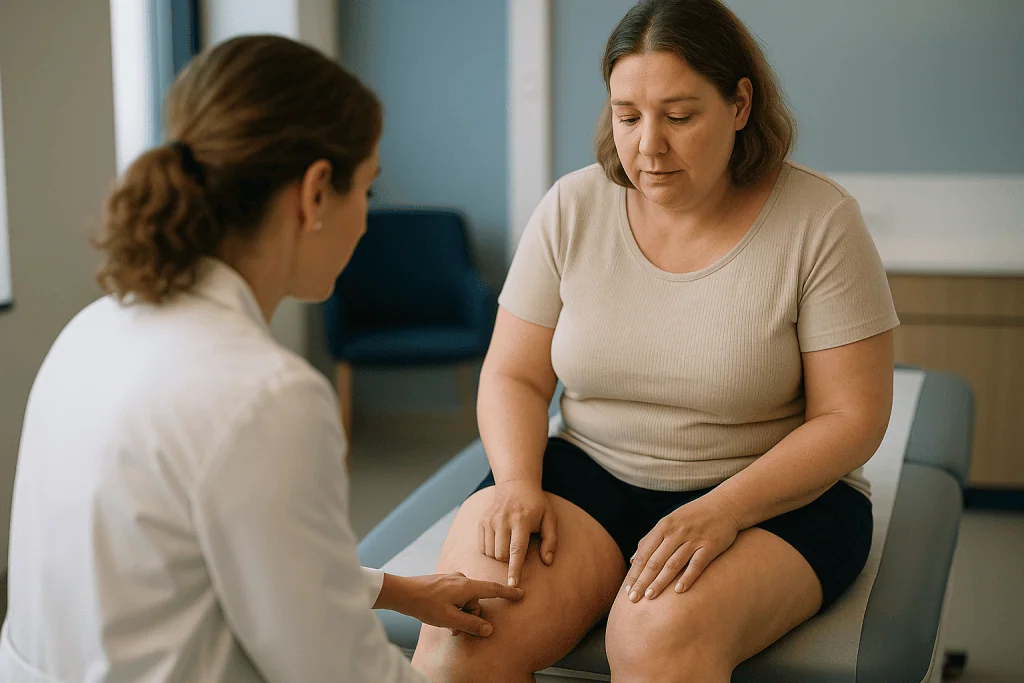
Several features set it apart. The feet are usually spared, producing a visible cuff at the ankle. The tissue is tender to pressure, bruises easily, and the swelling does not pit when pressed, at least in earlier stages. Patients often describe legs that feel heavy and ache by evening regardless of how much they have exercised.
Lipedema nodules are the small, firm, pea-to-marble-sized lumps that can be felt under the skin when the tissue is rolled between the fingers. They are clusters of enlarged fat cells and fibrous tissue, not cysts and not tumors. Their size and number tend to increase as the condition progresses, and they contribute to the tenderness. Surgery can remove many of them; it cannot change the underlying tendency to form them.
Clinicians often describe three stages: smooth skin with a thickened fat layer, an uneven surface with palpable nodules, and finally large folds of tissue, often around the knees. In later stages the lymphatic system can become overwhelmed and true lymphedema develops alongside, a combination sometimes called lipo-lymphedema. Knowing which stage you were in before surgery helps explain why your aftercare plan may be stricter or more relaxed than someone else’s.
Who is usually offered lipedema surgery, and who is asked to wait
Surgery is rarely the first step. The NHS and US consensus guidance both describe conservative care, meaning compression, movement, skin care and sometimes manual lymphatic drainage, as the starting point, with liposuction considered when pain, mobility or recurrent infections remain troublesome despite that care.
People who are typically considered good candidates share a few features. The diagnosis has been confirmed by a clinician familiar with the condition, other causes of leg swelling such as heart, kidney or venous disease have been checked, and body weight has been reasonably stable for several months. Stability matters because lipedema fat and ordinary fat sit side by side, and a result achieved on a changing baseline is hard to assess or maintain.
Others are usually asked to wait, and the reasons are medical rather than judgmental:
- Uncontrolled high blood pressure, diabetes or a bleeding disorder, each of which raises surgical and healing risk.
- Active skin infection or an open wound on the legs.
- Pregnancy, or plans to become pregnant soon, since hormonal shifts can change the tissue.
- Recent large weight loss or gain, until weight has settled.
- Smoking, because nicotine narrows the small vessels that healing depends on; many teams ask for a smoke-free period before and after surgery.
- Untreated lymphedema that would benefit from decongestive therapy first.
Lipedema liposuction is usually staged across several sessions, often one region at a time, because removing large volumes in one sitting carries fluid-shift and clotting risks. The treating team weighs how much to remove and in what order, and the decision about whether surgery is right at all sits with that team, not with a magazine article or an online group.
The first two weeks after lipedema liposuction: what the days usually look like
The first evening is usually the strangest. The legs are wrapped or already in a surgical garment, there is often a thin fluid leaking from the small incisions, and the overall feeling is more bruised than painful. That leakage is the tumescent solution, the diluted anesthetic fluid infused into the tissue during the operation, finding its way out, and it is expected rather than alarming.
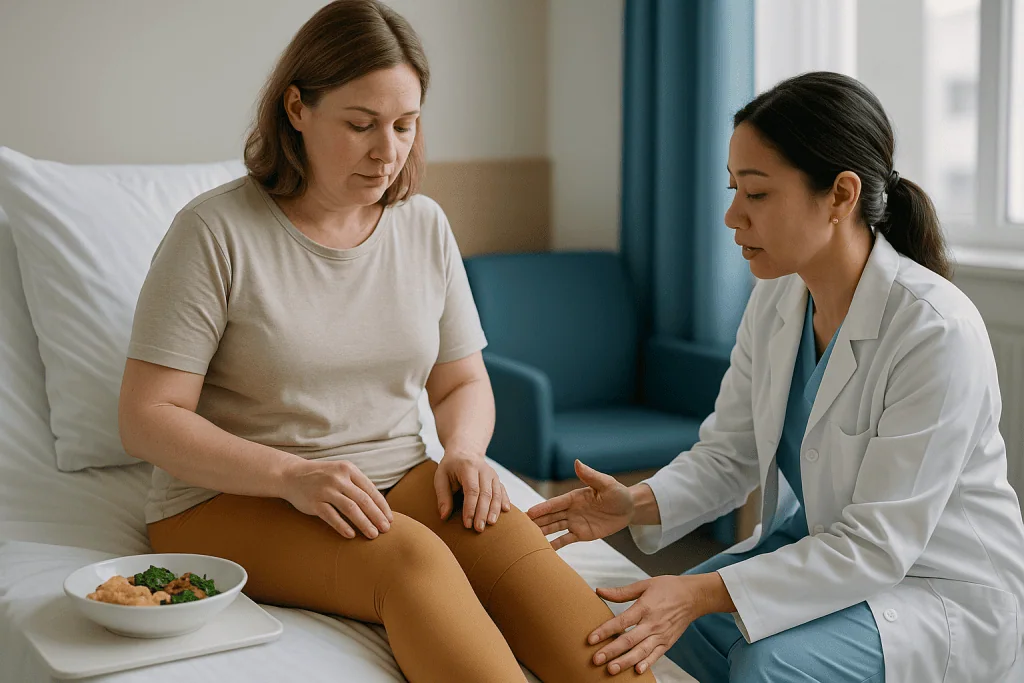
Over days two to four, bruising blooms and swelling peaks. Surgeons commonly ask patients to walk short distances several times a day from the first day onward, because walking squeezes the calf muscles and moves fluid upward. Long periods flat in bed are discouraged for the same reason, and because immobility is the main modifiable risk factor for deep vein thrombosis, a blood clot in a deep leg vein. MedlinePlus lists recent surgery and prolonged inactivity among the leading risk factors for such clots.
By the end of the first week most people can manage ordinary household tasks and are showering with the garment removed briefly, then replaced. Numbness, tingling and patches of altered sensation are common and usually settle over weeks to months as small nerves recover. Firm, lumpy areas under the skin, sometimes called fibrosis, appear as the tissue heals and typically soften with time, massage and continued compression.
Toward week two, incisions have usually closed, bruising is turning yellow, and the garment is swapped for a slightly smaller size or a fresh one, since the first one will have stretched as swelling fell. Follow-up at this stage checks for infection, uneven swelling and skin health. The final shape of the legs is not visible yet; swelling continues to recede over months, which is why photographs taken at two weeks are a poor guide to the outcome.
How long to wear compression after liposuction for lipedema
There is no single number, and anyone who gives you one without seeing your legs is guessing. The US standard-of-care consensus for lipedema describes compression as part of both pre-operative preparation and post-operative recovery, with garments typically worn continuously in the early weeks and the schedule then adjusted by the surgical team. In practice, published aftercare protocols fall into three broad phases.
In the first phase, roughly the initial weeks, the garment is worn day and night and removed only for washing. The goal is to control swelling while capillaries and lymphatics are leaking most. In the second phase, often from around the end of the first month, many teams move to daytime-only wear, with nights off, as bruising resolves and the tissue firms. The third phase is maintenance: compression worn during long days on the feet, in hot weather, when flying, or whenever the legs feel heavy. For some people that phase lasts months; for people with coexisting lymphedema it is lifelong, because the underlying drainage problem has not gone away.
Several things stretch the timeline. Larger-volume sessions, later-stage lipedema, a history of lymphedema and a tendency to swell easily all argue for longer wear. A smaller session on the arms may need a far shorter course than a full-leg procedure.
Two practical points matter more than the exact week count. Garments lose elasticity with washing and wear, so a piece that felt firm in week one may be doing little by week eight and needs replacing or re-measuring. And stopping compression should be a decision made with the team at a follow-up appointment, after they have seen how the legs behave without it, not a decision made alone on a hot afternoon.
Lipedema compression garments compared: flat-knit, circular-knit and surgical binders
Not all compression is the same fabric, and the differences explain why a drugstore stocking that helped with tired legs may be useless after surgery. Medical compression is measured in millimeters of mercury, written mmHg, the same unit as blood pressure, and is graded into classes; the class, length and style are chosen by the clinician based on tissue type, swelling and the stage of healing.
| Garment type | How it is made | Where it tends to be used | Common trade-offs |
|---|---|---|---|
| Surgical post-operative garment | Elastic panels, often with zips or hooks, sized to the immediate post-surgery leg | First weeks after surgery, when swelling is changing daily | Easy to adjust as swelling falls; less durable; may need resizing |
| Circular-knit stocking or legging | Knitted in a seamless tube, thinner and stretchier | Mild to moderate swelling, later recovery, everyday wear | Comfortable and discreet; can roll or cut in at folds on uneven tissue |
| Flat-knit garment | Knitted flat with a seam, firmer and less stretchy fabric | Lipedema with irregular contours, nodules or coexisting lymphedema | Bridges folds without tourniquet effect; thicker, warmer, usually custom-measured |
| Adjustable wrap | Overlapping bands with hook-and-loop fastening | People who cannot pull on a stocking; fluctuating swelling | Independent dressing; bulkier under clothing |
Fit is the whole game. A garment that is too loose does nothing; one that is too tight at a single point, typically behind the knee or at the top band, can act like a tourniquet and trap fluid below it, which is the opposite of the intention. MedlinePlus advises that compression stockings be fitted by measuring the leg, put on first thing in the morning before swelling develops, and checked for wrinkles, and those rules apply doubly to a healing lipedema leg. Rubber dishwashing gloves give grip for pulling fabric up; silicone-free lotion on the skin before dressing makes the fabric slide; and a second garment allows one to be washed while the other is worn.
Does compression help lipedema over the long term?
The short answer is that compression manages symptoms; it does not remove lipedema fat, and it is honest to say so. Lipedema fat is structurally abnormal tissue, and no amount of external pressure converts it back to normal. What compression reliably does, according to the NHS and the US consensus, is reduce the fluid component of swelling, ease the heavy and aching feeling, limit bruising from minor knocks and lower the risk that the lymphatic system becomes overwhelmed and progresses to lipo-lymphedema.
The evidence here is mostly from clinical experience, small studies and expert consensus rather than large randomized trials, and that is worth stating plainly. Lipedema has been under-researched for decades. Studies that do exist tend to measure pain scores, leg volume and quality of life over weeks to months, and they consistently point in the same direction: people who wear appropriate compression report less pain and smaller leg circumference than those who do not. Whether long-term compression slows the progression of the fat itself is unproven.
After surgery the calculus changes. Once the diseased tissue has been reduced, the lymphatics have less to drain and many people find they can rely on compression far less than before. Others, especially those who had lymphedema alongside, continue daily wear because their drainage capacity is permanently reduced. Neither pattern is a failure of the operation.
A useful way to think about it: compression is to lipedema roughly what glasses are to short sight. Taking the glasses off does not damage the eyes, but the world blurs again. Taking compression off does not undo surgery, but on long, hot or sedentary days the legs may remind you why it was prescribed.
Lipedema diet after surgery: what food can and cannot do
Start with the myth that needs clearing away. Lipedema is not caused by overeating, and the NHS states explicitly that the fat does not respond to diet and exercise in the way ordinary fat does. Anyone who has lost weight from their face and waist while their legs stayed the same already knows this. So the purpose of eating well after surgery is not to melt the remaining lipedema; it is to protect the result and reduce inflammation.
Protecting the result means keeping overall body weight stable. Ordinary fat can still be laid down in the treated areas, and large weight swings also change how garments fit and how much the legs swell. Reducing inflammation matters because lipedema tissue shows inflammatory changes under the microscope, and swelling and pain are partly inflammatory phenomena.
Patterns that are commonly recommended, and that have good general cardiovascular evidence behind them, include a Mediterranean-style way of eating: vegetables, fruit, legumes, whole grains, fish, nuts and olive oil, with limited processed food, added sugar and alcohol. Some clinicians favor lower-carbohydrate approaches for lipedema, and small studies have reported reduced pain, but the evidence is preliminary and no single diet has been proven superior for the condition.
Salt deserves attention in the early weeks, because sodium holds water in tissue and the legs are already struggling to drain. Protein supports wound healing. Adequate fluid is not the enemy of swelling; dehydration makes lymph thicker and harder to move.
Nothing here should be undertaken as a crash diet. Rapid weight loss in the months after surgery can leave loose skin and make the contour uneven, and a dietitian who understands lipedema can tailor an approach to your medical history, particularly if diabetes, thyroid disease or an eating disorder is part of the picture.
Exercise, the muscle pump and daily movement
Every time the calf contracts, it squeezes the deep veins and lymphatic vessels running through it and pushes fluid toward the heart. Clinicians call this the muscle pump, and it is the reason a brisk walk often relieves heavy legs more than an afternoon with the feet up. After lipedema surgery, movement is both the main clot-prevention strategy and the most powerful tool for clearing residual swelling.
In the first days, movement means getting up and walking around the home every hour or two while awake. Over the following weeks most teams allow gradual increases in walking distance, then low-impact activities. Swimming and water walking are often singled out once incisions have fully closed, because water pressure acts as gentle all-over compression and the buoyancy takes load off tender joints. Cycling on a stationary bike and rebounding on a mini trampoline are popular for the same lymph-moving reasons.
High-impact exercise, heavy lifting and contact sports are usually held back until the team confirms the tissue has healed, commonly a matter of weeks for lighter activity and longer for the most strenuous. The time ranges vary with the size of the procedure, so take the surgeon’s specific clearance over any general figure.
Long term, the goal is the same as for general health: regular aerobic activity most days plus some strength work. The American Heart Association’s general guidance of around 150 minutes of moderate activity a week is a reasonable framework, adjusted for joint pain, which is common in lipedema because the altered gait and tissue bulk around the knees load the joints unevenly. Wearing compression during exercise is frequently recommended, since it combines the muscle pump with external pressure, and because exercise raises blood flow and would otherwise increase swelling in the short term.
Manual lymphatic drainage, pneumatic compression devices and other therapies
Manual lymphatic drainage, usually shortened to MLD, is a very light, rhythmic skin-stretching massage performed by a trained therapist to encourage lymph to move toward working lymph nodes. It is not deep tissue massage; pressure firm enough to feel like a conventional massage can actually collapse the superficial lymphatic vessels. Many surgical teams recommend a course of MLD in the weeks after lipedema liposuction to reduce swelling and soften fibrosis, and the US consensus lists it among supportive therapies, while acknowledging that research specific to lipedema is limited and much of the supporting evidence comes from lymphedema care.
Pneumatic compression devices are inflatable sleeves that fill with air in sequence from the foot upward, mimicking the muscle pump. Mayo Clinic describes them as one option in lymphedema management. For lipedema, small studies suggest they can reduce leg volume and discomfort in the short term, but larger trials are lacking, and the devices are not a substitute for a properly fitted garment. They are generally not used in the immediate post-operative period until the team confirms the tissue can tolerate the pressure, and they are avoided in the presence of untreated heart failure, active infection or a suspected blood clot.
Other approaches people ask about include dry brushing, vibration plates and kinesiology taping. None has strong evidence in lipedema. Dry brushing is harmless if gentle and the skin is intact. Vibration plates may help some people move fluid, but data are thin. Taping is used by some lymphedema therapists; whether it adds anything on top of compression has not been established. A reasonable stance is that gentle, inexpensive add-ons are acceptable if they feel good and the skin is protected, while the core of care remains compression, movement, skin care and follow-up with the treating team.
Is diosmin good for lipedema? Supplements and medicines, explained
Diosmin is a flavonoid, a plant compound found in citrus peel, that is used in some countries for chronic venous insufficiency, a condition in which leg veins struggle to return blood to the heart. Its proposed mechanism is to improve the tone of vein walls and reduce leakage from capillaries, which sounds relevant to swollen legs. For lipedema specifically, however, there are no large, well-designed trials showing benefit, and a clinician cannot honestly call it an effective treatment for the condition. Some people with both lipedema and venous disease are offered it by their doctors on the strength of the venous evidence; that is a decision for the prescribing clinician who knows the full history.
Other supplements circulate in lipedema communities, including selenium, butcher’s broom, horse chestnut and various anti-inflammatory blends. The NIH Office of Dietary Supplements notes that supplements are not reviewed for effectiveness before sale in the United States, and that some interact with prescription medicines; horse chestnut and high-dose fish oil, for example, can affect bleeding, which is relevant around surgery. Always tell the surgical team about every supplement before an operation, because several are routinely paused beforehand.
Prescription medicines sometimes discussed include diuretics, which pull water out of the bloodstream and can worsen lipedema by thickening lymph without touching the fat, and newer weight-management medicines, which are being studied in lipedema but have no established role in treating the lipedema tissue itself. Pain is usually managed in the short post-operative period with medicines chosen by the team, with timelines of days rather than weeks.
No supplement or tablet replaces compression and movement, and nothing in this section is a recommendation to start or stop anything. It is a map of what is and is not supported, so the conversation with your care team starts from facts.
Long-term care of the legs: skin, heat, travel and weight changes
Years after surgery, the daily work of looking after lipedema legs is mostly unglamorous and mostly about skin. Compression and sluggish lymph both dry the skin, and dry skin cracks. Cracks let in bacteria, and cellulitis, a spreading skin infection, is one of the complications that lipedema and lymphedema patients are most prone to. The NHS advises daily moisturizing with a plain emollient, careful drying between toes, prompt cleaning of any cut or insect bite, and avoiding walking barefoot where injury is likely.
Heat is the other everyday antagonist. Hot baths, saunas and sunbathing dilate blood vessels and increase the fluid load the lymphatics must clear, so many people notice their legs are worse after a holiday in the sun. The practical answer is moderation, cooler showers, shade and keeping up compression on hot days rather than abandoning it.
Travel raises a specific concern. Sitting still for hours in a car or plane cabin slows blood flow in the legs, and MedlinePlus identifies prolonged travel as a recognized risk factor for deep vein thrombosis, more so in the months after any surgery. Sensible measures include wearing compression for the journey, walking the aisle or stopping the car every hour or two, flexing the ankles while seated, staying hydrated and limiting alcohol. Anyone planning long-distance travel in the early recovery period should ask their team how long to wait; typical advice is to avoid long journeys for the first weeks after a large-volume procedure, and the exact interval depends on the surgery and individual clot risk.
Finally, weight. Hormonal transitions such as pregnancy and menopause can reactivate lipedema, and significant weight gain can obscure a surgical result with ordinary fat. Regular check-ins with a clinician who knows the condition, rather than waiting for problems, are the quiet secret of long-term stability.
What people often get wrong about compression after lipedema surgery
Mistakes in this area tend to come from well-meaning advice passed around online, so it is worth naming the most common ones.
Tighter is better. It is not. Compression that is too tight at any single point blocks drainage below it and can damage skin and nerves. The right garment feels firm and even, never like a tourniquet, and the class is chosen by a clinician.
Once the bruising fades, compression is pointless. Bruising resolves in two to three weeks, but swelling continues to recede for months, and the tissue is still remodeling. Stopping early is one of the commonest reasons for a disappointing contour, and there is no way to retrieve the weeks that were missed.
Surgery means the condition is gone. Liposuction removes diseased tissue; it does not alter the biological tendency that produced it. Most people need some ongoing management, even if far less than before.
A diet will remove the remaining lipedema fat. The NHS is clear that lipedema fat does not respond to dieting the way ordinary fat does. Good nutrition protects the result and reduces inflammation; it is not a second operation.
Diuretics help the swelling. Water tablets pull fluid out of the blood, not out of lipedema tissue, and can make lymph thicker and harder to move. They are not a lipedema treatment.
Any massage is good massage. Deep tissue work on freshly operated tissue can bruise and worsen fibrosis; manual lymphatic drainage is deliberately light.
Compression garments last forever. Elastic fibers fatigue. A garment worn daily usually needs replacing after a few months, and a stretched garment gives a false sense of security.
Each of these errors is understandable, and each is avoidable with a single conversation at follow-up.
Questions to ask your care team
A good consultation leaves you with a plan you understand, not just a prescription for a garment. These questions help get there, before surgery and at each follow-up.
- Which compression class, length and style do you want me in for the first phase, and why that choice for my tissue?
- When will I be re-measured, and what signs tell you a garment no longer fits?
- What is the planned schedule for moving from day-and-night wear to daytime only, and what would make you extend it?
- Do you expect me to need compression long term, given my stage and whether lymphedema is present?
- How many surgical sessions are you planning, in what order, and how far apart?
- What activity is allowed in week one, week four and week twelve, and when can I swim?
- Do you recommend manual lymphatic drainage after my procedure, and if so, how will I find a suitably trained therapist?
- Which of my current medicines and supplements need to be paused before surgery, and when do they restart?
- What is your advice on nutrition after surgery, and can you refer me to a dietitian familiar with lipedema?
- How do I recognize a blood clot or an infection, and who do I call out of hours?
- How long should I avoid long-distance travel after each session?
- What results are realistic for my stage, and what will the legs look like at three months versus a year?
Write the answers down or bring someone who will. Recovery is a long enough road that the details given in a single appointment are easy to lose, and the plan you walk out with is the one most likely to be followed.
When to call your doctor
Most of recovery is uneventful, and most worries can wait for the next scheduled appointment. A handful of signs should not wait, because they point to complications that are far easier to treat early.
Seek urgent medical attention, calling emergency services if necessary, for sudden shortness of breath, chest pain, coughing up blood, or a racing heartbeat; these can signal a pulmonary embolism, a clot that has traveled to the lungs. Also seek urgent care for new swelling, pain, warmth or redness in one calf or thigh that is clearly worse than the other side, which MedlinePlus lists as the classic picture of deep vein thrombosis.
Contact the surgical team the same day for:
- Fever, chills or feeling generally unwell in the days after surgery.
- A spreading area of hot, red, painful skin, or red streaks moving up the leg, suggesting cellulitis.
- Incisions that are leaking cloudy or foul-smelling fluid, gaping open, or increasingly painful after initially settling.
- A rapidly enlarging, tense, very painful area under the skin, which may be a collection of blood or fluid.
- Numbness or color change in the toes or foot while wearing the garment, or pain under a band that does not ease when the garment is adjusted.
- Swelling that increases rather than decreases after the first two weeks, or swelling that reaches the feet.
- Dizziness, fainting or passing very little urine, particularly after a larger-volume session.
Trust the instinct that something is not right. Surgical teams would far rather hear about a false alarm than see a complication that has been nursed at home for a week. Any change to compression, medicines or activity in response to these signs should be made with the team, who will decide whether you need to be seen and what, if anything, needs to change.
Frequently asked questions
Do I have to wear a compression garment after liposuction for lipedema?
Yes, in almost every published protocol compression is a standard part of recovery after lipedema liposuction. The garment limits swelling and bruising, supports the lymphatic system while it heals and helps the skin settle evenly against the underlying tissue. The exact class, style and duration are set by the surgical team, and skipping it in the early weeks is one of the commonest reasons for prolonged swelling and an uneven contour.
How long to wear compression after liposuction for lipedema?
Typically day and night for the first weeks, then daytime only, then as needed, with the surgical team setting each step. Consensus guidance describes compression as integral to post-operative care but does not fix a universal week count, because larger procedures, later-stage disease and coexisting lymphedema all extend the schedule. Garments also lose elasticity and usually need replacing during the course.
Does compression improve lipedema?
Compression improves the symptoms of lipedema, particularly heaviness, aching, bruising and the fluid component of swelling, and it may help prevent progression to lipo-lymphedema. It does not reduce the abnormal fat itself. The evidence comes mainly from small studies and expert consensus rather than large trials, and both the NHS and the US standard-of-care document list it as a foundation of management.
What are lipedema nodules?
Lipedema nodules are small, firm lumps of enlarged fat cells and fibrous tissue that can be felt under the skin, ranging from pea to marble size. They are not cysts or tumors. Their number and size tend to grow as the condition progresses and they contribute to the tenderness typical of lipedema. Liposuction can remove many of them, but the underlying tendency to form them remains.
Is diosmin good for lipedema?
There is no robust evidence that diosmin treats lipedema. It is a citrus-derived flavonoid used in some countries for chronic venous insufficiency, where it is thought to improve vein wall tone and reduce capillary leakage. People with both lipedema and venous disease are sometimes offered it for the venous component, but that is a decision for the prescribing clinician, and it is not a substitute for compression or movement.
What is the best lipedema diet after surgery?
No single diet has been proven best for lipedema. The NHS notes that lipedema fat does not respond to dieting like ordinary fat, so eating after surgery aims to keep weight stable and lower inflammation. A Mediterranean-style pattern rich in vegetables, legumes, fish and olive oil is widely recommended; some clinicians favor lower-carbohydrate approaches, but the evidence is preliminary. A dietitian familiar with lipedema can personalize this.
Which lipedema compression garments are best after surgery?
The best garment is the one that fits your leg shape and healing stage, chosen by the surgical team. Zipped post-operative garments suit the first weeks when swelling changes daily; flat-knit custom garments suit uneven, nodular tissue or coexisting lymphedema because they bridge folds without cutting in; circular-knit stockings suit smoother legs later on. Pressure that is firm and even, never pinching, is the test of a good fit.
Can I sleep without compression after lipedema surgery?
Not at first. Most protocols require the garment at night as well as during the day in the early weeks, when leakage from damaged capillaries and lymphatics is greatest. Many teams then allow nights off from around the end of the first month, once swelling and bruising have settled. The switch should follow a follow-up assessment rather than a personal decision on an uncomfortable night.
Does compression help lipedema progress more slowly after surgery?
It is plausible but unproven. Compression reduces fluid load on the lymphatic system, which may lower the risk of lipo-lymphedema, a complication where lymphatic drainage fails alongside the fat accumulation. Whether it slows growth of the lipedema fat itself has not been shown in good-quality studies. After surgery, with less diseased tissue to drain, many people need compression less, but those with lymphedema usually continue.
When is it safe to fly after lipedema surgery?
Ask your surgical team for a specific interval, because it depends on the volume removed and your personal clot risk. Long periods of sitting slow blood flow in the legs, and MedlinePlus lists travel and recent surgery among recognized risk factors for deep vein thrombosis. When you do travel, wear compression, walk every hour or two, flex the ankles while seated, stay hydrated and arrange follow-up at your destination if needed.
References
- NHS: Lipoedema
- Cleveland Clinic: Lipedema
- MedlinePlus: Compression stockings
- MedlinePlus: Deep Vein Thrombosis
This article is for general information only and is not a substitute for professional medical advice. Please consult a qualified doctor about your individual situation.

More from the Blog

Liposuction Recovery Time: Swelling, Compression and When Results Actually Show
Most people return to desk work within one to two weeks after liposuction, but complete recovery takes far longer than many expect. Swelling peaks…

Who Is a Candidate for a BBL? Donor Fat, Body Shape and Why Very Slim Patients May Be Told No
A typical BBL candidate is a healthy adult who is at or near a stable weight, has enough spare fat on the abdomen, flanks,…

Sitting, Walking and Sleeping After a Thigh Lift: Protecting the Incision in the First Weeks
After a thigh lift, most surgical teams ask patients to walk short distances from the first day to lower blood-clot risk, while avoiding deep…
Vaser Liposuction Side Effects: Normal Swelling vs Signs Your Surgeon Wants to Hear About
After Vaser liposuction, swelling, bruising, soreness, mild numbness and pink fluid leaking from small incisions are expected in the first weeks, and swelling can…

Which Tests Come Before Lymphedema Surgery? Lymphatic Imaging, Staging and Planning
Before lymphedema surgery, most teams confirm the diagnosis, exclude other causes of swelling such as a blood clot or vein disease, measure limb volume,…
Vaser vs Traditional Liposuction: Bruising, Skin Tightening and Which Areas Each Suits
Vaser is a brand of ultrasound-assisted liposuction that uses sound energy to loosen fat before it is suctioned out; traditional liposuction removes fat with…