

Living in a Scoliosis Brace: School, Sport, Sleep and Skin Care Day to Day
Key Takeaways
- In the largest randomized bracing trial, 72 percent of braced adolescents reached skeletal maturity with a curve under 50 degrees compared with 48 percent of those only observed.
- Wear time measured by heat sensors mattered more than prescribed hours: averaging about 13 or more hours a day was associated with success rates of 90–93 percent in that trial.
- A brace aims to stop a moderate curve, broadly 25–40 degrees in a growing child, from progressing; ending treatment near the starting angle counts as a good result.
- Pink pressure marks that fade within about 20–30 minutes of removing the brace are expected, while marks lasting hours or broken skin mean the fit needs adjusting.
- Exercise and sport, including swimming, are normally done brace-free and count toward the daily hours off, so families should agree that budget with the team.
- Adults have no growth left to steer, so mainstream guidance does not describe bracing as a way to correct adult curves; any adult brace use is for short-term comfort decided with a clinician.
Living with a scoliosis brace means wearing a rigid, custom-molded shell for a set number of hours each day while the spine is still growing, usually to stop a moderate curve from worsening rather than to straighten it. Most teens keep attending school, playing sport and sleeping in the brace with adjustments; skin checks, a seamless undershirt and steady wear hours matter most, guided by the treating team.
The fitting room smells faintly of warm plastic. A thirteen-year-old stands in a thin cotton shirt while an orthotist, the specialist who builds and adjusts braces, presses a pale shell against her ribs and asks her to breathe. Her mother watches the straps tighten and does the math out loud: sixteen hours a day, maybe two years, through a growth spurt, a swim season and a school dance.
That arithmetic is where living with a scoliosis brace really begins. The X-ray and the degrees on the report belong to the clinic. The daily part, the sweaty afternoons, the friend who notices the outline under a hoodie, the 2 a.m. wriggle to find a comfortable side, belongs to the family.
This explainer stays with that daily part. It leans on what the evidence actually shows about wear time and progression, and it leaves every decision about starting, changing or finishing a brace with the team that knows the child and the X-rays.
How does a scoliosis brace actually work?
Scoliosis is a sideways curve of the spine, measured on an X-ray as the Cobb angle, which is the angle between the most tilted vertebrae at the top and bottom of the curve. A brace does not pull that curve straight for good. Its job is quieter: to hold the spine in a corrected position for many hours a day while the child is still growing, so that the curve grows into a straighter shape rather than a worse one.
The mechanism is mechanical and biological at once. Pads inside the shell press against the outward bulge of the curve, and relief windows on the opposite side give the trunk room to shift. On the biological side, growth plates, the soft zones at the ends of growing bones, grow more slowly under sustained compression and faster when unloaded. Pressing on the convex side while the spine lengthens nudges the vertebrae to grow more evenly. Once the skeleton stops growing, that lever disappears, which is why bracing is a treatment of childhood and adolescence.
An orthotist casts or scans the torso and builds a shell, then the team checks an in-brace X-ray to see how much correction the brace achieves while it is on. Straps are adjusted over the following weeks. The realistic goal, as the Mayo Clinic and NHS describe it, is to prevent progression, not to reverse the curve. When the brace comes off at the end of treatment, the spine usually settles close to where it was when bracing started. That is counted as a good result, because the alternative for many moderate curves was steady worsening.
Who is usually offered a brace, and who is asked to wait?
Bracing is mostly a treatment for adolescent idiopathic scoliosis, the common form that appears around puberty with no identifiable cause. Three things drive the decision: how large the curve is, how much growth is left, and whether the curve has been getting bigger between X-rays.
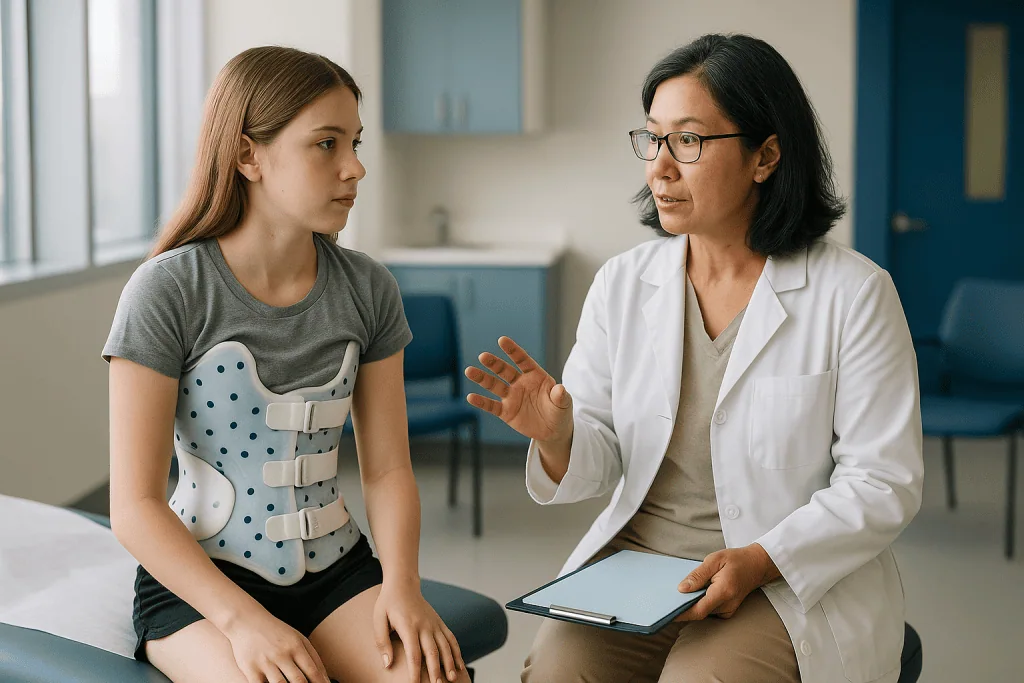
Guideline-level practice, echoed by the Cleveland Clinic and Mayo Clinic, is that braces are considered for growing children whose curves sit in a moderate range, broadly 25–40 degrees, or whose smaller curves have shown clear progression. Growth remaining is judged from the Risser sign, a grading of how much the top of the pelvic bone has hardened on X-ray, and from clues such as height velocity and, in girls, time since the first period.
Who is usually asked to wait? A child with a mild curve, often under about 20–25 degrees, is typically observed with a repeat X-ray every 4–6 months rather than braced. Someone who has essentially finished growing gains little from a brace because there is no growth left to steer, so observation or, for large curves, a surgical conversation becomes the pathway. At the other end, curves beyond roughly 45–50 degrees in a growing child are usually discussed as surgical candidates because bracing rarely holds them.
Bracing is also less predictable in scoliosis caused by neuromuscular conditions or congenital vertebral differences, where a brace may be used more for sitting support than for changing the curve. None of these thresholds are hard walls; a team weighs the whole picture, including the child’s readiness and family circumstances, before recommending a brace or a period of watchful waiting.
Which types of scoliosis brace exist, and how do they differ?
Families often arrive expecting one universal brace. In practice there are two broad approaches, and the choice depends on where the curve sits, how flexible it is and how the family can realistically manage wear time.
| Brace type | When it is worn | Usually suited to | Everyday trade-offs |
|---|---|---|---|
| Full-time rigid underarm brace (a thoracolumbosacral orthosis, or TLSO, meaning it spans the chest, lower back and pelvis) | Day and night, often 16–23 hours a day per NHS and Cleveland Clinic descriptions | Curves in the middle and lower spine in a growing child | Fits under loose clothing; heat, rib pressure and school logistics are the main hurdles |
| Nighttime bending brace | Sleep hours only, typically 8–10 hours | Selected single, flexible lower curves; not suitable for higher chest curves | School day is brace-free; the shell overcorrects the spine so it cannot be worn upright |
| Brace with neck ring (cervico-thoraco-lumbo-sacral orthosis) | Full-time | High chest curves, now rarely prescribed | Visible above clothing; most teams reserve it for specific cases |
The underarm rigid brace is the version most families will meet, and it is the type tested in the largest randomized trial of bracing. Nighttime braces trade fewer hours for a more aggressive corrected position; they appeal to teens who want a normal school day, but the team must be confident the curve pattern suits it.
Soft or elastic braces are sometimes advertised for scoliosis. Mainstream guidance from the NHS and Mayo Clinic describes rigid braces as the treatment with evidence for slowing progression, and does not describe soft supports as equivalent. If a product promises to straighten a curve or remove the need for wear hours, that claim outruns the evidence and is worth raising with the treating team before spending time on it.
How many hours a day do you wear a scoliosis brace, and does it matter?
Wear time is the single most important variable a family controls, and it is the part of living with a scoliosis brace that the evidence speaks to most clearly.

The Bracing in Adolescent Idiopathic Scoliosis Trial, published in the New England Journal of Medicine and indexed on PubMed, followed adolescents with moderate curves who were either braced or simply observed. Success was defined as reaching skeletal maturity with a curve under 50 degrees, the threshold at which surgery is commonly discussed. In the trial, 72 percent of braced participants met that definition compared with 48 percent of those observed. The study also used heat sensors inside the braces to record actual hours worn, which turned out to be far more telling than prescribed hours. Participants who averaged at least about 13 hours a day had success rates in the 90–93 percent range, while those wearing the brace only a few hours a day did little better than the observation group.
That dose-response relationship is why prescriptions from most teams land somewhere between 13 and 23 hours. The Mayo Clinic describes most braces as worn 13–16 hours a day; NHS guidance describes braces worn for up to 23 hours, removed for washing and exercise. The exact number for any one child is set by the treating team based on the curve, the growth remaining and what the family can sustain.
Two practical points follow. First, consistency beats heroics: a brace worn reliably 15 hours every day outperforms one worn 22 hours on weekdays and abandoned at weekends. Second, hours off should be planned around the things that matter to the teen, whether that is swim practice or a birthday party, because a schedule that respects normal life is one that actually gets followed.
Living with a scoliosis brace at school
School is where a brace stops being a medical device and becomes a social object. The good news is that the underarm rigid brace sits below the armpits and above the hips, so with a slightly looser top it is hard to spot. The harder news is that a teen knows it is there every minute.
A few adjustments make the school day workable. Rigid shells do not bend at the waist, so picking up a dropped pen means squatting rather than stooping. Chairs with a slight recline are easier than hard upright ones, and many students find a thin cushion helps on long days. Locker height matters more than anyone expects; a lower shelf saves the daily reach.
Toileting takes longer, since loosening straps and re-tightening them to the marked settings is a two-minute job. Schools generally accommodate this with a bathroom pass or a quiet word to teachers. Where a nurse’s office exists, storing a spare undershirt there covers the inevitable hot afternoon.
Disclosure is the teen’s call. Some choose to tell close friends and let the news spread on its own; others prefer a short explanation to the whole class once, which tends to end curiosity fast. Teachers benefit from knowing the practical basics: the student may need to stand and stretch, may sit differently in physical education, and should never be asked to remove the brace as a demonstration.
Backpacks come up constantly. A brace does not make carrying books dangerous, but the shell can dig in under heavy straps. Rolling bags, a locker routine that avoids hauling everything at once, or a second set of textbooks at home solve most of it. The aim is an ordinary school day with a few quiet workarounds, not a special status.
Can you play sports in a scoliosis brace?
Yes, and most teams actively encourage it. Scoliosis itself does not bar a child from sport, and the NHS explicitly advises that people with scoliosis can take part in exercise and sport, including contact sports, unless a clinician says otherwise. The brace is the variable, not the spine.
The usual arrangement is that daily exercise counts as brace-off time. Swimming is the classic example: the brace cannot get wet, so practice happens without it, and the water supports the trunk in a way many teens find relieving after hours in a shell. Running, cycling, dance and team sports are typically done brace-free for the same practical reason, then the brace goes straight back on afterward.
Some activities work perfectly well with the brace on. Walking, light gym work and many physical education classes are fine in a rigid brace, though twisting sports and anything requiring a full bend at the waist are awkward. Contact sports in a brace are a specific question for the team, partly because the hard shell can bruise an opponent and partly because a blow to the plastic transmits force oddly.
What about muscles going soft? Bracing does not weaken the back in any way that undoes itself with normal activity, and keeping the trunk and hips strong helps with posture when the brace comes off. Scoliosis-specific physiotherapy exercise programs are sometimes prescribed alongside a brace; systematic reviews summarized on PubMed describe the evidence for these as low to moderate quality, so they are best viewed as a supportive add-on decided by the team rather than a substitute for wear hours.
The practical rule most orthotists give is simple: exercise is always allowed, the brace-off hours are finite, and a family should agree with the team on how those hours are budgeted across the week.
Sleeping in a scoliosis brace: what helps at night
Night is where full-time prescriptions earn their hours, and where many teens struggle most in the first weeks. A rigid shell that feels manageable while standing can feel like a cage when lying down, because the pads press differently once body weight settles against them.
Position is the first lever. Most people find their back or the side opposite the main pad most comfortable; lying directly on the pressure pad is rarely tolerable. A pillow between the knees keeps the pelvis level on the side, and a thin pillow under the waist when on the back can fill the gap the brace creates against the mattress. Firm mattresses tend to work better than very soft ones, which let the hips sink and rotate the shell.
Straps are sometimes set a notch differently for sleep, but only if the orthotist marks that setting; loosening freely defeats the purpose. Overheating is common because the shell traps warmth, so a lighter duvet, a fan and a moisture-wicking undershirt make a real difference. Sleeping in a cool room also reduces sweat, which protects the skin.
Nighttime-only bending braces are a separate case. They hold the spine in an overcorrected sideways bend, which is why they can only be worn lying down. The first nights are usually the hardest, and comfort typically improves over 1–2 weeks as the body adapts and the orthotist fine-tunes pressure points, a timeline consistent with the break-in guidance from Cleveland Clinic and the NHS.
If sleep is badly disrupted for more than a couple of weeks, that is a fitting problem to solve, not a test of willpower. Poor sleep undermines school, mood and, eventually, wear time itself, so teams want to hear about it early.
Scoliosis brace skin irritation: daily care that prevents sores
Skin is the tissue that quietly decides whether a brace gets worn. A shell that rubs raw at the hip will be left off, so skin care is not cosmetic; it is part of the treatment.
Start with what sits under the brace. Orthotists generally advise a snug, seamless cotton or moisture-wicking shirt, long enough to be pulled well below the shell so no bare skin touches plastic. Seams and wrinkles under a pad concentrate pressure and are a common cause of blisters. Two or three undershirts in rotation mean there is always a dry one.
Then the daily check. When the brace comes off for bathing, look at, or have a parent look at, the pressure points: over the hips, the ribs and the lower back where pads press hardest. Pink marks that fade within about 20–30 minutes of removing the brace are the expected sign of a working pad. Marks that stay red for hours, skin that breaks or blisters, or a patch that feels hot are signals that the fit needs adjusting.
Keep skin clean and completely dry before the brace goes back on. Lotions, oils and powders under the shell are usually discouraged because they soften skin and trap moisture, unless the team specifically recommends a product. Wiping the inside of the brace with a mild soap solution and letting it dry daily controls odor and bacteria.
Rashes have two common causes: heat and sweat causing friction, which improves with better ventilation and a fresh shirt, and irritation from the brace lining, which the orthotist can pad or reline. Acne along the brace line is common in teens and generally settles with cleansing; persistent or infected spots deserve a clinician’s look rather than home treatment.
The first weeks in a brace: what breaking in usually looks like
Nobody goes from zero to a full prescription overnight. A typical break-in plan, along the lines described by Cleveland Clinic and NHS patient guidance, builds wear time gradually over 1–2 weeks: a few hours the first day, adding an hour or two daily, with the first full nights toward the end of that window. The exact schedule comes from the orthotist and depends on how the skin and the child are coping.
Week one is mostly about discovering pressure points. The brace will feel tight, breathing may feel shallow at first, and eating a large meal in a rigid shell feels strange because the stomach has less room to expand. Smaller, more frequent meals help. Many teens describe a dull ache under the pads that eases as muscles adapt.
Around the second to fourth week, a first adjustment visit is common. The orthotist trims edges, adds or removes padding and rechecks strap tension. A follow-up X-ray in the brace is usually taken within the first few months to confirm the brace is achieving the correction the team expects; the Mayo Clinic describes ongoing X-rays roughly every 4–6 months to track the curve through growth.
By about six weeks, most families report the brace has become routine: on and off without thinking, a rhythm for laundry and skin checks, and an agreed budget of brace-off hours. Growth spurts interrupt that routine, because a shell that fit last spring may pinch by autumn, and many adolescents need a new brace once or more during treatment.
Treatment ends when growth ends. Teams judge this from the Risser sign and, in girls, roughly two years after the first period. Coming off is usually gradual too, with hours reduced over weeks while X-rays confirm the curve is holding.
Can people with scoliosis carry heavy things or lift weights?
This question hides a fear: that lifting will make the curve worse. The evidence does not support that fear. Idiopathic scoliosis is driven by growth and genetics, not by carrying groceries or a heavy school bag, and mainstream sources including the NHS and Cleveland Clinic list no restriction on ordinary lifting for people with scoliosis.
What lifting can do, in anyone, is trigger muscle strain, and someone with a curve may have muscles working unevenly across the back. Good mechanics matter more than avoidance: bend at the hips and knees, keep the load close to the body, avoid twisting while loaded, and share very heavy items. A teen in a rigid brace cannot bend at the waist at all, so squatting to lift is not just advice but the only option, and the brace itself acts as a reminder of neutral posture.
Backpacks are the everyday version. A bag carried on both shoulders with padded straps and the heaviest books closest to the back distributes weight sensibly; a single-strap bag slung on one side loads the spine unevenly and tends to irritate the brace edge. Weight itself is rarely the issue, but comfort is, and a locker routine that limits what travels home each day keeps the load reasonable.
Strength training deserves its own mention because teens ask about it. Resistance exercise is generally encouraged in scoliosis for the same reasons it is encouraged in everyone, and a physiotherapist can shape a program around the curve. Very heavy overhead or loaded spinal flexion movements are the ones worth discussing with the team first, not because they change the curve but because form matters. The brace-off hours can include the gym; the brace-on hours suit walking and lighter activity.
The emotional side: body image, independence and family strain
A brace arrives at the exact age when bodies are already a source of scrutiny. It changes how clothes hang, how a hug feels and how a teenager moves through a hallway. Taking that seriously is not indulgence; it is part of making the treatment work, because a teen who feels controlled or exposed finds ways to shorten wear time.
Research on adolescents in braces, summarized in reviews on PubMed, consistently reports lower self-image scores during treatment compared with peers, with most measures recovering after bracing ends. That pattern is useful to say out loud: this is a hard chapter with a defined end, not a permanent identity.
Independence helps more than supervision. Letting the teen manage straps, skin checks and the daily brace-off budget, with a parent as backup rather than enforcer, tends to reduce conflict. Heat sensors built into many modern braces record actual wear hours; teams use them to open a conversation about what is realistic, not to hand out blame. Families do well to treat the numbers the same way.
Clothing choices matter more than adults assume. Slightly oversized tops, textured fabrics that hide the shell’s edge, and high-waisted trousers that meet the bottom of the brace all reduce the visible outline. Some teens prefer to decorate the shell and wear it openly; either approach is fine.
Watch for the signs that the strain is tipping into something more: withdrawal from friends, refusing school, changes in eating or sleep unrelated to brace comfort, or persistent low mood. Those are reasons to involve the pediatrician or a mental health professional early. Many scoliosis teams include a psychologist or peer-support link precisely because emotional health and wear hours rise and fall together.
Scoliosis brace for adults: what the evidence actually shows
Adults searching for the best back brace for scoliosis usually want one of two things: to stop a curve from worsening, or to ease pain. The evidence treats those goals very differently.
A rigid brace works by steering growth, and adults have none left to steer. Mainstream guidance from the NHS and Mayo Clinic therefore does not describe bracing as a way to correct or halt adult curves. Adult scoliosis can still progress slowly, particularly degenerative curves that develop from wear in the discs and joints later in life, but progression there is managed by monitoring, exercise and, for some, surgery, not by the growth-modulating brace of adolescence.
Pain is a more nuanced story. Some adults find a soft lumbar support or a lightweight rigid brace eases discomfort during long standing or a flare, and clinicians may suggest short-term use for that reason. The evidence base is thin and mostly small studies, so teams describe it as a comfort tool rather than a treatment for the curve. Relying on a support for many hours a day over months is generally discouraged because trunk muscles adapt to doing less work, which can leave the back feeling weaker when the brace is off.
What has better support in adult scoliosis is unglamorous: regular activity, targeted strengthening and flexibility work with a physiotherapist, weight management where relevant, and pain management planned with a clinician. Medicines used for back pain, such as over-the-counter anti-inflammatory drugs, act by reducing inflammation around irritated joints and are decisions for the prescribing clinician, who can weigh stomach, kidney and heart considerations.
An adult considering any brace should ask a spine specialist what the goal is, how long it would be worn and how the team will judge whether it is helping, rather than choosing from advertisements.
What people often get wrong about living with a scoliosis brace
Myths cluster around braces because the treatment is long, invisible and easy to misjudge. Correcting a few of them saves families real grief.
The first is that the brace will straighten the spine. It will not, at least not permanently. The measured goal, in the randomized trial evidence and in every major guideline, is preventing progression to a surgical range. A curve that ends treatment where it started is a success, even though the X-ray does not look dramatically different.
The second is that missing a few hours ruins everything. The trial data show a dose-response curve, not a cliff: more hours are better, and consistency over months is what counts. A skipped afternoon for a school trip is a rounding error; a pattern of skipped weekends is not.
The third is that a brace weakens the back or causes pain. Muscles do not waste away from ordinary bracing when the child stays active in brace-off hours, and scoliosis in adolescents is usually painless with or without a brace. New pain deserves assessment rather than acceptance.
Fourth, that bracing is only for girls. Girls with adolescent idiopathic scoliosis are more likely to progress to a treatable curve, but boys are braced too and follow the same wear-time logic.
Fifth, that once the brace is off, the story is over. Most teams continue X-rays for a period after skeletal maturity, and a small proportion of curves drift in adulthood, so a final check-in plan matters.
Finally, the belief that surgery has failed if bracing does not work. Bracing lowers the odds of needing surgery; it does not eliminate them. If a curve progresses despite good wear, that reflects the biology of that particular curve, not a failure by the family.
Questions to ask your care team about living with a scoliosis brace
Clinic appointments are short and families tend to remember their questions in the car afterward. Bringing a written list changes that. These are the questions experienced families say they wish they had asked at the start.
- What is the curve measurement now, and what change between X-rays would you consider progression?
- How much growth do you think is left, and what signs will tell us treatment is nearing its end?
- What in-brace correction are you aiming for, and when will the first in-brace X-ray be taken?
- How many hours a day are you prescribing, and how flexible is that around sport, swimming and special events?
- Does this brace have a wear sensor, and how will you use the data with us?
- What is the break-in schedule for the first two weeks, and who do we call if the skin breaks down?
- Which activities are fine in the brace, which need it off, and are any restricted altogether?
- Is a nighttime-only brace an option for this curve pattern, and what are the trade-offs?
- Would scoliosis-specific physiotherapy add anything here, and what does the evidence say for a curve like this?
- How often will we need a new brace as my child grows, and how do we recognize an outgrown fit?
- What would prompt you to talk about surgery, and what does that conversation look like?
- Is there a psychologist, nurse or peer group we can contact when the emotional side gets heavy?
Notice that none of these ask the team to guarantee an outcome. Bracing shifts probabilities, and the most useful answers describe what will be measured, when, and what the team will do with each result. A family that understands the plan is far better placed to keep the brace on for the hours that matter.
When to call your doctor
Most brace problems are fitting problems, and the orthotist is the first call for pressure marks, loose straps or a shell that has become tight after a growth spurt. A handful of situations, though, need the medical team promptly rather than at the next scheduled visit.
Call the doctor or clinic without waiting if you notice any of the following:
- Skin that has broken, blistered or ulcerated under a pad, or any area that is hot, swollen, weeping or increasingly painful, which can signal infection.
- New or worsening back pain, especially pain that wakes your child at night or does not ease when the brace is removed; adolescent idiopathic scoliosis is usually painless, so persistent pain deserves assessment.
- Numbness, tingling, weakness in the legs, or a change in walking or balance.
- Any new difficulty with bladder or bowel control.
- Shortness of breath at rest, chest pain or a feeling that breathing is restricted even after loosening the straps.
- Vomiting, persistent abdominal pain or an inability to eat normally that lasts beyond the first days of break-in.
- A visible change in the shape of the back or a shoulder or hip that looks noticeably more uneven than a month ago.
- Signs the emotional load has become unsafe: talk of self-harm, refusing to leave the house, or marked changes in mood or eating.
Numbness, weakness, bladder or bowel changes and breathing difficulty are rare with idiopathic scoliosis and are treated as urgent because they can point to a cause other than the curve itself. For anything on this list, the safest step is to contact the treating team the same day; if the clinic is closed and symptoms are severe or rapidly worsening, seek urgent care. The team may adjust the brace, order imaging or simply reassure, but that judgment belongs to them, not to a search engine.
Frequently asked questions
Is it possible to live with scoliosis without surgery?
Yes, most people with scoliosis never need surgery. Mild curves are simply monitored, moderate curves in growing children are often braced to prevent progression, and many adults live full lives with a stable curve managed through exercise and periodic check-ups. Surgery is usually discussed only when a curve reaches roughly 45–50 degrees or keeps progressing despite treatment, a judgment made by the treating spine team.
How many hours a day do you wear a scoliosis brace?
Prescriptions commonly range from about 13 to 23 hours a day depending on the brace type, the curve and what the family can sustain. The Mayo Clinic describes most braces as worn 13–16 hours daily, while NHS guidance describes wear of up to 23 hours. Trial data show more consistent hours are linked with better results, so the team sets a target and adjusts it around sport and daily life.
Can you live a normal life with scoliosis?
For the great majority of people, yes. Scoliosis does not usually cause pain in adolescents, does not prevent sport, work, pregnancy or travel, and often needs nothing more than monitoring. During bracing, daily life continues with practical workarounds for school, sleep and clothing. Larger curves can affect posture, breathing or comfort in adulthood, which is why teams track progression and discuss options if a curve keeps growing.
What is the best back brace for scoliosis in adults?
There is no evidence-supported brace that corrects or halts scoliosis in adults, because rigid braces work by guiding growth that adults no longer have. Some adults use a soft lumbar support briefly for pain during flares or long standing, as a comfort measure rather than a treatment. A spine specialist or physiotherapist can advise whether any support fits an individual plan alongside strengthening and activity.
Can people with scoliosis carry heavy things?
Yes. Lifting does not cause idiopathic scoliosis or make a curve progress, and mainstream guidance lists no lifting restriction for people with scoliosis. Good mechanics still matter: bend at the hips and knees, keep the load close, and avoid twisting while loaded. Someone wearing a rigid brace cannot bend at the waist, so squatting to lift is the practical approach. Very heavy training moves are worth discussing with the team.
How do I stop scoliosis brace skin irritation?
Wear a snug, seamless cotton or moisture-wicking undershirt pulled well below the brace, keep skin clean and fully dry before putting the brace on, and check pressure points daily. Avoid lotions or powders under the shell unless the team recommends them, wipe the brace lining daily and rotate shirts in hot weather. Marks that stay red for hours, blisters or broken skin mean the orthotist needs to adjust the fit.
Is sleeping in a scoliosis brace safe?
Yes, sleeping in a properly fitted brace is safe and is a routine part of full-time and nighttime-only prescriptions. Comfort usually improves over the first one to two weeks. Lying on the back or on the side away from the main pad, a pillow between the knees and a cool room help most people. Persistent sleep disruption beyond a couple of weeks is a fitting problem to raise with the orthotist.
Can you play sports while wearing a scoliosis brace?
Yes, sport is encouraged. Activities that involve water, sweat or a full bend at the waist are generally done with the brace off and count toward daily hours out of the brace, while walking and lighter activity can happen in it. The NHS advises that people with scoliosis can take part in sport, including contact sports, unless advised otherwise. Contact sport in a rigid brace is a specific question for the team.
How long do you have to wear a scoliosis brace in total?
Bracing continues until the skeleton stops growing, which teams judge from the Risser sign on X-ray and, in girls, roughly two years after the first period. For most adolescents that means a period of one to several years, depending on age at diagnosis. Weaning off is usually gradual, with hours reduced over weeks while X-rays confirm the curve is holding. The end point is set by the treating team.
What happens if the scoliosis brace does not work?
Bracing lowers the chance a curve reaches the surgical range but does not remove it. If X-rays show progression despite good wear, the team reviews fit and hours, and for curves approaching 45–50 degrees may discuss surgical options such as spinal fusion, which joins vertebrae to hold the curve. Progression reflects the biology of that curve rather than a failing by the family, and the decision remains with the treating team.
References
This article is for general information only and is not a substitute for professional medical advice. Please consult a qualified doctor about your individual situation.

More from the Blog
How Herniated Disc Surgery Is Done: Finding the Disc Level and Freeing the Nerve
Herniated disc surgery, usually a lumbar microdiscectomy, is done under general anesthesia through a small incision in the back. The surgeon confirms the exact…
What Spinal Stenosis Surgery Relieves and What It May Not: Leg Pain vs Back Pain
Spinal stenosis surgery, usually a decompression that widens the narrowed canal, is most reliable at easing leg symptoms caused by pinched nerves: the aching,…

Nucleoplasty Recovery: Why Back Pain Can Rise Briefly and When Bending and Lifting Resume
Nucleoplasty recovery usually involves going home the same day, a brief rise in back pain over the first days as the needle path and…

Lifting, Bending and Sitting After Herniated Disc Surgery: Habits That Protect the Repair
After herniated disc surgery, most surgical teams ask patients to avoid lifting anything heavier than a light grocery bag, roughly 5 to 10 pounds,…

When Spinal Fusion Does Not Fuse: Pseudarthrosis Explained and What Revision Involves
A failed spinal fusion, called pseudarthrosis or nonunion, means the bone graft placed between vertebrae did not grow into one solid piece within the…

Who Is a Candidate for Artificial Disc Replacement? Single-Level Disease and Healthy Facets
The typical artificial disc replacement candidate has neck or low back pain traced to a single worn disc, with facet joints and surrounding bone…