

Living With Febrile Seizures: Household Planning, Caregiver Briefings and Calm Fever Routines

Key Takeaways
- Febrile seizures affect about 2 to 5 percent of children, mostly between 6 months and 5 years, with the peak at 12 to 18 months.
- Most febrile seizures stop on their own within five minutes; passing that mark is the agreed trigger for calling emergency services.
- A seizure counts as complex if it lasts 15 minutes or longer, affects one side of the body, or recurs within 24 hours.
- Roughly one child in three has a second febrile seizure, and nearly all children stop having them by around age 5 to 6.
- Fever-reducing medicines ease discomfort but have not been shown to prevent febrile seizures, so comfort, not the thermometer reading, is the goal.
- A one-page caregiver briefing covering timing, side-lying, nothing in the mouth, and the call-for-help triggers is the most effective household preparation.
Parents cope best with febrile seizures by preparing before the next fever: a one-page plan every caregiver can follow, a calm first-aid routine (time it, lay the child on their side, nothing in the mouth, call emergency services if it passes five minutes), and comfort-focused fever care. Most febrile seizures end within minutes, cause no lasting harm, and stop happening by school age, though roughly one child in three has another.
It is 2 a.m., the baby monitor crackles, and your 18-month-old is making a sound you have never heard. Her arms are stiff, her legs jerk in a rhythm, her lips look dusky in the nightlight. You count, or you think you count, and ninety seconds later she goes limp and sleeps as if nothing happened. You do not sleep for a week.
That scene, or one very like it, plays out in a small but steady share of families with toddlers. When it comes to coping with febrile seizures, parents are rarely helped by reassurance alone. What helps is knowing what actually happened inside that small body, what the next fever is likely to bring, and what every adult who watches your child should do in the first five minutes.
This guide is built around that practical question: not just what a febrile seizure is, but how a household plans for it, briefs its grandparents and babysitters, and keeps fever days calm.
Coping with febrile seizures: parents and what actually happens in the first hour
A febrile seizure is a seizure triggered by a fever in a young child whose brain is otherwise healthy and who does not have an infection of the brain itself. It almost always occurs between 6 months and 5 years of age, and it is often the first sign that a child is ill at all; many parents only discover the fever afterward, when the thermometer comes out.
What you see is the developing brain’s response to a rapid rise in temperature. Neurons in a toddler’s brain sit closer to their firing threshold than an adult’s, and a surge of heat tips a susceptible child over it. The result is usually a generalized seizure: loss of awareness, stiffening of the body, then rhythmic jerking of the arms and legs. Eyes may roll back, breathing can become irregular, and the child may wet themselves. According to the National Institute of Neurological Disorders and Stroke, most episodes last a minute or two, and the great majority end on their own within five minutes.
What follows is the postictal phase, the brain’s recovery period after a seizure. Children are typically floppy, sleepy, or irritable, and some sleep for an hour or more. That drowsiness is expected, not a sign of damage. By the end of the first hour, most children are rousable, and the clinical focus has shifted to finding the cause of the fever.
The part no leaflet captures is the parent’s hour. Many describe genuinely believing their child was dying. Naming that reaction matters, because a plan written in daylight is what keeps the next episode from feeling like the first.
Why do some kids get febrile seizures and others never do?
About 2 to 5 percent of children have at least one febrile seizure before their fifth birthday, according to the NIH’s neurological institute, with the peak between 12 and 18 months as reported by Mayo Clinic. So the first answer is age: a brain that is still wiring itself is simply more excitable than one that has finished.

The second answer is inheritance. Febrile seizures run in families. A child whose parent or sibling had them is noticeably more likely to have one, and researchers have linked several gene variants affecting ion channels (the tiny gates that control electrical signaling in nerve cells) to that susceptibility. It is a tendency, not a certainty, and it fades with age.
The third answer is the infection. Ordinary childhood viruses are the usual trigger: roseola, influenza, common cold viruses, and ear infections all feature prominently. Vaccinations that cause a fever can occasionally precede a febrile seizure too; the CDC notes this is uncommon and that the seizure is caused by the fever response, not the vaccine itself, with no long-term consequences.
What about how high the fever climbs? The evidence is less tidy than parents assume. Some children seize at modest temperatures, and many seizures happen in the first hours of an illness, before anyone knows the child is hot. Speed of rise may matter as much as the peak, which is why ‘keep the number down’ is not a reliable prevention strategy.
None of this points to anything a parent did or failed to do. The combination of a young brain, a family tendency, and a common virus explains the vast majority of cases.
Simple vs complex febrile seizure: what the distinction means for your family
Clinicians sort febrile seizures into two groups, and the sorting shapes everything that follows: how much testing is done, whether a rescue plan is written, and how the recurrence conversation goes.
| Feature | Simple febrile seizure | Complex febrile seizure |
|---|---|---|
| Duration | Under 15 minutes (usually under 5) | 15 minutes or longer |
| Body involvement | Whole body, both sides | One side or one part of the body (focal) |
| Frequency | Once in a 24-hour period | More than once in 24 hours |
| Recovery | Back to baseline within about an hour | May be slower; temporary weakness on one side can occur |
| Share of cases | Large majority | Minority |
| Usual workup | Find the cause of fever; no routine EEG or scan | Individualized; may include further tests |
Those three characteristics of a complex febrile convulsion, long, focal, or repeated, are the ones the NIH and Mayo Clinic use. A child needs only one of them to be classified as complex. Temporary one-sided weakness after a focal seizure, known as Todd’s paresis, usually resolves within hours to a day.
A febrile seizure lasting 30 minutes or more, or a cluster without full recovery in between, is called febrile status epilepticus. It is uncommon and is treated as an emergency, which is why the five-minute threshold for calling emergency services exists: it leaves a margin.
Simple febrile seizures, even frightening ones, do not cause brain damage and do not meaningfully change a child’s development. Complex ones carry a somewhat higher chance of later epilepsy, which is why they prompt closer follow-up rather than alarm.
Who usually goes home with a plan, and who is usually asked for more tests
After a first febrile seizure, nearly every child is examined by a clinician the same day, even when the episode was short and the child is now cheerfully eating crackers. The purpose is not the seizure. It is the fever: a doctor needs to rule out the rare dangerous causes, above all meningitis, an infection of the membranes around the brain.
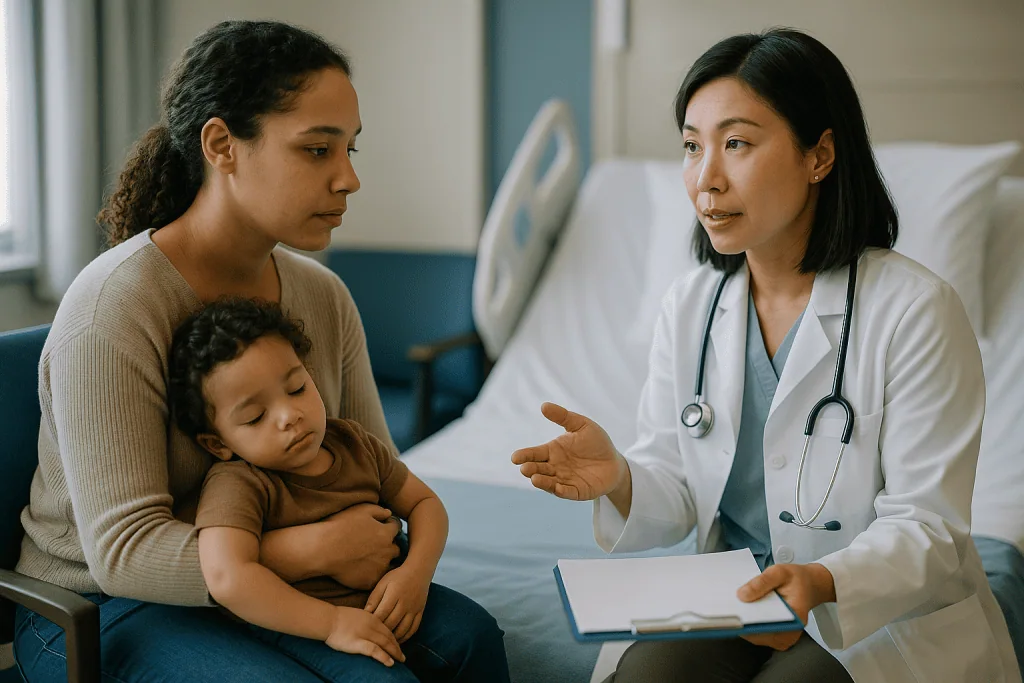
Children who typically go home with a written plan and little else are those with a simple febrile seizure, a clear and benign source of fever such as an ear infection or a recognizable virus, a normal neurological examination, and an age comfortably inside the usual window. For this group, the NIH advises against routine EEG (a recording of the brain’s electrical activity), blood tests, or brain imaging, because they rarely change management.
Children who are usually asked to stay longer or undergo more tests include:
- Infants under 12 months, in whom the classic signs of meningitis can be subtle; a lumbar puncture, which samples spinal fluid, may be recommended.
- Any child with a complex febrile seizure, especially a prolonged or focal one.
- Children who are not fully vaccinated or who were recently taking antibiotics, which can mask a serious infection.
- Children who remain unusually drowsy, irritable, or stiff-necked after recovery.
Parents often arrive wanting a scan. Being told their child does not need one can feel like being brushed off. It is the opposite: imaging carries its own risks in a toddler, including sedation, and has no role when the examination is normal. If your child falls into the second group, the extra testing is proportionate, not a verdict.
Febrile seizure first aid: what to do in the moment, step by step
The first-aid routine for a febrile seizure is short enough to memorize and important enough to rehearse. The NHS and Mayo Clinic describe essentially the same sequence.
- Note the time. Glance at a clock or start your phone’s stopwatch; your sense of time during a seizure is unreliable.
- Get the child safe. Lay them on their side on a soft, flat surface, away from furniture edges and hard objects. On their side, saliva or vomit drains out rather than in.
- Do not restrain the movements and do not put anything in the mouth. A child cannot swallow their tongue; a finger or spoon can break teeth or block the airway.
- Loosen tight clothing around the neck and stay with them.
- Call emergency services if the seizure lasts longer than five minutes, if breathing looks labored, if the child is injured, if a second seizure starts, or if they do not begin to come round afterward.
Once it stops, keep the child on their side in the recovery position, speak softly, and let them sleep if they want to. If a second adult is present, a short phone video is genuinely useful to the clinician later; one-sided movements or unusual eye deviation are easy to miss in the panic.
Two things are commonly done and should not be: putting the child in a bath to cool them, which risks drowning in a seizing or drowsy child, and shaking them to wake them. After a first-ever febrile seizure, arrange same-day medical assessment even if it was brief, because the cause of the fever needs checking. After a known pattern of simple seizures, your care team will have told you whether every episode needs a visit.
The caregiver briefing: one page every adult in your child's life should hold
The single most useful object in a febrile-seizure household is a sheet of paper. Not a pamphlet, not a saved web page: one printed page, taped inside a kitchen cupboard, folded in the nursery bag, and photographed onto every grandparent’s phone.
What goes on it, in large type and in this order:
- Your child’s name, date of birth, and the sentence ‘has had febrile seizures; this is expected and usually harmless.’
- The four actions: time it, side-lying on the floor, nothing in the mouth, stay with them.
- The call-for-help triggers, with the number for emergency services written out, not assumed.
- Your numbers and the pediatrician’s number.
- Any allergies, and, if a rescue medicine has been prescribed, where it is kept and which adults have been shown how to use it by the clinician.
Then brief in person. Reading a sheet is not the same as hearing a parent say, ‘It will look terrifying, it will probably stop within a couple of minutes, and here is exactly what I need you to do.’ Ask the caregiver to repeat the steps back. Many grandparents were raised with the advice to hold a child down or put a spoon between the teeth; correct that gently and specifically.
Childcare settings usually have a seizure policy. Give them the sheet, ask what their staff ratio means in practice, and confirm who would ride with your child if an ambulance were called. Babysitters deserve the same five-minute conversation before you leave, plus permission to call you about anything, including a fever that has not yet produced a seizure.
A briefing shrinks the unknown. Caregivers who know the plan tend to act, and children recover in calmer rooms.
Calm fever routines that help, and the ones that quietly make things worse
Once a child has had a febrile seizure, every fever becomes a loaded event. A good routine takes the edge off by giving you things to do that are actually useful.
Start with the premise the NHS and Mayo Clinic both emphasize: fever is the body’s response to infection, not the illness itself, and the goal of home care is comfort, not a number. A child who is drinking, playing in short bursts, and sleeping is managing well, whatever the thermometer says.
What helps:
- Fluids little and often: breast milk or formula for infants, water or diluted juice for older toddlers.
- Light clothing and a room that is comfortable rather than cold; overheating with blankets is a common mistake.
- Rest, cuddles, and low light. Screens are fine; this is not the day for rules.
- Checking temperature a few times a day for your own records, not hourly, which feeds anxiety without changing decisions.
What does not help, and can harm: tepid sponging, cold baths, or a fan aimed at the child. The NHS specifically advises against undressing or sponging down a feverish child to cool them; shivering can raise core temperature, and a bath is a drowning risk if a seizure begins. A feverish child should never be left in water, even shallow water, even for a moment.
Night one is the hard one. Many families keep the child in the parents’ room or use a monitor, and that is reasonable. Agree with your partner who is ‘on’ so that one of you actually sleeps. Keep the briefing sheet and phone by the bed. Then let the illness run its course; the fever will break when the infection does, and most febrile seizures do not repeat within the same illness.
Do fever medicines prevent febrile seizures? What the evidence actually shows
This is the question parents most want a yes to, and the honest answer is no. The NIH’s neurological institute and Mayo Clinic both state that fever-reducing medicines do not prevent febrile seizures, and controlled studies have not shown that giving them around the clock lowers the chance of a seizure during a fever.
The mechanism explains why. Acetaminophen (paracetamol) and ibuprofen lower fever by dampening prostaglandin signaling in the hypothalamus, the brain’s thermostat, which resets the body’s target temperature downward over an hour or so. They act on the peak, not on the speed of the rise, and the seizure is often triggered early, sometimes before the fever is even noticed. Lowering a temperature that has already peaked does not undo the trigger.
Where these medicines do earn their place is comfort: a miserable, achy child who will not drink may drink after the fever eases. Whether, when, and how to give them is a decision for your child’s clinician, and the leaflet or prescriber’s instructions govern how much; alternating products on a schedule to ‘protect’ against seizures has no supporting evidence and increases the risk of dosing errors. Aspirin is not used in children because of its link to Reye’s syndrome, a rare but serious condition affecting the liver and brain.
Separately, some children with prolonged or clustered febrile seizures are prescribed a rescue medicine from the benzodiazepine class, given by a caregiver at home to stop a seizure that will not stop on its own. These drugs boost GABA, the brain’s main calming neurotransmitter, and typically work within minutes. Daily anti-seizure medication is generally not recommended for simple febrile seizures, because side effects outweigh benefit for a condition that resolves with age. Every such decision sits with the prescribing clinician.
What the following days and weeks usually look like
The hours after a febrile seizure are mostly about sleep. Children are often clingy, off their food, and sleepier than usual for the rest of the day; Mayo Clinic describes this post-seizure drowsiness as part of normal recovery. Most are recognizably themselves by the next morning, with the ordinary grumpiness of a feverish toddler.
Day two and three belong to the infection. The fever typically rises and falls as the virus or ear infection runs its course, and each rise can feel like a countdown. Keep your written record going: time of each temperature check, fluids taken, wet diapers, and any unusual behavior. A second seizure during the same illness is possible but not the usual pattern; if it happens within 24 hours of the first, that reclassifies the episode as complex, and your care team will want to know.
Follow-up usually means a routine visit with your child’s pediatrician once the illness has settled. Expect a check of development, a conversation about family history, and a frank discussion of recurrence. If the seizure was complex, prolonged, or focal, a referral to a pediatric neurologist may be arranged, and an EEG may be scheduled in the weeks that follow; for a simple seizure, this is generally not needed.
Return to childcare follows the illness, not the seizure: when the fever has been gone for a day and the child is eating and drinking, most settings will welcome them back, with the briefing sheet on file.
The weeks after are mostly about you. Hypervigilance usually peaks around the next cold and softens with each fever that passes without incident. Many parents say the second uneventful fever did more for their nerves than any conversation.
Febrile seizure recurrence risk, epilepsy, and whether children grow out of it
Three questions arrive together at the follow-up visit, so here they are together.
Will it happen again? For about one child in three, yes, according to the NHS and the NIH. The risk is higher when the first seizure happened before 15 months of age, when there is a family history of febrile seizures, when the fever was relatively low at the time, or when the seizure came within an hour or so of the fever starting, as Mayo Clinic lists. A child with none of these features has a lower chance; a child with several has a higher one. Recurrences tend to cluster in the year or two after the first episode.
Can you grow out of it? Almost always. The susceptibility is tied to the immature brain, and febrile seizures stop by around age 5 to 6 in nearly all children, per NHS guidance. A child who seizes with fevers at 14 months and again at two and a half may never have another, simply because the brain has matured past the window.
Can febrile seizures cause epilepsy? The seizures themselves do not injure the brain, and the NIH notes they do not affect intelligence or learning. Most children who have febrile seizures never develop epilepsy, a condition of recurrent seizures without fever. The lifetime risk is slightly higher than in children who never had a febrile seizure, and higher again after a complex seizure, with a family history of epilepsy, or when a child already has a developmental or neurological condition. For a child with simple febrile seizures and none of those factors, the difference from the general population is small. Your pediatrician can place your child on that spectrum better than any average can.
Coping with febrile seizures: parents' own recovery and the rest of the household
Parents are reliably told their child will be fine, and reliably, nobody asks how the parents are. Yet the most common thing mothers and fathers say afterward is some version of ‘I thought I was watching my child die.’ Intrusive replays of the scene, jumpiness at every cough, waking at night to check breathing, and checking the thermometer far more often than any clinical reason requires are all ordinary responses to an abnormal event.
Two things shorten that phase. The first is understanding, which is why this article spends so long on mechanism: fear feeds on blanks, and a parent who knows the seizure lasted 90 seconds, ended on its own, and left no mark has fewer blanks. The second is the plan. Studies of parental coping consistently find that families with a written seizure plan and trained caregivers report less anxiety than those relying on memory and luck.
Partners often diverge: one wants a scan, the other wants to stop talking about it. Neither is wrong, and a joint appointment with the pediatrician to ask the questions out loud, together, is a reasonable use of a visit.
Siblings who witnessed the seizure deserve a simple, truthful script: ‘Her brain got too hot for a minute and her body shook. It stopped by itself. It is not catching, and it is nobody’s fault.’ Older children can be given a job, such as fetching the phone, which converts helplessness into a role.
If, weeks later, you are still not sleeping, avoiding leaving the house, or unable to let anyone else care for your child, say so to your own doctor. Caregiver distress is treatable, and treating it is part of caring for the child.
What people often get wrong about febrile seizures
Folk wisdom about seizures is old, widespread, and in several cases dangerous. Here are the corrections most worth passing along to every caregiver.
‘Put something in the mouth so they don’t swallow the tongue.’ Anatomically impossible; the tongue is anchored. Objects in the mouth cause broken teeth, bitten fingers, and blocked airways. Side-lying protects the airway far better.
‘Hold them still.’ Restraint does not shorten a seizure and can cause injury to the child or the adult. Clear the space and let it pass.
‘A cold bath will stop it.’ It will not, and a seizing or post-seizure child in water is at risk of drowning. The NHS advises against sponging or bathing to cool a feverish child at all.
‘Round-the-clock fever medicine prevents the next one.’ The evidence says otherwise, as the NIH and Mayo Clinic note. Use these medicines for comfort as your clinician advises, not as a shield.
‘Only very high fevers cause seizures.’ Many occur at moderate temperatures and early in an illness. A low reading is not a guarantee.
‘It means epilepsy.’ Most children with febrile seizures never develop epilepsy, and simple febrile seizures do not damage the brain.
‘It must be meningitis.’ A clinician will check for that, which is why the first seizure warrants same-day assessment, but the overwhelming majority of febrile seizures accompany ordinary viral infections.
‘Skip the vaccines to avoid it.’ Vaccine-associated febrile seizures are rare, and the infections vaccines prevent, including measles and influenza, are themselves common seizure triggers. The CDC does not consider a previous febrile seizure a reason to avoid routine immunization; discuss timing with your pediatrician.
‘We caused it by not acting fast enough.’ No. The seizure usually begins before anyone could have intervened, and nothing you could have done would have prevented it.
Questions to ask your care team before the next fever
Appointments after a febrile seizure are short and emotionally loaded, so arrive with a list. These are the questions that change what you do at home, grouped so you can skip the ones already answered.
About this episode:
- Was this a simple or a complex febrile seizure, and which feature made it so?
- Did you find the cause of the fever, and is any treatment needed for it?
- Is there anything in the examination that you want to recheck, and when?
About the future:
- Given my child’s age, family history, and this seizure, where do they sit on the recurrence spectrum?
- Does my child need a referral, an EEG, or any imaging, and if not, why not?
- Does my child’s history justify a rescue medicine for prolonged seizures? If so, who will teach us and the other caregivers to use it, and what written plan comes with it?
About daily life:
- When a fever starts, what do you want us to do, and what do you not want us to do?
- Which future seizures need a same-day visit, which need a call, and which can simply be recorded?
- Can my child continue routine vaccinations on schedule, and should any be timed differently?
- Is it safe for my child to swim or bathe as usual, and what supervision do you advise during a fever?
About us:
- Can you review our one-page caregiver briefing so that it reflects your advice?
- Who do we contact if we are struggling with anxiety about this?
Write the answers down in the appointment, not afterward. The point of the list is to leave with a plan your care team has endorsed, so that the next fever is managed by agreement rather than by instinct at 2 a.m.
When to call your doctor: red flags during and after a febrile seizure
Most febrile seizures need calm first aid and a same-day check of the fever’s cause. A smaller number need an ambulance. Knowing which is which is the heart of coping well.
Call emergency services immediately if:
- The seizure lasts longer than five minutes, or you are unsure how long it has lasted.
- A second seizure begins before the child has fully recovered from the first.
- Breathing is difficult, noisy, or the lips and face stay blue or gray after the shaking stops.
- The child is injured during the seizure, or the seizure happened in water.
- The child does not begin to rouse within a reasonable time afterward, or is unusually floppy, stiff, or unresponsive.
- You see a rash that does not fade when a glass is pressed against it, a stiff neck, a bulging soft spot on an infant’s head, repeated vomiting, or extreme drowsiness; these can signal meningitis or another serious infection, as the NHS lists.
Seek same-day medical assessment, by urgent care or your pediatrician, for any first-ever febrile seizure regardless of length; for a seizure in a child under 6 months or over 6 years; for a seizure that involved only one side of the body; for weakness in a limb afterward; or for signs of dehydration such as very few wet diapers.
Call your child’s regular doctor within a day or two when a child with known simple febrile seizures has another short, typical one and has recovered fully, when a fever persists beyond what you were told to expect, or when you simply want the plan reviewed.
Every decision about testing, referral, medication, and follow-up belongs to the clinicians who examine your child. A parent’s job during a febrile seizure is narrower and just as vital: keep the child safe, keep time, and know when to pick up the phone.
Frequently asked questions
Can you grow out of a febrile seizure?
Yes. Febrile seizures are tied to the immature, more excitable brain of early childhood, and the NHS and NIH report that they stop by around age 5 to 6 in nearly all children. A child may have one at 14 months and another at two, then never again, because the brain has simply matured past the susceptible window.
What are silent seizures?
‘Silent seizures’ usually refers to absence seizures, brief staring spells lasting a few seconds in which a child stops, stares blankly, and then resumes without noticing. They are a form of epilepsy, occur without fever, and are a different condition from febrile seizures. If you notice repeated unexplained staring or lapses, mention it to your pediatrician for evaluation.
Why do some kids get febrile seizures?
Three factors combine: a young brain that sits closer to its seizure threshold, an inherited tendency that runs in families, and a common infection that produces fever, such as roseola, influenza, or an ear infection. Speed of temperature rise appears to matter as much as the peak, which is why seizures often occur early in an illness before the fever is noticed.
What are the characteristics of complex febrile convulsions?
A febrile seizure is classified as complex if it has any one of three features: it lasts 15 minutes or longer, it involves only one side or one part of the body, or it happens more than once within 24 hours. Complex seizures prompt closer follow-up and sometimes further tests, and they carry a somewhat higher chance of later epilepsy than simple ones.
Does my child need the emergency room after every febrile seizure?
After a first-ever febrile seizure, same-day medical assessment is advised to find the cause of the fever, even if the episode was brief. Emergency services are needed if a seizure lasts over five minutes, repeats, or involves breathing difficulty or injury. For a child with a known pattern of short simple seizures, your care team will tell you which episodes require a visit and which can be reported by phone.
What is the febrile seizure recurrence risk after a first one?
About one child in three has at least one more, according to the NHS and NIH. Recurrence is more likely when the first seizure occurred before 15 months of age, when there is a family history of febrile seizures, when the fever was relatively low at the time, or when the seizure came very soon after the fever began. Most recurrences happen within a year or two.
Can febrile seizures cause epilepsy?
Febrile seizures do not injure the brain, and most children who have them never develop epilepsy. The lifetime risk is slightly higher than in children who never had one, and higher after a complex seizure, with a family history of epilepsy, or when a developmental condition is present. For a child with simple febrile seizures and none of those factors, the added risk is small.
Is a tepid bath good febrile seizure first aid?
No. Cold or tepid water does not stop a seizure and places a seizing or drowsy child at risk of drowning, and the NHS advises against sponging or bathing to cool a feverish child at all. Correct first aid is to note the time, lay the child on their side on a soft surface, put nothing in the mouth, stay with them, and call emergency services if it passes five minutes.
Should I give fever medicine around the clock to prevent a seizure?
Scheduled fever-reducing medicine has not been shown to prevent febrile seizures, as both the NIH and Mayo Clinic note. These medicines act on the fever’s peak, not the rapid rise that typically triggers the seizure. They remain useful for comfort when your child’s clinician advises them; how and when to use them is a decision for the prescriber, following the product instructions.
Can my child still get vaccinations after a febrile seizure?
In general, yes. Febrile seizures after vaccination are uncommon and result from the fever response, not the vaccine itself, and the CDC does not consider a previous febrile seizure a reason to skip routine immunization. The infections vaccines prevent, including measles and influenza, are themselves common seizure triggers. Discuss timing with your pediatrician, who may adjust the schedule for your child.
References
- NHS: Febrile seizures
- MedlinePlus: Febrile seizures
- NIH NINDS: Febrile Seizures
- Cleveland Clinic: Febrile Seizures
This article is for general information only and is not a substitute for professional medical advice. Please consult a qualified doctor about your individual situation.

More from the Blog
What Happens in a Sensory Integration Therapy Session? Swings, Textures and Guided Play
A sensory integration therapy session is a structured, play-based occupational therapy visit, typically lasting about an hour, in which a trained therapist guides a…
Phototherapy for Newborn Jaundice: What Happens Under the Lights and How Feeding Continues
Phototherapy treats newborn jaundice by shining blue-green light onto the baby's skin. The light changes bilirubin, the yellow pigment that builds up when an…

When Can a Child Bathe, Play and Return to School After Pediatric Surgery? Recovery Milestones
Most children can shower or bathe once the surgical team says the wound may get wet, often within one to two days of a…

Why Are Repeat Echocardiograms Scheduled After Kawasaki Disease and What Do They Track?
Repeat echocardiograms after Kawasaki disease track the coronary arteries, the vessels that supply the heart muscle, because inflammation can stretch them into aneurysms during…
Tongue Tie in Babies: What It Looks Like, Feeding, Speech and Whether It Grows Back
Tongue tie (ankyloglossia) is a condition present from birth in which the thin band of tissue under the tongue, called the lingual frenulum, is…

Questions Parents Can Ask Before Congenital Correction Surgery for a Heart Defect
Before congenital heart surgery, parents can ask the care team to name and draw the exact defect, explain why this operation and why now,…