

Menopause Face: How Falling Estrogen Changes Skin, Fat and Bone, and the Options
Key Takeaways
- Skin biopsy studies suggest roughly 30 percent of skin collagen is lost in the first five years after menopause, then about 1 to 2 percent a year, though the figure comes from small samples measured on the forearm, not the face.
- Daily broad-spectrum sunscreen reduced measurable skin aging by about 24 percent over four and a half years in a randomized trial of adults in their 40s and 50s, making it the best-evidenced habit for menopausal skin.
- Midface fat compartments deflate while lower-face fat holds or descends, so weight loss can make menopause-related hollowing look worse rather than better.
- Women can lose up to about 20 percent of bone density in the five to seven years after menopause, and imaging shows facial bone recedes too, which is why rapid facial change is a reason to ask about DXA screening.
- The November 2025 removal of the US boxed warning on menopausal hormone therapy did not add appearance to its approved uses; indications remain symptom relief and bone protection, decided with a prescribing clinician.
- Persistent facial puffiness with fatigue, weight gain or feeling cold is a reason to request a thyroid blood test, since underactive thyroid becomes more common in women over 50.
Menopause face is an informal term for the visible facial changes that follow falling estrogen: thinner, drier skin with less collagen, shrinking fat pads in the cheeks and temples, some fat settling toward the jawline, and slow thinning of facial bone. Daily sunscreen, retinoids and moisturizers have the strongest evidence for skin. Hormone therapy is prescribed for menopause symptoms, not appearance, and any treatment plan belongs with your clinician.
A reader described the moment precisely: a video call, a slow glance at her own thumbnail, and the odd feeling of not quite recognizing the woman in the corner. Same eyes, same smile. Something about the cheeks had moved. She was 52.
That small jolt now has a name. As of early 2026, the phrase “menopause face” is climbing search charts, pushed along by a wave of social videos comparing before-and-after selfies, by influencers selling face creams said to contain estrogen, and by a November 2025 US regulatory decision to remove the boxed warning from most menopausal hormone therapy labels, which sent millions of people back to their doctors with questions.
Some of what circulates is accurate. A fair amount is not. What follows is what the medical evidence supports about how falling estrogen reshapes skin, fat and bone, how strong that evidence is, and which options are worth a conversation with a clinician.
Does your face change with menopause? What is really happening underneath
Yes, and the changes are structural rather than cosmetic. Think of the face as three stacked layers: skin on top, fat pads in the middle, bone at the base. Estrogen, the main female sex hormone produced by the ovaries, supports all three. When ovarian estrogen output falls, each layer responds on its own timetable.
The skin layer thins because estrogen normally stimulates fibroblasts, the cells that build collagen (the protein that gives skin firmness) and elastin (the protein that lets it spring back). Estrogen also helps the skin hold water by supporting hyaluronic acid, a sugar-like molecule that binds moisture in the dermis, the skin’s thicker middle layer. Less estrogen means less of each.
The fat layer shifts. Deep fat compartments over the cheekbones and around the temples deflate, while fat is more likely to gather lower on the face and under the chin. The result is a face that looks less “lifted” even when body weight has not changed much.
The bone layer recedes. Facial bones remodel throughout life, and imaging studies of older adults show the eye sockets widening and the upper jaw retreating slightly. Bone loss accelerates in the years around menopause, so the scaffolding that holds fat and skin in place quietly shrinks.
None of this happens overnight, and none of it happens in isolation from ordinary aging. The honest picture, supported by observational data from groups such as the NHS and Mayo Clinic, is that menopause speeds up processes that were already under way, most visibly in the first five to ten years after the final period.
What changed recently: why menopause face is trending now
Three developments explain the surge in searches, and dating them matters because some of the viral content mixes them up.

First, the World Health Organization updated its menopause fact sheet in October 2024, stating plainly that menopause is a natural life stage affecting roughly a billion women worldwide by 2030 and calling for better access to information and care. That framing, menopause as a health-system priority rather than a private embarrassment, has given mainstream permission to talk about symptoms once treated as vanity, including facial change.
Second, in November 2025 the US Food and Drug Administration announced the removal of the boxed warning that had sat on most systemic menopausal hormone therapy products since the early 2000s. The label change did not create new evidence about skin or appearance. It reflected a reassessment of risk data for symptom treatment in healthy women within about ten years of menopause. Social media quickly linked the two ideas anyway, and “hormone therapy for menopause face” became a common query.
Third, a wave of creator videos in 2025 popularized the phrase itself, often alongside estrogen-containing face creams marketed as anti-aging. In the US, no topical estrogen product is approved for cosmetic use on the face. Vaginal estrogen products exist and are prescribed for genitourinary symptoms; applying them elsewhere is off-label and untested for appearance, and decisions about any hormonal product belong with a prescribing clinician.
Current NHS guidance on hormone replacement therapy, the UK term for menopausal hormone therapy, continues to list its purposes as relief of hot flashes, night sweats, mood and sleep disturbance, vaginal dryness and protection against bone thinning. Appearance is not on that list, and that has not changed.
Estrogen, collagen and the famous 30 percent figure
One number appears in almost every article on this topic: women lose about 30 percent of skin collagen in the first five years after menopause, then roughly 1 to 2 percent a year afterward. It is worth knowing where that comes from.
The estimate traces to small skin-biopsy studies from the 1980s and 1990s that measured collagen in the forearm and thigh, not the face, in a few dozen women. Later work using ultrasound to measure skin thickness broadly agreed that postmenopausal skin is thinner and that thickness correlates with years since menopause rather than age alone. So the direction of the finding is solid; the precise percentage is an approximation from limited samples.
What the biology supports with more confidence is the mechanism. Fibroblasts carry estrogen receptors. Stimulated, they produce type I and type III collagen and slow the enzymes that break collagen down. Deprived of estrogen, production falls and breakdown continues, so the net balance tips toward loss. Studies also show reduced sebum, the natural oil made by skin glands, which is why dryness and a sudden intolerance of products that used to be fine are among the earliest menopause skin changes women report.
Wound healing slows in parallel. Small trials in older adults show slower closure of minor skin wounds when estrogen is low, and faster closure when it is replaced, one reason dermatologists take longer recovery from procedures into account after menopause.
Two practical implications follow. Skin that has lost collagen does not respond well to aggressive scrubbing or frequent exfoliation, which many people try first. And the fastest window of change is early, which is exactly when protecting existing collagen from sun damage pays off most.
Where the facial fat goes, and where it turns up
The face has more than a dozen distinct fat compartments, discovered through anatomical dissection studies in the 2000s. They do not age together. Deep compartments in the midface, the ones that sit over the cheekbones and give a youthful fullness beneath the eyes, tend to lose volume first. Superficial compartments lower on the face are more likely to hold or gain fat and to slide downward as the ligaments that anchor them loosen.

Estrogen influences this pattern in two ways. It affects where the body stores fat, favoring hips and thighs during reproductive years; after menopause the pattern shifts toward the abdomen and upper body, a change documented consistently in observational cohorts. And it supports the connective tissue that keeps fat compartments in place.
Body weight itself is a separate story, and a common source of confusion. Longitudinal data from midlife cohorts show women gain on average about 1.5 pounds a year through their 40s and 50s, and Mayo Clinic notes this gain is driven mostly by aging, reduced muscle mass and lifestyle rather than by menopause directly. Menopause changes where fat goes more than how much there is.
On the face, the combination produces a recognizable pattern: hollowing under the eyes and at the temples, flattening of the cheeks, deeper folds from nose to mouth, and softening along the jawline. People often describe it as the face “falling” when in fact the upper structure has deflated.
This matters for treatment choices. Skin care cannot restore volume. Weight loss can make midface hollowing more pronounced. And approaches that add volume, discussed later, address a different layer than approaches that improve skin texture.
Facial bone also changes after menopause
Bone is the layer people forget, and the one with the clearest link to menopause. The skeleton is constantly remodeled: cells called osteoclasts remove old bone while osteoblasts lay down new bone. Estrogen restrains the osteoclasts. When it falls, removal outpaces rebuilding. Cleveland Clinic and the NIH note that women can lose up to about 20 percent of their bone density in the five to seven years after menopause, which is why osteoporosis, a condition of fragile, porous bone, becomes far more common after 50.
The facial skeleton follows the same rules, though at a slower and less well-studied pace. Computed tomography studies comparing younger and older adults show measurable changes: the bony rim of the eye socket enlarges, especially at the upper inner and lower outer corners; the maxilla, the upper jaw beneath the cheekbones, tilts backward; and the lower jaw loses height, particularly when teeth are missing. These are cross-sectional observational data, comparing different people at different ages rather than following one group over time, so they describe an association rather than proving a menopause-specific cause.
Still, the practical consequences are visible. A wider eye socket makes the eyes look more hollow and the lower lids longer. A retreating maxilla removes support under the cheeks and deepens the nasolabial folds. A shorter jaw lets soft tissue drape lower.
The face is also a reminder that bone health is systemic. Anyone noticing rapid facial change in the years after menopause has, at minimum, a reason to ask about overall bone density. US guidance recommends bone density screening with a DXA scan, a low-dose X-ray that measures bone mineral, for all women at 65 and earlier for those with risk factors such as early menopause, long-term steroid use, low body weight or a parent who fractured a hip. That is a screening decision to make with a clinician, not a self-diagnosis.
Menopause puffy face: why it happens and what genuinely helps
Alongside the hollowing, many women describe the opposite complaint: a face that looks swollen in the morning, especially under the eyes and along the jaw. Both can be true on the same face, and the puffiness usually has different causes.
Hormone fluctuation itself contributes. During perimenopause, estrogen and progesterone swing unpredictably, and fluid retention that once tracked the menstrual cycle can become erratic. Sleep disruption from night sweats promotes fluid pooling in the face because lying flat for broken, shallow sleep gives lymphatic drainage, the slow system that clears fluid from tissues, less chance to work. Alcohol, high sodium intake and seasonal allergies each add to the effect, and all three are common in midlife.
Skin thinning plays a part too. When the skin under the eyes loses collagen and fat, even normal amounts of fluid show more.
The measures with the most support are unglamorous and mostly rated as expert opinion rather than trial-proven: sleeping with the head slightly raised, limiting alcohol in the evening, reducing added salt, staying hydrated, treating allergies, and applying a cool compress for a few minutes on waking. Lymphatic facial massage is popular; small studies suggest temporary reduction in swelling, with no evidence of lasting structural change.
The more useful step is to rule out other causes. Persistent facial puffiness, particularly with fatigue, weight gain, feeling cold or a hoarse voice, can signal an underactive thyroid, which becomes more common in women over 50 and is diagnosed with a simple blood test. Some medicines, including corticosteroids and certain blood pressure drugs, cause facial fullness. Kidney and heart conditions can too. None of these should be self-managed with creams, and the “when to see a doctor” section below lists the warning signs.
What age is considered premenopausal, and when do perimenopause face changes start?
The terms trip people up, so here is the sequence. Premenopause covers the reproductive years before any menopausal transition begins: regular cycles, ovaries producing estrogen in a predictable rhythm. There is no fixed age; a woman of 38 with regular periods is premenopausal, and so is one of 47 in the same situation.
Perimenopause is the transition. Cleveland Clinic describes it as typically starting in the mid-40s, sometimes the late 30s, and lasting an average of about four years, though anywhere from a few months to a decade is normal. Cycles become irregular, hormone levels fluctuate rather than simply falling, and symptoms such as hot flashes, sleep disturbance and mood changes appear.
Menopause is a single point: twelve consecutive months without a period, not caused by another condition. The average age in the US and UK is 51; the NHS puts the usual range at 45 to 55. Menopause before 45 is termed early, and before 40 premature; both carry higher long-term risks to bone and heart, and specialist input is standard.
Postmenopause is everything after. Estrogen settles at a low, stable level, and this is when the collagen loss described earlier is fastest.
Facial changes follow that timeline loosely. During perimenopause, the most common complaints are dryness, new sensitivity, adult acne along the jaw driven by the shifting balance of estrogen and androgens (male-type hormones that women also produce), and fluctuating puffiness. In the first years after menopause, thinning, loss of firmness and midface deflation become more noticeable. Bone-related change is the slowest, unfolding over decades. Knowing which phase you are in helps set realistic expectations and makes conversations with a clinician more precise.
What the evidence actually says, graded
A trend explainer earns its keep by separating strong evidence from plausible speculation. Here is how the main claims about menopause face grade out, using the ordinary hierarchy in which randomized controlled trials outrank observational studies, which outrank expert opinion.
Strong (randomized trials): Daily broad-spectrum sunscreen slows visible skin aging. An Australian randomized trial of about 900 adults found those assigned to daily sunscreen showed roughly 24 percent less photoaging over four and a half years than those using it at their discretion. Prescription retinoids, vitamin A derivatives applied to the skin, improve fine wrinkles, roughness and pigmentation in multiple placebo-controlled trials lasting six months or longer, with a well-documented irritation trade-off.
Moderate (small trials and consistent observational data): Postmenopausal skin is thinner and has less collagen than premenopausal skin, with change tracking years since menopause. Systemic estrogen therapy increases skin thickness and collagen in small trials; whether that translates into a visible difference in wrinkles is unclear, and one year-long placebo-controlled trial found no meaningful improvement in facial aging scores.
Moderate to weak: Fat compartment deflation and facial bone recession are documented by imaging in cross-sectional studies. They describe aging populations, and menopause-specific causation is inferred rather than demonstrated.
Weak (expert opinion, mechanism, marketing): Oral collagen supplements, facial massage devices, estrogen face creams and most “menopause skincare” lines. Some small manufacturer-funded trials of collagen peptides report modest hydration gains; independent replication is thin.
An opinion, grounded in that grading: the interventions with the best evidence are also the least exciting, and they work by protecting what remains rather than restoring what is gone. That is the honest ceiling for skin care, and knowing it prevents a great deal of disappointment and expense.
Menopause skin changes and your options at a glance
The table below maps the main changes to the layer involved, the strength of the evidence behind common options, and who to talk with. It is a summary, not a treatment plan; every row ends with a clinician for good reason.
| Change | Layer | Options with the best evidence | Evidence grade | Who to consult |
|---|---|---|---|---|
| Dryness, sensitivity | Skin | Fragrance-free moisturizers with humectants and ceramides; gentle cleansing | Moderate | Pharmacist, dermatologist |
| Fine lines, rough texture, pigment | Skin | Daily broad-spectrum sunscreen; prescription retinoids | Strong | Dermatologist |
| Adult acne along jaw | Skin | Prescription topical or oral treatments chosen by a clinician | Moderate to strong | Dermatologist |
| Midface hollowing, jowls | Fat | Injectable fillers; energy-based tightening devices | Moderate (short-term); weak (long-term) | Board-certified dermatologist or plastic surgeon |
| Puffiness | Fluid / skin | Sleep position, alcohol and salt reduction, allergy treatment; rule out thyroid and medication causes | Weak (expert opinion) for measures; strong for testing causes | Primary care |
| Bone recession | Bone | Systemic bone health: calcium and vitamin D adequacy, resistance exercise, DXA screening when indicated | Strong for systemic bone; weak for facial appearance | Primary care, menopause specialist |
| Overall thinning and collagen loss | Skin | Systemic hormone therapy prescribed for menopause symptoms may increase skin thickness as a side benefit | Moderate for thickness; weak for visible wrinkles | Prescribing clinician |
Two patterns stand out. Skin-layer problems have the most trial-tested tools, and they are largely protective. Fat and bone changes have fewer evidence-based fixes, and the ones that exist are procedural or systemic. Matching the option to the layer avoids the common mistake of buying a serum for a volume problem.
Skin care that holds up in trials: sunscreen, retinoids, moisturizers
Three categories have real data behind them, and each works for a specific reason.
Sunscreen is first because ultraviolet light destroys collagen through the same enzymes that estrogen loss unleashes. After menopause, the skin has less collagen to spare and less capacity to rebuild, so the same afternoon of sun does proportionally more damage. The randomized evidence for daily use is unusually clean for a skin-care product, and the effect was seen in adults in their 40s and 50s, exactly the menopausal age band. Broad-spectrum protection, applied every morning regardless of weather, is the single highest-yield habit on this list.
Retinoids are next. Prescription forms have decades of placebo-controlled trials showing thicker epidermis, new collagen formation in the dermis and reduced fine wrinkling after several months. The over-the-counter relative, retinol, is weaker and less studied but shows similar effects at a slower pace. The catch is irritation, and menopausal skin is already dry and reactive, so dermatologists typically start low and slow. Prescription strength requires a clinician, and pregnancy or planned pregnancy rules retinoids out, which matters for women in perimenopause who may still conceive.
Moisturizers are the workhorse. Products built around humectants, ingredients such as glycerin and hyaluronic acid that draw water into the skin, plus ceramides, the lipids that seal the outer layer, measurably reduce water loss and improve the skin barrier in short trials. They do not add collagen. They make thin skin more comfortable and less reactive, which is a genuine quality-of-life gain.
Everything else in the skin-care aisle sits below these three on the evidence ladder. Peptides, growth factors, plant estrogens called phytoestrogens, and vitamin C serums have mechanisms and small studies, not robust trials. They are not harmful for most people, but they should not displace the basics.
Does hormone therapy help menopause face?
This is the question the trend keeps circling, so it deserves a careful answer.
Systemic menopausal hormone therapy, estrogen taken as a tablet, patch, gel or spray, usually with a progestogen for women who have a uterus, is prescribed to treat hot flashes, night sweats, sleep and mood disturbance and genitourinary symptoms, and to prevent bone loss in women at risk. Those are the indications listed by the NHS and Mayo Clinic. Appearance is not among them.
What the skin evidence shows: small randomized and observational studies find that women on systemic estrogen have thicker skin and more dermal collagen than untreated peers, with the effect most evident when treatment begins within a few years of menopause. That is a moderate-quality finding about tissue measurements. Whether faces look different is much less certain; a year-long placebo-controlled trial of hormone therapy in women some years past menopause found no significant difference in wrinkle or firmness scores. Nobody has run a large trial with facial appearance as the primary outcome, and none is likely.
Fat and bone: hormone therapy reliably slows systemic bone loss, which plausibly benefits the facial skeleton over time, though this has not been measured directly. It does not reverse fat compartment deflation.
The November 2025 US label change removed a boxed warning; it did not alter who the therapy is for. Risks and benefits still depend on age, time since menopause, personal and family history of breast cancer, clots, stroke and heart disease, and the type and route of hormone. A woman troubled by hot flashes who also hopes her skin benefits is having a legitimate conversation. A woman without symptoms seeking hormone therapy for her face is asking for off-label use, and that decision, and any decision to start, stop or change a prescribed medicine, rests with her prescribing clinician after a full risk discussion.
Estrogen creams marketed for the face fall outside any approval. Their absorption, effect and safety on facial skin are untested, and they are not appropriate for self-use.
In-office treatments: what dermatologists can offer and how strong the evidence is
Because skin care cannot replace lost fat or bone, procedures are the main route for people who want visible change in those layers. The evidence is real but shorter-term and less rigorous than for medicines, and results depend heavily on the operator.
Injectable fillers, most commonly made from hyaluronic acid, restore volume to deflated compartments such as the cheeks and temples. Controlled trials against no treatment show clear improvement in volume scores lasting roughly six to eighteen months depending on product and site. Their logic fits the biology: they compensate for exactly the midface deflation that estrogen loss accelerates. Risks include bruising, lumps, asymmetry and, rarely, vascular injury, which is why they should be performed by a physician trained in facial anatomy.
Energy-based devices, including fractional lasers, radiofrequency and ultrasound tightening, aim to stimulate new collagen by controlled injury. Small trials and before-and-after series show modest improvement in texture and mild laxity; head-to-head comparisons are scarce, and results in thin, low-collagen skin can be more variable. Microneedling, which creates tiny controlled punctures, has similar moderate-to-weak evidence for texture with a good safety record.
Neuromodulator injections that relax muscles soften expression lines but do nothing for volume or bone.
Surgical lifts reposition sagging tissue and remain the most durable option for significant laxity; they do not restore lost volume on their own, which is why surgeons increasingly combine them with fat grafting.
What the evidence does not support is any procedure marketed as a “menopause facelift” or as hormonally restorative. The physiology of menopausal skin, slower healing, thinner tissue, more bruising, argues for conservative settings and a practitioner who asks about hormone status, medications and bone health before proposing anything.
Common myths about menopause face
Viral content has produced a handful of claims that need correcting.
“It is a medical condition.” It is not a diagnosis. The phrase describes a cluster of ordinary changes accelerated by estrogen decline. No test confirms it, and no treatment is approved for it.
“Estrogen face cream reverses it.” No topical estrogen product is approved for facial use in the US, and there are no adequate trials of estrogen applied to the face for appearance. Vaginal estrogen prescribed for genitourinary symptoms should be used only as directed by the prescriber.
“Hormone therapy is now approved as anti-aging.” The 2025 US label change removed a boxed warning. Indications remain menopause symptoms and bone protection. Appearance was never added.
“Collagen supplements rebuild facial collagen.” Swallowed collagen is digested into amino acids like any protein. Some small, often industry-funded trials report modest hydration improvements; independent evidence that supplements restore facial structure does not exist.
“Losing weight fixes menopause face.” Weight loss often worsens midface hollowing because it removes the remaining deep fat. Body weight and facial volume are related but not the same problem.
“Facial exercises rebuild fat and bone.” One small study suggested facial exercises may slightly improve cheek fullness through muscle, not fat. Bone does not respond to facial exercise in any demonstrated way.
“It happens to everyone the same way.” Genetics, skin tone, sun history, smoking and body composition produce enormous variation. Darker skin, with more melanin, shows photoaging later; smokers show collagen loss earlier.
The pattern behind these myths is a real observation attached to an exaggerated fix. Recognizing the observation while declining the fix is the useful skill.
When to see a doctor
Most menopause-related facial change is gradual and does not need medical attention on its own. Some patterns do, either because they signal something other than menopause or because they indicate treatment side effects. Make an appointment, or seek urgent care where noted, for any of the following.
- Sudden facial swelling, especially with lip or tongue swelling, hives, wheezing or difficulty breathing: this may be an allergic reaction or angioedema and needs emergency care immediately.
- Swelling on one side only, or swelling with pain, redness, warmth or fever, which can indicate infection, a dental abscess or a salivary gland problem.
- Persistent puffiness with fatigue, unexplained weight gain, feeling cold, constipation or hair thinning, a combination that warrants thyroid testing.
- Facial fullness after starting a new medicine, particularly corticosteroids; do not stop the medicine yourself, but tell the prescriber.
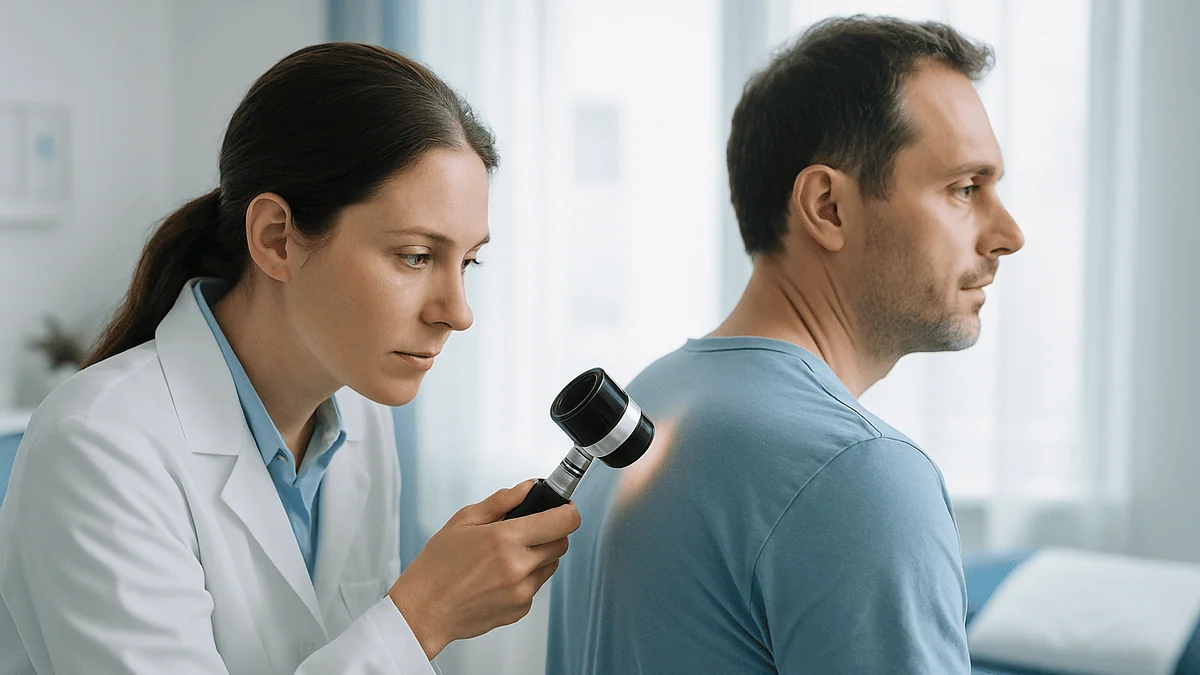
- A new mole, a spot that changes, bleeds or fails to heal within a few weeks, or a rough scaly patch that persists: skin cancer risk rises with cumulative sun exposure and age, and menopausal skin heals more slowly, so any non-healing lesion should be examined.
- Severe or scarring acne, or acne with excess facial hair growth and irregular periods, which may point to a hormonal condition needing assessment.
- Rapid change in facial appearance over weeks rather than years, or facial change alongside a height loss, back pain or a fracture from a minor fall, which raises the question of osteoporosis.
- Menopause symptoms before age 45, since early and premature menopause carry higher bone and heart risks and standard care involves specialist review.
- Any question about starting, adjusting or stopping hormone therapy or a prescription skin treatment: these decisions, including whether an off-label use is reasonable in your case, belong with the prescribing clinician, who can weigh your personal history.
If none of these applies and the concern is appearance alone, a board-certified dermatologist is the right first conversation. Bring a list of what you already use; menopausal skin is often over-treated, and simplifying is frequently the first recommendation.
Frequently asked questions
How to get rid of menopause face?
There is no single fix, because the changes involve three layers. Skin thinning and dryness respond to daily sunscreen, retinoids under a dermatologist’s guidance and barrier-repair moisturizers, all with trial evidence. Fat loss and bone recession do not respond to skin care; fillers and other procedures can address volume for months to a year or more. Hormone therapy is prescribed for menopause symptoms, not appearance, and any medicine decision rests with your clinician.
Does your face change with menopause?
Yes. Falling estrogen reduces collagen and skin moisture, deflates deep fat pads in the cheeks and temples, shifts fat toward the jawline and accelerates bone loss, including in the facial skeleton. Observational studies consistently show thinner skin in postmenopausal women, with change tracking years since the final period. The pace varies widely with genetics, sun exposure, smoking and skin tone, so no two faces change the same way.
How do I get rid of my menopause puffy face?
Start by ruling out causes other than menopause: an underactive thyroid, allergies and certain medicines all cause facial puffiness and are treatable once identified. If those are excluded, measures with expert-opinion support include sleeping with the head slightly raised, limiting evening alcohol and added salt, staying hydrated and using a cool compress in the morning. Sudden swelling, one-sided swelling or swelling with breathing difficulty needs urgent medical care.
What age is considered premenopausal?
Premenopausal refers to any age before the menopausal transition begins, when periods are regular and ovarian hormones follow a predictable cycle. There is no fixed cutoff. Perimenopause, the transition, usually starts in the mid-40s but can begin in the late 30s and lasts about four years on average. Menopause itself is confirmed after twelve months without a period, at an average age of 51 in the US and UK.
What are the first perimenopause face changes?
The earliest complaints are usually dryness, new sensitivity to products that were previously fine, adult acne along the jawline driven by the shifting balance of estrogen and androgens, and puffiness that no longer follows the menstrual cycle. Loss of firmness and midface hollowing tend to become noticeable in the first years after the final period, when estrogen has settled at a low, stable level and collagen loss is fastest.
Does hormone therapy reverse menopause face?
Not in any proven way. Small trials show systemic estrogen therapy increases skin thickness and collagen, but a year-long placebo-controlled trial found no meaningful difference in facial wrinkling scores. Hormone therapy does slow bone loss, which may benefit the facial skeleton over time, and it does not restore lost fat. It is prescribed for menopause symptoms and bone protection; using it for appearance is off-label and a decision for the prescribing clinician.
Do collagen supplements help menopause skin changes?
The evidence is weak. Swallowed collagen is broken down into amino acids like any protein, and while a few small, often industry-funded trials report modest improvements in skin hydration, independent studies showing rebuilt facial collagen do not exist. Adequate dietary protein matters for skin and muscle, but no supplement has been shown to restore facial structure. Sunscreen and retinoids have far stronger evidence for the same goal.
Why does menopause cause acne on the jawline?
During perimenopause estrogen falls faster than androgens, the male-type hormones women also produce, so the balance tips toward androgen effects on oil glands, particularly along the jaw and chin. The result is adult acne even in women who never had it as teenagers, often alongside dry skin elsewhere. Persistent or scarring acne, or acne with new facial hair and irregular periods, should be assessed by a clinician for hormonal causes.
Do facial bones really thin after menopause?
Imaging studies comparing younger and older adults show the eye sockets widen, the upper jaw tilts back and the lower jaw loses height with age, and menopause accelerates bone loss throughout the skeleton. These facial studies are cross-sectional, so they show association rather than menopause-specific cause. Rapid facial change, height loss or a fracture from a minor fall are reasons to ask a clinician about bone density screening.
How long do menopause skin changes continue?
Collagen loss is fastest in the first five years after the final period and then slows to roughly 1 to 2 percent a year, continuing indefinitely alongside ordinary aging. Fat redistribution and bone remodeling unfold over decades. The early window is when protecting existing collagen from sun damage pays off most, which is why dermatologists emphasize daily sunscreen from perimenopause onward rather than waiting for visible change.
References
- NHS: Menopause
- NHS: Hormone replacement therapy (HRT)
- Cleveland Clinic: Perimenopause
- World Health Organization: Menopause fact sheet
This article is for general information only and is not a substitute for professional medical advice. Please consult a qualified doctor about your individual situation.

More from the Blog
HRT and Breast Cancer Risk: What the Latest Evidence and the Updated Labeling Actually Say
Current evidence shows that systemic combined HRT (estrogen plus a progestogen) is linked to a small increase in breast cancer diagnoses that grows with…

Menopause Joint Pain: The Estrogen Connection Doctors Are Now Naming
Menopause joint pain is common: aching, stiff joints, often worst in the morning, that begin or worsen as estrogen declines in perimenopause and menopause.…

Testosterone Pellets vs Gels vs Injections: How the Delivery Method Changes Levels and Risks
Testosterone pellets, gels and injections deliver the same hormone but produce different blood-level patterns. Pellets implanted under the skin release testosterone steadily for months…

TRT Side Effects: Fertility, Blood Counts, Prostate and Heart: What Men Should Know Before Starting
The most common TRT side effects are a raised red blood cell count, acne, breast tenderness, fluid retention, worsened sleep apnea and suppressed sperm…
HRT Patches vs Tablets vs Gels: How the Route Changes Absorption and Risk
HRT patches and gels deliver estradiol through the skin, bypassing the liver, while tablets pass through the gut and liver first. Large observational studies…

Testosterone for Women: What It Is Prescribed For, What the Evidence Supports and What It Does Not
Testosterone for women is prescribed almost exclusively for one reason: low sexual desire that causes personal distress after menopause, once other causes have been…