

Mesotherapy Aftercare: Makeup, Saunas, Workouts and the Small Bumps That Settle in Days

Key Takeaways
- The raised bumps after mesotherapy are pockets of injected fluid in the dermis, and their flattening over hours to a couple of days is the tissue absorbing it, not a sign of failure.
- Heat is the aftercare factor most worth respecting: saunas, steam and hot baths widen already-leaky vessels and reliably add swelling and bruising, which is why a 48- to 72-hour pause is the common advice.
- Makeup is usually held back until the puncture channels have sealed, typically the rest of the treatment day, because applicators and fingers carry bacteria that intact skin would otherwise block.
- Bruises follow their own clock, with MedlinePlus describing color changes over days and full fading within about two weeks, so a small mark at day ten is ordinary even when everything else has settled.
- Never stop or adjust a prescribed blood thinner to reduce cosmetic bruising; that decision belongs to the prescriber, and the treatment should adapt to the medicine rather than the reverse.
- Spreading hot redness, fever, widespread hives, facial swelling or breathing difficulty are not normal aftercare and need same-day or emergency assessment, as described in NHS cellulitis and Mayo Clinic anaphylaxis guidance.
Mesotherapy aftercare usually means keeping the injected skin clean and untouched for the rest of the day, skipping makeup until the tiny puncture points have closed, and postponing saunas, hot baths, intense workouts, alcohol and direct sun for roughly two to three days. Small raised bumps at the injection sites typically flatten within hours to a few days; your practitioner's written instructions take priority over any general timeline.
The mirror in the treatment room is unforgiving. You lean in, tilt your chin, and there they are: a neat grid of pinhead bumps across each cheek, faintly pink, like the skin has been lightly stippled. You have a dinner tonight, a spin class booked for tomorrow, a sauna membership you actually use. And the nurse has just handed you a leaflet that says, in bold, no makeup.
That leaflet is the heart of mesotherapy aftercare, and it deserves a more honest explanation than most people get. Some of its rules rest on solid skin biology. Others are cautious habits handed down between practitioners with very little research behind them. Knowing which is which lets you follow the advice intelligently rather than anxiously.
So this is the long version: what is happening under those bumps, why heat and sweat are the two things most worth postponing, when foundation is reasonable again, and the handful of signs that should send you back to your care team rather than to the internet.
What mesotherapy actually does to your skin, and why aftercare follows from it
Mesotherapy is a cosmetic technique in which many small injections deliver a mixture of ingredients into the middle layer of the skin, the dermis, or just beneath it. The dermis is the living layer under the surface that holds collagen, blood vessels and the cells that repair damage. Facial mesotherapy mixtures commonly contain hyaluronic acid, a water-binding sugar molecule the body already makes, sometimes alongside vitamins, amino acids or other compounds chosen by the practitioner.
Two things happen at once. The needle creates a shallow wound, dozens or hundreds of them, each one a channel that briefly opens the skin’s barrier. And a small volume of fluid is deposited in tissue that was not expecting it, which is what you see as a raised bump, sometimes called a papule or wheal. That bump is not the product failing to absorb. It is simply liquid sitting in a tight space until the surrounding tissue takes it up.
Nearly every aftercare rule follows from those two facts. Open channels mean a route for bacteria, so the skin is kept clean and nothing is layered on top of it. Fresh injury means the vessels are leaky and inflamed, so anything that widens blood vessels further, such as heat, alcohol or a hard workout, is likely to add swelling and bruising. Deposited fluid means pressure and rubbing can shift or irritate it before it settles.
The NHS guidance on non-surgical cosmetic procedures describes the same pattern for comparable injectable treatments: temporary redness, swelling and bruising that usually settle over days, with a small risk of infection or an unwanted reaction. Mesotherapy aftercare is essentially the discipline of not making any of those three worse while the skin closes.
Who mesotherapy is usually for, and who is usually asked to wait
People who ask about facial mesotherapy are usually looking for a change in skin texture or hydration rather than a change in shape. That is a useful distinction. Dermal fillers, which the NHS describes as injections used to add volume to lips or cheeks or to fill lines, work by placing a gel where it can physically lift tissue. Mesotherapy places a thinner solution more superficially and broadly, and any effect is on the quality of the skin itself.

Practitioners commonly consider mesotherapy for adults with generally healthy skin who have realistic expectations and no active problems in the treatment area. A consultation should include a health history, a look at current medicines, and a frank conversation about what the evidence does and does not support.
Certain situations usually lead to a pause or a no. Active skin infection, a cold sore, acne flare or rash in the area is the clearest, because injecting through inflamed or infected skin risks spreading it deeper. Pregnancy and breastfeeding are usually excluded because safety data for injected cosmetic mixtures in these groups is lacking, not because harm has been shown. A known allergy to any component of the mixture rules that mixture out. People taking prescribed blood-thinning medicines, or with bleeding disorders, bruise more readily and need an individual decision, and that decision belongs to the prescriber, never to the injector alone. Uncontrolled diabetes, immune suppression and a history of keloid scarring are also common reasons to wait or reconsider.
None of this is a judgment about the person. It is a recognition that the procedure works by creating many tiny wounds, and some bodies heal those wounds less predictably. A reputable practitioner will be more interested in reasons to postpone than in reasons to proceed.
Mesotherapy recovery time: what the first few hours usually look like
Walk out of the room and the skin will look busier than when you walked in. Expect uniform pinkness, a scattering of raised bumps that map the injection pattern, and perhaps a few pinpoint dots of dried blood. Some people describe a warm, tight feeling, a bit like mild sunburn. Others feel almost nothing beyond the visual.
The bumps are the part that alarms people, so it helps to know what they are doing. Each one is a small pocket of fluid in the dermis. Over the following hours the tissue absorbs the water content and the raised profile softens. With very superficial injections this can happen within an hour or two; with slightly deeper placement or a thicker mixture, the bumps may persist into the next morning. Neither is a sign of a problem in itself. What matters is the direction of travel: bumps that are steadily flattening are behaving as expected.
Redness usually fades over the same period, though fair or reactive skin can stay pink into day two. Pinpoint bleeding stops within minutes. Small bruises, if they appear, tend to show up later that day or the next as the leaked blood settles under the surface.
What you do in these hours matters more than what you do on day four. The puncture channels are closing, and the fluid is still mobile. Practitioners generally ask you to keep your hands off your face, to skip washing with anything other than a gentle cleanser until later that day or the next morning, and to sleep on your back if you can manage it so the pillow does not press on one side. The NHS notes that side effects from comparable injectables usually resolve within days; the first evening is when you set that trajectory.
Mesotherapy side effects: bumps, bruising and what counts as normal
Three things account for almost all of the ordinary aftermath: bumps, bruises and redness. Each has a mechanism, and each has a typical arc.
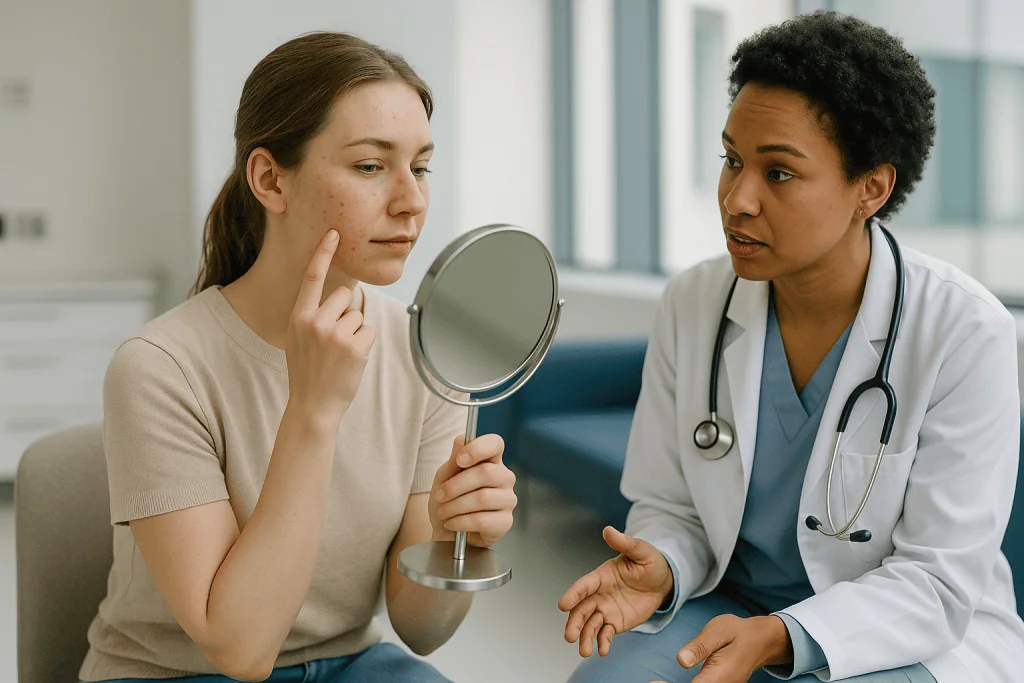
Bumps, covered above, are trapped fluid and usually settle within hours to a couple of days. A bump that is firmer than its neighbors, or that persists beyond the rest, is more likely a tiny bruise beneath the surface or a small pocket of product that has not dispersed; it generally softens with time and should be mentioned at follow-up rather than massaged at home.
Bruising happens when a needle nicks a small vessel and blood leaks into the tissue. MedlinePlus explains the color changes, from red or purple through green and yellow, as the body breaks down the leaked blood, a process that generally takes up to about two weeks. Most mesotherapy bruises are small and fade well before that. Bruising is more likely in people who take anticoagulants (medicines that slow clotting), anti-inflammatory painkillers, or supplements such as fish oil, vitamin E or ginkgo, and in people who drank alcohol shortly before treatment. Never stop a prescribed medicine on your own to reduce bruising; raise it with the prescriber well before the appointment.
Redness reflects widened blood vessels responding to injury. It is usually diffuse and even. Redness that spreads outward from one spot, becomes hot to the touch, or arrives with pain that is increasing rather than fading is a different story, discussed in the red-flag section below.
Less common effects include itching as the skin heals, temporary darkening of the skin at injection points, especially in deeper skin tones, and, rarely, small lumps that persist for weeks. Allergic reactions to a component of the mixture are uncommon but possible, which is why practitioners ask so carefully about prior reactions. If something does not look like the three ordinary effects, that is precisely what the follow-up contact number is for.
Can I wear makeup after mesotherapy? The honest answer
The short answer is: not yet, and the reason is bacteria, not vanity. Foundation, concealer and powder are applied with sponges, brushes and fingers that carry ordinary skin flora, and even a fresh product is not sterile. Pressing that onto skin studded with open puncture channels gives microbes a direct route into the dermis that intact skin would normally block.
How long those channels stay open depends on the depth of the injections and on your skin, but for shallow dermal punctures the surface typically seals within hours. This is why the most common advice is to leave the skin bare for the rest of the treatment day and to apply makeup, if you must, from the following morning. Some practitioners prefer a full 24 hours. There is no clinical trial that has tested a 12-hour rule against a 24-hour one; the window is expert consensus built on wound biology and on the infection precautions the NHS describes for injectable procedures generally. Follow the specific instruction you were given, because your practitioner knows how deep they went.
When you do return to makeup, a few habits reduce risk further. Wash your hands first. Use clean brushes or, better, a fresh disposable applicator. Mineral or non-comedogenic formulas are gentler than heavy, fragranced ones. Apply lightly rather than working product in with pressure. Remove it at night with a mild cleanser and lukewarm water rather than scrubbing pads or wipes soaked in alcohol.
Tinted sunscreen deserves a special mention because it solves two problems at once: it offers some cover, and the treated skin needs sun protection anyway. Ask whether your practitioner is happy for you to use one on the morning after treatment. Many are, provided the skin has stopped weeping and there are no open spots.
Saunas, steam rooms and hot baths: why heat is the thing most worth postponing
If you can only follow one aftercare rule, make it this one. Heat is the single factor most likely to turn a mild, tidy recovery into a puffy, blotchy one.
The mechanism is simple. Warmth causes blood vessels to widen, a process called vasodilation, which the body uses to shed heat through the skin. In freshly injected skin the vessels are already dilated and slightly leaky from the injury. Add a sauna and you push more fluid into tissue that is trying to drain it, which means more swelling, and you increase pressure in small vessels that may already have been nicked, which means more bruising. Sweat pooling on skin with open channels is also a minor infection concern in the first day.
Steam rooms add humidity, which softens the surface and slows sealing. Hot yoga combines heat with exertion, which is discussed in the next section. Very hot showers and long soaks in a hot bath do the same thing at lower intensity; a brief, lukewarm shower is generally fine from the evening of treatment, with the face kept out of the direct stream.
How long to wait? The typical advice is 48 to 72 hours, and again this is a consensus range rather than a trial result. It lines up with the period during which the NHS notes swelling and redness from comparable injectables are usually settling. If your skin is still visibly pink or bumpy at day three, waiting until it looks calm costs you nothing. If you have a strong sauna habit, it is worth booking treatment for a day when skipping a few sessions is easy.
Cold, by contrast, is generally welcome. A clean cool compress, not ice pressed directly on the skin, can take the edge off warmth and swelling in the first hours if your practitioner agrees.
Workouts after mesotherapy: sweat, blood flow and realistic timing
Exercise raises heart rate, widens blood vessels in the skin and produces sweat. All three are excellent for the body in general and unhelpful for a face that was injected a few hours ago, for the same reasons heat is. Increased skin blood flow can worsen swelling and encourage bruising at nicked vessels; sweat sitting on open channels is an avoidable irritant and a minor infection risk; and the instinct to wipe your face with a towel or the back of your hand is exactly the rubbing you have been asked to avoid.
The common advice is to skip strenuous exercise for 24 to 48 hours. Gentle movement is different: a walk, light stretching or unhurried housework does not meaningfully raise skin temperature and is fine from the day of treatment. What counts as strenuous is anything that leaves you flushed and sweating: running, cycling classes, heavy lifting, hot yoga and contact sports, which add the risk of a knock to the treated area.
Swimming deserves its own caution. Pool water is treated but not sterile, and chlorine is drying and irritating to healing skin. Sea and lake water carry their own bacteria. Most practitioners ask for a similar 48-hour pause, and longer if any spots are still open or crusted. Goggles and swim caps also press exactly where facial treatments are placed.
When you return, the first session is a good time to be deliberate: clean towel, no shared mats against your face, a gentle rinse afterwards rather than a scalding shower. If your skin looks angrier after that first workout than before it, that is your body telling you the tissue was not quite ready; let it settle and give it another day. The NHS framework of temporary side effects resolving over days is the useful reference point here rather than a fixed hour count.
What to avoid after mesotherapy beyond heat and sweat
Heat and exercise get the headlines, but a handful of everyday habits deserve a short pause too.
Sun is the most important. Freshly injured skin is more prone to lasting darkening, called post-inflammatory hyperpigmentation, especially in medium and deeper skin tones. Direct sun in the first days raises that risk and adds heat. Shade, a hat and, once the skin has sealed, a broad-spectrum sunscreen are the practical answers. Tanning beds fall under the same rule and are best avoided entirely.
Alcohol widens blood vessels and mildly impairs clotting, which is why practitioners often ask people to avoid it the evening before and for a day or two after. It is a bruising and swelling issue rather than a safety emergency.
Active skincare needs a rest. Retinoids, exfoliating acids such as glycolic or salicylic acid, vitamin C serums and physical scrubs all irritate a barrier that has just been punctured. Most practitioners suggest pausing them for several days and reintroducing one at a time. A bland moisturizer and a gentle cleanser are the whole routine for the first stretch.
Touching, picking and massaging are tempting, particularly when bumps are visible. Leave them. Pressure can shift fluid unevenly and fingers carry bacteria.
Other facial treatments, including peels, lasers, microneedling and dental work involving the face, are usually spaced apart by a couple of weeks so that one healing process is not stacked on another. Ask your practitioner how they prefer to sequence anything else you have planned.
Medicines are the one area where you should not act alone. Over-the-counter anti-inflammatory painkillers and some supplements increase bruising, and people sometimes stop them or, worse, stop a prescribed blood thinner to look better sooner. Do not. Any change to a prescribed medicine is a conversation with the prescriber, ideally before the appointment is booked.
Mesotherapy aftercare timeline: the first two weeks at a glance
Timelines vary with injection depth, skin type and the mixture used, so treat the ranges below as typical rather than promised. Where a figure has evidence behind it, the source is noted; where it is practitioner consensus, that is said plainly.
| Window | What the skin is usually doing | What is commonly advised | Basis |
|---|---|---|---|
| First 6 to 12 hours | Bumps visible, pinkness, puncture channels sealing | No makeup, no touching, gentle cleanser only, cool compress if approved | Wound biology; practitioner consensus |
| Day 1 | Bumps largely flattened, redness fading, any bruises appearing | Light makeup often permitted, sunscreen, no strenuous exercise | NHS: side effects of injectables settle over days |
| Days 2 to 3 | Skin calm in most people; residual pink in reactive skin | Heat, saunas, swimming and hard workouts usually cleared after this point if skin looks settled | Practitioner consensus aligned with NHS timeline |
| Days 4 to 7 | Bruises changing color; skin feels normal | Gradual return of active skincare, one product at a time | MedlinePlus: bruise color changes over days |
| Up to 2 weeks | Bruises fully faded in most people | Follow-up review; other facial treatments usually spaced after this | MedlinePlus: bruises generally fade within about two weeks |
Two things are worth reading off that table. First, the strictest rules cluster in the first day, and the rest is a gradual loosening. Second, the longest column is bruising, not bumps: MedlinePlus describes bruises as taking up to about two weeks to clear, which is why a small mark near the jaw at day ten is unremarkable even when everything else looks finished.
The table is not a substitute for the instructions you were given. If your practitioner asked for a longer pause on anything, they had a reason specific to your skin or your session.
Washing, sleeping and the small habits that quietly matter
Most aftercare failures are not dramatic. They are the unconscious things: the hand that props up a chin, the face buried in a pillow, the hot flannel out of habit.
Washing can resume the evening of treatment or the next morning, depending on your instructions, using lukewarm water and a fragrance-free cleanser applied with fingertips rather than a cloth. Pat dry with a clean towel; do not rub. Skip the scrubbing brush entirely for a few days. If any spot has a fine crust, leave it to lift on its own.
Sleep position matters more than people expect. Lying face-down or on one side presses the pillow onto treated skin for hours, which can increase swelling on that side and, in the first night, transfer bacteria from the pillowcase into channels that may not have fully sealed. Sleeping on your back for a night or two, with a fresh pillowcase, is the low-effort fix. An extra pillow to raise the head slightly may reduce morning puffiness, a practical tip rather than a proven one.
Phones and glasses are the forgotten culprits. A phone screen pressed against a cheek is warm and rarely clean; a speakerphone or earphones for the first day sidesteps it. Glasses rest on the bridge of the nose and cheeks, exactly where many facial treatments sit; wipe the pads and wear them lightly.
Hands are the constant. Every itch, every check in the mirror, every distracted chin-rest is contact with skin flora. Clean hands before any deliberate touch, and try to make the touches deliberate.
Hydration and sleep help every kind of healing, and there is nothing specific about mesotherapy that changes that. What is specific is the compounding effect of small habits over a short window: get the first 24 hours right and the rest of the fortnight tends to look after itself.
Does mesotherapy work? What the evidence actually shows
An honest aftercare guide has to say something about the treatment it is protecting, and the honest statement is this: the evidence for facial mesotherapy is thin. The published literature, searchable through PubMed, consists largely of small studies, case series and expert opinion, with few well-designed randomized trials, no standardized mixture, and outcomes that are often subjective. That does not mean it does nothing. It means that confident claims about lasting glow, collagen rebuilding or fat reduction are ahead of what has been demonstrated.
Hyaluronic acid, the most common ingredient, illustrates the gap. Harvard Health notes that hyaluronic acid binds large amounts of water and that injected forms have established roles as dermal fillers, while evidence for many marketed uses is more limited. Placing a dilute solution superficially is a different proposition from placing a structured gel to add volume, and the two should not be assumed to behave alike.
Fat-reduction mesotherapy, sometimes marketed for the chin or body, has a separate and more cautionary history. Mixtures have varied widely, some ingredients have been associated with nodules and skin reactions, and regulators in several countries have flagged unapproved formulations. If someone offers you mesotherapy for fat, the questions about what exactly is in the syringe become more urgent, not less.
Alternatives with more established evidence exist for most goals people bring to mesotherapy. For hydration and texture, consistent sunscreen, topical retinoids and moisturizers have decades of data. For volume, hyaluronic acid fillers have a defined regulatory pathway. For fine lines from muscle movement, botulinum toxin injections are well studied. None of this is a recommendation; it is context for a conversation with your treating team about what you are trying to achieve and which route has the evidence to match.
What people often get wrong about mesotherapy aftercare
“The bumps mean the product did not go in properly.” The opposite. Bumps show that fluid was placed in the dermis, where it was intended to go. Flattening over hours is the tissue absorbing it. A treatment that leaves no bumps at all was probably injected more deeply, which is a different technique rather than a better one.
“Massaging the bumps helps them settle.” Massage moves fluid unpredictably, irritates a fresh barrier and introduces bacteria from the fingers. Unless your practitioner specifically asked you to massage, leave the skin alone.
“A quick sauna will sweat out the swelling.” Heat widens vessels and pushes more fluid into tissue that is trying to drain. Sauna in the first two days is the most reliable way to look worse on day three.
“Antibacterial wipes are safer than water.” Many wipes contain alcohol or fragrance that sting and dry healing skin. Clean hands, lukewarm water and a mild cleanser do the job without the irritation.
“If it bruises, I should stop my blood thinner next time.” Never. Anticoagulants are prescribed to prevent clots that can be life-threatening. Bruising from a cosmetic treatment is cosmetic. Any adjustment is the prescriber’s decision, and most will say the treatment should adapt to the medicine, not the other way around.
“More aftercare means better results.” Aftercare protects against complications; it does not amplify a treatment’s effect. Piling on serums, masks and devices in the first week adds irritation without adding benefit.
“Downtime means I can’t go to work.” For most people the visible changes are pinkness and pinpoint bumps that settle within a day. Planning a quiet evening is sensible; planning a week off is usually unnecessary, though people with reactive skin or a tendency to bruise may want a buffer before an important event.
Questions to ask your care team before and after mesotherapy
The most useful aftercare conversation happens before the needle, and the NHS advice on non-surgical cosmetic procedures is a good frame: check the practitioner’s training and registration, ask what they would do if something went wrong, and make sure you know how to reach them afterwards. Beyond that, these questions tend to surface the information that matters.
- What exactly is in the mixture you plan to use, and is each ingredient licensed for injection in this country?
- How deep will the injections be, and how does that change the aftercare you will give me?
- Which of my current medicines or supplements could increase bruising, and should I speak to my prescriber before we book?
- What is your specific rule on makeup, saunas, exercise and swimming for my skin, and why?
- What does a normal reaction look like at 12 hours, 48 hours and one week, and what would make you want to see me sooner?
- How do I contact you or a covering clinician out of hours if something worries me?
- What is your plan if I have an allergic reaction or an infection?
- How many sessions do you usually suggest, and what happens if I decide not to continue?
- What evidence do you rely on for this treatment, and what are the alternatives for what I am trying to achieve?
At the follow-up, bring your questions again. Point to any spot that felt different from the rest, mention any bruise that is still changing, and ask whether what you experienced was typical for their patients. A practitioner who welcomes those questions is usually one whose aftercare advice is worth following closely. Every decision about whether to treat, retreat or stop rests with you and the treating team together, not with a leaflet or an article.
When to call your doctor: red flags after mesotherapy
Most recoveries are uneventful. A few are not, and the difference between a small problem and a large one is often how quickly someone picks up the phone. Keep the practitioner’s contact details to hand for the first two weeks, and know the general signs that need a clinician.
Infection. Ordinary redness is even and fades. Redness that spreads outward, skin that is hot, swollen, tight or increasingly painful, yellow discharge, or fever and chills are the features the NHS describes for cellulitis, a bacterial infection of the deeper skin layers. Cellulitis needs prompt medical assessment, usually the same day, because it can progress.
Allergic reaction. Widespread hives, itching well beyond the treated area, or swelling of the lips, eyelids or tongue should be reported urgently. Difficulty breathing, wheeze, a tight throat, dizziness, a racing heart or feeling faint are features of anaphylaxis, a severe whole-body reaction described by Mayo Clinic; these need emergency services immediately, not a message to the clinic.
Skin changes that do not fit. A patch that turns dusky, purple, white or blotchy in a pattern, especially with pain out of proportion to what you can see, could indicate a vessel problem and needs same-day review. Blisters, skin breakdown or an area that feels numb also warrant a call.
Lumps that behave badly. Bumps that flatten over days are normal. A lump that is enlarging, hardening, hot or painful after the first few days should be seen.
Anything that is getting worse rather than better after 48 hours. The expected direction is steady improvement. Reversal is the simplest red flag of all.
If you cannot reach the practitioner, contact your regular doctor or an urgent care service and tell them exactly what was injected and when. Bring any paperwork listing the mixture. You are not overreacting by asking; you are giving a clinician the chance to act early.
Frequently asked questions
Can I wear makeup after mesotherapy the same day?
Most practitioners ask you to leave the skin bare for the rest of the treatment day, because the tiny puncture channels are still sealing and makeup applicators carry bacteria. Light makeup with clean tools is commonly permitted from the next morning, though some clinicians prefer a full 24 hours. Follow the instruction you were given, since injection depth affects how quickly the surface closes.
How long is mesotherapy recovery time before my skin looks normal?
For most people the visible bumps flatten within hours and pinkness fades within a day, in line with the NHS description of injectable side effects settling over days. Small bruises can take longer, with MedlinePlus noting bruises generally fade within about two weeks. Reactive or fair skin may stay pink into day two. Anything worsening after 48 hours should be reported.
What should I avoid after mesotherapy in the first 48 hours?
Heat is the priority: saunas, steam rooms, hot baths and hot yoga widen blood vessels and increase swelling and bruising. Strenuous exercise, swimming, direct sun, alcohol, active skincare such as retinoids and acids, and touching or massaging the area are also commonly paused. Gentle walking, lukewarm washing and a bland moisturizer are generally fine.
Are mesotherapy side effects like bumps and redness normal?
Yes, small uniform bumps at each injection point, even pinkness and occasional pinpoint bleeding are the expected immediate effects of placing fluid into the dermis through a needle. They usually settle within hours to a couple of days. Bumps that enlarge, harden or become painful after the first few days, or redness that spreads and feels hot, are not typical and need review.
When can I use a sauna after mesotherapy?
The common advice is to wait 48 to 72 hours, and to extend that if the skin still looks pink or bumpy. This is practitioner consensus rather than a trial-based figure; it reflects the period in which swelling and redness from comparable injectables are usually resolving. Heat widens vessels and pushes fluid into healing tissue, so patience here directly reduces puffiness.
Can I exercise the day after mesotherapy?
Light activity such as walking is fine from the day of treatment. Workouts that leave you flushed and sweating are usually postponed for 24 to 48 hours because increased skin blood flow can worsen swelling and bruising, and sweat on freshly punctured skin is an irritant. If your skin looks angrier after your first session back, give it another day before trying again.
Why do I bruise after mesotherapy and how long do bruises last?
Bruises appear when a needle nicks a small vessel and blood leaks into the tissue. MedlinePlus describes them changing color from purple through green to yellow as the body clears the blood, generally within about two weeks. Blood-thinning medicines, anti-inflammatory painkillers, certain supplements and recent alcohol increase the chance. Never stop a prescribed medicine to reduce bruising; speak to the prescriber instead.
Can I sleep on my side after mesotherapy?
Sleeping on your back for the first night or two is usually recommended. Side or face-down sleeping presses the pillow onto treated skin for hours, which can increase swelling on that side and transfer bacteria from the pillowcase before channels have fully sealed. A fresh pillowcase and an extra pillow to raise the head slightly are simple, low-risk measures.
What are the signs of infection after mesotherapy?
Redness that spreads outward rather than fading, skin that is hot, swollen, tight or increasingly painful, yellow discharge, and fever or chills are the features the NHS lists for cellulitis, a bacterial infection of deeper skin layers. Normal post-treatment redness is even and improves daily. Suspected infection needs same-day medical assessment, not a wait-and-see approach.
Does mesotherapy actually work, and does aftercare improve the result?
The evidence for facial mesotherapy is limited, consisting mostly of small studies and expert opinion rather than large randomized trials, so confident claims about outcomes are ahead of the data. Aftercare does not amplify the effect; it protects against complications such as infection, excess bruising and pigment changes. Discuss the evidence and alternatives with your treating team before deciding.
References
- NHS: Non-surgical cosmetic procedures
- MedlinePlus: Bruises
- NHS: Cellulitis
- NIH PubMed: Published research on mesotherapy
This article is for general information only and is not a substitute for professional medical advice. Please consult a qualified doctor about your individual situation.

More from the Blog

Who Is a Candidate for Cryoablation of a Kidney Tumor? What Your Team Looks At
The usual cryoablation kidney tumor candidates are adults with a small kidney mass, generally about 3 cm or less and confined to the kidney,…
How Vascular Laser Treatment Targets Hemoglobin to Close Spider Veins and Port-Wine Stains
Vascular lasers work by emitting light at wavelengths that hemoglobin, the red pigment in blood, absorbs far more strongly than the surrounding skin. The…

Masseter Botox Results: When Clenching Eases, When the Jawline Changes and What Fades First
After botulinum toxin is injected into the masseter, the main jaw-clenching muscle, the relaxing effect usually begins within a few days and is fully…

Cryoablation vs Surgery for Selected Prostate Tumors: How Specialists Weigh the Options
Cryoablation freezes prostate tissue through thin needles guided by ultrasound, while surgery (radical prostatectomy) removes the whole gland. Specialists usually consider cryoablation for selected…

Hand Rejuvenation Results: How Long Volume and Texture Improvements Tend to Last
Hand rejuvenation results are temporary and vary by method. Hyaluronic acid fillers used to restore volume on the backs of the hands generally last…
What a Microdermabrasion Session Involves: Crystals or Diamond Tip, Suction and Timing
A microdermabrasion procedure uses either a stream of fine crystals or a diamond-coated wand, combined with gentle vacuum suction, to lift away the outermost…