

Microdermabrasion Side Effects: Normal Tightness vs Irritation That Should Be Reported
Key Takeaways
- Microdermabrasion removes only the stratum corneum, the dead outermost sub-layer of the epidermis, which is why it causes tightness and pinkness rather than open wounds or scabbing.
- Cleveland Clinic describes expected redness, mild swelling and tenderness as settling within a few hours to a day or two; symptoms that worsen after day one are the ones to report.
- Spreading redness, warmth, increasing pain, oozing or crusting together are the typical presentation of a skin infection on thinned skin and warrant a same-day call.
- Tingling near the lips followed by clustered blisters suggests a cold sore flare triggered by skin trauma, a recognized risk that is why practitioners ask about herpes simplex history beforehand.
- Post-inflammatory hyperpigmentation is more likely in deeper skin tones and after sun exposure during recovery, which is why sun protection is part of aftercare rather than optional.
- The evidence summarized in the National Library of Medicine's StatPearls review supports short-term improvement in texture and mild sun damage, with weak evidence for deep scars or wrinkles, so results require maintenance sessions.
After microdermabrasion, mild tightness, pinkness, dryness and a sunburn-like feeling are expected and typically settle within hours to a day or two, according to Cleveland Clinic. Irritation that should be reported includes worsening redness after the first day, swelling, blistering, oozing, crusting, pain that intensifies, new dark or light patches, or signs of a cold sore flare. The treating clinician decides what needs assessment.
The mirror check happens in the parking lot. A woman in her forties tilts the rear-view down, touches her cheek, and feels something close to the skin of a freshly washed apple: smooth, a little shiny, and pulled snug across the bones. Her face is pink. Her first thought is relief. Her second, an hour later, is a quieter one: is this still fine?
That question sits at the center of almost every conversation about microdermabrasion side effects. The treatment is deliberately mild, far gentler than the surgical dermabrasion it borrows half its name from, yet it still works by removing skin, and skin that has been removed tells you about it. The trick is knowing which messages are routine and which ones deserve a phone call.
This explainer walks through what the device actually does, what the next few days usually feel like, and where the line sits between ordinary tightness and irritation a clinician should hear about.
What actually happens to the skin during microdermabrasion
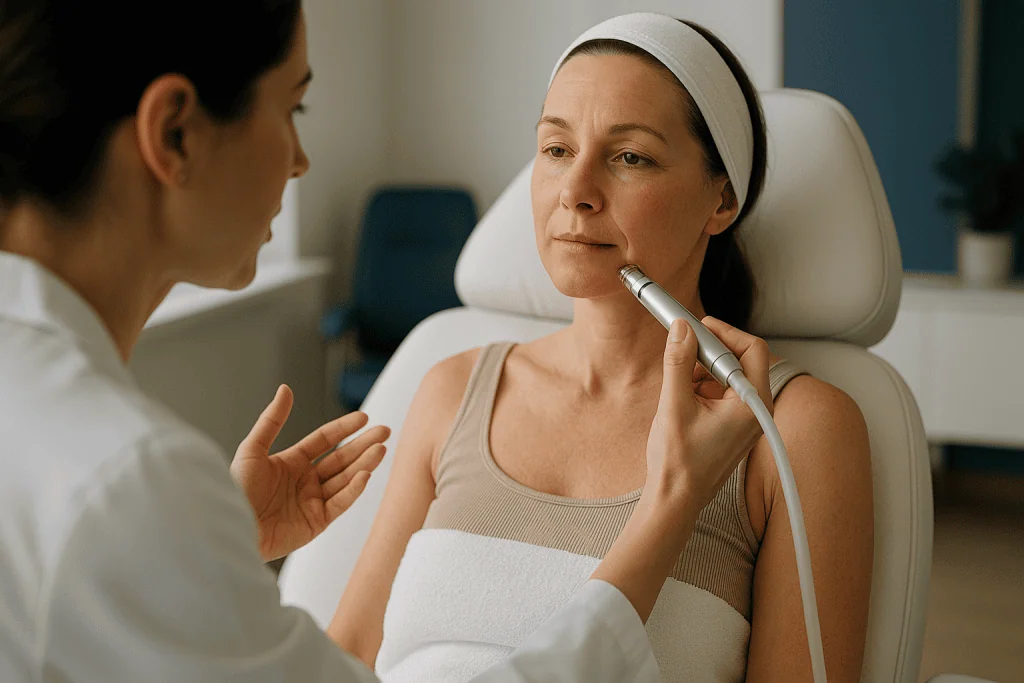
Microdermabrasion is a mechanical exfoliation. Exfoliation simply means removing dead cells from the skin’s surface. A handheld device either sprays very fine crystals (often aluminum oxide) across the skin and vacuums them back up, or uses a diamond-tipped head that abrades the surface directly while suction lifts the loosened debris away.
Two things are happening at once. The abrasive action thins the stratum corneum, the outermost layer of dead, flattened cells that acts as the skin’s weatherproof coat. The suction, meanwhile, pulls gently on the tissue beneath, which is believed to increase local blood flow and may nudge the deeper skin into a mild repair response. Cleveland Clinic describes the sensation most people report as a light scratching or a gritty, sandpaper-like feel, with a vibration from the suction, rather than pain.
A full-face session usually takes well under an hour, and no anesthetic is needed. There is no cutting, no heat and no chemical reaction, which is why the procedure sits at the mild end of resurfacing treatments. The flip side is that the effect is also mild: a single session will not reshape a scar or erase deep wrinkles, and the procedure is typically offered as a course of several visits spaced weeks apart, as Cleveland Clinic notes.
Understanding this mechanism explains the side effects. Thin the protective layer and you get a face that loses water faster (tightness, dryness), that shows the blood vessels beneath more readily (pinkness), and that reacts more sharply to anything you put on it (stinging). Those are not complications. They are the predictable cost of the procedure doing what it is designed to do.
How many layers of skin does microdermabrasion remove?
The honest answer is: part of one. The skin has two main layers. The epidermis is the thin outer layer, itself built from several sub-layers of cells that are born at the bottom and migrate upward, flattening and dying as they go. The dermis beneath it is thicker and houses collagen, blood vessels, nerves and hair follicles.
Microdermabrasion works almost entirely within the top of the epidermis. The National Library of Medicine’s StatPearls review describes it as removing the stratum corneum, the dead outermost sub-layer, with only superficial effects on the living epidermis below. Think of it as sanding the varnish, not the wood. By contrast, surgical dermabrasion, which Mayo Clinic describes as using a rapidly rotating device to remove the outer layers of skin, reaches into the dermis and requires a genuine healing period of roughly a week before new skin covers the area.
Why does this matter for side effects? Depth determines risk. Because the dermis is left intact, the procedure does not create an open wound, which is why bleeding, scabbing and scarring are not expected outcomes. It is also why the stratum corneum rebuilds itself quickly: the cells that replace it are already in the pipeline below.
One misconception worth correcting early: more aggressive is not better. Pushing the device harder or passing over the same area repeatedly in an attempt to “go deeper” moves the treatment out of the safe zone it was designed for and is a known route to pinpoint bleeding, streaky marks and uneven pigment afterward. Depth is a dial that belongs to a trained practitioner, not a number to maximize.
Microdermabrasion side effects that are considered normal
Expect your face to feel like it has spent an afternoon in wind. Cleveland Clinic lists the common after-effects as redness, mild swelling, tenderness and a feeling of tightness or dryness, and notes that these are generally short-lived, easing within a few hours to a day or two.
Here is what each one is doing. Tightness comes from water loss: with the outer barrier thinned, moisture evaporates faster and the skin surface contracts slightly. Pinkness is blood flow. The suction and friction dilate small vessels near the surface, and with less dead skin to mask them, the color shows through. Mild stinging when you apply a moisturizer or sunscreen is the same story; ingredients that normally sit on dead cells now reach living ones.
Fine flaking over the following couple of days is also within the normal range. It is the loosened edge of the stratum corneum finishing its exit. Some people notice their skin looks slightly shinier or more “glassy” for a day, because a smoother surface reflects light more evenly.
A few patterns tend to worry people unnecessarily. Small pink patches that look blotchy rather than uniform often reflect uneven pressure across different parts of the face and settle at the same pace as the rest. Skin that feels warm to the touch for the first hour is expected. A sensation like mild sunburn when you smile or wash is expected. None of these need treatment beyond gentle care.
The defining features of normal, in other words, are direction and timing: symptoms are at their worst immediately after the session and improve steadily from there. Anything that reverses that trend belongs in a different category, covered below.
What microdermabrasion recovery time usually looks like, day by day
Recovery from this procedure is less a convalescence than a short adjustment. Still, it helps to know the typical arc, because the side effects that matter are the ones that break the pattern.

In the first few hours, pinkness and tightness are at their peak. Cleveland Clinic describes this as the window in which most redness and mild swelling appear and then begin to fade. The skin may feel slightly tender if pressed, and products may sting on contact.
By the end of the first day, most people find the color has softened to a faint flush or disappeared. Dryness often lingers longer than redness, which is why practitioners generally emphasize moisturizer over anything else at this stage. Light flaking may begin.
Across days two to four, flaking finishes and the skin typically feels normal to the touch, though it remains more sun-sensitive than usual while the outer layer rebuilds. This is the period when an unprotected walk at midday can produce a sting or a burn you would not normally get.
Over the following one to two weeks, the stratum corneum restores its full thickness. Because the procedure is usually offered as a series, Cleveland Clinic notes that sessions are typically spaced weeks apart, partly so the barrier can fully recover between treatments.
Two caveats. First, these are typical ranges drawn from clinical descriptions, not promises; thinner, drier or more reactive skin often takes longer at each stage. Second, the timeline assumes a standard-depth treatment on intact skin. A session performed over active breakouts, over skin recently treated with other resurfacing methods, or at excessive pressure can turn a two-day recovery into a two-week one. The question your care team will ask is not just “how do you feel?” but “is it heading the right way?”
Irritation after microdermabrasion that should be reported
The signals that matter are the ones that get worse instead of better. Mild symptoms that peak at the clinic door and fade through the evening are the procedure. Symptoms that deepen on day two are something else.
Redness that intensifies or spreads after the first day is the headline sign. Cleveland Clinic and the StatPearls review both list skin infection among the uncommon risks of microdermabrasion, and a bacterial infection of thinned skin tends to announce itself with increasing redness, warmth, swelling and pain, sometimes with yellowish oozing or crusting. Those features together are a reason to contact the clinic the same day.
Blistering, raw or weeping patches, or pinpoint bleeding that does not stop promptly point to a treatment that went deeper than intended. Streaky lines following the path of the device, sometimes called tracking, suggest the same thing and should be looked at rather than waited out.
A cluster of small, painful blisters near the lips, often preceded by tingling, is the pattern of a herpes simplex (cold sore) flare. The virus can be reactivated by trauma to the skin, which is why practitioners ask about cold sore history beforehand. Mayo Clinic notes that cold sores typically announce themselves with tingling before blisters appear; after a resurfacing treatment, that tingling is worth a call rather than a wait.
New patches that are darker or lighter than the surrounding skin and persist beyond the pink phase should also be reported. Post-inflammatory hyperpigmentation, a darkening that follows skin irritation, is more likely in deeper skin tones and is easier to manage when it is addressed early.
Eye symptoms deserve their own mention. Crystal-based systems carry a small risk of particles reaching the eye; persistent grittiness, redness or light sensitivity after a session should be assessed promptly rather than rinsed and ignored.
Normal tightness vs irritation: a side-by-side guide
Most people want a simple way to sort what they are seeing. The table below is a plain-language comparison, not a diagnostic tool; the final judgment always rests with the clinician who performed the treatment and knows what was done.
| What you notice | Usually expected | Worth reporting |
|---|---|---|
| Color | Even pink or light red that peaks right after treatment and fades within about a day (Cleveland Clinic) | Redness that deepens, spreads or returns after improving; purple or dusky patches |
| Sensation | Tightness, dryness, mild sunburn-like sting on contact with products | Throbbing or increasing pain, intense burning, numbness |
| Surface | Fine flaking over two to four days; slight shine | Blisters, open or weeping areas, crusting, pinpoint bleeding that persists |
| Swelling | Slight puffiness in the first hours | Swelling that grows after day one, especially with warmth |
| Pigment | Temporary blotchiness that fades with the redness | New dark or light patches that remain after the pinkness has gone |
| Lips and mouth area | Mild dryness | Tingling followed by clustered blisters (possible cold sore flare) |
| Eyes | No symptoms | Grittiness, redness or light sensitivity that does not settle after rinsing |
| General | Feeling well | Fever, chills, or feeling unwell alongside skin changes |
Two patterns cut across every row. The first is trajectory: expected effects improve steadily; reportable ones plateau or worsen. The second is spread: expected effects stay where the device went; infection and inflammation tend to creep outward.
If you find yourself photographing your cheek to compare it with an hour ago, that instinct is useful. A series of photos taken in the same light, a few hours apart, is often more informative to a clinician than a verbal description, and it costs nothing to send.
Who microdermabrasion is usually for, and who is usually asked to wait
Cleveland Clinic lists the concerns the procedure is typically used for: dull or uneven skin tone, fine lines, mild sun damage, enlarged pores, superficial acne scars and age spots. The common thread is “superficial.” Each of these lives in or near the epidermis, within reach of a treatment that only sands the surface.
Because the procedure is so shallow, it is considered suitable across a wide range of skin tones, and it does not involve chemicals or heat, which removes some of the risks that accompany peels and lasers. That breadth is part of its appeal.
There are, however, situations in which practitioners routinely ask people to postpone. Active acne with inflamed, pus-filled spots is the most common; abrading over open or infected lesions can spread bacteria and worsen scarring. Active cold sores, open cuts, rosacea in a flaring phase, eczema or psoriasis on the treatment area, and recent sunburn are all reasons to wait until the skin has settled. Skin that has recently had a chemical peel or laser resurfacing is usually given time to recover fully before another surface treatment is layered on.
Medicines change the picture too. People taking oral isotretinoin, a retinoid used for severe acne, are generally asked to delay surface procedures because the drug alters how the skin heals; the timing of that delay is a decision for the prescribing clinician. Topical retinoids and some exfoliating acids are often paused for a short window before and after treatment for similar reasons. Anyone who develops keloids, raised scars that grow beyond the original injury, should raise this with the practitioner, because any skin trauma can be a trigger.
Pregnancy is often treated cautiously, less because of evidence of harm than because skin can become more reactive and pigment-prone during it. None of these are permanent exclusions. They are reasons for a conversation before, rather than a complication after.
Is microdermabrasion actually good for your skin? What the evidence shows
This is the question underneath most online searches, and it deserves a precise answer rather than a cheerful one.
The evidence base is modest. The StatPearls review in the National Library of Medicine summarizes the clinical literature as showing improvements in skin texture, mild photoaging (sun-related changes) and superficial acne scarring, while noting that many studies are small, short and lack strong controls. In plain terms: the procedure reliably makes skin feel smoother and look brighter for a time, and there is some histological evidence, meaning changes visible under a microscope, of a thicker, more orderly epidermis after a series of treatments. Evidence that it meaningfully remodels deeper collagen or produces lasting change in wrinkles or scars is far weaker.
Cleveland Clinic frames the realistic outcome the same way: a fresher-looking surface, with results that are temporary and maintained through repeat sessions rather than achieved once.
So is it “good for your skin”? It is not harmful when performed appropriately on suitable skin, and it is one of the lower-risk resurfacing options available because it leaves the dermis alone. Whether it is worthwhile depends entirely on what you are hoping to change. For dullness and rough texture, the evidence supports a visible if short-lived effect. For deep acne scars, etched wrinkles or significant pigment problems, it is unlikely to do what deeper treatments do, and a clinician may suggest alternatives such as chemical peels, which the NHS describes as using a solution to remove the outer layers of skin, or laser resurfacing.
The most useful opinion we can offer is this: the procedure’s safety comes from the same shallowness that limits its power. Expect maintenance, not transformation, and the side effects you accept will be proportionate to what you gain.
What are the disadvantages of microdermabrasion? Five honest ones
Marketing tends to list benefits. Patients ask about drawbacks, and there are five worth naming plainly.
- The results do not last on their own. Because only dead surface cells are removed and the stratum corneum rebuilds within a couple of weeks, the smoother look fades. Cleveland Clinic notes that multiple sessions are usually needed and that maintenance treatments are typical. Anyone expecting a one-time fix will be disappointed.
- It cannot reach what lives deeper. Ice-pick acne scars, deep wrinkles, melasma and significant sun damage sit in or below the dermis. The procedure skims above them. This is a limitation of depth, not of technique.
- Sun sensitivity rises for a period. With the protective layer thinned, ultraviolet light reaches living cells more easily, increasing the chance of burning and of pigment changes. The CDC’s general sun-safety advice (broad-spectrum sunscreen, shade, protective clothing) becomes non-negotiable rather than optional for the recovery window.
- It can aggravate skin that is already reactive. Rosacea, eczema, broken capillaries and active acne can flare or worsen when abraded. The treatment is for intact, calm skin, and practitioners who skip that screening step raise the risk substantially.
- Pigment changes and streaking are possible. Uneven pressure or overtreatment can leave temporary lines, and post-inflammatory hyperpigmentation, a darkening that follows irritation, is a recognized risk, particularly in deeper skin tones.
A sixth disadvantage is quieter: because the procedure is widely available outside medical settings, the quality of pre-treatment screening varies. The NHS’s general guidance on cosmetic procedures emphasizes checking a practitioner’s training and asking what happens if something goes wrong. For a treatment whose main risks come from being done too hard or on the wrong skin, that screening is where safety actually lives.
Microdermabrasion risks: pigment changes, infection and cold sores
Serious complications from microdermabrasion are uncommon, but three deserve a closer look because they are the ones people search for at eleven at night.
Pigment changes. Post-inflammatory hyperpigmentation happens when inflammation stimulates melanocytes, the pigment-producing cells, to release extra melanin. It appears as brown or gray-brown patches days to weeks after the irritation and is more common in medium to deep skin tones. Hypopigmentation, a lightening, is rarer with a treatment this shallow but can follow overaggressive passes. Both are more likely if the skin is exposed to sun during recovery, which is why sun protection is described as part of aftercare rather than a separate topic. Pigment changes often fade over months, but they can be slow, and early assessment gives more options.
Infection. The StatPearls review lists infection among the recognized risks. Thinned skin is a weaker barrier, and bacteria from hands, unclean devices or active acne can take hold. MedlinePlus describes the general signs of a skin infection as redness, swelling, warmth, pain and sometimes pus or fever. Reusable device heads and crystals that are not properly handled are a known contamination route, which is one reason hygiene standards in the treatment room are a legitimate question to ask.
Cold sore reactivation. Herpes simplex virus lives quietly in nerve cells between outbreaks, and physical trauma to the skin around the mouth is a well-recognized trigger. Someone with a cold sore history may be offered preventive antiviral medicine around a resurfacing treatment; the decision, and its timing, belong to the prescribing clinician. The practical point for patients is simply to disclose the history beforehand.
Rarer still are eye irritation from stray crystals and small bruises under the skin from excessive suction, especially around the thin skin near the eyes. Neither is dangerous in itself, but both signal that technique or settings need adjusting.
Microdermabrasion aftercare that actually helps the skin settle
Good aftercare is less a regimen than a short period of restraint. The skin has lost its outer coat; the job is to keep it moist, shaded and undisturbed while it rebuilds.
Moisturizer is the first priority. A bland, fragrance-free cream applied as often as the skin feels tight replaces the water the thinned barrier is losing and relieves most of the pulling sensation. Avoid products with alcohol, fragrance, exfoliating acids or retinoids for a few days; each of these would normally be buffered by dead cells and will sting on freshly abraded skin.
Sun protection is the second. The CDC’s sun-safety guidance recommends broad-spectrum sunscreen, shade during peak hours and protective clothing or a wide-brimmed hat. For the recovery window, treat that as a daily requirement even on overcast days, because the primary driver of post-treatment pigment problems is ultraviolet exposure on unprotected new skin.
Cleansing should be gentle: lukewarm water, a mild non-foaming cleanser, fingertips rather than cloths or brushes, and patting dry. Skip saunas, steam rooms, hot showers on the face and vigorous exercise for the first day or so; heat and sweat both increase redness and can irritate.
Hands off is the hardest rule. Picking at flaking skin or scrubbing to “speed it up” removes cells that are still attached and is a reliable way to turn normal flaking into raw patches. Let the flakes leave on their own schedule.
Makeup is often allowed after the first day if the skin feels comfortable, but mineral-based products tend to be tolerated better than heavy foundations, and clean brushes matter more than usual. Some practitioners ask people to wait longer; follow the instructions you were given rather than general advice, because they reflect what was actually done to your skin.
Medicines and skin products that change how your skin reacts
The same treatment can produce very different side effects depending on what the skin has been exposed to beforehand. This is where a short medication conversation prevents most avoidable problems.
Topical retinoids (a class of vitamin A-derived creams used for acne and photoaging) speed up cell turnover and thin the stratum corneum on their own. Layer mechanical abrasion on top, and the effective depth of treatment increases. Practitioners often ask that these be paused for a short window before and after a session. How long is a decision for the clinician who prescribed them; the mechanism is simply that two exfoliating forces together go deeper than either alone.
Oral isotretinoin changes skin healing more profoundly, reducing oil gland activity and altering how the epidermis repairs. Resurfacing treatments during or soon after a course have historically been avoided because of concerns about delayed healing and scarring. Whether, and when, surface treatments are appropriate after finishing the medicine is a judgment for the prescribing clinician, and it is never a reason to stop the medicine early.
Exfoliating acids such as alpha-hydroxy and beta-hydroxy acids, found in many over-the-counter serums and washes, have the same additive effect as retinoids and are commonly paused too.
Medicines that increase sun sensitivity, including some antibiotics and diuretics, raise the stakes on sun protection during recovery. Blood thinners and regular anti-inflammatory painkillers can make the small bruises from suction more likely, though they do not usually prevent treatment.
None of this means changing anything yourself. It means bringing a complete list of what you use on and in your body to the consultation, so that the person operating the device can set the pressure, the timing and the aftercare to match. The side effects you experience are, to a surprising degree, decided in that conversation.
What people often get wrong about microdermabrasion side effects
“If it’s not red, it didn’t work.” Pinkness reflects blood flow and individual reactivity, not effectiveness. Some people barely color at all and still get the surface smoothing the treatment is designed to produce. Chasing redness by asking for more pressure is how overtreatment happens.
“Peeling means it’s going deep.” The fine flaking afterward is the last of the loosened stratum corneum, not evidence that living skin was removed. Mayo Clinic’s description of surgical dermabrasion, with its week-long healing and months of pinkness, is what genuine deep resurfacing looks like. Microdermabrasion is not that, and should not look like it.
“It’s just a facial, so there’s nothing to report.” The procedure is mild, but it does remove skin. Infection, cold sore flares and pigment changes are documented, if uncommon, risks. Treating a worsening red patch as “part of the process” delays the one thing that helps: early assessment.
“More sessions, closer together, means faster results.” The barrier needs time to rebuild between treatments. Cleveland Clinic describes sessions as spaced weeks apart. Compressing that interval compounds dryness and sensitivity without adding benefit.
“Dark skin can’t have it.” Because the procedure uses no heat or chemicals and stays within the epidermis, it is generally considered suitable across skin tones. What deeper tones do carry is a higher risk of post-inflammatory hyperpigmentation if the skin is overtreated or sun-exposed afterward, which is a reason for gentler settings and strict sun protection, not exclusion.
“Home devices are the same thing.” Consumer devices use lower suction and gentler abrasion. They are not inherently unsafe, but they are also not equivalent, and the evidence summarized in the StatPearls review concerns professional treatment. The risks that do exist with home use come mostly from overuse on skin that is already irritated.
Questions to ask your care team before and after treatment
A short conversation before the first session shapes everything that happens afterward. These are the questions that tend to surface the information that matters.
- Which system will you use, crystal or diamond-tip, and how do you choose the pressure and number of passes for my skin type and tone?
- What is my skin likely to look and feel like this evening, tomorrow and over the next few days, given what you plan to do?
- Which of my current skincare products, especially retinoids and exfoliating acids, should be paused, and for how long before and after? (This is a question for the prescriber if the product was prescribed.)
- I have a history of cold sores, acne, rosacea, eczema or keloid scarring: how does that change your plan, or should I wait?
- How are the device heads and crystals cleaned or disposed of between clients?
- What signs would you want to hear about, and how do I reach you if something looks wrong after hours?
- How many sessions do you anticipate, how far apart, and what realistic change should I expect for my specific concern?
- If this is not the right treatment for what I want to change, what alternatives would you suggest, and what are their side effects?
After the session, a different set of questions becomes useful: what exactly was done (pressure setting, number of passes, areas treated), which products to use and avoid tonight, and when sunscreen can be applied. Writing the answers down sounds excessive for a treatment this mild, but if you do need to call the next day, a clinician can interpret your symptoms far more precisely when they know the settings used.
The pattern in all of these is accountability. The NHS’s guidance on cosmetic procedures stresses knowing who is responsible if something goes wrong. A practitioner who answers these questions readily is telling you something about how your side effects will be handled.
When to call your doctor after microdermabrasion
Most people will never need this section. Keep it anyway, because the value of knowing the red flags is that you can stop second-guessing the ordinary ones.
Contact the practitioner or your doctor the same day if you notice redness that is spreading or deepening after the first day rather than fading; swelling that increases; skin that feels hot, throbbing or increasingly painful; yellowish oozing, crusting or pus; blisters or raw, weeping areas; or pinpoint bleeding that does not stop. These features, especially in combination, are how an infection or an overtreated area presents, and both are easier to manage early.
Call promptly if tingling around the lips is followed by clusters of small blisters, which is the typical pattern of a cold sore flare after skin trauma, or if you have persistent eye grittiness, redness or light sensitivity after a crystal-based treatment.
Seek urgent care if skin changes are accompanied by fever, chills or feeling generally unwell, if swelling involves the eyelids or lips and is progressing, or if you develop hives, wheezing or difficulty breathing, which can indicate an allergic reaction to a product applied during or after the session.
Arrange a non-urgent review if new dark or light patches persist once the pinkness has gone, if redness lingers well beyond the day or two Cleveland Clinic describes as typical, or if streaky marks remain visible after a week.
When you call, have ready the date of treatment, what system and settings were used if you know them, any products applied since, and photos taken in consistent light. The decision about what needs assessment, what needs treatment and whether future sessions should be adjusted or paused sits with the clinician who examines you. Your part is simply to notice the direction of travel and to report it early rather than hope it reverses.
Frequently asked questions
How long does it take for your face to recover from microdermabrasion?
Most visible effects settle quickly. Cleveland Clinic describes redness, mild swelling and tenderness as typically easing within a few hours to a day or two, with dryness and light flaking sometimes lasting a few days longer while the outer skin layer rebuilds. Sun sensitivity persists for roughly a week or two. These are typical ranges, not guarantees; drier or more reactive skin often takes longer at each stage.
What are 5 disadvantages of microdermabrasion?
The five most commonly cited drawbacks are: results are temporary and need maintenance sessions; it cannot reach deep scars, deep wrinkles or dermal pigment problems; it increases sun sensitivity for a period; it can aggravate reactive conditions such as rosacea, eczema or active acne; and it carries a risk of temporary streaking or post-inflammatory hyperpigmentation, especially if overdone or followed by sun exposure.
Is microdermabrasion good for your skin?
It is considered a low-risk treatment when performed appropriately on calm, intact skin, because it stays within the epidermis and uses no heat or chemicals. The evidence reviewed in StatPearls supports short-term improvements in texture, dullness and mild sun damage. Whether it is worthwhile depends on your goal; it is not designed to change deep scars or etched wrinkles.
How many layers of skin does microdermabrasion remove?
It removes part of one layer: the stratum corneum, which is the dead, outermost sub-layer of the epidermis. The living epidermis beneath is only superficially affected, and the dermis is not reached. This is what separates it from surgical dermabrasion, which Mayo Clinic describes as removing the outer layers of skin deeply enough to require about a week of healing.
What are the main microdermabrasion risks I should know about?
Beyond expected tightness and pinkness, the recognized risks listed in clinical sources are skin infection, reactivation of cold sores around the mouth, post-inflammatory hyperpigmentation or lightening, temporary streaky marks from uneven pressure, small bruises from suction near the eyes, and eye irritation from stray crystals. All are uncommon, and most are linked to overtreatment, poor hygiene or treating skin that was not suitable.
What does microdermabrasion aftercare involve?
Keep the skin moist with a bland, fragrance-free moisturizer, use broad-spectrum sunscreen daily along with shade and hats as the CDC recommends, cleanse gently with lukewarm water, and avoid retinoids, exfoliating acids, alcohol-based products, saunas and heavy sweating for the first few days. Do not pick at flaking skin. Follow the specific instructions from your practitioner, since they reflect what was actually done.
Is it normal for my face to feel tight after microdermabrasion?
Yes, tightness is one of the most common expected effects. With the outer layer thinned, the skin loses water faster and the surface contracts slightly, producing a pulled, dry sensation. It usually eases over the first day as moisturizer replaces the lost water. Tightness that comes with worsening redness, swelling, heat or pain is a different pattern and should be reported.
Can microdermabrasion cause dark spots?
It can, though this is uncommon with appropriate settings. Post-inflammatory hyperpigmentation happens when irritation prompts pigment cells to overproduce melanin, leaving brown or gray-brown patches days to weeks later. The risk is higher in deeper skin tones, after aggressive treatment, and with sun exposure during recovery. New patches that remain after the pinkness fades should be assessed by a clinician.
Can I have microdermabrasion if I get cold sores?
Often yes, but it needs to be disclosed beforehand. Trauma to the skin around the mouth can reactivate the herpes simplex virus, so a clinician may discuss preventive antiviral medicine around the treatment; that decision and its timing rest with the prescriber. Treatment is generally postponed while a cold sore is active, and tingling followed by blisters afterward should prompt a call.
Is microdermabrasion the same as dermabrasion?
No. Despite the shared name, they differ greatly in depth. Microdermabrasion sands only the dead surface layer and needs little or no downtime. Dermabrasion, as Mayo Clinic describes it, uses a rotating device to remove the outer layers of skin into the dermis, requires roughly a week for new skin to form, and leaves the skin pink for months. Side effects and risks scale with that depth.
References
- NIH National Library of Medicine (StatPearls): Microdermabrasion
- NHS: Cosmetic procedures
- CDC: Sun Safety
- MedlinePlus: Skin Infections
This article is for general information only and is not a substitute for professional medical advice. Please consult a qualified doctor about your individual situation.

More from the Blog

Preparing for Trauma Reconstruction: Imaging, Infection Control and the Anesthesia Assessment
Preparing for trauma reconstruction usually involves three linked steps: detailed imaging (most often a CT scan) so surgeons can map displaced bone and missing…

Which Moles Can Be Removed for Cosmetic Reasons and Which Always Need Pathology First
A mole can generally be removed for cosmetic reasons only after a clinician has examined it, usually with a dermatoscope, and found no features…

Non-Surgical Facelift vs Surgical Facelift: What Each Treats and Where Each Stops
A surgical facelift repositions sagging deeper facial tissue and removes excess skin, so it treats jowls, a slack jawline and loose neck skin. Non-surgical…

What to Tell Your Doctor Before Botox: Past Treatments, Pregnancy and Blood Thinners
Before Botox, tell your doctor about every previous botulinum toxin treatment and how you responded, including medical uses such as migraine or sweating; all…
Preparing for Skin Graft Surgery: Wound Assessment, Infection Control and Stopping Smoking
Preparing for skin graft surgery centers on three things the evidence consistently supports: a wound bed that is clean, well supplied with blood and…
Fibroblast Treatment Risks Explained: Pigment Changes, Scarring and Skin Types at Higher Risk
Fibroblast treatment risks come mainly from the controlled burn the plasma pen creates on the skin surface. The most common problems are post-inflammatory dark…