

Nasal Endoscopy, Old Surgical Records and Photos: How a Revision Rhinoplasty Plan Is Built
Key Takeaways
- The operative report from the first surgery tells a revision surgeon what cartilage was removed or added, information that cannot be read from the surface of the nose.
- Nasal endoscopy takes only a few minutes but can reveal a deviated or perforated septum, a collapsing nasal valve and scar bands that change the entire surgical plan.
- Mayo Clinic advises waiting at least a year before a second operation because the nose can keep changing shape throughout the first year after surgery.
- The NHS states swelling after nose reshaping can take up to six months to settle fully, with the tip typically the last area to refine.
- When septal cartilage has already been harvested, revision surgeons commonly turn to ear or rib cartilage, each with its own donor-site recovery and trade-offs.
- No guideline-level figure exists for how often rhinoplasty needs revision; published estimates vary with definitions, so individual risk is best estimated from your own records and exam.
A revision rhinoplasty consultation is built from three sources of evidence: the operative report and records from the first surgery, dated photographs showing how the nose has changed, and a nasal endoscopy that inspects the septum and airway from inside. The surgeon combines these with a hands-on exam to map what cartilage remains, what breathing problems exist, and whether and when a second operation is reasonable.
The envelope arrived three weeks after she requested it, a single page from a surgical center she had not set foot in for four years. Most of it was abbreviations. She almost did not bring it to the appointment. The surgeon read it twice, then said something she had not expected: this page told him more about her nose than the mirror did.
That is the quiet truth of a revision rhinoplasty consultation. The nose you can see is the result of decisions made inside tissue you cannot see, and a second surgeon is working partly blind unless the first operation is reconstructed on paper. Old records, a chronological series of photographs and a few minutes with a thin camera in each nostril do that reconstruction.
This article walks through how that plan is actually assembled, what each piece of evidence contributes, where the honest uncertainties lie, and what to ask before anyone books an operating room.
What a revision rhinoplasty consultation actually involves
A first rhinoplasty consultation is mostly about wishes: what the person would like changed. A revision rhinoplasty consultation is mostly about archaeology. The surgeon is trying to work out what was removed, what was moved, what healed in an unexpected way, and what raw material is still available to work with.
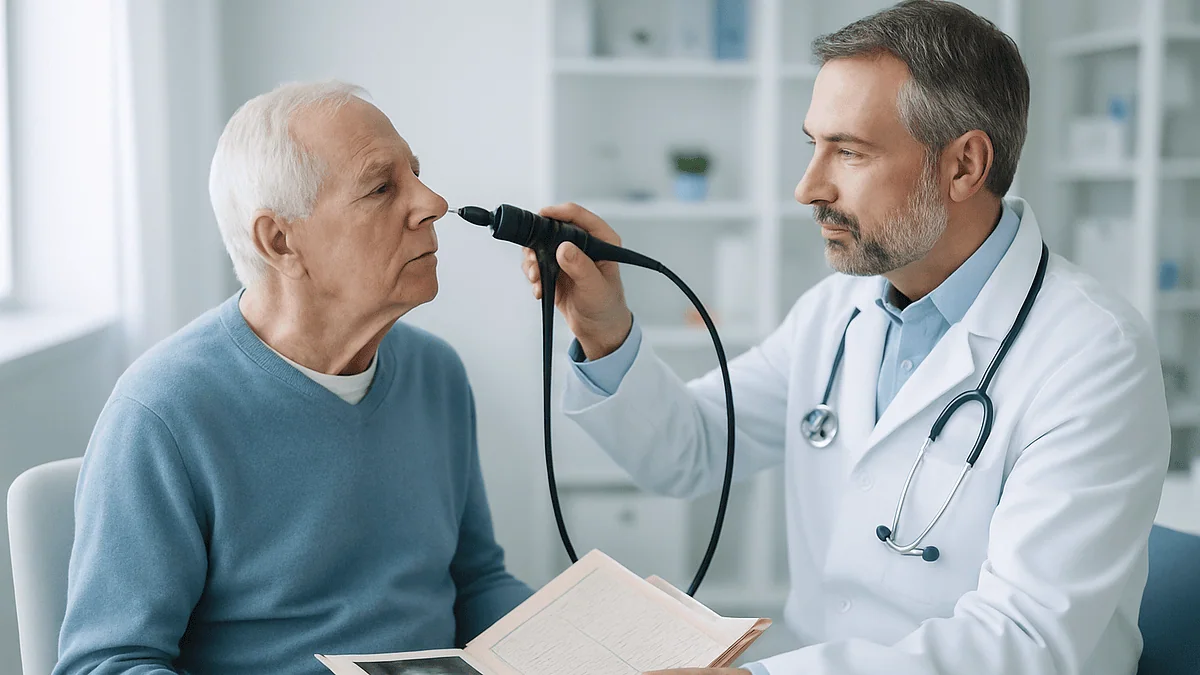
Expect the visit to run longer than a standard aesthetic appointment. It usually unfolds in a predictable order. The conversation comes first, and it goes deeper than appearance: how the nose breathes at rest and during exercise, whether one side blocks when lying down, whether the tip feels numb or stiff, and what exactly disappointed the person about the first result. Then come the documents. The surgeon reads the operative report (the surgeon’s written account of what was done during the operation), looks at pre-operative and post-operative photographs, and lines them up against the present-day nose.
The physical examination follows, including nasal endoscopy, a look inside the nose with a thin lighted tube. Many surgeons also palpate the nose, which simply means pressing gently to feel how thick the skin is, where cartilage ends, and whether scar tissue has formed under the surface.
Only then does planning start. Mayo Clinic describes rhinoplasty planning as a shared discussion of goals, risks and realistic expectations, and that applies with extra force to a second operation. A thoughtful surgeon often ends a revision consultation without a firm plan, asking for more records, more time for healing, or a second visit. That is not indecision. It reflects the fact that revision work is generally considered more technically demanding than primary surgery, and the plan is only as good as the evidence underneath it.
Why the first surgeon's operative report matters more than the old photos
The operative report is the single most valuable document a person can carry into the room. Photographs show results; the report shows methods. It tells the second surgeon whether the first operation was performed through an open approach (a small incision across the strip of skin between the nostrils, with the skin lifted) or a closed approach (incisions hidden entirely inside the nostrils). It records whether the nasal bones were broken and repositioned, how much of the bridge was lowered, whether the septum was straightened, and crucially whether cartilage was removed or added.

That last point drives the whole plan. If septal cartilage, the firm wall dividing the two nasal passages, was harvested during the first surgery, there may be little left to borrow. The second surgeon then knows early that cartilage from the ear or rib may be needed, and can discuss that openly rather than discovering a shortage in the operating room.
Reports also mention grafts (pieces of cartilage or other tissue placed to support or shape the nose) and implants, the presence of which changes both the surgical approach and the risk conversation. Mayo Clinic notes that surgeons may use cartilage from the septum, ear or rib in rhinoplasty, and a record of which source was already used saves guesswork.
Patients are entitled to copies of their medical records, and most surgical facilities release an operative note on written request. Ask also for the anesthesia record and any pathology report. Even an incomplete or terse note is useful. A single line such as “cephalic trim of lower lateral cartilages” tells an experienced reader that the tip cartilages were narrowed, a common contributor to later nostril collapse. Bring everything; let the surgeon decide what matters.
What old photos tell a surgeon, and the limits of computer morphs
Photographs do a job the operative report cannot: they show time. A revision surgeon wants three sets. The first is the nose before any surgery, ideally in standard views: straight on, both profiles, both three-quarter angles and from below looking up at the nostrils. The second is the early post-operative period. The third is a series across the following months and years, because a nose that looked straight at three months and pinched at eighteen is telling a different story from one that was pinched from the start.
Ordinary phone photos help, even casual ones, provided they are dated. A profile at a family event can reveal when a drooping tip or a bump above the tip, sometimes called a pollybeak deformity (fullness just above the tip that gives a parrot-like profile), first appeared. Timing distinguishes a surgical result from scar tissue that accumulated later, and the two are managed differently.
Many surgeons also take new standardized photographs at the consultation and may offer computer imaging, in which the current photo is digitally reshaped to preview a possible outcome. These images are useful for conversation and dangerous as promises. A morph can move pixels anywhere; cartilage, scar and skin thickness have limits. NHS guidance on nose reshaping is explicit that results cannot be guaranteed and that people should have realistic expectations before agreeing to surgery.
Treat the morph as a vocabulary tool, a way to say “less of this, more of that,” rather than a contract. A surgeon who hedges about what the simulation can deliver, especially where skin is thick or scarred, is being accurate, not evasive.
Nasal endoscopy: what happens, step by step
Nasal endoscopy is the examination that turns a cosmetic consultation into a medical one. An endoscope is a thin rigid or flexible tube, roughly the width of a cooked spaghetti strand to a drinking straw depending on the type, with a light and a lens at the end. It lets the surgeon see parts of the nose that a flashlight and speculum cannot reach.
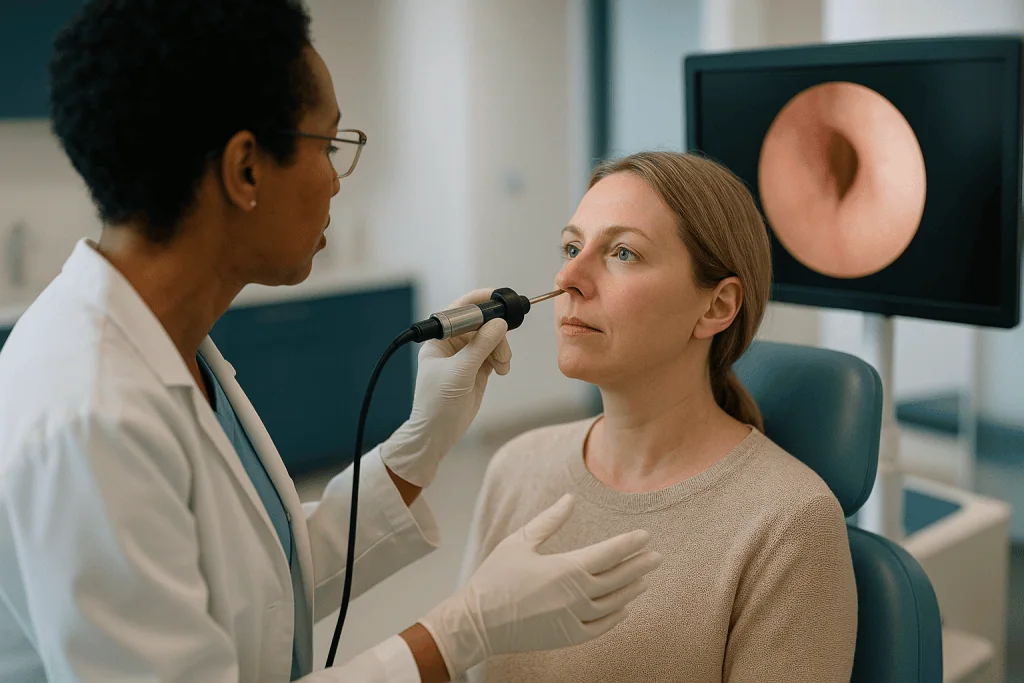
The sequence is straightforward. The person sits upright. The surgeon or a nurse usually applies a spray that shrinks the lining of the nose and numbs it, which widens the passage and makes the exam more comfortable. After a few minutes the scope is passed gently along the floor of each nostril, then angled upward. Most people describe pressure or a strange tickle rather than pain; the examination itself typically lasts only a few minutes, according to Cleveland Clinic’s description of the procedure. A video monitor often lets the person watch alongside.
What is the surgeon looking for? Several things specific to a revision. Whether the septum is straight or deviated, and whether a part of it is missing or perforated (a hole between the two passages, which can occur after prior septal surgery). Whether the internal nasal valve, the narrowest part of the airway located where the upper tip cartilages meet the septum, collapses with breathing. Whether the turbinates, the shelf-like structures on the side walls that warm and humidify air, are swollen or over-reduced. Whether there is scar tissue bridging two surfaces, called a synechia.
Each finding changes the plan. A perforation may need patching. A collapsing valve usually needs structural cartilage support rather than purely cosmetic reshaping. Endoscopy is how those decisions become evidence-based rather than guesswork.
The hands-on exam: skin, cartilage and breathing tests
Before and after the endoscope, the surgeon’s fingers do a surprising amount of diagnostic work. Skin thickness is assessed by gently pinching the bridge and tip. Thick, oily skin hides fine cartilage detail and tends to swell for longer; very thin skin shows every irregularity underneath and may reveal the edges of grafts. Neither is good or bad, but each sets a ceiling on how much refinement a revision can realistically show.
Palpation of the bridge checks for a step between bone and cartilage, for an “open roof” (a flat or notched feel where the bridge was lowered without the bones being brought back together), and for mobility of the nasal bones. Pressing the tip tests its support: a tip that sinks easily toward the lip suggests weakened cartilage, often from previous trimming.
Then come breathing tests that need no equipment. In the Cottle maneuver the surgeon pulls the cheek gently sideways, opening the nasal valve, and asks whether breathing improves. If it does, valve narrowing is likely contributing to obstruction. A variation uses a cotton-tipped applicator to support a specific part of the sidewall from inside while the person inhales, pinpointing the collapsing segment. The surgeon also watches the nostrils during a deep breath to see whether the sidewalls pull inward, a sign of external valve weakness.
Mayo Clinic lists breathing difficulty among the reasons people seek rhinoplasty and includes septal assessment as a standard part of evaluation, and in revision surgery this functional assessment carries more weight than in a first operation. Many people who come in for an appearance concern leave having learned that their blocked breathing has a structural cause the operation must address.
Function before form: septum, valves and airflow
One opinion runs through every careful revision plan: the nose has to work before it is asked to look a certain way. A beautiful profile that collapses on inhalation is a failed operation by any medical definition, and a second surgery that ignores airflow risks repeating the first surgery’s mistake.
The septum deserves most attention. A deviated septum, where the dividing wall leans or buckles into one passage, is a common cause of one-sided blockage, and Mayo Clinic describes septoplasty, the operation to straighten it, as frequently combined with external reshaping. After a previous rhinoplasty the septum may be partly harvested, bent by scar, or stable but misaligned at its base. Endoscopy and palpation together reveal which.
The valves matter next. The internal valve angle is naturally narrow, and procedures that lower the bridge or narrow the middle vault can tighten it further. Spreader grafts, thin strips of cartilage placed between the septum and the upper sidewall cartilages, are one standard way to hold that angle open. External valve collapse at the nostril rim is often supported with small battens, cartilage strips laid along the weak segment. Naming these techniques here is not a recommendation; the choice always belongs to the operating surgeon, who sees the specific anatomy.
Turbinates round out the assessment. Over-enlarged turbinates block air; over-reduced ones, a possible consequence of aggressive earlier surgery, can paradoxically leave the nose feeling blocked and dry because airflow sensors in the lining are lost. A revision plan that lists function first, with the aesthetic steps built on top of a restored airway, is generally the plan most consistent with mainstream surgical teaching.
Who revision rhinoplasty is usually for, and who is asked to wait
Revision is usually considered when there is a definable problem that surgery can plausibly address. Common examples include breathing obstruction that began or worsened after the first operation, visible asymmetry that persists after swelling has settled, a collapsed or pinched tip, a bridge that was over-reduced leaving a scooped profile (a saddle nose), or a residual bump. Structural problems with a clear anatomical cause tend to be the most predictable to treat; subtle refinements through thick or scarred skin are the least.
Surgeons commonly ask people to wait, or decline to operate for now, in several situations. The first is time: a nose still changing shape is a moving target, and the evidence sections below cover why. The second is health. Uncontrolled high blood pressure, bleeding disorders, active smoking and some medications affect healing, and a surgeon may ask for medical optimization first, coordinated with the prescribing clinician; this article does not advise stopping or changing any medicine. The third is expectation. NHS guidance on cosmetic surgery urges people to be clear about why they want a procedure and to discuss concerns with a GP first, and many revision surgeons apply extra caution when the stated problem is one they cannot see.
A fourth group is people with body dysmorphic disorder, a condition in which a person is intensely preoccupied with a perceived flaw that others find minor or invisible. Cleveland Clinic notes that surgeons may screen for this because surgery tends not to relieve the distress. A referral for psychological support in this situation is medical care, not a brush-off.
Finally, anyone whose first surgeon has not yet been given a chance to review the result is usually encouraged to have that conversation. Sometimes the original team can explain what happened or offer an adjustment.
How long should you wait before a revision rhinoplasty?
The single most common question in a revision consultation is how long to wait for revision rhinoplasty, and the honest answer is: long enough for the nose to stop changing. Swelling in the nose settles slowly, and the tip is the last area to refine. NHS guidance on nose reshaping states that it can take up to six months for swelling to fully go, and Mayo Clinic notes that the shape of the nose may continue to change during the first year after surgery. Mayo Clinic also advises that if a second operation is considered, people generally wait at least a year, because of those ongoing changes.
Why the patience? Early swelling can mimic problems that will disappear on their own, such as fullness above the tip or slight asymmetry, and it can also hide problems that will appear later, such as a tip that drops as the skin thins and support softens. Operating on swollen tissue means working with distorted landmarks and immature scar, which bleeds more and is harder to sculpt.
There are exceptions, and they are usually functional or acute. A severe breathing obstruction, an infected or exposed implant, or a displaced graft within the first weeks may be addressed sooner, at the operating surgeon’s discretion. These are medical decisions, not cosmetic ones.
Thick skin typically takes longer to settle than thin skin. Previous revisions also lengthen the timeline, since each operation adds scar that must mature. The practical advice, then, is to use the waiting year productively: gather records, take dated photographs every month or two from the same angles, and note breathing symptoms. A surgeon reviewing that record at the twelve-month mark has far more to work with than one meeting a fresh, frustrated patient at month four.
Where the cartilage comes from: revision rhinoplasty cartilage graft sources compared
Revision work is largely a question of material. The first operation often removed cartilage; the second frequently has to put structure back. The surgeon’s choice of a revision rhinoplasty cartilage graft source is shaped by what the old report says was already harvested, what the endoscope shows remains in the septum, and how much support the plan requires. Mayo Clinic lists septum, ear and rib as the usual sources. The table summarizes what each typically offers; specific suitability is always a decision for the treating surgeon.
| Source | What it offers | Typical trade-offs |
|---|---|---|
| Septal cartilage | Straight, firm, harvested through the same incisions; the standard first choice | Often depleted after a prior operation; limited quantity |
| Ear (conchal) cartilage | Curved, flexible; useful for tip, rim and small contour grafts; a separate small incision behind or inside the ear | Natural curve limits use for straight structural supports; small additional donor-site soreness |
| Rib (costal) cartilage | Abundant and strong; suited to rebuilding a collapsed bridge or major tip support | Chest incision, more post-operative discomfort, a tendency to warp over time that surgeons carve to minimize |
| Processed donor cartilage | Avoids a donor incision; sterilized tissue from a tissue bank | Variable long-term behavior reported; a decision discussed case by case |
Donor-site healing adds to recovery. Rib harvest in particular adds chest soreness for a period the surgical team will outline, and carries a small risk of injury to the lining of the lung, which teams screen for before discharge. Synthetic implants are an alternative to cartilage in some practices, with a different infection and extrusion risk profile that should be described neutrally and in full. No source is universally best; the right one is the one matched to the deficit the records and exam have revealed.
Risks, limits and alternatives in plain language
Every operation carries risk, and a second operation on scarred tissue carries somewhat more. Mayo Clinic’s list of rhinoplasty risks includes bleeding, infection, reaction to anesthesia, difficulty breathing through the nose, permanent numbness in or around the nose, an uneven appearance, pain or discoloration that persists, scarring, a hole in the septum, and the need for additional surgery. In revision, numbness and stiffness of the tip are reported more often because nerves and tissue planes have already been disturbed.
Limits deserve equal honesty. Skin that has been thinned or scarred may not redrape smoothly over a reshaped framework. Cartilage grafts can warp or become visible years later. A nose made too small by a first operation can be rebuilt, but rebuilt tissue rarely behaves exactly like the original. Breathing can usually be improved when a structural cause is found, yet it cannot be guaranteed, and some sensations of blockage have no surgical fix.
Alternatives are part of a complete consultation. For some contour irregularities, non-surgical options such as injectable fillers are discussed; these are temporary, carry their own risks including rare vascular injury, and may complicate later surgery, so the conversation belongs with the surgeon. Observation is a legitimate alternative when the problem is minor or the risk-benefit balance is unfavorable. Addressing breathing alone, with a septoplasty or valve repair and no external change, is another path for people whose chief complaint is function.
A fair risk discussion also covers the possibility of a third operation. No reputable published source gives a single reliable rate for how often rhinoplasty needs revision; published estimates vary widely with how “revision” is defined and who is counted, so this article does not quote one. What matters for an individual is that the surgeon explains the specific risks of the specific plan.
Revision rhinoplasty recovery time: what the following days and weeks usually look like
Revision rhinoplasty recovery time follows roughly the same arc as a first operation, often with more swelling and a slower settling of the tip. The ranges below are typical, drawn from general rhinoplasty guidance; a revision team will give an individual timeline.
In the first week, a splint usually sits on the bridge. Mayo Clinic describes wearing a splint for about one week, and the NHS notes that the splint and any stitches are commonly removed around seven days. Bruising around the eyes, a stuffy nose from internal swelling, and a dull ache are expected. Sleeping with the head raised and avoiding blowing the nose are standard instructions. If rib cartilage was used, chest discomfort when twisting or coughing is added to the picture.
Weeks two to three are when most people feel presentable again. NHS guidance suggests around two weeks off work for nose reshaping, and the same guidance advises avoiding strenuous exercise for four to six weeks, with Mayo Clinic giving a similar window of three to six weeks before resuming vigorous activity. Glasses that rest on the bridge are often avoided until the surgeon clears them.
From month one onward, swelling retreats from the top down. The bridge looks defined well before the tip does. The NHS places full resolution of swelling at up to six months, and Mayo Clinic notes continued subtle change for up to a year. Numbness at the tip typically improves over months. Follow-up visits track breathing, graft position and skin healing; small irregularities early on are often watched rather than treated, because many resolve.
Anyone considering travel home soon after surgery should plan it with the surgical team, who will advise on timing, mobility and follow-up arrangements so that early complications can be seen promptly by someone familiar with the operation.
What people often get wrong about a revision rhinoplasty consultation
Myths cluster around second surgeries, and a good consultation dismantles them one at a time.
The first is that old records are optional. People assume the new surgeon will simply see what is wrong. The surface is visible; the structure is not. Without the operative report, the surgeon is estimating how much cartilage remains and may discover a shortage mid-operation.
The second is that waiting is a delay tactic. A surgeon who asks for twelve months is following mainstream guidance tied to how long the nose keeps changing, as both Mayo Clinic and NHS resources describe. Operating earlier risks treating swelling as deformity.
The third is that revision is “smaller” than the first operation because less needs changing. Often the reverse is true. Rebuilding support generally takes longer than removing it, and graft harvest adds a second surgical site.
The fourth is that computer imaging shows the result. It shows a goal. Skin, scar and cartilage decide how close reality comes.
The fifth is that breathing problems are a separate issue from appearance. In the nose, they are usually the same structures viewed from different sides; a pinched tip and a collapsed valve are one problem.
The sixth is that a published percentage can tell someone their odds. Figures circulating online are drawn from very different populations and definitions, and no guideline-level number exists that applies to an individual. The relevant odds are the ones the surgeon estimates after reading the records and looking inside.
The seventh is that going back to the original surgeon is an admission of failure. Many surgeons want to see unhappy results, and the original team holds the fullest knowledge of what was done. Starting there is often the fastest route to a complete record.
Questions to ask your care team, and what to bring to the rhinoplasty consultation
Preparation turns a consultation from a sales conversation into a clinical one. Knowing what to bring to a rhinoplasty consultation of this kind is half the work: the operative and anesthesia reports from every previous nasal surgery, any pathology or imaging reports, a dated set of photographs from before and after the first operation, a list of current medicines and supplements, and a short written description of the problem in your own words, separating what bothers you about breathing from what bothers you about appearance.
Then ask. Useful questions include the following, and the answers should be specific rather than reassuring.
- Based on my records and the endoscopy, what exactly do you think went wrong, and what evidence supports that?
- Is my problem mainly structural, mainly scar, or mainly skin, and how does that change what surgery can achieve?
- Will you need cartilage, and from where? What does that donor site add to recovery and risk?
- Which parts of my plan address breathing, and how will you check the airway during and after surgery?
- What would you not try to fix, and why?
- What are the realistic risks of this specific plan, including the chance that a further operation could be needed?
- How many months do you expect swelling to last for my skin type, and when would you judge the result?
- What is the plan if a complication arises after I go home, and who do I call?
- Are there non-surgical alternatives or a watch-and-wait option worth considering?
- What written information will I receive, and how long do I have to decide?
NHS guidance recommends taking time to think, seeking a second opinion if unsure, and never feeling pressured into booking. A surgeon who welcomes those questions, and who shows you the endoscopy findings and old photographs while answering, is building the plan with you rather than for you.
When to call your doctor
Most of the time, the weeks after a revision consultation involve no urgency at all; people gather records, take photographs and wait. Problems that need prompt attention arise mainly after surgery, and they are worth knowing before the operation so they are recognized without hesitation.
Contact the surgical team the same day, or seek emergency care, for any of the following red-flag signs:
- Bleeding from the nose that soaks through gauze and does not slow with gentle pressure and head elevation after a short period, or bleeding that restarts repeatedly.
- Fever, spreading redness, warmth or increasing pain around the nose, or foul-smelling discharge, which can indicate infection.
- A clear, watery discharge from one nostril that drips when leaning forward, which in rare cases can signal a leak of the fluid surrounding the brain and needs urgent assessment.
- Sudden change in the shape of the nose after a knock or fall, or a graft that feels as if it has shifted.
- Shortness of breath, chest pain, or a cough with pain on deep breathing after rib cartilage harvest, which can indicate injury to the lining of the lung or, less commonly, a blood clot.
- Sudden vision change or severe eye swelling and pain.
- Any sign of an allergic reaction to medicines or dressings, such as widespread rash, swelling of the lips or tongue, or difficulty breathing.
Before surgery, the signs that warrant a call are different: a new skin infection or cold sore near the nose, a respiratory infection in the days before the operation, or a change in medicines prescribed by another clinician. Mayo Clinic lists bleeding, infection, breathing difficulty and septal perforation among recognized rhinoplasty risks, and all are more manageable when reported early.
Every decision about timing, technique, graft source and whether to operate at all rests with the treating surgical team, who alone have the records, the endoscopic view and the examination in front of them.
Frequently asked questions
How much does a revision rhinoplasty typically cost?
This magazine does not publish prices for any treatment, and cost varies widely with the complexity of the plan, whether cartilage is harvested from the ear or rib, the type of anesthesia and the facility. Ask the surgical team for a complete written estimate that lists every component, and ask what happens financially if a further procedure or an unplanned return to the operating room becomes necessary.
What percentage of nose jobs need revisions?
No reliable single figure exists. Published estimates vary widely because studies define revision differently, follow people for different lengths of time and draw from very different populations, and no mainstream guideline quotes a universal rate. For an individual, the more useful question is what the surgeon estimates for the specific plan after reviewing the operative records, photographs and endoscopy findings.
How long does it take to recover from a revision rhinoplasty?
Recovery broadly follows a first rhinoplasty, often with more swelling. Mayo Clinic describes a splint for about one week and avoiding strenuous activity for roughly three to six weeks; NHS guidance suggests about two weeks off work and up to six months for swelling to settle fully. Mayo Clinic notes subtle shape changes can continue for up to a year, and tip swelling in revision cases tends to be slowest.
How long should you wait to get a revision rhinoplasty?
Mayo Clinic advises waiting at least a year before a follow-up operation, because the nose can continue changing shape during that time. Operating sooner risks treating swelling as a permanent problem and working through immature scar. Exceptions are usually functional or acute, such as severe breathing obstruction or an infected implant, and those timing decisions belong to the operating surgeon.
What should I bring to a revision rhinoplasty consultation?
Bring the operative and anesthesia reports from every previous nasal surgery, any imaging or pathology reports, dated photographs from before and after the first operation, a list of all medicines and supplements, and a short written description separating breathing concerns from appearance concerns. Even a brief or incomplete operative note is valuable, because it indicates which cartilage was removed or used.
Does nasal endoscopy hurt?
Most people describe pressure, a tickle or a brief urge to sneeze rather than pain. A spray that shrinks and numbs the nasal lining is usually applied first, and the examination itself typically lasts only a few minutes according to Cleveland Clinic. Tell the examiner if you have had bleeding problems, a previous septal perforation, or significant anxiety about the exam so they can adjust their approach.
What does revision rhinoplasty cartilage graft surgery involve?
A graft is a piece of cartilage placed to rebuild support or shape. Septal cartilage is the usual first choice, but after a prior operation it may be depleted, so surgeons may harvest from the ear through a small hidden incision or from the rib through a chest incision. Each source adds a donor site to recovery; rib harvest adds chest soreness and a small risk to the lung lining the team will discuss.
Can a revision fix breathing problems as well as appearance?
Often the two are linked, because a pinched tip or narrowed middle vault can also be a collapsed nasal valve. Endoscopy and breathing tests at the consultation identify structural causes such as a deviated septum or valve collapse, which surgery can address with techniques like septoplasty or supporting grafts. Improvement cannot be guaranteed, and some sensations of blockage have no surgical cause.
Why does the surgeon want my old photos if they can see my nose now?
Photographs show change over time, which the current nose cannot. A series of dated images reveals when a problem first appeared, distinguishing a result of the original surgery from scar tissue or support loss that developed later. Those two scenarios are planned differently. Ordinary casual photos are useful as long as they are dated and show the nose from consistent angles.
Should I go back to my original surgeon first?
It is often worth doing. The original surgeon holds the most complete knowledge of what was done and may explain the result or offer an adjustment. Requesting your full records is your right either way, and a second opinion is reasonable; NHS cosmetic surgery guidance encourages taking time, asking questions and seeking further opinions before agreeing to any procedure.
References
This article is for general information only and is not a substitute for professional medical advice. Please consult a qualified doctor about your individual situation.

More from the Blog

How Long Does Cheek Augmentation Last? Implants, Fat Transfer and Fillers Over Time
Cheek augmentation lasts anywhere from months to decades depending on the method. Hyaluronic acid fillers are temporary, typically wearing off over roughly 6 to…

How Lip Lift Surgery Is Done: The Bullhorn Incision Under the Nose Explained Step by Step
A bullhorn lip lift is a short outpatient operation that removes a small, curved strip of skin from directly beneath the nose so the…

Brow Lift Results: What a Natural Lift Looks Like and Why Surgeons Avoid the Surprised Look
Natural brow lift results reposition a heavy or low brow closer to the bony rim above the eye, opening the upper eyelid without changing…

Compression Garments and Activity Limits After Cosmetic Surgery: The First Weeks Explained
A compression garment after cosmetic surgery is a snug, elastic wrap or suit worn over the treated area to limit swelling, support healing tissue…

How to Read a Facial Correction Treatment Plan: Staging, Combined Procedures and Limits
A facial balancing treatment plan is a written map of how a clinician proposes to adjust the proportions of the face, usually in stages,…
Liquid Facelift or Surgical Facelift: Which One Addresses Jowls and Loose Skin?
A surgical facelift repositions the deeper tissue layer and removes excess skin, so it is the option designed to address true jowls and loose…