

Reading a Brow Lift Treatment Plan: Questions to Ask About Technique, Scars and Fixation

Key Takeaways
- The technique in your plan tells you where the scar goes: endoscopic and coronal lifts hide incisions behind the hairline, hairline lifts sit at the front edge of the hair, and direct lifts leave a fine line just above the eyebrow.
- Fixation, the method that holds the lifted tissue while it re-attaches to bone, is as important as the incision; ask what is used, whether anything is permanent, and how settling is managed.
- Mayo Clinic lists an elevated hairline and hair loss along the incision among brow lift risks, which matters most with thin hair or a family history of hair loss.
- Candidacy depends on brow position, eyelid heaviness, health and expectations rather than age; no guideline sets an average age for brow lift or facelift surgery.
- Stitches are typically removed within about 7–10 days and visible bruising settles over roughly two weeks, but scalp numbness can persist for months and final settling can take many months.
- Lifting the brow can worsen dry eye or incomplete eyelid closure, so an eye assessment before surgery is a reasonable item to ask for in the plan.
A brow lift treatment plan should spell out the technique (endoscopic, coronal, hairline, temporal, direct or through an upper-eyelid incision), where each incision and scar will sit, and how the lifted tissue will be fixed in place. Ask why that combination suits your forehead, hairline and brow shape, what the realistic recovery looks like, and which risks apply specifically to you.
The envelope arrives a few days after the consultation. Inside is a two-page plan with a diagram of a forehead, three dotted lines, a word you have never heard before (“fixation”) and a box to sign. You put the kettle on, read it twice and realize you understood the first paragraph and almost nothing after it.
That gap is normal. A brow lift is a small procedure in centimeters but a dense one in choices: which incision, which layer of tissue is lifted, what holds it there, and what that means for your hairline in ten years. The right brow lift questions to ask are not about whether the surgeon is good. They are about whether this particular plan fits this particular face, and whether you understand the trade-offs you are signing for.
What follows is a way of reading that document line by line, with the evidence beside it.
What a brow lift actually does to the forehead
Start with the mechanics, because every later question hangs on them. The eyebrows sit on a sheet of muscle and connective tissue that is anchored to the skull. With age, sun exposure and repeated frowning, that sheet loosens and the brows drift downward, most noticeably at the outer third. The upper eyelid skin, which has not moved, now has nowhere to go and folds over the lash line. People describe looking tired or stern when they feel neither.
A brow lift (also called a forehead lift) repositions that whole sheet upward and re-anchors it, rather than simply trimming skin. Mayo Clinic describes the goal as raising the soft tissue and skin of the forehead and brow to improve the appearance of the brow and upper eyelids. Some techniques also weaken the muscles that pull the brows down and inward, which softens the vertical lines between the eyebrows.
Three things follow from this. First, the procedure is about position, not volume; it will not fill a hollow temple. Second, because the tissue is being moved against gravity and its own elasticity, something has to hold it in the new place while it heals. That “something” is the fixation your plan mentions, and it is as important as the incision. Third, a brow lift changes expression. Lift too much and the face can look surprised; lift only the center and the brows can take on an arched, unfamiliar shape.
So the first of your brow lift questions to ask is deceptively simple: which part of the brow is being lifted, by roughly how much, and how will the surgeon avoid overcorrection? A good plan answers that in millimeters and in words you can picture.
Brow lift questions to ask before you even open the plan
A treatment plan is easier to interrogate if you arrive with your own baseline. Before you read the surgeon’s version of your face, write down yours.

Look in a mirror with your forehead relaxed. Many people unconsciously raise their eyebrows all day to lift heavy lids; the horizontal forehead lines are the evidence. Rest the muscle and note where the brows actually sit relative to the bony rim above each eye. Note whether one side is lower. Mild asymmetry is universal, and a plan that does not mention it is a plan that has not looked closely.
Next, gather the medical facts that change surgical options. The NHS advises anyone considering cosmetic surgery to be honest about smoking, medicines, supplements and previous operations, because these affect healing and anesthetic safety. Blood-thinning medicines, including some over-the-counter pain relievers and herbal products, matter here; do not stop anything on your own, but do list everything so the prescribing clinician can decide.
Then decide what you actually want. “Less tired” is a different request from “smooth forehead,” and the two may call for different procedures. Photographs of yourself from ten or fifteen years ago are more useful than photographs of strangers, because the aim of most forehead surgery is restoration rather than invention.
Finally, think about your hairline. A high or receding hairline, a short fringe, a center part, future hair loss in the family: each one changes where a scar can be hidden. Bring these observations to the plan and the document will start to read like a conversation rather than a contract.
Which brow lift technique is in your plan, and why that one?
Most plans name one of five or six approaches. Each is defined here in a sentence, because the name alone tells you where the scar goes and roughly how the tissue is lifted.
An endoscopic brow lift uses several short incisions hidden behind the hairline and a thin camera on a tube (an endoscope) so the surgeon can release and lift the tissue under the skin without a long cut. Mayo Clinic describes this as the approach that leaves the smallest scars. A coronal brow lift uses a single long incision running over the top of the head from ear to ear, behind the hairline; a strip of scalp is removed and the forehead is lifted as one unit. A hairline (pretrichial) brow lift places the incision along the front edge of the hairline instead of behind it, so the forehead can be shortened rather than lengthened. A temporal brow lift uses incisions in the hair at the temples and lifts only the outer brow. A direct brow lift places the incision immediately above the eyebrow hairs, lifting the brow with the least tissue movement. A transblepharoplasty lift reaches the brow through an upper-eyelid incision, usually when an eyelid procedure is being done anyway.
The question to ask is not “which is best” but “why this one for me.” Typical reasons include the height of your hairline, the thickness of your hair, how much lift the outer brow needs compared with the center, whether the frown muscles are to be treated, and whether previous surgery has left scar tissue. If the plan does not state the reason, request it in writing. A technique chosen for the surgeon’s habit rather than your anatomy is the single most common mismatch in these documents.
Brow lift techniques compared: incision, scar and what each is usually for
The table below summarizes the approaches as mainstream sources such as Mayo Clinic describe them. It is a reading aid for your plan, not a recommendation; the choice belongs to you and your treating team.
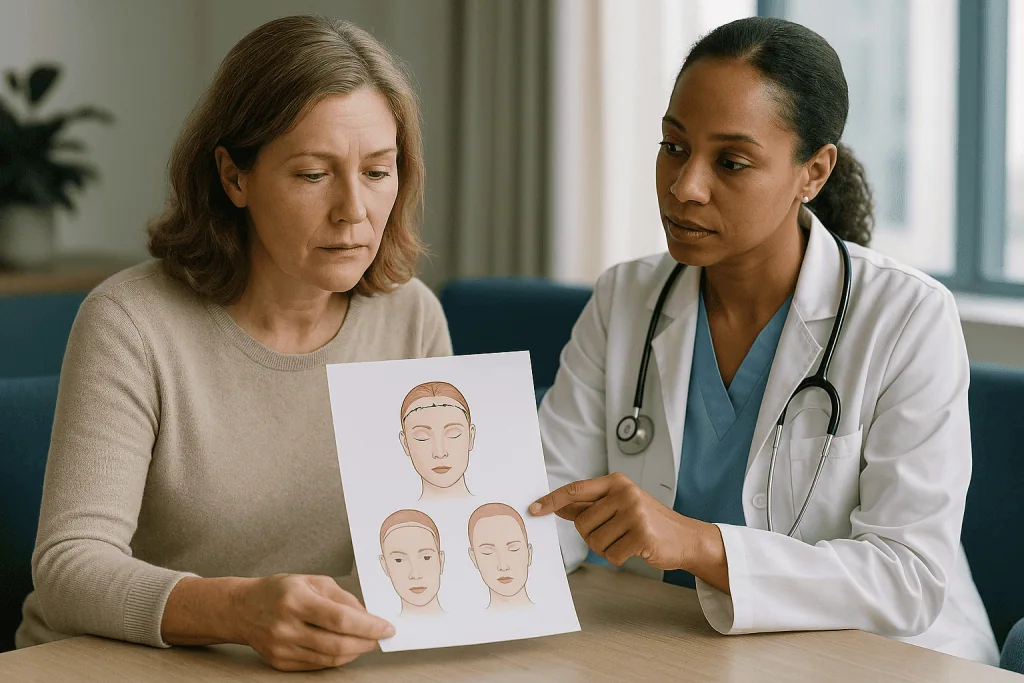
| Technique | Where the incision sits | Usually considered when | Points to ask about |
|---|---|---|---|
| Endoscopic | Several short cuts behind the hairline | Mild to moderate brow descent, normal hairline | Type of fixation; scalp numbness |
| Coronal | One long cut ear to ear behind the hairline | Significant descent, when more lift is wanted | Hairline moves higher; longer scar; more numbness |
| Hairline (pretrichial) | Along the front edge of the hair | High forehead or receding hairline | Scar visibility if hair is worn back |
| Temporal | In the hair at each temple | Outer brow sag only | Does the center brow need treatment later? |
| Direct | Just above the eyebrow hairs | Thin or absent hair at temples, some functional cases | A visible fine scar is accepted in exchange for precision |
| Transblepharoplasty | Through an upper-eyelid crease incision | Combined with eyelid surgery, modest lift needed | Limited amount of lift; fixation method |
Two patterns are worth noticing. The approaches with the longest scars generally allow the most movement and the most reliable fixation; the approaches with the shortest scars rely more on internal anchoring and suit smaller corrections. There is no free option. When a plan promises a large lift through tiny incisions, ask how the tissue will be held, because that is where the trade-off has been hidden.
Your plan may combine approaches, for example a temporal lift with eyelid surgery. That is common and reasonable, but each component should be listed separately with its own incision and its own risks.
Where are the scars for an eyebrow lift? Reading brow lift scars on the diagram
This is the question people type into search engines more than any other, and the honest answer is: it depends entirely on the technique, which is why the diagram in your plan deserves a ruler and a hand mirror.
For endoscopic and coronal approaches, the scars sit inside the hair, usually a finger’s width or more behind the hairline. They are hidden when hair is present but not invisible; part your hair over them and a pale line shows. The coronal scar is long, and Mayo Clinic lists an elevated hairline and hair loss along the incision among the recognized risks, which matters most for people with thinning hair or a family history of hair loss.
A hairline incision runs along the junction between forehead skin and hair. Surgeons typically cut at an angle so hair can regrow through the scar and soften it, but the line can remain visible when hair is pulled back or wet.
Temporal scars hide in the hair above the ears. Direct brow lift scars sit at the upper edge of the eyebrow and are the most visible of all; they are usually chosen when hiding a scar in hair is not possible or when precise control of brow shape matters more than concealment.
Brow lift scars, like all scars, mature over many months. The NHS notes that scars from facial cosmetic surgery usually fade with time but will not disappear completely, and that some people form raised or widened scars. Ask three things: exactly where each line will be, how long it will be, and what the surgeon’s plan is if a scar heals wider than expected. Ask also to see healed scars from the same technique in people with a similar hair pattern to yours.
What "fixation" means and why it matters more than the incision
Fixation is the method used to hold the lifted brow tissue in its new position while it heals and re-attaches to the bone. Think of it as scaffolding on a building: it is temporary, it is mostly hidden, and if it is inadequate the structure settles back.
The plan may describe several mechanisms. Sutures can anchor the deep tissue to the tough membrane over the skull (the periosteum) or to the dense tissue of the temples. Small tunnels can be drilled in the outer layer of skull bone so a stitch can pass through them. Absorbable anchoring devices, which dissolve over months, can be placed under the scalp. In some coronal lifts, removing a strip of scalp and closing the skin under tension does part of the holding. In a direct lift, the skin removal itself is the fixation.
None of these is universally superior, and mainstream patient sources do not rank them. What matters is that the method matches the amount of lift and the technique. A large correction with little fixation tends to relax; a small correction with aggressive fixation adds risk without benefit.
Questions worth asking, in plain language: What will hold my brow up, and for how long does it need to? Is anything left permanently in my scalp? If a device is used, will I be able to feel it, and can it be felt by others? What is the surgeon’s approach if one side settles more than the other? Mayo Clinic lists asymmetry among the known risks of brow lift surgery, and fixation is the main lever surgeons use to limit it.
If the plan does not mention fixation at all, that is the first gap to raise at your next appointment.
Who is usually a candidate for a brow lift, and who is asked to wait
Candidacy is about anatomy and health, not a birthday. People commonly search for an “average age” for facelift or brow lift surgery, but no guideline sets one. Mayo Clinic frames candidacy in terms of brow position, upper-eyelid heaviness and forehead lines, together with overall health and realistic expectations.
Brow lift candidacy usually rests on a few findings. The brows sit at or below the bony rim above the eye, often more so at the outer corners. Upper eyelid heaviness is partly caused by the low brow rather than by eyelid skin alone; surgeons test this by gently lifting the brow with a finger and watching the lid. Forehead lines are present because the frontalis muscle has been working overtime. The person is a non-smoker or willing to stop well in advance, because Mayo Clinic and the NHS both note that smoking impairs healing and raises complication risk.
People are usually asked to wait, or to consider a different plan, in several situations. Uncontrolled high blood pressure and bleeding disorders raise the risk of a collection of blood under the scalp. Active skin infection near the planned incisions is a reason to postpone. Significant dry eye or incomplete eyelid closure can be worsened by lifting the brow, so an eye assessment may come first. Recent weight loss in progress, unstable thyroid disease, or a major life stress can also prompt a pause, since the NHS encourages people to make cosmetic decisions when they feel settled rather than in response to a crisis.
A plan that lists why you are suitable, not just that you are, is a plan that has been written for you. Ask what would make the surgeon advise against proceeding, and whether any of those conditions apply.
What actually happens on the day of surgery
Most plans describe the day only briefly, so it helps to know what to expect and what to ask.
A brow lift is usually performed under general anesthesia or under local anesthesia with sedation, which means you are drowsy and comfortable but not fully unconscious. The choice depends on the technique, the length of the operation and your medical history, and it is made by the anesthesia team rather than being a preference you simply choose. Ask which is planned and why.
Hair along the planned incisions is usually parted and sometimes trimmed, though full shaving is uncommon. In an endoscopic lift, the surgeon makes the short scalp incisions, passes the camera and instruments beneath the skin, releases the tissue from the bone down to the brow, treats the frown muscles if planned, lifts and then fixes the tissue. In a coronal or hairline lift, the forehead is lifted as a flap, excess scalp or skin is removed and the wound closed with stitches or clips. Mayo Clinic notes the surgeon may place a small tube (a drain) to collect fluid and may wrap the forehead in a loose dressing.
Operating time varies with technique and with whether eyelid or face surgery is combined. Many brow lifts are done as day surgery, with the person going home the same day accompanied by an adult; combined procedures may involve an overnight stay. Your plan should state which applies to you and who will check on you overnight.
Questions for this section: Who will be giving my anesthesia, and have they seen my full medical list? Will I have a drain, and who removes it? Will stitches dissolve or need removal? What pain relief is planned, and who prescribes it? Decisions about medicines sit with the prescribing clinician; your job is to know the plan exists.
Endoscopic brow lift recovery and the first weeks after any technique
Recovery is where plans tend to be optimistic, so anchor the timeline to what mainstream sources describe rather than to what a brochure implies.
In the first days, expect swelling and bruising that spreads downward into the eyelids and sometimes the cheeks; gravity moves it, not the surgery. Mayo Clinic advises keeping the head elevated, applying cool compresses as directed and avoiding bending or lifting. A tight, numb or itchy sensation across the scalp is common and reflects small sensory nerves that were disturbed during the lift.
Mayo Clinic notes that stitches or clips are typically removed within about 7–10 days, and that most visible bruising and swelling settles over the first couple of weeks, though subtle swelling can persist longer. Endoscopic brow lift recovery is often described as somewhat quicker than recovery from a coronal lift because the incisions are shorter, but the deep tissue healing is similar, and numbness along the scalp can take months to return in either approach.
Returning to desk work in about one to two weeks and to strenuous exercise after several weeks is a common pattern described by Mayo Clinic for brow lift surgery; the NHS gives similar guidance for facial cosmetic surgery, noting that the final appearance of facial lifting procedures can take up to 6–9 months to settle. These are typical ranges, not promises, and your surgeon may give different instructions based on your technique and healing.
Ask the plan to state: when you can wash your hair, when you can drive, when you can sleep flat, when you can resume specific medicines, and when follow-up visits are scheduled. Then ask what the surgeon considers a slow recovery, so you know when to call rather than wait.
Risks of a brow lift explained without fear or false reassurance
Every plan includes a risk list. The useful exercise is to translate each line into something you can picture and then ask how likely it is for your technique.
Mayo Clinic lists these recognized risks: scarring; changes in skin sensation, which may be temporary or lasting; asymmetry of brow position; hair problems, including an elevated hairline and hair loss along the incision; bleeding; infection; and reactions to anesthesia. The NHS adds that any cosmetic operation carries a risk of blood clots, that results may not match expectations, and that further surgery is sometimes needed.
A few deserve plain-language detail. Numbness of the scalp behind the incision is common after coronal lifts because the sensory nerves run from the brow backward over the top of the head and are cut by the incision; the endoscopic approach avoids cutting most of them but can still bruise them. Weakness of the muscle that raises the brow can occur if the nerve branch that controls it, which runs across the temple, is stretched or injured; this is usually temporary but can be permanent. Overcorrection produces a surprised look; undercorrection means the lift relaxes. A collection of blood under the scalp (a hematoma) usually appears in the first day and is why your plan asks about blood-thinning medicines.
Hair matters more than people expect. Any incision in the scalp can cause temporary shedding nearby, and the coronal approach moves the hairline upward by the width of scalp removed.
Ask for each risk: how often does it happen with my technique, what do you do if it occurs, and would it be covered by a revision? Then check the consent form lists the same items as the conversation did.
Alternatives to a brow lift and what the evidence actually shows
A fair plan should state what else was considered, because the same complaint, “I look tired,” has several causes and several treatments.
Upper eyelid surgery (blepharoplasty) removes excess eyelid skin and sometimes fat. When the brow is in a normal position and the eyelid alone is heavy, it may be the more appropriate operation. When the brow is low, eyelid surgery on its own can pull the brow even lower, which is why surgeons assess both together. Mayo Clinic describes brow lift and eyelid surgery as procedures that are often combined for this reason.
Botulinum toxin injections, a medicine class that temporarily weakens targeted muscles, can relax the muscles that pull the brows down and produce a small, temporary lift of the outer brow for a few months. They do not reposition tissue and do not treat true sagging. This is mentioned here as a mechanism, not a recommendation; whether it suits you is a decision for a qualified clinician.
Thread lifts, in which barbed sutures are passed under the skin to pull tissue upward, are marketed for the brow. The evidence base is limited to small, short-term studies, and mainstream sources do not describe them as a durable substitute for surgical lifting; results are generally described as modest and temporary. Energy-based skin tightening devices face a similar evidence gap for brow position specifically.
The honest framing is this: non-surgical options can soften lines and give small, temporary changes in brow position; surgery repositions tissue for years, with surgical risks attached. Mayo Clinic notes that brow lift results can last years but that aging continues. Ask your surgeon which alternative they would choose if they were advising a relative with your findings, and why.
What people often get wrong about brow lift surgery
Several ideas circulate so widely that they end up written into people’s expectations. Each one is worth unlearning before you sign.
“A brow lift smooths the whole forehead.” It reduces the lines caused by over-lifting the brows and can soften the frown lines if those muscles are treated. Fine lines from sun damage and skin texture are not changed by repositioning tissue.
“Smaller incisions mean a smaller operation.” An endoscopic lift still releases tissue across the entire forehead and relies on internal fixation. The scars are shorter; the surgery underneath is comparable, and so is the swelling.
“It will give me a surprised look.” That outcome comes from overcorrection or lifting the center of the brow more than the outer third. Modern planning usually emphasizes the outer brow and modest movement. Ask how much lift is planned at each point.
“It is the hardest plastic surgery to recover from.” No guideline ranks procedures by difficulty of recovery, and the comparison people search for has no evidence-based answer. Brow lift recovery is often described by mainstream sources as a matter of a couple of weeks for visible bruising and months for numbness and final settling. Larger body procedures and combined facial surgery generally involve longer restrictions, but individual experience varies widely.
“Results are permanent.” Mayo Clinic says results can last years; it also says the face keeps aging, and some relaxation of the lift over time is expected.
“Scars in the hair are invisible.” They are concealed, not absent, and the hairline can move with the coronal approach.
“Age decides candidacy.” Tissue position, health and expectations decide it. A person in their forties with low outer brows may be a candidate; a person in their seventies with well-controlled health may be too.
Questions to ask your care team when you sit down with the plan
Bring the document and a pen. These brow lift questions to ask are grouped the way the plan is usually written, so you can work down the page.
- Which technique is proposed, and what about my hairline, hair thickness and brow shape led to that choice?
- Exactly where will each incision be, how long is each one, and may I see healed examples of this technique in someone with hair like mine?
- What will hold the lifted tissue in place, is anything permanent, and how do you manage settling or asymmetry?
- How much lift, in millimeters, is planned at the inner, middle and outer brow on each side?
- Will the frown muscles be treated, and what does that change about expression?
- Is eyelid surgery being combined, and if so, why that combination rather than one procedure first?
- Which anesthesia is planned, who provides it, and have they reviewed my full medicine and supplement list?
- Will I have a drain or dressing, and will stitches need removal?
- What does a typical week one, week two and month three look like after this specific technique, and what would make you worried?
- What are the risks that apply most to me, how often do you see them, and what is the plan if one occurs?
- Is revision surgery ever needed after this procedure, and how is it handled?
- Who do I call out of hours, and what number?
Expect answers that reference your anatomy rather than general statistics. If a question is deferred to a nurse or coordinator, that is fine for logistics but not for technique, fixation or risk; those belong to the operating surgeon. Write the answers on the plan itself so the signed document and the conversation match. The NHS encourages a cooling-off period between consultation and surgery; use it to reread your notes once the appointment nerves have passed.
Questions to ask a plastic surgeon about training, setting and the consent form
People search for “good questions to ask a surgeon” and usually mean questions about the person. Those matter, but phrase them around verifiable facts rather than reputation, and keep them neutral.
The NHS advises checking that a surgeon is registered with the relevant national regulator, holds recognized specialist qualifications in plastic or facial surgery, and operates in a facility that is licensed or accredited for the level of anesthesia planned. In the United States, MedlinePlus points patients toward board certification in the relevant specialty and toward accredited surgical facilities. Ask directly: Which board or specialist register are you on, and may I verify it? How often do you perform this specific technique? Where will the surgery take place, and is that facility accredited for general anesthesia if that is planned?
Then read the consent form as a document separate from the plan. It should name the procedure, the anesthesia type, the incision sites, the fixation method, the material risks discussed, the possibility of further surgery, and the arrangements for emergencies and follow-up. The NHS notes that a signed consent form is a record of a conversation, not a replacement for one; if something was discussed but is not on the form, ask for it to be added.
Photographs deserve a question of their own. Clinical before-and-after images are useful for seeing scar placement and brow shape; they are not evidence of what your outcome will be, and no reputable source frames them that way. Ask to see examples of imperfect results and how they were managed, which tells you more about judgment than a gallery of best cases.
Finally, ask about the aftercare pathway: who sees you at each follow-up, and what happens if you develop a problem at night or at a weekend. A plan is only as good as the team that stands behind it afterward.
When to call your doctor after a brow lift
Most of the first two weeks are uncomfortable rather than dangerous: swelling that peaks around day two or three, bruising that drifts into the eyelids, tightness and numbness across the scalp, and itching as incisions heal. Your plan should list these as expected. The signs below are different, and mainstream sources agree they warrant a same-day call to your surgical team, or emergency care if severe.
- Rapidly increasing swelling, tightness or pain on one side of the forehead or scalp, especially in the first 24 hours, which can indicate bleeding under the skin (a hematoma).
- Bleeding from an incision that soaks a dressing and does not stop with gentle pressure.
- Fever, spreading redness, warmth, foul-smelling discharge or an incision that opens, which may suggest infection.
- New or worsening weakness of the forehead or eyebrow on one side, or difficulty closing an eye fully.
- Vision changes, severe eye pain, or an eye that feels dry and gritty and does not improve with the drops your team advised.
- Pain, swelling or warmth in a calf, or sudden shortness of breath or chest pain, which can be signs of a blood clot and are a medical emergency.
- Any reaction you suspect is related to a prescribed medicine, such as rash, swelling of lips or tongue, or difficulty breathing.
Mayo Clinic and the NHS both emphasize that a surgical team would rather hear about a false alarm than miss a complication. Keep the out-of-hours number from your plan on your phone and on the fridge, and have someone with you for the first night.
Beyond the acute period, call if numbness, asymmetry or hair shedding is not improving along the timeline your surgeon described, or if a scar is thickening, widening or becoming raised. Early review gives the most options, and every decision about managing a problem, including any further surgery, sits with the treating team who know your operation in detail.
Frequently asked questions
What are the most important brow lift questions to ask before surgery?
Ask why the chosen technique suits your hairline and brow shape, exactly where each incision and scar will be, what fixation will hold the lifted tissue, how much lift is planned at each part of the brow, which anesthesia is planned, what a realistic recovery timeline looks like, and what the plan is if asymmetry, numbness or scarring is more than expected.
Where are the scars for an eyebrow lift?
It depends on the technique. Endoscopic lifts use several short scars behind the hairline; coronal lifts use one long scar across the top of the scalp; hairline lifts place the scar along the front edge of the hair; temporal lifts hide scars in the hair above the ears; direct lifts leave a fine line just above the eyebrow. Your plan’s diagram should show each one.
What is the average age someone gets a facelift or brow lift?
No guideline sets an average or recommended age. Mayo Clinic and the NHS frame candidacy around the degree of tissue descent, overall health, smoking status and realistic expectations rather than a number. People of very different ages can be suitable, and some younger people with naturally low outer brows ask about the procedure as well.
Is endoscopic brow lift recovery easier than a coronal lift?
Visible recovery is often described as somewhat quicker because the incisions are shorter, but the tissue release underneath is similar and swelling is comparable. The main difference is sensation: coronal incisions cut the nerves that supply the scalp, so numbness behind the incision is more common and can last longer. Both involve weeks of restrictions and months of settling.
What is the hardest plastic surgery to recover from?
There is no evidence-based ranking. Recovery difficulty depends on the size of the operation, the person’s health and whether procedures are combined. Brow lift recovery is generally described by mainstream sources in terms of a couple of weeks for bruising and swelling and months for numbness and final settling, which is typically shorter than large body procedures but varies widely between individuals.
What does brow lift candidacy actually depend on?
Surgeons look for brows sitting at or below the bony rim above the eye, upper eyelid heaviness that improves when the brow is lifted with a finger, forehead lines from constant brow raising, good general health and non-smoking status. Uncontrolled blood pressure, bleeding problems, significant dry eye or active skin infection are common reasons to wait or reconsider.
What does fixation mean in a brow lift plan?
Fixation is whatever holds the lifted forehead tissue in its new position while it heals and re-attaches to the bone. Options include deep sutures anchored to the membrane over the skull, stitches passed through small bone tunnels, absorbable anchoring devices under the scalp, or skin removal and closure under tension. Ask which is planned and whether anything stays permanently.
Will a brow lift make me look surprised?
That appearance comes from overcorrection, especially lifting the center of the brow more than the outer third. Current planning usually emphasizes modest movement concentrated at the outer brow. Asking how many millimeters of lift are planned at the inner, middle and outer brow on each side is the most direct way to understand the intended shape.
How long do brow lift results last?
Mayo Clinic notes results can last for years, but the face continues to age and some gradual relaxation of the lift is expected. Durability is influenced by technique, fixation, skin quality, sun exposure and smoking. No source gives a guaranteed number of years, and any plan promising permanence should prompt further questions.
What questions to ask a plastic surgeon about their qualifications?
Ask which specialist register or board certification they hold and how you can verify it, how often they perform your specific technique, whether the facility is accredited for the planned anesthesia, who provides the anesthesia, and how follow-up and out-of-hours problems are handled. The NHS and MedlinePlus both advise verifying registration and facility accreditation independently.
References
This article is for general information only and is not a substitute for professional medical advice. Please consult a qualified doctor about your individual situation.
Add us as a Preferred Source to see more of our trusted health content across Google Search, AI Overviews and Discover.

More from the Blog
Who Is a Candidate for Non-Surgical Facial Rejuvenation? Age, Skin Type and Expectations
A candidate for non-surgical facial rejuvenation is usually a healthy adult with early to moderate signs of aging, such as expression lines, mild volume…

Soft Diet and Oral Hygiene After Genioplasty: Caring for the Incision Inside the Mouth
After genioplasty the incision usually sits inside the lower lip, so aftercare centers on a liquid-to-soft diet for several weeks, gentle brushing that steers…

How Do You Prepare for Cosmetic Surgery? Tests, Smoking Cessation and Anesthesia Review
Preparing for cosmetic surgery means completing a pre-operative assessment with your surgical and anesthesia teams, having any blood tests or heart checks they request,…

Eating, Talking and Stretching the Lip After a Lip Lift: Habits to Change While You Heal
After a lip lift, the main things to avoid in the first one to two weeks are wide mouth opening, hard or messy foods,…
Is Rhinoplasty Right for Your Nose? Skin Thickness, Breathing and Health Factors Explained
A good rhinoplasty candidate is usually an adult whose facial growth is complete, who is in stable general health, does not smoke, has a…

Dimple Creation Surgery Recovery: Swelling, Mouthwash Routine and When the Dimple Softens
Dimpleplasty recovery is usually short and mostly about the inside of the cheek: mild swelling and soreness for the first several days, a saltwater…