

Brow Lift Results: What a Natural Lift Looks Like and Why Surgeons Avoid the Surprised Look

Key Takeaways
- The surprised look comes from lifting the inner brow as much as the outer; natural results keep the inner brow near its original height and raise the tail more.
- A brow lift raises the brow but does not remove excess upper eyelid skin, which is why it is frequently planned together with blepharoplasty when hooding has two causes.
- The brow typically looks too high in the first weeks because surgeons set it slightly above target and swelling adds apparent lift; position is judged at around three months.
- Mayo Clinic describes forehead and scalp numbness and itching lasting months after a brow lift, and a permanent numb strip is a recognized trade-off, especially with coronal incisions.
- Brow lift results are not permanent according to Mayo Clinic; the operation resets the brow to an earlier position and aging then continues from that new baseline.
- Botulinum toxin injections can raise the outer brow by a few millimeters for roughly three to four months per Mayo Clinic, a far smaller and shorter change than surgery.
Natural brow lift results reposition a heavy or low brow closer to the bony rim above the eye, opening the upper eyelid without changing your expression. Surgeons deliberately aim for modest, uneven lifting, higher at the outer brow than the inner, because over-elevating the inner brow produces the startled look. Swelling settles over weeks; the final position is judged after several months, and outcomes vary.
A woman in her late fifties leans toward the bathroom mirror, presses two fingertips gently against her temple, and slides the skin upward half an inch. Her eyes open. She looks rested rather than different. Then she lets go, and the fold of skin settles back over her lashes. That small private test is how many people first decide to ask a surgeon about brow lift results, and it is also where the first misunderstanding begins.
The mirror test lifts everything evenly. A skilled operation does not. Somewhere in most people’s memory is a face, on television or at a family gathering, with brows arched into permanent astonishment, and the fear of ending up with that expression is the single most common worry raised in consultations for this procedure.
This explainer walks through what a brow lift actually moves, why the surprised look happens, what a natural result looks like on real faces, how recovery typically unfolds, and where the honest limits of the operation sit.
What brow lift results actually change, and what they leave alone
A brow lift, sometimes called a forehead lift, repositions the soft tissue of the forehead and eyebrows so that the brows sit higher and the skin folding over the upper eyelid is reduced. Mayo Clinic describes it as an operation that raises the brows and can improve the appearance of the forehead, the brow, and the area around the eyes.
The mechanics matter because they explain the look. Over decades, the frontalis muscle, the broad sheet across the forehead that raises the brows, works against gravity and against the muscles that pull the brows down and inward. The skin thins, the fat pads beneath the brow shrink, and the ligaments anchoring the outer brow to the bone loosen. The outer third of the brow tends to descend first, which is why tired-looking eyes often begin at the temple rather than the center.
Surgery reverses part of that descent. Depending on technique, the surgeon loosens the forehead tissue from the bone, sometimes weakens the muscles that produce frown lines between the brows, then fixes the lifted tissue at a new position. What the operation does not do is equally important. It does not tighten the eyelid skin itself, it does not remove eyelid fat, and it does not change the shape of the eye. A brow lift also does nothing for the lower face; jowls and neck laxity are separate problems with separate operations.
Think of the forehead as a curtain hung slightly too low over a window. The brow lift raises the curtain rod. If the curtain fabric itself is stretched and bunched, that is an eyelid problem, and raising the rod alone will not fully fix it. Understanding that distinction is the foundation for realistic expectations about brow lift results.
Why the surprised look happens, and how surgeons avoid it
The startled or quizzical appearance people fear comes from a specific anatomical error: lifting the inner (medial) part of the brow as much as, or more than, the outer part. On a relaxed adult face, the brow usually sits at or just above the bony rim of the eye socket, with the inner end lower than the tail. Raise the inner brow too far and the face reads as alarmed, because that is exactly the shape the frontalis makes when a person is genuinely surprised.

Historically, early forehead lifts used a single long incision across the top of the scalp and pulled the whole forehead up uniformly. The result was often a smooth forehead, a higher hairline, and a brow arched in a way that looked permanently attentive. Modern approaches are more selective. Surgeons commonly concentrate the lift on the outer half of the brow, where descent is greatest, and leave the inner brow close to its original height.
Several habits protect against over-correction. Before surgery, the surgeon studies the brow with the forehead muscle fully relaxed rather than while the patient is unconsciously raising it, since many people with heavy brows hold them up all day without realizing it. During the operation, tissue is fixed at a position that anticipates a little settling. The lift is often deliberately conservative, on the principle that a brow that is slightly lower than the ideal still looks natural, while a brow that is a few millimeters too high looks operated on.
The other contributor to an unnatural result is muscle work. Weakening the frown muscles between the brows too aggressively can flatten expression or create a spread-apart look at the inner brow. Most surgeons now treat that muscle group sparingly. In short, the surprised look is a known, avoidable complication of planning, not an inevitable feature of the operation.
What a natural brow lift result looks like on a real face
Ask a room of experienced surgeons to describe a good outcome and the words that recur are “rested” and “unremarkable.” A natural brow lift result is one that a friend cannot name. They might say you look well, or ask whether you have been sleeping better. They should not ask what you had done.
Specific features define that look. The brow sits at or a little above the orbital rim, the bony ridge you can feel beneath the eyebrow. The tail of the brow sits slightly higher than the head, producing a gentle upward slope toward the temple rather than a peaked arch. The distance between the brow and the upper eyelid crease increases enough that eye makeup or the natural eyelid fold becomes visible again, but the eyelid itself still shows a soft fold rather than a stretched, wide-open look. Horizontal forehead lines soften because the frontalis no longer has to work overtime holding the brows up, though a brow lift is not primarily a wrinkle operation.
Symmetry is a goal, not a guarantee. Nearly everyone starts with one brow higher than the other, and Mayo Clinic lists brow asymmetry among recognized outcomes; surgeons can reduce a pre-existing difference but rarely eliminate it, and a small residual difference is itself a marker of a natural face.
Gender and age shape the target too. A flatter, lower brow that sits at the rim reads as typically masculine; a brow that arches above the rim reads as typically feminine, though individual preference governs the plan. In older patients, the aim is usually restoration of the brow position from earlier adulthood rather than creation of a new shape. Photographs from decades earlier are often more useful in planning than any idealized template, because the most convincing brow lift results look like the person’s own face, only earlier.
Endoscopic, temporal, hairline, coronal, direct: how technique shapes the result
There is no single brow lift. The technique chosen changes the incision, the amount of lift possible, the effect on the hairline, and the recovery. The endoscopic method uses several small incisions hidden in the scalp and a thin camera called an endoscope to see beneath the skin; MedlinePlus and Mayo Clinic both describe this as a common current approach. A coronal lift uses one long incision across the top of the head from ear to ear. A hairline (pretrichial) lift places the incision along the front edge of the hair and can shorten a tall forehead. A temporal lift uses small incisions above the ears to raise only the outer brow. A direct lift removes a strip of skin just above the eyebrow itself, usually reserved for people with very heavy brows and deep forehead lines.
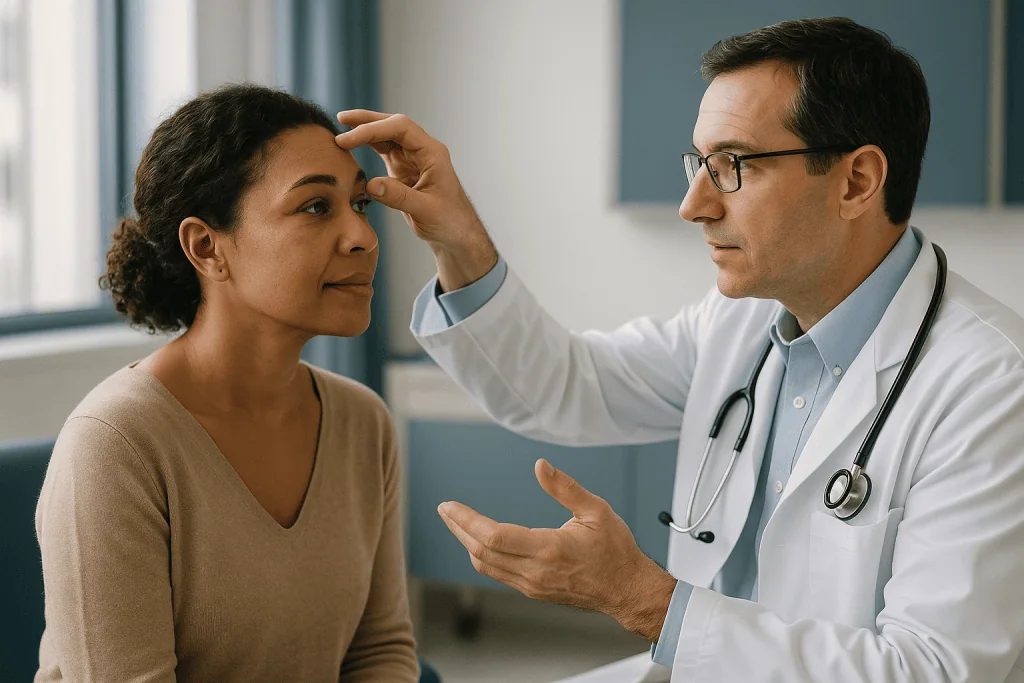
| Technique | Where the incisions sit | What it lifts best | Main trade-off |
|---|---|---|---|
| Endoscopic | Several small cuts behind the hairline | Whole brow, moderate lift | Less suited to very heavy brows or high foreheads |
| Temporal | Small cuts in the hair above the ears | Outer brow only | Does not address the inner brow or frown lines |
| Hairline (pretrichial) | Along the front hairline | Whole brow; shortens a tall forehead | Scar sits at a visible edge until it matures |
| Coronal | Ear to ear across the top of the scalp | Strong, durable lift | Raises the hairline; longer scar; more scalp numbness |
| Direct | Just above the eyebrow | Very heavy or asymmetric brows | Visible scar above the brow |
None of these is universally best. A person with a receding hairline, thick brows, and deep horizontal lines may be steered toward a direct or hairline approach, while someone with early outer-brow descent and a low forehead may need only a temporal lift. The surgeon’s recommendation depends on anatomy, and the choice belongs to that discussion.
Can a brow lift fix hooded eyes? Brow lift vs eyelid surgery
Hooding, the fold of skin that drapes over the upper eyelid, has two possible sources, and telling them apart is the most important judgment in the consultation. Excess eyelid skin causes hooding from below. A descended brow causes hooding from above, by pushing forehead skin down onto the lid. Many people have both.
The distinction determines the operation. Upper blepharoplasty, the eyelid surgery that removes excess skin and sometimes fat from the lid itself, treats the first cause. A brow lift treats the second. Mayo Clinic notes that blepharoplasty and brow lift are frequently considered together, and that a brow lift alone will not correct excess eyelid skin.
Here the surprised look re-enters. If a patient with a very low brow has only eyelid skin removed, the eyelid may look tidy but the brow can appear even lower, because the tissue that once bunched has been trimmed away and nothing remains to disguise the descent. Conversely, if a surgeon tries to fix true eyelid skin excess with a brow lift alone, the only way to clear the lashes is to lift the brow beyond its natural position, which produces exactly the raised, startled appearance patients dread. Matching the operation to the source of the hooding is what keeps brow lift results natural.
Surgeons assess this with simple maneuvers. They watch the brow while the patient’s forehead is fully relaxed, gently hold the brow at its natural rim position, and see how much eyelid skin still overhangs. If the lid clears with the brow held, a brow lift may be enough. If skin still drapes, eyelid surgery is needed, alone or combined. Vision insurance and medical criteria sometimes differ between the two operations because heavy hooding can restrict the upper visual field; that is a conversation for the treating team and is separate from cosmetic goals.
Who a brow lift is usually for, and who is usually asked to wait
The typical candidate has a brow that sits at or below the bony rim when the forehead is relaxed, skin folding onto the upper eyelid that lifts away when the brow is raised, and often deep horizontal forehead lines from years of compensating with the frontalis muscle. Age alone is not the criterion. Some people inherit a low brow and notice hooding in their thirties; others keep a high brow into their seventies.
General health shapes eligibility as much as anatomy. Mayo Clinic and the NHS both emphasize that people considering cosmetic surgery should be in good overall health, have realistic expectations, and understand the procedure and its risks. Smoking is a particular concern because nicotine narrows small blood vessels and impairs healing of the lifted scalp and forehead flap; many surgeons ask patients to stop well before and after the operation, and the advice on timing comes from the surgical team.
Certain situations commonly prompt a recommendation to wait or to reconsider. Uncontrolled blood pressure raises bleeding risk beneath the scalp. Conditions or medicines that affect clotting need review with the prescribing clinician; no one should stop a prescribed blood thinner on their own. Active skin infection or a flare of a skin condition on the forehead is a reason to postpone. Dry eye that is already troublesome deserves careful discussion, because anything that opens the eye wider can worsen it. A drooping upper eyelid caused by weakness of the eyelid-lifting muscle, known as ptosis, is not treated by a brow lift and may need a different operation.
Expectations are the final filter. Someone hoping the operation will change how others treat them, or who is under pressure from a partner, is often asked to take more time. The NHS advises anyone considering cosmetic surgery to reflect on their reasons and to avoid deciding during a period of emotional upheaval. The decision to proceed always rests with the patient and the treating team together.
How long does it take for a brow lift to work? The first two weeks
The honest answer is that a brow lift works immediately in the operating room and looks its worst for the next several days. The lift is real from the moment the tissue is fixed in place, but swelling, bruising, and a forehead that feels tight or heavy hide it.
The first night usually involves a snug dressing around the head and, in some techniques, a small drain to prevent blood from collecting under the scalp. Mayo Clinic describes a forehead that may be loosely wrapped and small tubes placed to drain excess fluid, which are typically removed within the first day or two. Pain tends to be moderate and is described more often as pressure or a dull headache than as sharp; the care team advises on pain control and any medicine decisions belong to them.
Swelling peaks over the first few days and, because fluid follows gravity, often travels downward to the eyelids and cheeks before it drains. Patients are commonly told to keep the head elevated, including during sleep, and to apply cool compresses as instructed. Bruising around the eyes is normal and can look dramatic without indicating a problem.
By the end of the first week, most sutures or clips in the scalp are removed and washing the hair is usually permitted. Mayo Clinic notes that bruising and swelling can take around two weeks or longer to settle, and that itching and numbness of the scalp are common and lessen over time. The brow at this stage often looks too high. That is expected: surgeons fix the tissue a little above the intended final position because some relaxation follows, and swelling adds to the apparent lift. Judging brow lift results in week one is like judging a haircut while it is still wet.
Endoscopic brow lift recovery from week two to month three
Once the acute swelling drains, a different phase begins, quieter and longer. Most people return to desk work and ordinary social activity around the two-week mark, when bruising can be covered or has faded; Mayo Clinic gives roughly this timeframe, though it varies with technique and with the individual. Strenuous exercise, heavy lifting, and anything that raises blood pressure into the head are typically restricted for longer, with the surgical team setting the timeline.
Numbness is the sensation that surprises people most. The nerves that supply feeling to the forehead and front of the scalp run through the operative field, and even when they are preserved, they are stretched and bruised. Mayo Clinic describes numbness and itching that can persist for months. Many patients report a curious insensitivity when brushing their hair, sometimes with tingling as the nerves recover. In a minority, particularly after coronal lifts, a strip of scalp numbness is permanent, and that is one of the trade-offs discussed before surgery.
The brow itself continues to settle. Small fixation devices used in endoscopic lifts, whether absorbable anchors or sutures, hold the tissue while it re-adheres to the bone; as they dissolve or as the tissue heals into its new position, the brow relaxes slightly toward its final height. Mild asymmetry in this period is common because the two sides swell and heal at slightly different rates, and surgeons generally ask patients not to judge symmetry until swelling is gone.
Scars mature slowly. Incisions in the hairline are typically pink and slightly raised for several weeks before flattening and fading over months. Hair around the incisions may shed temporarily, a stress response called telogen effluvium, before regrowing. By about three months, the picture is usually clear enough to assess the result, though subtle refinement continues for up to a year, which is why many surgeons schedule a longer follow-up before declaring the outcome final.
How long does a brow lift last? What the evidence actually says
People want a number, and the truthful response is that no clinical guideline provides one. Mayo Clinic states plainly that brow lift results are not permanent and that, with age, facial skin may begin to droop again. Beyond that, longevity depends on the technique, the quality of the fixation, the thickness and elasticity of the person’s skin, sun exposure, smoking, and simple genetics.
A useful way to think about it is that a brow lift resets the clock rather than stopping it. If the brow is lifted to the position it held roughly a decade or more earlier, aging then resumes from that new starting point at the same pace as before. The brow will descend again, but from a higher baseline, so many people never return to the appearance that prompted surgery. Patient resources commonly describe outcomes lasting many years, and coronal lifts, which fix the entire forehead, are generally considered more durable than temporal or minimally invasive approaches; the endoscopic method, with less tissue release, trades some longevity for smaller scars and faster recovery in most surgeons’ experience.
Certain factors shorten the visible benefit. Thin, sun-damaged skin stretches more readily. Continued heavy use of the frontalis muscle, as in people who frown or squint habitually, pulls against the new position. Significant weight loss changes the fat under the brow. None of these can be promised against.
What surgeons can do is set the brow accurately, fix it securely, and avoid over-tightening, since a brow lifted too high in an attempt to “buy time” simply produces the surprised look for longer. Revision, when wanted years later, is possible but more complex because of scar tissue, and that too is a conversation for the treating team rather than a plan made in advance.
What are the cons of a brow lift? Risks in plain language
Every operation has a ledger, and the cons of a brow lift deserve the same clear-eyed reading as the benefits. Mayo Clinic and MedlinePlus list the recognized risks, and they fall into a few groups.
Sensation changes head the list. Numbness or itching across the forehead and scalp is nearly universal for a time and can be permanent in some people, especially after coronal incisions. Rarely, nerve injury affects movement rather than feeling: damage to the small branch of the facial nerve that lifts the brow can leave one side unable to rise, producing asymmetry that may or may not recover over months.
Hair and hairline issues follow. The coronal approach raises the hairline, which is why it is generally avoided in people with tall foreheads. Hair loss along incisions occurs from the trauma of surgery and usually regrows, but permanent thinning at a scar is possible. Scars themselves are hidden in most techniques yet can widen, thicken, or stay visible, particularly in the direct approach above the brow.
Position problems are the risk most relevant to this article. Over-correction gives the surprised look; under-correction leaves hooding; asymmetry between sides can persist. Some early relapse of the lift, where the brow drifts back toward its original position during the first months, is also described.
General surgical risks apply: bleeding under the scalp (a hematoma) that may need drainage, infection, poor wound healing, especially in smokers, and reactions to anesthesia. Eye-related effects include temporary difficulty closing the eyes fully and worsened dryness, which is why pre-existing dry eye matters. Finally, there is the recovery itself: weeks of swelling, months of altered sensation, and time away from exercise and, for some, from work. Weighing these against a cosmetic benefit is a personal calculation that no one else can make.
Scars, hairlines, and numbness: the trade-offs behind a hidden lift
Where an incision sits determines what a person sees in the mirror years later, and it is worth understanding the compromise built into each choice. The scalp is generous with cover: hair hides scars completely once it regrows, which is why endoscopic and coronal incisions are placed behind the hairline. The price is that lifting from behind the hairline pulls the hairline itself upward. For someone with a low, full hairline that is a minor effect; for someone whose forehead is already tall, it can be conspicuous.
The hairline incision solves that by cutting exactly along the front edge of the hair, so the forehead skin is lifted and excess removed without moving the hair. The scar, however, sits at a boundary that is visible when hair is pulled back or wet. Surgeons bevel the cut so hair grows through the scar and camouflages it, and most such scars fade to a fine line over months, but a person who wears hair scraped back should know the scar is there.
The direct brow lift places the scar in plain view just above the eyebrow. It is chosen when the brow is very heavy, when hair is sparse, or when a precise, powerful lift is needed on one side to correct asymmetry from nerve weakness. The scar is usually tucked into the top edge of the brow hairs and, in people with deep horizontal forehead lines, can be hidden in a crease. Still, it is a visible incision, and that is a real trade-off.
Numbness follows the same geography. Nerves exit the skull above the inner brow and run upward across the forehead into the scalp; the longer and further back the incision, the more of that pathway is disturbed. Mayo Clinic notes that numbness and itching may persist for months, and surgeons should explain which pattern their chosen technique tends to produce. Knowing this in advance makes a numb patch in month three an expected sensation rather than an alarming one.
Non-surgical alternatives: what injectables and energy devices can and cannot do
Not everyone with a heavy brow wants or needs an operation, and the alternatives deserve neutral description. Botulinum toxin injections, a class of medicine that temporarily blocks the nerve signal to a muscle, are widely used around the brow. By weakening the muscles that pull the brow down at the outer corner and between the brows, while sparing the frontalis that holds it up, an injector can produce a modest rise in the tail of the brow. MedlinePlus and Mayo Clinic describe the effect as temporary, with Mayo Clinic citing a duration of roughly three to four months before repeat treatment is needed. The lift is measured in millimeters rather than the centimeter-scale change surgery can achieve, and the decision to use any medicine, and how, belongs to a qualified prescribing clinician, not to a magazine.
Fillers, injectable gels that add volume, can restore fullness under a deflated outer brow so that the skin is supported rather than lifted. They do not move a descended brow. Energy-based skin tightening, using radiofrequency or ultrasound to heat the deeper layers and provoke collagen tightening, is marketed for brow elevation; the evidence for meaningful, lasting brow repositioning with these devices is limited and results are typically subtle, so it is fair to describe them as unproven for anything beyond mild change.
Where do these fit? For early outer-brow descent in a younger person, or for someone who is not a surgical candidate, temporary measures can be reasonable. For a brow that sits well below the rim with significant hooding, no injection or device replicates the effect of moving the tissue itself. A common pattern is that a person uses injectables for some years, finds the benefit diminishing as the brow continues to descend, and then discusses surgery. Neither path is superior in the abstract; the right one depends on anatomy, goals, tolerance for downtime, and the advice of the treating clinician.
What people often get wrong about brow lift results
Misconceptions cluster around this operation, partly because the surprised look is so memorable and partly because before-and-after galleries are curated. A few corrections.
“A brow lift will make me look surprised.” Over-elevation of the inner brow does that, and modern technique specifically avoids it by lifting the outer brow more than the inner and fixing conservatively. A natural result does not change expression at rest.
“It removes forehead wrinkles.” Horizontal lines often soften because the frontalis stops overworking, and frown lines can lessen if the muscles between the brows are weakened, but a brow lift is a repositioning operation, not a skin-resurfacing one. Fine lines from sun damage remain.
“It fixes hooded eyes.” Only when the hooding comes from the brow. Eyelid skin excess needs eyelid surgery, and combining the two is common for that reason.
“Results are permanent.” Mayo Clinic states they are not; aging continues from the new position.
“The brow looks too high, so it went wrong.” In the first weeks, a high brow is expected, because surgeons set the tissue slightly above target and swelling exaggerates it. Judgment belongs at three months and beyond.
“Numbness means nerve damage.” Temporary numbness is a normal consequence of stretching sensory nerves and typically improves over months; permanent numbness is possible but is the exception and is disclosed as a risk beforehand.
“Endoscopic is always better because the scars are smaller.” Smaller scars are real, but the endoscopic method offers less lift for very heavy brows and may be less durable than a coronal lift. Technique should match anatomy, not marketing.
“A good surgeon can guarantee symmetry.” Faces are asymmetric before surgery and heal at different rates on each side; improvement is realistic, perfection is not, and Mayo Clinic lists asymmetry among possible outcomes.
Questions to ask your care team before a brow lift
A consultation goes better with specific questions, and the answers reveal a great deal about how a surgeon thinks about natural brow lift results. These are worth bringing on paper.
- Where does my brow sit relative to the bony rim when my forehead is fully relaxed, and how much of my hooding comes from the brow versus the eyelid skin?
- Which technique are you recommending for my anatomy, and why that one rather than the alternatives?
- Where exactly will the incisions be, and how will they affect my hairline, especially if I wear my hair back?
- How high do you plan to set my brow, and how do you decide how much to lift the inner versus the outer brow?
- Do you expect I will also need upper eyelid surgery, now or later, to reach the result I am describing?
- What pattern of numbness should I expect from this technique, and how often is it permanent in your experience?
- What is your approach if one brow heals higher than the other?
- Which of my current medicines or supplements need review before surgery, and who should I speak to about them?
- How long will you ask me to avoid exercise, and when do you consider the result final enough to judge?
- What signs after surgery should prompt me to call you immediately, and how do I reach the team out of hours?
- Are you able to show me results in people whose starting anatomy resembles mine, including those you consider less than ideal?
- If I am unhappy with the position at six months, what are the options, and what are the limits of revision?
Notice what these questions have in common: they ask about the plan for your face rather than about the surgeon’s reputation. A team comfortable answering them in detail is demonstrating the kind of individualized thinking that keeps the brow where it belongs. The final decision, including whether to proceed at all, sits with you and that team.
When to call your doctor after a brow lift
Most of what follows surgery, including swelling, bruising that drifts into the eyelids, tightness, itching, and patches of numbness, is expected and improves week by week. A smaller set of signs indicates a complication that needs prompt attention, and knowing them in advance removes the guesswork.
Contact your surgical team the same day, or seek emergency care if you cannot reach them, for any of the following: rapidly increasing swelling on one side of the forehead or scalp, particularly if it is firm, tense, or accompanied by worsening pain, which can signal a hematoma that may need to be drained; bleeding from an incision that does not stop with gentle pressure; a fever, or increasing redness, warmth, and tenderness spreading from an incision, or discharge that is cloudy or has an odor, all of which can indicate infection; sudden severe headache or vision changes; new inability to raise one brow or close one eye fully after the initial swelling has begun to settle; and any sign of a reaction to a medicine such as a rash, swelling of the lips or tongue, or difficulty breathing, which is an emergency.
Eye symptoms deserve their own line. If an eye feels persistently gritty, painful, or sensitive to light, or if you cannot fully close it at night, tell the team; the surface of the eye can dry and be damaged if it is not protected.
General surgical warning signs also apply: chest pain, shortness of breath, or calf pain and swelling can indicate a blood clot and warrant emergency evaluation regardless of the operation performed.
Beyond the acute period, call if something simply feels wrong to you. A brow that remains markedly uneven at three months, sensation that is worsening rather than improving, or a scar that is thickening and itchy all merit review rather than waiting for a scheduled visit. Your treating team is the right judge of what needs action, and no article, including this one, replaces that conversation.
Frequently asked questions
How long does a brow lift last?
There is no guideline figure; Mayo Clinic states the results are not permanent and that skin may begin to droop again with age. The operation moves the brow to an earlier position and aging then resumes from there, so many people never return to their pre-surgery appearance. Durability depends on technique, skin quality, sun exposure, smoking, and genetics, and coronal lifts are generally considered longer-lasting than minimally invasive approaches.
What are the cons of a brow lift?
The main drawbacks are numbness or itching of the forehead and scalp that can last months and occasionally persists, hair loss or a raised hairline along incisions, scars that may remain visible with some techniques, asymmetry, over- or under-correction, and general surgical risks such as bleeding under the scalp, infection, and anesthesia reactions. Recovery also involves weeks of swelling and time away from exercise. Mayo Clinic and MedlinePlus list these risks.
Can a brow lift fix hooded eyes?
Only when the hooding is caused by a descended brow pushing forehead skin onto the lid. If the excess is in the eyelid skin itself, upper eyelid surgery is needed, and many people require both because they have both problems. Attempting to clear eyelid hooding with a brow lift alone requires over-lifting the brow, which produces the surprised look surgeons work to avoid.
How long does it take for a brow lift to work?
The lift exists the moment surgery ends, but swelling and bruising hide it for roughly two weeks according to Mayo Clinic, and the brow often looks too high at first because surgeons set it slightly above target. As swelling drains and tissue settles over about three months, the final position emerges, with subtle refinement of scars and sensation continuing for up to a year.
What is endoscopic brow lift recovery like compared with other techniques?
Endoscopic lifts use several small scalp incisions and a camera, so scars are hidden and swelling and numbness tend to be less extensive than after a coronal incision that runs ear to ear. Return to desk work is commonly around two weeks in either case, with exercise restricted longer by the surgical team. The trade-off is that the endoscopic method offers less lift for very heavy brows and may be less durable.
How is a brow lift different from eyelid surgery?
A brow lift repositions the eyebrows and forehead tissue from above, using incisions in the scalp or hairline. Eyelid surgery, or blepharoplasty, removes excess skin and sometimes fat from the eyelid itself through an incision in the lid crease. They treat different causes of a tired or hooded appearance, and Mayo Clinic notes they are often considered together when both the brow and the eyelid contribute.
Will a brow lift change my expression or make me look surprised?
A well-planned brow lift should not change your resting expression. The startled look results from raising the inner brow too far, and contemporary technique deliberately lifts the outer brow more than the inner and sets the position conservatively, since a brow a few millimeters too high looks operated on while one slightly low still looks natural. Discuss the planned brow height with your surgeon before the operation.
Does a brow lift get rid of forehead wrinkles?
Partly. Horizontal forehead lines often soften because the frontalis muscle no longer has to work constantly to hold a heavy brow up, and frown lines between the brows can lessen if those muscles are weakened during surgery. A brow lift does not resurface the skin, so fine lines from sun damage and texture changes remain, and separate treatments would be needed for those.
Who should not have a brow lift or is usually asked to wait?
People with uncontrolled blood pressure, active skin infection on the forehead, or clotting problems needing review are commonly asked to postpone. Smoking impairs healing of the lifted tissue, and troublesome dry eye deserves careful discussion because widening the eye can worsen it. A drooping eyelid from muscle weakness, called ptosis, is not treated by a brow lift. The treating team makes the final assessment.
Is scalp numbness after a brow lift permanent?
Usually not, but it can be. Nerves supplying the forehead and front scalp are stretched during surgery, and Mayo Clinic describes numbness and itching that may last months before improving. A permanent numb area is a recognized possibility, more often after coronal incisions that cross the nerve pathways. Ask your surgeon which sensation pattern the planned technique typically produces so changes afterward are expected rather than alarming.
References
This article is for general information only and is not a substitute for professional medical advice. Please consult a qualified doctor about your individual situation.

More from the Blog

Compression Garments and Activity Limits After Cosmetic Surgery: The First Weeks Explained
A compression garment after cosmetic surgery is a snug, elastic wrap or suit worn over the treated area to limit swelling, support healing tissue…

How to Read a Facial Correction Treatment Plan: Staging, Combined Procedures and Limits
A facial balancing treatment plan is a written map of how a clinician proposes to adjust the proportions of the face, usually in stages,…
Liquid Facelift or Surgical Facelift: Which One Addresses Jowls and Loose Skin?
A surgical facelift repositions the deeper tissue layer and removes excess skin, so it is the option designed to address true jowls and loose…

Sliding Genioplasty vs Chin Implant: Which Option Fits a Receding or Long Chin?
Sliding genioplasty moves the patient's own chin bone forward, back, up, or down and fixes it with small plates, so it can treat both…
What Happens at a Liquid Rhinoplasty Appointment? Numbing, Injection Points and First Swelling
A liquid rhinoplasty procedure is a nonsurgical treatment in which small amounts of dermal filler, usually hyaluronic acid, are injected along the bridge or…
How to Compare Two Facial Aesthetic Surgery Plans: Technique, Scars and Recovery Weighed
To compare two facial aesthetic surgery plans, line them up on the same four points: what each technique changes beneath the skin, where every…