

Who Is a Candidate for Non-Surgical Facial Rejuvenation? Age, Skin Type and Expectations

Key Takeaways
- Botulinum toxin softens only lines made by muscle movement, typically begins working within one to three days and wears off over roughly three to four months according to Mayo Clinic.
- Hyaluronic acid fillers replace lost volume rather than lifting loose skin, and the NHS reports results generally lasting six to eighteen months before the gel is broken down.
- Skin tone changes the risk calculation: Mayo Clinic notes deeper Fitzpatrick types carry a higher chance of lasting pigment change after medium or deep peels and ablative lasers.
- Active infection, pregnancy, uncontrolled bleeding tendencies, certain neuromuscular conditions and previous permanent filler are common reasons a clinician postpones or declines injectable treatment.
- Vascular occlusion from filler is rare but sight-threatening; white, dusky or mottled skin, severe pain or any vision change after injection needs immediate medical attention.
- When the main complaint is sagging along the jaw or neck, no injectable or device convincingly substitutes for a facelift, and adding volume can make the face look heavier rather than younger.
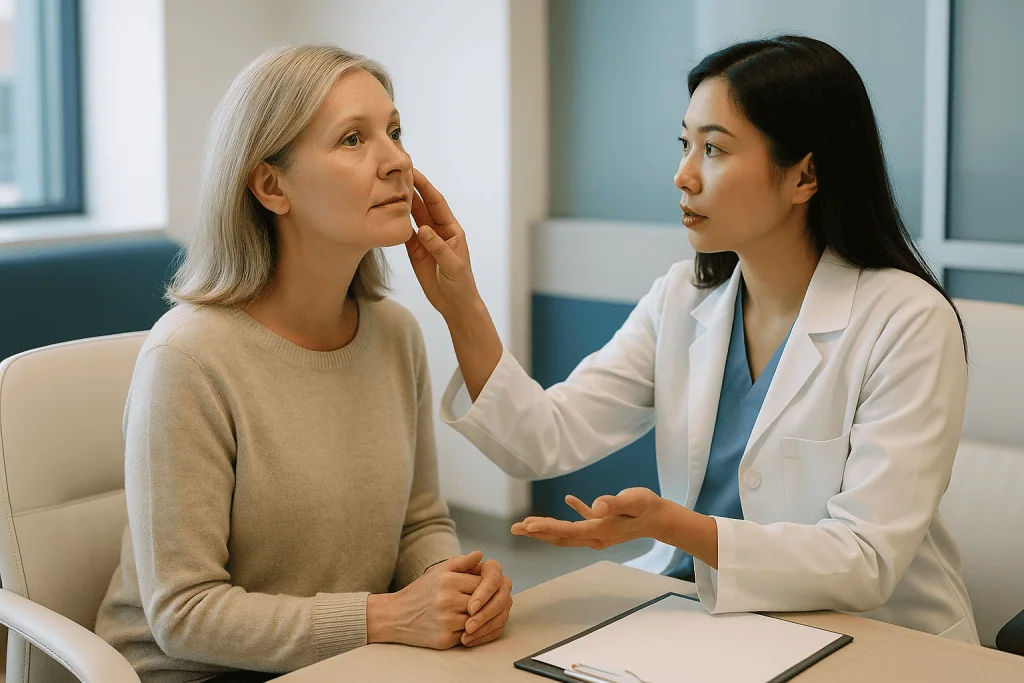
A candidate for non-surgical facial rejuvenation is usually a healthy adult with early to moderate signs of aging, such as expression lines, mild volume loss or sun-related texture change, who has realistic expectations and no active skin infection, pregnancy, uncontrolled medical condition or untreated body image concern. Age matters less than skin quality, health and goals, and the treating clinician decides suitability after an in-person assessment.
She is 52, standing in a changing-room mirror under a light that forgives nothing. The lines fanning from the corners of her eyes do not bother her; she earned those laughing. What bothers her is the tiredness she sees when her face is at rest, a heaviness at the jaw that was not there five summers ago. A friend mentioned injectables. A colleague swears by a laser. Neither of them can answer the question she actually has: is any of this meant for someone like me?
That question, whether you are a genuine facial rejuvenation candidate, is more useful than any product name, because the answer depends on you rather than on the treatment. Your skin, your health, your history, the way you talk about what you hope to see.
This explainer walks through how clinicians think about that assessment: what age does and does not tell them, why skin type changes the conversation, and how expectations quietly decide whether a person walks out pleased or disappointed.
What does 'facial rejuvenation candidate' actually mean?
Facial rejuvenation is an umbrella term for treatments that aim to soften visible signs of skin aging. The non-surgical branch covers anything that does not involve incisions: injections that relax muscles, gel injections that restore volume, and energy or chemical treatments that renew the skin surface. Surgery, such as a facelift, sits on the other branch and is discussed later for comparison.
When a clinician calls someone a candidate, they are saying three separate things at once. First, that the changes bothering the person are the kind these treatments can plausibly address. A crease that appears only when you frown behaves very differently from a fold that is etched in at rest, and both differ from sagging caused by loosened ligaments and displaced fat. Second, that the person’s health and skin make the risk acceptable. Third, and this part is often skipped in marketing, that what the person expects matches what the treatment can deliver.
Aging skin changes in predictable ways. MedlinePlus describes the outer layer thinning, pigment cells decreasing in number, connective tissue losing strength and elasticity, and the fat layer beneath the skin shrinking, all of which contribute to lines and a less padded look. Sun exposure accelerates every one of those processes, which is why the backs of hands and the face age faster than skin that stays covered.
Candidacy, then, is not a yes-or-no label stamped on a birth certificate. It is a match between a specific change, a specific method and a specific person, and it is decided in a consultation, not online. Everything that follows is meant to help you have a better version of that consultation, not to replace it.
How does non-surgical facial rejuvenation work?
Most non-surgical options fall into four mechanisms, and understanding them explains who benefits from each.
Muscle relaxants. Botulinum toxin is a purified protein that temporarily blocks the signal between a nerve and the small facial muscles that create expression lines. Mayo Clinic notes the effect usually starts within one to three days, can take a week or more to fully appear, and wears off over roughly three to four months as nerve endings recover. It does nothing for lines caused by sun damage or lost volume, which is why it suits the person whose lines vanish when their face is still.
Volume replacement. Dermal fillers are injectable gels, most commonly made from hyaluronic acid, a sugar molecule the body already produces to hold water in tissue. They are placed beneath the skin to restore contour where fat and bone have receded. The NHS notes results typically last between six and eighteen months before the body gradually breaks the material down.
Surface renewal. Chemical peels apply an acid solution that removes damaged outer layers so smoother skin can grow in; laser resurfacing does something similar with focused light, either removing thin layers (ablative) or heating the deeper skin without breaking the surface (non-ablative). Mayo Clinic describes both as treatments for fine lines, uneven pigment and texture rather than for sagging.
Collagen stimulation. Microneedling, radiofrequency and some biostimulatory injectables create controlled, minor injury or heat so the skin responds by producing more collagen, the protein scaffold that gives skin firmness. Results here are slower and more modest, and evidence quality varies widely between devices.
The practical lesson is that each mechanism treats one layer of the problem. A skilled assessment identifies which layer is bothering you before anyone reaches for a syringe.
Non-surgical facelift candidates: who is usually suitable and who is asked to wait
Clinicians tend to describe the typical non-surgical candidate in remarkably similar terms across guidance from Mayo Clinic, the NHS and Cleveland Clinic. Good general health. Skin that still has reasonable elasticity, meaning it springs back when gently pinched. Concerns that are early to moderate: dynamic lines, mild hollowing under the eyes or in the cheeks, softening of the jawline rather than a heavy, folded neck. A stable weight, because significant weight change reshapes the face and can undo volume work. Non-smoking, or willing to stop, since smoking impairs healing and accelerates skin aging.
People are usually asked to wait, or steered elsewhere, in a few recognizable situations.
- Active skin infection, cold sores, acne flare or rash in the treatment area, because injecting or resurfacing inflamed skin raises infection and scarring risk.
- Pregnancy or breastfeeding, where safety data for injectables are lacking and clinicians routinely defer.
- Uncontrolled medical conditions, particularly bleeding disorders, autoimmune disease affecting skin or nerves, or use of blood-thinning medicines that the prescribing doctor has not reviewed.
- A history of keloid or abnormal scarring, which matters most for peels and ablative lasers.
- Advanced laxity: when the primary concern is loose, hanging skin, no injectable or device convincingly substitutes for surgery, and honest clinicians say so.
One more group deserves a gentle mention. Body dysmorphic disorder is a recognized mental health condition in which a person is preoccupied with a perceived flaw others barely notice. Reputable practitioners screen for it because cosmetic treatment tends to worsen rather than relieve the distress. Being asked a few questions about how you feel about your appearance is a sign of good practice, not an insult.
Does age matter? Am I too young for Botox, or too old for fillers?
Age is the number everyone leads with and the one clinicians weigh least. Two people born the same year can have skin a decade apart depending on sun exposure, smoking, genetics and hormones. Still, age shapes the conversation in a few honest ways.

In the twenties, the face is usually full and elastic, and most lines are purely dynamic. Some people seek muscle relaxants early with the idea of preventing creases from forming. The mechanism is plausible, since a line that is never repeatedly folded may etch more slowly, but there is no high-quality long-term evidence quantifying how much benefit this offers, and repeated treatment over decades carries its own uncertainty. A cautious clinician often suggests starting with sun protection and a retinoid, which Mayo Clinic lists among wrinkle treatments with supporting evidence, and revisiting injectables when lines begin to persist at rest.
In the thirties and forties, fine lines settle in, the mid-face begins to lose volume and skin tone becomes less even. This is the period in which the widest range of non-surgical options are realistically matched to the changes present.
From the fifties onward, the balance shifts. Volume loss deepens, bone remodels, and skin laxity becomes the dominant change. Fillers still help with hollows, and relaxants still soften expression lines, but when the main complaint is sagging along the jaw or neck, adding volume can make a face look heavier rather than younger. There is no upper age limit for non-surgical treatment in itself; what changes is whether it is the right tool.
MedlinePlus is clear that skin aging is gradual and individual. Treat the skin in front of you, not the date on the form.
How skin type and skin tone change the assessment
Skin type in a clinical sense usually refers to the Fitzpatrick scale, a six-step classification of how skin responds to sun, from type I (always burns, never tans) to type VI (deeply pigmented, rarely burns). It matters here because the risk profile of surface treatments changes across the scale.
Lighter skin tends to show sun damage earlier: fine crinkling, broken capillaries and uneven red-brown patches. It also tolerates a wider range of peels and lasers with lower pigment risk. Deeper skin tones age differently. They keep a smoother surface for longer, because more melanin offers some protection from ultraviolet light, and the changes people notice are more often volume loss, uneven tone and lines around the mouth. Mayo Clinic notes that laser resurfacing and medium to deep chemical peels carry a higher risk of post-inflammatory hyperpigmentation, meaning darkened patches after healing, or hypopigmentation, meaning lightened patches, in people with darker skin. Neither is dangerous, but both can be long-lasting and are the main reason a clinician may steer toward gentler settings, a test patch or a different approach altogether.
Injectables are less affected by skin tone, since they work beneath the surface, though bruising can be less visible on deeper skin and therefore easier to miss when checking for problems.
Skin quality matters alongside tone. Very thin, sun-fragile skin bruises more easily and can show filler edges. Oily, thick skin may need different peel strengths. Rosacea, a chronic redness condition, and eczema both make surface treatments riskier and are usually controlled first.
A consultation that does not ask how your skin reacts to sun, what your parents’ skin looked like, and whether you have ever had a dark mark linger after a spot, is a consultation missing half the picture.
Who should not get dermal fillers or other injectables?
Because injectables are the most common entry point, their exclusions deserve their own space. These are the situations in which Cleveland Clinic, Mayo Clinic and the NHS describe clinicians as routinely declining or postponing.
Known allergy to any component of the product, including lidocaine, a local anesthetic mixed into many fillers, or a previous serious reaction to a similar injection.
Active infection anywhere in the body, not only the face. Bacteria circulating in the blood can seed a filler and form a biofilm, a slow-growing infection that is difficult to treat. Many clinicians also defer around dental work for the same reason.
Bleeding tendencies, whether from a diagnosed condition or from medicines and supplements that thin the blood. This does not mean a person on prescribed anticoagulation can never be treated, but it does mean the prescribing doctor must be involved; nobody should stop a prescribed medicine to make a cosmetic appointment possible.
Certain neuromuscular conditions. Botulinum toxin is generally avoided in people with disorders that already weaken muscle signaling, because the effect can be exaggerated. Mayo Clinic lists this among the reasons a doctor may advise against treatment.
Pregnancy and breastfeeding, as noted earlier, because the studies simply have not been done.
Previous permanent filler in the same area. Older permanent or semi-permanent materials can react unpredictably when new product is layered on top, and a clinician needs to know exactly what is already in the tissue.
Finally, unrealistic goals. A person who arrives wanting to look like a filtered photograph, or who expects a single session to lift a jowl, is not a candidate for the treatment they are describing, however healthy they are. Saying no in that moment is part of competent care.
Does facial rejuvenation really work, and what does 'younger' realistically mean?
Yes, within limits, and the limits are the whole story.
Botulinum toxin for dynamic lines has decades of clinical use and consistent evidence; Mayo Clinic describes it as an effective treatment for wrinkles caused by muscle movement, with results that fade over three to four months. Hyaluronic acid fillers reliably restore volume where it has been lost, with the NHS citing a typical duration of six to eighteen months. Chemical peels and laser resurfacing measurably improve fine lines, pigment and texture, with deeper treatments producing larger changes at the price of longer recovery. These are real effects, visible in photographs and confirmed in controlled studies.
What they do not do is turn back a clock. There is no validated way to promise that someone will look a specific number of years younger, and any figure you see advertised is opinion, not evidence. A more useful frame is the one experienced clinicians tend to use: rested, not different. Well-judged treatment makes people say you look well; over-treatment makes them ask what you had done.
The other honest caveat is that results are temporary and maintenance is part of the deal. A relaxed frown line returns. Filler is metabolized. New sun damage accumulates on freshly resurfaced skin unless it is protected. Anyone planning treatment should picture it as a series of appointments over years, not a single fix, and should weigh whether that ongoing commitment suits their life and budget.
Evidence quality also varies. Injectables and resurfacing are well studied. Many energy devices marketed for tightening have smaller, shorter, industry-funded studies, and thread lifts have limited long-term data. When a clinician cannot point to independent evidence, the right response is curiosity, not enthusiasm.
Comparing the main non-surgical options: what each treats and typical downtime
The table below summarizes what mainstream sources describe for each approach. Durations are typical ranges reported by the cited references, not guarantees, and individual results vary with skin, technique and lifestyle.
| Approach | Main target | Typical downtime | How long results are typically reported to last | Common cautions |
|---|---|---|---|---|
| Botulinum toxin | Expression lines (forehead, frown, crow’s feet) | Minimal; small bumps settle within hours | About 3–4 months (Mayo Clinic) | Neuromuscular disorders, pregnancy, asymmetry, drooping eyelid |
| Hyaluronic acid filler | Volume loss, deeper folds, contour | Swelling and bruising for several days | About 6–18 months (NHS) | Vascular occlusion, infection, lumps, allergy |
| Light chemical peel | Fine lines, dullness, mild pigment | Redness and flaking about 1–7 days (Mayo Clinic) | Cumulative; repeated sessions | Sun sensitivity, pigment change in darker skin |
| Medium or deep peel | Deeper lines, sun damage | About 7–14 days for medium; longer for deep (Mayo Clinic) | Longer lasting; deep peels often once | Scarring, pigment change, heart monitoring for deep phenol peels |
| Ablative laser | Texture, lines, scars, pigment | Raw, swollen skin healing over roughly 1–2 weeks (Mayo Clinic) | Long lasting, but aging continues | Pigment change, infection, cold sore reactivation |
| Non-ablative laser or radiofrequency | Mild texture and tone | Little to none | Gradual, modest; several sessions | Variable evidence between devices |
Two patterns stand out. The gentler the treatment, the shorter the downtime and the smaller the change. And the treatments with the strongest evidence are also the oldest: relaxants, fillers, peels and lasers. Newer devices are not automatically worse, but the burden of proof sits with the device, and a candidate who understands this asks better questions.
What the days and weeks after treatment usually look like
Recovery is where expectations most often collide with reality, so it helps to know the usual arc before booking.
After botulinum toxin, most people leave with small raised bumps at the injection points that flatten within an hour or so. Mild redness or a pinpoint bruise can occur. Mayo Clinic advises avoiding rubbing the treated area for a day so the product stays where it was placed. The effect creeps in over one to three days and settles fully in about two weeks, which is why any follow-up assessment is usually scheduled after that window rather than the next morning.
Filler brings more visible change immediately, along with swelling that can make the result look larger and less even than the final outcome. Bruising is common and can take a week or more to fade. Lips and the under-eye area swell the most. Clinicians commonly suggest avoiding strenuous exercise, alcohol and heat for the first day or two because all three increase swelling, though the specific advice varies and the treating team’s instructions take precedence.
Peels and lasers follow a healing timeline rather than a settling one. Mayo Clinic describes a light peel producing redness and flaking for one to seven days, a medium peel around seven to fourteen days of swelling, crusting and peeling, and ablative laser resurfacing leaving skin raw and swollen with new skin covering the area in roughly one to two weeks, followed by pinkness that can persist for months. During this period the skin is exceptionally sun-sensitive; strict sun protection is not optional, it is part of the treatment.
Across all methods, the emotional timeline matters too. Many people feel a dip of doubt at day three, when swelling or peeling is at its peak. Knowing that this is expected turns a frightening moment into a predictable one.
Risks of non-surgical facial rejuvenation, described plainly
Non-surgical does not mean risk-free, and a candid list is more reassuring than a vague one because it shows what your clinician is watching for.
Botulinum toxin. The most common problems are bruising, headache and a temporary droop of the eyelid or brow if the product spreads to a nearby muscle; Mayo Clinic notes these usually resolve as the effect wears off. Uneven results can happen. Very rarely, the toxin spreads beyond the treatment area and causes weakness, swallowing or breathing difficulty, which is a medical emergency.
Dermal fillers. Cleveland Clinic and the NHS list swelling, bruising, lumps and asymmetry as the common issues. The serious one is vascular occlusion: filler entering or compressing a blood vessel and cutting off supply to the skin or, exceptionally, to the eye. Warning signs include unusual pain, blanching (skin turning white), a dusky or mottled color, or any change in vision, and they require immediate attention. Delayed nodules and infection can appear weeks later. Filler can also migrate from where it was placed, particularly around the lips.
Peels and lasers. Beyond the expected redness and peeling, Mayo Clinic describes scarring, infection, reactivation of cold sores, and lasting pigment change as the main risks, with pigment problems more likely in deeper skin tones and with deeper treatments. Deep phenol peels carry additional heart rhythm risk and are performed with monitoring.
Across all methods, the single largest modifiable risk is who performs the treatment. Injectables and energy devices are medical procedures. The NHS advises checking that the practitioner is a suitably trained healthcare professional working in a clean clinical setting with the ability to recognize and manage complications. Convenience and price are poor reasons to choose a provider for something that can, rarely, threaten your sight.
Non-surgical versus a facelift: when surgery is the more honest answer
Sooner or later many people ask about the operation their friend had, or about the deep plane facelift they have read about. A facelift, described by MedlinePlus as surgery to tighten and lift the skin and underlying tissue of the face and neck, is the only approach that directly repositions sagging tissue. Variants such as the deep plane technique release and lift the deeper layer of muscle and connective tissue rather than pulling skin alone, an approach surgeons have refined for decades rather than a new invention.
Surgery becomes the more honest discussion when the dominant complaint is laxity: jowls, a heavy neck, deep folds running from nose to mouth that persist when the face is relaxed and do not improve when a clinician gently lifts the cheek in the mirror. Adding filler to a face like this can create a fuller but not younger result; relaxants do nothing for hanging skin. A good non-surgical practitioner will say when they have reached the edge of what their tools can do.
The trade-offs are real. Surgery involves anesthesia, incisions, weeks of recovery and the risks MedlinePlus lists, including bleeding, infection, nerve injury and scarring, and its results also age over time. Non-surgical care involves smaller, repeated interventions with faster recovery and smaller changes. Neither is superior in the abstract; they answer different questions.
What this article cannot do is tell you which is right for you, or where to have it. That is a decision made with a treating team who has examined your face, reviewed your health and heard your goals. If someone offers you a definitive answer online, or urges you to travel somewhere for a package, treat that as a warning sign rather than a shortcut.
What people often get wrong about facial rejuvenation
The myths here are persistent partly because the marketing is loud and the evidence is quiet.
“There is a new facelift everyone is getting.” Techniques evolve, and terms like deep plane, mini lift or liquid facelift circulate in waves. None of them is a universal answer, and the right procedure depends on anatomy, not fashion. Be wary of any technique described as suitable for everyone.
“A Cinderella facelift is a real procedure.” This is a marketing name, not a medical term. It is used loosely for temporary lifts using threads or fillers meant to look good for an event and fade afterward. Thread lifts, in which dissolvable barbed sutures are placed under the skin to reposition tissue, have limited long-term evidence and carry risks of visible threads, dimpling and infection. A name borrowed from a fairy tale should prompt more questions, not fewer.
“Injectables prevent aging.” They can soften the lines that repeated expression creates, but they do not stop collagen loss, bone change or sun damage. Daily broad-spectrum sunscreen, which the CDC recommends alongside shade and protective clothing, does more to slow visible aging than any injection.
“Non-surgical means no risk.” See the previous section. Blindness from filler is rare but documented.
“More product means a better result.” Overfilled faces look older and stranger, not younger. Restraint is a skill.
“Cost tells you about quality.” This article does not discuss prices, because they vary enormously and say little about safety. What predicts a good outcome is a trained, regulated clinician, a thorough assessment and honest expectations.
“Results are permanent.” Almost nothing non-surgical is, and even surgery ages.
Questions to ask your care team before deciding
A consultation is not a sales appointment; it is your chance to test whether the person in front of you sees your face clearly and speaks about it honestly. These questions tend to surface the answers that matter.
- What exactly do you see when you look at my face, and which of those changes is causing the effect that bothers me?
- Which layer are we treating: muscle, volume, surface or laxity? Why that one first?
- What is the evidence for this specific treatment, and how strong is it? Is any of it independent of the manufacturer?
- What will I look like at day three, day fourteen and month six?
- How long do results typically last for someone with my skin, and what does maintenance realistically involve over five years?
- What are the serious complications, how would I recognize them, and how do I reach you out of hours if one happens?
- Have you managed a vascular occlusion or a pigment complication, and what did you do?
- Given my skin tone and history, is there a version of this treatment you would avoid?
- Is there anything about my health, medicines or plans, such as pregnancy, dental work or travel, that means I should wait?
- What would you recommend if I decided to do nothing at all?
Listen as much to how questions are answered as to what is said. A clinician who is comfortable saying “I would not treat that” or “the evidence is thin” is showing you exactly the judgment you want applied to your face. One who promises a specific number of years or discourages a second opinion is telling you something too.
Bring a list of every medicine and supplement you take, including over-the-counter pain relievers, fish oil and vitamin E, which can increase bruising. Never stop a prescribed medicine for a cosmetic appointment without speaking to the doctor who prescribed it.
When to call your doctor after facial rejuvenation treatment
Most recovery is uneventful, and most of what you notice in the first days is expected swelling, bruising or peeling. A small number of signs are different in kind and need prompt contact with the treating clinician, or emergency care if you cannot reach them.
After filler, seek help immediately for skin that turns white, gray, dusky, mottled or unusually purple in or near the treated area; pain that is severe or out of proportion; a blister or area of skin breakdown; or any change in vision, including blurring, double vision, a shadow or loss of sight in one eye. These can indicate a blood vessel has been blocked, and treatment is time-critical. Call urgently for spreading redness, warmth, fever or pus, which suggest infection, or for a hard, painful lump appearing days to weeks later.
After botulinum toxin, seek emergency care for difficulty swallowing, speaking or breathing, generalized muscle weakness, or trouble controlling the bladder, which Mayo Clinic lists as signs the toxin may have spread beyond the treatment area. A drooping eyelid or uneven brow is not dangerous but should be reported so it can be assessed.
After peels or lasers, contact the team for increasing rather than decreasing pain, thick yellow crusting, clusters of small painful blisters (which may be a cold sore flare), fever, or any area that looks deeper or darker than the rest.
For any treatment, an allergic reaction with facial or throat swelling, hives or breathing difficulty is an emergency.
Do not wait to see whether something settles when it is on this list. Clinicians would far rather hear from you about a false alarm than see you late with a problem that was treatable earlier. Keep the out-of-hours number your care team gave you somewhere you can find it, and if you have any doubt, call.
Frequently asked questions
Does facial rejuvenation really work?
Yes, within clear limits. Botulinum toxin reliably softens expression lines for a few months, hyaluronic acid fillers restore lost volume for months to over a year, and peels and lasers measurably improve texture and pigment, all with mainstream clinical evidence. None of these reverse aging or lift genuinely loose skin, and no treatment can promise a specific number of years off your appearance. Results are temporary and need maintenance.
How much does a full facial rejuvenation cost?
This article does not give prices, because they vary widely by region, practitioner, product and how many sessions your face actually needs, and cost is a poor guide to safety or quality. Ask any prospective clinician for a written plan that explains which treatments are proposed, why, how often they would need repeating, and what follow-up is included, then weigh that plan against your budget over several years rather than one appointment.
What is the new facelift everyone is getting?
There is no single new facelift. Terms such as deep plane facelift describe surgical techniques that lift the deeper muscle and connective tissue layer rather than the skin alone, and surgeons have refined these approaches over decades. The right procedure depends on your anatomy, laxity and health, not on what is being discussed most. Be cautious of any technique promoted as suitable for everyone.
What is a Cinderella facelift?
It is a marketing name, not a recognized medical procedure. It is usually applied to temporary lifting effects from dissolvable threads or fillers intended to look good for an event and fade afterward. Thread lifts have limited long-term evidence and can cause dimpling, visible threads or infection. Any treatment sold under a fairy-tale name deserves the same scrutiny as any other: who performs it, what the evidence shows, and what the risks are.
Who are the typical non surgical facelift candidates?
Typically healthy adults with early to moderate changes: expression lines, mild volume loss, softening rather than heavy sagging of the jawline, and skin that still has reasonable elasticity. Non-smokers at a stable weight with realistic expectations do best. People with advanced laxity, active skin infection, pregnancy, uncontrolled medical conditions or an untreated body image disorder are usually asked to wait or offered a different path.
Am I too young for Botox if I am in my twenties?
Age alone does not decide it. In the twenties most lines appear only with expression and vanish at rest, and there is no strong long-term evidence quantifying how much early treatment prevents future creases. Many clinicians suggest starting with daily sunscreen and a retinoid, and revisiting injectables when lines begin to persist when the face is still. The decision rests with an assessing clinician who has examined your skin.
Who should not get dermal fillers?
Clinicians generally decline or postpone fillers in people with active infection, known allergy to filler components including lidocaine, pregnancy or breastfeeding, uncontrolled bleeding tendencies, previous permanent filler in the same area, or unrealistic expectations. Prescribed blood thinners are not an automatic bar but require input from the prescribing doctor. Never stop a prescribed medicine for a cosmetic appointment without medical advice.
Is there an upper age limit for non-surgical facial rejuvenation?
No fixed limit exists. What changes with age is whether non-surgical tools match the main concern. Relaxants still soften expression lines and fillers still address hollows at any age, but once sagging skin along the jaw and neck dominates, a facelift becomes the more honest discussion. Health, medicines and skin quality matter more than the number itself, and the treating team makes the call.
How long do non-surgical facial rejuvenation results last?
It depends on the method. Mayo Clinic describes botulinum toxin effects lasting about three to four months. The NHS reports hyaluronic acid fillers typically lasting six to eighteen months. Peels and lasers produce longer-lasting surface improvement, but skin continues to age and new sun damage accumulates unless protected. All non-surgical results are temporary, so plan for maintenance rather than a single fix.
Can I combine treatments in one visit?
Often yes, and combining a muscle relaxant with filler or a light peel is common, because each addresses a different layer. Clinicians may still stage treatments so that swelling from one does not obscure the assessment of another, or so that a resurfacing procedure heals before injections. Whether and how to combine is an individual decision made with your treating team after examining your skin and reviewing your health.
References
This article is for general information only and is not a substitute for professional medical advice. Please consult a qualified doctor about your individual situation.
Add us as a Preferred Source to see more of our trusted health content across Google Search, AI Overviews and Discover.

More from the Blog

Soft Diet and Oral Hygiene After Genioplasty: Caring for the Incision Inside the Mouth
After genioplasty the incision usually sits inside the lower lip, so aftercare centers on a liquid-to-soft diet for several weeks, gentle brushing that steers…

How Do You Prepare for Cosmetic Surgery? Tests, Smoking Cessation and Anesthesia Review
Preparing for cosmetic surgery means completing a pre-operative assessment with your surgical and anesthesia teams, having any blood tests or heart checks they request,…

Eating, Talking and Stretching the Lip After a Lip Lift: Habits to Change While You Heal
After a lip lift, the main things to avoid in the first one to two weeks are wide mouth opening, hard or messy foods,…

Is Rhinoplasty Right for Your Nose? Skin Thickness, Breathing and Health Factors Explained
A good rhinoplasty candidate is usually an adult whose facial growth is complete, who is in stable general health, does not smoke, has a…

Dimple Creation Surgery Recovery: Swelling, Mouthwash Routine and When the Dimple Softens
Dimpleplasty recovery is usually short and mostly about the inside of the cheek: mild swelling and soreness for the first several days, a saltwater…

Are Buccal Fat Removal Results Permanent? How Cheeks Age After the Fat Pad Is Reduced
Buccal fat removal is generally considered permanent because the portion of the buccal fat pad that is taken out does not grow back, according…