

Neck Dissection Preparation: Imaging, Nutrition and How Prior Radiotherapy Changes the Plan

Key Takeaways
- Neck dissection removes lymph nodes, not the primary tumor, and surgeons describe the extent by numbered neck levels I to VI.
- Selective dissections that preserve the accessory nerve, jugular vein and sternocleidomastoid muscle are now far more common than radical operations.
- CT, MRI, PET-CT and ultrasound-guided needle biopsy each answer a different pre-operative question, and none can rule out microscopic node disease.
- Previously irradiated neck tissue has fewer blood vessels and more scar, so surgeons plan for slower dissection, longer drains and a higher risk of wound breakdown.
- Unintended weight loss before surgery is common in head and neck cancer, and dietitian and swallowing assessments are part of standard preparation.
- Stopping smoking before surgery improves oxygen delivery and wound healing, with benefit beginning within days of the last cigarette.
Preparing for neck dissection usually involves imaging to map which lymph node groups need removal, an anesthetic assessment, and attention to nutrition, smoking and swallowing in the weeks beforehand. If the neck has previously been irradiated, the surgical team plans for stiffer, less well-supplied tissue and slower healing, and may adjust the operation's extent, drains and wound care accordingly. The surgeon and anesthetist individualize every step.
The letter arrives with a date, a fasting instruction and a phrase most people have never said aloud: neck dissection. Someone reads it twice at the kitchen table, then does what nearly everyone does next and types it into a search engine, where the first results are anatomy diagrams meant for surgical trainees.
Preparing for neck dissection is a more human task than those diagrams suggest. It is about scans, yes, but also about whether you can chew a sandwich comfortably, how many cigarettes you smoked this week, and whether that same stretch of neck was treated with radiation two years ago. Each of those details changes what the team plans for and how the days afterward tend to unfold.
This explainer walks through what the operation removes and why, which imaging is typically ordered, how nutrition is assessed, and, in particular, why a previously irradiated neck gets its own conversation. None of it replaces your surgical team; all of it is meant to help you ask them better questions.
What is a neck dissection, and what does preparing for neck dissection actually mean?
A neck dissection is an operation to remove lymph nodes from the neck. Lymph nodes are small bean-shaped filters, strung along vessels beneath the skin and muscles, that trap bacteria, debris and, sometimes, cancer cells traveling from a nearby tumor. Cancers of the mouth, throat, larynx, thyroid, salivary glands and skin of the head and neck commonly spread first to these nodes, which is why surgeons remove them either because imaging shows disease there or because the risk of hidden spread is high enough to justify checking (MedlinePlus).
Surgeons divide the neck into numbered regions called levels, roughly running from under the chin (level I) down the side of the neck (levels II to IV) to the back (level V) and the central compartment around the windpipe (level VI). Naming levels lets the team describe precisely which node groups will be removed and which will be left alone.
Three broad patterns exist. A selective neck dissection removes only the levels most likely to be involved, sparing others. A modified radical neck dissection removes levels I through V while preserving one or more of three key structures: the internal jugular vein, the sternocleidomastoid muscle that turns the head, and the spinal accessory nerve that lifts the shoulder. A radical neck dissection, now uncommon, removes all of these (Cleveland Clinic).
Preparation, then, is the work of matching the operation to the person. Imaging decides which levels are at stake. Nutrition and fitness checks decide how well the body can heal. A history of radiotherapy decides how the surgeon expects the tissue to behave under the knife. Understanding those three strands makes the pre-operative weeks feel less like a checklist and more like a plan you can follow.
How long does neck dissection take, and what actually happens in the operating room?
The operation is done under general anesthesia, meaning you are fully asleep with a breathing tube in place. The surgeon makes an incision in a natural skin crease of the neck, lifts the skin and a thin layer of tissue away, and then works methodically through the chosen levels, freeing the fatty tissue that contains the nodes from the muscles, vessels and nerves it surrounds. Everything removed goes to a pathologist, a doctor who examines tissue under a microscope, to count the nodes and check them for cancer (Cleveland Clinic).

How long does neck dissection take? There is no single answer that applies to everyone. A selective dissection on one side is measured in a few hours; a dissection on both sides, or one combined with removal of the primary tumor and a reconstruction using tissue moved from elsewhere in the body, can occupy most of a day. Surgical teams give patients and families an estimated range in advance, and running over that estimate is common and does not by itself signal a problem.
Before the skin is closed, the surgeon usually places one or two soft plastic drains. A drain is a thin tube that carries fluid from beneath the skin into a small container, preventing a collection that could delay healing. The wound is closed with stitches, staples or glue and covered with a light dressing.
Most people wake in a recovery area and then move to a ward. Hospital stays commonly last a few days, longer when the neck dissection is part of a larger reconstructive operation (Cleveland Clinic). Nurses check the wound, the drains and, importantly, your breathing and swallowing during those first hours.
Who is usually offered a neck dissection, and who is asked to wait?
The clearest candidates are people whose imaging or needle biopsy shows cancer in the neck nodes and whose primary tumor is also being treated surgically. Removing the nodes at the same sitting treats both sites in one anesthetic and gives the pathologist a complete picture that guides decisions about radiotherapy afterward (NHS).
A second group has no visible node disease but a primary tumor whose location, depth or type carries a meaningful chance of microscopic spread. Here the operation is described as elective or prophylactic: nodes are removed to find and treat disease that scans cannot yet see. Whether to do this is a judgment weighed at a multidisciplinary team meeting, where surgeons, oncologists, radiologists and pathologists review the case together.
A third group has already had radiotherapy, with or without chemotherapy, and has a node that has not shrunk away or has reappeared. This is called a salvage neck dissection, and it is where prior treatment most changes the technical plan, a theme returned to below.
Some people are asked to wait. If a scan taken a few weeks after radiotherapy shows an incomplete response, guidelines commonly favor repeating imaging rather than operating immediately, because irradiated nodes keep shrinking for weeks and some early residual signals settle on their own (Mayo Clinic). Others are asked to delay because a chest infection, uncontrolled diabetes, recent heart trouble or very low weight would raise the anesthetic risk. Waiting in these cases is not neglect; it is the team choosing the moment when the operation is most likely to help and least likely to harm.
Which imaging is done before a neck dissection?
Imaging answers two questions: where the cancer is, and where it is not. Both matter, because the surgeon wants to remove every involved level and spare uninvolved ones.

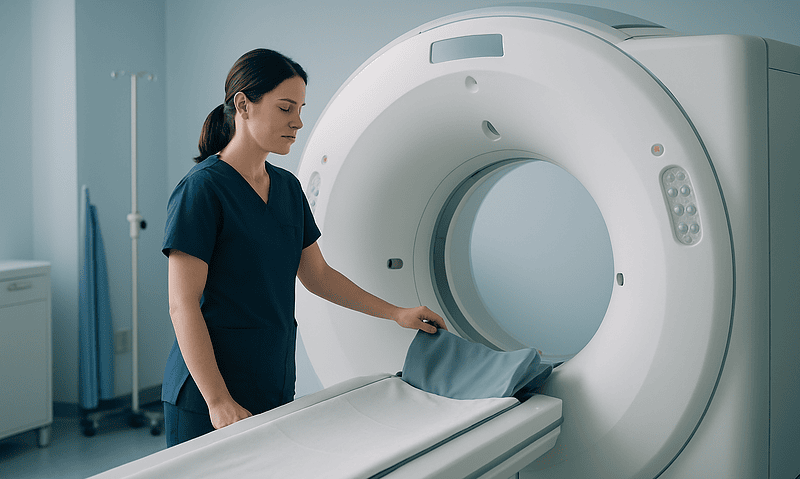
A CT scan uses X-rays to build cross-sectional pictures and is often the first study, usually with an injected contrast dye that lights up blood vessels and abnormal nodes. MRI uses magnetic fields rather than radiation and shows soft tissue, nerves and the tongue base in finer detail. PET-CT combines a CT with a scan that tracks a sugar tracer taken up by metabolically active cells; it can flag nodes that look normal in size but behave abnormally, and it checks the rest of the body for spread. Ultrasound, a bedside scan using sound waves, is often used to guide a fine needle into a suspicious node so cells can be examined (Mayo Clinic).
| Study | What it shows best | Typical role before neck dissection |
|---|---|---|
| CT with contrast | Node size, bone, relationship to vessels | Baseline mapping of levels |
| MRI | Soft tissue and nerve detail | Tongue, throat and skull-base tumors |
| PET-CT | Metabolic activity across the body | Staging, and response check after radiotherapy |
| Ultrasound with needle biopsy | Real-time view of a single node | Confirming cancer in a node before surgery |
No scan is perfect. Nodes smaller than a few millimeters can harbor cancer that no study detects, which is precisely why elective dissections exist. Conversely, inflammation from a recent infection or radiotherapy can make a node glow on PET without cancer present. Your radiologist and surgeon read these images together, and it is entirely reasonable to ask which levels the scans implicate and which the operation will cover.
Pre-operative tests and the anesthetic assessment
A few weeks before surgery most hospitals run a pre-assessment clinic, sometimes by telephone, sometimes in person. Its purpose is to make sure the body is ready for a long anesthetic and to catch anything that could be optimized first (NHS).
Expect blood tests checking blood count, kidney function, clotting and blood sugar, and a sample so blood can be matched in case a transfusion is needed. An electrocardiogram, a painless recording of the heart’s rhythm, is routine for most adults. People with lung disease or a heavy smoking history may be asked to do breathing tests, and those with heart conditions may need a cardiology review.
The anesthetist, the doctor who keeps you asleep and safe during the operation, will ask about previous anesthetics, loose teeth, sleep apnea and how far you can open your mouth and tilt your head back. Those last two matter more than in most surgery, because a tumor, previous operations or radiotherapy can make the airway harder to manage. A planned approach to a difficult airway, sometimes including a temporary breathing opening in the windpipe called a tracheostomy, is far safer than an improvised one.
Bring a complete list of everything you take, including over-the-counter products and herbal supplements, because some affect bleeding or interact with anesthetic drugs. The team will tell you which to continue and which to pause, and for how long; do not stop anything on your own. Blood-thinning medicines in particular need a plan made jointly by the surgeon and whoever prescribed them.
A dental check is often arranged too, especially if radiotherapy is likely afterward, since teeth in poor condition are harder to treat once the jaw has been irradiated.
Nutrition before neck dissection: why weight and swallowing matter so much
Head and neck cancers have a habit of stealing weight before anyone operates. Pain on swallowing, altered taste from earlier treatment, or a tumor that simply gets in the way can shave off kilograms in weeks. That loss matters, because healing a neck wound and fighting infection require protein and energy the body cannot borrow from thin air.
Most teams therefore screen nutrition early: current weight, how much has been lost and over what period, what a typical day’s eating looks like, and whether swallowing is safe. A dietitian, a professional trained in medical nutrition, may recommend higher-protein meals, fortified drinks or small frequent snacks. Where swallowing is unsafe or intake is falling badly, a temporary feeding tube through the nose or directly into the stomach may be discussed before surgery so that nutrition does not collapse afterward (NHS).
A speech and language therapist may assess swallowing formally. This is not only about comfort. Food or liquid slipping into the lungs, called aspiration, causes pneumonia, and pneumonia after a long anesthetic is a serious complication. Knowing your baseline lets the team compare after surgery and choose safe textures.
Simple things help in the run-up. Eat regularly rather than skipping meals when appetite is poor. Prioritize protein at each sitting. Keep well hydrated. Ask before starting any supplement, because high doses of some vitamins and herbal products can affect bleeding or interact with medicines, and the evidence that megadoses speed surgical healing is weak.
Alcohol deserves its own mention. Heavy drinking impairs wound healing, raises bleeding risk and can trigger dangerous withdrawal after surgery. If you drink heavily, tell the team honestly; they can plan for it, but only if they know.
Neck dissection after radiotherapy: how a previously treated neck changes the plan
Radiotherapy treats cancer by damaging the DNA of rapidly dividing cells, but the tissue that remains is changed for good. Over months, small blood vessels close off and normal elastic tissue is replaced by scar, a process called fibrosis. The skin can become thin and less supple, the fat between structures shrinks, and the tissue planes surgeons rely on to separate nerve from vein become matted together (NHS).
For a neck dissection after radiotherapy, this has several consequences the surgeon plans for in advance. Dissection is slower and more deliberate, because the accessory nerve, jugular vein and carotid artery no longer sit in predictable, easily separated layers. Bleeding can be paradoxically both less brisk and harder to control, since irradiated vessels are fragile. Healing is slower: wound edges with a reduced blood supply are more prone to breaking down, to infection and to fistula, an abnormal channel that lets saliva leak into the neck.
The team may respond in practical ways. Incisions are placed to protect the skin’s remaining blood supply. Drains may stay in longer. Antibiotic plans and wound checks are often more intensive. Where the skin is badly damaged, a reconstructive surgeon may bring in healthy tissue with its own blood supply from the chest, back or forearm to cover the neck; this adds hours to the operation and is discussed beforehand.
Timing is also weighed carefully. Operating too soon after radiotherapy meets tissue at the height of inflammation, while waiting too long risks fibrosis and cancer regrowth. Guidelines generally favor confirming residual disease with repeat imaging before proceeding, so that the operation is performed when it is genuinely needed (Mayo Clinic). Pre-existing swallowing and shoulder problems from radiotherapy are documented too, so the team can distinguish old effects from new ones.
Smoking, alcohol and medicines: what the weeks before surgery should look like
If one change in the weeks before surgery earns its effort, it is stopping smoking. Nicotine narrows blood vessels and carbon monoxide steals oxygen from tissue, so smokers’ wounds heal more slowly and their lungs cope less well with anesthesia. Stopping even a few weeks before an operation reduces breathing complications and improves wound healing, and the benefit is greatest when the neck has already been irradiated, because that tissue has little oxygen to spare (NHS).
Quitting is hard, and the diagnosis itself often makes it harder. Ask the team about nicotine replacement and behavioral support rather than going it alone; they can advise on what is compatible with your operation. Vaping is not a proven safe alternative around surgery, and most surgical teams ask patients to stop that too.
Alcohol should be reduced steadily rather than stopped abruptly if intake has been heavy, again with the team’s guidance, because sudden withdrawal can be dangerous. Cutting down improves liver function, clotting and immune response within weeks.
Medicines fall into three groups. Some continue unchanged. Some, such as certain blood thinners and diabetes medicines, need a specific plan for the days around surgery. Some supplements and over-the-counter painkillers that affect clotting are usually paused. The prescribing clinician and the surgical team make these calls together; a patient’s job is to give a complete, honest list and follow the written instructions.
Fitness matters in a gentler way. Regular walking in the weeks before surgery, within whatever limits your condition allows, improves lung capacity and stamina for recovery. Some hospitals run formal prehabilitation programs combining exercise, nutrition and psychological support; ask whether one is available.
How painful is a neck dissection?
People are often surprised that the neck wound itself is not the main source of discomfort. Skin incisions in the neck heal readily and are usually described as sore and tight rather than sharply painful once the first day or two has passed. The more persistent complaints come from elsewhere.
The shoulder is the commonest. The spinal accessory nerve, which runs through the levels usually removed and powers the trapezius muscle that lifts the shoulder, is preserved whenever possible but is inevitably handled and stretched. Even an intact nerve may work poorly for weeks, letting the shoulder droop and producing an aching, heavy sensation that worsens with reaching overhead. Where the nerve has to be removed because cancer surrounds it, weakness is permanent, and pain from the unsupported shoulder joint can be significant (Cleveland Clinic).
Numbness is near universal. The small nerves supplying the skin of the neck and the ear are cut during the operation, leaving a patch of altered sensation that many people find stranger than painful: a wooden feeling, tingling or hypersensitivity to a collar. Some sensation returns over months; some does not.
Pain control after surgery usually combines several approaches rather than relying on one strong medicine. Regular simple painkillers form the base, stronger medicines are added for breakthrough pain in the first days, and the team steps down as comfort allows. Everything is prescribed and adjusted by the treating team based on how you report your pain, so honest reporting matters more than stoicism.
Physiotherapy, started early, is the most effective long-term answer to shoulder pain. Gentle range-of-motion exercises prevent the joint stiffening while the nerve recovers, and most people are taught them before leaving hospital.
Neck dissection recovery time: what the following days and weeks usually look like
The first day is about the basics: breathing, drinking, drains and getting out of bed. Nurses check the wound frequently and empty the drains, recording how much fluid comes out. A modest amount of blood-stained fluid is expected; a sudden increase, or fluid that turns milky, is reported to the surgeon because it may signal bleeding or a chyle leak, in which lymphatic fluid escapes from a damaged channel (Cleveland Clinic).
Drains typically come out when their output falls to a low daily volume, which for many people means within the first several days, though irradiated necks and bilateral operations often take longer. The stay in hospital is usually measured in days rather than weeks when the neck dissection is done alone, and lengthens when combined with tumor removal and reconstruction (Cleveland Clinic).
The neck dissection recovery time people ask about most, when can I drive, work, lift, exercise, does not have one number. Most surgical teams suggest avoiding driving until you can turn your head comfortably and are off stronger painkillers, returning to desk work within a few weeks and to heavy lifting later, once the shoulder has strength. Someone whose operation was small and whose job is sedentary recovers faster than someone with a reconstruction and a manual job.
Swelling of the face and neck, called lymphedema, appears in some people weeks after surgery because lymph channels have been removed. It is usually managed with gentle massage taught by a therapist and positioning, and it tends to be worse after radiotherapy.
Pathology results arrive within a week or two and are discussed at a follow-up appointment, where the team decides whether further treatment such as radiotherapy is advised. That conversation, not the day of discharge, is often the real emotional milestone of recovery.
Is neck dissection a risky surgery? Neck dissection risks and alternatives explained
Neck dissection is major surgery performed near important structures, but in experienced hands serious complications are uncommon, and most people go home without any of the problems listed here. Understanding the risks is not meant to frighten; it is what allows a genuinely informed consent conversation.
Bleeding after the operation, which can occasionally need a return to theater, is the most urgent early risk. Infection and wound breakdown are more likely in irradiated tissue, in smokers and in people who are undernourished. Chyle leak, described above, is uncommon but prolongs the hospital stay. Nerve injury is the risk people remember longest: the accessory nerve affects the shoulder, the marginal branch of the facial nerve can weaken the lower lip’s movement, and, in central compartment dissections, the nerves to the voice box can affect voice and breathing (Cleveland Clinic).
Anesthetic risks depend more on general health than on the operation itself, which is why the pre-assessment clinic exists. Blood clots in the legs or lungs are a risk of any long operation and are reduced by early walking and, when appropriate, clot-preventing measures chosen by the team.
Alternatives exist, and a good team will explain why surgery is being recommended over them. Radiotherapy, with or without chemotherapy, treats neck nodes without an incision and is the primary approach for some throat cancers. Observation with regular imaging is an option for some low-risk necks. Sentinel node biopsy, in which only the first draining node is removed and examined, is used in selected early cancers to avoid a full dissection. Each carries its own trade-offs, and the choice depends on the tumor’s type, location and stage and on your own priorities, which is exactly what the multidisciplinary meeting weighs (NHS).
What people often get wrong about preparing for neck dissection
The first myth is that a neck dissection removes the cancer itself. Usually it does not; it removes the lymph nodes that cancer may have spread to, while the primary tumor is treated separately, either at the same operation or with radiotherapy. Confusing the two leads people to wonder why they still need other treatment.
The second is that the scar will run around the whole neck. Modern selective dissections use incisions placed in skin creases and hidden beneath the jawline; the long, sweeping incisions of older radical operations are rarely needed today (Cleveland Clinic).
The third is that shoulder problems mean the surgeon damaged the nerve. Temporary weakness is expected even when the nerve is preserved, because handling any nerve stuns it for weeks. Early physiotherapy, not blame, is the useful response.
The fourth is that eating less before surgery is sensible because you will be fasting anyway. The opposite is true: the body needs to enter surgery as well-nourished as possible, and fasting instructions apply only to the hours immediately beforehand.
The fifth is that stopping smoking a week before surgery is pointless. Lung function and oxygen delivery begin improving within days, and every smoke-free week before an operation helps (NHS).
The sixth concerns radiotherapy. Some people assume a previously irradiated neck cannot be operated on, others assume it makes no difference. Neither is right. Surgery after radiotherapy is routinely performed, but it is technically more demanding and heals more slowly, which is why the team plans differently.
The last is that once the drains are out, recovery is over. Numbness, shoulder function, swelling and swallowing continue to change for months, and the follow-up schedule exists to track them.
Questions to ask your care team before a neck dissection
Consultations are short and the vocabulary is unfamiliar, so a written list helps. The questions below are ones surgical teams expect and welcome.
- Which levels of my neck will be removed, and what did the imaging show in each?
- Is this operation being done because nodes are known to contain cancer, or to check for spread that scans cannot see?
- Will the accessory nerve, sternocleidomastoid muscle and internal jugular vein be preserved, and what would change that during surgery?
- Where will the incision be, and will any reconstruction be needed to cover the neck?
- How does my previous radiotherapy alter the plan, the healing time and the risk of wound problems?
- Roughly how long is the operation expected to take, and how long might I stay in hospital?
- Will I need a feeding tube or a tracheostomy, even temporarily?
- Which of my medicines and supplements should I continue, pause or discuss with my other doctors?
- What help is available to stop smoking or reduce alcohol before surgery?
- When will I meet the dietitian, speech therapist and physiotherapist, and can that happen before the operation?
- How and when will I receive the pathology results, and who will explain what they mean for further treatment?
- Who do I call, day or night, if something worries me after I go home?
Bring someone with you if you can; two sets of ears catch more. Ask whether the consultation can be recorded or whether written information is available. If English is not your first language, request an interpreter in advance rather than relying on a family member, who may struggle with medical terms or soften difficult news.
It is also fair to ask what would happen if you chose not to have surgery, and what the team would do in your position. Honest answers to both questions tell you a great deal about how the decision has been reached.
When to call your doctor after a neck dissection
Most recoveries are uneventful, but a few problems need same-day attention. Keep the ward’s number and your surgeon’s contact details somewhere visible, and do not wait for a routine appointment if any of the following occurs.
Call emergency services immediately, rather than the ward, if you have any difficulty breathing, noisy breathing, a rapidly swelling neck, or bleeding that soaks through a dressing or fills a drain quickly. Swelling in the neck can compress the airway, and it is the one complication where minutes matter (Cleveland Clinic).
Contact your surgical team the same day for a fever or shaking chills; increasing redness, warmth or spreading pain around the wound; pus, saliva or foul-smelling fluid leaking from the incision or drain site; drain fluid that turns milky or cloudy; new or worsening pain in the calf or chest, or sudden breathlessness, which can signal a blood clot; inability to swallow fluids, or coughing and choking when you try; a wound edge that opens; or sudden new weakness of the face, arm or leg, or difficulty speaking.
Less urgent but still worth a call within a day or two are persistent vomiting that prevents you keeping medicines down, a shoulder that is becoming markedly more painful rather than gradually easier, dizziness on standing, or swelling of the face that is increasing rather than settling.
None of these signs means something has definitely gone wrong, and many turn out to be manageable with a dressing change or a short course of treatment. What they share is that early assessment makes a difference. Surgical teams would far rather see a patient whose worry turned out to be unnecessary than one who waited. Every decision about what happens next rests with the team who know your operation.
Frequently asked questions
How long does it take to recover from neck dissection surgery?
Recovery unfolds in stages rather than ending on one date. Hospital stays are typically a few days when neck dissection is performed alone and longer with reconstruction (Cleveland Clinic). Most people return to light activity within a few weeks, while shoulder strength, numbness and swelling continue to change for months. Your surgeon will give a range based on the extent of your operation and whether the neck was previously irradiated.
How painful is a neck dissection?
The incision itself is usually described as sore and tight rather than severely painful after the first day or two. Shoulder aching from a stretched accessory nerve and numbness of the neck and ear are the more persistent complaints. Pain is managed with a combination of regular and as-needed medicines chosen by the treating team, and early physiotherapy is the most effective long-term approach to shoulder discomfort.
Is neck dissection a risky surgery?
It is major surgery near important nerves and vessels, but serious complications are uncommon and most people recover without them. Recognized neck dissection risks include bleeding, infection, chyle leak, nerve weakness affecting the shoulder or lower lip, and anesthetic complications related to general health (Cleveland Clinic). Prior radiotherapy, smoking and poor nutrition raise wound problems, which is why pre-operative preparation focuses on those areas.
How long does a neck dissection operation typically take?
It depends on how many levels are removed and whether other procedures are combined. A one-sided selective dissection takes a few hours; a bilateral operation, or one paired with tumor removal and reconstruction, can last most of a day. Surgical teams give families an estimated range in advance, and running past that estimate is common and does not by itself indicate a problem.
What imaging is needed before neck dissection?
Most people have a contrast CT or MRI of the neck to map node levels, and many have a PET-CT to check metabolic activity and the rest of the body (Mayo Clinic). Ultrasound-guided needle biopsy may confirm cancer in a specific node. After radiotherapy, repeat imaging a few weeks later is often used to decide whether a salvage operation is actually needed.
Does neck dissection after radiotherapy heal more slowly?
Generally yes. Radiotherapy closes small blood vessels and replaces elastic tissue with scar, so irradiated skin and muscle receive less oxygen and mend more slowly (NHS). Surgeons plan for this with careful incision placement, longer drain use, closer wound checks and sometimes reconstruction with healthy tissue. Stopping smoking and optimizing nutrition matter even more in this situation.
What should I eat before neck dissection surgery?
Aim for regular, protein-rich meals and good hydration in the weeks beforehand, and follow the fasting instructions only for the hours immediately before the operation. If swallowing is painful or weight is falling, a dietitian can suggest fortified drinks or softer textures, and a temporary feeding tube may be discussed (NHS). Ask before starting any supplement, since some affect bleeding.
Will I lose movement in my shoulder after neck dissection?
Temporary shoulder weakness and aching are common even when the accessory nerve is preserved, because handling the nerve during surgery stuns it for weeks. Function usually improves with physiotherapy exercises started early. Where the nerve must be removed because cancer surrounds it, weakness is permanent, and the team will discuss this possibility before the operation (Cleveland Clinic).
Can I smoke or drink alcohol before neck dissection?
Surgical teams strongly advise stopping smoking as early as possible, because nicotine and carbon monoxide impair oxygen delivery and wound healing, with benefit beginning within days (NHS). Heavy alcohol use should be reduced under medical guidance rather than stopped abruptly, as sudden withdrawal can be dangerous. Be honest about both so the team can plan safely.
What happens to the lymph nodes removed during neck dissection?
They are sent to a pathologist, who counts them and examines each under a microscope for cancer cells and for spread beyond the node capsule. Results typically take one to two weeks and are discussed at a follow-up appointment, where the multidisciplinary team decides whether further treatment such as radiotherapy is advised. This report is one of the most important pieces of information the operation provides.
References
- NHS – Head and neck cancer
- NHS – Radiotherapy: side effects
- NHS – Having an operation (surgery): preparation
- MedlinePlus – Head and Neck Cancer
This article is for general information only and is not a substitute for professional medical advice. Please consult a qualified doctor about your individual situation.

More from the Blog

Is a Second Opinion Worth It for Lymphocytic Leukemia? Questions a Hematologist Expects
A second opinion is often worthwhile for chronic lymphocytic leukemia (CLL), a slow-growing blood cancer in which experienced hematologists can reasonably disagree about when…

Follow-Up After Thyroid Cancer: What Blood Tests and Ultrasound Track Over Time
After treatment for differentiated thyroid cancer, follow-up usually combines a blood test for thyroglobulin, a protein made only by thyroid tissue, with a check…

Who Is a Candidate for Mohs Surgery? Skin Cancer Types, Locations and What Surgeons Consider
Candidates for Mohs surgery are usually people with basal cell or squamous cell skin cancer that sits in a high-risk or cosmetically sensitive area…
Does Surgery Come First or Chemotherapy? How Surgical Oncology Teams Sequence Cancer Treatment
Neither order is automatically better. Surgery first or chemotherapy first depends on the cancer type, its stage, how fast it tends to spread, and…

Can You Work and Travel During Immunotherapy? Planning Life Around Infusion Cycles
Many people can work during immunotherapy, often with reduced hours or flexible days around infusion cycles, because most checkpoint-inhibitor infusions take under a few…

How Remission Is Confirmed After Lymphoma Treatment and Then Monitored Over Time
Remission after lymphoma treatment is usually confirmed with an end-of-treatment PET-CT scan read against a standard scale, plus a physical examination and blood tests,…