

Nose Filler (Liquid Rhinoplasty): Who It Suits, the Specific Risks in the Nose and How It Compares With Surgery

Key Takeaways
- Nose filler can only add volume, so it disguises a hump or lifts a tip but cannot make a nose smaller, narrower or less bulbous.
- Hyaluronic acid filler in the nose typically lasts 9 to 18 months, longer than in the lips because the nose barely moves.
- The nose and the area between the eyebrows are the two facial sites most often implicated in the roughly 150 published cases of filler-related vision loss.
- Sudden skin blanching, dusky or lace-like discoloration, escalating pain or any change in vision during or after injection is an emergency requiring immediate treatment.
- So-called permanent non-surgical nose jobs use non-dissolvable materials that cannot be reversed with hyaluronidase, removing the main safety net in this high-risk area.
- No filler is approved specifically for the nose in the United States; nasal use is off-label, which places the judgment of suitability on a qualified medical injector.
Nose filler, or liquid rhinoplasty, is an injection of hyaluronic acid gel into the bridge or tip of the nose to smooth a bump, lift a drooping tip or improve symmetry. It cannot make a nose smaller, typically lasts about 9 to 18 months and carries a rare but serious risk of blocked blood vessels that can cause skin loss or vision loss. A qualified medical injector and realistic expectations matter more than any product.
The video has a familiar rhythm. A profile shot, a bump on the bridge, a needle you barely see, then a straight line where the bump used to be. The caption promises a “permanent non-surgical nose job” in fifteen minutes, no downtime, no surgeon. It has been viewed more times than most clinical trials have been read.
As of September 2026, searches for nose filler are running at their highest level yet, driven less by new science than by that word “permanent” and by a wave of before-and-after clips that make the procedure look as casual as a haircut. The reality is narrower and more interesting. Liquid rhinoplasty solves a small set of problems very well, does nothing for others, and works in the one part of the face where an injection error can reach the eye.
So this is the long version: who it actually suits, what the nose’s blood supply means for safety, and how it stacks up against surgery when you strip out the marketing.
What is nose filler, and what does liquid rhinoplasty actually do?
Nose filler is the injection of a soft, clear gel, almost always hyaluronic acid, into specific points along the nose to change its outline. Hyaluronic acid is a sugar molecule your body already makes to hold water in skin and joints; manufactured versions are cross-linked so they hold their shape for months rather than hours. “Liquid rhinoplasty” and “non-surgical nose job” are marketing names for the same procedure. Nothing is cut, no bone is moved, and the anatomy underneath is untouched.
What the gel does is add. That single fact explains almost everything about the treatment. A dorsal hump, the bump partway down the bridge, is not removed; instead, small amounts of filler above and below it raise the surrounding line until the bump no longer reads as a bump. A drooping tip is lifted by placing gel at the base and tip to change the angle between nose and lip. A slight deviation is disguised by filling the concave side. In each case the nose ends up marginally larger in absolute terms while looking straighter, and often smaller, in profile.
Cleveland Clinic describes dermal fillers as gel-like substances injected beneath the skin to restore volume and smooth lines; the nose is one of several facial areas where they are used. Worth stating plainly: in the United States, hyaluronic acid fillers are approved for facial folds and volume loss in areas such as the cheeks and lips. Use in the nose is off-label, meaning a clinician is using an approved product for a purpose the approval did not specifically cover. That is legal and common in medicine, but it shifts the responsibility for judging suitability squarely onto the treating clinician.
The procedure takes roughly 15 to 30 minutes in a clinic room. Results are visible immediately, settle over about two weeks as minor swelling resolves, and fade gradually as the body’s own enzymes break the gel down. If you remember one sentence, make it this one: filler reshapes by adding, and it is temporary by design.
What changed recently to put nose filler in the headlines
Nothing in the filler itself is new. Hyaluronic acid fillers have been approved for facial use in the United States since 2003, and nasal injection has appeared in the dermatology and plastic surgery literature for well over a decade. What has shifted is the story being told around the procedure.

The first change is the “permanent” claim. Several widely shared clips and clinic pages now advertise permanent or semi-permanent non-surgical nose jobs using non-dissolvable materials such as polymethylmethacrylate microspheres or silicone. These products either lack approval for facial cosmetic use at all, or are approved for other indications and are being used off-label in an area where a mistake cannot be undone with an enzyme. Harvard Health’s overview of dermal fillers notes that permanent fillers carry a higher risk of lumps and long-term complications precisely because they cannot be reversed.
The second change is regulatory attention to who is injecting. In the United Kingdom, a 2021 law made it illegal to give cosmetic fillers to anyone under 18, and the NHS now advises that fillers should only be carried out by a trained, insured healthcare professional, warning that the market remains largely unregulated. In the United States, the Food and Drug Administration issued a public warning in 2021 against needle-free “hyaluron pen” devices marketed for at-home filler, citing reports of serious injury. Both moves reflect a growing case load of complications in non-medical settings.
The third change is the evidence on vision loss. Published case reviews have collected more than 140 reports worldwide of blindness or partial vision loss after facial filler, and the nose consistently ranks among the two or three most commonly implicated sites. These are case reports rather than trials, so they cannot give an exact rate, but their steady accumulation has pushed professional bodies to emphasize cannula technique, small volumes and immediate access to hyaluronidase, the enzyme that dissolves hyaluronic acid.
Put together: a booming, loosely regulated market, a viral promise of permanence, and a safety literature that is getting louder. That is why nose filler is trending, and why it deserves a careful explanation rather than a fifteen-second clip.
Who nose filler suits, and who it does not
The ideal candidate is easier to describe than most people expect. Someone with a small to moderate dorsal hump, a slightly low or flat bridge, a mildly drooping tip, a shallow depression after previous surgery, or minor asymmetry, who wants a subtle change in profile and understands the result will fade. For these people, filler can produce a visibly straighter line with essentially no recovery time.
The poor candidate is defined by the direction of change they want. Filler cannot:
- Make a nose smaller, shorter or narrower overall.
- Reduce wide nostrils or a bulbous tip; adding volume to a tip that is already round tends to make it rounder.
- Correct a functional problem such as a deviated septum, the wall dividing the nostrils, or improve breathing.
- Fix a large hump; the amount of gel needed to hide it would create a bridge that looks heavy from the front.
Anyone wanting reduction is, by definition, a surgical candidate, and an honest injector will say so at the first consultation.
Medical history matters too. Previous rhinoplasty is not an absolute barrier, but scar tissue changes the position and flexibility of blood vessels, and expert consensus treats the post-surgical nose as higher risk for vascular injury. Active skin infection, cold sores, uncontrolled autoimmune disease or a known allergy to filler components are reasons to postpone or avoid treatment. Blood-thinning medicines increase bruising, and no one should stop a prescribed medicine for a cosmetic injection without their prescribing clinician agreeing.
Age is the final filter. The NHS is explicit that cosmetic fillers should not be given to anyone under 18, and reputable clinicians in the United States follow the same line, partly because the nose is still maturing into the late teens and partly because body image concerns at that age deserve a different conversation.
A useful self-check before booking: if you are hoping the nose will look smaller from the front, filler is unlikely to satisfy you. If you are hoping the profile will look straighter, it might.
How a non surgical nose job is done, step by step
The appointment begins, or should begin, with a conversation rather than a needle. The injector examines the nose from the front, both sides and below, asks what bothers you, and explains whether filler can address it. Photographs are taken. This is also the moment to disclose previous nose surgery, medications and any history of cold sores, since the virus can flare after injections around the face.
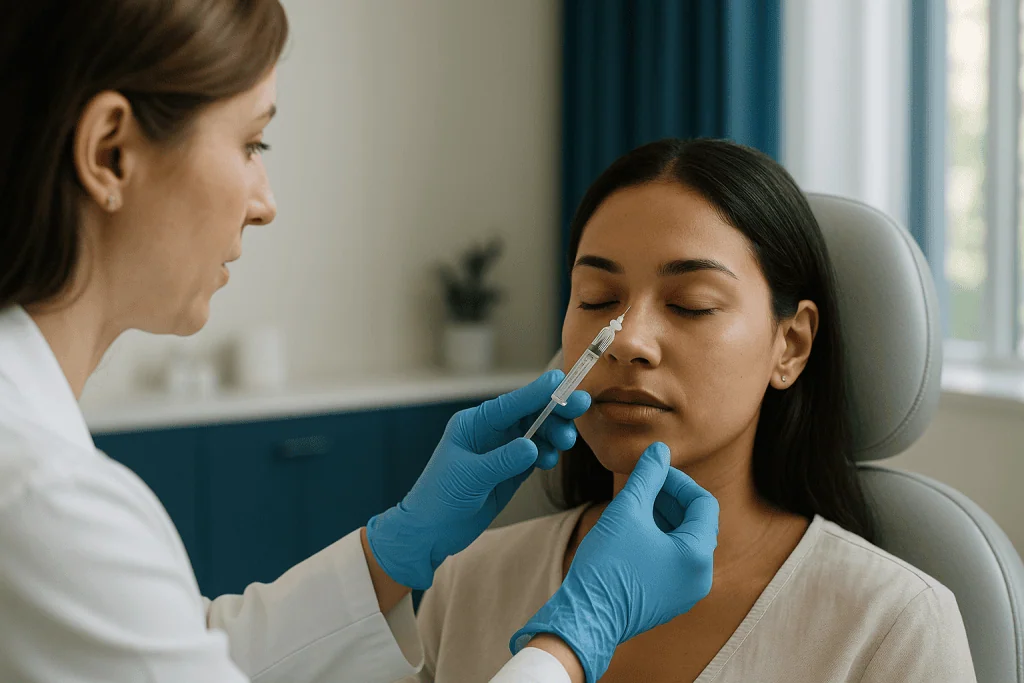
Skin is cleaned with an antiseptic. Many injectors apply a numbing cream and wait 15 to 30 minutes; most hyaluronic acid fillers also contain a local anesthetic, so discomfort drops after the first few seconds of each injection. Marking points on the skin is common.
The injection itself uses either a needle or a cannula. A cannula is a thin, blunt-tipped tube inserted through a single small entry point and threaded under the skin; because it does not have a sharp tip, it is less likely to pierce a vessel, and many nasal specialists prefer it for the bridge. Filler is placed in tiny increments, deep against the bone or cartilage rather than in the skin, in the midline where major vessels are least likely to run. The injector watches the skin color constantly; sudden blanching, pain or a mottled purple pattern signals a blocked vessel and treatment stops at once.
Aspiration, drawing back the syringe plunger to check for blood before injecting, is used by some clinicians as an extra safeguard, though the evidence on its reliability is mixed. Slow injection and small volumes per pass are the safety measures with the broadest expert support.
Afterwards the nose is gently molded, the area is checked once more, and you look in a mirror. Most people leave within half an hour of sitting down, with mild redness and perhaps a pinprick mark at the entry site.
What you should not see: an injector working alone with no hyaluronidase on the premises, a rushed procedure with no examination, or a promise that the result will be permanent. Each is a reason to stand up and leave.
Is getting nose filler painful?
Most people describe nose filler as uncomfortable rather than painful, and the discomfort is brief. The nose has a dense supply of nerves, so the first needle or cannula entry is felt as a sharp pinch, and the sensation of gel spreading under the skin along the bridge is often described as pressure or a deep ache lasting a few seconds. The tip is generally more sensitive than the bridge.
Two things keep it tolerable. Topical numbing cream applied beforehand dulls the surface. Most hyaluronic acid fillers also contain lidocaine, a local anesthetic, so the area becomes progressively numb as the injection proceeds. Cleveland Clinic notes that dermal filler injections are usually well tolerated and typically cause only minor, temporary discomfort.
Pain that is intense, escalating or out of proportion to the injection is not normal, and this is the single most useful thing to know before the appointment. Severe pain during or immediately after injection, particularly with the skin turning white, dusky or blotchy, is the classic early sign of vascular occlusion, meaning filler has entered or compressed an artery and blood flow to the skin is blocked. Injectors are trained to stop immediately and treat. Never assume the pain “will settle.” Say so at once.
After the appointment, expect tenderness when you touch the nose or put on glasses for a few days, similar to a bruise. Swelling peaks within 24 to 48 hours and mostly resolves by two weeks. A small number of people notice a dull headache the same day, probably from tension during the procedure rather than from the gel.
Over-the-counter pain relief may be discussed with the injector. Anti-inflammatory medicines such as ibuprofen can increase bruising, so many clinicians prefer alternatives in the first days; follow the specific advice you are given rather than a general rule.
The honest summary: a few seconds of sharp pinching and pressure, then a sore nose for a couple of days. Pain beyond that pattern is a warning, not a nuisance.
How long does nose filler last?
The common answer is 9 to 18 months, and the honest answer is that it depends on the product, the placement and the person. The NHS gives a range of roughly 6 to 18 months for hyaluronic acid fillers in general, and the nose tends to sit at the longer end of that range for an anatomical reason: the nose barely moves. Filler in the lips is squeezed with every word and sip and breaks down faster; filler resting on the bony bridge is left almost undisturbed.
Several factors shorten or lengthen the result:
- Product firmness. Thicker, more heavily cross-linked gels resist breakdown longer and hold projection better, which is why injectors choose robust fillers for the bridge and tip.
- Metabolism and activity. People who exercise intensely or have a faster metabolism often report earlier fading, though this is observational rather than proven in trials.
- Depth of placement. Filler placed deep against bone is protected and lasts longer than superficial placement.
- Repeat treatments. Some patients find subsequent sessions last longer, possibly because residual gel and collagen stimulation build a base; this is widely reported by clinicians but not well quantified.
Fading is gradual. The nose does not suddenly revert; it slowly returns toward its original shape over weeks, and many people book a touch-up when they first notice the hump reappearing in photographs.
A caution about longevity claims. Imaging studies of facial filler have found traces of hyaluronic acid persisting for years in some patients, longer than the visible effect. That is not the same as a lasting result, and it raises a practical point for anyone who later wants surgery: the surgeon needs to know filler is there, and may recommend dissolving it first so the true anatomy can be assessed.
If someone offers a hyaluronic acid nose filler that “lasts forever,” they are either describing a different, non-dissolvable product with a different risk profile or making a claim the evidence does not support.
Why the nose is different: the anatomy behind liquid rhinoplasty risks
Every facial filler carries some risk of bruising, swelling and lumps. The nose carries an extra risk that comes from plumbing. Understanding it explains why experienced injectors treat this small area with more respect than almost any other.
Two arteries run up the sides of the nose, the lateral nasal and angular arteries, and a smaller dorsal nasal artery travels along the bridge. Near the inner corner of each eye, these vessels connect with branches of the ophthalmic artery, the vessel that supplies the retina. That connection is the problem. If filler is injected into an artery under pressure, or a bolus compresses one, the gel can travel in either direction. Pushed forward, it blocks flow to the skin of the nose and tip, which turn white and then dusky as they starve of oxygen. Pushed backward, against the normal direction of flow, it can reach the ophthalmic artery and stop blood reaching the retina.
The skin of the nasal tip adds a second vulnerability. It is thick, tightly bound to the cartilage beneath, and has limited collateral circulation, meaning few alternative routes for blood if one vessel is blocked. That is why tip and columella injections, the columella being the strip of tissue between the nostrils, are associated with a disproportionate share of skin necrosis, the medical term for death of tissue.
Previous surgery makes matters worse. Rhinoplasty leaves scar tissue that pins vessels in unpredictable positions and reduces the mobility that would normally let a blunt cannula slide past them. Expert opinion consistently rates the operated nose as higher risk, and some injectors decline to treat it at all.
None of this means nose filler is reckless. It means the margin for error is thinner than in a cheek. Safety techniques, including deep midline placement, blunt cannulas, tiny increments, slow injection and constant observation of skin color, exist precisely because of this anatomy. So does the requirement to have hyaluronidase in the room, since dissolving the gel within minutes of a blockage can restore flow before tissue dies. The anatomy is the reason. The technique is the answer.
Liquid rhinoplasty risks: what the numbers actually show
Risk falls into two tiers, and mixing them up is where most online discussion goes wrong.
The first tier is common and minor. Bruising, swelling, redness and tenderness at injection points affect a large share of patients and resolve within one to two weeks. Small lumps or slight asymmetry can occur and usually settle or can be massaged out; persistent lumps respond to hyaluronidase. Cold sore reactivation happens in people who carry the virus. Delayed swelling, sometimes months later and occasionally after viral illness or vaccination, has been described with hyaluronic acid fillers and is generally treatable. Infection is uncommon with sterile technique.
The second tier is rare and serious. Vascular occlusion, the blocked vessel described above, is estimated in large practice series at somewhere in the region of one in several thousand filler treatments across the face, though figures vary widely and depend heavily on injector experience and the area treated. When it happens in the nose and is recognized and treated within the first hour, most cases resolve without permanent damage. When it is missed, the result can be scarring, loss of tip skin or, in the worst cases, a defect requiring reconstructive surgery.
Vision loss is rarer still. Systematic reviews of published reports had collected around 150 cases worldwide by the late 2010s, out of many millions of filler treatments, with the glabella (the area between the eyebrows) and the nose the most frequently involved sites. Most reported cases involved permanent loss of sight in the affected eye, and no treatment has been shown in trials to reliably reverse it. Stroke has been reported in a very small number of cases where filler reached brain circulation. These figures come from case reports, so they almost certainly under-count events and cannot give a true rate. What they do establish is that the nose is one of the two highest-risk sites on the face.
The NHS summarizes the serious risks of fillers as infection, filler moving from the intended area, lumps, and blocked blood vessels that can cause tissue death, permanent blindness or pulmonary embolism. Those words appear on a public health service page, not a sensationalist blog, and they are worth reading before any nasal injection.
Nose filler vs rhinoplasty: a side-by-side comparison
People searching “nose filler vs rhinoplasty” usually want a straight answer about which is better. The more useful answer is that they are different tools for different goals, and the table below sets out where each one wins.
| Factor | Nose filler (liquid rhinoplasty) | Surgical rhinoplasty |
|---|---|---|
| What it can change | Camouflage a small hump, raise a low bridge, lift a drooping tip, even out minor asymmetry | Reduce size, remove a hump, narrow the bridge or tip, refine nostrils, straighten a deviated septum, improve breathing |
| Direction of change | Adds volume only | Adds or removes bone, cartilage and soft tissue |
| Anesthesia | Numbing cream and anesthetic in the gel | General anesthesia or sedation with local anesthetic |
| Procedure time | About 15 to 30 minutes | Typically 1.5 to 3 hours |
| Recovery | Mild swelling or bruising for up to two weeks; normal activities the same day | Splint for about a week; visible swelling and bruising for two to three weeks; final shape settles over up to a year |
| Duration of result | Roughly 9 to 18 months, then repeat | Permanent, allowing for normal aging |
| Reversibility | Hyaluronic acid can be dissolved with hyaluronidase | Not reversible; revision surgery is more complex than a first operation |
| Most serious risks | Vascular occlusion causing skin necrosis or vision loss (rare) | Bleeding, infection, breathing difficulty, numbness, unsatisfactory shape requiring revision, anesthesia risks |
| Who performs it | Physicians, nurse injectors and physician assistants with filler training; regulation varies by state | Board-certified plastic or facial plastic surgeons |
Mayo Clinic describes surgical rhinoplasty as an operation that changes the shape of the nose by modifying bone, cartilage, skin or all three, with results that continue to refine for up to a year. MedlinePlus lists the surgical risks as bleeding, infection, breathing problems, numbness and the possibility of needing a second operation.
Read the table for pattern rather than a verdict. Filler is faster, gentler and reversible, but limited and temporary. Surgery is definitive and versatile, but slower, costlier in recovery and irreversible. The right question is not “which is better” but “what am I trying to change, and how permanently?”
What the evidence actually says about nose filler, graded honestly
Cosmetic medicine is not blessed with large randomized trials, and nasal filler is no exception. Here is what exists, and how much weight it can bear.
Effectiveness, moderate confidence. The evidence that hyaluronic acid filler produces visible, patient-satisfying improvement in profile comes from prospective case series and retrospective cohort studies, typically involving dozens to a few hundred patients, with satisfaction rates commonly reported above 80 to 90 percent at follow-up. There are no large randomized trials comparing filler to no treatment or to surgery, mainly because blinding is impossible and the outcome is aesthetic. The consistency of results across independent groups and countries supports the conclusion, but the studies are small and often authored by the injectors themselves, which introduces bias.
Duration, moderate confidence. Observational follow-up consistently places visible effect at around a year, with a spread from 6 to 18 months. Imaging studies showing gel persisting longer than the visible effect are small but reproducible.
Serious complication rates, low confidence on the exact figure, high confidence on the pattern. Rates of vascular occlusion come from practitioner surveys and single-center series, which under-report. Vision loss data come entirely from case reports and reviews. We cannot state a precise risk, but the finding that the nose and glabella are the highest-risk facial sites is repeated across every review and is anatomically explained. That pattern is about as solid as observational evidence gets.
Safety techniques, mostly expert opinion. Blunt cannulas, slow injection, small volumes, deep midline placement and aspiration are recommended in consensus statements and taught in training. Cadaver and laboratory studies support the rationale, and cohort data suggest lower complication rates with cannulas in some areas, but no randomized trial has tested these measures in the nose. They are best described as widely endorsed expert practice.
Hyaluronidase rescue, moderate confidence. Case series show that dissolving filler promptly after vascular occlusion frequently restores skin perfusion. Its ability to reverse established vision loss is unproven.
The takeaway for a reader: nose filler works for the right indication, the duration is well characterized, the serious risks are real but rare, and the safety measures rest on anatomy and experience rather than trials. That is a reasonable evidence base for a cosmetic procedure, provided it is presented as such.
Common myths about the non-surgical nose job, corrected
The viral version of this procedure carries a set of claims that deserve individual correction.
“It’s a permanent non-surgical nose job.” Hyaluronic acid filler is temporary; that is a feature, not a flaw, because it can be dissolved. Products marketed as permanent are non-dissolvable materials such as polymethylmethacrylate or liquid silicone. Harvard Health warns that permanent fillers carry higher long-term risks of lumps, migration and inflammation. In the nose, where a blocked vessel must be reversed within the hour, an irreversible product removes the safety net. Liquid silicone injection for cosmetic nasal use is not approved in the United States and has a long record of late complications.
“It makes your nose smaller.” It adds volume. A straighter profile can look smaller, but the nose is marginally larger in every dimension. Anyone wanting genuine reduction needs surgery.
“It’s completely safe because it’s non-surgical.” Non-surgical is not the same as risk-free. The nose is one of the two facial sites most often implicated in filler-related blindness. The NHS lists tissue death and permanent blindness among the risks of fillers on its public information page.
“Anyone can do it after a weekend course.” Regulation of who may inject varies by US state and is loose in many places. The evidence on complications points repeatedly to injector experience and the ability to recognize and treat vascular occlusion as the main determinants of safety. This is an area for medical professionals with specific nasal training, not for beauty-bar walk-ins.
“At-home hyaluron pens are the same thing without the needle.” The FDA issued a warning in 2021 against needle-free injection devices sold for filler, citing reports of infection, lumps, vascular injury and disfigurement. The high-pressure jet cannot be placed precisely and the products sold for these devices are unapproved.
“If something goes wrong, they just dissolve it.” True only if the filler is hyaluronic acid, the injector has hyaluronidase on hand, and the problem is recognized within minutes to hours. Vision loss, once established, has no proven reversal.
Each of these myths sells the procedure short in a different direction, either overstating what it can do or understating what it can cost. The truth sits between them.
How to choose an injector for nose filler: what the evidence supports asking
Because the serious risks of nasal filler hinge on recognition and rescue, the person holding the syringe matters more than the brand of gel. These are the questions the safety literature justifies.
What is your medical qualification, and who supervises you? The NHS advises that fillers be given only by a trained, insured healthcare professional. In the United States, injectors may be physicians, nurse practitioners, physician assistants or registered nurses under physician supervision, depending on state law. A non-medical injector in a residential or retail setting is a clear no.
How many noses do you treat, and how many vascular events have you managed? Volume in this specific area is more relevant than general filler experience. An injector who has never seen a blockage may not recognize one; an experienced one will describe exactly what they would do.
Is hyaluronidase in the room, and have you used it? The answer must be yes. Expert consensus treats this as non-negotiable for nasal work. Ask whether an emergency protocol exists and whether they have a relationship with an ophthalmologist for suspected eye involvement.
Which product, and is it hyaluronic acid? You are entitled to know what is being injected and to see the sealed packaging. Decline anything described as permanent.
Needle or cannula, and why? Either can be used safely; a thoughtful answer about the choice is more reassuring than the choice itself.
Will you tell me if filler is the wrong tool for my nose? An injector who also performs or refers for surgery, or who routinely turns patients away, is demonstrating the judgment you are paying for.
Red flags that should end the consultation: pressure to decide the same day, discounts for booking immediately, refusal to discuss complications, treatment offered to anyone under 18, or an injector working alone without a plan for emergencies. None of these is a point of etiquette. Each removes a layer of the safety system that makes the procedure reasonable in the first place.
Aftercare and what recovery from liquid rhinoplasty really looks like
Recovery is genuinely light, which is the procedure’s strongest selling point, but “no downtime” is a small exaggeration. Here is the realistic timeline and the handful of instructions that matter.
The first hour. The nose may look slightly red and puffy and feel tender. Some injectors ask you to wait in the clinic for 15 to 30 minutes so the skin can be checked once more for color changes before you leave. Use that time.
Days one to three. Swelling peaks around 24 to 48 hours; bruising, if it occurs, appears as small purple marks at entry points and along the bridge. Cold compresses applied gently help. Sleep with your head slightly raised. Avoid strenuous exercise, saunas, alcohol and heavy sun, all of which increase blood flow and swelling. Do not press, massage or pinch the nose unless specifically told to.
Glasses and masks. Most injectors advise keeping the weight of glasses off the bridge for one to two weeks so the gel is not pushed sideways while it is still soft. Contact lenses or light frames worn briefly are usually acceptable; ask.
Makeup and skincare. Wait until the entry points have closed, usually 12 to 24 hours, before applying makeup. Skip retinoids, acids and facial treatments on the nose for about a week.
Weeks one to two. Swelling settles and the true result emerges. Minor asymmetry visible on day one often disappears; anything that persists past two weeks is worth a review appointment, where small adjustments or dissolving can be discussed.
Watch the skin. The single most important aftercare instruction is to check the nose in good light several times on the first day and evening. Skin that turns white, dusky, gray, purple or develops a lace-like pattern, or pain that increases rather than fades, is an emergency and requires immediate contact with the injector, not a wait until morning.
Most people return to work the same afternoon. Photographs the next day usually show a slightly swollen version of the final result. Patience over the fortnight is the only real discipline required.
When to see a doctor after nose filler
Most people never need this section, and everyone who has nose filler should read it before the appointment rather than after. The warning signs below separate ordinary healing from the two complications that cause lasting harm.
Seek emergency care immediately, calling the injector on the way, if you notice any of the following during or after treatment:
- Skin on the nose, tip or surrounding cheek turning white, then dusky, gray, purple or blotchy in a lace-like pattern.
- Severe or worsening pain, or pain out of proportion to the injection.
- Any change in vision in either eye: blurring, a dark patch, double vision, or loss of sight, even if it lasts only seconds.
- Eye pain, a droopy eyelid or the eye moving abnormally.
- Sudden weakness, numbness, facial drooping, confusion or trouble speaking, which are stroke symptoms and require calling emergency services at once.
Vascular occlusion is treatable when caught early; vision loss is largely not, which is why even a fleeting visual disturbance warrants same-hour assessment by an ophthalmologist.
Contact the injector or your doctor within a day if you have:
- Increasing redness, heat, swelling or pus, or a fever, suggesting infection.
- A firm, painful or growing lump.
- Blistering or a cold sore erupting on or near the nose.
- Spreading rash, facial swelling or difficulty breathing, which may indicate an allergic reaction and, if breathing is affected, is an emergency.
Book a routine review if: asymmetry or a visible lump persists beyond two weeks; swelling appears weeks or months later, particularly after an illness or vaccination; the result is not what you discussed; or you are considering surgery and need advice on dissolving the filler first.
Bring the product name, lot number and date of treatment to any appointment; reputable injectors give this to patients as a matter of routine. Decisions about dissolving filler, using steroids for delayed swelling or referral to a surgeon belong to the treating clinician, who can examine the nose directly. Nothing in this article replaces that examination, and no complication should be managed by waiting to see whether it improves on its own.
Is a nose filler worth it? An evidence-based way to decide
“Worth it” is a personal calculation, but the evidence can structure it. Three questions do most of the work.
Does filler match the change you want? If the answer is a straighter profile, a lifted tip or a smoothed dent, the observational evidence says most patients are satisfied. If the answer is a smaller, narrower or less bulbous nose, filler will disappoint you and the honest choice is a surgical consultation, or acceptance.
Are you comfortable with the risk profile? The common risks are trivial and short-lived. The serious risk is rare but grave, and it is concentrated in exactly this location. A person with a low tolerance for a small chance of a permanent outcome may reasonably decide the trade is not for them; a person who values reversibility and minimal recovery may reasonably decide it is. Both are defensible. What is not defensible is deciding without knowing.
Can you live with the temporariness? A result lasting around a year means repeat appointments and repeat exposure to the same small risk each time. Over a decade, that adds up to many injections. For someone certain they want the change forever, surgery front-loads the risk and recovery into a single episode. For someone unsure, filler offers a rehearsal: a reversible preview of what a straighter profile feels like to live with. Some surgeons actively encourage that use.
There is one more consideration that no trial measures. Filler in the nose sits in a gray zone between medicine and beauty, and the marketing around it often outruns the evidence. The most protective decision you can make is to treat it as a medical procedure, delivered by a medical professional, with the same seriousness you would bring to any other injection near your eyes.
If you take that view and still want it, liquid rhinoplasty is a reasonable, well-characterized option for a specific set of noses. If you take that view and hesitate, the hesitation is also reasonable. Either way, the decision should be made with a clinician who has examined your nose, explained what filler can and cannot do, and told you, without being asked, exactly what they would do if something went wrong.
Frequently asked questions
How long do nose fillers last?
Most hyaluronic acid nose fillers give a visible result for about 9 to 18 months, with many people noticing gradual fading around the one-year mark. The nose tends to hold filler longer than mobile areas such as the lips because it barely moves. Firmer gels placed deep against the bone last longest. Imaging studies show traces of gel can persist beyond the visible effect, which is why anyone later considering surgery should tell the surgeon about previous filler.
Is filler in the nose safe?
Nose filler is generally well tolerated, with bruising and swelling the most common effects, but it carries a rare, serious risk that is higher in the nose than in most facial areas. Filler entering or compressing an artery can block blood flow to the skin or, through connections near the eye, to the retina, causing tissue loss or permanent vision loss. Choosing a medically qualified injector who uses hyaluronic acid and keeps hyaluronidase on hand is the main safeguard.
Is a nose filler worth it?
For someone wanting a straighter profile, a smoothed hump or a lifted tip, observational studies report high satisfaction, so many people find it worthwhile. It is not worth it for anyone hoping to make the nose smaller, since filler only adds volume. Factor in the temporary result, the need for repeat treatments and the rare but serious vascular risk. Discussing goals with a clinician who also understands surgical options helps you judge honestly.
Is getting nose filler painful?
Most people describe nose filler as a brief, sharp pinch followed by pressure, rather than true pain. Numbing cream and the local anesthetic mixed into most fillers reduce discomfort within seconds of the first injection. The tip is more sensitive than the bridge. Severe or increasing pain during or after treatment is not normal and can signal a blocked blood vessel; tell the injector immediately rather than waiting for it to settle.
What are the main liquid rhinoplasty risks compared with other facial areas?
The specific extra risk in the nose is vascular occlusion, where filler blocks an artery. Nasal arteries connect with the vessel supplying the retina, so filler can cause skin death on the nose or, rarely, blindness. The nose ranks alongside the glabella as the highest-risk filler site in published case reviews. Common risks such as bruising, swelling, lumps and cold sore flare-ups are the same as elsewhere on the face.
Nose filler vs rhinoplasty: which should I choose?
Choose based on the change you want. Filler suits small humps, low bridges, drooping tips and minor asymmetry, works in about 20 minutes, is reversible and lasts around a year. Surgery is the only option for making a nose smaller, narrower or less bulbous, or for fixing breathing problems, and its result is permanent. Filler can also serve as a reversible preview before committing to an operation. A consultation with a clinician familiar with both is the fairest way to decide.
Can nose filler make my nose look smaller?
Not in absolute terms. Filler adds volume, so the nose becomes marginally larger in every dimension. What it can do is create a straighter profile by filling around a hump or raising a low bridge, and a straight nose often reads as smaller and more balanced, especially from the side. From the front, a bridge that is over-filled can look wider, so experienced injectors use small amounts. Genuine reduction requires surgery.
Is a permanent non surgical nose job real?
Products marketed as permanent nose fillers exist, usually polymethylmethacrylate microspheres or liquid silicone, but they carry higher long-term risks of lumps, migration and inflammation and cannot be dissolved if a blood vessel is blocked. Liquid silicone injection for cosmetic nasal use is not approved in the United States. Because the ability to reverse filler quickly is the main safety net in the nose, most specialists advise against permanent products in this area.
Can I have nose filler if I have had rhinoplasty before?
Sometimes, but the risk is higher. Surgery leaves scar tissue that fixes blood vessels in unpredictable positions and reduces the ability of a blunt cannula to slide past them, so experts consistently rate the previously operated nose as a higher-risk site for vascular occlusion. Some injectors decline these cases; others treat them with extra caution and smaller volumes. The decision belongs to a clinician who has examined the nose and knows its surgical history.
What should I do if my nose turns white or blotchy after filler?
Treat it as an emergency. Skin turning white, dusky, purple or developing a lace-like pattern, especially with pain, is the classic sign of a blocked blood vessel. Contact the injector immediately and go back or to emergency care; the standard treatment is prompt injection of hyaluronidase to dissolve the filler and restore blood flow, and it works best within the first hour. Any change in vision, however brief, needs urgent assessment by an ophthalmologist.
References
This article is for general information only and is not a substitute for professional medical advice. Please consult a qualified doctor about your individual situation.

More from the Blog

Microsurgery Risks Explained: Why Blood Flow Is Watched Hourly in the First Days
Microsurgery complications most often involve the tiny reconnected blood vessels that feed transplanted tissue, called a flap. A clot in the artery or vein…

Scar Treatment Results: What Realistic Improvement Looks Like and Why Sessions Repeat
Realistic scar treatment results mean a scar that is flatter, softer, paler and less noticeable, not a scar that vanishes. Scar tissue is permanent,…

Neck Lift Recovery Time: Healing Stages, Scars and Results That Settle
Most people look socially presentable about two to three weeks after a neck lift, once visible bruising fades and swelling starts to settle. Full…

How to Prepare for Microneedling: Sun, Retinoids and the Two Weeks Before Your Session
Preparing for microneedling usually means keeping the skin out of strong sun and free of sunburn or tan for the two weeks beforehand, pausing…

IPL Photorejuvenation Results: Why Spots Darken Before They Fade and How Sessions Build
IPL photorejuvenation results usually appear gradually. Treated brown spots often turn darker and coffee-ground-like for several days before flaking away over one to two…

Surface Reconstruction Recovery: Early Supervised Walking, Physical Therapy and Milestones
Surface reconstruction recovery after ocular surface surgery usually unfolds in stages: the corneal surface layer re-covers over days, comfort and light sensitivity settle over…