

Orthognathic Surgery Recovery: Liquid Diet, Swelling and Milestones Over the First Weeks

Key Takeaways
- Mayo Clinic describes initial jaw healing at about six weeks and complete bone healing at about twelve, which is why chewing restrictions outlast how solid the jaw feels.
- Swelling typically peaks over the first several days rather than on day one, and bruising can drift down onto the neck or chest as gravity moves pooled blood.
- Numbness of the lower lip and chin is expected after lower jaw surgery because the sensory nerve runs through the bone that is cut; it recovers slowly and in patches, and a minority keep some permanent change.
- A full liquid diet, per MedlinePlus, means foods that are liquid at room temperature, and calories and protein commonly fall short unless meals are deliberately fortified.
- Jaw surgery is usually timed after growth ends, which Mayo Clinic places around ages 14 to 16 for girls and 17 to 21 for boys, so a correction does not drift as bones lengthen.
- Relapse, the drift of moved bone toward its old position, is a recognized risk, and it is the reason elastics, splints and follow-up X-rays continue well past the point you feel healed.
Recovery from orthognathic (corrective jaw) surgery usually unfolds in stages: a short hospital stay, swelling that builds over the first days and fades over weeks, a liquid then soft diet for several weeks, and initial jaw healing around six weeks. Complete bone healing typically takes about twelve weeks, and numbness, bite fine-tuning with braces and facial settling can continue for months. Your surgical team sets your personal timeline.
The blender is already on the counter. The soup cans are stacked, the straws bought and then returned because the surgeon said no straws, and the calendar has a block of days crossed out with a single word: surgery. What nobody can quite picture yet is what the morning after looks like.
That gap is why a realistic jaw surgery recovery timeline matters more than any pep talk. People searching for it are rarely asking whether the operation works; they want to know when they can eat a sandwich, when their face will stop looking borrowed, and whether the tingling in their lip will go away.
Here is the honest version, staged week by week, built from mainstream surgical guidance rather than message-board bravado. Where the evidence gives a range, you will get the range. Where it is uncertain, you will hear that too.
What actually happens during orthognathic surgery
Orthognathic surgery, from the Greek for “straight jaw,” is an operation that repositions the upper jaw, the lower jaw, or both so the teeth meet properly and the face is in balance. It treats a malocclusion, meaning a bite in which the upper and lower teeth do not line up, when the cause is the bones themselves rather than the teeth alone.
The surgeon works almost entirely through incisions inside the mouth, so visible facial scars are rare. Cuts are made in the bone; each one is called an osteotomy, a controlled surgical cut that lets a bone segment move. The upper jaw (the maxilla) can be moved forward, back, up or down. The lower jaw (the mandible) is usually split along both sides behind the molars and slid to its new position. Small titanium plates and screws hold everything where it belongs while bone knits, and most people keep them permanently without noticing them.
Braces do much of the preparation. According to Mayo Clinic, an orthodontist typically places braces 12 to 18 months before surgery to line the teeth up so they will fit together once the bones move. Those braces usually stay on afterward for the final adjustments, and small elastics, rubber bands hooked between the upper and lower brackets, guide the new bite while muscles relearn their job.
Wiring the jaws shut used to be routine. Today, rigid plate fixation means many people are not wired at all, though some teams still use a plastic bite splint or firm elastics for a period. Which approach you get depends on how far the bones moved and how stable they were on the table, and that is a call for your surgeon, not a general rule.
Who jaw surgery is usually for, and who is asked to wait
The most common reasons are functional: difficulty biting or chewing, trouble swallowing, chronic jaw joint pain, an open bite where the front teeth cannot meet, excessive wear on the teeth, or a receding or protruding jaw. Mayo Clinic also lists breathing problems, including obstructive sleep apnea, a condition in which the airway narrows repeatedly during sleep, among the conditions that jaw repositioning can help address when other approaches have not worked. Facial injuries and some congenital differences such as cleft-related jaw growth patterns fall in the same category.

Appearance changes come with the territory, but surgeons frame the operation around function and bite stability. If the only concern is cosmetic and the bite is healthy, many teams will explore whether orthodontics or other options meet the goal first.
Timing is the biggest reason someone is asked to wait. The jaws need to have finished growing, or the correction can drift as the bones continue to lengthen. Mayo Clinic notes this is usually between ages 14 and 16 for girls and 17 and 21 for boys, and surgeons often confirm it with serial X-rays rather than a birthday.
Other pauses are medical. Uncontrolled diabetes, active gum disease, smoking, certain bleeding disorders and some medicines that affect bone healing may need to be addressed beforehand. People whose expectations do not match what bone movement can achieve are also encouraged to talk it through further. None of this means “no”; it usually means “not yet, and here is what would change that.”
The jaw surgery recovery timeline at a glance
Every recovery is personal, and the numbers below are typical ranges drawn from Mayo Clinic and Johns Hopkins patient guidance, not deadlines. Two people with the same operation can sit at opposite ends of these ranges and both be healing normally.
| Stage | Typical window | What is usually happening |
|---|---|---|
| Hospital stay | Roughly one to a few days | Airway monitoring, fluids, swelling begins, first liquids |
| Peak swelling | First several days | Face at its fullest; bruising may appear on neck or chest |
| Liquid diet | Often the first one to two weeks | Blended, strained foods; no chewing |
| Soft, no-chew diet | Weeks two to about six | Mashed and fork-tender foods as the surgeon allows |
| Initial jaw healing | About six weeks | Bone stable enough for gentle chewing to resume |
| Complete bone healing | About twelve weeks | Orthodontic finishing accelerates; most restrictions lifted |
| Numbness and final facial shape | Months, sometimes longer | Nerve recovery and soft tissue settling continue |
Mayo Clinic puts initial jaw healing at about six weeks and complete healing at about twelve, and those two figures anchor everything else in this article. The diet steps between them are set by your surgeon based on how the bone was fixed and how it looked on follow-up imaging.
Use the table as a map, not a scorecard. The people who struggle most emotionally are often those who measured themselves against a stranger’s week-three photo.
The first 72 hours: hospital, airway and the start of swelling
You wake up with a full-feeling face, a dry mouth and, if the lower jaw was moved, a lip and chin that feel like they belong to someone else. That numbness is expected and is discussed later. Nurses will focus on three things in the first day: keeping your airway clear, keeping you hydrated, and keeping nausea under control so you can start taking fluids by mouth.
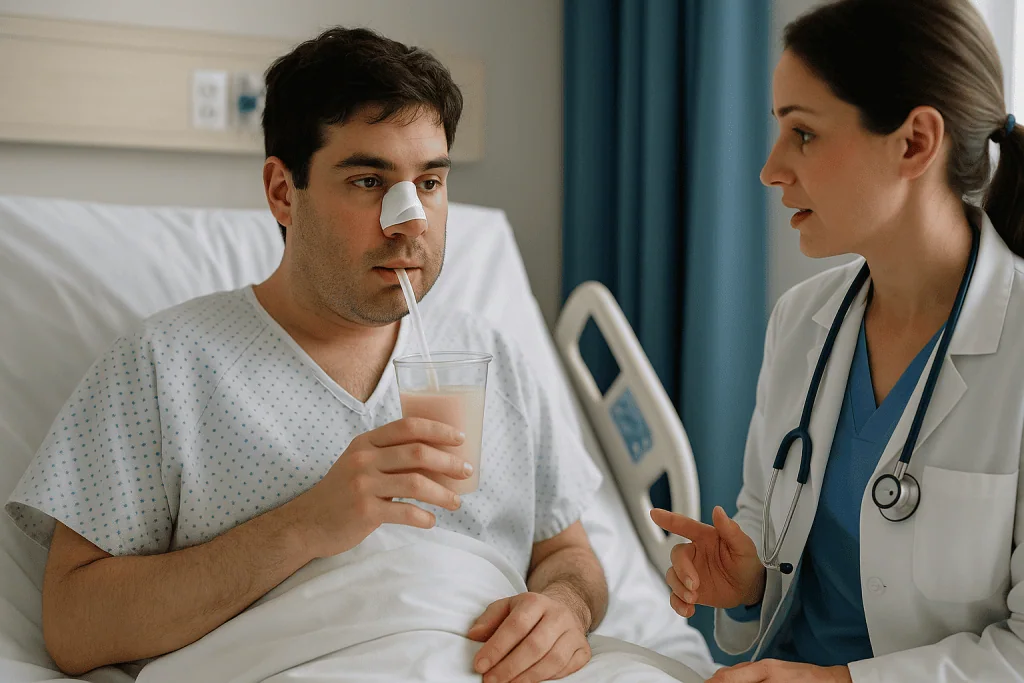
Breathing through your nose can be congested after upper jaw surgery because the sinuses sit directly above the maxilla. Teams often ask you to avoid blowing your nose forcefully for a period so pressure does not disturb the healing site, and a saline mist may be suggested to keep things comfortable. Sleeping propped up on several pillows, or in a recliner, helps drain fluid away from the face and is one of the few interventions almost every surgeon recommends.
Mayo Clinic describes a hospital stay of roughly one to a few days, depending on how you are managing fluids and pain. Many people go home on day two or three feeling weaker than they expected, mostly from limited calories and disrupted sleep rather than the operation itself.
Mouth care starts almost immediately, because a clean mouth heals better. Most teams provide a gentle antiseptic rinse or salt-water rinses and a small soft brush for the teeth you can reach. Incision lines inside the cheeks should be left alone; no poking with a tongue or finger, however tempting.
Ice or cold packs are commonly encouraged in these first days to limit swelling. After that early window, some teams switch to warmth to encourage circulation, which is why you should follow your own written instructions rather than a general rule.
Swelling after jaw surgery: why it builds before it fades
Swelling is not a sign that something went wrong. It is the body’s inflammatory response to bone cuts and tissue handling: blood vessels become leakier, fluid moves into the tissue, and the face, which has little spare room, expands visibly. It typically builds over the first several days rather than peaking on day one, which catches people off guard when the mirror looks worse on day three than it did leaving the hospital.
Bruising can migrate. Gravity carries pooled blood downward, so purple or yellow patches may appear on the neck or upper chest a few days in, well away from where any work was done. This is normal and resolves as the bruise breaks down.
The decline is asymmetric. Most of the dramatic swelling eases over the first few weeks, but a subtler puffiness along the cheeks, jawline and under the chin can linger for months. Surgeons often say the face keeps refining well past the twelve-week bone-healing mark that Mayo Clinic cites, because soft tissue drapes and settles more slowly than bone knits. One side may also look fuller than the other for a while; the two sides rarely resolve at identical speeds.
What helps, according to standard post-surgical guidance: sleeping with the head elevated, early cold packs, gentle walking to keep circulation moving, avoiding very salty foods, and keeping hydration up. Some surgeons prescribe a short course of corticosteroid, a medicine that dampens inflammation, around the time of surgery; whether and how that is used is entirely the surgical team’s decision.
If swelling suddenly increases days after it began improving, becomes hot and tense, or is accompanied by fever or a bad taste, that is a different picture and belongs in the red-flag section below.
Jaw surgery liquid diet: what you can actually eat
The liquid phase is less about the jaw being fragile and more about the fact that you cannot open wide, cannot feel your lip, and may have elastics or a splint limiting movement. MedlinePlus describes a full liquid diet as one made of foods that are liquid or turn liquid at room temperature: strained soups, milk and fortified milk alternatives, smooth yogurt, thinned cereals, pudding, fruit and vegetable juices without pulp, and nutrition drinks.
Thin is not enough; it has to be smooth. Even a stray oat or seed can lodge against a healing incision. A blender and a fine sieve are the two most useful tools in the kitchen for the first week or two. Foods that blend well include cooked pasta with sauce, lentil or bean soups, scrambled eggs thinned with milk, and roasted vegetables with stock. Season generously; when you cannot chew, flavor is most of the pleasure of eating.
Protein and calories tend to run short. People often lose weight in the first weeks because a cup of blended soup carries far fewer calories than the plate it came from. Adding milk powder, nut butters, silken tofu or full-fat dairy to blended meals lifts the numbers without changing the texture. A dietitian can tailor this, especially for anyone who was underweight before surgery.
Most surgeons ask you to skip straws in the early days, since the suction can disturb clots and incision lines; a cup, spoon or syringe with a soft tip works instead. Very hot liquids are also usually discouraged while the lip is numb, because you can burn yourself without noticing.
How long the strictly liquid stage lasts varies by team; Johns Hopkins patient guidance describes a progression from liquids to soft foods over the early weeks. Your surgeon will tell you exactly when mashed textures are allowed.
How painful is it after jaw surgery? An honest answer
Most people are surprised that pain is not the hardest part. The face is more pressure and tightness than sharp pain, largely because the nerves supplying the lower lip, chin and parts of the cheek are stunned during surgery, so the areas that would normally hurt most are partly numb. What does hurt tends to be the throat from the breathing tube, the jaw muscles as they cramp against the new position, and the ears and temples from referred discomfort.
Pain control typically works in layers. Anti-inflammatory medicines reduce the chemical signals that drive swelling and pain. Acetaminophen, a common pain reliever, works centrally rather than at the site. Opioids, strong pain medicines that act on the nervous system, are sometimes prescribed for a short period after larger operations, with the goal of stopping them as soon as the first days pass. Which combination you receive, and for how long, is a decision for the prescribing team, and any change should go through them.
Liquid formulations are common early on because swallowing tablets can be awkward with a limited opening. Taking pain relief on a steady schedule during the first days rather than waiting for pain to spike is standard surgical advice, but again, the schedule comes from your clinician.
Discomfort usually eases substantially over the first two weeks. What lingers is stiffness: the muscles that open and close the jaw have been on strike, and the joint feels rusty. Gentle opening exercises, when the surgeon clears them, address this. Pain that is getting worse rather than better after the first week, or pain concentrated on one side with new swelling, deserves a phone call rather than another dose.
Numbness after jaw surgery: how nerve recovery unfolds
Numbness is the symptom people underestimate before surgery and think about most afterward. The nerve that carries sensation to the lower lip and chin, the inferior alveolar nerve, runs inside the lower jaw exactly where the bone is cut and moved. It is almost always stretched or bruised during a mandibular osteotomy, and the upper jaw has its own network that supplies the cheeks, upper lip and gums.
The result is paresthesia, which simply means altered sensation: numbness, tingling, pins and needles, or a rubbery feeling. MedlinePlus explains that nerves recover slowly because they regenerate along their original path, and that pressure or stretching injuries often improve over weeks to months.
Recovery is gradual and patchy. Feeling often returns first as tingling or itching, then as odd hot-and-cold sensations, then as something closer to normal. Areas can recover at different speeds, so half a lip may feel fine while the other half is still asleep. Mayo Clinic lists nerve injury among the recognized risks of jaw surgery, and a minority of people, particularly older adults or those with large lower jaw movements, are left with some permanent change in sensation. Surgeons discuss this beforehand precisely because it cannot be promised away.
Practical consequences matter more than the label. A numb lip means you can dribble without knowing, bite your lip while eating, or burn it on a hot drink. Checking the lip in a mirror after meals, keeping drinks lukewarm, and using a small soft brush around the numb gums all help.
Movement of the face is different from feeling. Orthognathic surgery does not usually touch the nerve that moves the facial muscles, so a smile that looks weak in the first weeks is far more often swelling and stiffness than nerve damage.
Jaw surgery recovery week by week: weeks two through six
By the second week the acute phase is over, and the recovery becomes a test of patience rather than endurance. Bruising fades, the worst swelling recedes, and most people can hold a short conversation without exhausting themselves, though speech may sound slushy because the tongue is working around a numb lip and unfamiliar tooth positions.
Food usually steps up to soft, no-chew textures around this stage when the surgeon agrees: mashed potatoes, soft-cooked fish, well-cooked pasta, scrambled eggs, ripe bananas, soft-cooked vegetables. The instruction is to mash with the tongue, not the teeth, because the bone is still knitting even though it feels stable.
Energy is the surprise. Weeks of reduced calories, interrupted sleep and healing demand leave many people wiped out by a short walk. Johns Hopkins guidance frames the early weeks as a gradual return of stamina, and many people plan two to three weeks off work or school for a lower jaw procedure and somewhat longer for two-jaw surgery, adjusting around how they feel. A desk job is often resumed earlier than a physically demanding one.
Follow-up appointments cluster here. The surgeon checks the incisions, the bite and the elastics, and the orthodontist may begin small adjustments. Elastics might be changed in strength or direction several times as muscles adapt.
Mouth care gets easier as the opening increases. Brushing all surfaces becomes possible again, and rinses continue. Toward the end of this window, the six-week mark that Mayo Clinic identifies as initial jaw healing, many people are told they can begin gentle chewing of soft foods and resume light exercise. “Gentle” and “light” are doing a lot of work in that sentence, and your surgeon defines them.
Weeks six to twelve and beyond: bone healing and the face that finally looks like yours
Around six weeks, the new position is usually stable enough for the jaw to take modest loads. Around twelve weeks, Mayo Clinic describes the bone as healed, and this is typically when remaining dietary restrictions come off and the orthodontist accelerates the finishing work on the bite. Braces often remain for several months after surgery, sometimes closer to a year, depending on how much fine-tuning the teeth need.
“How long until my face looks normal?” has two honest answers. The face that looks like an unfamiliar, puffy version of you resolves largely over the first month or two. The final face, the one where the soft tissue has fully settled onto the new bone, can take six months to a year to reveal itself. Surgeons commonly tell people to withhold judgment on the result until the swelling is completely gone, and that is not evasive; it is how soft tissue behaves.
Function comes back in layers too. Chewing feels awkward at first because the muscles are working against a bite they have never used. Speech patterns adjust. The jaw joint may click or feel tired at the end of the day. These usually improve with use and with the gentle stretching exercises your surgeon prescribes.
Relapse, the tendency of a moved bone to drift partway back, is a recognized risk that Mayo Clinic lists, which is why elastics, splints and follow-up X-rays continue past the point where you feel healed. Keeping those appointments is the single most useful thing a patient can do in this stage.
People asking whether you ever “fully” recover are usually asking about sensation and appearance. Bone healing is expected to complete. Sensation usually improves substantially, with some lasting change possible in a minority. The face reaches its settled shape within roughly a year.
Breathing, sleep, exercise and mouth care: the daily details nobody tells you
The small logistics shape how a recovery feels more than the big milestones do. A few that come up at almost every follow-up visit:
- Sleep position. Sleeping with the head raised for the first weeks reduces morning swelling. A wedge pillow or recliner helps people who cannot stay propped on ordinary pillows.
- Nasal congestion. Upper jaw surgery temporarily disturbs the sinuses. Saline mist and a humidifier are commonly suggested; forceful nose-blowing is usually off the table for a period set by the surgeon.
- Dry, cracked lips. A numb lip, mouth breathing and constant rinsing dry the lips fast. Plain lip balm applied often is one of the most-recommended comfort measures.
- Exercise. Walking is encouraged from the first days for circulation and mood. Anything that raises blood pressure sharply, involves contact, or risks a fall to the face is generally paused until the surgeon clears it, often around the six-week mark.
- Talking. Speech is tiring and slurred early on. Texting, a whiteboard or a notes app spares the jaw and the patience of everyone around you.
- Weight. Some loss is common on a liquid diet. Weighing yourself weekly and reporting steep drops to the team lets them adjust the plan.
Mouth hygiene deserves special mention because it links directly to infection risk. The mouth is not sterile, and incisions sit right beside food and bacteria. Rinsing after every meal, brushing what you can reach with a small soft brush, and avoiding smoking, which impairs blood flow to healing bone, are the three habits surgeons emphasize most. Alcohol is generally discouraged while healing and while taking prescribed pain medicine; the reasons are both tissue healing and medicine interactions, and the guidance comes from your team.
What people often get wrong about jaw surgery recovery
“Your jaw will be wired shut for six weeks.” That was common decades ago. With titanium plates holding the bone, many people today are never wired. Some have elastics or a splint for a period, which limits opening but is not the same as wiring, and the decision is individual.
“It is the most painful surgery there is.” Message boards amplify the worst experiences. Most people describe pressure, tightness and fatigue more than severe pain, partly because numbness blunts the areas that would otherwise hurt most. Pain that escalates after the first week is the exception and should be reported, not endured.
“If the swelling is not gone in two weeks, something is wrong.” Gross swelling fades over weeks; subtle fullness lingers for months. Mayo Clinic frames bone healing at about twelve weeks, and soft tissue settling runs longer still. Judging the result early is the most common cause of unnecessary worry.
“Numbness means the nerve was cut.” Almost everyone has numbness after lower jaw surgery because the nerve is stretched or bruised, not severed. MedlinePlus notes that nerves recover slowly and along their original path, which is why sensation returns in patches over months.
“You can eat whatever you can fit in your mouth.” The bone feels solid long before it is fully healed. Chewing too early can shift segments and contribute to relapse, one of the risks Mayo Clinic lists. Textures advance on the surgeon’s schedule, not on how you feel that day.
“Once the braces come off, it is over.” Follow-up imaging and bite checks continue for months to confirm stability. Skipping those appointments is where otherwise smooth recoveries drift.
Questions to ask your care team before and after surgery
A good consultation leaves you with fewer surprises, not more paperwork. These questions are worth bringing on a note, because the answers shape your first month more than the surgical technique does.
- Will one jaw or both be moved, and how does that change my expected recovery?
- Will I have elastics, a splint or wiring, and for roughly how long?
- How long do you expect me to stay in hospital, and what needs to happen before I go home?
- What does my diet progression look like, and who decides when I step up from liquids to soft foods?
- What pain-relief plan are you prescribing, how long do you expect me to need it, and whom do I call if it is not enough?
- What numbness should I expect, in which areas, and what does recovery usually look like for a movement like mine?
- When can I return to work or school, drive, exercise and play contact sports?
- How will you monitor for relapse or infection, and how often will I be seen in the first three months?
- What signs mean I should call the on-call team tonight rather than wait for my appointment?
- How long will my braces stay on after surgery, and when will the final bite be assessed?
- Is a dietitian available if I struggle with weight or nutrition?
After surgery, the questions shift to specifics: is this swelling pattern expected, is this level of opening on track, is this area of numbness changing. Photographing your face from the same angle every few days gives the team something concrete to compare and gives you evidence of progress on the days it does not feel like any.
None of these questions has a universal answer. The point is to hear your team’s answer for your jaw, and to write it down while the anesthesia is still a future event rather than a recent one.
When to call your doctor: red flags after jaw surgery
Most of what you will feel in the first weeks is expected: swelling, numbness, stiffness, fatigue, mild oozing of blood-tinged saliva, a sore throat. A smaller set of signs points to a problem that needs the surgical team the same day, and surgeons would far rather take that call than see a complication late.
Contact your surgical team promptly, or seek emergency care if you cannot reach them, if you notice any of the following:
- Difficulty breathing, noisy breathing, or swelling that makes it hard to swallow saliva
- Bleeding that soaks through gauze or does not slow with steady pressure
- Fever, or swelling that becomes hot, tense and increasingly painful after it had begun to improve
- Pus, a foul taste or smell, or a wound edge that opens inside the mouth
- Pain that is getting worse rather than better after the first week, especially on one side
- Signs of dehydration: very dark urine, dizziness on standing, unable to keep fluids down
- A sudden change in how the teeth meet, a loose plate you can feel, or a sensation that the jaw has shifted
- Chest pain, shortness of breath, or a painful swollen calf, which can signal a blood clot after any surgery
- Numbness that is spreading to new areas rather than slowly improving
- Vision changes or severe headache after upper jaw surgery
The airway items at the top are the ones that justify calling emergency services rather than waiting for a callback. Everything else warrants a same-day conversation with the on-call team, who can judge whether you need to be seen, whether imaging is needed, or whether a medicine change is appropriate. Do not adjust prescribed medicines yourself while waiting.
Every decision about your recovery, from when to advance your diet to whether a symptom needs review, rests with the team who operated and know your anatomy. This article is a map; they hold the compass.
Frequently asked questions
Do you ever fully recover from jaw surgery?
Bone healing is expected to complete, typically around twelve weeks according to Mayo Clinic, and chewing, speech and facial shape settle over the following months. The one element that may not return fully is sensation: most people regain most feeling in the lip and chin over months, but a minority are left with some permanent numbness or altered sensation, which surgeons discuss as a known risk beforehand.
How painful is it after jaw surgery?
Most people describe pressure, tightness, throat soreness and muscle cramping rather than severe pain, partly because the operated areas are numb from stunned nerves. Discomfort usually eases substantially over the first two weeks. Pain that worsens after the first week, or new one-sided pain with swelling, is not typical and should be reported to the surgical team rather than managed at home.
Is jaw surgery a hard surgery to recover from?
It is more demanding in patience than in pain. The difficult parts are weeks of liquid and soft food, fatigue from reduced calories, a face that looks unfamiliar for a month or more, and numbness that recovers slowly. Serious complications are uncommon, and most people return to desk work within a few weeks, but the full recovery of sensation and appearance is measured in months.
How long does it take for your face to look normal after jaw surgery?
The obvious swelling fades over the first several weeks, so you look recognizably yourself within a month or two. The final result, with soft tissue fully settled onto the repositioned bone, usually takes six months to a year to emerge. Surgeons commonly advise waiting until all swelling has resolved before judging the outcome, because subtle fullness along the jawline can persist long after bone has healed.
How long is the jaw surgery liquid diet?
Strictly liquid eating commonly lasts the first one to two weeks, then advances to soft, no-chew textures until the surgeon confirms initial healing, which Mayo Clinic places at about six weeks. MedlinePlus defines a full liquid diet as foods that are liquid at room temperature, such as strained soups, smooth yogurt and nutrition drinks. Your surgeon sets the exact progression based on how your bone was fixed.
Is double jaw surgery recovery longer than single jaw?
Bimaxillary surgery, meaning both jaws are moved, usually brings more swelling, more nasal congestion and a longer hospital stay than a single-jaw operation, and people often plan a longer break from work. The bone-healing milestones are similar, roughly six weeks for initial and twelve for complete healing per Mayo Clinic, but the early weeks tend to feel heavier. Your surgeon can estimate your own recovery.
How long does swelling after jaw surgery last?
Swelling builds over the first several days, eases noticeably over the first few weeks, and then declines slowly, with subtle puffiness along the cheeks and jawline sometimes lasting months. Head elevation during sleep, early cold packs, walking and hydration are standard measures. Swelling that returns or becomes hot and painful after improving is not typical and should be checked by the surgical team.
Will my jaw be wired shut after orthognathic surgery?
Often not. Modern surgery uses small titanium plates and screws to hold bone, so many people are never wired. Some teams use elastics between the braces or a bite splint for a period to guide the new bite, which limits opening but still allows liquids and speech. Whether any of these is used depends on how far the bones moved and how stable they were, and your surgeon decides.
When can I go back to work or exercise after jaw surgery?
Many people return to desk-based work or school within two to three weeks, longer after two-jaw surgery or physically demanding jobs. Walking is encouraged from the first days. Strenuous exercise, heavy lifting and anything with a risk of a blow to the face are typically paused until the surgeon clears them, often around the six-week mark when Mayo Clinic describes initial healing.
Why is my lip still numb months after jaw surgery?
The nerve supplying the lower lip and chin runs through the bone that is cut, and stretching or bruising it during surgery is almost unavoidable. MedlinePlus notes nerves regenerate slowly along their original path, so recovery appears as tingling, patchy return and odd temperature sensations over months. Most people improve substantially; some change can persist. Numbness that spreads rather than improves should be reported.
References
This article is for general information only and is not a substitute for professional medical advice. Please consult a qualified doctor about your individual situation.

More from the Blog

What Tooth Decay Looks and Feels Like: Early Signs, Stages and When to See a Dentist
Early tooth decay often looks like a dull, chalky white patch on the enamel, usually near the gumline or between teeth, and typically causes…

Eating After a Tooth Extraction: Soft Foods, Straws to Avoid and Getting Back to Normal
After a tooth extraction, most people are asked to stick to cool, soft foods such as yogurt, applesauce or smooth soup for the first…

Questions to Ask Your Surgeon and Orthodontist Before Orthognathic Surgery
Before orthognathic (corrective jaw) surgery, ask your surgeon which jaw or jaws will be moved and why, what the alternatives are, how surgery and…

How Clear Aligner Treatment Unfolds: From Scan to Attachments to Your First Trays
Clear aligner treatment usually unfolds in stages: an orthodontic examination and digital scan of the teeth, a computer-planned sequence of movements the clinician reviews…

How a Jaw Cyst Is Diagnosed: Panoramic X-Ray, CT Imaging and Pathology Review
A jaw cyst is usually diagnosed in three steps. A panoramic dental X-ray first reveals a dark, fluid-filled space in the bone, often by…

Gummy Smile Results: How the Gum Line Settles and What a Balanced Smile Realistically Means
Gummy smile results depend on the cause and the method used. Gum reshaping produces a new gum line that is visible at once but…