

What Comes Before Porcelain Veneers: Treating Decay, Smile Planning and Choosing the Shade

Key Takeaways
- Conventional porcelain veneers involve removing a thin, irreversible layer of enamel, roughly half a millimeter, so the health of that enamel is checked first.
- Active tooth decay is filled or otherwise treated before a veneer is bonded, because caries continues to advance under ceramic and weakens the bond.
- Bleeding gums are the earliest sign of gingivitis, and inflamed tissue at the veneer margin can shrink after treatment and leave a visible gap.
- Whitening must be finished, and its color allowed to settle, before the veneer shade is chosen, since porcelain cannot be lightened afterward.
- Grinding or clenching does not rule out veneers but usually adds a custom night guard and may change the veneer design or material.
- A mock-up worn in the mouth before any drilling is the single best chance to change shape, length or number of teeth without consequence.
Preparing for porcelain veneers usually means resolving active tooth decay and gum inflammation first, checking the bite for grinding or clenching, completing any whitening before the shade is chosen, and reviewing a planned design or mock-up with the dental team. Veneers bond to healthy enamel, so untreated cavities, bleeding gums or an unstable bite are typically addressed before any tooth is reshaped.
The photo that started it was a birthday snapshot. She noticed the chip on one front tooth, the grey shadow along another, and the way she had learned to smile with her lips closed. A week later she was in a dental chair asking about veneers, half expecting to be measured for them that afternoon. Instead the conversation opened with an X-ray, a gum probe and a question about whether she clenched her jaw at night.
That detour is the real story of preparing for porcelain veneers. The thin ceramic shells people picture are the last step in a sequence that begins with the health of the teeth underneath them. Decay has to be treated, gums have to be quiet, the bite has to be understood and the color has to be settled before anyone picks up a drill.
This explainer walks through that sequence in order, what each step is for, and which questions are worth asking before the first appointment.
Why preparing for porcelain veneers starts with the teeth underneath
A porcelain veneer is a wafer of ceramic, often around half a millimeter thick, bonded to the front surface of a tooth to change its shape, color or alignment. Cleveland Clinic describes the procedure as removing a thin layer of enamel so the veneer sits flush rather than bulging outward. Enamel is the hard outer coating of the tooth, and it does not grow back once removed.
That single fact reorganizes the whole plan. The veneer is only as sound as the surface it is glued to. Bond a ceramic shell over softened, decayed enamel and the adhesive has nothing reliable to grip. Cement it beside inflamed gums and the tissue can recede, exposing a dark line at the edge months later. Place it in a mouth that grinds at night and the ceramic absorbs forces it was never designed for.
Dentists therefore tend to treat a veneer consultation as a general check-up with a specific goal. They look for cavities, particularly between the front teeth where the veneer margins will sit. They measure the pockets around each tooth to gauge gum health. They ask about headaches on waking, flattened edges on the back teeth and any history of jaw clicking.
None of this is a delay tactic. It is the difference between a restoration that lasts and one that fails at the seam. Cleveland Clinic notes that veneers can last a decade or longer with good care, but that figure assumes a healthy foundation. The weeks spent on fillings, cleanings or a night guard are part of the treatment, not a hurdle before it. Understanding that from the first visit makes the rest of the process far less frustrating.
How porcelain veneers actually work
Think of a veneer as a custom-made false fingernail for a tooth, only harder, thinner and permanently attached. The dentist reshapes the front of the tooth by a fraction of a millimeter, records the new shape with a mold or a digital scan, and a dental laboratory fabricates a ceramic shell to fit precisely. At a second visit the veneer is checked for fit and color, the tooth surface is roughened with a mild acid gel, and a resin cement is hardened with a blue light.

Two properties make porcelain useful here. It reflects light the way natural enamel does, so a well-made veneer picks up the translucency of the tooth beside it rather than looking painted on. It also resists staining better than the resin composites used in direct bonding, which is why Cleveland Clinic lists stain resistance among the advantages of ceramic over composite.
The bond itself is the working part. Resin cement flows into microscopic pits etched into the enamel and locks the ceramic in place. Enamel bonds far more predictably than dentin, the softer, yellower layer beneath it. When decay or heavy wear has already exposed dentin, the dentist has to weigh whether a veneer will hold or whether a crown, which wraps the whole tooth, is a sounder choice.
Local anesthetic is typically offered during preparation, because removing enamel close to the nerve can be uncomfortable. Temporary veneers, usually made of acrylic, protect the reshaped teeth while the laboratory works. Cleveland Clinic gives a typical wait of a few weeks between the two visits, though timelines vary with the laboratory and the number of teeth involved.
Once bonded, a veneer is not a coating that wears off. It is a permanent commitment to maintaining and eventually replacing that restoration, which is why the checks before it matter.
Can you get veneers with cavities? What has to be treated first
The short answer is that active decay is treated before a veneer is placed, not hidden beneath it. Tooth decay, or caries, is the breakdown of enamel and dentin by acids produced when mouth bacteria feed on sugars. The NHS explains that it begins as a chalky spot where minerals have leached out and progresses to a cavity, a physical hole, if the process continues.
A veneer over a cavity fails for two reasons. Decay keeps advancing under the ceramic, where it cannot be seen or cleaned, and the softened tooth structure cannot hold the bond. The result is a veneer that debonds or a tooth that eventually needs far more extensive work.
What happens instead depends on how far the decay has gone:
- Early enamel-only lesions may be managed with fluoride applied by the dentist and changes to brushing and diet, since MedlinePlus notes that early demineralization can sometimes be halted before a cavity forms.
- A small cavity is usually cleaned out and filled with a tooth-colored composite, then allowed to settle before the veneer appointment.
- Decay that reaches deep dentin or the pulp, the nerve and blood supply at the center of the tooth, may need root canal treatment, and the dentist may then recommend a crown rather than a veneer because too little enamel remains.
Between-teeth decay deserves particular attention. Veneer margins often end in exactly these areas, and a bitewing X-ray, which shows the sides of the teeth, is the usual way to check them. Asking whether every planned tooth has been X-rayed is a reasonable question at the consultation.
The timing gap between a filling and a veneer is set by the treating dentist. Some prefer the tooth to be symptom-free for a period before committing to permanent ceramic work.
Gum health before veneers: why bleeding gums pause the plan
Gums that bleed when brushed are not a cosmetic footnote. They are the earliest sign of gingivitis, inflammation of the gum caused by plaque along the gumline, and the NHS lists bleeding on brushing or flossing as the first symptom most people notice. Left alone, gingivitis can progress to periodontitis, where the bone supporting the tooth begins to break down.
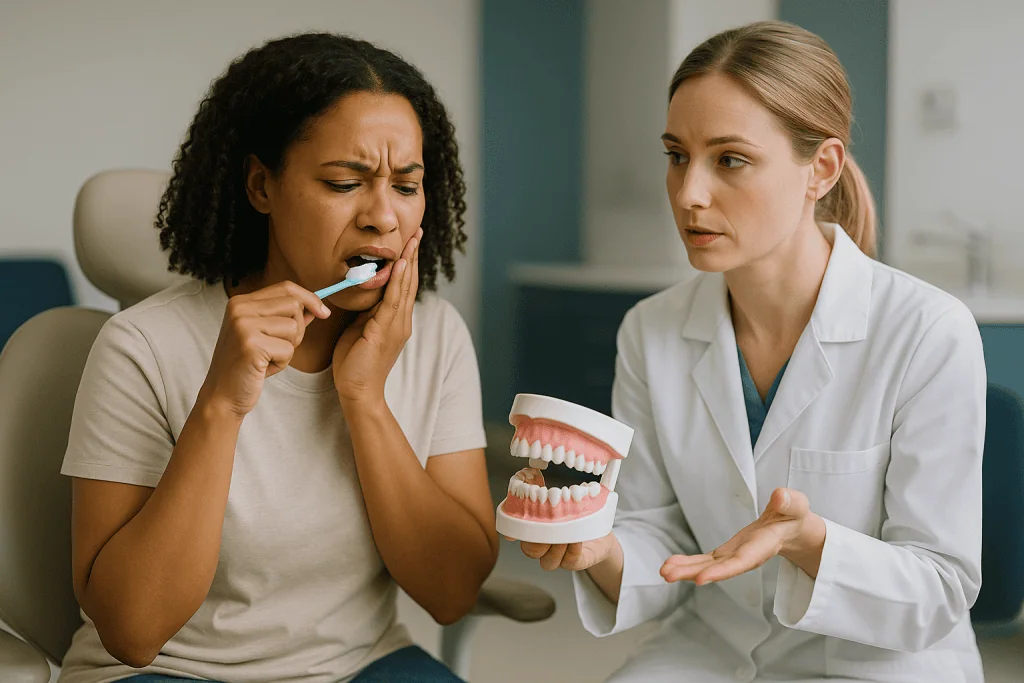
Veneer margins sit right at the gumline, so the state of that tissue determines how the finished result looks and lasts. Inflamed gums are swollen. If a veneer is shaped to meet swollen tissue and the swelling then subsides after treatment, a gap or a dark band of exposed tooth appears at the edge. Recession from periodontitis does the same over a longer period.
Bleeding also interferes with the bonding step itself. Resin cement needs a dry, clean surface, and gum bleeding contaminates the enamel at the exact point where the seal matters most.
For these reasons the dentist typically measures the depth of the pocket between gum and tooth with a slim probe. Shallow, non-bleeding pockets suggest healthy tissue. Deeper or bleeding pockets usually lead to a professional cleaning, sometimes with the gums numbed, followed by a review visit to confirm the inflammation has settled before veneers proceed.
Home habits matter during this phase. The NHS guidance on gum disease is straightforward: brush twice daily with fluoride toothpaste, clean between the teeth once a day, and stop smoking if you smoke, since tobacco impairs gum healing and masks bleeding. People who see their gums calm down within a few weeks often find the rest of the veneer process moves more smoothly.
Persistent bleeding despite good hygiene warrants a closer look, and occasionally referral to a periodontist, a dentist who specializes in gum treatment.
Teeth grinding, bite and the hidden forces on a veneer
Porcelain is hard but brittle. It tolerates the ordinary forces of chewing well and the sideways grinding of clenched teeth poorly. Bruxism is the medical term for grinding or clenching, often during sleep, and Mayo Clinic notes that many people are unaware they do it until a partner hears the noise or a dentist spots flattened, chipped or worn edges.
The planning visit includes a bite check for this reason. The dentist looks at the wear patterns on the back teeth, asks about morning jaw soreness or dull headaches, and may check whether the front teeth meet edge to edge, a pattern that loads veneers heavily. Cracked or chipped veneers are among the complications Cleveland Clinic lists, and an unmanaged grinding habit is a common contributor.
Bruxism does not automatically rule veneers out. It changes the plan. A custom night guard, a molded acrylic tray worn during sleep, spreads the force and shields the ceramic. Some dentists ask patients to wear one for a period before veneers so the habit and the appliance are established. The design of the veneers may also change, with slightly shorter edges or a material choice that trades some translucency for strength.
Bite problems beyond grinding matter too. Crowded or rotated teeth can be disguised with veneers to a point, but a significantly misaligned bite may be better served by orthodontic treatment first. Moving teeth into a better position often means less enamel has to be removed later, because the veneer no longer has to compensate for a tooth that sits too far forward.
Mayo Clinic points out that stress, certain medications and sleep disorders can all drive bruxism. Where a cause is suspected, addressing it sits with the treating team and, where needed, a physician.
Smile design before veneers: what the planning visit involves
Smile design is the planning stage in which the dentist and laboratory decide the shape, length and arrangement of the veneers before any tooth is touched. It sounds like marketing language, but the underlying steps are practical and, done well, prevent the most common regret: teeth that look too long, too white or too uniform.
The visit usually begins with photographs of the face at rest and in a full smile, plus impressions or a digital scan of both arches. From these the laboratory produces a wax-up, a physical or digital model of the proposed result. Proportions are checked against the face. The two central front teeth are typically slightly longer than the teeth beside them, and the smile line, the curve made by the tooth edges, ideally follows the lower lip rather than sitting flat.
Many dentists then transfer that design into the mouth as a mock-up: a temporary resin layer placed over the untouched teeth for an hour or a few days. It lets the patient see the shape in a mirror, feel how the lips move over it and speak with it. Sounds like "f" and "v" depend on the top front teeth meeting the lower lip, and a design that is too long can make those consonants feel awkward.
The mock-up is where honest feedback belongs. Changes at this stage cost nothing but time; changes after enamel is removed are far harder. Bringing an older photograph of your natural smile can help, since most people want to look like a rested version of themselves rather than a stranger.
Planning also settles how many teeth are involved. Veneering only the teeth visible in a broad smile, rather than every front tooth, is a common approach that keeps the result natural and preserves untouched enamel where it is not needed.
Who is usually a candidate, and who is usually asked to wait
Veneers suit a fairly specific set of problems. Cleveland Clinic lists chipped or broken teeth, discoloration that whitening does not shift, small gaps, mildly crooked or unevenly sized teeth and worn edges among the usual reasons. The common thread is a tooth that is structurally sound but cosmetically compromised on its front face.
People who tend to be asked to wait or to consider an alternative include:
- Anyone with active decay or gum disease, until it is treated and stable.
- People with heavy, unmanaged grinding, until a night guard or other approach is in place.
- Those whose teeth have lost a large amount of enamel, because the bond may be unreliable and a crown may serve better.
- People with significant bite problems that would be better corrected with orthodontics first.
- Children and teenagers whose teeth and gums are still changing position, since the gumline often continues to shift into early adulthood.
Pregnancy is not a contraindication in itself, but many dentists prefer to schedule elective cosmetic work for after delivery, in part because pregnancy-related gum changes can affect the tissue around veneer margins.
Expectations matter as much as anatomy. Veneers change the color and shape of the front surface of a tooth. They do not straighten a rotated tooth in the way braces do, and they cannot brighten a smile beyond what the surrounding teeth and lips will make look natural. Someone hoping veneers will address jaw pain, a clicking joint or generalized sensitivity is likely to be redirected, because those problems have different causes.
The decision about candidacy sits with the treating dentist, who weighs enamel thickness, gum health, bite and the person’s own priorities. A "not yet" is common and usually comes with a plan for turning it into a "yes."
Whitening before veneers: timing and why order matters
Veneers are typically placed on a handful of front teeth, and the teeth beside and behind them stay natural. If you want those natural teeth brighter, whitening has to happen before the veneer shade is chosen, because porcelain does not lighten afterward. Match a veneer to yellowed neighbors, whiten those neighbors later, and the veneer is suddenly the darkest tooth in the smile.
Professional whitening uses peroxide-based gels that break down pigment molecules within the enamel. The NHS describes the process as taking several visits or a course of home trays fitted by the dentist, and cautions that results are not permanent, typically fading over months to a few years depending on diet and smoking.
Timing is the practical issue. Freshly whitened enamel is temporarily dehydrated and can look brighter than it will a week or two later. Many dentists therefore wait for the color to settle before selecting the veneer shade, so the ceramic is matched to the stable result rather than the peak. Whitening also leaves residual oxygen in the enamel for a short period, which can weaken the resin bond, another reason for a gap between the last whitening session and the bonding appointment.
Sensitivity is the most common side effect of whitening. It usually eases within days, but people with exposed roots or existing sensitivity should raise this with the dentist, who may adjust the approach.
Whitening does not change the color of existing fillings, crowns or bonding. If an old composite filling sits on a tooth that will not be veneered, it may need replacing after whitening to match. All of this belongs in the smile design conversation so that the sequence, whitening, settling, shade selection, preparation, runs in the right order.
How to choose veneer shade: light, translucency and the teeth next door
Choosing a veneer shade is less like picking paint and more like matching a fabric under different lights. Natural teeth are not one color. They are darker and more saturated near the gum, lighter toward the edge, and slightly translucent at the tip where light passes through. A good veneer copies that gradient rather than presenting a single flat white.
Dentists use a shade guide, a fan of ceramic tabs in graded colors, held against the teeth. Several practical rules improve the match:
- Shade is chosen at the start of the appointment, before the teeth dry out under the light and appear artificially lighter.
- Natural daylight or a color-corrected lamp is preferred over ordinary overhead lighting, which can tint everything yellow or blue.
- Bright lipstick and strongly colored clothing are usually removed or covered, because they alter how the eye perceives tooth color.
- The neighboring untouched teeth, not the ceiling or a magazine photo, set the reference.
Translucency is the property people forget. Two veneers of identical base shade can look completely different if one is opaque and the other lets light through. Opaque ceramic is sometimes necessary to mask a very dark tooth, but it can look chalky. Translucent ceramic looks lifelike but shows whatever lies beneath, which is why a heavily stained tooth may need a slightly thicker or more opaque veneer than its neighbor.
Try-in paste is the final safeguard. Before permanent cementing, the dentist places the veneers with a water-soluble paste in a range of tints so both of you can see the result in the mouth. The cement shade itself can nudge the final color warmer or cooler by a small margin. If something looks wrong at try-in, that is the moment to say so, because the laboratory can still adjust.
Veneers vs. bonding vs. crowns: how the options compare
Veneers sit between two neighbors on the spectrum of cosmetic restorations. Composite bonding, in which the dentist sculpts tooth-colored resin directly onto the tooth in a single visit, is more conservative. A crown, which covers the entire tooth, is more extensive. Cleveland Clinic outlines these as the main alternatives when discussing veneers, and the choice depends on how much healthy tooth remains and what needs to change.
| Feature | Composite bonding | Porcelain veneer | Crown |
|---|---|---|---|
| Enamel removed | Little or none | Thin layer, front surface | Substantial, all surfaces |
| Visits | Usually one | Usually two | Usually two |
| Stain resistance | Lower; resin picks up color over time | High | High |
| Typical use | Small chips, minor gaps | Color, shape, mild alignment on sound teeth | Weakened, heavily filled or root-treated teeth |
| Reversible | Largely | No | No |
| Repair if chipped | Often patched in the chair | Usually replaced | Usually replaced |
The table clarifies why preparation matters differently for each. Bonding forgives an imperfect plan because it can be reshaped or removed. A veneer commits the tooth to a lifetime of ceramic restorations. A crown is chosen when the tooth is already compromised, often after decay has been treated and the remaining structure is judged too weak for a veneer.
Longevity figures are approximate. Cleveland Clinic gives a typical span of around a decade or longer for porcelain veneers with good care, and notes that composite tends to need replacement or refreshing sooner because it stains and wears. Individual results vary with bite, hygiene and habits, and no restoration is permanent.
Some people combine approaches, veneering the teeth that show most and using bonding on smaller edge chips elsewhere. The treating dentist maps this out during planning.
What the weeks before and after placement usually look like
Preparing for porcelain veneers unfolds over weeks rather than days, and knowing the shape of that timeline reduces the sense of being strung along.
The first stretch is diagnostic and restorative. Fillings, professional gum cleaning and any whitening happen here, followed by a pause for gums to settle and tooth color to stabilize. How long depends on what was found; a single small filling needs little recovery, while treating established gum inflammation can take several weeks of hygiene work and a review.
Planning follows, with photographs, scans, the wax-up and often a mock-up. Some people wear a trial mock-up for a few days to test speech and appearance.
Preparation day comes next. The teeth are numbed, reshaped and scanned, and temporaries are placed. Cleveland Clinic notes that the laboratory phase typically takes a few weeks. During this window, temporaries are more fragile than the final veneers, so sticky or very hard foods are usually avoided, and a temporary may occasionally loosen and need re-cementing.
Bonding day involves try-in, adjustment and permanent cementing. Some sensitivity to cold in the following days is common as the teeth recover from preparation and settle under the new ceramic. Mild gum soreness around the margins is also expected after the cement is cleaned away.
Most dentists schedule a review a week or two later to check the bite, polish any rough margins and confirm the gums are healing. After that, veneers are cared for like natural teeth: brushing twice daily with fluoride toothpaste, cleaning between teeth, and regular check-ups. A night guard, if one was recommended during planning, is worn from the first night.
Every timeline here is a typical range, not a guarantee, and the treating team adjusts it to the individual mouth.
What people often get wrong about preparing for porcelain veneers
Several beliefs surface again and again at consultations, and most of them stem from photographs that show the end result but none of the groundwork.
"Veneers will fix the cavity too." They will not. A veneer is a cosmetic layer over the front of a tooth. Decay beneath it continues, and the veneer hides the warning signs until the damage is extensive. Treating decay first is not optional.
"Whiter is always better." Very bright ceramic against natural neighbors, gums and skin tone tends to look flat and artificial. Shade is chosen relative to the face, not to an absolute scale, and the neighboring teeth set the ceiling unless they are whitened first.
"There is no drilling." Minimal-preparation veneers exist for some cases, but Cleveland Clinic is clear that conventional porcelain veneers involve removing a thin layer of enamel, and that this step is irreversible. Anyone told otherwise should ask exactly how much enamel will be removed.
"Veneers are maintenance-free." The tooth under the veneer can still decay at the margins, gums can still recede, and porcelain can chip. Check-ups, hygiene and, where relevant, a night guard remain part of life.
"One consultation is enough to decide." The mock-up exists because seeing a design in your own mouth changes minds. Rushing from the first visit to preparation skips the step most likely to prevent regret.
"Bleeding gums are normal and can be ignored." The NHS identifies bleeding as the first sign of gum disease. It is treatable, and treating it protects both the veneer and the tooth.
The honest summary is that veneers reward patience. The mouth that arrives at bonding day healthy, stable and well planned is the one most likely to keep its result.
Questions to ask your care team
A well-prepared consultation is a two-way exchange. These questions tend to surface the information that shapes the plan, and a thoughtful team will welcome them.
- Have all the teeth you plan to veneer been X-rayed, and is there any decay between them or under old fillings?
- What did the gum measurements show, and do I need a professional cleaning or a review before we proceed?
- Do you see signs that I grind or clench, and would you recommend a night guard before or after the veneers?
- How much enamel will be removed from each tooth, and are any of these teeth better suited to bonding or a crown?
- Will I see a wax-up or a mock-up in my mouth before any preparation, and can I take time to live with it?
- Should I whiten first, and how long will we wait afterward before choosing the shade and bonding?
- How many teeth do you suggest treating, and why that number rather than more or fewer?
- What material and level of translucency are you planning, and how will you handle any tooth that is darker than the others?
- What will the temporaries feel like, and what should I do if one comes loose?
- What sensitivity or soreness is expected afterward, and what would be a sign that something is wrong?
- How do you handle a veneer that chips or debonds later, and how often should I return for checks?
- Are there alternatives, including doing nothing for now, that you would consider reasonable for my situation?
Writing the answers down helps, because a great deal of information arrives in one sitting. If the responses feel rushed or a question about decay, gums or enamel is brushed aside, it is reasonable to seek a second professional opinion before committing to an irreversible step. The decision about whether and how to proceed always rests with you and the treating team together.
When to call your doctor
Most of the preparation phase and the days after veneer placement are uneventful. A few signs, though, should prompt a call to the dental office or, in some cases, urgent medical care rather than waiting for the next scheduled visit.
Contact your dentist promptly if you notice:
- Toothache that lingers for more than a few seconds after hot or cold, or that wakes you at night, at any stage before or after veneers, since MedlinePlus lists persistent or spontaneous pain among the signs that decay may have reached the nerve.
- A temporary or permanent veneer that loosens, cracks or falls off, so the exposed tooth can be protected.
- Gum swelling, pus, a bad taste or a small bump on the gum near a treated tooth, which can indicate infection.
- Bleeding from the gums that continues despite good brushing and flossing for more than a couple of weeks.
- A bite that feels high or uneven after cementing, because a veneer that takes too much force can chip or cause jaw discomfort.
- Sensitivity that is worsening rather than easing in the weeks after placement.
Seek urgent care the same day if you develop facial swelling that spreads toward the eye or neck, fever alongside dental pain, difficulty swallowing or opening the mouth, or breathing that feels restricted. The NHS advises that a dental abscess with these features needs emergency attention because infection can spread beyond the tooth.
People taking blood-thinning medication, those with heart valve conditions or a weakened immune system should tell the dental team before any procedure, including gum cleaning, so that any precautions can be arranged with the prescribing clinician. Never adjust a prescribed medicine on your own before dental work; the decision belongs to the doctor who prescribed it, in conversation with the dentist.
Frequently asked questions
Can you get veneers with cavities already in the teeth?
No, active cavities are treated before a veneer is placed. Decay under ceramic keeps advancing where it cannot be seen, and softened enamel cannot hold the resin bond. Small cavities are usually filled with composite and allowed to settle; deeper decay reaching the pulp may need root canal treatment, after which a crown is often a sounder choice than a veneer.
How long does preparing for porcelain veneers usually take?
It varies with what the check-up finds. A healthy mouth may move from planning to bonding within a few weeks, while treating gum inflammation or several cavities can add weeks. Cleveland Clinic gives a typical laboratory wait of a few weeks between preparation and bonding. These are ranges, not promises, and the treating dentist sets the pace.
Should I do whitening before veneers or after?
Before. Veneers usually cover only some front teeth, and the natural neighbors set the shade. Porcelain cannot be lightened later, so whitening afterward would leave the veneers looking darker. Dentists typically wait for whitened teeth to rehydrate and stabilize before choosing the shade, because freshly whitened enamel briefly looks brighter than its settled color.
How do you choose veneer shade so it looks natural?
Shade is matched to the neighboring teeth under daylight or color-corrected lighting, at the start of the appointment before teeth dry out and lighten. Translucency matters as much as base color, and a try-in with temporary paste lets you see the veneers in your mouth before permanent cementing. Very bright, flat white tends to look artificial against gums and skin.
What does smile design before veneers actually involve?
It is the planning stage: photographs of the face and smile, impressions or a digital scan, a wax-up model of the proposed result, and often a temporary mock-up placed over untouched teeth. The mock-up lets you test appearance and speech, particularly sounds like “f” and “v,” and request changes while they are still easy to make.
Do bleeding gums stop me from getting veneers?
They pause the plan rather than end it. Bleeding is the first sign of gum disease according to the NHS, and inflamed tissue at the veneer edge can shrink after treatment and expose a gap. A professional cleaning, improved daily hygiene and a review visit usually bring the gums to a stable state before veneers proceed.
Can I have veneers if I grind my teeth at night?
Often yes, with adjustments. Porcelain is brittle under sideways grinding forces, so a custom night guard is usually recommended, sometimes worn for a period before placement. The dentist may also alter the veneer shape or material for strength. Mayo Clinic notes many people grind without knowing, which is why wear patterns are checked at the planning visit.
Is enamel removal for veneers really permanent?
Yes. Cleveland Clinic describes removing a thin layer of enamel so the veneer sits flush, and enamel does not regenerate. Once prepared, a tooth will always need a veneer or another restoration. Minimal-preparation approaches exist for selected cases, but it is reasonable to ask exactly how much enamel will be removed from each tooth before agreeing.
How long do porcelain veneers typically last?
Cleveland Clinic gives a typical span of around a decade or longer with good care, though individual results depend on bite, hygiene and habits such as grinding. Veneers can chip, debond or develop decay at the margins, so regular check-ups continue. No figure is a guarantee, and eventual replacement should be expected.
What are the alternatives if I am asked to wait for veneers?
Composite bonding can address small chips and gaps in one visit with little or no enamel removal and is largely reversible. Whitening alone may be enough for discoloration. Orthodontics may better correct alignment problems and reduce how much enamel a later veneer needs. A crown is considered when a tooth is already heavily filled or weakened.
References
This article is for general information only and is not a substitute for professional medical advice. Please consult a qualified doctor about your individual situation.

More from the Blog

Can Gum Disease Be Cured or Reversed? What Treatment Achieves at Each Stage
Gum disease can be cured only in its earliest stage. Gingivitis, where gums are red, swollen and bleed but no bone is lost, is…

When Is a Smile Makeover More Than Veneers? Combining Whitening, Bonding and Gum Work
A smile makeover is a planned combination of treatments, and veneers are only one possible piece. Dentists often reach for whitening when color is…

When a Root Canal Fails: Retreatment, Apicoectomy and What Happens Next for the Tooth
A failed root canal is usually managed in one of three ways: nonsurgical retreatment, where a dentist or endodontist reopens the tooth, removes the…

How Long Until Gums Stop Bleeding After Treatment? What Usually Happens Week by Week
For gum inflammation without bone loss (gingivitis), bleeding typically eases within about one to two weeks of a professional cleaning combined with careful daily…
Life After SRP: Gentle Brushing, Interdental Cleaning and Keeping Gum Pockets Clean
After scaling and root planing, care centers on keeping the treated gum pockets free of plaque while the tissue settles. Guidance from the NHS…

Preparing for Oral and Maxillofacial Surgery: Imaging, Blood Tests and Anesthesia Review
Oral surgery preparation usually involves three checks: imaging (a panoramic X-ray, sometimes a cone beam CT scan) to map teeth, nerves and bone; blood…