

OTC Hearing Aids and AirPods as Hearing Aids: What Changed and Who Benefits
Key Takeaways
- The FDA rule creating OTC hearing aids took effect October 17, 2022, and applies only to adults 18 and older with perceived mild to moderate hearing loss.
- The AirPods Pro hearing aid feature received FDA authorization on September 12, 2024, as the first over-the-counter hearing aid software, cleared for the same adult, mild-to-moderate group.
- In the ACHIEVE randomized trial, a hearing intervention slowed cognitive decline by about 48 percent over three years only in the higher-risk subgroup, with no overall effect across all 977 participants.
- Original Medicare Parts A and B do not cover hearing aids or fitting exams, though Part B covers diagnostic hearing tests a clinician orders to investigate a medical cause.
- Otosclerosis causes conductive hearing loss from bone growth around the stapes, typically begins between the late teens and forties, and cannot be distinguished from age-related loss by an app-based test.
- Sudden hearing loss, one-sided loss, ear pain, drainage, dizziness or pulsing tinnitus are red flags that require medical evaluation before any over-the-counter device is considered.
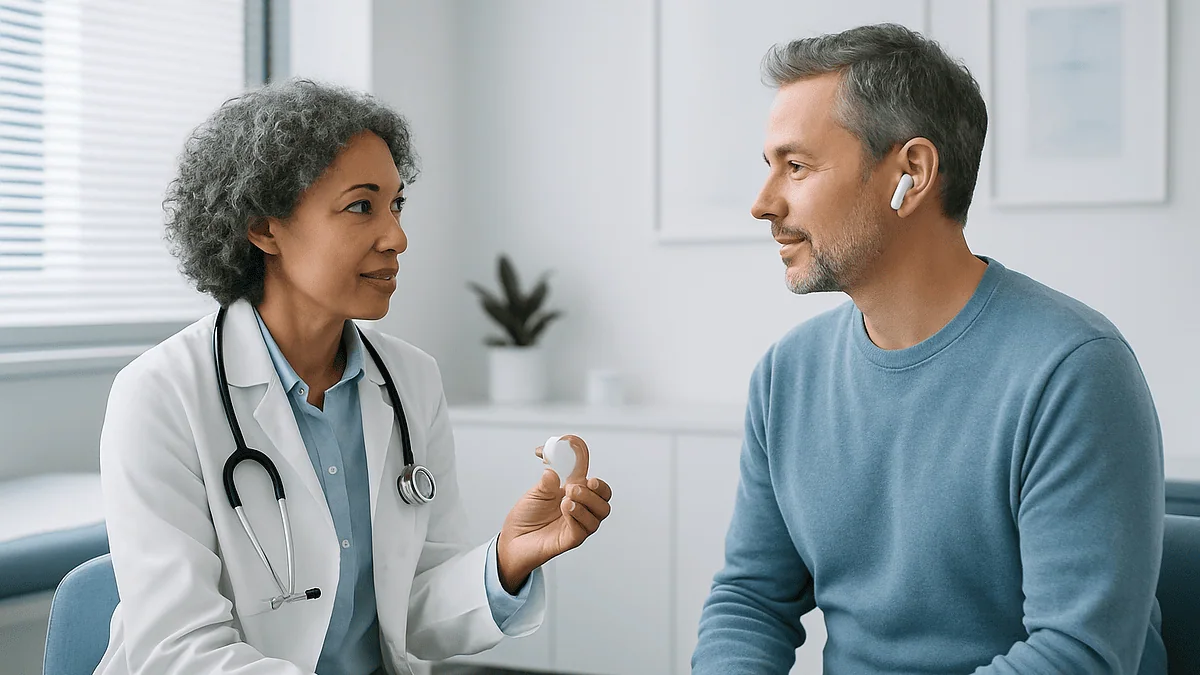
OTC hearing aids are FDA-regulated devices that adults 18 and older can buy and fit themselves for perceived mild to moderate hearing loss, a category created by an FDA rule that took effect in October 2022. Since September 2024, the FDA has also authorized a hearing aid feature in AirPods Pro for the same group. Both can help with everyday listening, but neither replaces a hearing evaluation when loss is sudden, one-sided or severe.
The man at the next table was wearing white earbuds through an entire anniversary dinner, and his wife did not seem to mind. He was not listening to music. He was listening to her. That small scene, repeated in restaurants and living rooms across the country, explains why otc hearing aids are back at the top of search results as of September 2026: a wave of social posts claiming that “your AirPods are now hearing aids” has collided with the real, dated facts of two FDA decisions, and most people cannot tell where the marketing ends and the medicine begins.
Here is the shape of the story. In 2022 the FDA created a new class of hearing aids sold without a prescription. In 2024 it authorized software that turns a popular consumer earbud into one. In between, a large randomized trial changed how researchers talk about hearing and the aging brain.
What follows is the honest version: who these devices are for, what the evidence can and cannot support, and the handful of warning signs that mean the answer is a clinic visit, not a checkout page.
What changed recently: the dates behind the trend
Three dates explain the current surge of interest, and each one is public record.
On August 16, 2022, the FDA issued its final rule establishing over-the-counter hearing aids as a regulatory category. The rule took effect on October 17, 2022. For the first time, adults 18 and older with what the rule calls “perceived mild to moderate” hearing loss could buy a hearing aid in a store or online without a prescription, a medical exam or a professional fitting. The FDA set limits on how loud these devices can get and required a user-adjustable volume control and plain-language labeling about when to seek care.
On September 12, 2024, the FDA granted marketing authorization for Apple’s Hearing Aid Feature, software that runs on AirPods Pro 2 earbuds paired with a compatible iPhone or iPad. It was the first over-the-counter hearing aid software the agency had cleared, and it was reviewed through the De Novo pathway, the route the FDA uses for low-to-moderate-risk devices that have no close predecessor. The feature reached US users with a software update in late October 2024, and newer AirPods Pro models have carried it since.
The third date is scientific rather than regulatory. In July 2023, the ACHIEVE trial, a randomized study of nearly 1,000 older adults supported by the National Institutes of Health, reported that a hearing intervention slowed cognitive decline over three years in participants who were already at higher risk. That finding has been quoted, and often overstated, in nearly every viral post since.
So as of September 2026, the category is approaching its fourth birthday, the earbud feature its second, and the question has shifted from “is this allowed?” to “does it work, and for whom?”
What are OTC hearing aids, and who are they designed for?
A hearing aid is a small amplifier tuned to the frequencies a person struggles to hear. OTC hearing aids are the subset you can buy without seeing a hearing professional first, and the FDA drew the boundaries deliberately narrow.
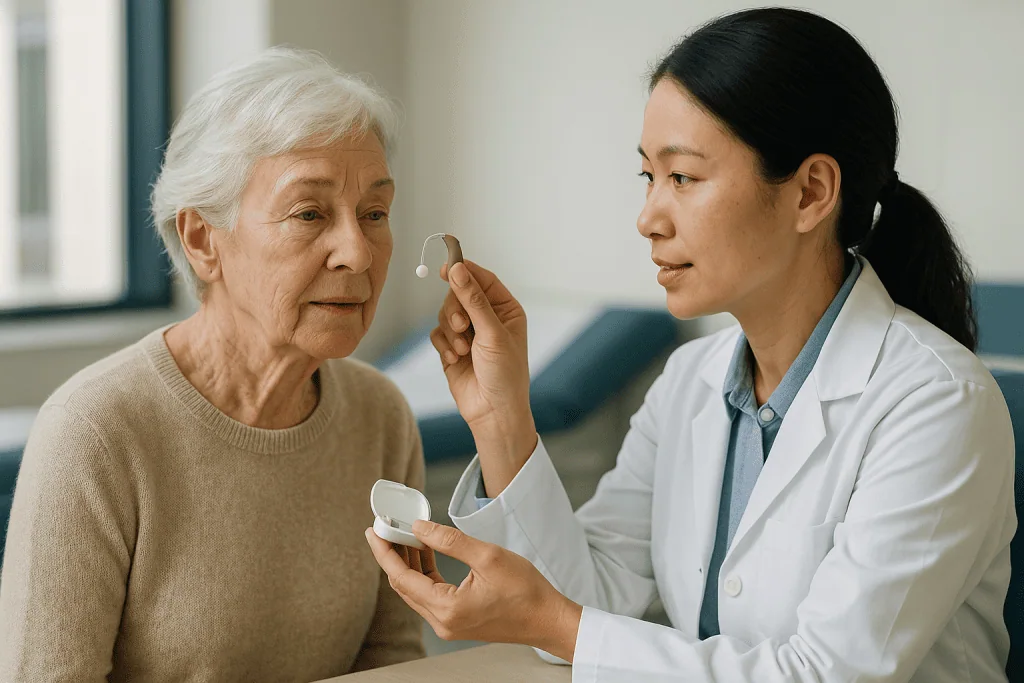
The intended user is an adult, 18 or older, who believes their own hearing loss is mild to moderate. In practical terms that means trouble following conversation in a noisy restaurant, turning the television up louder than others want, asking people to repeat themselves, or struggling on the phone. It does not mean having difficulty hearing loud sounds, hearing speech in quiet, or being unable to follow a one-on-one conversation at normal volume. Those patterns suggest more significant loss, which the rule leaves to prescription devices.
Why the age limit? Hearing loss in children has different causes, affects language development, and demands medical evaluation. The FDA kept all pediatric hearing aids in the prescription category.
Why the severity limit? Amplification that is too strong can damage hearing, and people with severe loss need the precise, verified fitting that a professional provides using an audiogram, the chart that plots your hearing threshold at each pitch. Mild loss is defined by audiologists as thresholds roughly between 26 and 40 decibels; moderate loss sits roughly between 41 and 60. A decibel is a unit of loudness; a quiet conversation is around 60 decibels, a whisper around 30.
It helps to know what OTC hearing aids are not. They are not personal sound amplification products, the inexpensive gadgets sold for birdwatching or lectures, which are not regulated as medical devices and make no claims about hearing loss. They are also not a replacement for the diagnostic exam that identifies treatable causes of hearing loss such as earwax, infection or otosclerosis. They are a tool for a specific, common problem in a specific group of adults.
OTC hearing aids vs prescription hearing aids: what actually differs
Strip away the branding and the two categories differ in four meaningful ways: who they are for, how they are fitted, how loud they can go, and who is accountable when something is wrong.
| Feature | OTC hearing aids | Prescription hearing aids |
|---|---|---|
| Intended user | Adults 18+, perceived mild to moderate loss | Any age, any degree of loss |
| Hearing test | Optional; often an app-based self-test | Full audiogram by an audiologist or hearing specialist |
| Fitting | Self-fitted using presets or a smartphone app | Programmed to the audiogram, then verified with real-ear measurement |
| Maximum output | Capped by FDA rule | Higher outputs allowed for severe and profound loss |
| Follow-up | Manufacturer support; user adjusts | Scheduled adjustments, counseling, repairs |
| Medical screening | Labeling lists red flags; user decides | Clinician screens for treatable causes before fitting |
The fitting difference is the one that matters most and is least visible. Real-ear measurement means placing a tiny microphone in the ear canal while the hearing aid plays sound, to confirm the device delivers the intended amplification at each pitch in that particular ear. Ear canals vary enormously, and the same setting can be too loud in one person and too soft in another. OTC devices skip this step by design, relying on your own judgment of what sounds right.
That is not a fatal flaw for mild loss, where the margin for error is wide. It becomes a real limitation as loss grows, and it is one reason the category is capped where it is.
Can AirPods really work as a hearing aid?
Yes, within limits, and the limits are written into the FDA authorization. The airpods hearing aid feature is software, not a special earbud. On compatible AirPods Pro models paired with a recent iPhone or iPad, a user takes a hearing test in the Health app, and the results are used to amplify specific frequencies in real time, boosting the consonants and high pitches that most age-related hearing loss erodes first.

The FDA authorized the feature for adults 18 and older with perceived mild to moderate hearing loss, the same population covered by the 2022 rule. The agency’s review relied on a clinical study comparing the self-fitted feature with a professional fitting of the same hardware; participants achieved similar perceived benefit and similar speech understanding in noise. That is encouraging, but it is a single manufacturer-sponsored study in a selected group, and it tells us about this device, not about earbuds in general.
Several practical realities follow from the design:
- Battery life is measured in hours, not days. Dedicated hearing aids are built to run from morning to bedtime; earbuds are not.
- The earbuds seal the ear canal. That is excellent for noise cancellation and poor for people who find occlusion, the plugged, boomy sensation of hearing your own voice, intolerable.
- Comfort for all-day wear was not the original design brief, and many users remove them after a few hours.
- Social signaling cuts both ways. Some people prefer looking like a music listener; others find that companions assume they are distracted.
None of this makes the feature a gimmick. For an adult with early, mild loss who already owns the hardware, it is a legitimate entry point, and the hearing test alone has prompted people to seek evaluation who never would have otherwise. It is simply a different tool than a device engineered from the start to be worn 14 hours a day.
How the AirPods hearing test and hearing aid feature actually work
The test is a version of pure-tone audiometry, the same basic method used in clinics: tones at different pitches are played at decreasing volume until you can barely detect them, and the quietest level you reliably hear at each pitch becomes your threshold. The app walks you through this in a quiet room over about five minutes, using the earbuds’ noise cancellation to reduce background sound and a check for ambient noise before starting.
The result is a simplified audiogram and a classification of little to no, mild, moderate, severe or profound loss in each ear. The FDA cleared this test as a screening tool, which is a careful word. A screening test sorts people into “probably fine” and “worth a closer look.” It is not the same as a diagnostic exam, which also uses bone conduction testing to distinguish sensorineural loss, where the inner ear or nerve is damaged, from conductive loss, where sound is blocked on its way in by wax, fluid or stiffened middle-ear bones.
That distinction is the whole reason clinicians exist in this process. An app can tell you that high pitches are quiet in your right ear. It cannot tell you whether that is decades of noise exposure or a treatable blockage, and it does not look in the ear canal at all.
Once a test is saved, the hearing aid feature applies a personalized boost to live sound picked up by the earbud microphones. Users can adjust overall amplification, balance between ears, and tone, and the same profile can be applied to phone calls and media. A separate hearing protection mode reduces loud environmental sound.
The engineering is genuinely clever. The medical caveat is unchanged: software that amplifies sound treats the symptom of reduced hearing. It does not examine the ear, and it does not know what it cannot see.
What the evidence actually says, graded honestly
Enthusiasm about any new category runs ahead of the data, so it is worth sorting what is known by how it is known.
Strong evidence (randomized trials): Hearing aids improve communication and hearing-related quality of life in adults with mild to moderate loss. This has been shown repeatedly, and a 2017 randomized trial from Indiana found that older adults who self-fitted a device achieved benefit similar to those fitted by an audiologist over six weeks, though the professionally fitted group was more satisfied and more likely to keep using the device. The ACHIEVE trial, published in 2023, is the largest randomized test of a hearing intervention on cognition to date.
Moderate evidence (observational studies): Untreated hearing loss is consistently associated with faster cognitive decline, more social isolation, more falls and more depressive symptoms. Hearing aid use is associated with lower risk in several cohorts. Association is not proof; people who use hearing aids also tend to be healthier and better resourced.
Limited evidence (small studies, manufacturer data): That specific OTC devices or the AirPods feature perform comparably to prescription aids. The FDA authorization for AirPods rested on one company-funded comparison study, and most OTC product data come from manufacturers. Independent head-to-head trials in real-world use remain few.
Expert opinion: That self-fitting is safe for mild loss when red flags are absent, that OTC devices will increase the share of adults who use amplification at all, and that an initial medical evaluation is still the ideal first step. Professional bodies broadly agree on these points without decisive trial data.
The honest summary: amplification works, self-fitting is reasonable for mild loss, and the big claims about brain health rest on one well-designed trial whose main result was in a subgroup. Hold each claim at its proper weight.
Are OTC hearing aids worth buying? An honest decision framework
Worth it for whom? That is the only version of the question with an answer.
OTC hearing aids tend to make the most sense when several things are true at once. You are an adult whose difficulty is mostly in background noise and group conversation. You hear fine in quiet. Both ears seem roughly equal. Nothing changed suddenly. You have no pain, drainage, dizziness or ringing that is new or one-sided. You are comfortable with a smartphone app or willing to learn. And, crucially, you have been putting off doing anything at all. Studies consistently find that adults wait years after first noticing hearing trouble before seeking help, and anything that shortens that delay has value.
They tend to make less sense when the loss is greater than you think. People are poor judges of their own hearing; a common pattern is to describe loss as mild while an audiogram shows moderate to severe, particularly in the high frequencies. Self-fitted devices capped at OTC output levels will under-serve that person, and the frustration can sour them on hearing aids altogether.
A few questions to ask yourself before buying:
- Can I return it? Return windows vary, and a device you cannot wear comfortably for eight hours is a device you will not wear.
- Does it fit my ear and my hands? Small batteries and tiny buttons defeat many first-time users, especially those with arthritis or reduced dexterity.
- Have I ruled out the obvious? A clinician looking in the ear canal takes seconds and finds impacted wax surprisingly often.
The strongest case for OTC hearing aids is not that they beat prescription devices. They do not, on the measures that have been studied. The case is that a good-enough device actually worn beats an excellent device never acquired, and for mild loss, good enough is frequently good.
What is the very best OTC hearing aid? Why that is the wrong question
Search engines are full of ranked lists, and a hospital magazine will not add to them. Partly that is editorial neutrality. Mostly it is because the ranking question misunderstands how hearing aids succeed or fail.
The device that works is the device that matches your audiogram, fits your ear canal, suits your dexterity and gets worn. A model that scores highly in a review for sound quality may be unusable for someone whose main complaint is restaurant noise if its directional microphones are weak, or unwearable for someone with narrow ear canals. The variable that predicts outcome is fit, in every sense of the word, not the name on the box.
With that said, the features that matter are knowable:
- A self-fitting process based on your own hearing test rather than a handful of generic presets. The FDA distinguishes self-fitting devices from preset ones, and the former adapt more closely to individual loss.
- Directional microphones or a dedicated noise program, since speech in noise is the most common complaint in mild loss.
- Feedback cancellation, which suppresses the whistle that occurs when amplified sound leaks back into the microphone.
- Rechargeable batteries with enough capacity for a full waking day.
- A physical form you can insert and remove without help.
There is one more honest point. A clinician cannot tell you which brand to buy either, and a reputable one will not try. What a hearing professional can do is tell you the shape and degree of your loss, which immediately narrows the field, and later verify whether whatever you chose is delivering appropriate sound. Several audiology practices now offer fitting checks for self-purchased devices, and that pairing of consumer purchase with professional verification may be the most practical middle path to emerge from the 2022 rule.
Hearing loss, the brain and what the ACHIEVE trial really found
The viral version goes: hearing aids prevent dementia. The real version is more interesting and considerably more modest.
Observational studies over the past 15 years have shown that adults with hearing loss experience faster cognitive decline and higher dementia risk than peers with normal hearing, and the risk rises with the degree of loss. The proposed mechanisms are plausible: the brain diverts effort to decoding sound at the expense of memory, social withdrawal shrinks mental stimulation, and the auditory cortex itself may lose volume when deprived of input. But observational data cannot prove that treating hearing changes the trajectory.
The ACHIEVE trial was designed to test exactly that. Researchers randomized 977 adults aged 70 to 84 with untreated mild to moderate hearing loss to either a hearing intervention, meaning fitted hearing aids plus counseling over several visits, or a health-education control. After three years, across the whole trial population, there was no significant difference in the rate of cognitive decline.
The result that made headlines came from a prespecified subgroup. Among participants drawn from an existing heart-health cohort, who were older and carried more risk factors for cognitive decline, the hearing intervention slowed decline by roughly 48 percent compared with controls. Among healthier volunteers recruited from the community, who declined very little over three years regardless of group, there was no measurable effect.
What to take from this: in older adults already at elevated risk, treating hearing loss may slow cognitive decline, and that is a meaningful finding from a well-run trial. What not to take from it: that any hearing device prevents dementia, that benefit was shown in low-risk people, or that OTC devices specifically were studied. The trial used professionally fitted prescription aids with counseling. Longer follow-up is under way, and the question is open rather than settled.
What is otosclerosis, and why does it matter in an OTC world?
Otosclerosis is the clearest example of a hearing problem that looks, from the inside, like ordinary age-related loss and is nothing of the kind.
In otosclerosis, abnormal bone growth forms in the middle ear, most often around the stapes, the smallest bone in the body, which normally vibrates like a piston against the inner ear. As the growth stiffens the stapes, sound reaches the inner ear less efficiently. The result is conductive hearing loss, meaning the inner ear and nerve may be perfectly healthy while sound simply fails to get through. Over years, the process can also affect the inner ear directly, producing a mixed loss.
Several features set it apart from typical presbycusis, the gradual high-frequency loss of aging. Otosclerosis tends to begin between the late teens and the forties rather than after 60. It often runs in families; roughly half of people with the condition have a relative who has it. It is more common in women, and some notice it worsening during or after pregnancy. The loss frequently affects lower pitches first, and many people report that they hear better in noisy places, a paradox called paracusis that arises because other people raise their voices. Tinnitus, the perception of ringing or buzzing, is common.
Why does this matter for self-fitted devices? Because an app-based hearing test measures only air conduction and cannot distinguish a conductive loss from a sensorineural one. A person with otosclerosis who buys OTC hearing aids may get useful amplification, but they will never learn that a surgical option exists. Stapedectomy, in which the fixed stapes is replaced with a tiny prosthesis, is an established procedure that an ear specialist can discuss; hearing aids are also a standard option. Which is appropriate depends on the individual and is a decision for the person and their treating clinician. The point is that you cannot weigh options you do not know you have.
Does Medicare cover hearing aids?
This is among the most searched questions on the topic, and the answer has not changed with the OTC rule.
Original Medicare, meaning Parts A and B, does not cover hearing aids or the exams performed specifically to fit them. This exclusion dates to the program’s founding statute and has survived repeated legislative attempts to change it. Part B does cover diagnostic hearing and balance evaluations when a clinician orders them to decide whether medical treatment is needed, for example to investigate sudden loss, dizziness or suspected otosclerosis. So the test that determines what kind of hearing loss you have may be covered; the device that treats it is not.
Medicare Advantage plans, the private alternatives to Original Medicare, frequently advertise hearing benefits. These vary widely from plan to plan in what they include, which devices qualify, how often a replacement is allowed and which providers are in network. Anyone comparing plans should read the hearing benefit in the plan’s evidence-of-coverage document rather than the summary brochure, because the details are where the differences live.
Medicaid coverage of adult hearing aids is decided state by state, and the rules change. Some states cover devices and fittings for adults; others cover only children. Veterans enrolled in VA health care may be eligible for hearing aids through that system. Some employer and private insurance plans include a hearing allowance, and flexible spending or health savings accounts can generally be used for hearing aids, including OTC devices, because they are recognized medical devices.
One consequence of the coverage gap is worth stating plainly. The 2022 rule did not appear in a vacuum; it was in part a response to the reality that most American adults with hearing loss pay for devices themselves and most never acquire them. OTC hearing aids lower one barrier. They do not change the insurance picture.
Common myths about OTC hearing aids and the AirPods feature
Viral claims age quickly. These are the ones still circulating, and what the evidence supports instead.
Myth: Any earbud is now a hearing aid. The FDA authorized a specific software feature on specific AirPods Pro models paired with specific devices. Other earbuds with “hearing enhancement” or “conversation boost” settings are not authorized hearing aids unless the manufacturer has gone through the same regulatory process, and most have not.
Myth: OTC hearing aids are just cheap versions of prescription aids. Some use the same chips and manufacturers. The difference is regulatory and procedural: capped output, no required professional fitting, and an intended population limited to mild to moderate loss. Quality varies enormously within the category.
Myth: Hearing aids prevent dementia. One randomized trial found slowed cognitive decline in a higher-risk subgroup over three years. It did not measure dementia diagnoses, did not find an effect in lower-risk adults, and used prescription devices with counseling. The honest phrase is “may slow decline in some older adults,” not “prevents.”
Myth: Hearing aids make your hearing worse. Devices meeting the FDA output cap, worn as intended, do not damage hearing. What people notice is that unaided hearing feels worse by contrast once they have grown used to amplification, and that underlying age-related loss continues regardless.
Myth: Wearing them means you are old. Mild hearing loss is common from the forties onward, and noise-related loss is rising in younger adults. The average first-time hearing aid user in the US is in their late sixties, mostly because of the decade-long delay between noticing a problem and acting on it, not because loss begins that late.
Myth: If an app says my hearing is normal, it is. App-based tests are screening tools in a quiet room with a particular earbud seal. A borderline or unexpected result, or a normal result despite real-world difficulty, is a reason to test properly, not a reason to stop looking.
Getting the most from a self-fitted device
Most hearing aids that end up in a drawer were abandoned in the first month. The reasons are predictable, and so are the fixes.
Expect your own voice to sound strange. Amplified, slightly boomy, oddly loud. This is occlusion plus the novelty of hearing consonants you have been missing, and for most people it fades within two to four weeks of consistent wear. The mistake is to wear the device for an hour at a restaurant, hate it, and stop. The brain adapts to amplification the way it adapts to new glasses, through hours of exposure in ordinary environments. Start at home, in quiet, with one person talking, and build from there.
Retest periodically. App-based hearing tests make this easy, and hearing changes. A profile created two years ago may be under-amplifying today. If results shift noticeably in one ear only, or faster than you expect, that is a clinic visit rather than a settings tweak.
Keep the sound path clean. Wax and moisture are the leading causes of a hearing aid that “stopped working.” Wipe the device daily, replace domes and wax guards as instructed, and keep it dry.
Tell the people around you. Hearing aids restore access to sound; they do not restore the brain’s ability to separate one voice from five. Companions who face you, pause the television, and skip the shouting from another room will do more for your comprehension than any setting.
Consider a professional check even for a self-purchased device. A hearing professional can measure what the device is actually delivering in your ear, look at your ear canals, and tell you whether the OTC category is the right place for you to be. That one visit can rescue a device that would otherwise be given up on, and it is the single piece of advice most audiologists give about this category.
When to see a doctor: red flags that override any app
The FDA requires OTC hearing aid labeling to list warning signs, and they deserve more than fine print. Each of these means the right next step is a clinician, not a device, regardless of what a self-test reported.
- Sudden hearing loss in one or both ears, over hours to a few days. Sudden sensorineural hearing loss is treated as a medical urgency; evaluation within days matters, and the window for treatment is narrow. Do not wait to see if it passes.
- Hearing loss in one ear only, or clearly worse in one ear. Age and noise affect both ears roughly equally. Asymmetry needs explanation.
- Ear pain, pressure or a feeling of fullness that persists.
- Fluid, pus or blood draining from the ear within the past few months.
- Dizziness or vertigo, especially alongside hearing change.
- Tinnitus in one ear only, or ringing that pulses with your heartbeat.
- Hearing that fluctuates, better some days and worse others.
- A visible deformity of the ear, a history of ear surgery, or a suspected foreign body or wax blockage.
- Hearing loss after a head injury, or that began during treatment with certain chemotherapy or antibiotic medicines known to affect hearing; raise this with the prescribing clinician rather than adjusting anything yourself.
Beyond red flags, a baseline evaluation by a hearing professional is reasonable for anyone considering amplification, and a visit to a primary care clinician or an ear, nose and throat specialist is appropriate whenever an app result surprises you, whenever OTC hearing aids do not seem to help after a fair trial, or whenever difficulty in quiet one-on-one conversation suggests the loss is beyond mild. Every decision about diagnosis and treatment, including whether a surgical option such as that for otosclerosis is worth discussing, belongs with the clinician who has examined your ears and your audiogram, not with a review site or this magazine.
Frequently asked questions
Are OTC hearing aids worth buying?
For adults with mild hearing loss, mostly in noisy settings, and no red-flag symptoms, OTC hearing aids are a reasonable and evidence-supported option. A randomized trial found self-fitted devices delivered benefit similar to professionally fitted ones for mild to moderate loss over six weeks. They are a poor fit when loss is greater than it feels, which is common, so a baseline hearing evaluation first improves the odds of choosing well.
What is the very best OTC hearing aid?
There is no single best device, because success depends on how well a device matches your hearing loss, ear canal, dexterity and daily routine. Look for a true self-fitting process based on your own hearing test, directional microphones for speech in noise, feedback cancellation, all-day battery life and a return policy long enough for a fair trial. A hearing professional can tell you the degree and type of your loss, which narrows the choice considerably.
Can I use my AirPods as a hearing aid?
If you have compatible AirPods Pro models paired with a recent iPhone or iPad, yes: the FDA authorized a hearing aid feature in September 2024 for adults 18 and older with perceived mild to moderate hearing loss. You take an in-app hearing test and the earbuds amplify the frequencies you miss. Battery life, all-day comfort and the sealed-ear sensation are the main practical limits compared with dedicated hearing aids.
Does any Medicare cover hearing aids?
Original Medicare does not cover hearing aids or the exams to fit them, though Part B covers diagnostic hearing and balance tests when a clinician orders them to investigate a medical problem. Many Medicare Advantage plans include some hearing benefit, but the specifics vary widely by plan, so read the full evidence-of-coverage document. Medicaid coverage for adults depends on the state.
What is otosclerosis?
Otosclerosis is abnormal bone growth in the middle ear, usually around the stapes, which stiffens the bone and blocks sound from reaching the inner ear. It causes conductive hearing loss, often beginning between the late teens and forties, frequently runs in families and is more common in women. Options include hearing aids and a surgical procedure called stapedectomy; which is appropriate is a decision for an ear specialist after examination.
How do I know if my hearing loss is mild or moderate?
You cannot reliably tell by feel; people routinely underestimate their own loss. An audiogram, the hearing test that measures your threshold at each pitch, classifies mild loss at roughly 26 to 40 decibels and moderate at roughly 41 to 60. App-based tests give an estimate, but a professional test adds bone conduction, which distinguishes inner-ear loss from blockage, and an examination of the ear canal.
Do hearing aids prevent dementia?
The evidence does not support that claim. The ACHIEVE randomized trial found no overall effect on cognitive decline over three years, but in a higher-risk subgroup of older adults a hearing intervention slowed decline by about 48 percent. It did not measure dementia diagnoses and used professionally fitted prescription aids with counseling. Treating hearing loss may slow cognitive decline in some older adults; that is the accurate statement.
What is the difference between OTC hearing aids and personal sound amplifiers?
OTC hearing aids are FDA-regulated medical devices intended for adults with perceived mild to moderate hearing loss, with capped output, required labeling and safety standards. Personal sound amplification products are consumer electronics for people with normal hearing who want to hear distant sounds, such as birdwatchers, and they are not regulated as medical devices or permitted to claim they treat hearing loss.
Can OTC hearing aids damage my hearing?
Devices that meet the FDA output limits for the OTC category, worn as intended, are not expected to damage hearing. The sensation that unaided hearing feels worse after using amplification reflects contrast and ongoing age-related change, not harm from the device. Turning any device to maximum volume for long periods is unwise, and persistent discomfort, pain or new ringing after use warrants a clinician’s evaluation.
Should I see a doctor before buying OTC hearing aids?
It is not required by the rule, but it is strongly advisable, and essential if you have any red flag: sudden loss, one-sided loss, pain, drainage, dizziness, pulsing tinnitus or fluctuating hearing. A clinician can find treatable causes such as impacted earwax or otosclerosis that no app detects, and a hearing professional can confirm whether your loss truly falls within the mild-to-moderate range the OTC category is designed for.
References
- Over-the-Counter Hearing Aids – NIH National Institute on Deafness and Other Communication Disorders
- Hearing Aids – MedlinePlus
- Hearing Aids and Implants – NHS
This article is for general information only and is not a substitute for professional medical advice. Please consult a qualified doctor about your individual situation.

More from the Blog
Cavities in Adults: Why They Still Happen and Whether Early Decay Can Reverse
Cavities still happen in adults because bacteria in plaque turn sugars into acid, and when acid attacks outnumber saliva's repair cycles, enamel loses mineral…
Mouth Ulcers: Why They Recur and When They Need a Doctor
Mouth ulcers, often called canker sores, are shallow breaks in the lining of the mouth that usually heal on their own within one to…

Mouthwash: Does It Help or Harm the Oral Microbiome?
Mouthwash can help or disturb the oral microbiome depending on its active ingredient. Fluoride rinses strengthen enamel without killing bacteria and have the strongest…

Eye Vitamins and Lutein: What the AREDS Trials Actually Showed
The AREDS trials showed that a specific antioxidant and zinc formula modestly slows progression in people who already have intermediate age-related macular degeneration, and…
Electric Toothbrushes, Water Flossers and Floss: What Dental Trials Show
Randomized trials pooled in a Cochrane review found that electric toothbrushes remove modestly more plaque and reduce gum inflammation slightly more than manual brushes,…
Receding Gums: Causes, Whether They Grow Back and the Treatments That Help
Receding gums happen when gum tissue pulls away from a tooth and exposes more of its root, most often because of gum disease, aggressive…