

Myopia Control in Children: Atropine Drops, Special Lenses and Outdoor Time: What Works
Key Takeaways
- Each extra millimetre of eye length adds roughly two to three diopters of nearsightedness, which is why clinics now track axial length as closely as the prescription.
- Adding a 40-minute outdoor class to the school day cut new myopia cases from about 40 to about 30 percent over three years in a randomized Guangzhou trial.
- Low-concentration atropine shows a clear concentration-response effect, and the weakest tested concentration failed to beat placebo in a 2023 NIH-funded US trial.
- Defocus spectacle lenses, dual-focus soft contact lenses and orthokeratology each slowed eye growth by roughly 40 to 60 percent in two- to three-year trials.
- Deliberately undercorrecting a child's glasses does not slow myopia and in trials sometimes sped it up.
- Overnight orthokeratology carries the highest corneal infection risk of the options, so a red, painful eye in any lens wearer needs same-day care.
Myopia control means slowing how fast a child's nearsightedness worsens, not reversing it. Randomized trials show that low-concentration atropine eye drops, specially designed defocus spectacle or contact lenses, and overnight orthokeratology each slow progression by roughly 30 to 60 percent over two to three years, while daily outdoor time mainly lowers the chance of myopia starting. An eye care professional should guide the choice and monitor it.
The optician slides the new prescription across the counter and a parent does the arithmetic: the nine-year-old’s lenses have thickened again, the third jump in two years. That small moment at the counter is why myopia control, the set of treatments that aim to slow a child’s nearsightedness rather than simply correct it, has become one of the most searched eye-health phrases of the year.
Several things converged. As of September 2026, defocus spectacle lenses for children sit on mainstream optician shelves across Europe, Asia and Canada; the first low-concentration atropine eye drop authorised for slowing childhood myopia reached European prescribers after its 2025 approval; and the World Health Organization keeps repeating a projection that unsettles every school nurse: roughly half the world’s population could be nearsighted by 2050. Add a wave of social videos promising to reverse myopia with eye exercises or red lights, and families are left sorting evidence from hope.
This guide does the sorting. It explains what progressive myopia is, how each option works, how strong the trial data really are, and when a child needs an urgent eye examination rather than a new lens design.
What changed recently in myopia control
For most of the twentieth century, a nearsighted child got stronger glasses each year and nobody expected to alter the trajectory. The past seven years rewrote that script, and the dates matter because they explain why clinics now offer options that did not exist when today’s parents were children.
- 2019: The US Food and Drug Administration approved the first soft contact lens specifically indicated to slow myopia progression in children who begin wearing it between ages 8 and 12. The same year, the World Health Organization’s World report on vision counted about 2.6 billion people with myopia and named childhood progression a public-health priority.
- 2020 to 2022: Randomized trials from Hong Kong and China published two- and three-year results for spectacle lenses with built-in peripheral defocus, a design that keeps central vision sharp while bending light at the edges of the lens so it lands in front of the retina. These lenses spread quickly across Europe and Asia.
- 2023: Two large US randomized trials of very low-concentration atropine reported conflicting results. One, funded by the National Institutes of Health, found the lowest tested concentration no better than placebo over two years; the other found a modest benefit. Together they confirmed what earlier Asian trials had hinted: the effect depends on concentration, and the weakest drops may do little for some children.
- 2025: A low-concentration atropine eye drop received marketing authorisation in the European Union, the first product of its kind approved there for this purpose. In the United States, atropine for myopia remains an off-label use with no approved manufactured product, a point every parent should hear from the prescriber.
The National Eye Institute’s current patient information now lists atropine drops, specialty contact lenses and outdoor time alongside ordinary glasses, a quiet signal that myopia control has moved from research clinics into routine paediatric eye care.
What is progressive myopia in children?
Myopia, or nearsightedness, means the eye focuses images in front of the retina instead of on it, so distant objects blur while near ones stay clear. In children the usual reason is not a misshapen cornea but an eyeball that has grown too long from front to back. Eye doctors call that front-to-back measurement axial length; in a typical adult it sits near 24 millimetres, and every extra millimetre adds roughly two to three diopters of nearsightedness. A diopter is the unit on a glasses prescription, and the minus sign marks myopia.
Progressive myopia simply describes a prescription that keeps climbing year after year. Almost all childhood myopia progresses to some degree, because the eye grows while the child does. What varies is speed. A child who becomes nearsighted at six or seven often worsens by half a diopter or more each year through the early teens, while a child whose myopia starts at twelve tends to change more slowly and settle sooner. Progression usually eases in the late teens, though it continues into the twenties in some people.
The clinical threshold for high myopia is minus six diopters or stronger, and it is the number that worries ophthalmologists, since the stretched eye wall behind it carries lifelong risks discussed next. Two patterns raise the odds of reaching it: early onset and rapid annual change. Having one nearsighted parent roughly doubles a child’s chance of myopia and having two roughly triples it, yet genes alone cannot explain why prevalence among young adults in some East Asian cities has passed 80 percent within two generations. Environment, chiefly time spent indoors doing close work, filled in the rest.
Why slowing myopia matters more than the glasses
Parents sometimes ask why anyone bothers, since glasses fix the blur. The answer lies in what stretching does to the back of the eye over decades. The retina, the light-sensing layer, and the choroid beneath it do not grow new tissue to match a lengthening eyeball; they thin, like paint on an expanding balloon.
That thinning shows up in adulthood as a cluster of conditions. Retinal detachment, in which the retina peels away from its blood supply, is several times more common in people with high myopia than in those with none. Myopic maculopathy, a degeneration of the central retina, has become a leading cause of untreatable vision loss in parts of East Asia where myopia is near-universal. Primary open-angle glaucoma, damage to the optic nerve, occurs roughly twice as often in myopic eyes, and cataract tends to arrive earlier. None of these is guaranteed, and most highly myopic adults see well with correction, but risk rises steadily with each diopter and each millimetre.
That gradient is the whole rationale for slowing progression. Treatments that cut it by a third to a half do not keep a child out of glasses; they aim to leave a 25-year-old at minus three rather than minus five, with a shorter eye, a thicker retina and a lower lifetime chance of the complications above. Population studies suggest that each diopter shaved off final myopia lowers the odds of maculopathy by a meaningful margin, though that is an inference from observational data rather than a trial result.
One honest gap remains. No randomized study has yet followed treated children into middle age to count detachments or maculopathy, because the oldest trial participants are still young adults. The biology points one way, and clinicians act on it, but the long-term proof is still being lived out.
How eye doctors diagnose and track childhood myopia
No myopia plan starts without a proper baseline, and the baseline is more involved than reading letters off a chart. Children focus so powerfully that their eye muscles can mask or exaggerate a prescription, so eye care professionals use cycloplegic drops, which temporarily relax the focusing muscle and widen the pupil, before measuring. A cycloplegic refraction, meaning the prescription measured after those drops, is the gold standard in paediatric eye care and the reason a child’s eyes may stay dilated for several hours after a visit.
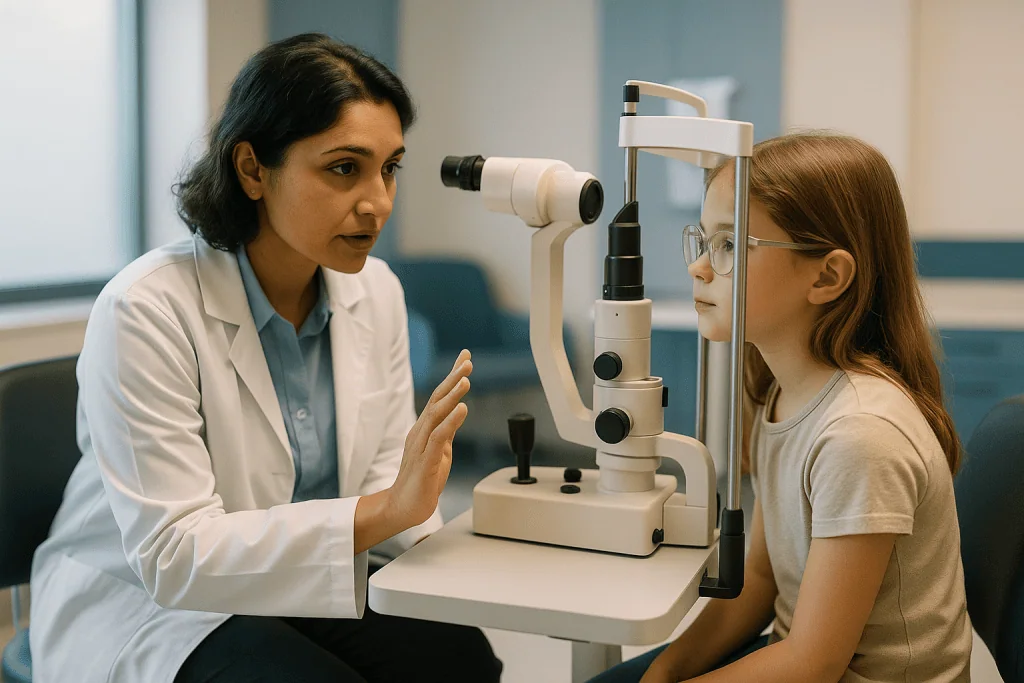
The second measurement, increasingly standard, is axial length, taken with a non-contact optical biometer that bounces light off the back of the eye and reads growth to a hundredth of a millimetre. Because axial length does not fluctuate with focusing effort, it is a cleaner yardstick than the prescription alone, and it is the measurement most tightly linked to future retinal risk. Many clinics now plot a child’s axial length on growth charts, much as a paediatrician plots height, to see whether the eye is tracking along an expected curve or racing ahead of it.
Follow-up visits typically fall every six months once treatment begins. At each one the clinician compares the change against what untreated eyes of the same age would be expected to do, judges whether the current approach is holding progression to an acceptable rate, and checks for side effects. Expect candid uncertainty here: an eye that grew a tenth of a millimetre in six months is doing well; one that grew three tenths may need a different strategy or a combination. Tracking exists not to produce a perfect number but to catch fast progression early, while years of remaining growth give treatment room to work.
Does outdoor time really prevent myopia?
Of all the findings in this field, the outdoor effect is the most democratic: it costs nothing and needs no prescription. Observational studies across continents consistently show that children who spend more time outdoors are less likely to become nearsighted, and the link survives adjustment for near work, parental myopia and family circumstances. Randomized school trials strengthened the case. In Guangzhou, adding a 40-minute outdoor class to the school day lowered the three-year incidence of new myopia from about 40 percent to about 30 percent. A Taiwanese programme that sent children outside during breaks produced a similar drop.
The leading explanation is light intensity. An overcast day outdoors delivers roughly 10,000 lux, a bright classroom perhaps 500, and bright light prompts the retina to release dopamine, a chemical messenger that slows eyeball elongation in animal studies. Looking at distant objects may also contribute. Sunscreen and a hat do not blunt the effect, since the light reaching the eye, not the skin, is what matters.
Two caveats follow. First, outdoor time works best at preventing or delaying onset; once a child is already myopic, its effect on progression appears smaller and less consistent, which is why clinicians pair it with other treatments rather than relying on it alone. Second, screens are not quite the villain of the headlines. Evidence linking screen time to myopia is mixed, and most researchers believe screens matter mainly because they displace daylight and because any close work held near the face for long stretches adds load.
The guidance that follows from the data is modest: aim for around two hours of daylight a day, take regular breaks from close work, and hold books and devices at a comfortable distance rather than against the nose.
Low dose atropine for myopia: how the drops work
Atropine has been in eye clinics for more than a century as a dilating drop, and at the full strength used for examinations it leaves a child light-sensitive and unable to read for days. The modern idea is to use a tiny fraction of that strength, low enough that most children notice little, and to let it act on the eye over years. How it works is still debated. The original theory, that it paralyses focusing, has largely been abandoned, because the lowest concentrations barely touch focusing yet still slow growth. Current thinking points to receptors in the retina and the sclera, the eye’s white outer wall, where atropine appears to dampen the biochemical signal that tells the eye to lengthen.
The trial record is the richest of any myopia treatment. Singapore’s ATOM trials established that higher concentrations slow progression strongly but cause rebound, a surge of progression when drops stop, and that lower concentrations trade some effect for far fewer side effects. The LAMP trial in Hong Kong then tested three low concentrations head to head and found a clear concentration-response relationship: the strongest of the low concentrations roughly halved progression over two years, the weakest did considerably less. The two 2023 US trials complicated the picture for that weakest concentration, with one finding no benefit over placebo in American children, perhaps because of differences in iris pigmentation or baseline progression rates.
Regulatory status varies by country. A low-concentration atropine product gained marketing authorisation in the European Union in 2025. In the United States no approved manufactured product exists as of 2026, so any use is off-label and prescribed at the clinician’s discretion. Which concentration, for how long, and how treatment eventually ends are decisions that belong entirely to the prescribing eye care professional, who weighs the child’s age, progression rate and eye colour. Parents should never source drops independently or adjust what has been prescribed.
Myopia control glasses for kids: how special lenses work
Ordinary single-vision glasses correct the centre of vision perfectly and, in doing so, focus peripheral light slightly behind the retina. Animal research in the 1990s showed that this peripheral hyperopic defocus, light landing behind the retina at the edges, acts as a grow signal. Myopia control spectacles flip that signal. Their central zone is a normal prescription; around it, dozens to hundreds of tiny lenslets or a ring of added plus power push peripheral light forward, in front of the retina, which the eye reads as a cue to slow down.
The pivotal evidence comes from randomized trials in Hong Kong and China. A two-year trial of a lenslet design reported roughly 50 percent less prescription change and about 60 percent less axial growth than single-vision glasses, with the benefit holding through a third-year extension. A separate trial of a different lenslet geometry produced results in the same range. Children adapted within days, and sharpness through the central zone matched ordinary glasses. These designs are now sold widely in Europe, Asia, Canada and Australia; approval status differs by country, so families should ask what is authorised where they live.
Older spectacle approaches deserve a mention mainly to set expectations. Bifocals and progressive lenses, which add near power in the lower half, slow progression only modestly, by around a tenth to a third in most studies, and are now reserved for children with specific focusing problems. Deliberately undercorrecting, giving weaker glasses than needed in the belief that it rests the eyes, has been tested and found useless or slightly harmful.
The appeal of defocus spectacles is obvious: no drops, nothing touching the eye, and a child who would wear glasses anyway. Their limits are equally plain. They work only while worn, the lenslet zone can look faintly textured, and wearing time of ten or more hours a day appears to matter for full effect.
Contact lenses and orthokeratology for myopia control
Two very different contact lens strategies apply the same defocus principle closer to the eye. The first is a daily-wear soft lens with alternating zones of distance correction and added plus power, worn during the day and discarded each night. In the three-year randomized trial behind its 2019 US approval, children fitted between ages 8 and 12 showed about 59 percent less prescription change and 52 percent less axial growth than children in standard soft lenses. A follow-on study extending to six years found the slowing continued, and that children switched from standard lenses later still benefited, though with less time to gain.
The second is orthokeratology, usually shortened to ortho-k: rigid, gas-permeable lenses worn overnight that gently flatten the central cornea so the child sees clearly without correction during the day. The flattening also creates a ring of peripheral myopic defocus, and meta-analyses pooling randomized and controlled studies estimate that ortho-k slows axial growth by roughly 40 to 60 percent over two years. The reward for active children is freedom from glasses on the sports field; the price is a nightly routine, regular checks of corneal health, and strict hygiene.
Both lens options share one safety concern that no parent should wave away. Any contact lens raises the risk of microbial keratitis, an infection of the cornea that can scar and permanently reduce vision. Surveillance studies put the rate for daily disposable soft lenses well under one case per thousand wearers per year, and for overnight ortho-k somewhat higher, in the range of one to a few per thousand. Serious outcomes are rare when families follow lens-care rules, keep tap water away from lenses, and stop wear and seek care at the first sign of a red, painful eye. Children as young as eight have handled daily disposables well in trials, but maturity and family support matter more than birthdays.
What the evidence actually says: grading each option
Enthusiasm and evidence do not always travel together, so it helps to sort the options by the quality of the studies behind them.
Strong randomized evidence over two to three years: low-concentration atropine (multiple trials in Asia, the United States and Europe, with a clear concentration-response gradient), the dual-focus soft contact lens (one large multinational randomized trial plus a six-year extension), and lenslet-based defocus spectacles (at least two independent randomized trials with third-year data). Effect sizes cluster between 30 and 60 percent slowing of axial growth. Where trials disagree, as with the weakest atropine concentration, the honest reading is that the effect is real but small and possibly population-dependent.
Moderate evidence: orthokeratology, where randomized trials are smaller and several key studies were controlled but not randomized, yet results are consistent across countries. Outdoor time has strong randomized support for preventing onset and weaker, mostly observational support for slowing established myopia.
Weak or emerging evidence: combining treatments, for example atropine with ortho-k or with defocus lenses. Early trials suggest an additive effect, but they are few and short. Repeated low-level red-light therapy has shown striking short-term results in Chinese trials, yet case reports of retinal injury and the absence of long-term safety data mean mainstream bodies have not endorsed it outside research settings.
No credible evidence: eye exercises, vision-training apps, blue-light-blocking glasses, dietary supplements and pinhole glasses marketed to reverse myopia.
One grading note applies to everything above. Every trial measures surrogate outcomes, chiefly axial length and prescription, over a few years. None has followed treated children to middle age to count retinal detachments or maculopathy. Clinicians recommend treatment because the surrogate is tightly linked to those outcomes in population data, which is reasonable, but it remains an inference, and a seasoned eye doctor will say so.
Myopia control options at a glance
The table below compresses the previous sections into something a family can carry into an appointment. Percentages describe the slowing of eye growth seen in the best available trials over two to three years, not a promise for any individual child, and every row assumes supervision by an eye care professional.
| Option | How it works | Trial slowing of progression | Evidence strength | Main trade-offs |
|---|---|---|---|---|
| Outdoor time, about 2 hours a day | Bright light and distance viewing signal the eye to grow more slowly | Lowers onset by a quarter to a third; modest once myopic | Randomized school trials for prevention | Hard to fit into school weeks; weak for established myopia |
| Low-concentration atropine drops | Acts on retinal and scleral receptors to dampen the growth signal | Roughly 30–60% depending on concentration | Strong; multiple randomized trials | Light sensitivity, near blur, rebound if stopped abruptly; off-label in some countries |
| Defocus spectacle lenses | Lenslets focus peripheral light in front of the retina | About 50–60% over 2 years | Strong; randomized trials in Asia | Works only while worn; faint texture; availability varies |
| Dual-focus soft contact lenses | Alternating zones create myopic defocus | About 50–60% over 3 years | Strong; one large randomized trial plus extension | Daily handling; low infection risk; needs a mature child |
| Orthokeratology | Overnight corneal reshaping plus peripheral defocus | About 40–60% of axial growth | Moderate; smaller trials | Nightly routine; highest infection risk among options |
| Bifocal or progressive glasses | Reduce focusing effort at near | About 10–30% | Moderate; older trials | Small effect; mostly for children with focusing problems |
Reading across the rows reveals a pattern that surprises many parents: the three leading optical and pharmaceutical options land in the same range. The choice between them therefore turns less on potency than on the child. A seven-year-old who dislikes drops but already wears glasses points toward defocus spectacles; a twelve-year-old swimmer may do best in ortho-k; a child progressing fast on lenses alone may be a candidate for adding atropine. The eye care professional’s judgement, informed by six-monthly axial length checks, is what converts a table into a plan.
What are the side effects of myopia control?
Every effective treatment carries trade-offs, and the reassuring news is that the common ones here are mild and the serious ones rare. Parents still deserve specifics.
Atropine’s side effects track its concentration. Light sensitivity from a slightly larger pupil and blurred near vision from reduced focusing are the two most reported, affecting a minority of children at low concentrations and a majority at high ones; photochromic lenses often solve the glare. Allergic conjunctivitis, an itchy red reaction of the eye surface, occurs in a small percentage and usually settles once drops stop. Systemic effects such as flushing, dry mouth, a racing heart or unusual behaviour are rare at the concentrations used for myopia but are the reason prescribers explain simple precautions and ask parents to watch for them. Rebound, an acceleration of progression after abrupt discontinuation, was marked with older high-strength regimens and appears small with modern low concentrations, which is why clinicians, not families, manage the end of treatment.
Spectacle options are the gentlest. Children in lenslet trials reported brief adaptation blur and occasional awareness of the textured zone; no safety signals emerged.
Contact lenses bring the only sight-threatening risk in the field: corneal infection. Soft daily disposables carry the lowest rate; overnight orthokeratology carries more, and children who sleep in lenses while unwell, swim in them or rinse them with tap water account for most reported cases. Minor problems such as dryness, lens awareness and corneal staining are more common and usually manageable.
Then there is the side effect no trial measures: burden. Six-monthly dilated examinations, nightly routines and a decade-long commitment to specialty lenses or drops wear on families. A plan a child will actually follow for years beats a theoretically stronger one abandoned by spring.
Common myths about childhood myopia
Search traffic for myopia control rides on a current of confident claims, many of them false. A few deserve direct correction.
“Eye exercises or vision-training apps can reverse nearsightedness.” Childhood myopia is an anatomical change, a longer eyeball, and no exercise shortens an eye. Controlled studies of eye exercises show no effect on refraction or axial length. The claim persists because myopia naturally stabilises in the late teens, which coincidentally rewards whatever a family was trying at the time.
“Wearing glasses makes eyes weaker.” The opposite has been tested. Undercorrection trials found that children given deliberately weak glasses progressed as fast or faster than fully corrected children. Accurate correction is the baseline for every modern treatment.
“Screens are the cause, so cutting screen time will fix it.” Screen time’s link to myopia is inconsistent across studies and much weaker than the link to time spent indoors. Reducing screens helps mainly when the freed hours move outdoors.
“Blue-light glasses protect against myopia.” No trial supports this. Blue-filtering lenses were built around sleep and eye-strain claims, and even those are poorly supported; they do nothing to the growth signal.
“Atropine is a permanent fix.” Atropine slows progression only while in use, and stopping too early or too abruptly can bring some rebound. It is a multi-year treatment managed by a clinician.
“Red-light devices sold online are a safe home alternative.” Repeated low-level red light is an investigational approach. Trials exist, but so do reports of retinal damage, and no mainstream regulator or professional body recommends home devices for children outside supervised research.
“Myopia control is only for children with high prescriptions.” Progression rate and age, not the current number, decide who benefits most. A six-year-old at minus one who worsens a diopter a year is a far stronger candidate than a sixteen-year-old at minus four who has barely changed.
How to slow myopia progression: building a plan with the eye care professional
Families often arrive at the first consultation braced for a single verdict, drops or lenses, when the useful outcome is a plan with checkpoints. Five questions shape it.
How fast is my child progressing, and compared with what? Ask for both the cycloplegic prescription change and the axial length change over the past year, and how those compare with untreated children of the same age. A child tracking along the expected curve may need only full correction and more daylight; one racing ahead of it is the candidate for active treatment.
Which option fits this child’s life? A seven-year-old who already wears glasses happily may slip into defocus spectacles without noticing. A sporty eleven-year-old who hates glasses may thrive in daily disposables or ortho-k, provided the family can supervise hygiene. Drops suit children who dislike anything on the eye during the day, with the proviso that the prescriber will discuss light sensitivity and the eventual plan for ending treatment.
What does success look like? Agree a target, often holding axial growth to a rate typical of non-myopic children of the same age, and a review date. Treatments are not failures if progression continues more slowly than before; they fail only if the child does not use them.
When might we combine or switch? Fast progressors on a single treatment are increasingly offered combinations, and a good clinician will say plainly that the evidence for these is early but encouraging.
How long does this go on? Usually until progression has plateaued for a year or more, typically in the mid to late teens, with the clinician deciding when and how to taper.
Underneath all five sits habit: two hours of daylight, reading at a sensible distance, regular breaks from close work. These do not replace treatment once myopia is established, but every trial above was run on top of them, not instead of them.
When to see a doctor
Myopia control is elective and unhurried, but some eye symptoms in a child are neither. Knowing the difference is part of any plan.
Book a routine eye examination if a child squints at the board, sits unusually close to screens, complains of headaches after school, rubs the eyes often, or has a nearsighted parent and has never been formally tested. Children rarely report blur, because they assume everyone sees as they do; many first myopia diagnoses come from a teacher. A comprehensive examination before school entry, with annual checks thereafter for a child who is myopic or has myopic parents, matches mainstream guidance.
Seek same-day care if a child using any treatment develops:
- A red, painful or light-sensitive eye, especially in a contact lens wearer, which may signal corneal infection; lenses should come out at once and stay out until examined.
- Sudden new floaters, flashes of light, or a shadow or curtain across part of the vision, which can indicate a retinal tear or detachment and need urgent assessment by an ophthalmologist.
- A sudden drop in vision in one or both eyes, or a sudden change in how the eye looks.
- After atropine drops, flushing, fever, a rapid heartbeat, marked drowsiness or confusion, or unusual agitation, uncommon systemic effects that warrant prompt medical advice.
- Persistent eye pain, eyelid swelling or discharge.
Between scheduled visits, contact the prescribing clinician rather than stopping or altering a treatment if a child develops troublesome glare, near blur or difficulty with lens handling. Every adjustment, including whether to pause, taper or switch, belongs to the eye care professional who knows the child’s measurements. A parent’s job is to keep the appointments, report honestly, and get the child outside as often as the week allows.
Frequently asked questions
How can myopia be prevented?
No method prevents myopia entirely, but about two hours of daylight a day lowers the chance of it starting by roughly a quarter to a third in randomized school trials. Regular breaks from close work and holding books and devices at a comfortable distance help at the margins. For children with nearsighted parents, an early comprehensive eye examination matters, because treatment is most effective when progression is caught young.
Is astigmatism worse than myopia?
Neither is worse; they are different problems. Astigmatism means the cornea or lens is unevenly curved, so light focuses at two points and vision blurs at all distances. It is usually stable through childhood and simply corrected. Myopia, by contrast, tends to progress, and high myopia stretches the back of the eye, raising lifetime risks of retinal detachment and maculopathy. That progression, not the blur, is why myopia gets active treatment.
What is progressive myopia in children?
Progressive myopia is nearsightedness that keeps worsening year after year as the eyeball lengthens. Nearly all childhood myopia progresses to some degree; the concern is speed. Children who become myopic before age eight often worsen by half a diopter or more annually, while later starters change more slowly. Rapid progression and early onset are the two signals that push eye care professionals toward active myopia control.
What are the side effects of myopia control?
Low-concentration atropine most often causes light sensitivity and mild near blur, with rare allergic reactions and very rare systemic effects such as flushing or a racing heart. Defocus spectacles cause brief adaptation blur and nothing more serious in trials. Contact lenses and orthokeratology carry a small risk of corneal infection, higher with overnight wear. Rebound progression can follow stopping atropine abruptly, so ending treatment is a clinician’s decision.
At what age should myopia control start?
Most trials enrolled children between six and twelve, and benefit is greatest when treatment begins soon after myopia appears, because younger eyes have more years of growth to slow. There is no fixed minimum age; the decision rests on the child’s progression rate, axial length and ability to manage drops or lenses. An eye care professional weighs these together rather than applying a birthday cut-off.
Does low dose atropine for myopia work for every child?
No. Response varies with the concentration prescribed, the child’s age and progression rate, and possibly eye colour. The LAMP trial showed stronger low concentrations roughly halved progression, while a 2023 NIH-funded US trial found the weakest concentration no better than placebo. Roughly one child in ten shows little response at any low concentration, which is why six-monthly axial length checks guide whether to adjust or combine treatments.
Can myopia control glasses for kids replace ordinary glasses?
Yes. Defocus spectacle lenses contain a full prescription in the central zone, so a child sees as sharply as with single-vision glasses while the surrounding lenslets slow eye growth. In two-year randomized trials they cut axial growth by about 60 percent compared with standard lenses. They work only while worn, so clinicians typically ask for ten or more hours of daily wear, and availability depends on each country’s approvals.
Does screen time cause myopia?
The evidence is weaker than headlines suggest. Studies linking screen hours to myopia are inconsistent, while the link between time spent indoors and myopia is strong and repeatable. Screens most likely matter because they displace daylight and because any close work held near the face for long stretches adds focusing load. Moving an hour of indoor screen time outdoors does more than simply switching devices off.
How long does myopia control treatment continue?
Usually for several years, until progression has plateaued for a year or more, which for most children happens in the mid to late teens. Stopping atropine abruptly can cause rebound progression, so prescribers plan a gradual end. Lens-based options simply stop working when wear stops, and the child moves to ordinary correction. The treating clinician decides timing using the child’s axial length trend, not a calendar.
Can a child's myopia be reversed?
No treatment shortens an eyeball that has already lengthened, so established myopia cannot be reversed. Orthokeratology gives clear daytime vision by temporarily reshaping the cornea overnight, but the effect fades within days of stopping. Claims that eye exercises, supplements or devices reverse myopia have no credible trial support. The realistic goal of myopia control is a lower final prescription and a shorter eye than a child would otherwise reach.
References
- National Eye Institute (NIH): Nearsightedness (Myopia)
- Cleveland Clinic: Myopia (Nearsightedness)
- NHS: Short-sightedness (myopia)
- World Health Organization: World report on vision
This article is for general information only and is not a substitute for professional medical advice. Please consult a qualified doctor about your individual situation.

More from the Blog

Gum Disease and Heart Disease: What the Link Really Is
Gum disease and heart disease are linked, but the evidence shows association rather than proof of cause. People with periodontitis have roughly 20 to…
Dental Probiotics: Can Bacteria Fight Cavities and Bad Breath?
Dental probiotics are live bacterial strains, usually Streptococcus salivarius or Lactobacillus reuteri, sold as lozenges or chewables to shift the mouth's microbial balance. Small…
Ear Pressure and Popping: Eustachian Tube Problems Explained
Ear pressure and popping usually come from the Eustachian tube, the narrow channel that equalizes air between the middle ear and the back of…
Dental Anxiety: Why It Is Common and the Options From Sedation to CBT
Dental anxiety is common because the mouth is a sensitive, personal space and dental care combines needles, noise, loss of control and past bad…
ICL Surgery: The Implantable Lens Alternative to LASIK
ICL surgery places a thin, flexible implantable collamer lens inside the eye, between the iris and the natural lens, to correct nearsightedness and astigmatism…
Charcoal Toothpaste: The Whitening Claim vs the Enamel Risk
Charcoal toothpaste can lift some surface stains because activated charcoal is abrasive, but reviews in dental journals have found no good evidence that it…