

PCOS Belly: Why Insulin Resistance Shapes Fat Distribution, and What Helps

Key Takeaways
- Visceral fat, the deep abdominal layer around the organs, is the type most linked to PCOS and to diabetes and heart risk, and it can be elevated even at a normal BMI.
- High insulin drives ovarian androgen production and lowers SHBG, and androgens in turn favor abdominal fat storage, creating a self-reinforcing loop.
- A waist-to-height ratio of 0.5 or above, or a waist over about 35 inches (88 cm), is a more honest marker of PCOS-related central fat than body weight.
- The CDC reports that more than half of women with PCOS develop type 2 diabetes by age 40, which is why glucose screening is recommended at diagnosis and every one to three years.
- Resistance training improves insulin sensitivity and waist circumference in PCOS trials even when scale weight barely changes, because muscle takes up glucose independently of insulin.
- The proposed name “polyendocrine metabolic ovarian syndrome” (PMOS) stems from a renaming process begun with the 2023 international guideline; it is not a new diagnosis and has not been formally adopted.
PCOS belly is the informal name for abdominal fat that builds up in polycystic ovary syndrome, largely because insulin resistance and higher androgen levels steer fat storage toward the waist and deep abdomen. It is not a diagnosis, and it can occur at any body weight. Evidence supports lifestyle changes and, for some, clinician-prescribed medicines such as metformin, but no approach removes belly fat selectively or quickly.
Type the words into a search bar this month and the suggestions almost finish themselves: pcos belly, then PMOS, then polyendocrine metabolic ovarian syndrome. That last phrase is the reason the topic is spiking. A proposed replacement name for polycystic ovary syndrome, floated after the 2023 international guideline formally called the current name misleading, has been ricocheting through short-form video as of early 2026, usually attached to a promise that a “new diagnosis” explains stubborn abdominal weight.
The name debate is real. The new-diagnosis part is not. What has genuinely shifted is how confidently clinicians now describe PCOS as a metabolic condition rather than purely a gynecological one, with insulin resistance sitting near the center of the story.
Picture a patient who runs three mornings a week, eats carefully, and still notices her jeans tightening only at the waistband while her arms and legs stay unchanged. Her frustration is not imagined. It has a biology, and that biology is the subject of this piece.
What is PCOS belly, and is it a real medical term?
Open a textbook and you will not find “PCOS belly.” The phrase grew up online to describe a pattern many people with polycystic ovary syndrome recognize instantly: weight that collects around the midsection, sits firm rather than soft, and resists the diets that seem to work for friends. Clinicians call the same thing central or abdominal adiposity, which simply means fat stored in and around the belly.
Polycystic ovary syndrome (PCOS) itself is a hormonal condition that affects roughly 1 in 10 women of reproductive age, according to the NHS; the CDC puts the US figure between 6 and 12 percent. Despite the name, cysts are not required for a diagnosis, and many people with the syndrome never have them.
Two features make the abdominal pattern worth taking seriously rather than treating as a cosmetic complaint. The first is location. Belly fat comes in two layers: subcutaneous fat, which lies just under the skin and can be pinched, and visceral fat, which wraps around the liver, intestines and other organs deep inside the abdomen. Visceral fat is metabolically active, releasing fatty acids and inflammatory signals directly into the bloodstream that feeds the liver. Research consistently links it to insulin resistance, type 2 diabetes and heart disease more strongly than fat stored on the hips or thighs.
The second feature is that the pattern shows up across body sizes. Imaging studies have found that people with PCOS at a normal body mass index still tend to carry a higher proportion of visceral fat than peers of the same weight without the condition. A “PCOS belly” is therefore less about the number on the scale and more about where the body has decided to store energy, and why.
That “why” is largely a story about insulin, the hormone that moves glucose from the blood into cells. Understanding it explains both the frustration and the realistic options, so the next sections take it in order: what recently changed in how experts frame the condition, then the mechanism, then how to tell whether the pattern applies to you.
What changed recently: a proposed new name and a global guideline
The current wave of searches traces back to a decision made in 2023. That year, the International Evidence-based Guideline for the Assessment and Management of PCOS was updated, endorsed by dozens of professional societies across multiple continents. Alongside its clinical recommendations, the guideline stated plainly that the name “polycystic ovary syndrome” focuses on a feature that is neither necessary nor sufficient for diagnosis, and it called for a structured process to rename the condition.

Since then, several candidate names have circulated. “Polyendocrine metabolic ovarian syndrome,” abbreviated PMOS, is one of them, and it is the version that took off on social media in 2025 and early 2026. No renaming has been formally adopted by the major endocrine or reproductive societies at the time of writing. If your clinician still writes PCOS in your chart, nothing is out of date.
The guideline also did three things that matter directly for the belly question. It reaffirmed that insulin resistance is a core feature present in a majority of people with the condition, regardless of weight. It recommended lifestyle intervention as first-line care for metabolic health while explicitly warning against weight stigma in consultations. And it clarified how medicines such as metformin fit in, which a later section covers without straying into dosing.
Public health messaging has moved in the same direction. When the CDC reorganized its diabetes content in 2024, PCOS was listed squarely as a risk factor, with the statement that more than half of women with PCOS develop type 2 diabetes by age 40. That is a striking figure, and it reframes abdominal fat in PCOS as a marker of metabolic risk rather than a purely aesthetic concern.
The takeaway from all this is not that a new disease has been discovered. It is that mainstream medicine has caught up with what many patients already sensed: their condition is metabolic first, and the waistline is one of the places it shows.
How does insulin resistance in PCOS steer fat to the middle?
Insulin resistance means the body’s cells respond sluggishly to insulin, so the pancreas compensates by producing more of it. That extra insulin, called hyperinsulinemia, is where the chain of events begins.
Insulin is a storage hormone. When levels stay high for long stretches, the body is nudged toward building fat stores and away from burning them. In most people this effect is distributed across the body. In PCOS, three additional forces tilt the storage toward the abdomen.
The first is androgen production. Androgens are hormones such as testosterone that everyone makes in small amounts. In the ovaries, high insulin acts directly on theca cells, the hormone-producing cells surrounding developing eggs, and prompts them to release more androgens. At the same time, insulin tells the liver to make less sex hormone-binding globulin (SHBG), the protein that keeps testosterone inactive in the blood. Less SHBG means more free, active androgen. Androgens, in turn, favor the deposition of visceral fat, the same pattern seen in men.
The second force is the behavior of the fat tissue itself. Visceral fat cells in insulin-resistant states release more free fatty acids into the portal vein, the blood vessel that carries nutrients from the gut straight to the liver. A liver flooded with fatty acids becomes more insulin resistant, produces more glucose, and often begins storing fat itself. This is one reason non-alcoholic fatty liver disease is more common in PCOS.
The third force is inflammation. Visceral fat secretes signaling molecules such as interleukin-6 and tumor necrosis factor-alpha while producing less adiponectin, a hormone that improves insulin sensitivity. Higher inflammation worsens insulin resistance, which raises insulin further, which raises androgens further.
Notice that the sequence is circular. Insulin drives androgens, androgens drive belly fat, belly fat drives inflammation, inflammation drives insulin resistance. That loop is why the pattern feels self-reinforcing, and why interventions that touch any part of the loop, such as improving insulin sensitivity through muscle-building exercise, can produce effects out of proportion to the change on the scale.
PCOS belly shape: how do I tell if I have one?
There is no single look that confirms a PCOS belly, and no photo online can diagnose it. What clinicians actually assess is whether abdominal fat, particularly the deep visceral kind, is elevated relative to overall body size. Two simple measurements get most of the way there.
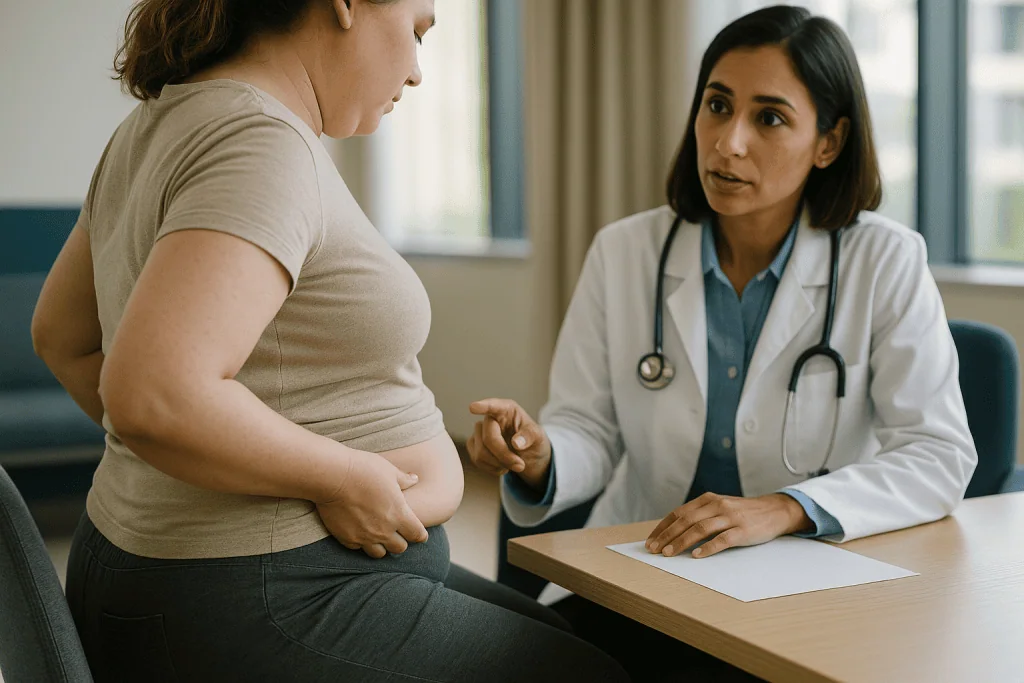
Waist circumference is the workhorse. Measured at the level of the navel, standing, after a normal exhale, a waist above about 35 inches (88 cm) in women is associated with higher cardiometabolic risk in guidance from the NIH and the American Heart Association. The threshold is lower for people of South and East Asian ancestry, which matters because PCOS is common in those populations.
Waist-to-height ratio adds context. Divide your waist by your height in the same units; a ratio at or above 0.5 suggests central fat is elevated regardless of your weight. A 5-foot-4 woman, for instance, would cross that line at a waist of 32 inches. This measure is increasingly favored because it works across body sizes and captures the “lean PCOS” pattern that body mass index misses.
Beyond numbers, a few descriptive features tend to accompany insulin-driven abdominal fat, though none is specific to PCOS:
- Fat that feels firm and sits higher, around and above the navel, rather than the softer lower-belly fat that shifts with position.
- A waist that has changed more than the hips or thighs over time.
- Darkened, velvety skin patches at the neck, armpits or groin, called acanthosis nigricans, which is a visible sign of high insulin.
- Small skin tags in the same skin folds.
Body mass index alone is a poor guide here. Some people with PCOS have a normal BMI and a waist-to-height ratio above 0.5; others carry weight predominantly on the hips and have a low visceral fat burden despite a higher BMI. The measurement, not the mirror, is the honest tool, and a clinician can pair it with blood glucose, HbA1c or lipid tests to complete the picture.
What are the biggest signs of PCOS beyond the belly?
Abdominal weight is one of the more visible features, but it is neither required nor diagnostic. The formal diagnosis rests on the Rotterdam criteria, which ask for two of three findings once other conditions such as thyroid disease or elevated prolactin have been ruled out.
The first criterion is irregular or absent ovulation, which usually shows up as periods that arrive more than 35 days apart, fewer than eight times a year, or not at all. The second is hyperandrogenism, meaning excess androgen activity. It can be clinical, seen as coarse hair growth on the face, chest or back, persistent acne into adulthood, or thinning scalp hair in a male pattern; or it can be biochemical, detected on a blood test for testosterone. The third is polycystic ovarian morphology on ultrasound, meaning enlarged ovaries with many small follicles. The 2023 guideline allows an elevated anti-Müllerian hormone (AMH) level to substitute for ultrasound in adults, and it advises against relying on ultrasound in adolescents, whose ovaries often look polycystic normally.
Around these core criteria cluster the metabolic features: insulin resistance, difficulty losing weight, cravings for carbohydrate, and fatigue after meals. Sleep apnea, low mood and anxiety are also more common, and the guideline recommends screening for both mood disorders and sleep problems as part of routine care.
Here is the pattern that trips people up. The NHS estimates that more than half of women with PCOS have no obvious symptoms, or have symptoms they attribute to something else. Acne is blamed on skin type, irregular periods on stress, weight gain on age. The diagnosis often surfaces only when someone tries to conceive or when a routine blood test shows high glucose.
None of this means every irregular cycle or every stubborn waistline is PCOS. It does mean that if two or more features from the list above describe you, a conversation with a clinician is more useful than another online quiz.
Why is losing belly fat so much harder with PCOS?
Ask a room of people with PCOS whether they have tried “just eating less,” and most hands go up. The frustration is legitimate, and it has several documented mechanisms.
Hyperinsulinemia is the first. High circulating insulin suppresses lipolysis, the process by which fat cells release stored fat to be burned. A body bathed in insulin holds onto fat more tightly during a calorie deficit than an insulin-sensitive body would, so the same effort yields a slower result. Studies of women with PCOS undergoing supervised diets have generally found that they lose weight, but small trials suggest the pace is often slower than in matched controls, and the difference is most consistent for abdominal fat.
Appetite regulation is the second. Several studies have measured lower or blunted post-meal rises in cholecystokinin and other satiety hormones in women with PCOS, alongside altered ghrelin patterns. In plain terms, the “I’m full” signal may arrive later and quieter. Cravings for high-carbohydrate foods are frequently reported, and they make physiological sense when blood glucose swings are exaggerated by insulin resistance.
Androgens are the third factor, promoting visceral fat deposition and, in some studies, a modest reduction in resting energy expenditure. Sleep is the fourth: obstructive sleep apnea is several times more common in PCOS, and fragmented sleep independently worsens insulin sensitivity and appetite control. Mood is the fifth, since depression and anxiety are more prevalent and make sustained behavior change harder.
It helps to be honest about what this does and does not mean. The evidence does not show that weight loss is impossible in PCOS; supervised lifestyle programs produce meaningful improvements in insulin sensitivity, ovulation and waist size. What it shows is that the effort-to-result ratio is tilted, that the belly tends to be the last region to respond, and that strategies designed for insulin-sensitive bodies may need adjusting.
The most useful reframe is to stop treating the scale as the scorecard. Waist circumference, fasting glucose, HbA1c, energy levels and cycle regularity often improve before weight does, and they are the outcomes that actually track health.
What the evidence actually says about PCOS belly, graded
Health writing about PCOS tends to collapse three very different kinds of evidence into one confident voice. Separating them is the single most useful thing a reader can do.
Strong evidence (multiple randomized trials, consistent results): Lifestyle intervention combining dietary change and physical activity improves insulin sensitivity, reduces waist circumference and improves menstrual regularity in PCOS. A weight reduction in the range of 5 to 10 percent, where weight loss is a goal, improves ovulation and metabolic markers, a finding echoed by the Mayo Clinic and NHS. Metformin improves insulin sensitivity and modestly reduces weight and waist circumference compared with placebo across many trials, which is why the 2023 guideline recommends it for metabolic outcomes in adults with PCOS and higher BMI.
Moderate evidence (randomized trials, but small, short or inconsistent): No specific diet composition beats another for belly fat in PCOS once calorie intake is matched; lower-glycemic-index eating shows advantages for insulin markers in some trials but not all. Resistance training improves insulin sensitivity and body composition in PCOS in trials that typically run 12 to 16 weeks with fewer than 100 participants. Inositol supplements improve some insulin and ovulation markers versus placebo, but trials are small and the guideline rates the evidence as limited.
Observational or expert-opinion level: Vitamin D deficiency is more common in PCOS and correlates with insulin resistance, but trials of supplementation have produced mixed results on metabolic outcomes. Reduced sleep quality and higher visceral fat are linked in PCOS, but intervention data are scarce. GLP-1 receptor agonists such as semaglutide and liraglutide reduce weight and waist size in trials of people with obesity, including some with PCOS, but PCOS-specific trials remain small and short, and use for PCOS itself is off-label in most countries.
Weak or absent evidence: Claims that a particular food “melts” PCOS belly fat, that dairy or gluten must be eliminated, that specific teas or “hormone-balancing” supplements target visceral fat, or that fat can be lost from the abdomen selectively. Spot reduction has never been demonstrated in any population.
Where the evidence is strong, act. Where it is moderate, experiment with a clinician’s knowledge. Where it is weak, spend your money elsewhere.
How to lose PCOS belly: what diet and exercise evidence supports
Nobody can lose fat from the belly alone, in PCOS or otherwise. What the evidence does support is lowering the insulin and inflammatory drive that concentrates fat there, so that when fat is lost, the abdomen participates. Four levers have trial support.
Steadier carbohydrates. Trials comparing lower-glycemic-index diets with conventional healthy diets in PCOS have found better insulin sensitivity and menstrual regularity in several, though not all, studies. The practical version is not carbohydrate elimination but pairing carbohydrates with protein, fat and fiber, favoring whole grains, legumes and vegetables over refined starches, and avoiding large gaps between meals that end in cravings. The 2023 guideline explicitly declines to endorse any single diet composition, which is liberating: the one you can sustain is the one that works.
Adequate protein. Higher-protein meal patterns improve satiety and preserve muscle during weight loss, which matters because muscle is the body’s largest site for insulin-mediated glucose disposal.
Resistance training. Muscle contraction moves glucose into cells through pathways that bypass insulin entirely. Trials in PCOS lasting three to four months have found that progressive strength training two to three times weekly improves insulin sensitivity and reduces waist circumference even when scale weight barely moves. That last point deserves emphasis: body composition changes are real even when weight is stable.
Aerobic movement, especially after meals. Moderate-intensity walking, cycling or swimming lowers post-meal glucose and, over weeks, visceral fat. Higher-intensity interval training has produced similar or slightly better insulin outcomes in small PCOS trials, but adherence tends to be lower, so preference should decide.
Sleep and stress sit beneath all four. Short or fragmented sleep raises next-day insulin resistance and appetite in controlled studies, and untreated sleep apnea can undermine every other effort. Anyone with PCOS who snores, wakes unrefreshed or has been told they stop breathing at night should raise it with a clinician.
A realistic timeline is measured in months, not weeks, and waist circumference is a better progress marker than weight. Tracking it monthly, in the same spot, under the same conditions, tells the truth that the scale sometimes hides.
What vitamin am I lacking if I have PCOS?
The honest answer is that PCOS does not cause a single, predictable deficiency, and no vitamin reverses it. Several nutrients do deserve attention because they are more often low in this group or are affected by common treatments.
Vitamin D. Observational studies consistently find that vitamin D insufficiency is more common in women with PCOS than in the general population, and lower levels correlate with greater insulin resistance and higher androgens. That correlation has tempted many to assume supplementation will fix the metabolic picture. Randomized trials have been disappointing on that front: some show small improvements in insulin markers, others show none. The NIH Office of Dietary Supplements notes that deficiency is worth correcting for bone and general health regardless, so a blood test and clinician-guided correction is reasonable; expecting it to flatten the belly is not.
Vitamin B12. This one is treatment-related rather than PCOS-related. Long-term metformin use lowers B12 absorption, and the Mayo Clinic and Cleveland Clinic both flag periodic monitoring. Symptoms of low B12 include fatigue, tingling in the hands or feet and low mood, all of which can be mistaken for PCOS itself. Anyone taking metformin should ask about B12 checks rather than starting a supplement on their own.
Inositol. Not a vitamin but often sold alongside them, myo-inositol is a sugar-like compound involved in insulin signaling. Small randomized trials suggest modest improvements in ovulation and some insulin markers compared with placebo. The 2023 guideline says it “could be considered” while rating the evidence as limited and noting metformin has stronger data for metabolic outcomes. It is a supplement, not a regulated medicine, and quality varies between products.
Iron, folate and omega-3 fats. Heavy or prolonged bleeding after long gaps between periods can lower iron, so a ferritin check is sensible when fatigue is prominent. Folate matters for anyone who may become pregnant. Omega-3 trials in PCOS show small triglyceride and inflammatory benefits with no clear effect on abdominal fat.
Testing before supplementing is the principle. A blood panel that includes vitamin D, B12 and ferritin answers the question for your body rather than for an average one.
Metformin, GLP-1 medicines and the pill: what they can and cannot do
Medicines enter the PCOS belly conversation constantly, so it helps to know what each is actually for. None is prescribed to change body shape. All are decisions for a treating clinician who knows your history, and nothing here should prompt starting, stopping or adjusting anything.
Metformin is a diabetes medicine that reduces glucose output from the liver and improves insulin sensitivity. In PCOS it has the longest track record. Pooled trial data show modest reductions in weight, waist circumference and fasting insulin compared with placebo, along with improved menstrual regularity in some women. The 2023 international guideline recommends it for metabolic outcomes in adults with PCOS and a BMI of 25 or above, alongside lifestyle change, and notes it can be considered in adolescents. Gastrointestinal side effects are common early on and usually settle; B12 monitoring is advised with long-term use.
GLP-1 receptor agonists such as semaglutide and liraglutide mimic a gut hormone that slows stomach emptying, reduces appetite and improves insulin secretion. Large trials in people with obesity show substantial weight and waist reductions. Trials specifically in PCOS are small and short, though early results for weight and insulin markers are promising. These medicines are approved for type 2 diabetes and, in some formulations, for weight management; their use for PCOS as such is off-label in most countries, and the guideline frames them as an option to consider with specialist input for weight management where BMI is higher. Compounded or online versions marketed outside licensed channels are not equivalent to approved products, are not endorsed by regulators for this use, and are not for self-purchase.
Combined oral contraceptives regulate cycles and lower androgens by raising SHBG, which helps acne and hair growth. They do not improve insulin resistance and are not a treatment for abdominal fat. Spironolactone blocks androgen receptors and is used for hair and skin symptoms, again without metabolic effect.
The pattern is clear: only metformin and the GLP-1 class act on the insulin loop that shapes fat distribution, and even they work best as partners to lifestyle change rather than substitutes for it.
PCOS belly approaches at a glance
The table below summarizes what each commonly discussed approach targets and how strong the supporting evidence is for abdominal fat or insulin resistance in PCOS specifically. Grades follow the same logic as the earlier evidence section: strong means consistent randomized trials, moderate means trials that are small or mixed, and limited means mostly observational data or expert opinion.
| Approach | Main target in the insulin loop | Evidence for waist or insulin outcomes in PCOS | Practical note |
|---|---|---|---|
| Combined diet and activity program | Insulin sensitivity, energy balance | Strong | First-line in the 2023 guideline; no single diet composition proven superior |
| Resistance training | Muscle glucose uptake | Moderate | Improves body composition even when weight is stable |
| Lower-glycemic-index eating | Post-meal insulin spikes | Moderate | Benefits seen in some trials, not all; sustainability matters most |
| Sleep and sleep apnea treatment | Insulin resistance, appetite hormones | Limited for fat outcomes; strong for health overall | Screen if snoring or daytime sleepiness |
| Metformin (prescribed) | Liver glucose output, insulin sensitivity | Strong for insulin; moderate for waist | Guideline-recommended for metabolic outcomes; B12 monitoring |
| GLP-1 receptor agonists (prescribed) | Appetite, gastric emptying, insulin secretion | Strong in obesity trials; limited PCOS-specific data | Off-label for PCOS in most countries; specialist decision |
| Inositol supplements | Insulin signaling | Limited to moderate | Small trials; guideline says “could be considered” |
| Vitamin D supplementation | Possible insulin signaling | Limited | Correct deficiency for general health; metabolic benefit unproven |
| Combined oral contraceptives | Androgens (via SHBG) | None for abdominal fat | Helps cycles, acne and hair, not insulin |
| “Fat-burning” teas, detoxes, elimination diets | None demonstrated | None | No trial evidence for targeted belly fat loss |
Two things stand out when the options sit side by side. The strongest evidence belongs to the least glamorous interventions, and the interventions with the loudest marketing have the least. The middle of the table, where resistance training and metformin sit, is where realistic expectations and meaningful change most often meet.
Common myths about PCOS belly, corrected
Viral health content thrives on certainty. PCOS deserves better, so here are the claims that circulate most, alongside what the evidence actually supports.
“PMOS is a new diagnosis that explains your belly fat.” PMOS is one proposed alternative name for the same condition, arising from a renaming process the 2023 guideline set in motion. No new disease has been defined, no new criteria have been adopted, and no clinician can diagnose you with PMOS. The metabolic understanding it emphasizes has been in the medical literature for decades.
“PCOS belly means you have PCOS.” Central fat is common in many conditions and in many people without any condition. Diagnosis rests on ovulation, androgens and ovarian findings, not waistline.
“You cannot lose weight with PCOS.” Trials consistently show that people with PCOS lose weight and waist size with structured lifestyle programs. The pace can be slower and the belly tends to respond last, which is different from impossible.
“Cutting out dairy and gluten fixes PCOS belly.” No randomized trial supports eliminating either food group for PCOS unless a person has celiac disease or a diagnosed intolerance. Restrictive rules often reduce overall calorie intake, and any benefit usually traces to that.
“Cardio is bad for PCOS because it raises cortisol.” Aerobic exercise improves insulin sensitivity and visceral fat in PCOS trials. Cortisol rises briefly with any exercise and returns to baseline; there is no evidence that moderate cardio worsens PCOS.
“A vitamin or supplement can target visceral fat.” No supplement has demonstrated selective abdominal fat loss in any population. Correcting a measured deficiency is sensible; expecting it to reshape the abdomen is not.
“Thin people don’t have PCOS belly.” Imaging studies show that normal-weight women with PCOS carry proportionally more visceral fat than weight-matched controls. Waist-to-height ratio catches this; BMI does not.
“Metformin or a GLP-1 medicine will remove it.” Both act on the insulin loop and can reduce waist circumference, but neither is a shape-altering drug, both carry side effects, and both are clinician decisions.
What are the signs that PCOS is getting worse?
PCOS is not a single fixed state. Its metabolic side can drift in either direction over years, and because the changes are gradual, they are easy to normalize. Knowing what progression looks like helps you and your clinician catch it early, which is where intervention works best.
A steadily rising waist measurement, especially when weight is stable, suggests visceral fat is increasing. Acanthosis nigricans, the velvety darkening at the neck or underarms, appearing or spreading points to higher insulin levels. Blood tests tell the sharper story: fasting glucose or HbA1c creeping toward the prediabetes range, rising triglycerides, falling HDL cholesterol or a new finding of fatty liver on imaging all mark metabolic worsening. The CDC’s statement that more than half of women with PCOS develop type 2 diabetes by age 40 is the reason guidelines recommend glucose screening at diagnosis and every one to three years thereafter, sooner if risk factors accumulate.
Reproductive signs matter too. Cycles that were irregular becoming absent for several months, or bleeding that becomes heavier and more unpredictable, indicate that ovulation has become less frequent. Long gaps between periods leave the uterine lining exposed to estrogen without the balancing effect of progesterone, which raises endometrial cancer risk over time. Fewer than four periods a year is the threshold at which clinicians typically want to discuss protecting the lining; this is a risk to raise with a doctor, not one to assess alone.
New or worsening hair growth on the face and body, or accelerating scalp thinning, suggests rising androgen activity and warrants a review, since a rapid change can occasionally signal a different cause.
Then there is the less visible territory. Increasing daytime sleepiness, loud snoring or witnessed pauses in breathing raise the question of sleep apnea. Persistent low mood, anxiety or a shift toward disordered eating are recognized complications and are screened for in current guidelines. Blood pressure rising into the hypertensive range rounds out the picture.
None of these signs is a verdict. Each is information that changes the conversation, and most respond to earlier rather than later attention.
When to see a doctor about PCOS belly and related symptoms
Abdominal weight gain alone rarely needs urgent care, but PCOS sits alongside conditions that do, and some of its own features deserve prompt attention. Every treatment decision, including whether to start, continue or change any medicine or supplement, belongs with your prescribing clinician; this section is a guide to when that conversation should happen sooner rather than later.
Make a routine appointment if you notice two or more features of PCOS, such as irregular cycles, excess hair growth, adult acne and central weight gain, and have never been assessed. Ask about the diagnostic work-up, glucose and lipid screening, blood pressure, and vitamin D and B12 levels if relevant. Book sooner if you are planning pregnancy, since irregular ovulation and insulin resistance both benefit from early management.
Arrange an earlier visit if you experience any of the following:
- Periods that have stopped for three months or more, or fewer than four periods in a year, given the long-term effect on the uterine lining.
- Very heavy bleeding, soaking through protection hourly, or bleeding after a long gap that lasts more than a week.
- Rapidly increasing facial or body hair, a deepening voice or enlargement of the clitoris, which can point to an androgen source other than PCOS.
- New dark, velvety skin patches, excessive thirst, frequent urination or unexplained weight loss, which can indicate blood glucose has risen significantly.
- Loud snoring with daytime sleepiness or a partner reporting pauses in breathing.
- Low mood, anxiety or eating patterns that feel out of control, all of which are recognized parts of PCOS care.
- Persistent tingling or numbness in the hands or feet while taking metformin, which can signal low vitamin B12.
Seek emergency care immediately for sudden severe pelvic or abdominal pain, particularly with fainting or heavy bleeding; chest pain or shortness of breath; sudden severe headache or vision change; or a swollen, painful calf, especially if you take combined hormonal contraception. If you are taking a GLP-1 medicine and develop severe, persistent abdominal pain that may radiate to the back, with or without vomiting, seek same-day medical assessment.
Bring your waist measurements, cycle dates and any home glucose readings. Concrete numbers make a short appointment far more productive, and they turn a vague worry about a “PCOS belly” into a precise conversation about metabolic health.
Frequently asked questions
How do I tell if I have a PCOS belly?
Measure rather than guess: a waist over about 35 inches (88 cm), or a waist-to-height ratio of 0.5 or higher, indicates elevated central fat regardless of your weight. In PCOS this fat tends to sit firm around and above the navel and may come with velvety dark skin patches at the neck or armpits, a sign of high insulin. Only a clinician can confirm PCOS itself, using cycle history, androgen tests and, sometimes, ultrasound.
What is the typical PCOS belly shape?
There is no single shape, but the pattern most people describe is fat concentrated at the waist and upper abdomen while arms, hips and legs change less. This apple-type distribution reflects visceral fat, which is driven by insulin and androgens. It can occur in people with normal body weight, which is why BMI alone often misses it and why waist-to-height ratio is a better guide.
What is the difference between PCOS belly vs bloating?
Bloating fluctuates through the day, often worsens after meals or before a period, and softens or resolves overnight; it is gas or fluid, not fat. PCOS-related abdominal fat is stable from morning to night, feels firm, and changes over months rather than hours. Both can coexist, since PCOS is associated with gut symptoms in some people, so persistent bloating with pain or altered bowel habit deserves its own assessment.
How does insulin resistance in PCOS cause belly fat?
When cells respond poorly to insulin, the pancreas makes more of it. High insulin tells the body to store energy, stimulates the ovaries to make androgens, and reduces the liver protein that keeps androgens inactive. Androgens favor visceral fat around the organs, and that fat releases inflammatory signals that worsen insulin resistance, closing a loop that keeps abdominal fat in place.
How to lose PCOS belly realistically?
The evidence supports a combination: steadier carbohydrate intake paired with protein and fiber, progressive resistance training two to three times weekly, regular aerobic movement, and attention to sleep. Trials show waist circumference and insulin sensitivity often improve before weight does, so track your waist monthly. Some people are prescribed metformin or, with specialist input, other medicines; those decisions belong with a clinician. No method removes belly fat selectively.
What vitamin am I lacking if I have PCOS?
No single deficiency defines PCOS. Vitamin D insufficiency is more common and correlates with insulin resistance, though supplementation trials show mixed metabolic results. Vitamin B12 can fall in people taking metformin long term, so monitoring is advised. Iron may be low after heavy bleeding. The reliable approach is a blood panel and correction of what is actually low, guided by a clinician, rather than starting supplements on assumption.
What are the biggest signs of PCOS?
The three diagnostic features are irregular or absent ovulation, usually seen as cycles longer than 35 days or fewer than eight a year; excess androgen activity, shown as coarse facial or body hair, persistent acne or scalp thinning, or on a blood test; and polycystic-appearing ovaries or a high AMH level. Two of the three are needed. Central weight gain, insulin resistance and dark skin patches are common companions but not diagnostic.
What are the signs that PCOS is getting worse?
A rising waist measurement, spreading dark velvety skin patches, fasting glucose or HbA1c drifting toward prediabetes, rising triglycerides or a new fatty liver finding all mark metabolic worsening. Periods stopping for months, heavier unpredictable bleeding, rapidly increasing hair growth, new snoring with daytime sleepiness, or persistent low mood are also signals. Each warrants an earlier review with your clinician rather than waiting for a routine check.
Can you have PCOS belly and be thin?
Yes. Imaging studies show that women with PCOS at a normal body mass index carry a higher proportion of visceral fat than weight-matched women without the condition, and they still show insulin resistance more often. This so-called lean PCOS is frequently missed because clinicians and patients look at weight rather than waist. A waist-to-height ratio of 0.5 or above is the simplest way to detect it.
Does metformin get rid of PCOS belly?
Not by itself, and it is not prescribed for that purpose. Metformin improves insulin sensitivity and, across many trials, produces modest reductions in weight and waist circumference compared with placebo, which is why the 2023 international guideline recommends it for metabolic outcomes in adults with PCOS and higher BMI. Its effects are strongest alongside lifestyle changes. Whether it is appropriate, and any adjustments, are decisions for your prescribing clinician.
References
- NHS: Polycystic ovary syndrome
- CDC: PCOS (Polycystic Ovary Syndrome) and Diabetes
- Cleveland Clinic: Polycystic Ovary Syndrome (PCOS)
- MedlinePlus: Polycystic Ovary Syndrome
This article is for general information only and is not a substitute for professional medical advice. Please consult a qualified doctor about your individual situation.

More from the Blog

Ahead of a Reproductive System Consultation: Cycle Timing, Records and Questions to Bring
To prepare for a gynecologist appointment, note the first day of your last period and your usual cycle length, bring a list of every…

When to See a Specialist About Reproductive System Concerns: Cycle Changes, Pain and Fertility
See a reproductive specialist if you have tried to conceive for 12 months without a pregnancy, or 6 months if you are 35 or…

Cycle Syncing and Seed Cycling: What the Trends Claim and What the Evidence Shows
Seed cycling (eating flax and pumpkin seeds in the first half of the menstrual cycle, then sesame and sunflower seeds in the second half)…

Spotting After Embryo Transfer: What Is Usually Normal and When to Call Your Clinic
Light spotting after embryo transfer is common and usually not a sign that something has gone wrong. Pink or brown streaks can come from…

Who Is ICSI Recommended For? Male-Factor Infertility, Prior Fertilization Failure and More
ICSI is usually recommended when sperm are unlikely to fertilize an egg on their own: severe male-factor infertility such as very low sperm count,…

GIFT (Gamete Intrafallopian Transfer) Step by Step: Eggs, Sperm and the Laparoscopic Placement
GIFT, or gamete intrafallopian transfer, is an assisted reproduction technique in which eggs are collected after ovarian stimulation, mixed with prepared sperm, and placed…